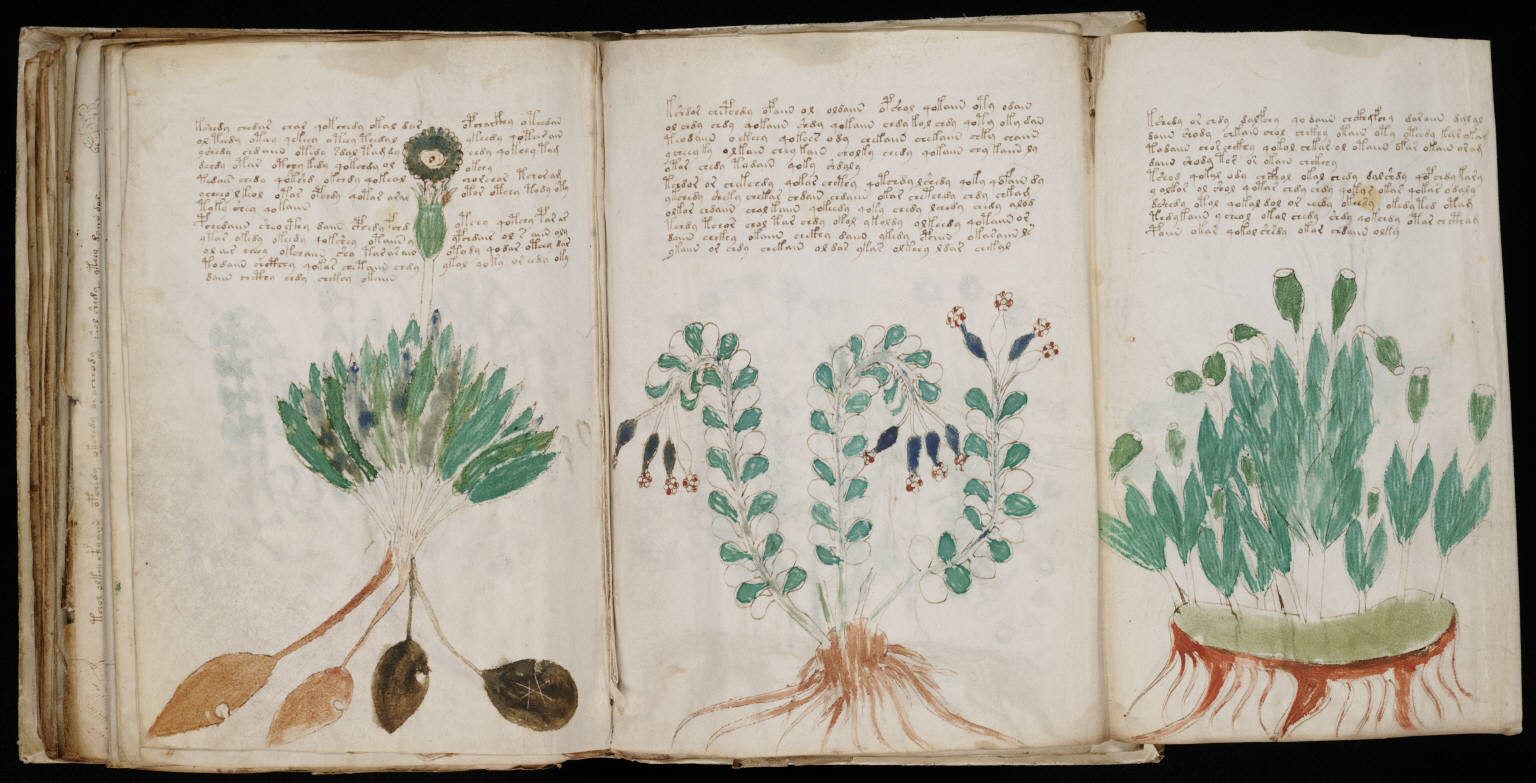
In 1912, a book dealer named Wilfrid Voynich was sorting through a chest of old manuscripts in a Jesuit college in Italy when he found a small, battered volume unlike anything he had ever handled. It was filled with looping, fluid handwriting in an alphabet no one could identify, illustrated with plants that match no known species, naked women bathing in green pools fed by elaborate plumbing, and circular diagrams that look like astronomy or astrology. Voynich, a man who had handled thousands of rare books, could not read a single word of it. More than a century later, after attention from professional codebreakers, computer scientists, linguists and cranks of every description, neither can anyone else. The Voynich Manuscript remains exactly what it was the day he found it: a real, physical book that no living person can read.
It is probably the most famous unsolved text in the world, and it has a special power to drive intelligent people slightly mad. Every few years someone announces, with great confidence, that they have cracked it. Every few years, the wider community of experts examines the claim and finds it wanting. What makes the manuscript so maddening is that it looks so much like it should mean something. This is the honest state of the puzzle: fascinating, unsolved, and surrounded by far more certainty than the evidence can bear.
The object itself
Let us start with what is solid, because a surprising amount about the manuscript is not in dispute. It is a real codex of around 240 pages of vellum (calfskin parchment), roughly 23 by 16 centimetres, now held at Yale University's Beinecke Rare Book and Manuscript Library, where it is catalogued as MS 408. Some pages fold out into larger sheets. The text runs left to right in a single, confident hand (or possibly two or more hands; scholars debate this) with no obvious corrections or hesitations, as if the scribe knew exactly what they were writing.
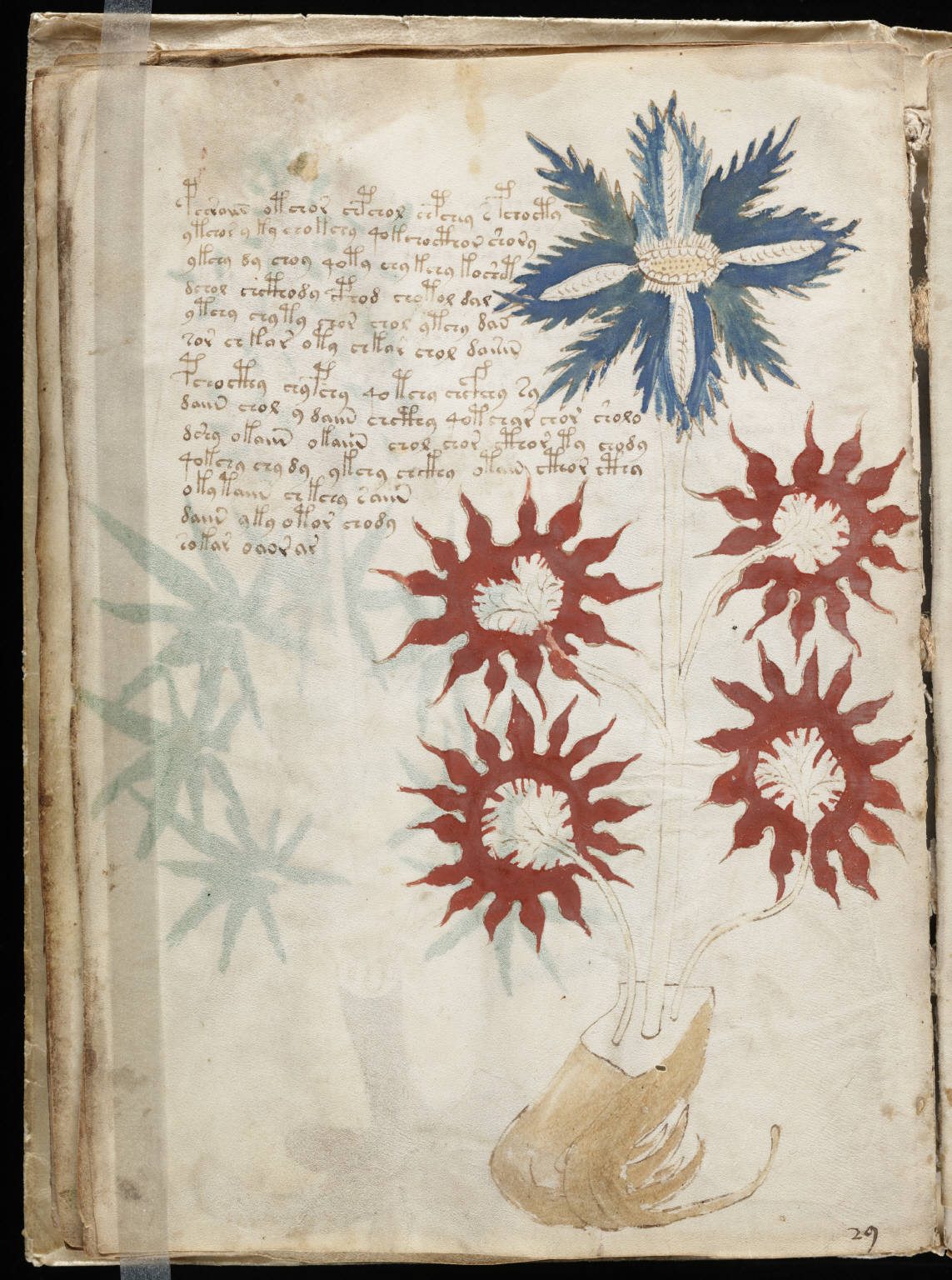
The book is conventionally divided into sections based on its illustrations. There is a "botanical" or herbal section full of unidentifiable plants; an "astronomical" section of stars, suns, moons and zodiac-like circles; a "balneological" section of small naked women in pools and tubes of green liquid; a "pharmaceutical" section with what look like jars and plant parts; and a final section of dense text with star-like markers beside short paragraphs, often called the "recipes." The format strongly resembles a real medieval or early-modern scientific or medical reference work. It looks, in other words, like a serious book. It just happens to be written in a script nobody can decode and illustrated with things that do not exist.
In 2009 the University of Arizona radiocarbon-dated samples of the manuscript's vellum to roughly 1404–1438. That single result killed off a whole family of theories. It means the parchment, at least, is early-15th-century, which rules out the popular idea that Voynich himself, or the 16th-century occultists once blamed, forged the book centuries later. Whatever it is, the material is real and old.
The text that behaves like a language
The deepest part of the mystery is the writing itself, often called "Voynichese." It uses an alphabet of roughly twenty to thirty distinct characters, some resembling Latin letters and Roman numerals, others wholly invented. And here is the frustrating fact that has defeated every easy explanation: the text statistically behaves a great deal like a real language.
When linguists run the standard tests, Voynichese shows the kind of structure natural languages have. It obeys Zipf's law, the statistical pattern that governs word frequencies in real human languages. Certain "words" recur, some characters appear only at the start of words and others only at the end, and the "vocabulary" shows regularities that look grammatical. This is exactly what makes a pure-gibberish explanation hard to sustain: random scribbling does not usually reproduce these deep statistical fingerprints of language. Yet at the same time, the text has oddities no known language has: words repeated two or three times in a row, very little variation in word length, and other quirks that no natural tongue quite matches. It is language-like and language-unlike at once, which is precisely why it has resisted everyone.
The codebreakers who failed
The roll-call of people who have tried and failed to read the Voynich Manuscript is humbling, because it includes some of the best minds ever to work on secret writing. During and after the Second World War, professional American cryptanalysts took a serious run at it. William Friedman, the legendary cryptologist who led the team that broke the Japanese "Purple" cipher, studied the manuscript for years with colleagues and never cracked it. He came to suspect it might be an early attempt at an artificial or "synthetic" language rather than a cipher in the ordinary sense. That was a guess, not a solution.
Since then, the manuscript has been attacked with every tool available, from hand analysis to modern computers and machine learning. The full transcribed text has been made freely available, and an entire amateur and professional community has picked over it for decades. The consistent result is that nothing has produced a reading that other experts can verify and reproduce. That is the gold standard for a solution: you can hand your method to a sceptic and they get sensible, consistent text out the other end. No proposed solution has ever met it.
"The Voynich MSS was an early attempt to construct an artificial or universal language of the a priori type."— William F. Friedman, the senior American cryptologist who studied the manuscript for decades, recording his tentative conclusion in a coded note (he never claimed a full decipherment).
Theory one: it is a real cipher
The most natural assumption is that Voynichese is ordinary text, perhaps Latin or a regional European language, hidden by a code or cipher. People in the 15th and 16th centuries were fascinated by secret writing, and concealing knowledge, especially anything that smelled of magic, alchemy or forbidden medicine, would have been a real motive.
The problem is that the text does not behave the way enciphered text from that era should. The repetitions, the rigid word structure, and the lack of the variety you would expect from encoded Latin all argue against a simple substitution cipher, which 15th-century cryptography would have been limited to. A fiendishly complex modern-style cipher seems anachronistic for the period. Some have proposed elaborate schemes, arguing that the text encodes meaning through the shapes of letters or uses a grille or table, but none has yielded a consistent, reproducible plaintext. The cipher theory is not impossible, but it has stubbornly refused to deliver.
Theory two: it is an elaborate hoax
A second camp argues the book is meaningless by design, a beautiful, deliberate fraud. The most cited version comes from the scholar Gordon Rugg, who argued in the early 2000s that the text could have been generated using a low-tech device called a Cardan grille: a table of syllables and a card with holes, moved around to spin out endless plausible-looking nonsense quickly. In this view, someone in the 16th century manufactured the book to sell to a wealthy, credulous collector. There were such collectors, including the Holy Roman Emperor Rudolf II, who is said to have paid a large sum for it.
The hoax theory has real appeal: it explains the meaningless-but-structured quality of the text and the made-up plants. But it has a serious weakness. Critics point out that the deep statistical properties of Voynichese, its language-like entropy and structure, are remarkably sophisticated, arguably harder to fake by accident than to produce by writing a real, if unknown, system. Generating that much consistent, language-like text by a grille method, across 240 pages, without slipping up, is not obviously easier than the alternatives. The hoax remains a live possibility, not a proven verdict.
"The Voynich Manuscript has been solved — scholars decoded it as medieval Hebrew / proto-Romance / an ancient Mexican language."
Several such "solutions" have made headlines, including a 2019 claim that it was a lost proto-Romance language. Each was examined by specialists and rejected as unverifiable: none could produce consistent, reproducible translations that hold up across the whole book. As of today no decipherment is accepted by the scholarly community. The manuscript remains unread.
Theory three: a lost or constructed language
A third possibility, and the one Friedman leaned toward, is that the manuscript records a real but now-unknown writing system: either a natural language written in an invented script, or a wholly "constructed language" of the kind some Renaissance thinkers tried to build. The era did produce philosophical projects to design rational, universal languages from scratch, so the idea is not as wild as it sounds.
More recent statistical work has kept this avenue open. Some studies have found that, at the level of how information is distributed across the page and how words relate to their neighbours, Voynichese carries the kind of patterns you would expect from a text that actually encodes meaning, rather than from random noise. If that is right, the book may be a sincere attempt to write something down in a system whose key is simply lost. The trouble is that "it's a real but unknown language" is extraordinarily hard to prove without an independent reference, a Rosetta Stone the manuscript does not have.
Is there meaning in the Voynich Manuscript at all? This is the real fault line. One camp, pointing to the language-like statistics, argues the text must encode real content (in a cipher, a lost language, or a constructed one) and that the key is simply missing. The other camp, pointing to the strange repetitions and the impossible plants, argues it is sophisticated nonsense, a hoax or a glossolalic exercise that only mimics language. Both sides include serious scholars, and the radiocarbon date constrains but does not resolve the dispute. Until someone produces a reproducible reading, the question is open.
Who owned it, and how it travelled
One reason the manuscript feels so tantalising is that its trail of ownership keeps brushing against famous and shadowy figures. The clearest early evidence is a 17th-century letter found with the book, in which a Prague scholar named Johannes Marcus Marci sends the manuscript to the famous Jesuit polymath Athanasius Kircher in Rome, asking for his help in reading it. Marci also reports a tradition that Emperor Rudolf II had once paid 600 gold ducats for it, believing it to be the work of the 13th-century English friar and proto-scientist Roger Bacon.
That Roger Bacon attribution is now considered legend; the radiocarbon date places the vellum well after Bacon's death, so he cannot have written it. But the letter does anchor the book in the swirling intellectual world of 16th- and 17th-century central Europe, a milieu obsessed with alchemy, cryptography, hidden knowledge and the dream of a universal language. After passing through Jesuit hands, the manuscript eventually came to rest in the college library where Wilfrid Voynich bought it in 1912, and from his estate it made its way, in 1969, to Yale, where it has stayed.
Why it refuses to let us go
The Voynich Manuscript occupies a peculiar emotional space. We live in an age that has decoded the human genome, read the cosmic microwave background, and translated languages dead for millennia. The idea that a single small book, sitting on a shelf at Yale, freely photographed and pored over by thousands of people, can simply refuse to be understood feels almost personally affronting. That is exactly its grip on us. It is not lost, not hidden, not destroyed. It is right there, fully visible, and still silent.
It also makes a quiet point about how knowledge and certainty work. The manuscript attracts so many confident "solutions" precisely because it looks meaningful; our pattern-hungry minds insist there must be an answer, and supply one. The discipline the puzzle demands is the willingness to say "we do not know" and mean it, and to resist the satisfying ending until the evidence earns it. Maybe one day a scholar will find the key, or a new technique will pull sense from the script, and the green pools and impossible plants will finally speak. Or maybe the book is a magnificent fraud whose only secret is that it has none. For now, honestly, both endings are still on the table. The Voynich Manuscript keeps its silence, and we keep talking about it, which is, in its way, the most eloquent thing an unreadable book could do.
Image: a page from the "balneological" section of the Voynich Manuscript (Beinecke MS 408, Yale University; the manuscript and its digital images are in the public domain, via Wikimedia Commons).
Read next: The Copper Scroll: The Dead Sea Scroll That Maps Buried Treasure.
Sources & further reading
- Beinecke Rare Book and Manuscript Library, Yale University — MS 408 catalogue record and full high-resolution digital facsimile (the primary source; freely available online).
- University of Arizona radiocarbon dating results (2009), reporting a vellum date of c. 1404–1438, widely published in subsequent studies.
- Gordon Rugg, "An Elegant Hoax? A Possible Solution to the Voynich Manuscript," Cryptologia (2004) — the Cardan-grille hoax argument.
- Mary E. D'Imperio, The Voynich Manuscript: An Elegant Enigma (National Security Agency, 1978) — the classic survey of the cryptanalytic work, including Friedman's studies.
- Stephen Bax and other linguistic analyses, plus the rejected 2019 "proto-Romance" claim by Gerard Cheshire — useful as examples of proposed and contested readings.