At dawn on Friday the 13th of October 1307, agents of King Philip IV of France moved across the kingdom in a single coordinated sweep and arrested almost every Knight Templar they could find. The order they raided was one of the richest and most respected institutions in Christendom: warrior monks who answered to no king, only to the Pope. Within seven years the Knights Templar would be tortured into confessions, dissolved by papal decree, and their last grand master burned alive on an island in the Seine. How an order of holy knights rose to such power, and then fell so suddenly and completely, is one of the strangest stories of the Middle Ages, and it has been buried under more nonsense than almost any other.
The Templars have become a magnet for legend: secret treasure, the Holy Grail, hidden bloodlines, the origin of Friday the 13th as an unlucky day. Most of that is later invention, some of it very recent. But the real history doesn't need embellishing. A bank that was also a monastery that was also an army, brought down by a king who owed it money: you couldn't make it up, and you don't have to.
Born to guard a road
The order began with a modest and very practical problem. In 1099 the armies of the First Crusade had captured Jerusalem, and a Christian kingdom was established in the Holy Land. Pilgrims flooded in to visit the holy sites, and were robbed, kidnapped and killed in large numbers on the dangerous roads. Around 1119, a French knight named Hugues de Payens and a small band of companions took monastic vows and proposed to protect these pilgrims. The King of Jerusalem gave them quarters on the Temple Mount, in part of the complex believed to stand on the site of the Temple of Solomon. From this they took their name: the Poor Fellow-Soldiers of Christ and of the Temple of Solomon, or the Knights Templar.
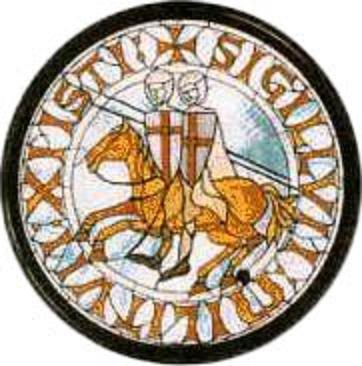
At first they really were poor. The early order's seal famously showed two knights sharing a single horse, a symbol of their humility. What transformed them was endorsement. The hugely influential churchman Bernard of Clairvaux championed their cause and helped write a rule for them, and in 1129 the Church formally recognised the order. Bernard wrote a treatise praising this new kind of warrior, the holy knight who could kill in battle without sin because he killed for Christ. It was a radical idea (monks were supposed to renounce violence), and it gave the Templars a unique and powerful identity.
The first international corporation
Donations poured in. Pious nobles across Europe, eager to support the defence of the Holy Land, gave the Templars land, money, castles and entire estates. Crucially, in 1139 the Pope granted the order extraordinary privileges: the Templars answered to the Pope alone, were exempt from local taxes, and could cross borders freely. They became, in effect, a sovereign body operating across all of Christendom, accountable to no king or bishop.
This network of properties across Europe and the Holy Land turned the Templars into something new, arguably one of the first multinational financial organisations in history. A pilgrim or crusader could deposit money at a Templar house in, say, Paris or London, receive a coded note, and withdraw the equivalent value at a Templar house in the Holy Land, without carrying gold across a continent of bandits. That is essentially an early form of banking, complete with letters of credit. The Templars lent money to kings, managed royal treasuries, and financed crusades. The "poor fellow-soldiers" had become bankers to the powerful.
Worth knowing: The Templars effectively ran an international banking system centuries before modern banks existed. A traveller could deposit funds at one Templar house and draw them at another far away using a written note, an early letter of credit. At various points the order even served as the royal treasury of France, holding and managing the French crown's money in its fortified Paris headquarters.
Warrior monks in the Holy Land
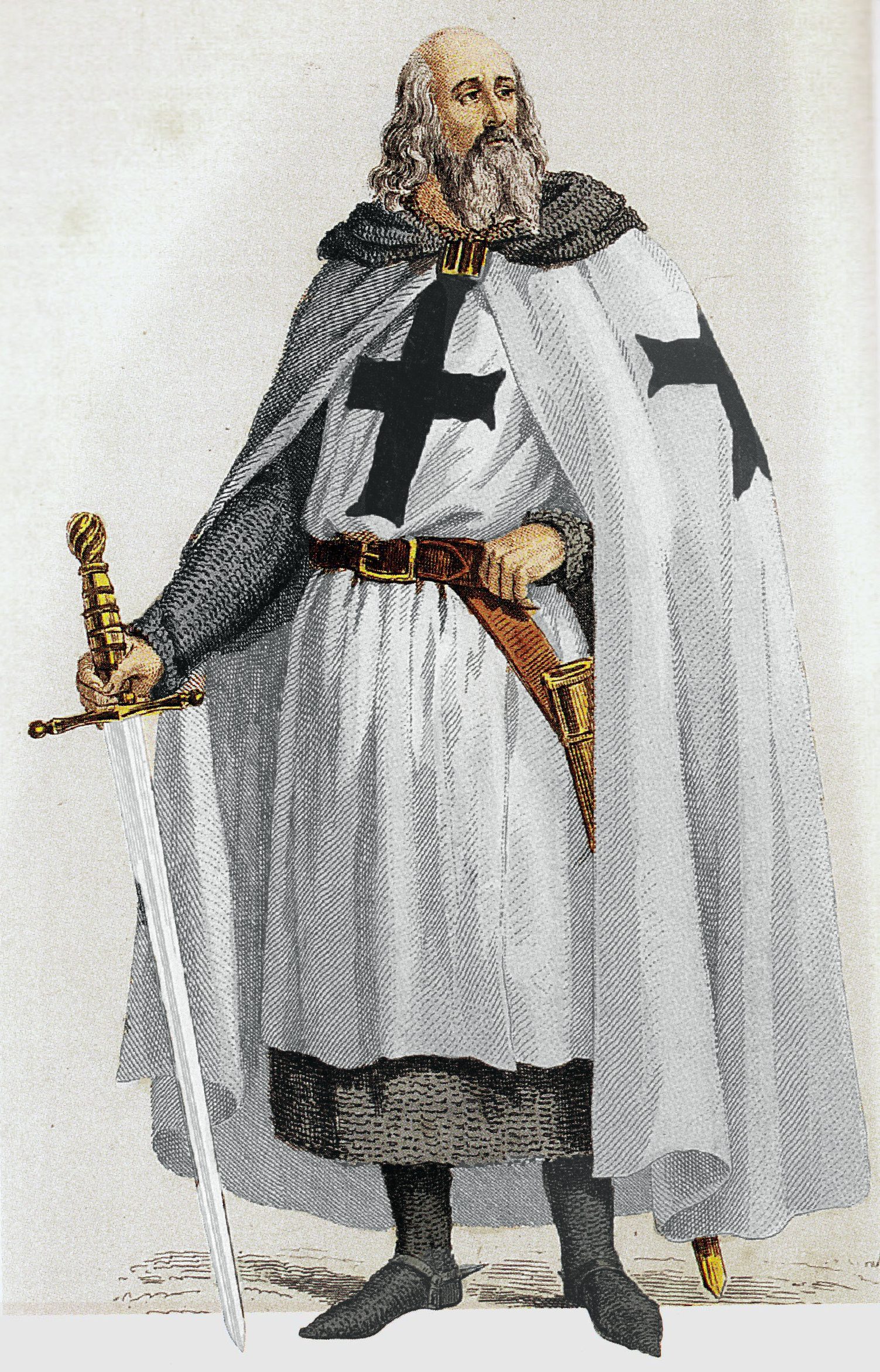
For all the banking, the Templars never stopped being soldiers. In the Holy Land they became the shock troops of the crusader states: disciplined, fanatically brave, and forbidden by their rule to retreat unless the odds against them were overwhelming. They garrisoned great castles and formed the hard core of crusader armies. A Templar in his white mantle with its red cross was a feared and respected sight on the battlefield.
That same discipline could tip into recklessness, and the order suffered catastrophic losses in several battles. When the Muslim leader Saladin crushed the crusader army at the Battle of Hattin in 1187 and went on to retake Jerusalem, captured Templars were singled out for execution precisely because they were considered the most dangerous and implacable of enemies. The order fought on through the long, slow collapse of the crusader states over the following century.
Losing the Holy Land, and their purpose
Here is the strategic problem that ultimately doomed the Templars. Their entire reason for existing was the defence of the Holy Land. In 1291 the city of Acre, the last major crusader stronghold, fell to Muslim forces. The crusader presence in the Holy Land was essentially finished. The Templars relocated their base to Cyprus, but the awkward truth hung over them: an order founded to protect pilgrims and hold Jerusalem now held nothing in the East, while still controlling vast wealth and property across Europe.
An organisation that is enormously rich, answerable to no local authority, militarily trained, and suddenly lacking an obvious purpose is in a dangerous position. It begins to look less like an asset and more like a target. And the man who came to see it as a target was the King of France.
A king with debts and designs
Philip IV of France, "Philip the Fair" more for his looks than his conduct, was an ambitious, ruthless and chronically cash-strapped monarch. He had already expelled Jews and persecuted Italian bankers to seize their assets, and he had clashed bitterly with the papacy over taxing the clergy. He owed the Templars a great deal of money. And the Templar order, with its independence and its treasure, sat squarely inside his kingdom while answering to no one but a Pope who, by 1307, was a Frenchman named Clement V whom Philip heavily influenced.
So on Friday the 13th of October 1307, Philip struck. In a carefully planned operation, royal officers arrested the Templars across France on charges that were lurid and almost certainly fabricated: that initiates were forced to deny Christ and spit on the cross, that they engaged in obscene kissing and homosexual acts, that they worshipped an idol called Baphomet. These were the standard accusations of the age, the kind thrown at any group a ruler wished to destroy, and they were extracted through torture.
Confessions under torture
Under brutal interrogation, including the rack and the application of fire to the feet, many Templars confessed to whatever their accusers wanted to hear. Some, including the grand master Jacques de Molay, confessed and then later publicly retracted, insisting the confessions had been forced. The retractions were fatal: under the rules of the time, retracting a confession made one a "relapsed heretic," punishable by death.
Pope Clement V, caught between his duty to an order that answered directly to him and the relentless pressure of the French king, wavered and ultimately gave way. In 1312 he dissolved the Knights Templar by decree, not on a finding that the charges were proven but, in his own careful wording, to avoid scandal and because the order's reputation had been so damaged it could no longer function. The Templars' property was officially transferred to their rival order, the Knights Hospitaller, though Philip made sure to recoup his costs first.
The last grand master
Jacques de Molay, the last grand master, had spent years in prison. In March 1314, brought out to hear his sentence of perpetual imprisonment, he instead defiantly proclaimed his and the order's innocence one final time. An enraged Philip had him burned at the stake that same day on a small island in the Seine in Paris. Legend later claimed that from the flames de Molay summoned both the Pope and the King to meet him before God's judgement within the year, and that both men did indeed die within months. It's a marvellous story, and both men really did die in 1314, but the curse is a later embellishment, not contemporary record.
"God knows who is wrong and has sinned. Soon misfortune will come to those who have wrongly condemned us. God will avenge our death."— words attributed to Jacques de Molay at his execution, as reported by the chronicler Geoffroi de Paris, 1314
The myths that grew in the ashes
This is where the legends took over, and it's worth separating the durable myths from the documented history, because the gap is enormous.
"The Templars hid a vast secret treasure — and maybe the Holy Grail — before they were arrested, and Friday the 13th is unlucky because of their downfall."
There's no historical evidence for a hidden Templar treasure or any link to the Grail; those ideas come from much later fiction and speculation, not the trial records. And the superstition around Friday the 13th cannot be traced to the 1307 arrests at all. That connection only became popular in the twentieth century, well after the unlucky-Friday and unlucky-thirteen traditions had developed separately.
The "lost treasure" idea has a kernel of plausibility: Philip was certainly disappointed by how little ready cash he found in the Paris temple, which fed centuries of speculation about where it had gone. But the most likely explanation is mundane: the order's wealth was largely tied up in land, buildings and outstanding loans, not piles of gold waiting to be spirited away. The romantic notion that the Templars survived in secret, guarding sacred relics and arcane knowledge, owes far more to eighteenth-century Freemasonry, Victorian romanticism, and modern novels and films than to anything in the historical record.
Were the Templars guilty of anything? Almost all historians agree the dramatic charges of idol-worship and systematic heresy were fabricated and extracted by torture to justify a financially and politically motivated attack. But there's real debate at the edges: a document rediscovered in the Vatican in 2001, the so-called Chinon Parchment, shows Pope Clement privately absolved the Templar leaders of heresy, which historians read as confirmation the central charges didn't hold up. Scholars still argue over how much Clement could realistically have resisted Philip, and how much, if any, irregular initiation practice lay behind the wild confessions.
A monastery, an army and a bank
Stripped of the conspiracy theories, the Knights Templar were something historically extraordinary in their own right: a religious order that was simultaneously a monastery, a standing army and an international bank, operating across borders with papal protection, for nearly two centuries. They embodied one of the central contradictions of medieval Christendom, the marriage of monastic piety with organised violence, and they pioneered financial techniques that prefigured modern banking.
Their destruction is, in the end, a fairly clear-eyed story about power and money. A king who was broke, jealous and unrestrained saw a wealthy, independent, vulnerable institution within his reach, manufactured charges that the conventions of the age made easy to "prove" through torture, and leaned on a weak Pope to make it stick. The supposedly sinister Templars were, on the evidence, the victims rather than the villains. That they have been remembered ever since as keepers of dark secrets is one of history's odder ironies: the men burned for imaginary crimes turned, in legend, into exactly the shadowy conspirators their accusers pretended they were.
Image: two Templar knights depicted on a single horse, the order's early seal motif, from a medieval manuscript (public domain, via Wikimedia Commons).
Read next: Joan of Arc: The Peasant Girl Who Crowned a King and Nalanda: The Ancient University That Was Fading Before the Fire.
Sources cited
- Malcolm Barber, The New Knighthood: A History of the Order of the Temple (Cambridge University Press, 1994).
- Malcolm Barber, The Trial of the Templars (Cambridge University Press, 2nd ed., 2006).
- Helen Nicholson, The Knights Templar: A New History (Sutton, 2001).
- Dan Jones, The Templars: The Rise and Spectacular Fall of God's Holy Warriors (Viking, 2017).
- Encyclopaedia Britannica, "Templar"; Barbara Frale's work on the Chinon Parchment (Vatican Secret Archives).