On the 8th of June in the year 793, raiders came out of the sea onto the little tidal island of Lindisfarne, off the coast of Northumbria. They sacked the monastery there, one of the holiest sites in the British Isles, killed or carried off some of the monks, and sailed away with whatever silver and slaves they could load. The scholar Alcuin, writing from the court of Charlemagne, was horrified: never, he said, had such a terror appeared in Britain. For Western Europe, it felt like the world had cracked open. We've called the centuries that followed the Viking Age ever since.
The word conjures a very particular image: horned helmets, blood-soaked beaches, bearded men screaming as they leap from longships. Some of that is fair. The Vikings could be appallingly violent, and the people they raided were not exaggerating their fear. But if that's all you think they were, you've got maybe a third of the story. The same culture that produced the Lindisfarne raid also produced some of the finest sailors in the medieval world, long-distance traders who reached Baghdad, settlers who founded towns from Dublin to Kyiv, and explorers who reached North America five centuries before Columbus.
The word, and the people behind it
First, a small but important point about the word. "Viking" was originally something closer to a job description than an ethnic label. In Old Norse, to go i viking meant roughly to go raiding or on an overseas expedition. The people we lump under the name were Norse, Scandinavians from what is now Denmark, Norway and Sweden, and the great majority of them were farmers, fishermen, craftsmen and traders who never raided anyone. When we call the whole society "the Vikings," we're really naming a culture after its most dramatic minority activity. It's a bit like naming the whole of a country after its navy.
What pushed some of them to take up raiding around the end of the eighth century is still debated. The usual suspects include population pressure and a shortage of good farmland in mountainous Norway, political consolidation at home that left ambitious young men looking for fortune elsewhere, and, above all, a technological edge at sea. Whatever the mix of causes, by 793 the Norse had the ships, the skills and the motive to start reaching out across the water, and for the next roughly three centuries they did so on a scale that reshaped the map of Europe.
The ships that made it all possible
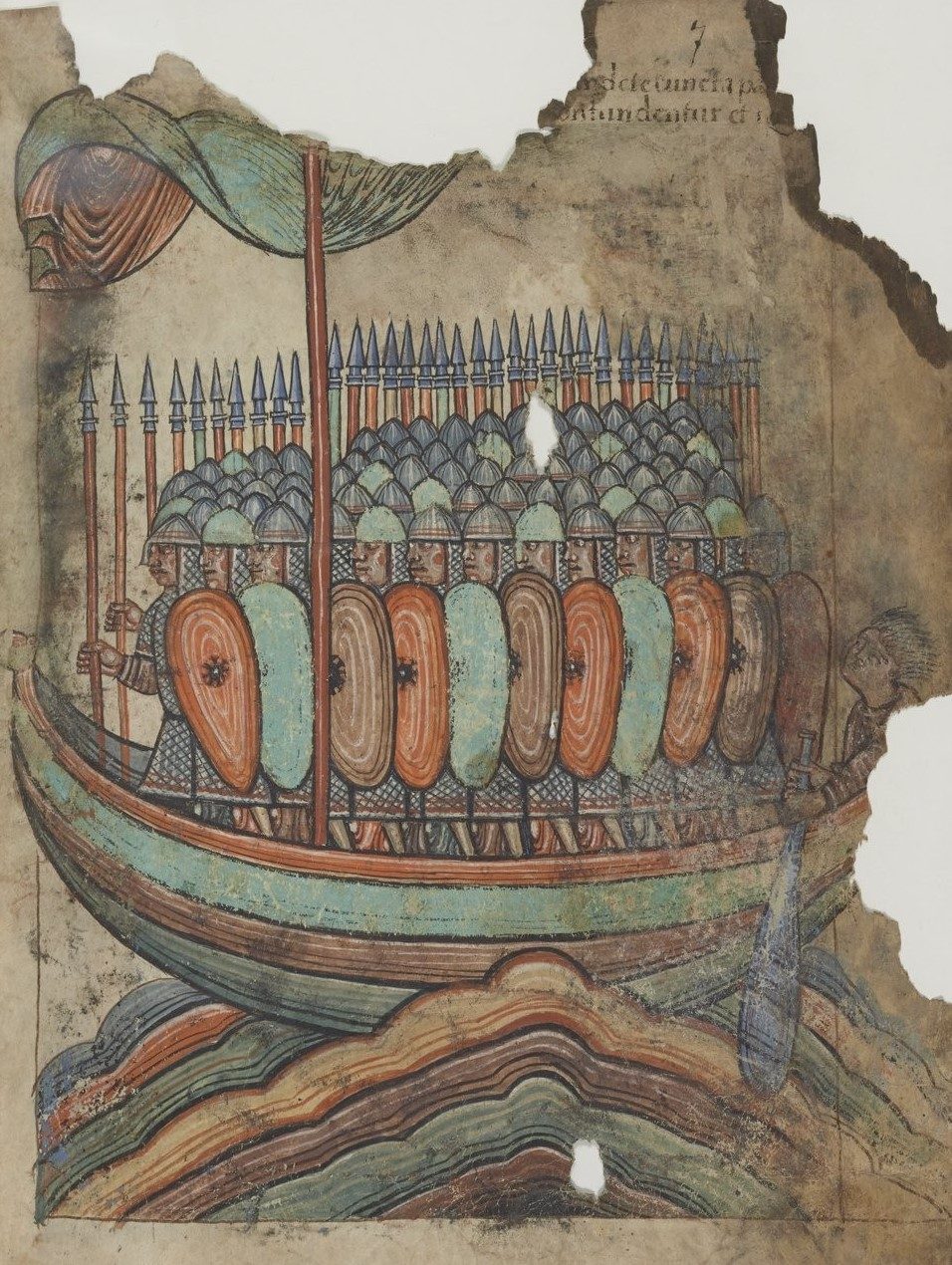
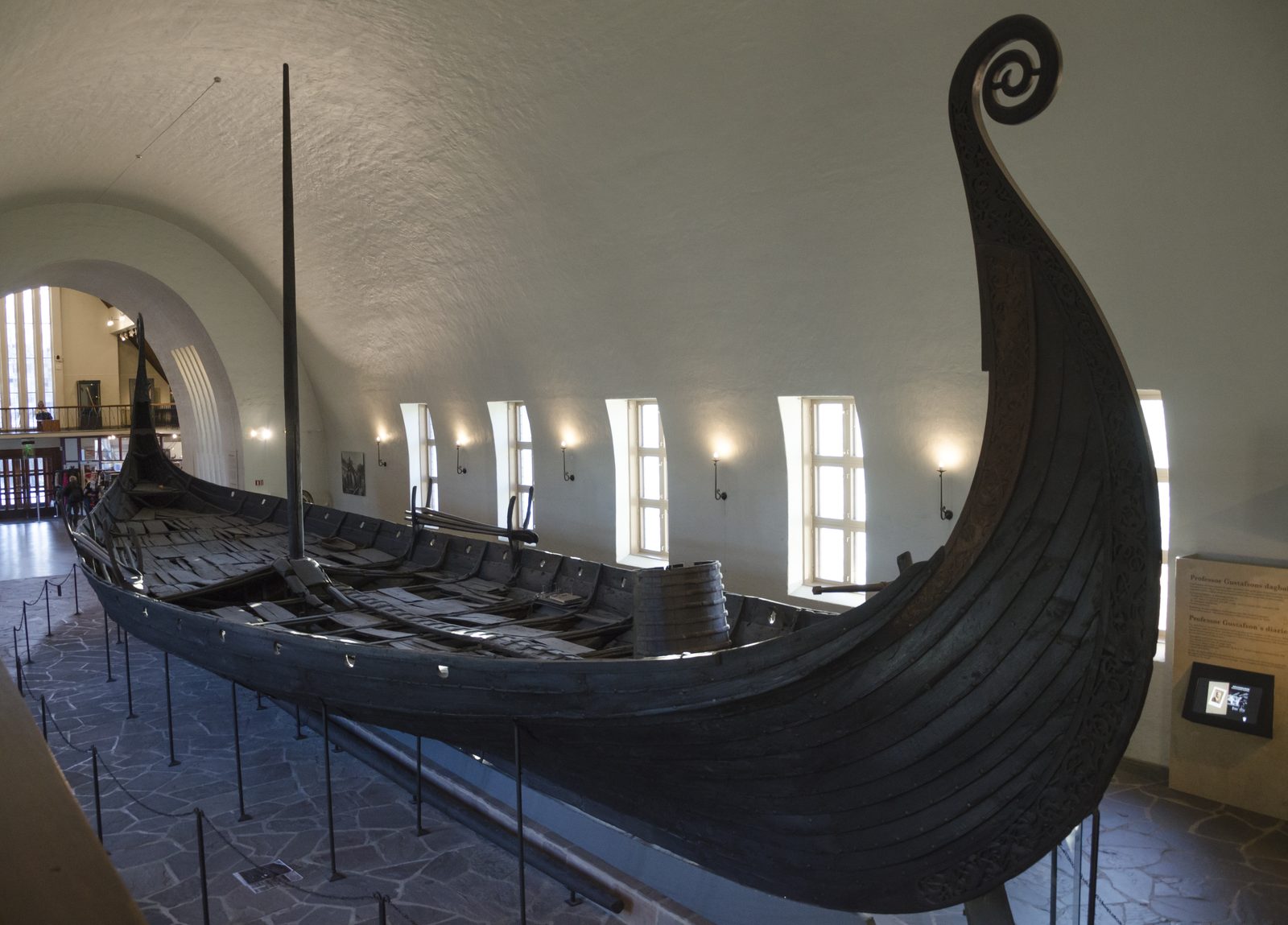
You cannot understand the Vikings without understanding their boats, because almost everything they did rested on them. The Norse longship was a masterpiece of shipbuilding: long, narrow, and light, built with overlapping planks (clinker construction) that gave the hull both strength and flexibility, so it could flex with the waves rather than fight them. It carried a single square sail for open water and oars for when the wind failed or stealth was needed.
The genius of the design was its shallow draught. A longship could cross open ocean and then run straight up onto a beach or push far up a shallow river, which is exactly why no riverside monastery or town was safe. The Vikings didn't need ports; they could appear almost anywhere there was water. They also built broader, deeper cargo ships called knarrs for hauling trade goods and livestock across the North Atlantic. Without these vessels, none of the raiding, trading or exploring that defines the age would have been possible.
The Vikings reached North America around the year 1000, roughly five centuries before Christopher Columbus. At L'Anse aux Meadows in Newfoundland, archaeologists have excavated the remains of an authentic Norse settlement, complete with turf buildings and iron-working debris. It is the only confirmed Viking site in the Americas, and it turned what had long been dismissed as saga fantasy into hard, datable fact.
Raiders: the violent decades
The raiding phase was real and it was brutal. After Lindisfarne, attacks spread along the coasts of Britain, Ireland and the Frankish empire. At first these were hit-and-run affairs: strike a monastery or coastal settlement in summer, grab the portable wealth and slaves, and be gone before any defence could gather. Monasteries were favourite targets precisely because they were rich, poorly defended, and conveniently placed near water.
Over time the raids grew bigger and more organised. By the middle of the ninth century, Viking forces had stopped going home for the winter and started overwintering in the lands they attacked. In 865 a large combined force the English sources call the "Great Heathen Army" landed in England, and over the following years it overran several of the Anglo-Saxon kingdoms. It came close to swallowing the lot, until Alfred of Wessex, later "the Great", checked it and negotiated a frontier. Much of eastern and northern England came under Norse law and settlement, an area later known as the Danelaw, whose Scandinavian influence still echoes in English place-names and vocabulary today.
Traders: the side that gets forgotten
Here is the half of the story the horned-helmet image buries completely. The Vikings were among the most far-ranging traders of their era. Norse merchants ran networks that stretched from the British Isles all the way to the Caspian Sea and beyond, dealing in furs, walrus ivory, amber, honey, weapons and, uncomfortably, large numbers of enslaved people, who were a central commodity of the Viking economy.
The eastern routes are especially striking. Swedish Norse traders and warriors, known in the east as the Rus, pushed down the great rivers of what is now Russia and Ukraine, founding or fortifying trading centres along the way, and gave their name, by most accounts, to Russia itself. They reached the Black Sea and Constantinople, the dazzling capital of the Byzantine Empire, where some served as the emperor's elite Varangian Guard. They traded with the Islamic world too: enormous quantities of Arabic silver coins, called dirhams, have been dug up across Scandinavia, mute evidence of commerce reaching all the way to the Abbasid Caliphate. One Arab diplomat, Ibn Fadlan, famously left a vivid eyewitness account of Norse traders he met on the Volga in the 920s.
"I have seen the Rus as they came on their merchant journeys and encamped by the Itil. I have never seen more perfect physical specimens, tall as date palms, blond and ruddy."— Ibn Fadlan, account of his journey to the Volga, c. 922 CE (Risala)
Explorers: out across the empty Atlantic
The third face of the Vikings is the one I find most extraordinary: they were explorers and colonists who pushed out across the North Atlantic into unknown ocean. They settled the Faroe Islands, then Iceland (from around 870), building a remarkable society there with its own law-making assembly, the Althing, which still gives its name to Iceland's parliament today.
From Iceland they pressed further. Around 985, an exiled chieftain named Erik the Red led settlers to Greenland and established colonies that survived for centuries on its hostile southern fringe. And from Greenland, according to the Icelandic sagas, his son Leif Erikson sailed still further west and reached a land he called Vinland ("Wine-land") somewhere on the coast of North America. For a long time historians treated this as a tall tale. Then, in the 1960s, the excavation of L'Anse aux Meadows in Newfoundland proved there really had been a Norse presence in the Americas around the year 1000. The sagas, it turned out, were remembering something true.
How far did the Vinland voyages actually reach? L'Anse aux Meadows is confirmed, but the sagas describe a richer land of wild grapes and self-sown wheat further south, and scholars still argue over how much exploring the Norse really did along the North American coast, and how long they kept doing it. A handful of finds, like a Norse coin in Maine, hint at contact, but the evidence is thin and fiercely debated. The one settlement we can stand on is in Newfoundland; everything beyond it is reconstruction.
The myth of the horned helmet
If there is one image that has to be dragged out into the light and corrected, it's this one. The Vikings did not wear horned helmets. They simply didn't. Not one authentic horned helmet has ever been recovered from a Viking-age warrior grave, and there is no contemporary depiction of Norse warriors wearing them. Real Viking helmets, where they survive (the well-preserved Gjermundbu helmet from Norway is the famous example), were simple, practical rounded caps of iron, sometimes with a guard for the nose or eyes. Horns on a battlefield would have been worse than useless, snagging weapons and getting in the way.
"Viking warriors charged into battle wearing helmets with great curving horns."
The horned helmet is a nineteenth-century invention. It was popularised largely by costume designers for Wagner's Ring operas in the 1870s and by Romantic-era artists, then cemented by a century of cartoons and films. No authentic Viking-age horned war helmet has ever been found. Real ones were plain iron caps.
How the age ended, and how it didn't
The Viking Age is conventionally said to close in 1066. That year the Norwegian king Harald Hardrada, a former member of that very Varangian Guard in Constantinople, invaded England and was killed at the Battle of Stamford Bridge by the English king Harold Godwinson. Three weeks later Harold himself was killed at Hastings by William of Normandy, whose own ancestors, neatly enough, had been Vikings who settled in northern France (Normandy means "land of the Northmen"). It's a tidy bookend, even if the reality was more gradual.
What really ended the age was less a single battle than a transformation of Scandinavian society. Over the tenth and eleventh centuries the Norse lands consolidated into Christian kingdoms (Denmark, Norway and Sweden) with kings, bishops and the apparatus of medieval European statehood. As Scandinavia became Christianised and centralised, the freelance raiding that defined the early Viking Age faded. The Norse didn't vanish; they became medieval Europeans like everyone else. The Greenland colonies clung on for centuries before dying out, probably in the fifteenth century, as the climate cooled and contact with Europe withered.
What the Vikings left behind
The legacy is far larger than the raids that made them feared. They founded or developed towns that became great cities, Dublin, York and Kyiv among them. They left a deep mark on the English language; everyday words like sky, knife, egg, law and even the pronoun they are Norse inheritances. They reshaped the politics of England, Ireland, France and Russia. They produced a stunning literary tradition in the Icelandic sagas, written down in the thirteenth century but preserving older memory, and a rich mythology of Odin, Thor and the doomed gods of Ragnarok that still saturates modern fantasy and film.
The honest picture of the Vikings is the one that holds all three faces at once. They were raiders capable of real savagery; they were also traders who knitted together half a continent, and explorers who crossed an ocean no one before them had crossed. The single-image version, the snarling horned berserker, flatters our love of a simple villain and loses almost everything that made them remarkable. The truth is more unsettling and far more interesting: the people who terrorised Lindisfarne were the same people who, two centuries later, were farming in Newfoundland at the far edge of the known world.
Image: the Oseberg ship, a remarkably preserved Viking longship excavated in Norway, now in the Viking Ship Museum, Oslo (public domain, via Wikimedia Commons).
Read next: Salme Ship Burials: The Raid That Came Before the Viking Age.
Sources & further reading
- Neil Price, The Children of Ash and Elm: A History of the Vikings (Basic Books, 2020).
- Anders Winroth, The Age of the Vikings (Princeton University Press, 2014).
- Else Roesdahl, The Vikings (Penguin, revised editions) — a standard archaeological overview.
- The Icelandic sagas, especially the Saga of the Greenlanders and Erik the Red's Saga (Penguin Classics translations).
- Ibn Fadlan, Mission to the Volga (modern translation, e.g. by James Montgomery); Encyclopaedia Britannica, "Viking."