A man sits on a foreign shore at the edge of the sea, weeping. He has a beautiful goddess for a companion and an island paradise for a home, and he would trade all of it in an instant for a glimpse of the smoke rising from his own rocky little kingdom across the water. He has been away twenty years — ten at war, ten trying to get home — and he is so famous for his cleverness that even the gods have to scheme to keep him in one place. His name is Odysseus, and Homer's Odyssey, composed nearly three thousand years ago, is the story of his long, battered, miraculous journey home. It is, at heart, the oldest and greatest story we have about how badly a person can want to go home.
The Odyssey is one of two great epic poems attributed to the Greek poet Homer, the other being the Iliad, which tells of the Trojan War. The Odyssey picks up the thread afterward: Troy has fallen, the other Greek warriors have gone home or died, and only Odysseus is still missing, lost somewhere on the wine-dark sea. What follows is not a war story but a homecoming story — a nostos, the Greek word for a return home, which gives us our word "nostalgia," literally the ache to return. Twenty-four books of longing, cunning, monsters and patience, all bent toward a single goal: getting one man back to his wife, his son, and his bed.
Who wrote it down, and when
Before the monsters, a word about the poet, because it is more complicated than it sounds. "Homer" is the name the ancient Greeks gave to the author of both epics, but we know essentially nothing reliable about him as a person — not his dates, his birthplace, or even whether he existed as a single individual at all. The poems clearly grew out of a long oral tradition: generations of bards reciting and reshaping heroic tales aloud, using stock phrases and repeated formulas that helped them improvise enormous narratives from memory. The repeated epithets everyone notices — "rosy-fingered Dawn," "the wine-dark sea," "much-enduring Odysseus" — are partly the tools of that oral craft. The Odyssey was probably given something like its final shape around the 8th or 7th century BCE, and only later written down. Whether one genius called Homer composed it or it crystallised out of a tradition is a debate that has run for over two thousand years and is unlikely ever to be settled.
Worth knowing: The Odyssey does not tell its story in order. It opens with Odysseus already most of the way through his ordeal, stranded on the goddess Calypso's island, and the most famous adventures — the Cyclops, Circe, the Sirens — are told as a long flashback, narrated by Odysseus himself at a banquet. A poem composed nearly three millennia ago already uses the kind of nonlinear, story-within-a-story structure we tend to think of as modern. Homer was playing with time long before anyone called it a literary device.
The Cyclops, and the danger of being clever
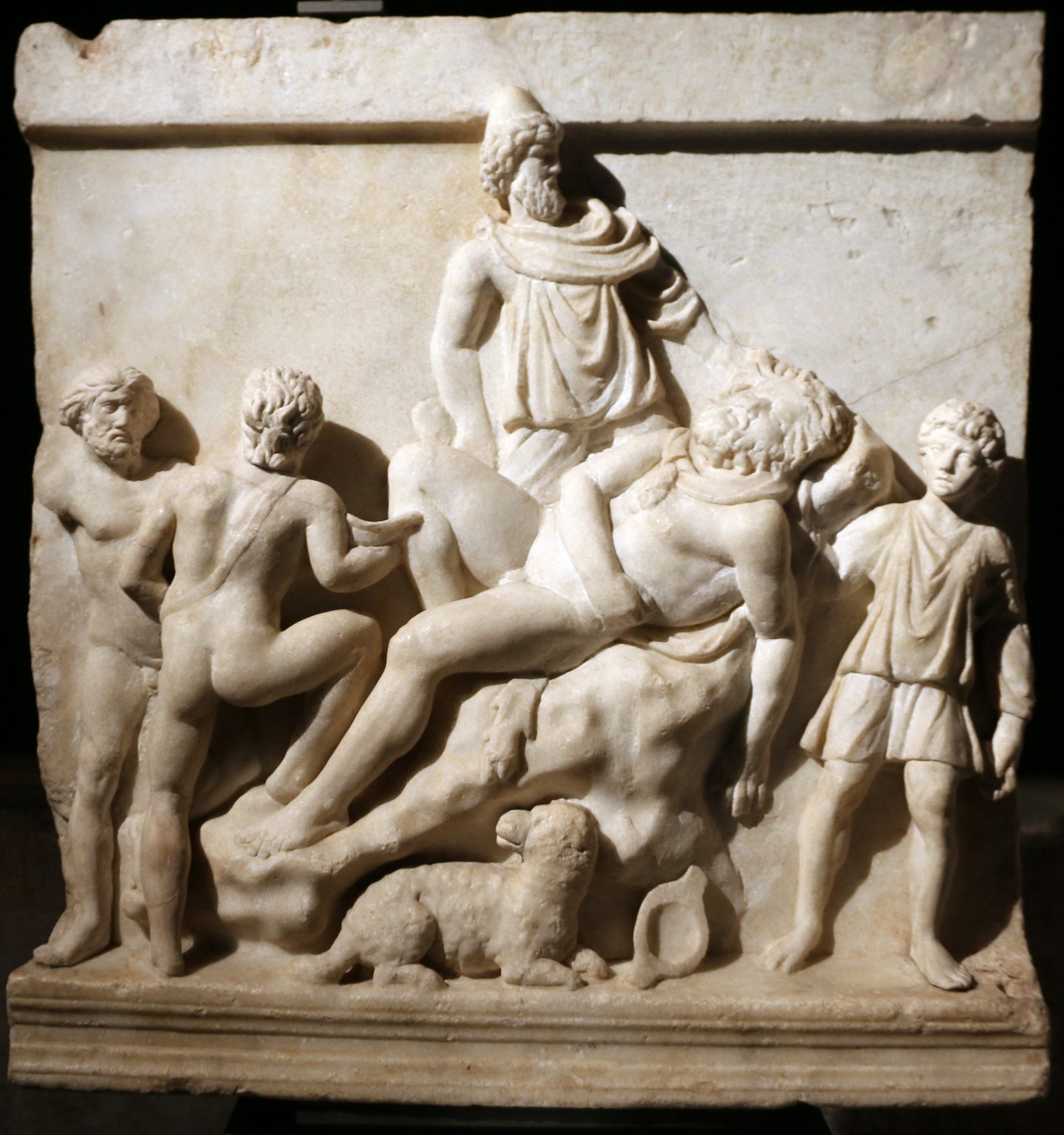
The most celebrated episode in the poem is Odysseus's encounter with the Cyclops, a one-eyed giant named Polyphemus, son of the sea god Poseidon. Trapped with his men in the giant's cave, watching Polyphemus devour his companions two at a time, Odysseus relies on the quality that defines him: his wits. He tells the Cyclops his name is "Nobody," gets the giant drunk on strong wine, and then blinds his single eye with a sharpened, fire-hardened stake while he sleeps. When the wounded Polyphemus bellows to his neighbours that "Nobody" is killing him, they assume he is fine and ignore him — a grim pun that turns on Odysseus's false name. The Greeks then escape by clinging to the bellies of the giant's sheep as they are let out to pasture.
But the episode also reveals Odysseus's flaw. As he sails away, safe, he cannot resist taunting the blinded giant and finally shouting his real name — letting Polyphemus know exactly who blinded him. The Cyclops calls out to his father Poseidon to curse Odysseus, and the sea god duly spends the rest of the poem hounding him with storms and delays. Odysseus's cleverness saves his life, and his pride very nearly costs him everything. That tension — brilliant cunning married to dangerous pride — is the engine of his whole character.
"Sing to me of the man, Muse, the man of twists and turns / driven time and again off course, once he had plundered / the hallowed heights of Troy."— Homer, The Odyssey, Book 1, opening lines, in the translation by Robert Fagles (Penguin, 1996)
Circe, the underworld, and the long way round
Odysseus's wanderings pile marvel upon marvel. He reaches the island of the enchantress Circe, who turns several of his men into pigs with a potion; protected by a herb given to him by the god Hermes, Odysseus resists her magic, and she eventually becomes his ally and lover for a year. On Circe's advice he sails to the very edge of the world to consult the dead, summoning the ghosts of the underworld — including the blind prophet Tiresias, who tells him how he might yet reach home, and the shade of his own mother, who died of grief in his absence. It is one of the most haunting passages in ancient literature, this living man among the longing dead.
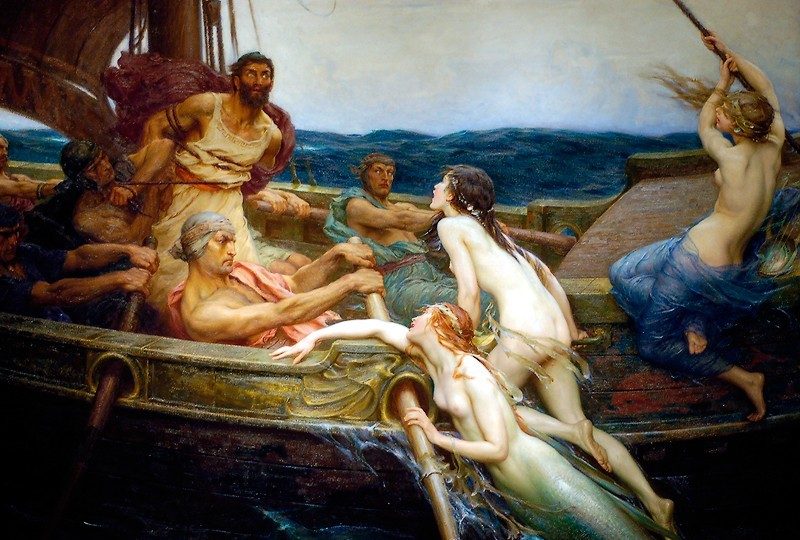
Then come the famous perils in quick succession: the Sirens, whose irresistible song lures sailors to their deaths, and whom Odysseus survives by having his crew stop their ears with wax while he alone listens, lashed to the mast so he cannot steer toward them; the twin terrors of Scylla, a six-headed monster, and Charybdis, a ship-swallowing whirlpool, between which he must thread a narrow strait, losing six men to Scylla because there is no other choice. Finally his remaining crew, against his orders, slaughter and eat the sacred cattle of the sun god, and for that sacrilege Zeus destroys the ship with a thunderbolt. Every man drowns. Only Odysseus survives, washing up alone on Calypso's island — which is where, years later, the poem first finds him, weeping for home.
The patient ones at home
What makes the Odyssey more than an adventure story is that it never forgets the home Odysseus is trying to reach. Much of the poem takes place not at sea but in Ithaca, where his wife Penelope has been holding out for twenty years against more than a hundred aggressive suitors. These men have moved into Odysseus's house, are eating him out of his estate, and are pressuring Penelope to accept that her husband is dead and marry one of them. They are a slow-motion invasion of everything he is fighting to return to.
Penelope is one of the great characters of ancient literature, and her defining quality matches her husband's: she is cunning. Her most famous stratagem is the shroud. She announces she will choose a new husband only once she has finished weaving a funeral shroud for Odysseus's aged father — and then secretly unravels her day's work each night, keeping the suitors at bay for years with a task that can never be completed. She is Odysseus's equal in patience and guile, which is precisely why the poem treats their reunion as the true destination of the whole epic. Their grown son Telemachus, meanwhile, sets out on his own journey in the poem's early books, searching for news of his father and growing from an uncertain boy into a man who can stand beside him.
"The Odyssey is basically a list of sea monsters — the real story is the wild adventures."
The famous monsters take up a surprisingly small slice of the poem and are told as a single flashback. The bulk of the Odyssey is about home: a faithful wife outwitting suitors, a son searching for his father, a king disguised as a beggar testing who has stayed loyal. It is less a monster-of-the-week saga than a story about loyalty, identity, and the long fight to reclaim a life.
The homecoming, and the test of identity
When Odysseus finally reaches Ithaca — set ashore at last by friendly sailors — he does not march in and announce himself. True to character, he comes in disguise, transformed by the goddess Athena into a ragged old beggar, so that he can move through his own household unrecognised and learn who has stayed loyal and who has not. This long, tense final movement of the poem is, in a way, its most psychologically rich. The king is a stranger in his own home, watching the suitors abuse his hospitality, revealing himself only gradually — first to his son, then to a faithful old swineherd, then to an old servant who recognises him by a childhood scar on his leg.
The climax is famous: Penelope announces a contest, promising to marry whichever suitor can string Odysseus's great bow and shoot an arrow through a line of axe-heads — a feat only Odysseus himself can perform. The suitors fail one after another. Then the ragged beggar asks to try, strings the bow with ease, and turns it on the men who have invaded his home. The reckoning that follows is bloody. And even then the poem withholds the reunion we have waited the whole epic for: Penelope, cautious to the last, tests her returned husband with a secret about their marriage bed — built by Odysseus around a living olive tree, immovable — that only the real Odysseus could know. When he proves he knows it, her guard finally falls, and the two are reunited. It is one of the most moving recognition scenes in all of literature precisely because it is earned through suspicion and intelligence rather than easy sentiment.
Was there really a "Homer," and is the Odyssey the work of one author? This is the long-running "Homeric Question." Some scholars hold that a single great poet shaped the epic into its unified form; others argue it is the crystallisation of a centuries-long oral tradition with no single author. The discovery in the 20th century that the poems are built from formulaic oral techniques (work associated with the scholar Milman Parry) reshaped the whole debate. There is no consensus, and the figure of "Homer" remains as much a question as an answer.
Three thousand years without going out of print
The Odyssey has never gone out of circulation in nearly three thousand years, and the reasons are not hard to find. On one level it is simply a tremendous adventure, full of monsters and magic and narrow escapes. But its deeper hold comes from how human it is beneath the marvels. Strip away the Cyclops and the witches and what remains is achingly recognisable: a person trying to get home; a marriage tested by impossibly long separation; a son who barely knows his absent father; the temptation to give up and stay somewhere easier; the question of who you still are after twenty years away, and whether the home you remember will still know you. Odysseus turns down immortality with a goddess in order to return to an ordinary, aging wife on a poor island, and the poem treats that as the most heroic choice he makes.
That is why the story keeps being retold and reinvented — translated freshly by every generation (the poet Emily Wilson's celebrated 2017 translation was the first into English by a woman, and reopened the poem for many modern readers), reworked into novels like James Joyce's Ulysses, echoed in films and songs and the very word "odyssey" itself, which we now use for any long, transformative journey. Homer took the universal human longing for home and gave it a shape so durable that we are still using it. The man weeping on the shore at the start of this article is, in the end, every one of us who has ever been far away and wanted nothing more than to go back.
Image: 'Ulysses and the Sirens' by John William Waterhouse, 1891 (National Gallery of Victoria; public domain, Wikimedia Commons). This article discusses an ancient Greek epic poem, not a historical event.
Where the story comes from
- Homer, The Odyssey (c. 8th–7th century BCE) — the epic poem itself, the primary source for everything described here.
- Homer, The Odyssey, translated by Robert Fagles (Penguin Classics, 1996) — a widely read modern verse translation.
- Homer, The Odyssey, translated by Emily Wilson (W. W. Norton, 2017) — the acclaimed first English translation by a woman, with an extensive introduction on the poem and its tradition.
- Homer, The Iliad — the companion epic on the Trojan War, essential background to Odysseus's homecoming.
- Encyclopaedia Britannica, "Odyssey," "Homer" and "Homeric Question," for overviews of the poem and the scholarly debates around its authorship.