Imagine a tree so vast that its roots reach down into three different worlds and its branches hold up the sky. An eagle sits at its crown, a dragon gnaws at its roots, and a squirrel runs up and down the trunk all day long carrying insults between the two. Gods hold council beneath it. The dead pass under it. And one day, the Norse believed, the whole thing will tremble when the world ends. This is Yggdrasil, the World Tree, and it stands at the centre of one of the most haunting mythologies the human imagination has ever produced — a cosmos that knows, from the very beginning, that it is doomed.
Norse mythology comes to us mostly from the far edge of medieval Europe — Iceland, settled by Norwegian seafarers, where the old stories were finally written down in the 13th century, two centuries after the region had officially converted to Christianity. That gap matters, and we'll come back to it. But strip away the questions of transmission and what survives is a body of myth unlike any other: grim, funny, fatalistic and strangely moving, populated by gods who are powerful but not all-powerful, clever but not wise, and above all mortal in the one sense that counts — they know they are going to die.
Nine worlds and a tree that holds them
The Norse cosmos is built around Yggdrasil, an immense ash tree whose branches and roots bind together Nine Worlds. The names and exact arrangement shift between sources, but the broad shape is familiar enough: there is Asgard, home of the Aesir gods; Midgard, the "middle enclosure," which is the world of human beings; Jotunheim, the land of the giants; Niflheim, a realm of ice and mist; Muspelheim, a realm of fire; and Hel, the cold underworld of most of the dead. Around the outside coils Jormungandr, the Midgard Serpent, so enormous that it encircles the entire world of humans and bites its own tail.
What's striking is how alive and contested this universe feels. Yggdrasil is not a serene cosmic pillar; it suffers. According to Snorri Sturluson, the Icelandic scholar who compiled much of what we know, deer nibble its branches, the dragon Nidhogg chews its roots from below, and the trunk rots even as the tree endures. The whole structure is held in a kind of permanent, straining tension — which is a fair description of the Norse universe as a whole.
Odin, the one-eyed wanderer
At the head of the Aesir stands Odin, and he is nobody's idea of a comfortable father-god. He is the god of war, of poetry, of frenzy and of wisdom, and he pursues knowledge with an appetite that borders on the disturbing. To gain understanding of the runes — the sacred letters that carried magical power — Odin hanged himself from Yggdrasil for nine nights, wounded by his own spear, a sacrifice of himself to himself. To drink from the well of wisdom guarded by the being Mimir, he gave up one of his eyes. He is a god who pays appalling prices for what he learns.
And what he mostly learns is bad news. Odin alone among the gods understands clearly what is coming — the doom called Ragnarok — and much of his behaviour is an attempt to delay or prepare for it. He gathers the souls of slain warriors into his hall, Valhalla, not out of simple generosity but because he is assembling an army for the final battle. He sends his ravens, Huginn and Muninn ("Thought" and "Memory"), out across the worlds each day to bring him news. He is restless, manipulative, and perpetually afraid, in the way that only someone who can see the future has a right to be.
Four days of the English week are named after Norse and Germanic gods. Tuesday belongs to Tyr (Old English Tiw), Wednesday to Odin (Woden — "Woden's day"), Thursday to Thor ("Thor's day"), and Friday most likely to the goddess Frigg. The gods of the Vikings are quietly embedded in the calendar of people who haven't worshipped them in a thousand years.
Thor, the defender of the worlds
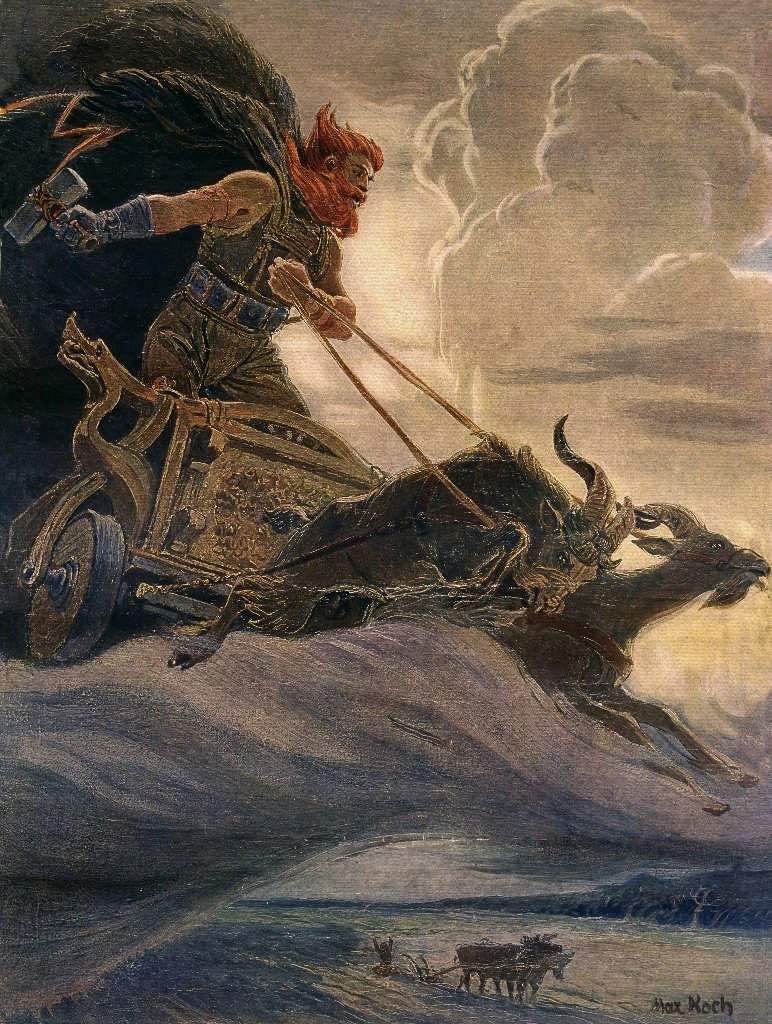
If Odin is the unsettling intellectual, his son Thor is the people's god — and in the Viking Age he may actually have been the most widely worshipped of all. Thor is the god of thunder, immensely strong, red-bearded and hot-tempered, armed with the hammer Mjollnir, which never misses and always returns to his hand. His great enemies are the giants, the jotnar, and his role in the cosmos is essentially that of a guardian: he keeps the forces of chaos from overrunning Asgard and Midgard, smashing skulls with grim, reliable enthusiasm.
The myths about Thor are often unexpectedly funny. In one famous tale, his hammer is stolen by a giant who demands the goddess Freyja as the price of its return; the solution the gods hit upon is to dress Thor himself as the bride, veil and all, and send him to the wedding, where he eventually retrieves Mjollnir and slaughters the wedding party. In another, he goes fishing for the Midgard Serpent itself, hooks the monster, and is only prevented from hauling it up and killing it when his terrified companion cuts the line. These are not solemn theological texts. They are stories told by people who clearly enjoyed their gods.
Loki, the trouble at the heart of things
And then there is Loki, who is harder to categorise than perhaps any figure in world mythology. Loki is counted among the Aesir but is of giant descent, and he occupies a uniquely ambiguous place: he is the gods' companion, helper and travelling partner, the clever one who gets them out of the scrapes — many of which he also got them into in the first place. He is a shape-shifter who has appeared as a salmon, a fly, a mare (in which form he gave birth to Odin's eight-legged horse, Sleipnir), and an old woman.
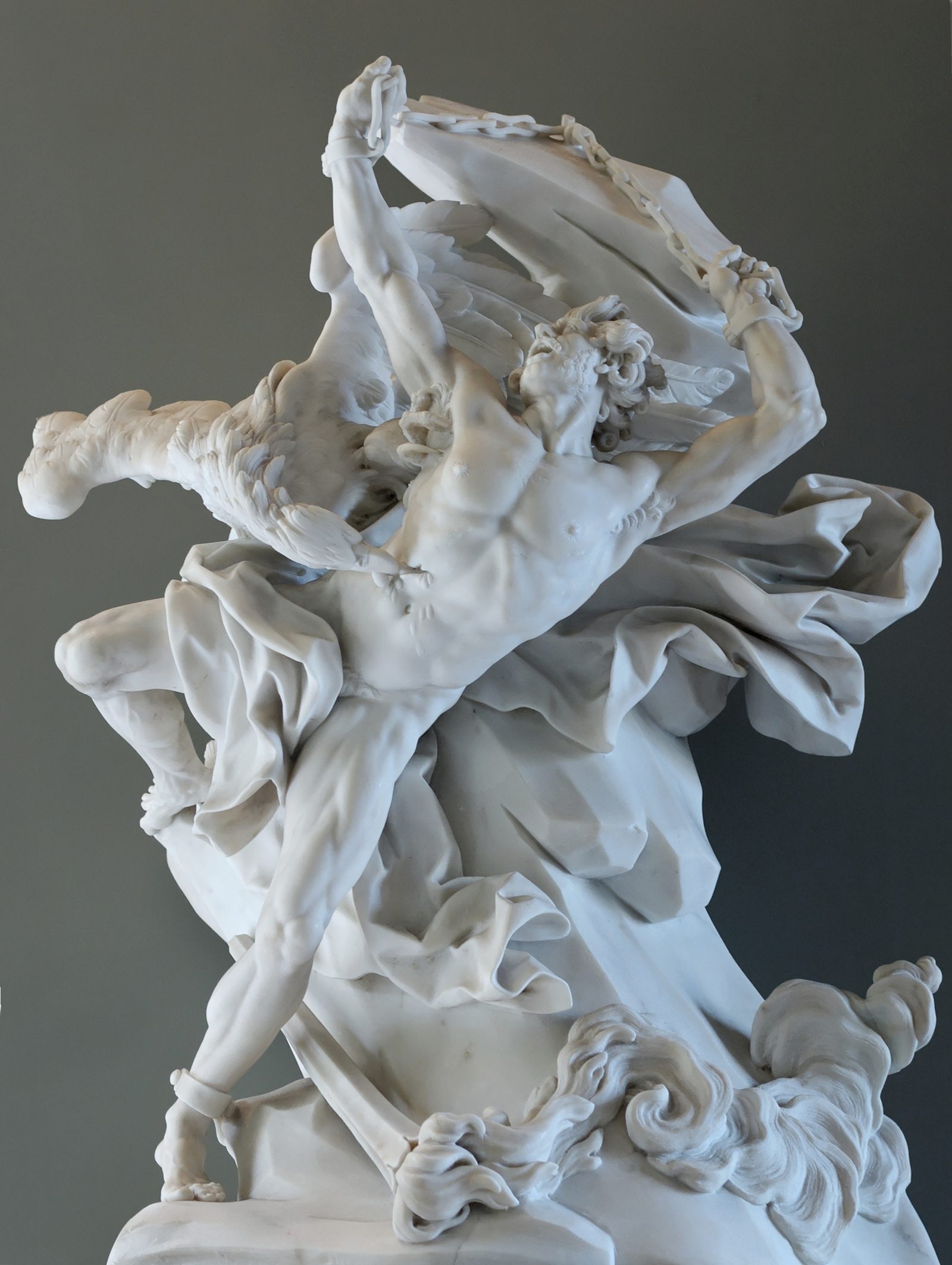
For much of the mythology Loki is mischievous rather than evil, a trickster whose schemes are often genuinely useful to the gods. But there is a turn. Loki engineers the death of Baldr, the beloved, shining son of Odin and the gentlest of all the gods, by tricking the blind god Hodr into killing him and then preventing his return from the dead. With that act, the comic trickster curdles into something darker. The gods seize Loki and bind him beneath the earth with a serpent dripping venom onto his face, and there he writhes — his struggles, the Norse said, are what cause earthquakes — until the end of the world finally sets him loose.
"Brothers will fight and kill each other, sisters' children will defile kinship... an axe age, a sword age, shields are riven, a wind age, a wolf age, before the world goes down."— the seeress, in the Voluspa ("The Prophecy of the Seeress"), Poetic Edda, describing the moral collapse that precedes Ragnarok. Trans. after Carolyne Larrington.
Ragnarok: the doom of the gods
No part of Norse mythology is more famous, or more characteristic, than its ending. Ragnarok — often translated "the doom" or "fate of the gods" — is the prophesied destruction of the cosmos, and what makes it remarkable is that the gods know it is coming and know they will lose. The great poem Voluspa, spoken in the voice of a seeress summoned by Odin, lays it out: a terrible winter, Fimbulwinter, will grip the world; moral order will collapse into kin-murder and chaos; the wolf Fenrir, another of Loki's monstrous children, will break free; the Midgard Serpent will rise from the sea; and the fire-giant Surtr will come from the south with a sword brighter than the sun.
Then the gods march out to a battle they cannot win. Odin is swallowed by the wolf Fenrir. Thor kills the Midgard Serpent but staggers only nine paces before dying of its venom. Loki and the watchman god Heimdall destroy each other. Surtr's fire engulfs the Nine Worlds, and the earth sinks beneath the sea. It is, on the face of it, total annihilation — a mythology with a built-in apocalypse, written by a culture that seems to have found something bracing rather than despairing in the idea.
But the seeress does not stop there. After the fire and the flood, she sees the earth rise again, green and renewed, out of the water. A few gods survive — among them Baldr, returned at last from the dead — and two human beings, Lif and Lifthrasir, emerge from where they had sheltered to repopulate the world. The cycle, it seems, begins again. Whether this hopeful coda is genuinely ancient or owes something to Christian ideas of resurrection is one of the real puzzles of the subject, and it leads us straight to the central problem of Norse mythology.
How "pure" are the myths we have? Almost everything survives through two Icelandic books written down around 1220-1270, after centuries of Christianity. The Poetic Edda is a collection of older anonymous poems; the Prose Edda was written by Snorri Sturluson, a Christian chieftain, partly as a handbook for poets. Scholars argue over how much Snorri reshaped, rationalised or even invented to make the material coherent — and whether the redemptive "new world" after Ragnarok reflects authentic pagan belief or a Christian gloss laid over it. There is no surviving pagan-era account to check him against.
The problem of the sources
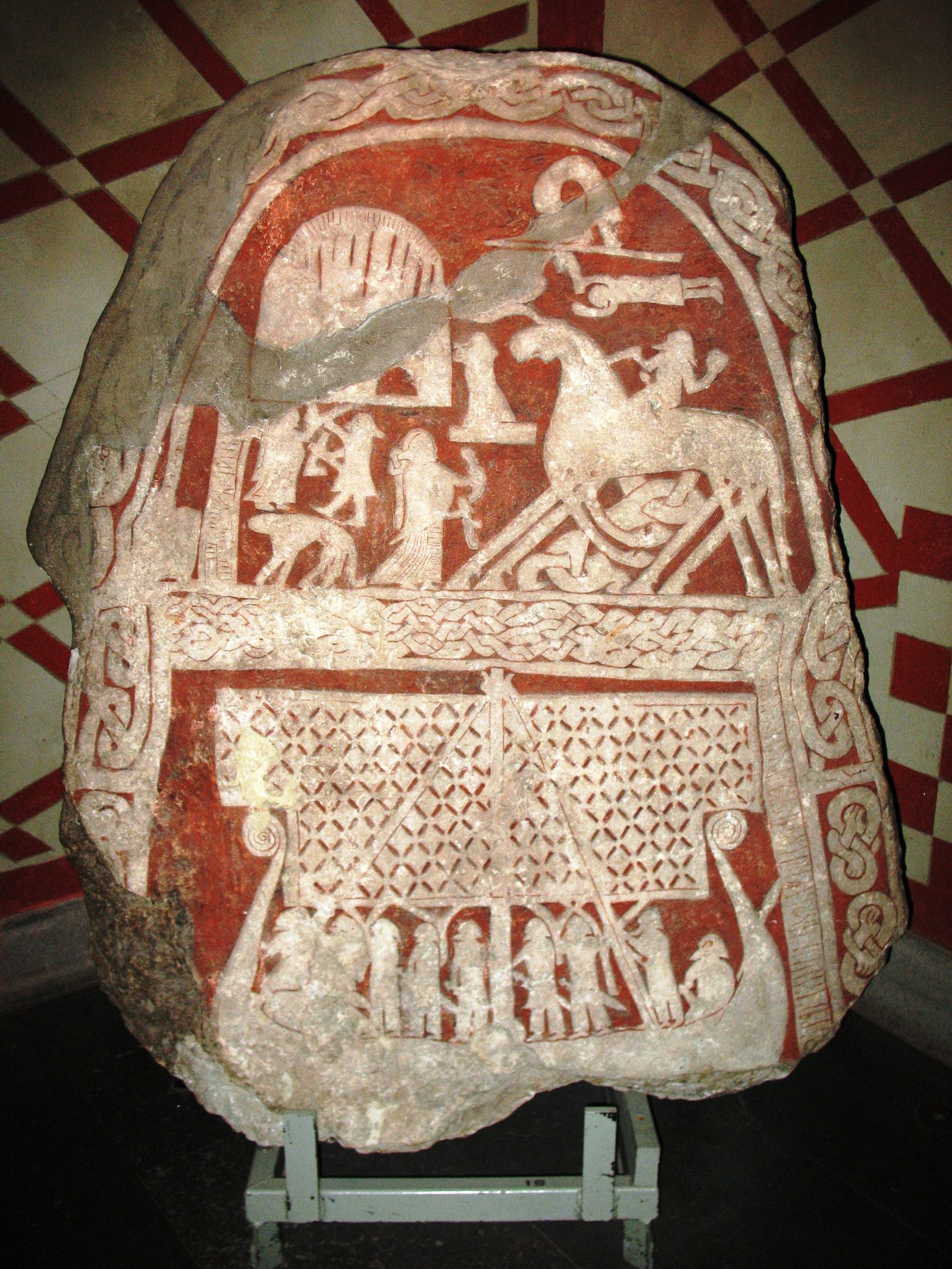
This is worth being honest about, because it shapes everything. The Vikings themselves left us no scriptures. They had runic inscriptions, carved images, place-names and the testimony of horrified foreign monks, but the connected stories — the ones with plots and dialogue and named characters — come overwhelmingly from two medieval Icelandic compilations. The Poetic Edda is an anthology of mythological and heroic poems, some of which may genuinely date back to the pagan Viking Age, preserved orally and finally committed to vellum. The Prose Edda is the work of one identifiable author, Snorri Sturluson, a brilliant and politically ambitious Icelander writing around 1220.
Snorri is our single most important informant, and he is also a problem. He was a Christian writing about a religion his ancestors had abandoned, and his stated purpose was partly practical — to teach the old poetic conventions to a new generation who no longer understood the mythological references that traditional verse depended on. He clearly knew a great deal. But he was also organising, smoothing and explaining, and a modern reader has to hold two thoughts at once: that without Snorri we would know a fraction of what we do, and that the tidy, systematic cosmos he presents may be tidier and more systematic than anything the Vikings actually believed. The mythology we love is, in part, a 13th-century reconstruction.
"Vikings wore horned helmets into battle."
There is no archaeological evidence that Viking warriors wore horned helmets — they would have been useless and dangerous in combat. The image is essentially a 19th-century invention, popularised by costume designs for Wagner's operas and by Romantic painters. The real Norse helmets that survive are plain, practical iron caps.
A religion lived, not just a story told
It's easy to read these tales as literature and forget that, for centuries, they underpinned a living religion. The Norse worshipped these gods with sacrifices, called blot, often involving animals and feasting, at temples and sacred groves. Medieval writers describe a great temple at Uppsala in Sweden with images of Thor, Odin and Freyr, where offerings were made. People wore small Thor's-hammer amulets — many have been dug up — quite possibly as a defiant pagan answer to the Christian cross as the new religion spread. Names, oaths and the days of the week were soaked in the gods.
The pantheon was also larger and stranger than the famous trio of Odin, Thor and Loki suggests. There were in fact two families of gods, the Aesir and the Vanir, who in myth had once fought a war and then merged — the Vanir, associated with fertility and prosperity, contributing figures like Freyr and his sister Freyja, goddess of love, war and a particular kind of magic called seidr. There were the Norns, three female beings who sat at the root of Yggdrasil and wove the fates of gods and men alike, an authority that stood above even Odin. The Norse universe was governed less by the will of its gods than by fate itself — orlog, "primal law" — which not even the All-Father could escape. That, more than anything, is the keynote of the whole mythology.
Why a doomed cosmos still speaks to us
There is something in Norse mythology that the more triumphant religions don't quite offer, and it accounts for the grip these stories still have. The gods are not promised victory. They face a future they cannot change, and they choose to face it anyway — to stand at Ragnarok and fight the wolf and the serpent and the fire, knowing they will fall. It is a heroism defined not by the hope of winning but by the refusal to surrender to a fate you can clearly see coming. Scholars have long noted how this fatalism mirrored the warrior ethic of the people who told the stories, for whom courage in the face of certain death was the highest virtue precisely because death was certain.
That is why the myths feel so modern, and why they keep being borrowed — by Wagner, by Tolkien, who drew deeply on the Eddas and even lifted dwarf-names straight from them, by comic books and films that have made Thor and Loki household names again a thousand years after the last blot was offered. We no longer believe in Asgard. But the image at the centre of it all — a tree holding nine worlds together, a god who hangs himself for wisdom, a company of the doomed marching out to meet an end they cannot avoid — has outlived the religion that produced it. The Norse looked clear-eyed at a universe that would not last and decided that the only thing worth doing was to meet it well. There are worse things to inherit from the Vikings than that.
Image: 'The Wild Hunt of Odin' by Peter Nicolai Arbo, 1872 (public domain, via Wikimedia Commons). This article retells Norse myth as preserved in medieval Icelandic sources, not a historical event.
Where the story comes from
- The Poetic Edda (compiled 13th century, from older oral poems) — including Voluspa, the great prophecy of creation and Ragnarok, and the Havamal, sayings attributed to Odin. Modern translation by Carolyne Larrington (Oxford World's Classics).
- Snorri Sturluson, Prose Edda (c. 1220) — especially the Gylfaginning, our fullest systematic account of the myths. Translation by Anthony Faulkes (Everyman).
- Snorri Sturluson, Heimskringla — sagas of the Norwegian kings, which preserve mythological and religious detail.
- Adam of Bremen, Gesta Hammaburgensis (c. 1070) — a near-contemporary Christian description of pagan worship at Uppsala.
- Neil Gaiman, Norse Mythology (2017) — an accessible modern retelling, useful for orientation rather than as a primary source.