There is a sword that, by tradition, has never been seen. It is said to be one of the three sacred treasures of the Japanese imperial family, kept at a shrine near Nagoya, and so holy that even the emperor does not look upon it. When a new emperor is enthroned, a wrapped, hidden object stands in for it in the ceremony. No photograph exists; no modern scholar has examined it. And the story Japan tells about where this blade came from begins not in a forge but in the belly of a monster — an eight-headed, eight-tailed serpent so vast that moss and trees grew on its back, slain by a banished storm god to rescue a girl who was about to be devoured.
This is the myth of Yamata no Orochi, one of the oldest and most important stories in Japanese tradition. It sits at the very root of the imperial mythology, because the sword pulled from the serpent's body becomes, eventually, a symbol of the legitimacy of Japan's emperors. To understand where that sword comes from, you have to meet the god who wielded the blade that found it — a god who had just been thrown out of heaven in disgrace.
The chronicles that carry it
The tale survives in Japan's two oldest books, both compiled in the early 8th century from older oral traditions. The first is the Kojiki ("Record of Ancient Matters"), completed in 712 CE, traditionally said to have been recited from memory by a court figure named Hieda no Are and written down by the official O no Yasumaro. The second is the Nihon Shoki (or Nihongi, "Chronicles of Japan"), completed in 720 CE, a more formal court history written in classical Chinese that often gives several variant versions of the same event side by side.
Both books were produced under imperial sponsorship, and both had a clear purpose: to establish the divine ancestry of the ruling family by tracing it back to the gods, the kami. That political agenda matters for how we read the Orochi story. It is a genuine piece of ancient myth, but it has been arranged within a larger narrative whose aim is to legitimise a dynasty. The two accounts agree on the broad shape of the tale while differing in details — exactly the kind of variation we should expect from myths first transmitted by mouth and only later fixed in writing.
The god who was thrown out of heaven
The hero of the story is Susanoo (also written Susa-no-o), the god of storms and the sea, and one of the most turbulent figures in the whole Japanese pantheon. He is the brother of Amaterasu, the sun goddess from whom the imperial line claims descent, and the two of them do not get along. In the episodes leading up to the Orochi tale, Susanoo behaves appallingly in the heavenly realm — he destroys his sister's rice fields, defiles her sacred hall, and flings a flayed horse into her weaving room, frightening her so badly that she hides in a cave and plunges the world into darkness.
For these outrages the assembly of gods punishes Susanoo: his beard is cut, his fingernails and toenails are pulled out, and he is expelled from heaven altogether. It is as a disgraced exile, then, that the storm god descends to earth — specifically to the land of Izumo, on the Japan Sea coast of western Honshu, a region that genuinely seems to have been an important early centre of myth and cult. The violent troublemaker of heaven is about to become, on earth, a dragon-slaying rescuer. That reversal is part of what makes the character so compelling: Susanoo is destructive and heroic, like the storms he embodies.
Susanoo is credited in the same mythic cycle with composing the very first Japanese poem — a short verse celebrating the palace he builds with his new bride after the battle. Japanese tradition therefore traces the origin of waka, its classical poetry, back to a storm god fresh from killing a dragon. The monster-slayer is also, by legend, the first poet.
The weeping family by the river
Arriving in Izumo, beside the upper reaches of the river Hi, Susanoo comes upon an old man and an old woman weeping, with a young girl between them. He asks why they grieve. They are an earthly couple, they tell him, and they once had eight daughters. But every year a monstrous serpent, Yamata no Orochi, comes and devours one of them. Seven have already been taken. Now the time has come for the eighth and last, their daughter Kushinada-hime, and they weep because they are about to lose her too.
Susanoo asks them to describe this serpent, and their description is one of the great monster-portraits of world mythology. The creature has eight heads and eight tails. Its eyes are red like the winter-cherry. Its body is so enormous that it stretches across eight valleys and eight hills, and on its back grow moss and cypress and cedar trees, as though it were a moving landscape. Its belly, they say, is always raw and bloody. This is no mere big snake; it is something closer to a living mountain range with the appetite of a god.
"This Orochi has eight heads and eight tails. Its eyes are red, like the winter-cherry; and on its body grow moss, and also chamaecyparis and cryptomeria. Its length extends over eight valleys and eight hills, and if one look at its belly, it is all constantly bloody and inflamed."— The old couple describing the serpent, Nihon Shoki (720 CE), in W.G. Aston's 1896 translation.
A trap made of sake
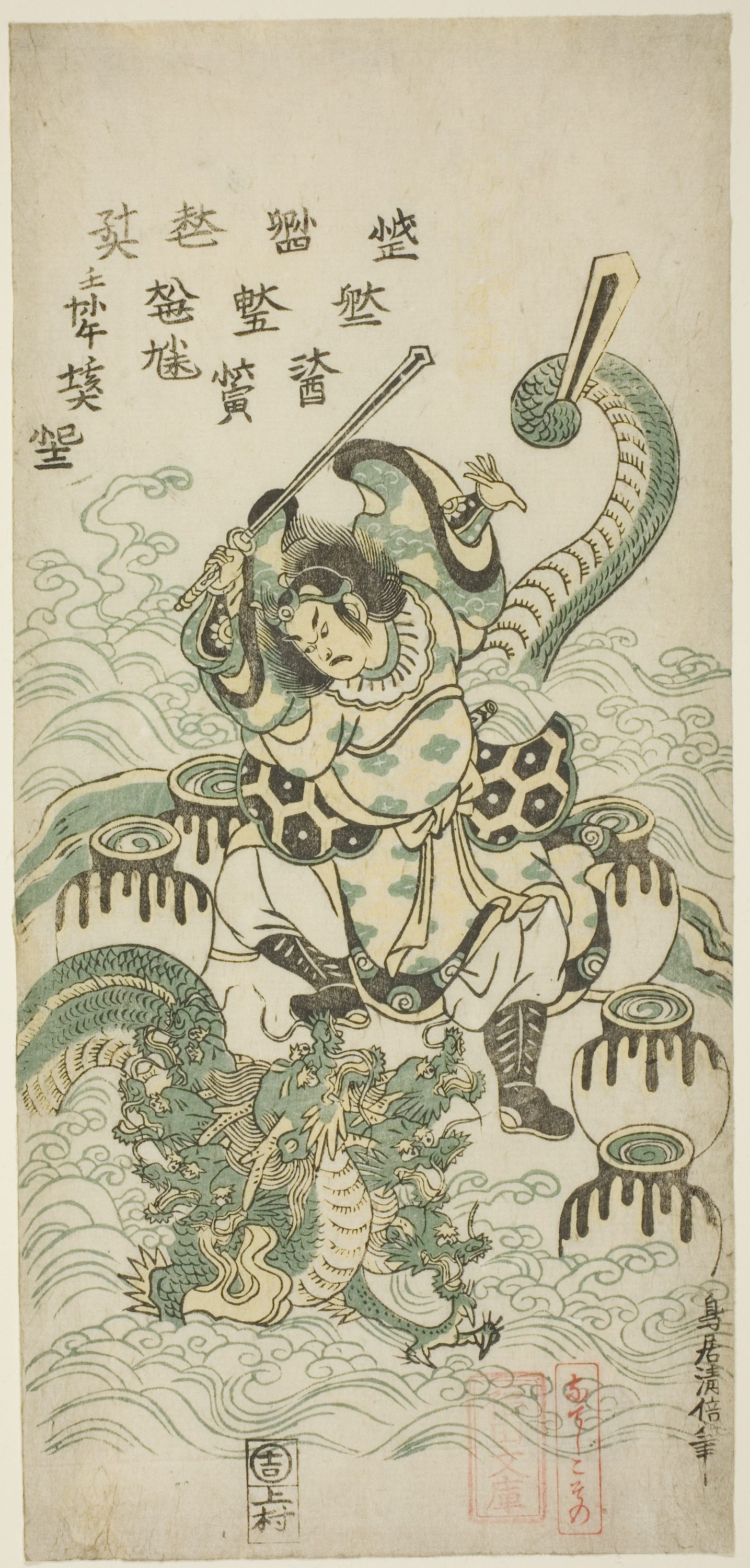
Susanoo offers a bargain: he will kill the serpent if the parents give him their daughter in marriage. They agree at once. What follows is not a straightforward duel but a clever trap, and the cunning of the plan is part of why the story has stayed memorable. First, in some versions, Susanoo transforms Kushinada-hime into a comb and tucks her into his hair, keeping her safe and close. Then he instructs the old couple to brew an especially strong rice liquor — sake refined many times over — and to build a fence with eight gates, or eight platforms, each holding a vat of the powerful drink.
When the serpent arrives, its eight heads are drawn to the eight vats. Each head plunges into its own vat and drinks deeply, and the monster, drunk on the potent sake, sinks down and falls asleep. Now Susanoo strikes. He draws his sword — a ten-span blade — and hacks the sleeping serpent to pieces, cutting through its heads and its tails, until the river Hi runs red with its blood. The great devourer of daughters is destroyed not by brute force alone but by intelligence: the storm god understood that even a monster has appetites that can be used against it.
The sword in the tail
Then comes the detail that gives the myth its lasting significance. As Susanoo cuts through the fourth tail of the serpent, the edge of his own sword chips, as though it has struck something hard inside. Curious, he splits the tail open and finds within it a sword — a great, fine blade. Recognising it as an extraordinary and sacred thing, and as a marvel too important to keep for himself, Susanoo presents this sword to his sister Amaterasu, the sun goddess in heaven, as a gift and a reconciliation after all the trouble he had caused her.
This sword is the heart of the whole story. In the myth it first bears the name Ame-no-Murakumo-no-Tsurugi, the "Sword of the Gathering Clouds of Heaven," reflecting the cloud that was said to hang above the serpent. Later in the mythic cycle it acquires the name by which it is best known: Kusanagi-no-Tsurugi, the "Grass-Cutting Sword." The blade drawn from the body of a monster will pass down through the divine line and become one of the Three Sacred Treasures of Japan — sword, mirror and jewel — that symbolise imperial authority to this day.
"The sword was called 'Kusanagi,' the grass-cutter, from the very moment it was pulled from the serpent's tail."
In the myth itself the blade is first named the Sword of the Gathering Clouds of Heaven. It only earns the name Kusanagi, "grass-cutter," generations later, in the legend of the hero Yamato Takeru, who uses it to cut down burning grass and escape a fire-trap set by his enemies. The two stories are often blurred together, but the famous name comes from the second, not the first.
How the sword became a symbol of empire
To follow the sword's journey is to see how a monster-slaying tale becomes the foundation of a nation's idea of itself. After Amaterasu receives the blade, it descends from heaven with her grandson Ninigi when he is sent down to rule the earthly land — together with the sacred mirror and the curved jewel, the three treasures handed to the line that would become Japan's emperors. According to the chronicles, these regalia are passed down through the generations of that line.
The sword's most famous later adventure belongs to Yamato Takeru, a semi-legendary prince and culture-hero. In one celebrated episode he is lured onto an open plain by treacherous enemies who set the grass on fire to burn him alive. Using the sword, he cuts away the grass around him, and (in some versions, with the help of a fire-striking device) turns the flames back on his enemies, escaping the trap. It is from this grass-cutting that the blade takes the name Kusanagi. The sword later comes to rest at the Atsuta Shrine near present-day Nagoya, where tradition holds it is still enshrined.
Does the physical Kusanagi sword actually exist, and what is it? Because the blade is hidden by sacred taboo and has (officially) never been examined, scholars cannot verify it. Some treat the enshrined object as a genuine ancient sword of unknown date; others note that medieval records claim the original was lost at sea in 1185 during the Battle of Dan-no-ura, when a child emperor drowned with the regalia, raising the question of whether any "original" survives at all. With no access and competing legends, the truth remains, by design, beyond reach.
What the monster might mean
Like many great myths, the Orochi story invites interpretation, and Japanese and Western scholars have offered several readings. One long-standing suggestion connects the serpent to the river itself. The Hi river of Izumo was prone to flooding, and a vast serpent winding across eight valleys, with a perpetually bloody-red belly, has been read as an image of a destructive, iron-rich, seasonally flooding river that "devoured" the people and fields along its banks. In this reading, Susanoo's victory is a mythologised memory of taming the river — and the sword in the tail, fittingly, may echo the region's ancient iron-working, since Izumo was associated with iron sand and metal production.
Another reading is structural and almost universal: this is a classic dragon-slaying, maiden-rescuing tale of the kind found across Eurasia, from the Greek Perseus rescuing Andromeda to Saint George and countless others. A hero arrives, a monster demands a sacrificial maiden, the hero outwits and kills it, and wins the maiden as bride. The Orochi story is the Japanese member of that worldwide family. What makes it distinctive is the trick with the sake and, above all, the sword — the way the slaying produces a sacred object that then carries political and religious meaning down the centuries.
Susanoo's happy ending
It is easy, focusing on the sword, to forget that the myth has a genuinely tender conclusion. Having killed the serpent and saved Kushinada-hime, Susanoo restores her from the comb to her own form and marries her. He searches the land of Izumo for a place to build their home, and when he reaches a spot called Suga he says that there his heart feels refreshed and at peace. There he builds a palace, and clouds rise around it. Moved, the storm god — the disgraced, violent exile from heaven — composes a poem about the rising clouds and the palace he has made for his wife.
That verse is traditionally honoured as the first Japanese poem, the beginning of the long tradition of waka. It is a remarkable turn for the character: the god of destructive storms, freshly expelled from heaven and dripping with a dragon's blood, settles down, finds peace, and writes poetry. The Orochi myth thus carries an arc of redemption inside its monster-slaying. Susanoo enters the story as heaven's worst troublemaker and leaves it as a husband, a king in Izumo, and a poet — and the descendants of his line, in the chronicles, go on to figure in the deep background of Japan's imperial story.
A story doing several jobs at once
The tale of Yamata no Orochi endures because it does so many jobs at once. It is a thrilling monster story with one of the most vivid dragons in any mythology. It is an origin tale for the most sacred object in the Japanese imperial regalia, tying the legitimacy of a still-reigning dynasty back to a moment of mythic heroism. It may preserve a folk-memory of real things — a flooding river tamed, the rise of iron-working in ancient Izumo. And it carries a satisfying human drama of disgrace, courage and redemption.
That a sword supposedly drawn from a serpent's tail thirteen centuries ago should still, in the 21st century, play a role in the enthronement of Japanese emperors is an extraordinary thing. Most of the world's dragon-slayings are simply good stories. This one became part of the machinery of a living state. The hidden, never-seen blade at Atsuta Shrine is the thread that runs from a weeping family beside a river in myth all the way to the modern Chrysanthemum Throne — which is perhaps the best evidence of all for how much power a really good story can hold.
Image: 'Susanoo slaying the Yamata no Orochi', a 19th-century woodblock print by Utagawa Kuniyoshi (public domain, via Wikimedia Commons). This article retells a Japanese myth, not a documented historical event.
Where the story comes from
- The Kojiki ("Record of Ancient Matters," 712 CE) — the earliest version of the Susanoo and Orochi myth; standard English translation by Basil Hall Chamberlain (1882) and the modern translation by Donald Philippi (1968).
- The Nihon Shoki / Nihongi ("Chronicles of Japan," 720 CE) — gives several variant versions of the tale; translated by W.G. Aston (1896).
- The legend of Yamato Takeru and the renaming of the sword as Kusanagi, also preserved in the Kojiki and Nihon Shoki.
- Tradition of the Atsuta Shrine near Nagoya, the shrine that holds the sword among the Three Sacred Treasures of Japan.