Two hundred metres above the surface of the Moon, the alarms started going off. The guidance computer flashed "1202", an error nobody in the cabin recognised in the moment, and back in Houston a 26-year-old controller had about fifteen seconds to decide whether to abort the most expensive journey in human history. He said go. Then Neil Armstrong, looking out the window, realised the computer was steering them straight into a field of boulders, took manual control, and flew the lander sideways across the lunar surface hunting for somewhere flat, with the fuel gauge dropping toward empty. When the Eagle finally touched down, there were maybe twenty-five seconds of fuel left. "The Eagle has landed," Armstrong said. In Houston, a controller replied that they had a bunch of guys "about to turn blue. We're breathing again."
That's the part the famous photographs leave out. The first Moon landing wasn't a serene triumph of technology gliding to a halt. It was a white-knuckle improvisation that came within seconds of being called off. And honestly, knowing how close it ran only makes it more astonishing that it worked at all.
Why two superpowers spent fortunes to reach a rock
To understand why anyone went to the Moon, you have to understand the fear that drove it. The space race was the Cold War conducted by other means. When the Soviet Union launched Sputnik, the first artificial satellite, in October 1957, Americans were badly shaken. If the Soviets could put a beeping metal ball in orbit, they could put a warhead anywhere. Then the Soviets kept winning the firsts: first animal in orbit, first man in space (Yuri Gagarin, April 1961), first woman, first spacewalk. The United States was, embarrassingly, playing catch-up.
So a young President made a wildly ambitious bet. In 1961 John F. Kennedy committed the country to landing a man on the Moon and returning him safely "before this decade is out", a goal that, when he announced it, the technology to achieve did not yet exist. The following year, in a speech at Rice University, he laid out the reasoning in words that still give people chills.
"We choose to go to the Moon in this decade and do the other things, not because they are easy, but because they are hard."— President John F. Kennedy, Rice University, 12 September 1962
It was a political gamble dressed as an inspirational one. But it worked, and over the 1960s NASA's budget swelled to something like four percent of the entire federal budget, employing at its peak around 400,000 people across the country. The whole enterprise was enormous, and it was all aimed at one decade-ending deadline.
A decade of practice first
Apollo 11 didn't come out of nowhere. It sat on top of nearly a decade of relentless, step-by-step build-up, and it's worth remembering how much had to be invented along the way. The early Mercury programme just proved an American could survive in orbit at all. Then came Project Gemini in the mid-1960s, which was really where the hard skills were learned: how to change orbits, how to rendezvous and physically dock two spacecraft together (utterly essential for a Moon mission), and how to survive a spacewalk without overheating or exhausting yourself, which early on very nearly went wrong.
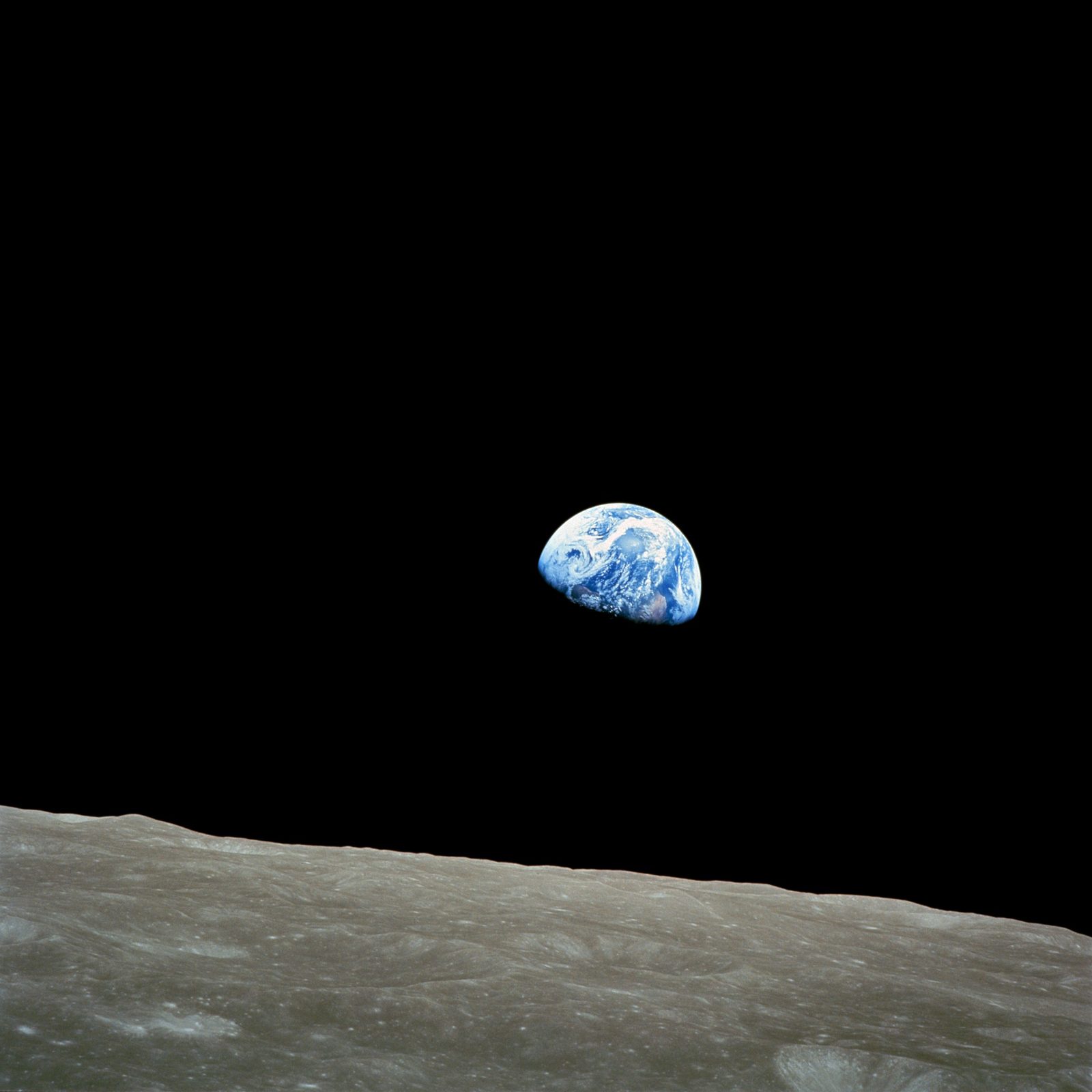
By the time the Apollo missions began flying, NASA had rehearsed almost every piece of the puzzle except the landing itself. Apollo 8 sent humans around the Moon for the first time at the end of 1968. They didn't land, but they orbited it and came home, and beamed back that famous "Earthrise" photograph of our blue planet hanging over the grey lunar horizon. Apollo 10 flew the lunar module to within a few miles of the surface as a full dress rehearsal, then deliberately came back without landing. So when Armstrong and Aldrin began their descent, almost everything had been tested. Almost.
The mission
Apollo 11 launched on 16 July 1969 atop a Saturn V rocket, still the most powerful machine humans have ever successfully flown, a vehicle as tall as a 36-storey building that burned through its first-stage fuel in about two and a half minutes. On board were three men: Neil Armstrong, the famously unflappable civilian commander; Buzz Aldrin, the lunar module pilot with a doctorate in orbital mechanics; and Michael Collins, who would fly the command module.
Collins's role is the one people forget, and it may be the loneliest job in the story. While Armstrong and Aldrin descended to the surface in the lander, Collins stayed in orbit around the Moon, alone, circling the far side where he lost all radio contact with Earth entirely, more cut off from humanity than anyone had ever been. He has said he didn't feel lonely so much as acutely aware that if his two crewmates died on the surface, he would have to fly home by himself, the man who got so close and came back without them.
On 20 July 1969, the Eagle made its harrowing descent. And then, a few hours later, Armstrong opened the hatch, climbed down the ladder, and put a boot on the Moon.
"That's one small step for man, one giant leap for mankind."— Neil Armstrong, stepping onto the lunar surface, 21 July 1969 (UTC). He always maintained he said "a man"; the static may have eaten the article.
On the surface
They were on the surface for only about 21 hours, and outside the lander for barely two and a half. But they made it count. Armstrong and Aldrin planted an American flag (stiffened with a horizontal rod, because there's no wind to make it fly), collected about 21.5 kilograms of lunar rock and soil, set up scientific instruments, and took the photographs that would define the 20th century. They left behind a plaque reading "We came in peace for all mankind," and took a phone call from President Nixon.
The computer that guided Apollo 11 to the Moon had a tiny fraction of the power of the phone in your pocket: a few tens of kilobytes of memory, with software literally woven by hand into "core rope" by factory workers, thread by thread. The "1202" alarms during the descent were that overloaded little computer protecting itself, dumping low-priority tasks to keep flying. It didn't crash. A modern smartphone is millions of times more capable than the machine that landed humans on another world.
"It was faked", and why that doesn't hold up
"The Moon landings were staged on a film set; look at the waving flag and the missing stars."
The flag "waves" because Aldrin was twisting the pole to plant it and there's no air to damp the motion; the stars are missing because the cameras were set for the brilliant sunlit surface, which washes faint stars out (your phone does the same thing). Beyond that: hundreds of kilos of Moon rock have been independently studied worldwide, retroreflectors left by the missions are still bounced with lasers today, and rival nations tracking the flights had every reason to expose a hoax and never did. Keeping 400,000 people silent for half a century would be the real miracle.
It's worth saying plainly, because the conspiracy theory has proven weirdly durable: the evidence that Apollo 11 happened is about as overwhelming as evidence gets in history. The most decisive single fact may be the lunar laser-ranging experiments. The astronauts left mirrors on the surface, and observatories on Earth still fire lasers at them and time the reflection. Somebody put those mirrors there.
The price paid to get there
It's easy, looking back at the triumph, to forget how many people the programme nearly broke and, in one terrible case, killed. In January 1967, during a routine ground test of the very first crewed Apollo capsule, a fire broke out in the pure-oxygen cabin and spread with horrifying speed. The three astronauts inside, Gus Grissom, Ed White and Roger Chaffee, died before anyone could get the hatch open. Apollo 1 never flew.
The disaster forced a brutal reckoning. NASA tore the spacecraft design apart and rebuilt it: the hatch, the wiring, the flammable materials, the use of pure oxygen at the pad were all reconsidered. In a grim way, the deaths of those three men are part of why Apollo 11 came home safely two years later; the program that reached the Moon was built, in part, on lessons paid for in the worst possible currency. The astronauts knew the risks intimately. They strapped themselves to the rockets anyway.
Getting home was its own gamble
Landing on the Moon was only half the danger; the other half was leaving it. The top half of the lunar module had a single ascent engine, with no backup. If it failed to ignite, there was no rescue. Armstrong and Aldrin would simply be stranded on the surface to die, and President Nixon's speechwriters had, sombrely, prepared a statement for exactly that outcome. The engine fired. The two astronauts rose back into orbit, rejoined a relieved Michael Collins, and began the three-day fall back toward Earth.
Even re-entry was a knife-edge: the capsule had to hit the atmosphere within a narrow corridor. Too steep and it would burn up; too shallow and it would skip off into space. It threaded the needle, splashed down in the Pacific on 24 July, and the crew were promptly sealed into quarantine in case they'd brought back lunar microbes (they hadn't). Every single phase of the mission had been a thing that had to work the first time, with lives riding on it. Remarkably, all of them did.
Why they stopped, and why it still matters
If we could do it in 1969, why did we stop, and was it worth the staggering cost? Twelve people walked on the Moon between 1969 and 1972, and then nobody, for over fifty years. Critics argue the money could have done more good on Earth; defenders point to the vast technological spin-offs and the simple human value of the achievement. The honest answer is that Apollo was a Cold War sprint, not a sustainable programme; once it had beaten the Soviets and the political urgency drained away, so did the funding.
Whatever you make of that debate, the cultural weight of the moment is hard to overstate. An estimated 600 million people, a fifth of everyone alive at the time, watched or listened to the landing, the largest shared experience in human history up to that point. For a few hours, a planet that spent the decade terrified of nuclear war looked up at the same small light in the sky and watched two of its members walk around on it.
Armstrong himself, characteristically, tried to keep it modest. He thought the achievement belonged to the hundreds of thousands of people who built the machines, not to the three men who rode them. But there's a reason his single sentence on that ladder is one of the most quoted things anyone has ever said. For one night, the whole species did something that, for all of prior history, had belonged only to gods and dreamers. We left footprints somewhere that wasn't Earth, and because there's no wind up there to erase them, those first footprints are, in all likelihood, still exactly where they were left.
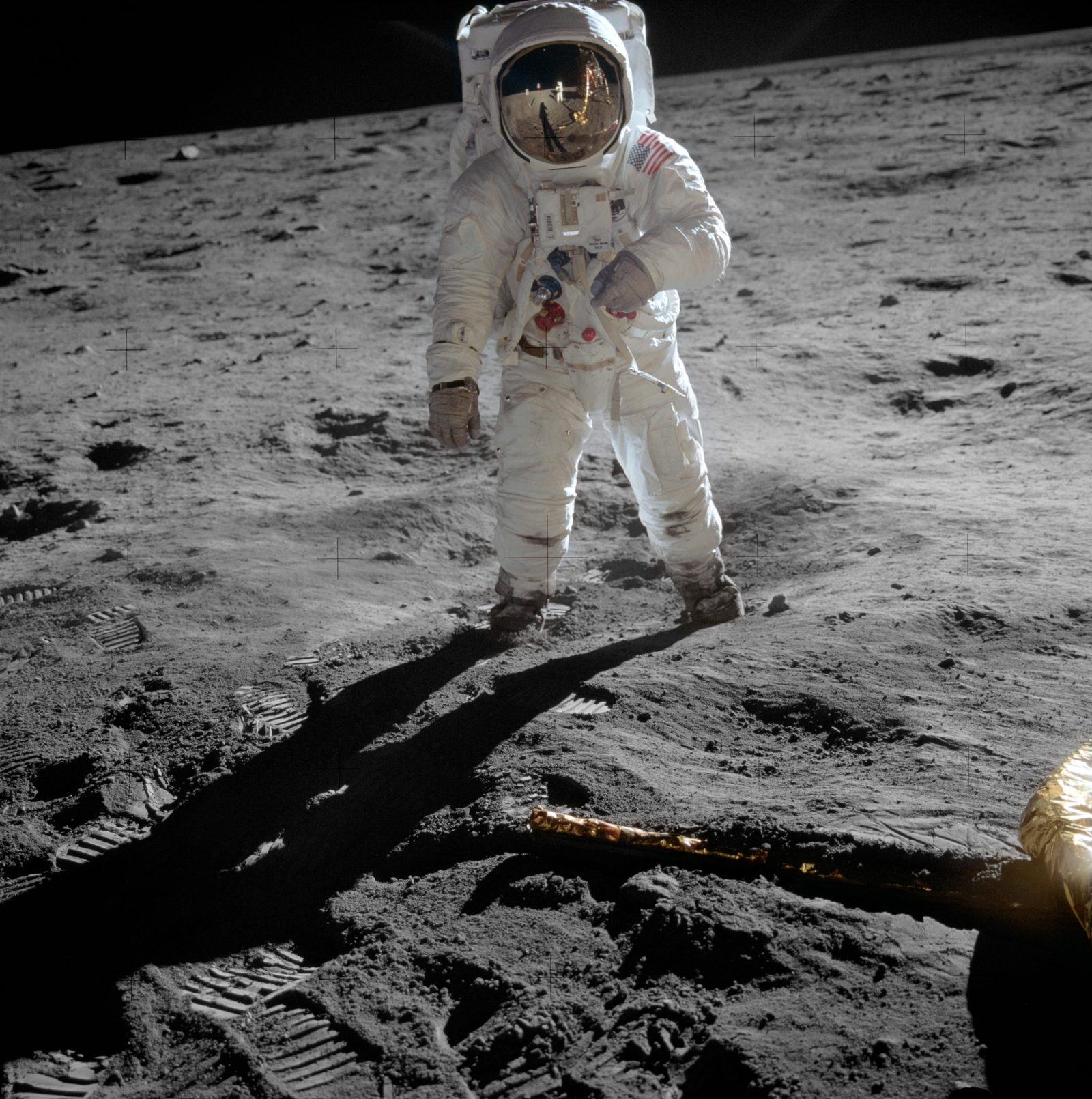
Image: Buzz Aldrin on the lunar surface, photographed by Neil Armstrong, 21 July 1969 (NASA, public domain, via Wikimedia Commons).
Read next: Operation Paperclip: How America Recruited Hitler's Scientists and Nazi Wonder Weapons: From the V-2 to the Orbital Sun Gun.
Sources & further reading
- Andrew Chaikin, A Man on the Moon: The Voyages of the Apollo Astronauts (Viking, 1994) — the definitive narrative history.
- Michael Collins, Carrying the Fire: An Astronaut's Journeys (1974) — the finest astronaut memoir, by Apollo 11's command module pilot.
- Charles Fishman, One Giant Leap: The Impossible Mission That Flew Us to the Moon (2019).
- NASA History Office, Apollo 11 Mission Reports and transcripts; the John F. Kennedy Presidential Library (1962 Rice University address).