On a winter night in Colorado Springs in 1899, a tall, gaunt man stood inside a wooden laboratory while artificial lightning crackled from a giant coil and bolts of electricity longer than a city bus split the air with a roar heard fifteen miles away. He had built the machine himself. He claimed to have detected signals he believed might come from another planet, and he sometimes spoke of wireless power that could light the whole world for free. His name was Nikola Tesla, and by the time he died, alone and nearly broke in a New York hotel room in 1943, he had become two different people: the brilliant engineer who helped electrify the modern world, and the half-mythical wizard the internet would later turn him into. Telling those two Teslas apart is harder, and more interesting, than the legend suggests.
Tesla deserves his fame. The electrical system that powers the building you are sitting in owes a real and central debt to his work. But in the past few decades his reputation has swollen into something the historical record does not support: a lone, persecuted super-genius who invented practically everything and was robbed of all credit by lesser men. The true story is better than the meme, because it is about an actual person, with extraordinary gifts and real flaws, working inside a messy world of rivals, money and luck.
From Smiljan to America
Nikola Tesla was born in 1856 in the village of Smiljan, in what was then the Austrian Empire and is now Croatia, to a Serbian family; his father was an Orthodox priest. From early on he showed a formidable memory and a vivid visual imagination. He claimed he could picture machines in his mind in complete detail and even "run" them mentally to find flaws. After studying engineering and working for telephone and electrical companies in Europe, he emigrated to the United States in 1884, arriving in New York with little money and a letter of introduction to the most famous inventor in America.
That inventor was Thomas Edison, and Tesla went to work for him. The relationship did not last. The standard story has Edison promising Tesla a large bonus to improve his machines, then refusing to pay it and joking that the young immigrant did not understand American humour. Whatever the exact truth, Tesla left Edison's employ within about a year, and the two men would soon find themselves on opposite sides of one of the great technological rivalries of the age.
The War of the Currents
To understand why Tesla matters, you have to understand the central electrical argument of the 1880s and 1890s: how should electric power be delivered? Edison had built his empire on direct current, or DC, in which electricity flows in one constant direction. DC worked, but it had a crippling flaw: it could not be transmitted efficiently over distance. A DC power station could only serve customers within roughly a mile or so before the power faded, meaning cities would need a generating plant on nearly every block.
The alternative was alternating current, or AC, which reverses direction many times a second. AC's great advantage is that its voltage can be stepped up very high for efficient long-distance transmission, then stepped back down for safe use, something that was practical with AC and not with DC. The missing piece had been a good way to run motors on AC. Tesla's key contribution was a practical alternating-current induction motor and a complete "polyphase" AC system to go with it. His patents in this area were foundational. In 1888 the industrialist George Westinghouse licensed Tesla's AC patents, and the battle was joined: Westinghouse and Tesla's AC against Edison's DC.
To frighten the public away from AC, Edison's camp staged grisly public electrocutions of animals using alternating current, and Edison associates promoted the first electric chair, deliberately powered by AC, so that being executed could be described as being "Westinghoused." It was one of history's first technology smear campaigns, and it failed: AC's engineering advantages were simply too great, and it won anyway.
Niagara and the triumph of AC
The War of the Currents was settled not by propaganda but by results. The turning point came with two great public demonstrations. In 1893 Westinghouse won the contract to light the World's Columbian Exposition in Chicago, illuminating the "White City" with Tesla's AC system before millions of visitors and proving the technology safe and spectacular on a huge stage. Then came the prize that really clinched it: the contract to tap Niagara Falls.
The Niagara hydroelectric project, completed in the mid-1890s, used Tesla's polyphase AC system to generate power at the falls and transmit it more than twenty miles to the city of Buffalo. It worked. Long-distance power transmission was now a demonstrated reality, and the world's electrical infrastructure would be built on AC from then on. This is the solid core of Tesla's greatness, and it needs no exaggeration: the alternating-current system that lights and powers virtually the entire modern world rests substantially on his inventions. When people say Tesla "lit the world," this much is simply true.
"Were we to seize and eliminate from our industrial world the results of Mr. Tesla's work, the wheels of industry would cease to turn... our towns would be dark and our mills would be idle and dead. His name marks an epoch in the advance of electrical science."— The engineer B.A. Behrend, introducing Tesla as he received the AIEE's Edison Medal in 1917.
Wireless dreams and Wardenclyffe
Had Tesla stopped there, he would be remembered as a straightforwardly successful inventor. But his ambitions grew steadily grander and more speculative. He became fascinated with high-frequency electricity, wireless transmission, and radio. He built enormous "Tesla coils," conducted his dramatic experiments at Colorado Springs, and developed real and pioneering ideas about transmitting signals and even power without wires. He demonstrated radio-controlled devices and held important early patents related to radio, though credit for radio's invention is tangled and contested, involving Guglielmo Marconi and others, and was fought over in courts for decades.
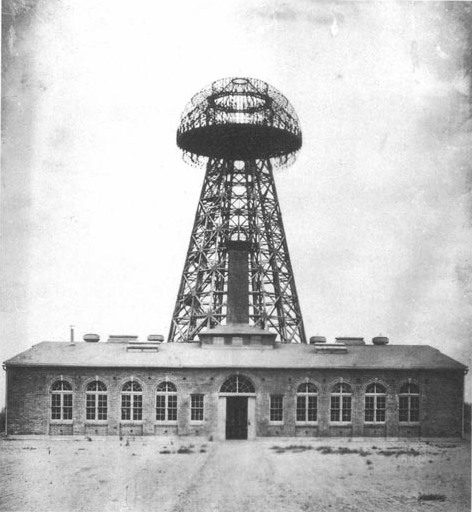
His most famous and most heartbreaking project was Wardenclyffe, a laboratory and giant transmitting tower he began building on Long Island around 1901. Tesla's grand vision was a global system of wireless communication and, more radically, the wireless transmission of usable electrical power across the world. He persuaded the financier J.P. Morgan to fund it. But the project ran over budget, Morgan eventually withdrew support, and the more extravagant goal, beaming free power through the earth, was never achievable in the way Tesla imagined. The tower was never completed as he hoped and was eventually demolished. Wardenclyffe became the symbol of Tesla's later life: visionary, financially ruinous, and unfulfilled.
The exaggerated legend
Here is where the modern myth needs careful handling, because Tesla has become a kind of patron saint of internet enthusiasm, and a great deal of what circulates about him online is distorted or simply false. He was a real genius. He was not a wizard who single-handedly invented the 20th century and was erased by jealous conspirators.
"Tesla invented radio, X-rays, radar, the modern computer and free wireless energy, and a shadowy establishment stole his ideas and erased him from history."
Tesla made real, foundational contributions to AC power, the induction motor, and early radio, and did pioneering work on wireless transmission. But many sweeping internet claims are exaggerated or false: technologies like X-rays and radar had multiple independent originators, his "free energy" was never demonstrated as a working system, and far from being erased, he was famous in his lifetime, honoured with the Edison Medal, and has the SI unit of magnetic flux density (the tesla) named after him. He was celebrated, not buried.
The exaggeration does Tesla a disservice, oddly enough. By inflating him into a mythical figure who did everything, the legend obscures the specific, concrete things he actually achieved, which are impressive enough on their own terms. It also flattens the real history of invention, which is almost never the work of a single lone genius but a collaborative, competitive, incremental process involving many people. Tesla's AC system itself built on the work of predecessors and was commercialised through Westinghouse's company and a team of engineers. Even his greatest triumphs were not the product of one man working in heroic isolation.
The man himself
The real Tesla was a fascinating and increasingly eccentric individual. He was tall, elegant, multilingual and a fixture of New York society in his prime, dining at the best hotels and counting writers like Mark Twain among his friends. He never married and said he had chosen celibacy as a discipline for his work. As he aged, his eccentricities deepened: he developed pronounced phobias (a horror of pearls and of germs), counted obsessively, and in his final years became devoted to the pigeons he fed in New York parks, speaking of one white pigeon in particular with startling tenderness, as a creature he loved like a person.
His later years were difficult. The income from his most valuable patents dwindled, his grander projects failed to find backing, and he grew steadily poorer and more isolated, living in a series of hotels and making periodic announcements about fantastical future inventions (death rays and the like) that never materialised. He died in January 1943 in room 3327 of the Hotel New Yorker, largely alone and in reduced circumstances, at the age of 86. A man who had once been one of the most famous engineers alive ended his life almost forgotten by the public that would, decades later, resurrect him as an icon.
Edison, Tesla, and a false binary
The internet loves to frame Tesla and Edison as hero and villain: the pure visionary versus the greedy thief. It is a satisfying story and a misleading one. Edison was a relentless, sometimes ruthless businessman, and his conduct in the War of the Currents was ugly. But he was also a prodigiously productive inventor and a brilliant organiser of industrial research who gave the world the practical incandescent light, the phonograph, and much more. Tesla, for his part, was a visionary who was often a poor businessman, whose grandest ideas outran what was physically or financially possible.
The honest picture is of two very different kinds of genius, Edison the practical, commercial, incremental tinkerer and Tesla the theoretical, intuitive visionary, clashing in an era when the rules of the new electrical industry were still being written. Reducing them to a cartoon of saint and sinner makes for good memes and bad history. Both men were essential to the electrified world, and both were more complicated than their fan clubs allow.
What remains when you strip both legends away
Strip away both the establishment neglect that the legend complains of and the internet hagiography that overcorrects it, and what remains is remarkable. Nikola Tesla helped give the world its most important technology: the alternating-current system that delivers electricity to billions of people. He invented a practical AC motor that still turns in countless machines. He did pioneering work in wireless transmission and high-frequency electricity that pointed toward technologies we use every day. And he did it all while seeing, in his mind's eye, possibilities that his own century could not yet build.
That last quality, the reach of his imagination beyond the limits of his time, is probably why he speaks so powerfully to a later age. Tesla dreamed of a wirelessly connected, electrically abundant world, and although he could not build it, much of it eventually came true in forms he would recognise. He was not a magician, and he was not robbed of his rightful place; the unit of magnetic flux density is literally named after him. He was something more useful than a myth: a real, gifted, flawed human being who saw further than almost anyone around him, and helped switch on the modern world before fading into the shadows of the very age he had helped to light.
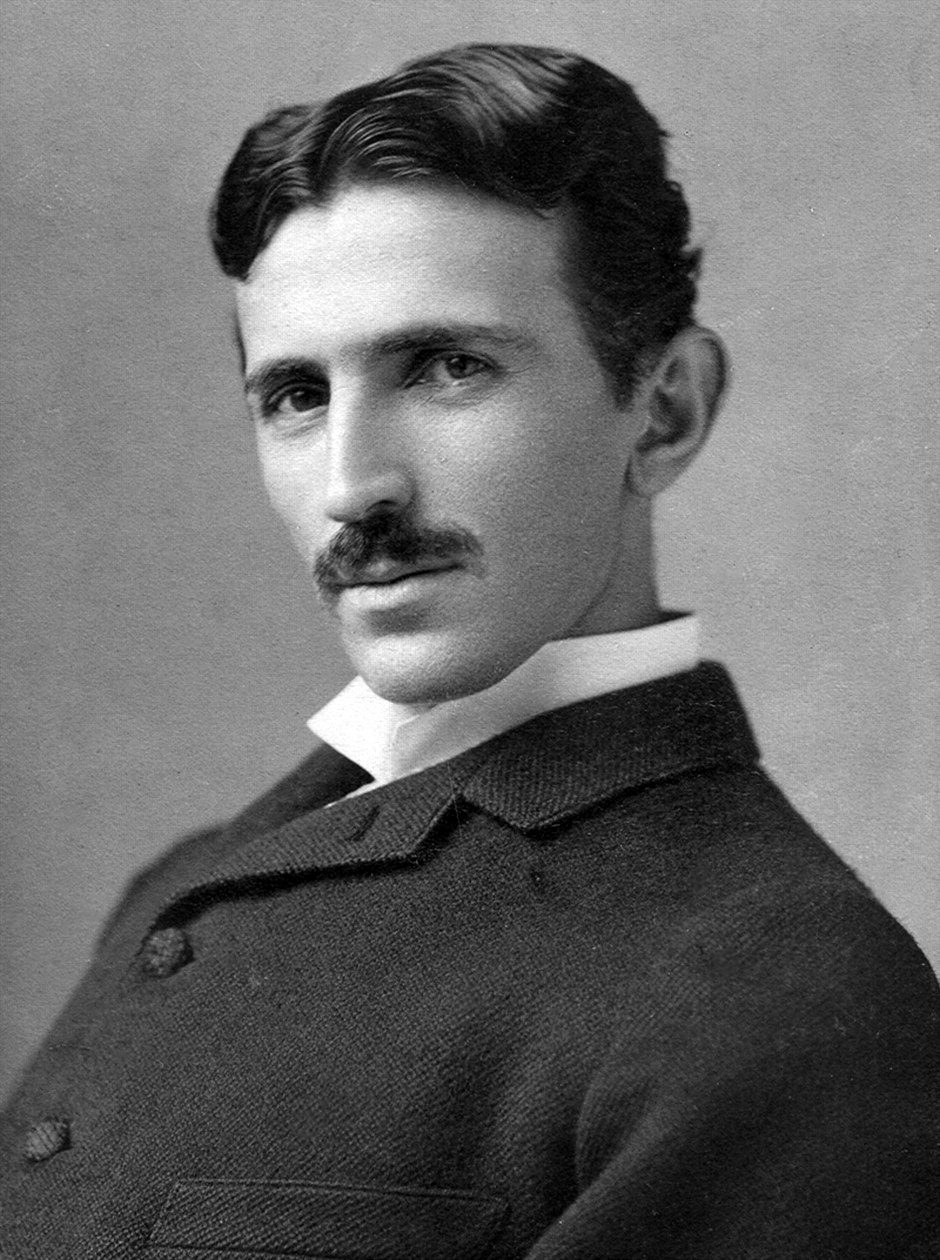
Image: Nikola Tesla, photographed around 1890 (portrait by Napoleon Sarony; public domain, via Wikimedia Commons).
Read next: Nazi Wonder Weapons: From the V-2 to the Orbital Sun Gun and Ghost Army: The Inflatable Tanks Two Men Could Lift.
Sources & further reading
- W. Bernard Carlson, Tesla: Inventor of the Electrical Age (Princeton University Press, 2013) — the leading scholarly biography, careful about separating fact from legend.
- Margaret Cheney, Tesla: Man Out of Time (1981) — the influential popular biography that helped revive his fame.
- Nikola Tesla, My Inventions (autobiographical articles, 1919) — Tesla's own account of his life and methods (a primary source, and self-mythologising in places).
- Jill Jonnes, Empires of Light: Edison, Tesla, Westinghouse, and the Race to Electrify the World (2003) — on the War of the Currents.
- Tesla Science Center at Wardenclyffe — on the Long Island laboratory and its preservation.