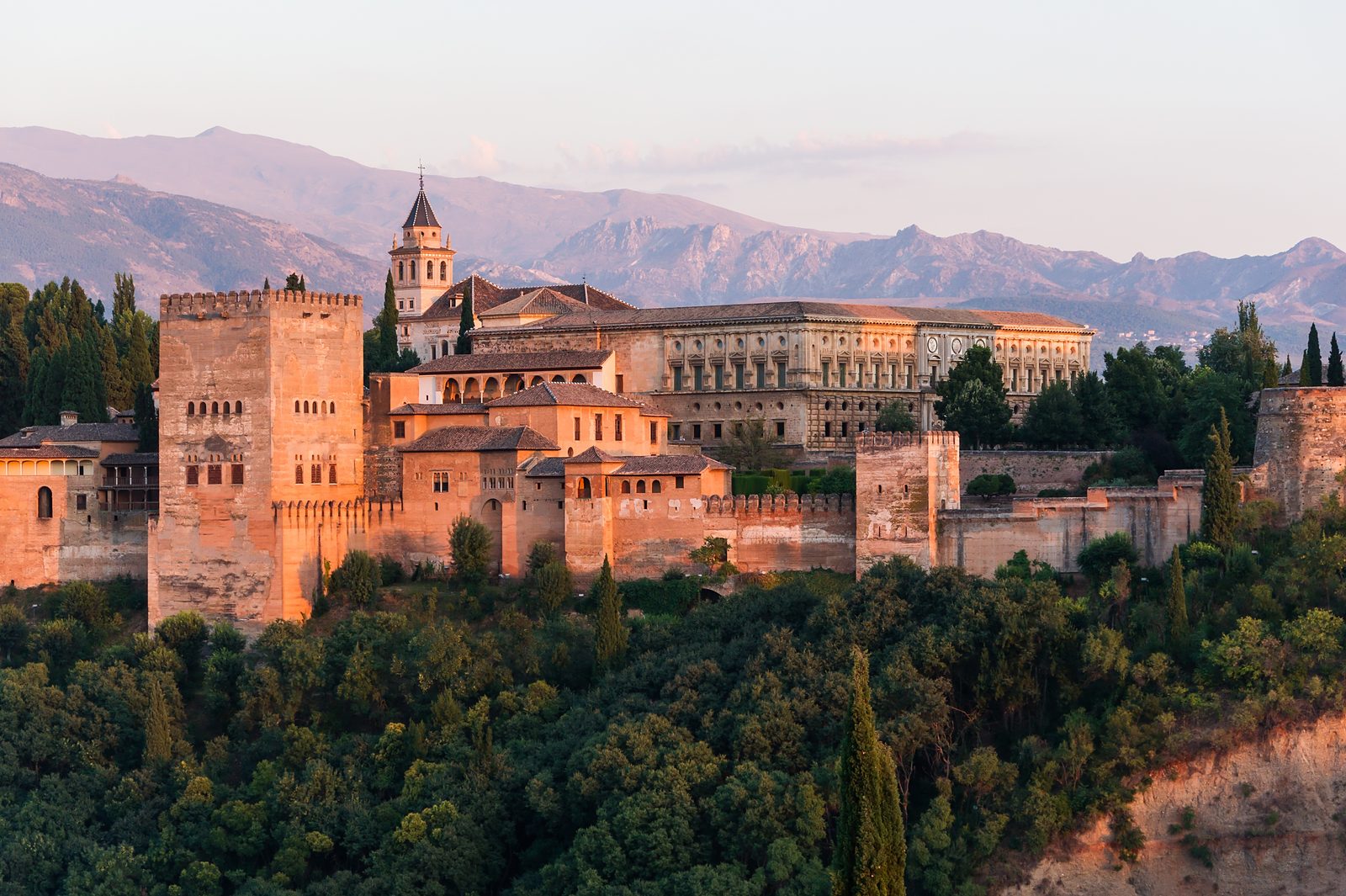
In the 1820s a wandering American writer named Washington Irving talked his way into lodgings inside a crumbling, half-abandoned palace on a hill above Granada. The Alhambra was then a romantic ruin: its courts overgrown, its halls occupied by squatters and bats, its fountains silted up, garrisoned by a handful of soldiers and haunted, the locals said, by ghosts and buried Moorish treasure. Irving moved into the empty royal apartments, listened to the caretakers' tales, and wrote a book of stories that would make this faded Spanish palace famous across the world. He had stumbled, almost by accident, into one of the last and most exquisite monuments of a civilisation that had once ruled most of Spain and had vanished only a few centuries before.
The Alhambra is often described, a little loosely, as the crowning jewel of Moorish Spain, and for once the cliché holds up. It is the best-preserved palace city of the medieval Islamic west, the final great work of a Muslim dynasty making its last stand on European soil, and a building of such delicate beauty that it can stop you in your tracks. But to understand it you have to understand the world that built it: a Spain that was, for nearly eight centuries, partly an Islamic country.
The long centuries of al-Andalus
In 711 a Muslim army crossed from North Africa into the Iberian Peninsula and, within a few years, overran most of the Visigothic kingdom that had ruled there. The territory they established became known as al-Andalus, and for the next several hundred years much of what is now Spain and Portugal was part of the Islamic world. Under the Umayyad rulers of Córdoba, al-Andalus became one of the most sophisticated societies in Europe, its capital a centre of learning, libraries, philosophy, mathematics, medicine and architecture at a time when much of Christian Europe was comparatively poor and fractured.
From the eleventh century onward, the Christian kingdoms of the north pushed steadily southward in the long, uneven series of campaigns later called the Reconquista. City by city, region by region, Muslim al-Andalus contracted. By the mid-thirteenth century it had shrunk to a single surviving Muslim state in the far south: the Emirate of Granada, ruled by the Nasrid dynasty. For about two and a half centuries this last Islamic kingdom in Western Europe held on, tucked against the mountains of the south coast, paying tribute, playing rivals against one another, and surviving by a mixture of diplomacy, fortune and the divisions of its enemies. And it was here, in their mountain capital, that the Nasrids built the Alhambra.
A red fortress that became a palace of light
The name "Alhambra" comes from the Arabic al-qal'a al-hamra, meaning roughly "the red fortress", most likely a reference to the reddish tone of its outer walls and towers in certain light. And it began as exactly that: a fortified citadel on the hilltop, defensive and military. But over the fourteenth century, especially under the emirs Yusuf I and Muhammad V, it was transformed into something far more ambitious: a self-contained royal city of palaces, courtyards, gardens, baths, mosques and administrative buildings, all enclosed within its walls.
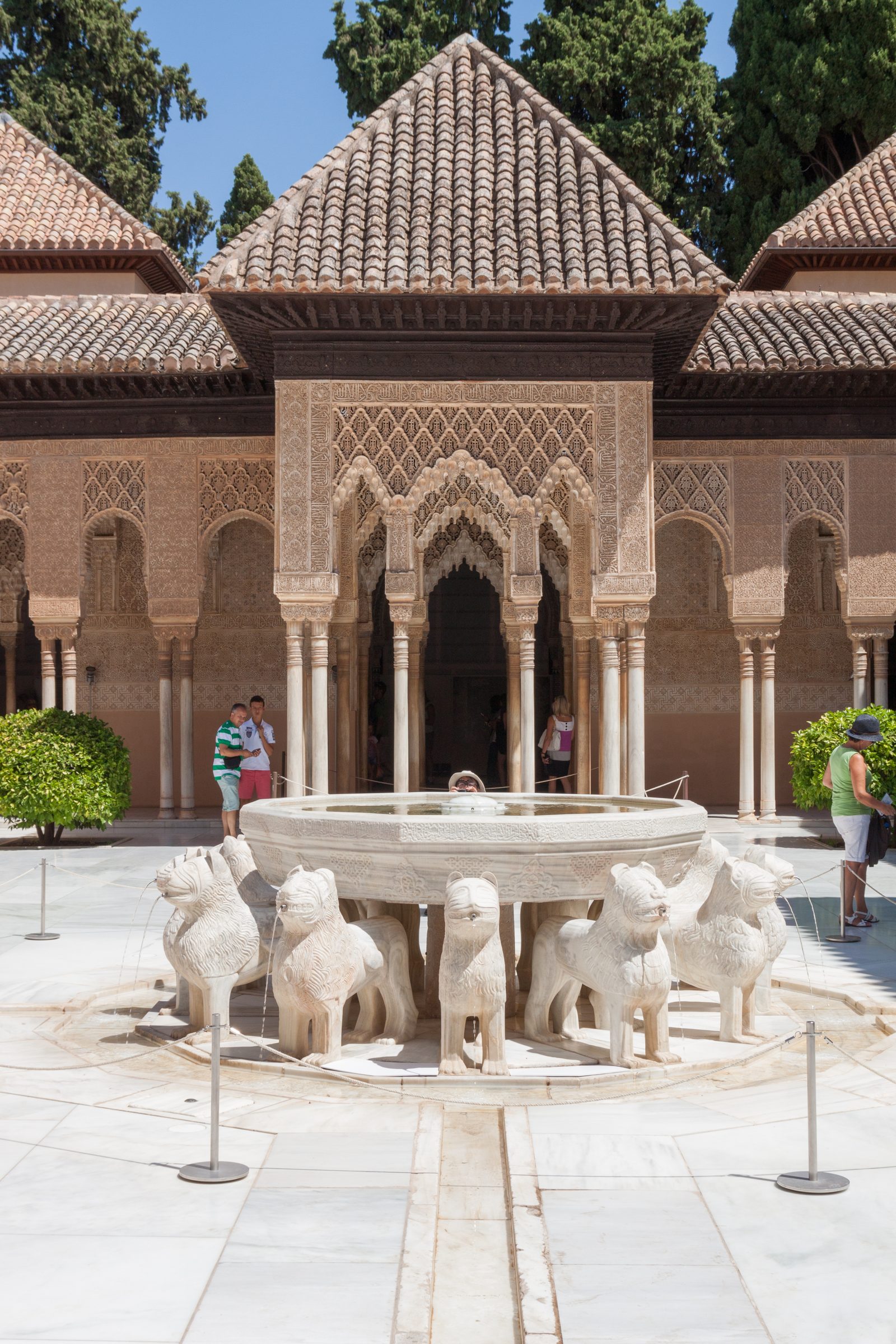
What survives of the Nasrid palaces is the heart of the Alhambra's fame. The Court of the Myrtles, with its long still pool reflecting the surrounding halls; the Court of the Lions, where a fountain rests on the backs of twelve carved stone lions at the centre of an arcaded courtyard; the Hall of the Ambassadors and the Hall of the Two Sisters, with their breathtaking carved and honeycombed ceilings: these are masterpieces of a particular aesthetic. The architecture is not about massive scale or structural daring but about surface, light, water and inscription: walls covered in finely worked stucco and tilework, geometric and floral patterns, and bands of elegant Arabic calligraphy.
The walls of the Alhambra are, quite literally, covered in writing. Much of the ornamental decoration consists of Arabic inscriptions: Quranic verses, poems and pious phrases worked into the stucco. One short phrase recurs so often that it became a kind of motto of the palace: wa la ghaliba illa Allah, "there is no victor but God." It was the dynastic motto of the Nasrids, and a visitor who can read it finds it repeated, again and again, across the very walls of the last Muslim kingdom in Spain.
Water, mathematics and a garden of paradise
One of the marvels of the Alhambra is its use of water, in a hot, dry landscape, as both engineering and art. An ingenious system of channels brought water up to the hilltop from the river and mountain snowmelt, feeding the pools, fountains and irrigation of the entire complex, including the gardens of the nearby Generalife, the rulers' leafy summer retreat. Water in this architecture is everywhere, still and mirroring in the great courts, trickling and musical in the fountains, and it is no accident. In the Islamic imagination, the garden with its running water and shade was an earthly image of paradise, and the Alhambra was designed to evoke exactly that.
The decoration, too, rewards a closer look. The dazzling geometric tilework, with its endlessly interlocking stars and polygons, embodies a mathematical sophistication that has fascinated modern scholars; some have argued that the patterns at the Alhambra anticipate concepts of symmetry that mathematics would only formalise centuries later. Whether or not one pushes that claim too far, the effect is undeniable: a building that turns abstract pattern, calligraphy, light and water into an atmosphere of serene, almost otherworldly beauty. It was meant to overawe and to soothe at once, a statement of refinement by a kingdom that knew its days might be numbered.
1492: the fall of Granada
The end came in 1492, a year heavy with consequence in Spanish history. The marriage of Isabella I of Castile and Ferdinand II of Aragon had united the two great Christian kingdoms, and they turned their combined strength on the last Muslim emirate. After a long war and a final siege, the last Nasrid emir, Muhammad XII, known to history by the Spanish form of his name, Boabdil, surrendered Granada to the Catholic Monarchs on the second of January 1492. The terms of the surrender, the Capitulations, promised the Muslim population protection of their religion, property and customs.
"You did well to weep as a woman for what you could not defend as a man."— words attributed by tradition to Boabdil's mother as he looked back on Granada; recorded in later chronicles and retold by Washington Irving. The episode is legendary rather than firmly documented.
There is a famous, poignant tradition attached to Boabdil's departure: that as he rode away into exile he paused at a mountain pass for a last look at the city and the palace he had lost, and wept. The spot has been remembered ever after as "the Moor's last sigh." The story is almost certainly embellished, and the cutting remark from his mother is the kind of line that improves with retelling, but it captures something real about the magnitude of the moment. After nearly eight centuries, there was no longer any Muslim-ruled territory in Western Europe. The same year, the Catholic Monarchs expelled the Jews of Spain and sent Christopher Columbus across the Atlantic. 1492 was a hinge of history, and Granada's fall was one of its great turning points.
What happened after the promises
How tolerant, really, was Muslim Spain, and how brutal was the Christian aftermath? An older romantic view celebrated al-Andalus as a golden age of convivencia, harmonious coexistence among Muslims, Christians and Jews. A sharply revisionist view counters that this is rose-tinted, pointing to periods of persecution, forced conversion and violence under Muslim rule too. Most historians today take a middle path: al-Andalus was often more pluralistic and intellectually lively than contemporary Christian Europe, but it was not a modern liberal paradise, and coexistence varied enormously by ruler and era. What is less disputed is that the surrender terms of 1492 were soon broken: within a decade the Muslims of Granada faced forced conversion, and over the following century Spain's converted Muslims (the Moriscos) were persecuted and, in 1609-14, expelled altogether.
The promises of the Capitulations did not last. Within a few years, pressure for conversion mounted; revolts were met with repression; and the religious tolerance pledged in 1492 gave way to forced baptisms, the banning of Arabic and Islamic customs, the work of the Inquisition, and ultimately the expulsion of the Moriscos in the early seventeenth century. The civilisation that had built the Alhambra was, within a few generations, erased from Spain as a living culture, leaving the palace itself as one of its most eloquent survivors.
The myth of the palace frozen in time
"The Alhambra survives exactly as the Moorish kings left it — a perfect, untouched relic of Muslim Spain."
It has been altered, neglected and restored many times. After 1492 the Christian monarchs adapted parts of it; Emperor Charles V demolished a wing of the Nasrid palace to insert a massive Renaissance palace that still sits incongruously beside it. The complex later fell into serious decay, was damaged and looted, and even had explosives set in it by Napoleon's retreating troops in 1812. Much of what visitors admire reflects later restoration and reconstruction. The Alhambra is a survivor that has been patched, scarred and rebuilt, not a place frozen in 1492.
The intervening centuries were not kind to the palace. After the initial Christian adaptations, including Charles V's bulky Renaissance palace driven into the heart of the complex, the Alhambra slid into long neglect. By the time Washington Irving arrived in the 1820s it was a romantic ruin inhabited by squatters; not long before, French troops occupying it during the Napoleonic Wars had mined several towers with gunpowder as they withdrew, destroying some and, by one cherished local story, being thwarted from worse only by a crippled soldier who managed to disable the charges. It was precisely this air of faded, melancholy grandeur that the Romantics fell in love with, and Irving's Tales of the Alhambra, published in 1832, did more than almost anything else to spark international fascination and, eventually, serious efforts at preservation.
Irving, the Romantics, and a second life
It is one of history's neat ironies that this supremely Spanish and Islamic monument owes a great deal of its modern fame to a visiting American. Washington Irving's Tales of the Alhambra mixed travel writing, history and retellings of the legends he gathered from the palace's caretakers: stories of enchanted Moorish princesses, buried treasure guarded by spells, and the ghosts of the vanished kings. The book was a sensation. It cast a spell of its own over nineteenth-century readers, turning the Alhambra into a byword for romance, mystery and the lost glamour of Moorish Spain, and drawing a stream of travellers and artists to Granada.
That attention helped change the palace's fate. Over the following century the Alhambra was gradually rescued from decay, restored, studied and protected; in 1984 it was inscribed, together with the Generalife gardens and the old Albaicín quarter of Granada, as a UNESCO World Heritage Site. Today it is one of the most visited monuments in Spain, so popular that tickets must be limited and timed to protect the fragile stucco and tilework from the sheer press of admirers.
Why it still casts a spell
Stand in the Court of the Lions on a quiet morning, with the water moving in the channels and the light filtering through the carved screens, and it is easy to feel why the Alhambra has fascinated people for two hundred years and more. Part of it is sheer beauty. The patterns, the calligraphy, the play of light and water are sublime. But part of it is what the place represents: the last refined flowering of a civilisation that shaped Spain for eight centuries and was then driven from it, leaving behind this exquisite, melancholy monument as a kind of message carved into the walls.
And the message is, in a sense, literally there. Among the thousands of inscriptions that cover the Alhambra, the recurring motto reminds every visitor that "there is no victor but God." The Nasrids who carved it lost their kingdom; the palace was conquered, half-ruined, rebuilt and turned into a tourist wonder. Yet the building itself endured all of that, and still draws the world to a hilltop in Andalusia to marvel at what was made there. For a civilisation that vanished from Spain, that is a strange kind of survival, and perhaps the most fitting one the Alhambra could have.
Image: the Court of the Lions in the Nasrid palaces of the Alhambra, Granada, Spain (public domain, via Wikimedia Commons).
Read next: The Vijayanagara Empire: The Hindu Kingdom That Held the South for 300 Years and Mansa Musa: The Richest Man in History and the Hajj That Crashed a Currency.
Sources & further reading
- Washington Irving, Tales of the Alhambra (1832) — the book that revived the palace's fame; useful as a primary document of nineteenth-century Romantic fascination.
- Robert Irwin, The Alhambra (Harvard University Press / Profile Books, 2004).
- María Rosa Menocal, The Ornament of the World: How Muslims, Jews, and Christians Created a Culture of Tolerance in Medieval Spain (Little, Brown, 2002) — for the (contested) convivencia view.
- L. P. Harvey, Islamic Spain, 1250 to 1500 (University of Chicago Press, 1990).
- UNESCO World Heritage Centre, "Alhambra, Generalife and Albayzín, Granada"; Encyclopaedia Britannica, "Alhambra."