Some dates get used as tidy bookmarks for the end of an age. 29 May 1453 is one of the few that earns it. That was the day Constantinople, the city that had stood as the capital of the Roman and then Byzantine world for over a thousand years, finally fell to the Ottoman Turks. People at the time felt the weight of it immediately. And a lot of historians still use it as the line where the medieval world stops and the modern one begins.
A city living on borrowed time
By 1453 the "Byzantine Empire" was an empire mostly in name. Centuries of crusades, civil wars, plague and Ottoman expansion had whittled it down until it was little more than the city of Constantinople itself plus a few scraps of territory. The Ottomans had been swallowing Byzantine land for generations and had already surrounded the capital on almost every side. The city was a Christian island in an Ottoman sea.
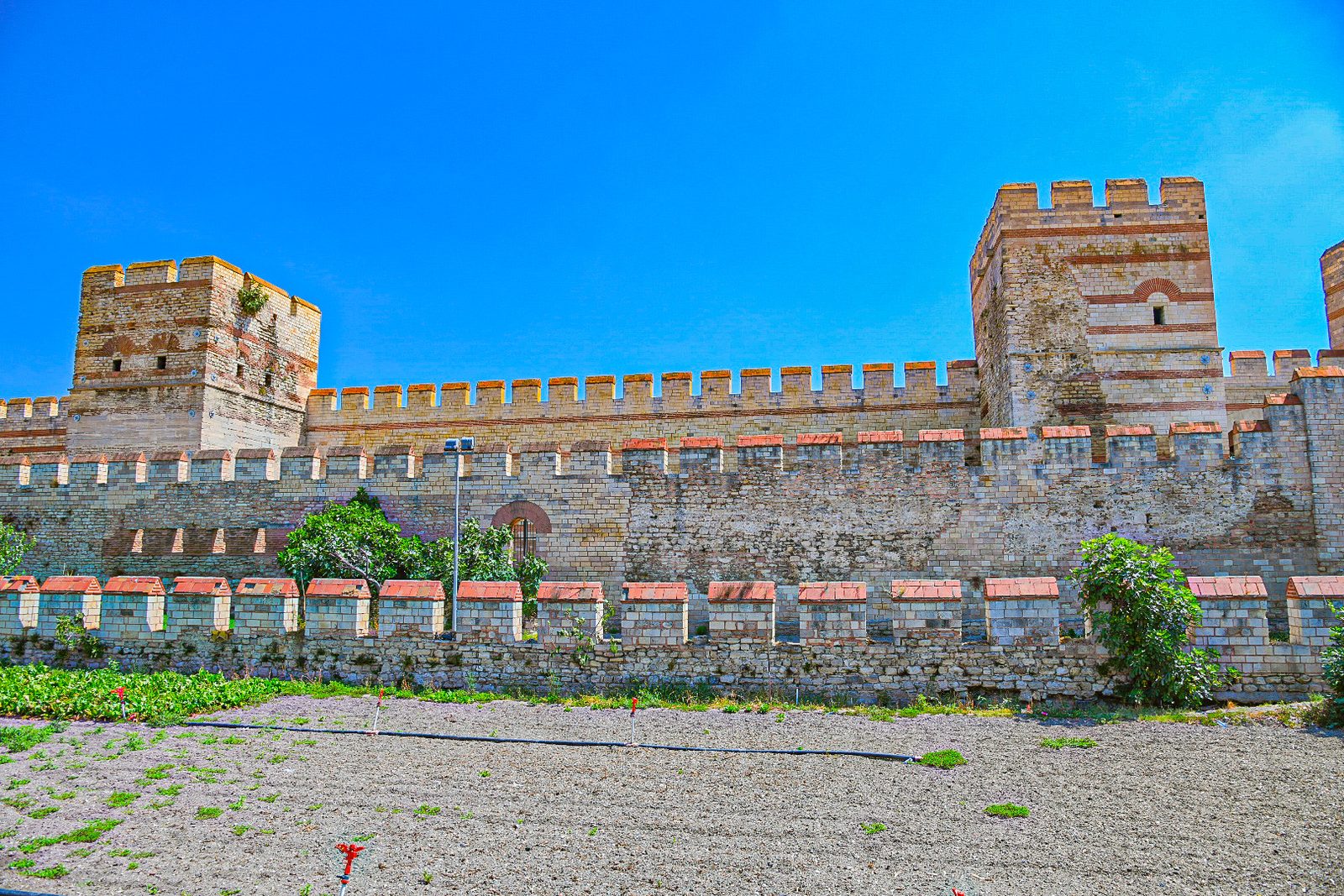
What kept it standing was geography and engineering. Constantinople sat on a defensible peninsula, protected by the sea on two sides and, on the landward side, by the Theodosian Walls, a triple line of fortifications with a moat that had repelled attacker after attacker for a thousand years. As long as those walls held, the city had survived. Everyone on both sides knew the whole campaign would come down to them.
The young sultan and his enormous guns
The man who decided to finish the job was Sultan Mehmed II, and he was only about 21 years old. Don't let the age fool you. He was clever, relentless, and obsessed with taking the city. He understood that the old walls had one new enemy the previous besiegers hadn't had: gunpowder artillery.
Mehmed assembled a siege train of cannon, including a few real monsters. The most famous was built by a Hungarian (or possibly German) founder named Orban, who had first offered his services to the Byzantine emperor, a detail that always gets me, because the emperor couldn't afford to pay him. So Orban went to the Ottomans instead. His great bombard could hurl a stone ball weighing several hundred kilograms, and although it was slow and awkward and reportedly cracked under its own use, it could do something no army had managed before: batter the legendary walls into rubble.
The defenders patched the breaches with earth and timber every night. The cannons knocked them down again every day. It became a grim race between gunpowder and shovels.
Orban's giant bombard was so enormous that, by contemporary accounts, it took dozens of oxen and hundreds of men to haul into position, could be heard for miles, and could only be reloaded and fired a handful of times a day. Its builder had offered the weapon to the Byzantine emperor first, and the emperor simply couldn't afford to pay him.
The siege itself
The siege began in early April 1453 and lasted roughly seven weeks. The numbers were lopsided. Mehmed had a vast army; modern estimates usually land somewhere in the range of 50,000 to 80,000 fighting men, though contemporary chroniclers wildly inflated it. Inside the city, the emperor Constantine XI Palaiologos could muster only around 7,000 to 8,000 defenders, many of them not even Byzantine but Italian volunteers, most famously a Genoese contingent under the soldier Giovanni Giustiniani.
The Byzantines had a few tricks. A massive iron chain was strung across the mouth of the Golden Horn, the inlet that formed the city's harbour, to keep the Ottoman fleet out. It worked until Mehmed, in one of the siege's most audacious moves, had dozens of his ships dragged overland on greased wooden rollers, around the chain and into the harbour from behind. Suddenly the defenders had to guard a stretch of sea wall they'd thought was safe, stretching their tiny garrison even thinner.
The last night
By late May the situation inside the city was desperate. The defenders were exhausted, food was short, and they knew no real relief from the West was coming. The help promised by Catholic Europe never materialised in force, partly because of the bitter, long-running split between the Orthodox and Catholic churches. There's a haunting account of a final church service held in the great cathedral of Hagia Sophia, Orthodox and Catholic Christians praying together as the end approached.
The final assault came in the early hours of 29 May. Mehmed threw his forces at the walls in waves: irregulars first to wear the defenders down, then his regular troops, and finally his elite Janissaries. The defenders held for hours. Two things broke them. Giustiniani, the Genoese commander holding a critical section, was badly wounded and carried off the line, which shook the morale of his men. And a small gate, the Kerkoporta, was reportedly left or found open, letting attackers slip inside and raise their banners on the walls. Once the Ottomans were through and inside, it was over. The Emperor Constantine XI, by most accounts, threw off his imperial insignia and died fighting somewhere in the chaos. His body was never identified with certainty.
"Constantinople fell because someone carelessly left a little gate — the Kerkoporta — unlocked."
The open postern is a real detail in the sources, but it wasn't the cause. A city with 6 km of walls defended by ~7,000 men against an army many times larger was always living on borrowed time; the wounding of the commander Giustiniani mattered far more. The unlocked gate is the kind of tidy single-cause story we like better than history usually allows.
The shock that travelled west
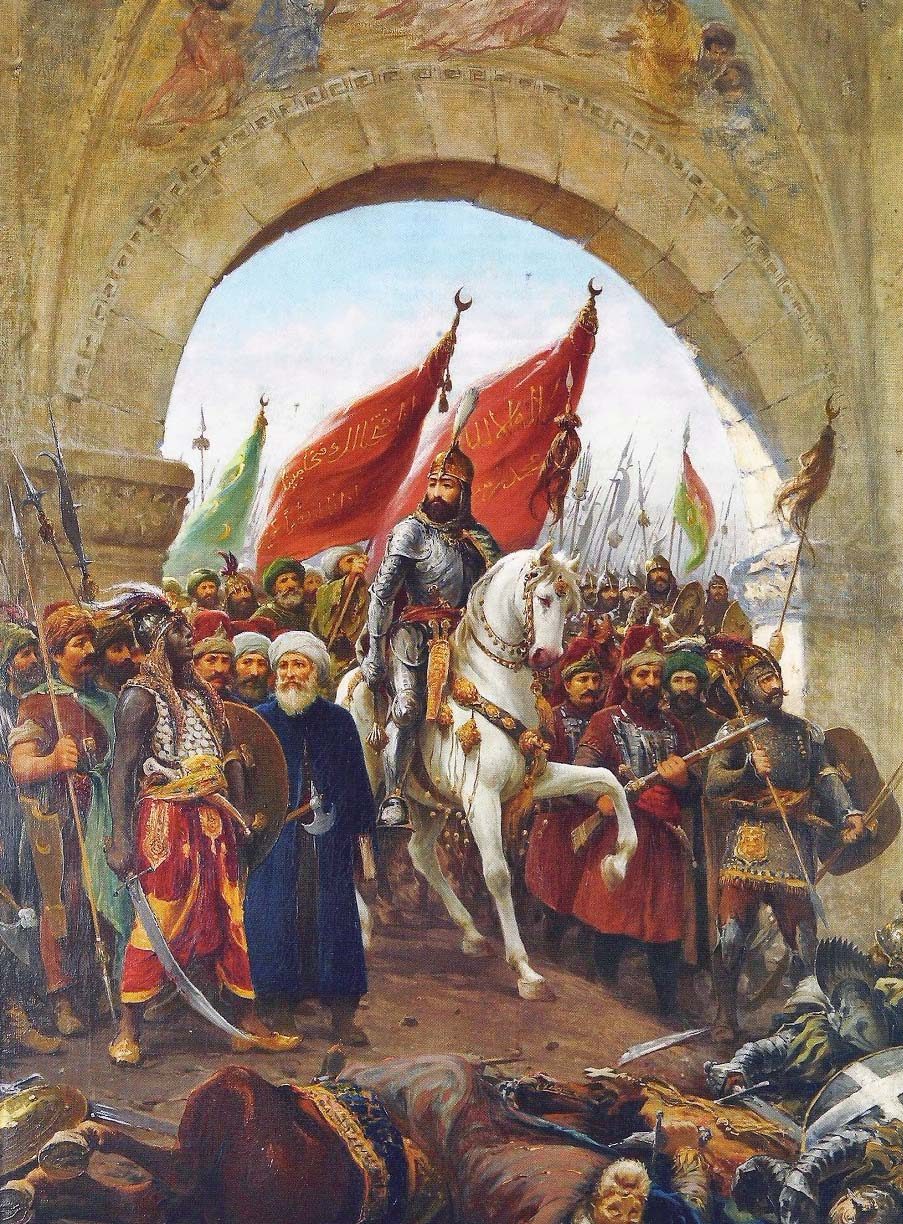
Mehmed entered the city he had dreamed of and made it his new capital. He converted Hagia Sophia into a mosque and set about rebuilding the place as the centre of an empire that would dominate the eastern Mediterranean for centuries. He took the title Kayser-i Rûm, Caesar of Rome, and he wasn't entirely wrong to. In a real sense the Roman Empire, in its long Byzantine afterlife, ended that morning.
The shockwaves spread outward. Greek scholars fleeing the fallen city carried manuscripts and classical learning west into Italy, feeding the Renaissance that was already underway. The Ottoman lock on the eastern trade routes gave European powers one more reason to go looking for sea routes to Asia, the kind of voyaging that, within four decades, would bump into the Americas. It's a stretch to draw a straight line from these walls to Columbus, but the connection is real enough that historians keep drawing it.
So when textbooks reach for a single day to close the medieval chapter, they often pick this one. A thousand-year-old empire, a 21-year-old conqueror, and a wall that had never fallen until the gunpowder age arrived and changed what walls could do.
The wound that never healed: 1204
To understand why a thousand-year-old empire was so weak by 1453, you have to go back almost 250 years, to a betrayal that came not from the Turks but from fellow Christians. In 1204 the soldiers of the Fourth Crusade, supposedly on their way to fight in the Holy Land, were diverted, partly by Venetian financial pressure, into attacking Constantinople itself. They took the city and sacked it with appalling thoroughness, looting its churches, melting down its treasures, and carting off its relics and artworks to Western Europe. (If you've ever admired the four bronze horses on the front of St Mark's Basilica in Venice, you've seen the loot.)
The Byzantines eventually clawed their capital back in 1261, but the empire never fully recovered. The sack shattered its wealth, fractured its territory into rival fragments, and left a bitterness between the Orthodox East and the Catholic West that would still be poisoning relations two centuries later. When the city finally faced the Ottomans alone, the deep reluctance of Western Europe to ride to its rescue had roots that ran straight back to 1204. In a real sense, Constantinople was mortally wounded by its own allies long before Mehmed's cannon ever arrived.
Inside the city during the siege
It's easy to talk about walls and cannon and forget that tens of thousands of ordinary people were living through this. By 1453 Constantinople was a strange, half-empty place: a city built for perhaps half a million that now held only a fraction of that, with fields and orchards growing inside the ancient walls where neighbourhoods had once stood. Into this faded grandeur was packed the fear of a population that knew, with grim clarity, what was coming.
The chronicles are full of the psychology of those last weeks. People prayed almost constantly. Religious processions wound through the streets carrying the city's holiest icons. And because this was a deeply superstitious age, every unusual event was read as an omen, and several unsettling ones are recorded. There was an eclipse of the moon, which the defenders took hard because of an old prophecy that the city could not fall while the moon was full. During one icon procession, the sacred image is said to have slipped and fallen into the mud. A sudden, eerie thunderstorm scattered another procession. And on one of the final nights, observers reported a strange light or glow around the dome of Hagia Sophia, which the terrified citizens interpreted as the divine presence, the Holy Spirit itself, abandoning the city. Whatever the natural explanations, you can feel the morale draining out of the place through these accounts.
To the defenders, the heavens themselves seemed to be reading out the verdict in advance. It is hard to fight when you believe God has already closed the book.
A handful of defenders and an impossible math problem
The emperor Constantine XI faced a problem that no amount of courage could really solve: the Theodosian Walls were enormous, about six kilometres of land fortifications, and he simply did not have enough men to stand on all of them. With only seven or eight thousand defenders against an army many times larger, the walls were thinly manned everywhere and strongly manned nowhere. The Ottomans could rest and rotate fresh troops; the defenders could not. Every man who fell was effectively irreplaceable.
That is why the smaller dramas of the siege counted for so much. The wounding of the Genoese commander Giustiniani didn't just remove one soldier. It pulled the linchpin out of the defence at exactly the wrong moment, on the most threatened stretch of wall, and the gap that opened could not be plugged. In a defence stretched that thin, a single failure anywhere could unravel everything. That fragility, as much as Ottoman strength, is the real story of how the city fell.
Did 1453 really "end the Middle Ages"? It's a tidy bookmark, but where you draw that line is always an argument. Some historians prefer 1492 and the voyages of Columbus; some point to the printing press; some to the Reformation. And others note that for the people living through it, no "era" ended at all; the period label is something we found useful long afterward, not something anyone felt at the time.
The aftermath, and the legend
When the city fell, there were three days of looting, as was the brutal custom of the age, though Mehmed reportedly moved fairly quickly to restore order, because he wanted Constantinople as a living capital, not a gutted ruin. He repopulated it, encouraged people of different faiths to settle, and rebuilt it into the glittering heart of the Ottoman Empire, the city we now know as Istanbul. Hagia Sophia, which had been the greatest cathedral in Christendom for nearly a thousand years, became a mosque.
For the Greek-speaking Orthodox world, the loss was so traumatic that it generated its own folklore. The most beautiful legend holds that the Emperor Constantine XI did not really die but was turned to marble by an angel and hidden away, the "Marble Emperor," who will one day awaken to take the city back. Another story tells of a priest who was in the middle of celebrating the liturgy in Hagia Sophia when the attackers broke in, and who simply walked into the cathedral's wall, which closed behind him. He will emerge and finish the service, the story goes, when the city is one day restored. These aren't history, obviously, but they're a window into how deeply the fall scarred the collective memory, and how unwilling people were to accept that something that had lasted a thousand years could really be gone.
And maybe that's the most human part of the whole story. We reach for clean dividing lines ("the end of the Middle Ages," "the fall of Rome") because they help us make sense of a past that's really just one long, messy continuity. The people inside Constantinople weren't thinking about historical periods. They were defending their homes, burying their friends, and praying for a rescue that never came. The tidy textbook date, 29 May 1453, is something we imposed afterward. For those who lived it, it wasn't the end of an era. It was the end of their world, and somehow, against the odds, the memory of that world refused to die with the city.
Image: 'Mehmed II entering Constantinople' by Fausto Zonaro (public domain, Wikimedia Commons).
Read next: Varangian Guard: The Vikings Who Plundered a Dead Emperor’s Treasury and Vlad the Impaler: The Real Dracula.
Sources & further reading
- Steven Runciman, The Fall of Constantinople 1453 (Cambridge University Press) — the classic narrative account.
- Roger Crowley, 1453: The Holy War for Constantinople and the Clash of Islam and the West (Hyperion, 2005).
- Marios Philippides & Walter Hanak, The Siege and the Fall of Constantinople in 1453 (Ashgate).
- Encyclopaedia Britannica, "Fall of Constantinople"; primary eyewitness account of Nicolò Barbaro, a Venetian present at the siege.