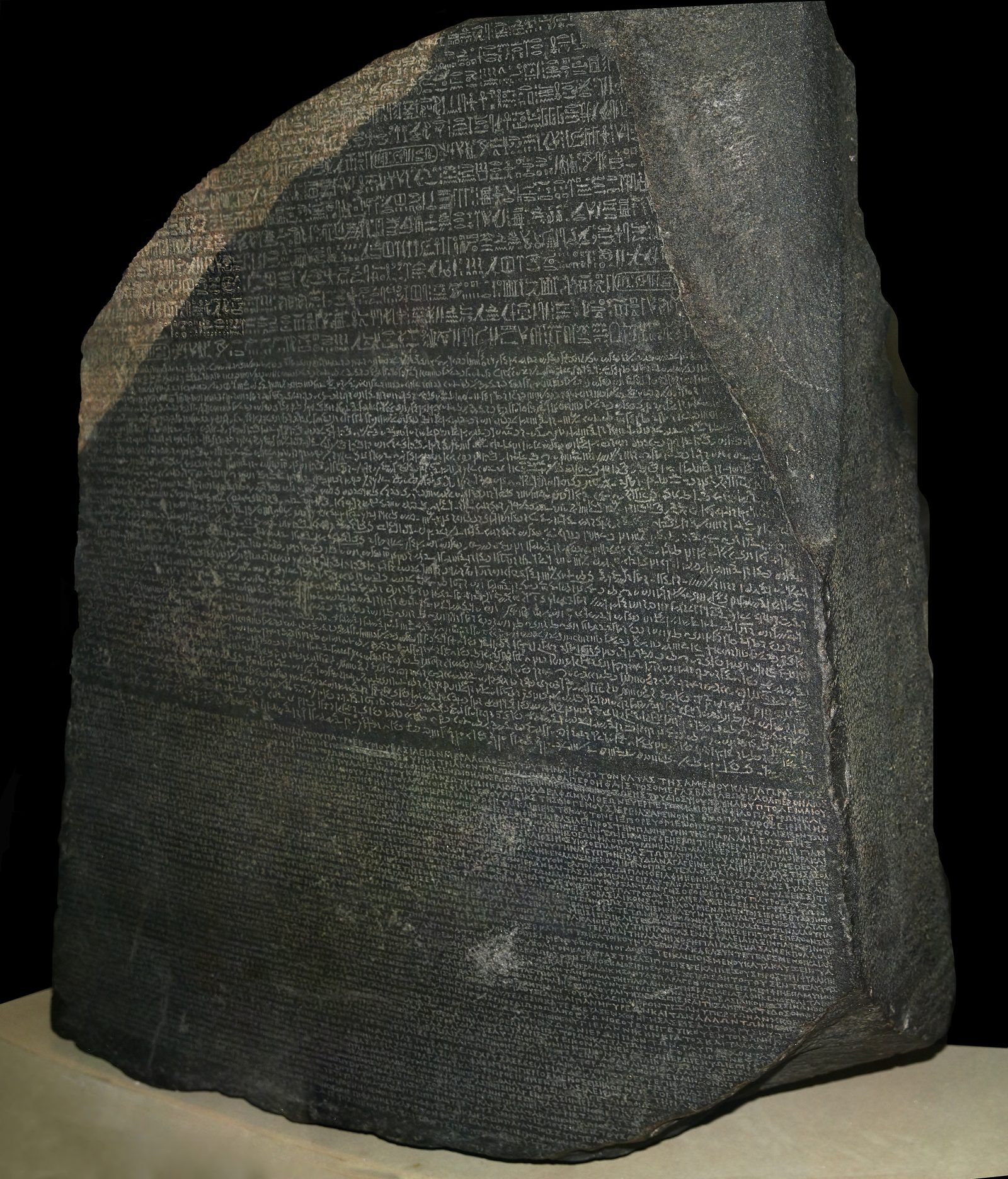
In the high summer of 1799, a group of French soldiers were knocking down an old wall near the Egyptian town of Rosetta to make room for a fort. One of them noticed a slab of dark stone built into the rubble: broken, heavy, and covered top to bottom in three bands of writing nobody present could read. They could easily have used it as building material and thought nothing of it. Instead, somebody realised it might matter. That slab turned out to be the key that would unlock 3,000 years of silence.
We call it the Rosetta Stone, and it is probably the most famous object in the British Museum; there's almost always a crowd around it. But most people who've heard the name couldn't tell you what it actually says, or why a chipped lump of granodiorite became shorthand for "the thing that cracks a code." The real story is messier, slower, and frankly more interesting than the legend.
A broken slab with three bands of text
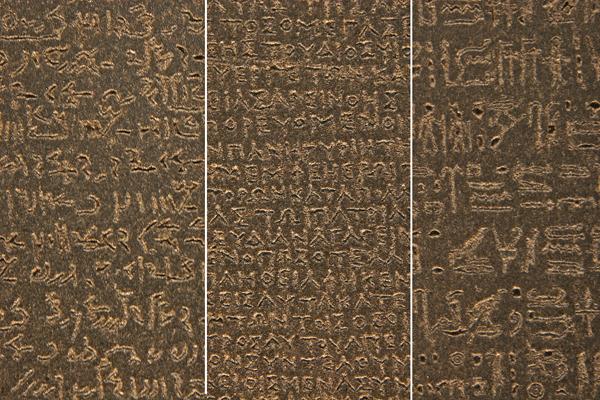
First, a reality check, because this trips up almost everyone. The Rosetta Stone is not some ancient dictionary, and it is not written in three languages. It's a fragment of a larger stone slab, a stele, and it carries a single piece of text repeated in three different scripts. The text is a decree issued by a council of priests at Memphis in 196 BCE, during the reign of the boy-king Ptolemy V.
"The Rosetta Stone is written in three languages, which is why it let us translate Egyptian."
It's two languages in three scripts: Egyptian (written once in hieroglyphs, once in everyday Demotic) and ancient Greek. Scholars could already read the Greek, so it served as a built-in answer key for the Egyptian above it.
That last point is the whole reason the stone matters. By 1799, the knowledge of how to read Egyptian hieroglyphs had been completely dead for over a thousand years. But ancient Greek had never been lost. So here was the same message, written out in a language scholars knew perfectly and a script they couldn't read at all. If you could match them up, you had a fighting chance of finally working out what those little birds, eyes and squiggles meant.
And yet it still took more than twenty years
Here's the part the "magic key" version skips. Having the stone did not instantly let anyone read hieroglyphs. The thing was found in 1799. The script wasn't really cracked until 1822. That's twenty-three years of brilliant people staring at the same object and getting stuck.
Why so hard? Because everyone started with the wrong assumption. For centuries, European scholars had been convinced, partly thanks to a late-antique writer named Horapollo, that hieroglyphs were purely symbolic. The idea was that each little picture stood for a whole idea or concept, a kind of mystical pictorial wisdom, with no connection to the sounds of any spoken language. As long as people believed that, they were never going to get anywhere, because it isn't true. They were trying to read an alphabet as if it were a tarot deck.
For all its world-changing fame, the text on the Rosetta Stone is mostly… admin. The decree grants tax breaks to temples, sets out honours for the 13-year-old king, and orders that copies be displayed in temples. The most important object in the history of language is, at heart, a government memo about priestly tax relief.
Two rivals and a very famous breakthrough
The decipherment is usually told as a duel between two men, and there's truth to that even if it flattens the story a bit.
The first was Thomas Young, an English polymath who seemed to be good at everything: physics, medicine, optics, you name it. Working in the 1810s, Young made real progress. He focused on the cartouches, those oval loops you see drawn around certain groups of hieroglyphs, and correctly guessed that they enclosed royal names. He worked out the sounds of several signs, especially in the name "Ptolemy," and he made important headway on the Demotic script too. For a while he was ahead.
But Young was, in a sense, still half-trapped in the old assumption. He treated the phonetic spelling as a special trick used mainly for writing foreign names like the Greek-derived "Ptolemy," rather than realising it ran through the entire system.
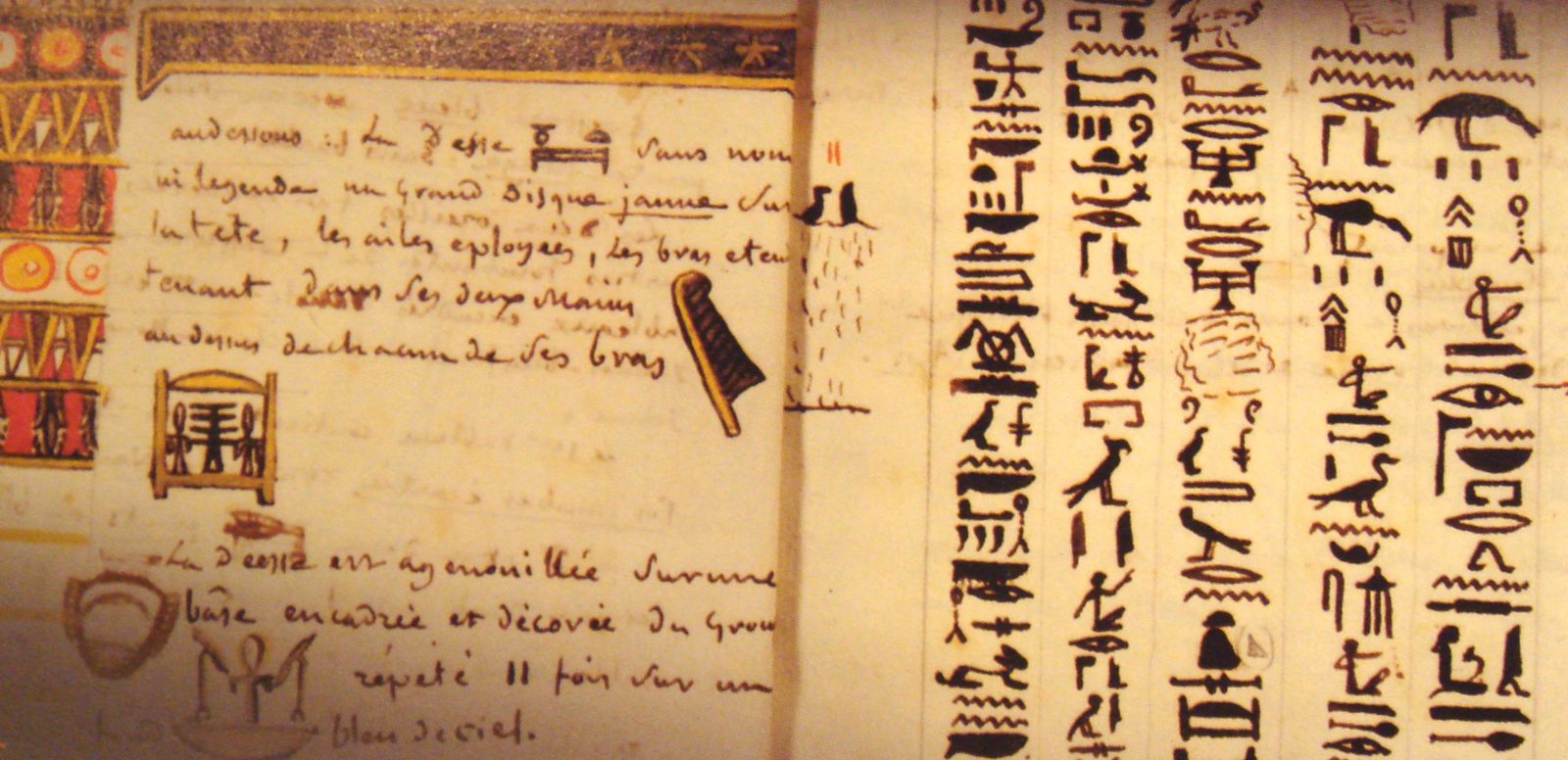
The man who saw the whole picture was Jean-François Champollion, a French prodigy who had been obsessed with ancient Egypt since boyhood and, just as importantly, had taught himself Coptic, the very late form of the Egyptian language that survived in the liturgy of the Egyptian Christian church. That was his secret weapon. Coptic gave him a living echo of how ancient Egyptian had actually sounded. When he compared royal names across different cartouches and started sounding the signs out, the system finally cracked open. Hieroglyphs were a mixture: some signs stood for sounds, some for whole words or ideas, sometimes in the very same name. And the phonetic principle applied to native Egyptian words too, not just foreign ones.
"It is a complex system, a script all at once figurative, symbolic and phonetic, in one and the same text, one and the same sentence, one and the same word."— Jean-François Champollion, Lettre à M. Dacier, 1822, announcing his solution
There's a story, possibly polished over the years but too good to leave out, that on the day it all came together in September 1822, Champollion burst into his brother's office, shouted "Je tiens l'affaire!" ("I've got it!"), and promptly collapsed, reportedly out cold for several days from sheer exhaustion. Whether or not the fainting is exact, the man had been chasing this since childhood. You can forgive him a dramatic moment.
The debate historians still have
So who really "deciphered" hieroglyphs, Young or Champollion? It became a bitter, nationally tinged feud (English champions of Young versus French champions of Champollion) that has never entirely died down.
The honest answer is that it's not a clean either/or. Young made real, foundational contributions, the cartouche insight and several correct sound values among them, and Champollion almost certainly knew of Young's published work. Young's supporters argued, then and later, that Champollion underplayed how much he'd borrowed. Champollion's defenders counter that Young only ever cracked isolated pieces, whereas Champollion grasped the underlying system, the thing that turned a handful of lucky guesses into a method you could use to read any inscription. Most Egyptologists today land on a both/and: Young opened the door a crack; Champollion kicked it down and walked through. But if you have to pick one name for "the person who learned to read hieroglyphs," it's Champollion's, and the field he essentially founded proved him right.
How the stone ended up in London
One more twist that delights and annoys people in roughly equal measure: the French found the Rosetta Stone, but they don't have it. After Napoleon's Egyptian campaign collapsed and the French forces surrendered to the British in 1801, the terms of the surrender (the Capitulation of Alexandria) handed over the antiquities the French had collected, the stone among them. It arrived in England in 1802 and has been in the British Museum almost ever since. You can still see "CAPTURED IN EGYPT BY THE BRITISH ARMY" painted on the side of it, which is not exactly subtle. Egypt has, in recent years, called for its return, a debate that's very much alive and not going away.
The boy-king and the politics behind the stone
It helps to know who was actually being praised on that slab, because it explains the odd three-script format in the first place. Egypt in 196 BCE wasn't ruled by native pharaohs. It was ruled by the Ptolemies, a dynasty descended from one of Alexander the Great's Macedonian generals. They were, culturally and linguistically, Greek. For nearly three centuries this Greek-speaking family sat on the throne of the pharaohs, mostly without bothering to learn the Egyptian language at all (Cleopatra, near the very end of the line, was a famous exception).
So when the priests of Memphis gathered to honour the thirteen-year-old Ptolemy V, they had a practical problem: the rulers and the administration worked in Greek, but the temples and most of the country worked in Egyptian. A decree meant to be read and obeyed by everyone who mattered therefore had to appear in both worlds at once: Greek for the government, hieroglyphic for the sacred and traditional sphere, and everyday Demotic for the wider literate public. The stone is, in a sense, a snapshot of a divided society papering over the gap. And the decree itself was a transaction: the priesthood publicly backed a shaky boy-king during a period of revolts, and in return got tax relief and privileges. Politics, then as now.
After the code broke: a civilisation starts talking
Champollion didn't stop at the announcement. He poured the rest of his short life into building out the full grammar and vocabulary of ancient Egyptian, and in 1828–29 he finally did the thing he'd dreamed of since boyhood: he went to Egypt. Standing in front of the very temples and tombs he'd spent years deciphering on paper, he was able to read the inscriptions aloud, on the spot, confirming that his system actually worked in the wild. By all accounts it was the great joy of his life.
It didn't last long. Champollion died in 1832, at just 41, of a stroke, worn out, many said, by years of relentless work. His full Egyptian grammar and dictionary were published after his death by his devoted brother, who had spent decades supporting him. But the door was open and could never be closed again. Within a generation, scholars were reading their way through the vast inheritance of Egyptian writing, and an entire new discipline, Egyptology, was born from it. Temple walls that had been beautiful, mute decoration for over a thousand years suddenly turned back into sentences: hymns, histories, spells, contracts, complaints, jokes. The dead were speaking again.
Why a tax decree changed the world
It's worth stepping back to feel the size of what happened here. Before 1822, the entire written record of one of humanity's greatest civilisations was locked. Three thousand years of Egyptian history (the names of the pharaohs, the prayers, the love poems, the letters, the medical texts, the accounts of battles and harvests and gods) was sitting there carved on temple walls and written on papyrus, completely mute. People could look at it and admire it, but they couldn't hear it.
Champollion's breakthrough, built on that broken slab of priestly bureaucracy, didn't just translate one decree. It handed scholars the ability to read everything else. An entire civilisation got its voice back. That's the strange beauty of the Rosetta Stone: a dull little tax memo, repeated three times for the most ordinary administrative reasons, became, purely by accident of survival, the doorway through which we walked back into ancient Egypt. History is full of accidents like that. This is just the most famous one.
Featured image: the Rosetta Stone, British Museum (photo by Hans Hillewaert, CC BY-SA, via Wikimedia Commons). Other images: Champollion's notebook and a detail of the three scripts (public domain, via Wikimedia Commons).
Read next: Cleopatra VII: The Last Pharaoh of Ancient Egypt and Behistun: The Cliff Carving That Cracked Cuneiform.
Sources & further reading
- Jean-François Champollion, Lettre à M. Dacier relative à l'alphabet des hiéroglyphes phonétiques (1822) — the original announcement of the decipherment.
- Andrew Robinson, Cracking the Egyptian Code: The Revolutionary Life of Jean-François Champollion (Oxford University Press, 2012).
- Richard Parkinson, The Rosetta Stone (British Museum Press) — by the museum's own Egyptologist.
- John Ray, The Rosetta Stone and the Rebirth of Ancient Egypt (Harvard University Press).
- The British Museum, object record and history of the Rosetta Stone; Encyclopaedia Britannica, "Rosetta Stone" and "Jean-François Champollion."