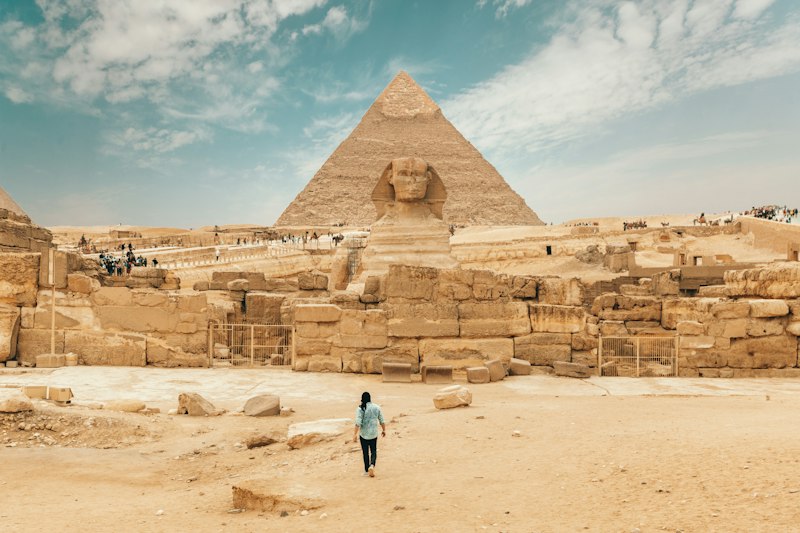
For more than three millennia, the civilization of ancient Egypt was sustained not just by the Nile's annual floods but by one of the most elaborate religious systems ever devised. Egyptian mythology wove together creation stories, cosmic battles, moral philosophy, and an obsessive preparation for the afterlife into a tapestry that influenced Greek, Roman, and eventually modern Western thought.
The Creation
Egyptian creation myths varied by city, but the most influential version comes from Heliopolis. In the beginning, there was only Nun — the dark, formless waters of chaos. From these waters rose Atum (later identified with Ra, the sun god), who created himself through sheer will. Standing on the first mound of earth to emerge from the waters, Atum sneezed (or spat) forth Shu (air) and Tefnut (moisture), who in turn produced Geb (earth) and Nut (sky). Geb and Nut then gave birth to Osiris, Isis, Set, and Nephthys — the gods whose stories would define Egyptian mythology.
The Osiris Myth
The central narrative of Egyptian mythology is the story of Osiris. Beloved king of Egypt, Osiris was murdered by his jealous brother Set, who tricked him into lying in a coffin, sealed it with lead, and threw it into the Nile. Isis, Osiris's devoted wife, searched the world for his body and found it encased in a tamarisk tree in Byblos (modern Lebanon).
She brought it home, but Set found the body, tore it into fourteen pieces, and scattered them across Egypt. Isis painstakingly gathered the pieces, reassembled her husband, and through powerful magic, conceived their son Horus. Osiris, unable to return to the world of the living, became lord of the underworld — the judge of the dead.
Horus grew up in hiding and eventually challenged Set for the throne of Egypt. Their conflict — sometimes depicted as a series of contests, sometimes as outright war — ended with Horus victorious. Every living pharaoh was considered an incarnation of Horus; every dead pharaoh became Osiris.
The Afterlife
No civilization was more focused on the afterlife than Egypt. The Egyptians believed that death was not an end but a transition to the Duat — the underworld — where the deceased faced a series of trials. The most critical was the Weighing of the Heart ceremony, presided over by Osiris himself.
The dead person's heart was placed on a scale opposite the feather of Ma'at (truth and justice). If the heart was lighter than the feather — unburdened by sin — the soul was welcomed into the Field of Reeds, an idealized version of Egypt with eternal harvests and perfect weather. If the heart was heavier, it was devoured by Ammit, a fearsome creature part crocodile, part lion, part hippopotamus, and the soul ceased to exist.
To navigate the underworld successfully, the dead needed the Book of the Dead — a collection of spells, prayers, and instructions written on papyrus scrolls and placed in tombs. These texts provided passwords, maps, and magical formulas to overcome the dangers of the Duat.
Legacy
Egyptian religious concepts profoundly influenced later civilizations. The Osiris myth's themes of death, resurrection, and divine judgment echo in Christianity and other religions. The Greek historian Herodotus declared that "almost all the names of the gods came into Greece from Egypt." While this was an overstatement, the cultural exchange between Egypt and the classical world was enormous and lasting.
Today, Egyptian mythology continues to captivate through literature, film, video games, and art — a testament to the enduring power of stories that ancient priests first told along the banks of the Nile.