Ask people how the Library of Alexandria was destroyed and you'll get a confident answer almost every time. It was burned. One great fire, one terrible night, and the accumulated knowledge of the ancient world went up in smoke, set alight by Julius Caesar, or by a fanatical mob, or by Arab conquerors, depending on who's telling the story and what point they want to make. It's one of history's great tragic images: civilisation's memory consumed in a single blaze. And it's almost certainly wrong. The truth is slower, sadder, and in some ways more unsettling than any fire.
The Library didn't die in a night. It seems to have faded over centuries: defunded, neglected, and left to crumble. Which raises a more uncomfortable question than "who burned it?" The real question might be: how do you let the greatest library in the world simply rot away?
The dream of collecting everything
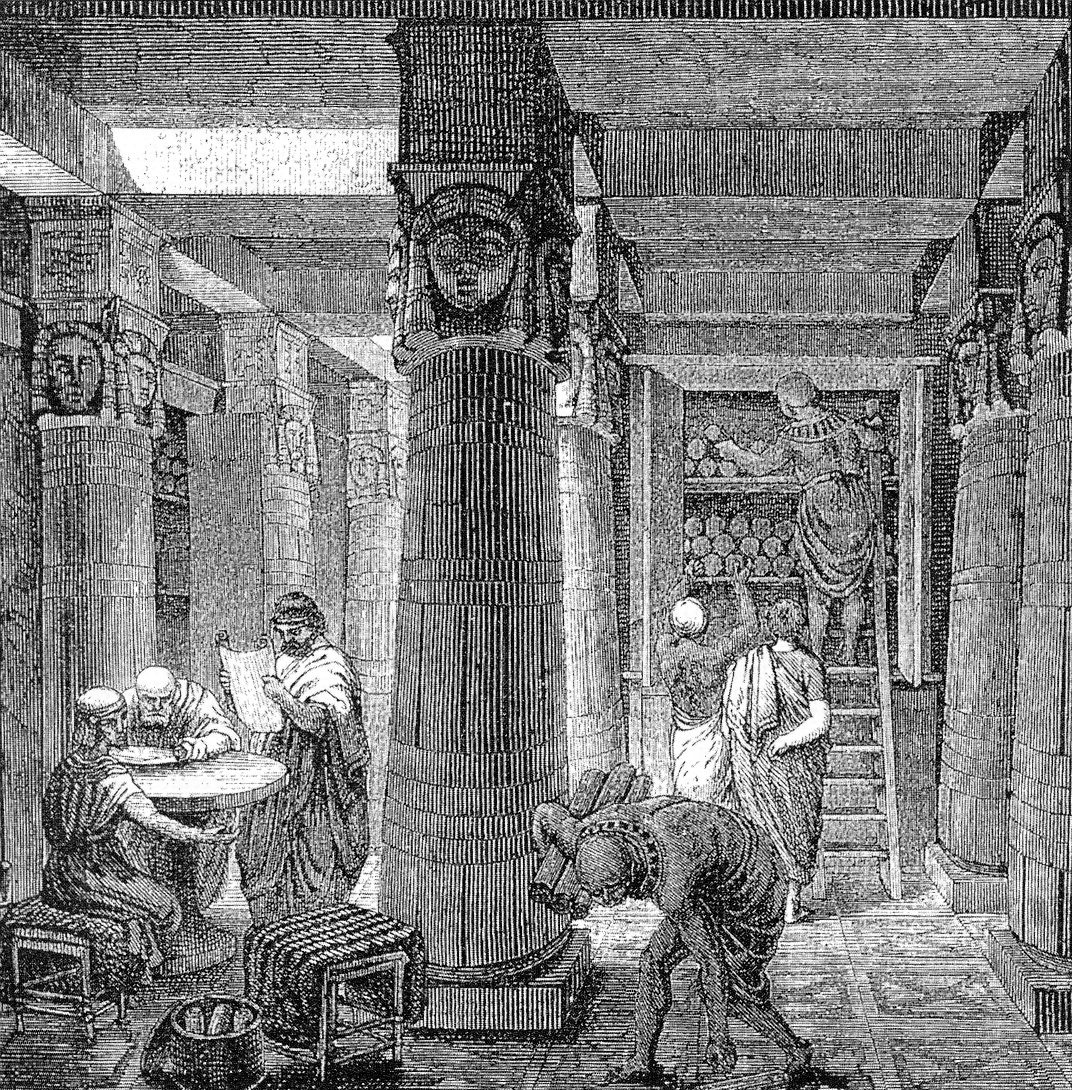
First, what was actually lost. The Library of Alexandria was founded in the Egyptian city of Alexandria, probably in the early third century BCE under the first couple of Ptolemaic kings, the Greek dynasty that ruled Egypt after Alexander the Great. It was part of a larger institution called the Mouseion, the "shrine of the Muses," from which we get the word "museum." Think of it less as a public lending library and more as a vast research institute, a kind of ancient university where scholars lived, studied, and were paid by the crown.
The ambition behind it was breathtaking, and new. The Ptolemies wanted to collect all the knowledge of the world, to gather a copy of every book in existence under one roof. They pursued this with something close to obsession. Agents were sent across the Mediterranean to buy scrolls. There's a famous story that every ship docking at Alexandria was searched, and any books found aboard were seized and copied. The copy went back to the owner; the original stayed in the Library. Whether or not that's literally true, it captures the spirit of the place: an empire trying to download the entire mind of the ancient world.
The collection held hundreds of thousands of scrolls. The ancient estimates vary wildly, from tens of thousands up to half a million or more, and we can't pin the number down. What we can say is that for a few centuries, Alexandria was the intellectual capital of the world.
Some of the greatest minds of antiquity worked at or studied in Alexandria. Euclid likely taught there and wrote his Elements, the foundation of geometry for the next two thousand years. Eratosthenes, the Library's chief librarian, calculated the circumference of the Earth with astonishing accuracy using shadows and simple geometry. The scholars there also produced the definitive scholarly editions of Homer that shaped how the epics came down to us. This was not a dusty storeroom; it was a working engine of discovery.
The fire everyone blames
So where does the burning come from? There was a fire, and Julius Caesar really was involved, but the popular version inflates a real, limited event into a total apocalypse.
In 48 BCE, Caesar was caught up in a war in Alexandria, besieged in the palace quarter. To save himself, he ordered the ships in the harbour set alight. The fire spread from the docks into parts of the city, and ancient sources do say it burned warehouses near the waterfront that held books, possibly scrolls awaiting export or part of the Library's holdings stored near the harbour. Some thousands of scrolls were likely lost.
But the Library as an institution clearly survived this. We have references to it, and to the Mouseion, continuing to function afterward. Scholars kept working in Alexandria for a long time. Caesar's fire was real and damaging, but it was not the death of the Library. The neat story of "Caesar burned the Library of Alexandria" compresses a partial dockside fire into a civilisational catastrophe that didn't actually happen that night.
"The Library of Alexandria was destroyed in a single catastrophic fire that wiped out ancient knowledge overnight."
There was no single destruction. The Library appears to have declined gradually over several centuries through a series of blows - Caesar's harbour fire (which it survived), the loss of royal Ptolemaic patronage, political upheaval, and slow neglect. Most historians now see a long fade, not one fiery apocalypse. No reliable ancient source describes a single event that destroyed it all.
The candidates for "the" destruction
Over the centuries, several events have been nominated as the moment the Library died. It's worth running through them, because each one tends to get used to make a moral point, and that's part of why the legend is so slippery.
There's Caesar's fire of 48 BCE, which we've covered: real, but not fatal to the institution.
There's the emperor Aurelian, who in the 270s CE fought a war to retake Alexandria from a breakaway regime, and in doing so devastated the very palace district where the Mouseion stood. By this point the Library may already have been a shadow of itself, but this fighting likely finished off whatever remained of the original royal institution.
There's the destruction in 391 CE of the Serapeum, a temple of the god Serapis that housed a "daughter library" (a secondary collection), destroyed by a Christian mob during the religious conflicts of the late Roman Empire, under the patriarch Theophilus. This is often conflated with the main Library, but it was a different, later collection, and by then the great original was almost certainly long gone.
And there's the Arab conquest of Egypt in 642 CE, with a much-repeated tale that the caliph Umar ordered the books burned to heat the city's bathhouses. This story is the least credible of all. It appears only in much later sources, centuries after the supposed event, and most historians regard it as a legend, probably invented to serve later polemics, with no good contemporary evidence behind it. By 642 there likely wasn't a great library left to burn.
Where opinion splits: This is the heart of the scholarly debate: was there a single decisive destruction, or a long decline? The strong modern consensus leans toward gradual decline - a series of fires, wars, funding cuts and neglect across centuries, with no one cataclysmic end. But historians still argue over the relative weight of each blow, when the Library effectively ceased to function, and how reliable the scattered, often contradictory ancient sources really are. The honest answer to "when was it destroyed?" is that there may be no single answer.
The quieter killer: neglect
If the dramatic fires aren't the whole story, what actually happened? The unglamorous answer is that institutions need sustained support to survive, and the Library lost it.
The Library flourished because the Ptolemaic kings poured money and prestige into it for their own reasons: it glorified their dynasty and made Alexandria a magnet for the brightest minds. But that patronage was fragile. As the Ptolemaic dynasty declined and grew unstable in its later centuries, the support wavered. There's a telling episode where a Ptolemaic king, in a fit of political paranoia, is said to have purged or expelled scholars from Alexandria, driving talent away. Royal favour, once the Library's lifeblood, became unreliable.
Then Egypt became a Roman province, and Roman emperors had their own priorities; some supported the Mouseion, many didn't especially care. Over generations, the intellectual centre of gravity shifted. Funding dried up. Scrolls, which were fragile and needed constant recopying to survive, decayed faster than anyone replaced them. Scholars drifted to other cities. The institution that had tried to collect every book in the world slowly stopped being able to keep the ones it had.
This is what I find haunting. We love a villain, a tyrant with a torch, because it lets us imagine the loss as a single crime that might have been prevented. More likely, the greatest library in history was lost the way most things are lost: a little at a time, through indifference, budget cuts, and the simple failure of one generation to value what the last one built. No single night to mourn. Just a long, quiet fading-out that nobody bothered to record because, while it was happening, it never felt like the end.
What went missing
It's tempting to imagine that some unique store of secret ancient wisdom vanished with the Library: lost technologies, hidden truths, knowledge that would have leapt civilisation forward by centuries. That's mostly romantic exaggeration, and it's worth resisting. A lot of what was in Alexandria existed in copies elsewhere, and much of the most important Greek science and philosophy survived precisely because it was copied and recopied in other places.
"The Museum is also a part of the royal palaces; it has a public walk, an exedra with seats, and a large house, in which is the common mess-hall of the men of learning who share the Museum."— Strabo, Geography, Book XVII (early 1st century CE), one of the few firsthand descriptions of the Mouseion
But the losses were still real and irreplaceable. We know of countless ancient works only by their titles, or by quotations in surviving books. Plays by great dramatists, histories, scientific treatises, poems: they simply don't exist anymore. Of the work of many ancient authors, we have a fraction; of some, nothing but a name. Not all of that perished at Alexandria specifically, but the Library represented the ancient world's single greatest concentration of texts, and its decline is bound up with the broader, grinding loss of ancient literature that left us with only scraps of a once-enormous body of writing.
The lesson in the ashes that weren't
The Library of Alexandria endures as a symbol precisely because of what it represents: the fragility of knowledge, and the terrible ease with which what one generation gathers can slip through the next one's fingers. The popular image of the single great fire is, I think, almost a comfort. It turns the loss into a tragedy with a clear cause and a clear villain.
The real history is harder to sit with. The Library probably wasn't murdered; it was allowed to die. It needed money, attention, and care, decade after decade, and at some point the world stopped providing them, not out of malice but out of distraction and changing priorities. The flames make a better story. The slow neglect makes a better warning.
We still build great libraries and archives and databases, still try to gather and preserve the sum of what we know. Alexandria is the reminder that none of it preserves itself. Knowledge survives only as long as people keep choosing to maintain it, and the moment they stop, it doesn't go out in a dramatic blaze. It just disappears, scroll by crumbling scroll, until one day someone looks for it and finds it gone.
We don't know how many scrolls the Library held. The ancient figures range wildly, from around 40,000 up to 700,000, and they were almost certainly inflated for prestige. A single "book" in the modern sense might be spread across many scrolls, which muddies the numbers further. The Library's value was never just the hoard of texts; it was the community of scholars it gathered. Eratosthenes measured the circumference of the Earth there. It was a research institution as much as a storehouse, which is exactly why its slow loss of funding and talent, not any one fire, was the real catastrophe.
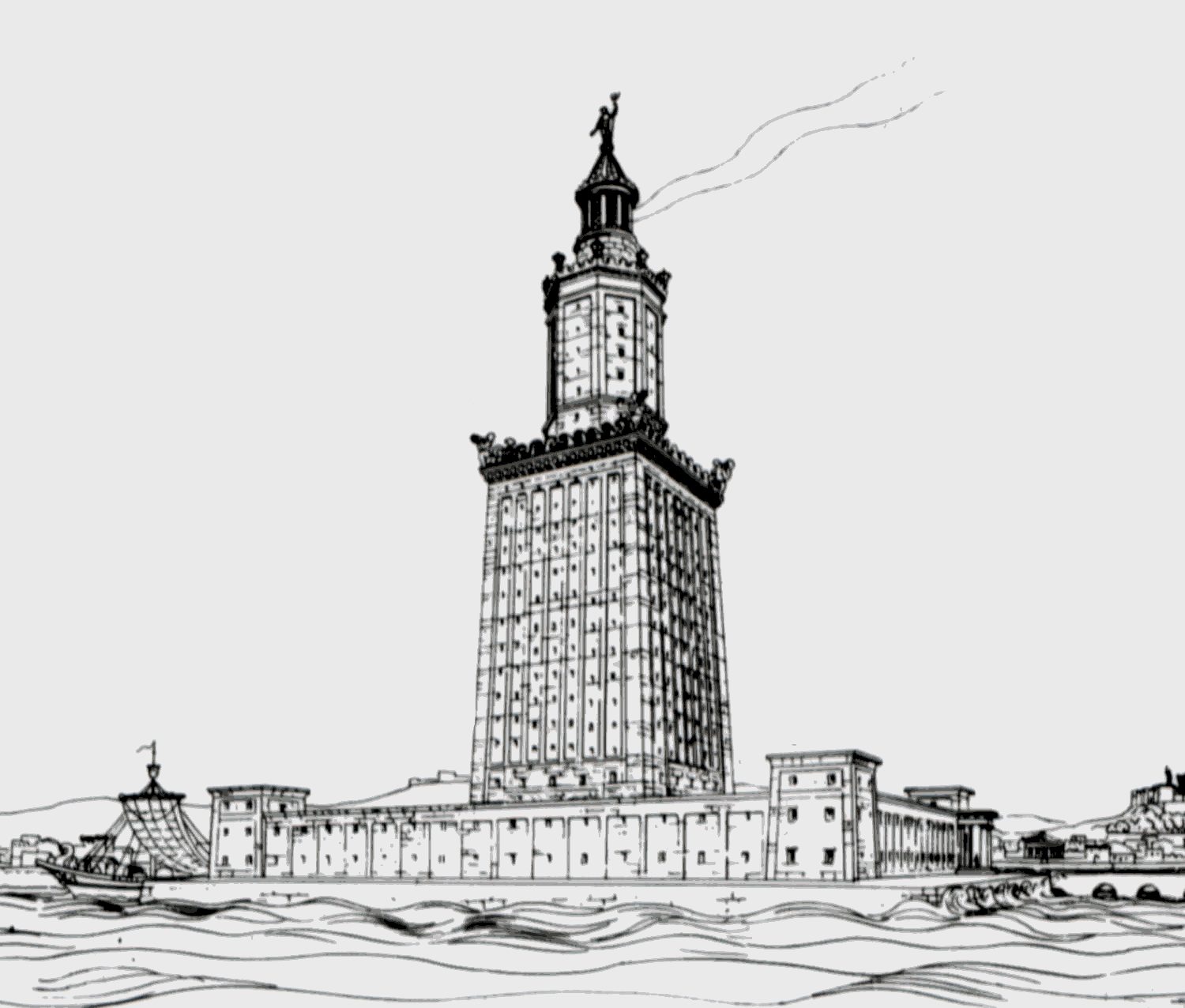
Image: a 19th-century artist's imaginative reconstruction of the Great Library of Alexandria (public domain, via Wikimedia Commons).
Read next: Nalanda: The Ancient University That Was Fading Before the Fire and Cleopatra VII: The Last Pharaoh of Ancient Egypt.
Sources cited
- Roy MacLeod (ed.), The Library of Alexandria: Centre of Learning in the Ancient World (I. B. Tauris, revised ed. 2004).
- Lionel Casson, Libraries in the Ancient World (Yale University Press, 2001).
- Edward J. Watts, City and School in Late Antique Athens and Alexandria (University of California Press, 2006) — on Alexandria's later intellectual life and decline.
- Strabo, Geography, Book XVII — a rare firsthand ancient description of the Mouseion.
- Encyclopaedia Britannica, "Library of Alexandria"; the UNESCO and Bibliotheca Alexandrina historical notes on the ancient library.