There is something almost suspicious about how perfect the story is. A magnificent island empire, more advanced and more powerful than anyone, grown arrogant and corrupt, that picks a fight with a smaller, nobler people — and is then swallowed by the sea in a single terrible day and night, vanishing utterly from the earth. It has everything: lost grandeur, divine punishment, a sunken city waiting to be found. People have searched for it for centuries, in the Atlantic, the Mediterranean, the Caribbean, even Antarctica. But the awkward truth, the one that gets lost beneath all the documentaries and treasure maps, is that we know exactly where Atlantis came from. It came from the imagination of one Greek philosopher, who invented it to make a point.
Atlantis is unusual among famous legends in that we can name its author and very nearly its publication date. The story appears, for the first time anywhere, in two dialogues written by the Athenian philosopher Plato around 360 BCE: the Timaeus and the unfinished Critias. There is no older source. No earlier Greek text mentions Atlantis; no independent tradition records it. It enters human culture fully formed, in the work of a single philosopher who used invented stories — what scholars call myths or allegories — as teaching tools throughout his writing. To understand Atlantis honestly, you have to start there, with Plato and what he was actually trying to say.
The only ancient source there is
In the Timaeus, and at greater length in the Critias, Plato has a character named Critias relate a tale supposedly passed down from the great Athenian statesman Solon, who in turn supposedly heard it from Egyptian priests. (Already we are several hands removed from any first-hand witness — a story about a story about a story.) According to this account, some nine thousand years before Solon's time, there existed beyond the Pillars of Heracles — the Strait of Gibraltar — a vast island called Atlantis, larger than Libya and Asia combined.
Plato describes it in loving, almost architectural detail: a great power founded by the sea god Poseidon, with a capital city of concentric rings of land and water, harbours and bridges and canals, walls sheathed in precious metals, hot and cold springs, temples, racecourses, a huge and disciplined military. It was, for generations, a noble and virtuous civilisation. But over time, Plato writes, the divine element in the Atlanteans was diluted; they grew greedy, grasping and corrupt, and set out to conquer the entire Mediterranean. They were stopped by one city alone — an idealised, ancient Athens, which heroically defeated the mighty invader. And then, in punishment for Atlantean arrogance, came the cataclysm.
"But afterwards there occurred violent earthquakes and floods; and in a single day and night of misfortune... the island of Atlantis disappeared in the depths of the sea."— Plato, Timaeus (c. 360 BCE), translated by Benjamin Jowett
A story with a purpose, not a chronicle
Here is the crucial context that the lost-continent industry tends to skip: Plato was not writing history. He was a philosopher constructing an argument, and Atlantis is the centrepiece of a deliberate thought experiment. The dialogues in which it appears are concerned with the nature of the ideal state and how a virtuous society behaves under pressure. Plato had spent his masterwork, the Republic, describing his model of a just city in the abstract. In the Timaeus and Critias he wanted, in effect, to see that ideal city in action — to tell a story of his perfect Athens proving its virtue against a magnificent but morally rotten enemy.
Atlantis, in other words, is the villain Plato needed: a civilisation rich and powerful enough to be a worthy threat, and corrupt enough to deserve destruction. Its fall is a moral lesson about hubris — the way pride and greed bring ruin, even to the mightiest — and a foil that lets idealised Athens shine. The story is structured as a parable from beginning to end. The very framing, with its long chain of distant sources and impossibly remote dates, reads to many scholars like Plato signalling that this is a constructed tale, dressed in the costume of ancient testimony to make its lesson land harder.
Worth knowing: Plato never finished Atlantis. The Critias, the dialogue that describes the island in the most loving detail, breaks off mid-sentence — stopping abruptly just as Zeus is gathering the gods to decide Atlantis's punishment. The single most influential lost civilisation in history was abandoned by its own author before he wrote the ending. We have spent over two thousand years searching for a place whose creator never even bothered to finish the story.
Even the ancients doubted it
It is worth knowing that scepticism about Atlantis is not a modern invention. The ancient world itself largely treated it as a fiction. Plato's own most brilliant student, Aristotle, is reported to have been dismissive of the tale, with a much-quoted remark to the effect that the man who invented Atlantis was also the man who destroyed it — meaning Plato made it up and then conveniently sank it so no one could check. Whether or not the exact quip is reliable, it captures how the story was often received: as a philosopher's invention, not a record of a real place. For most of antiquity and the Middle Ages, Atlantis attracted little of the obsessive searching it inspires today.
How a teaching parable became a "lost continent"
So how did a philosophical thought experiment turn into the most relentlessly hunted lost civilisation on earth? The modern Atlantis craze owes an enormous amount to one 19th-century book: Atlantis: The Antediluvian World, published in 1882 by the American writer and politician Ignatius Donnelly. Donnelly argued, with great confidence and very little evidence, that Atlantis had been a real continent and the source of all human civilisation — that the world's ancient cultures, from Egypt to the Americas, were all descended from this single sunken motherland.
It was, by the standards of evidence, nonsense, but it was wildly influential, and it kicked off a flood of speculation that has never really stopped. From Donnelly, the idea passed into occult and esoteric movements, into pseudo-archaeology, into science fiction and fantasy, and eventually into the endless stream of television documentaries promising that Atlantis has finally been found off the coast of wherever. Along the way it accumulated everything Plato never wrote: crystal technology, alien contact, psychic powers, advanced lost sciences. None of this has any basis in the ancient text. It is later invention layered onto an older invention.
"Atlantis was a real, super-advanced ancient civilisation that sank beneath the ocean, and explorers are closing in on its ruins."
There is no archaeological, geological or textual evidence for Atlantis as a real place, and the ocean floor shows no sunken continent where Plato put it. The story exists in exactly one source — Plato — who wrote it around 360 BCE as a moral parable about pride and an ideal state. Most scholars regard it as deliberate fiction, not a memory of a vanished land.
But could a real disaster have inspired it?
None of this means the story sprang from absolutely nothing. Even if Atlantis itself is invented, Plato did not write in a vacuum, and there is a genuine, respectable scholarly discussion about which real events and places might have coloured his imagination. Here the conversation gets more interesting and more careful.
The leading candidate is the Bronze Age eruption of the volcano on the island of Thera — modern Santorini — in the Aegean Sea, sometime in the second millennium BCE. It was one of the largest volcanic eruptions in human history. It blew much of the island apart, leaving a great flooded caldera, and it generated tsunamis and ashfall that devastated parts of the region. On nearby Crete, the sophisticated Minoan civilisation — a wealthy, sea-going, palace-building culture — went into decline not long after, for reasons that probably included the eruption's effects. A brilliant maritime civilisation, partly destroyed by the sea and by geological catastrophe, within cultural memory of the Greek world: it is not hard to see how echoes of such events, passed down and distorted over centuries, could have supplied Plato with raw atmosphere for a tale of an island power swallowed by the waves.
Did the Thera eruption and the Minoan decline inspire Atlantis? Some scholars find the parallels suggestive — an advanced island culture, a catastrophic eruption, destruction from the sea — and think a faint folk memory may have fed Plato's imagination. Others are firmly sceptical: Plato dates Atlantis to 9,000 years before Solon and places it in the Atlantic beyond Gibraltar, not a few centuries earlier in the Aegean, and they argue the resemblances are loose and the philosophical purpose obvious. The careful position is that real Aegean disasters may have lent colour to the story without Atlantis being a literal memory of any one of them. Inspiration is plausible; identification is not proven.
Why the wrong reading is so seductive
It is worth being honest about why the literal version of Atlantis is so much more popular than the accurate one. A philosopher's allegory about hubris and the ideal state is intellectually rich but emotionally cool. A lost super-civilisation drowned beneath the waves, possibly findable, possibly holding secrets we have forgotten — that is irresistible. The literal Atlantis flatters a very human set of desires: the romance of a golden age now lost, the thrill that history is hiding something enormous from us, the hope that beneath the ordinary record lies a marvel waiting to be uncovered. It is a much better story for a Friday night than "a Greek philosopher made up an instructive parable."
This is precisely why Atlantis is such a useful case study in how myths are made and remade. We can watch, in unusually clear documentary daylight, a fiction being created for one purpose (a philosophical argument), forgotten for centuries, then revived in the 19th century for entirely different purposes and steadily inflated into a cultural obsession. Each age has refashioned Atlantis in its own image — the occultists' spiritual motherland, the science-fiction writers' advanced lost world, the modern documentary's tantalising mystery. The one thing it has almost never been allowed to be is what Plato actually wrote.
The truer marvel
There is a real loss in all this, and it is not a sunken continent. By insisting that Atlantis must be a literal lost city, the popular imagination overlooks what is genuinely remarkable about it: that a single thinker, twenty-four centuries ago, invented an image so potent that it broke free of its author and its argument and took on a life of its own across the whole of Western culture. Plato built Atlantis to illustrate a point about pride and virtue, and instead created one of the most durable fictions ever written — a sunken paradise that millions of people, against all evidence, still half-believe in.
That, in the end, is the real story of Atlantis. Not a continent at the bottom of the ocean, but a parable that escaped its philosopher. It survives not because it is true but because it speaks to something permanent in us: the suspicion that there was once something greater than what we have now, and that the sea, or time, or our own arrogance, has taken it away. Plato understood that suspicion perfectly. He used it to make a point about hubris — and in doing so, accidentally, created the most successful lost world in history. The lesson he buried inside the tale, about pride preceding a fall, is arguably proven all over again every time someone confidently announces they have finally found the place that was never there.
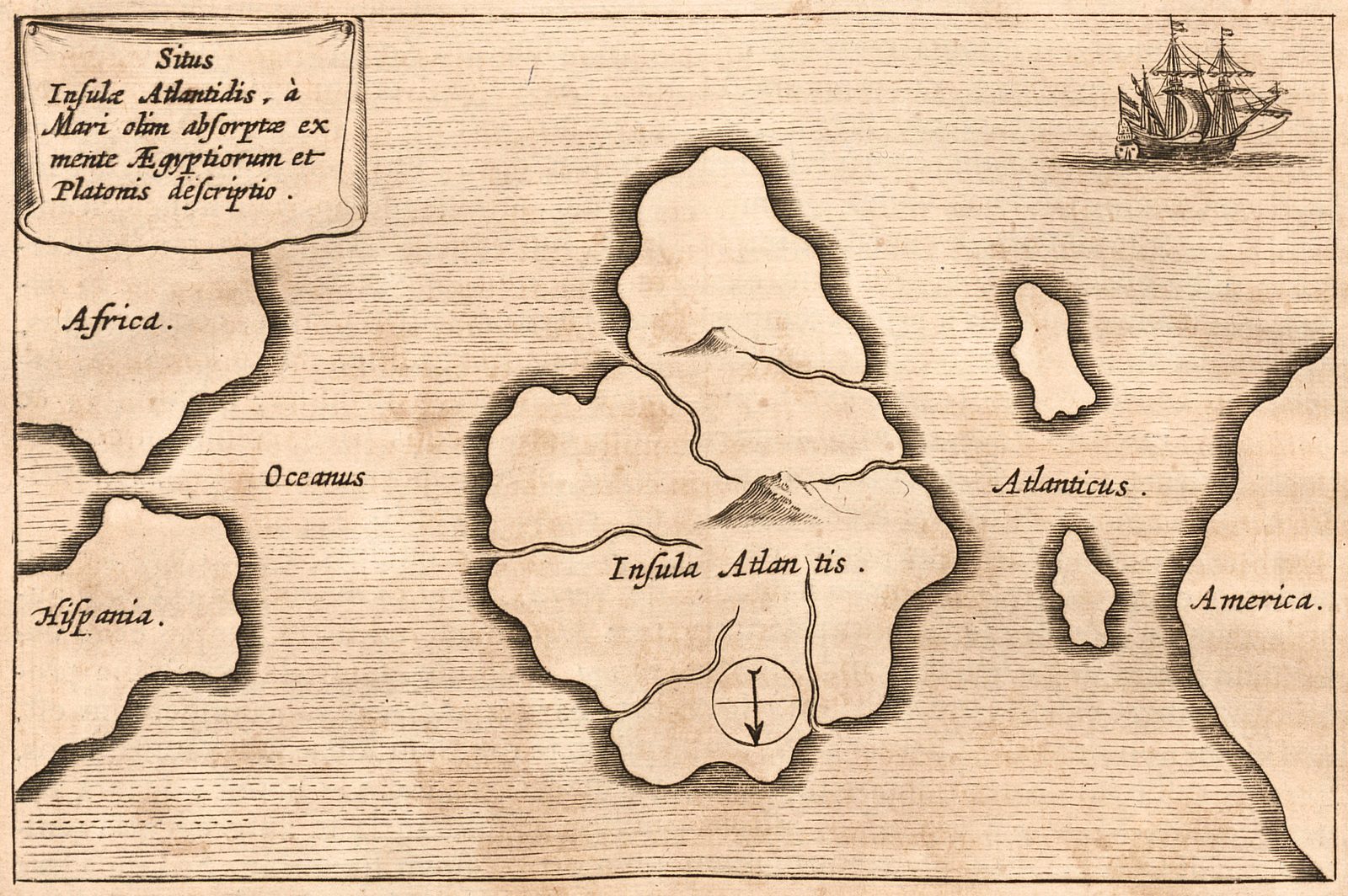
Image: a fanciful map of Atlantis drawn by the scholar Athanasius Kircher in 1669, with south at the top (public domain, Wikimedia Commons). This article discusses a philosophical fiction, not a historical place.
Where the story comes from
- Plato, Timaeus and Critias (c. 360 BCE) — the only ancient sources for Atlantis, where the story is invented and told.
- Plato, Republic — the dialogue on the ideal state that the Atlantis story was designed to complement and dramatise.
- Ignatius Donnelly, Atlantis: The Antediluvian World (1882) — the hugely influential 19th-century book that launched the modern belief in a real, lost Atlantis.
- Christopher Gill, Plato's Atlantis Story: Text, Translation and Commentary (Liverpool University Press) — a scholarly treatment of the dialogues and their literary purpose.
- Encyclopaedia Britannica, "Atlantis"; on the Thera eruption and Minoan decline, see overviews of "Thera (Santorini)" and "Minoan civilization."