In November 1519 a band of a few hundred Spanish soldiers, footsore and far from home, came over a high mountain pass and saw the valley of Mexico spread out below them. In the middle of a great lake stood a white city laced with canals and causeways, glittering with temples and palaces, larger and cleaner than almost any city in Europe. One of those soldiers, Bernal Díaz del Castillo, would write decades later that the men wondered whether what they were seeing was even real, or some enchantment out of a tale of chivalry. The city was Tenochtitlan, the capital of the Aztec Empire, and within two years it would be a smoking ruin and the empire would be gone — destroyed by a combination of force, disease, politics and betrayal that historians still work to untangle.
The story of the Aztecs and their conquest is one of the most dramatic and most distorted in all of history. It has been told as a tale of a handful of bold Spaniards toppling a mighty empire through sheer courage and superior steel — and that version is badly misleading. The reality is at once more complicated and more interesting: a sophisticated, expansionist empire with deep internal tensions, brought down not by a few hundred Europeans alone but by tens of thousands of indigenous allies, a catastrophic epidemic, and a cascade of decisions and accidents. Let us start with the empire itself.
The rise of the Mexica
The people we call the Aztecs called themselves, more precisely, the Mexica. According to their own origin traditions, they were latecomers to the Valley of Mexico — a wandering people who arrived after the great cities of earlier civilisations had already risen and fallen. Their legend held that their god Huitzilopochtli told them to settle where they saw an eagle perched on a cactus devouring a snake, an image that survives today on the Mexican flag. That sign, the story goes, appeared on a marshy island in Lake Texcoco around 1325, and there they founded Tenochtitlan.
From these unpromising beginnings on a swampy island, the Mexica rose with astonishing speed. In the early fifteenth century they joined with two neighbouring city-states, Texcoco and Tlacopan, to form the Triple Alliance — the political structure usually meant by "the Aztec Empire." Through war, alliance and shrewd politics, the Alliance, with Tenochtitlan increasingly dominant, came to control much of central Mexico, exacting tribute from hundreds of conquered towns and peoples. By the time the Spanish arrived, the empire ruled, directly or indirectly, over millions of people.
The city on the lake
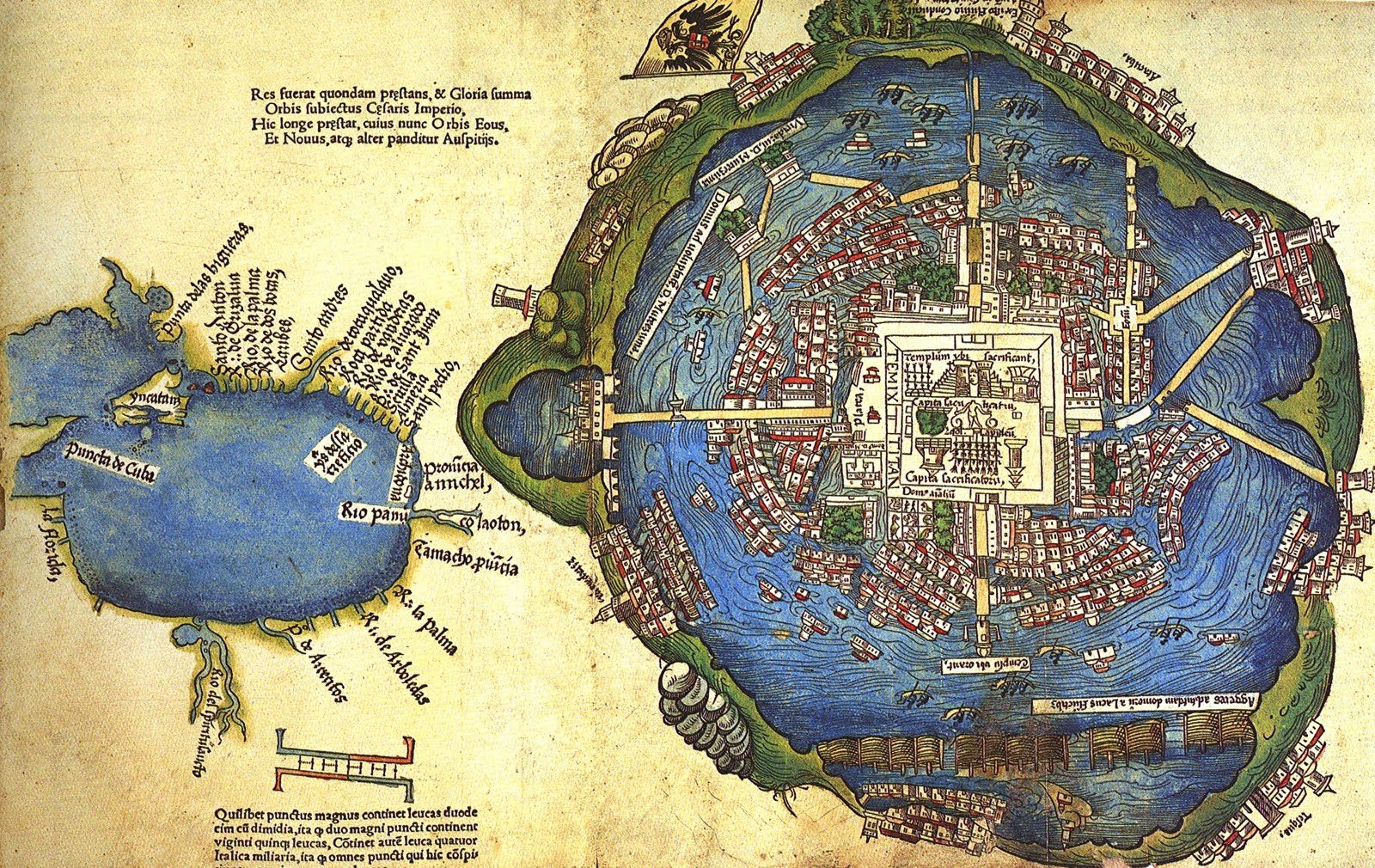
Tenochtitlan itself was a genuine marvel of engineering and planning. Built on islands in the lake and expanded with artificial plots, it was connected to the mainland by great causeways with removable bridges, supplied with fresh water by an aqueduct, and fed in part by chinampas — the famous "floating gardens," rectangular plots of fertile reclaimed land that produced abundant crops. The city was organised into districts, with markets, temples, palaces, schools and a vast ceremonial precinct dominated by the Templo Mayor, the great twin pyramid at its heart. Estimates of its population vary, but many scholars put it at well over a hundred thousand, possibly two hundred thousand — making it one of the largest cities in the world at the time, larger than most European capitals.
"And when we saw all those cities and villages built in the water, and other great towns on dry land, and that straight and level causeway leading to Mexico, we were astounded... some of our soldiers asked whether it was not all a dream."— Bernal Díaz del Castillo, The True History of the Conquest of New Spain, written from memory decades after the events
Bernal Díaz, an ordinary soldier who marched with Hernán Cortés and wrote his account many years later in old age, partly to correct what he saw as the flattering histories that gave all the credit to the leaders, is one of our most vivid sources. He is also, of course, a partisan and fallible one, writing long after the fact, and historians read him with care. But his wonder at Tenochtitlan rings true, and it is corroborated by other accounts: this was a city that genuinely amazed the men who came to destroy it.
Religion, tribute and the seeds of resentment
Aztec society was deeply religious, and its religion has become the lurid centrepiece of the popular image: human sacrifice. The Mexica did practise human sacrifice, sometimes on a large scale, in the belief that the gods — and especially the sun — required human hearts and blood to keep the cosmos in motion. Captives taken in war were a primary source of victims, which gave Aztec warfare a particular character; the famous "flower wars" were, in part, ritualised conflicts that supplied sacrificial captives. The scale of this is genuinely debated, and we will come to that, but the practice was real and central to the state's ideology.
Just as important politically was the empire's tribute system. The Aztecs did not generally administer conquered peoples directly; instead they left local rulers in place and demanded heavy tribute — goods, textiles, food, and captives — backed by the threat of brutal reprisal. This made the empire wealthy but also widely resented. Many subject peoples loathed Aztec domination, and some independent states, above all the fiercely anti-Aztec city of Tlaxcala, had never been conquered at all. That reservoir of resentment would prove utterly decisive when the Spanish arrived, looking for allies.
Worth knowing: Cortés never commanded an army that was mostly Spanish. The force that besieged and took Tenochtitlan was overwhelmingly indigenous — tens of thousands of warriors from Tlaxcala and other peoples who hated Aztec rule and saw the Spanish as a means to overthrow it. The few hundred Europeans were, in a real sense, a faction in a vast indigenous war against the Aztec Empire. The "conquest" was as much a regional uprising, with Spanish leadership and weapons, as a foreign invasion.
Cortés, Moctezuma and the strange first encounter
Hernán Cortés landed on the Mexican coast in 1519 with about five hundred men, in defiance of the governor who had sent him and then tried to recall him. As he marched inland he fought, negotiated and recruited, crucially forging an alliance with Tlaxcala after some hard fighting. He was aided throughout by an enslaved indigenous woman known as La Malinche (or Doña Marina), who spoke both Nahuatl and Maya and became his interpreter and adviser — a figure of enormous historical importance and enduring controversy in Mexico to this day.
When the Spanish and their allies reached Tenochtitlan, the Aztec ruler Moctezuma II received them, for reasons historians still debate, more or less peacefully, lodging them in the city. The arrangement soon collapsed. The Spanish took Moctezuma hostage in his own capital; tensions mounted; and while Cortés was away dealing with a rival Spanish expedition, his deputy ordered a massacre of Aztec nobles during a religious festival. The city rose in fury. Moctezuma died during the crisis — by Spanish accounts stoned by his own people, by other accounts killed by the Spanish — and on the night known as the Noche Triste, the "Night of Sorrows," in mid-1520, the Spanish and their allies were driven out of the city with heavy losses, fighting their way across the causeways in the dark.
The role of disease — and of allies
It would have been easy for the story to end there, with the Spanish expelled and the empire intact. It did not, and the reasons are crucial to understanding what really happened. Two factors, above all, turned a defeat into a conquest: indigenous allies and disease.
"A few hundred Spaniards, with their guns, steel and horses, conquered the mighty Aztec Empire through sheer European superiority."
The Spanish were a small part of a much larger force. Tens of thousands of indigenous allies, especially the Tlaxcalans, did most of the fighting, and a devastating smallpox epidemic — a disease to which the people of the Americas had no immunity — swept through Tenochtitlan in 1520, killing a huge share of its population, including its new leadership, before the final siege. Steel and horses mattered, but allies and disease were decisive. This was not a tidy clash of "European versus Aztec."
The smallpox epidemic deserves special emphasis because it is so often left out of the dramatic retellings. The disease, apparently introduced by a member of a later Spanish expedition, tore through the densely populated valley in 1520 with catastrophic effect. The Aztecs, like all the peoples of the Americas, had no prior exposure and no immunity. The epidemic killed an enormous proportion of Tenochtitlan's inhabitants, struck down warriors and leaders alike — including Moctezuma's successor Cuitláhuac after a reign of only weeks — and shattered the city's ability to resist at the very moment it most needed to. Indigenous accounts recorded the horror of bodies piling up faster than they could be buried. No account of the conquest is honest without it.
The siege and the fall
Regrouped in Tlaxcalan territory and reinforced, Cortés returned in 1521 with a vastly larger indigenous army and a clever plan: he had small ships, brigantines, built and carried in pieces to the lake, giving him control of the water and allowing him to cut the causeways and sever the city's supplies. The siege of Tenochtitlan that followed, over several brutal months in 1521, was one of the most destructive episodes in the history of the Americas. The defenders, under their last ruler Cuauhtémoc, fought with extraordinary tenacity, district by district, even as famine and disease ravaged the encircled city.
When Tenochtitlan finally fell in August 1521, much of it had been deliberately demolished in the fighting, and great numbers of its people were dead. Cuauhtémoc was captured, later to be tortured for gold and eventually executed. On the ruins of the Aztec capital the Spanish would build Mexico City, deliberately erecting their cathedral and government over the sacred Aztec centre — a layering of conquest that is still being literally excavated today, as the remains of the Templo Mayor continue to emerge from beneath the modern city.
How many were sacrificed — and how reliable are the sources?
How extensive was Aztec human sacrifice, really? Spanish and allied sources cite staggering figures — one oft-repeated claim of tens of thousands sacrificed at a single temple dedication. Some historians take the practice as genuinely large-scale, supported by archaeological finds of skull racks and sacrificial remains; others argue the numbers were inflated by conquistadors and missionaries who had every motive to portray the Aztecs as monstrous and thereby justify the conquest. Archaeology confirms that human sacrifice was real and ritually central, but the precise scale is contested, and the most extreme figures are widely doubted. As with much of this history, our sources are written largely by the victors and the converted, and must be read critically.
This problem of sources runs through the whole subject. Much of what we know about the Aztecs comes either from Spanish conquistadors and friars or from indigenous accounts recorded after the conquest, often under Spanish supervision, in works like the great Florentine Codex compiled by the friar Bernardino de Sahagún with native informants. These sources are invaluable, but every one of them was shaped by the catastrophe and by the agendas of those who wrote it down. Reconstructing the Aztec world means reading such documents against the grain, cross-checking them with archaeology, and being honest about how much uncertainty remains.
What was lost, and what survived
The fall of Tenochtitlan was not only a military and political event but a civilisational rupture. In the decades that followed, the population of central Mexico collapsed, wave after wave of introduced epidemics killing, by many estimates, the great majority of the indigenous population — one of the worst demographic catastrophes in human history. Temples were torn down, codices burned, and a new colonial order imposed, blending with and overwriting what came before.
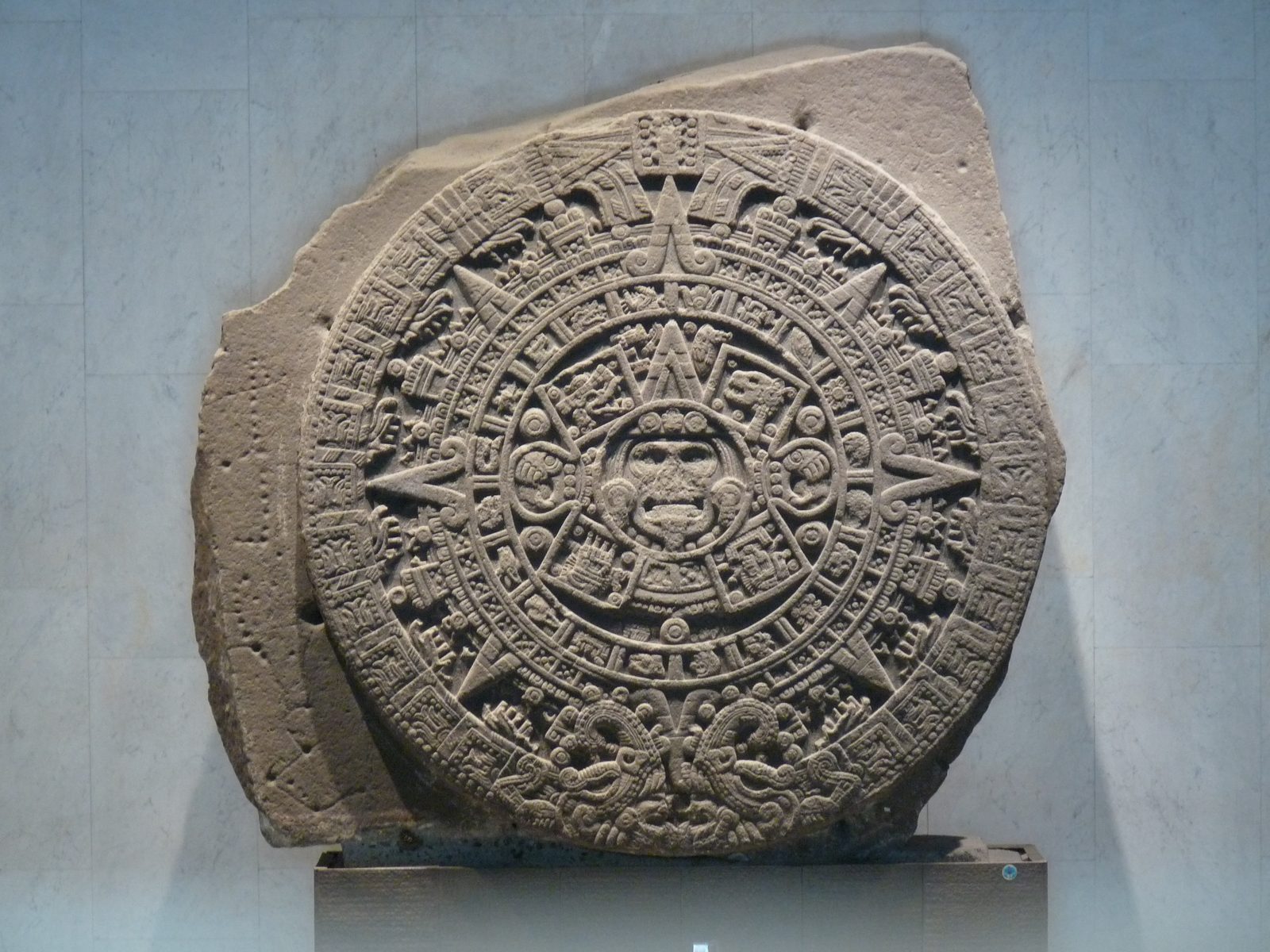
Yet the Aztec world did not vanish completely. The Nahuatl language is still spoken by well over a million people in Mexico today. Aztec foods, words, place-names and traditions are woven through Mexican culture. The eagle-and-serpent of the founding legend flies on the national flag. And the physical heart of the empire keeps resurfacing: in 1978, workers in Mexico City uncovered a huge carved stone of an Aztec goddess, leading to the ongoing excavation of the Templo Mayor in the very centre of the modern capital, where tourists now walk among the ruins of the great pyramid the Spanish thought they had erased. Modern Mexico has, in recent generations, increasingly reclaimed this heritage as a source of identity and pride rather than shame.
The honest story of the Aztecs and their fall, then, resists the easy myths from every direction. They were neither the simple savages of conquistador propaganda nor a faultless paradise destroyed by pure European villainy. They built a brilliant, expansionist, sometimes brutal empire that made many enemies, and that empire was brought down by a convergence of indigenous rebellion, catastrophic disease, and a small band of determined, ruthless foreigners who knew how to exploit a divided land. The eagle on the cactus still stands for a civilisation that was conquered but, in language and blood and stone, never entirely erased.
Image: a 16th-century map of Tenochtitlan published with Hernán Cortés's letters in 1524 (public domain, via Wikimedia Commons).
Where to read more
- Bernal Díaz del Castillo, The History of the Conquest of New Spain (written 1560s; many modern translations) — eyewitness account by a common soldier.
- Bernardino de Sahagún, Florentine Codex: General History of the Things of New Spain (16th century) — compiled with Nahua informants.
- Inga Clendinnen, Aztecs: An Interpretation (Cambridge University Press, 1991).
- Matthew Restall, Seven Myths of the Spanish Conquest (Oxford University Press, 2003).
- Camilla Townsend, Fifth Sun: A New History of the Aztecs (Oxford University Press, 2019); Encyclopaedia Britannica, "Aztec" and "Tenochtitlan."