Imagine a single bolt of Chinese silk in the first century. It starts its journey near the Han capital, traded to a merchant who carries it a few hundred miles west and sells it on. That trader sells to another, who sells to another — across deserts, over mountain passes, through oasis towns and the hands of Sogdian middlemen and Persian caravans — until, perhaps two or three years and a dozen owners later, it is draped across the shoulders of a wealthy Roman who has no real idea where China is, only that this impossibly fine fabric comes from somewhere at the edge of the world. Almost nobody travelled the whole route. The road moved goods; the goods moved by relay. And that single bolt of silk is a decent way to picture the most famous trade network in history.
There was never actually a "Silk Road"
Let's start by dismantling the name, because it's misleading in almost every word. There was no single road. There was no signposted highway you could set off down. And it wasn't really about silk, not mainly.
Nobody living in the era of the "Silk Road" ever called it that. The term — Seidenstrasse — was coined in 1877 by a German geographer, Ferdinand von Richthofen (uncle of the Red Baron, as it happens). So a network that flourished for well over a thousand years got its romantic name from a 19th-century academic, applied retroactively. The traders who actually used it would have had no idea what you meant.
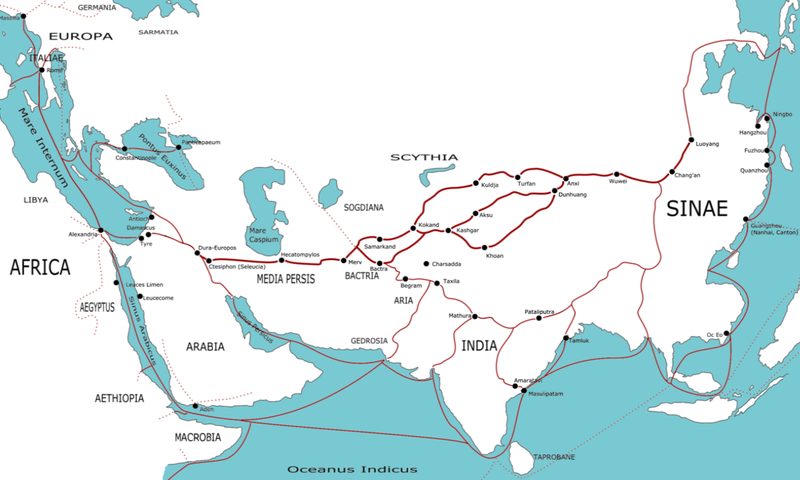
What we call the Silk Road was really a sprawling, shifting web of overland and maritime routes connecting China, Central Asia, India, Persia, the Arab world, and the Mediterranean. Branches opened and closed with politics, weather, and war. Calling it "the Silk Road" is a bit like calling the entire internet "the cat-video network" — technically there are cat videos on it, but you've badly missed the scale of the thing.
Relay, not through-traffic
The conventional starting point is the Han dynasty in the second century BCE. A Chinese envoy named Zhang Qian was sent west by the emperor on a diplomatic mission and came back, years later, with detailed reports of sophisticated civilisations out there in the west that the Chinese hadn't known existed. His journey is often credited with opening up sustained contact between China and Central Asia — the moment the routes really came alive.
From there, trade ran on a relay system. Goods passed through a chain of intermediaries — and the real winners were often the middlemen, especially the Sogdians, a Central Asian people who became the great merchant-translators of the network, their language a kind of commercial lingua franca for centuries. Caravans of camels (superbly adapted to the deserts) moved between oasis cities like Samarkand, Kashgar, and Dunhuang, stopping at caravanserais — roadside inns where travellers, animals and goods could rest and trade. Each leg was its own enterprise. The system didn't need anyone to make the whole trip; it just needed every link to want a profit.
What really travelled the routes
Silk went west, certainly — the Romans were mad for it, to the point where moralists grumbled about the gold draining east to pay for a fabric they considered scandalously see-through. But the cargo ran in every direction and covered far more than cloth: Chinese paper and, eventually, papermaking itself; Central Asian horses (which the Chinese craved); glassware from the Roman world; spices, gems, and cotton from India; furs from the north. It was a genuine exchange, not a one-way silk pipeline.
"The Silk Road was a single road where merchants carried silk from China to Rome."
It was a shifting web of many routes, land and sea; the goods moved by relay through countless middlemen rather than end-to-end traders; and silk was only one commodity among many. Its most important cargo wasn't a product at all — it was ideas.
The real cargo was ideas
Here's what makes the Silk Road genuinely world-changing, and it's the part the "luxury goods" framing undersells. The routes carried religion, technology, art, and language across the entire continent. Buddhism travelled from India into China along these roads — the spectacular cave temples at Dunhuang and Bamiyan grew up as waystations of faith as much as commerce. Later, Islam spread along the same arteries. Technologies leapfrogged civilisations: papermaking moved west out of China, and many historians trace the long, slow westward drift of things like gunpowder and the compass along these networks too.
When you move silk, you move the people carrying it — and people carry their gods, their inventions, their stories, and their alphabets with them. The Silk Road was, in effect, the ancient world's information network. Cultures that never knew each other's names were quietly reshaping one another across thousands of miles.
The cities the road built
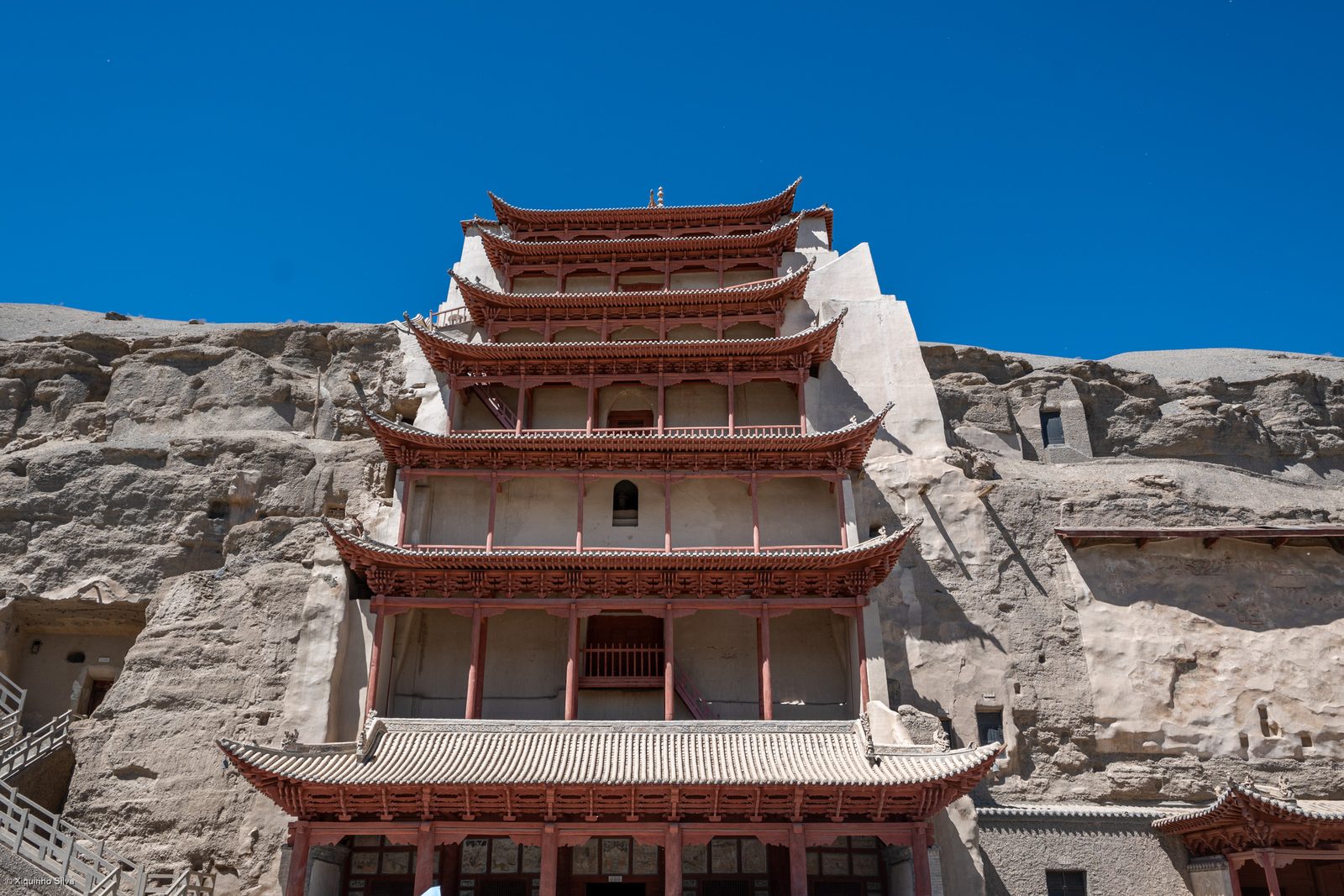
A trade network this vast didn't just move goods through empty space — it grew cities, and some of the most glittering places of the ancient and medieval world owed their wealth to it. Samarkand, in modern Uzbekistan, became a byword for exotic splendour, its markets thick with merchants from a dozen cultures. Dunhuang, on the western edge of China, guarded the gateway to the deserts and filled its nearby cliffs with hundreds of Buddhist cave-shrines painted by grateful (and nervous) travellers. Palmyra in the Syrian desert grew rich as a caravan city linking the Roman world to the east. Merv, Bukhara, Kashgar — these were the service stations and treasure houses of the network, and their prosperity rose and fell with the traffic that passed through them.
It's a useful corrective to the romantic image of lonely camels in empty dunes. The Silk Road was, at its height, intensely urban — a chain of cosmopolitan boomtowns where languages, currencies and faiths collided daily.
A Roman craving and a Chinese secret
The western appetite for silk became something close to an obsession, and it genuinely worried Roman moralists, who saw fortunes in gold flowing east to pay for a fabric they considered indecently revealing. The philosopher Seneca, in the first century CE, was scathing about it.
"I see silken clothes, if one can call them clothes at all… in which there is nothing that could defend the body, or indeed the modesty… Wretched flocks of maids labour so that the adulteress may be visible through her thin dress."— Seneca the Younger, on the Roman fashion for Chinese silk, 1st century CE
What the Romans didn't have was the secret of how silk was made. For centuries China guarded the mystery of the silkworm and the mulberry leaf as a jealously protected state monopoly — revealing it was, by some accounts, punishable by death. That monopoly held for a remarkably long time. The traditional story holds that it was finally broken in the 6th century, when two monks supposedly smuggled silkworm eggs out of the east to the Byzantine emperor Justinian, hidden inside their hollow bamboo staffs — and the West could at last make its own silk. Whether the smuggling happened exactly that way or not, it's a nice illustration of how, on the Silk Road, the most valuable thing you could steal wasn't gold. It was know-how.
The travellers who wrote it down
We know as much as we do because a handful of remarkable people made the journey and left records. In the 7th century the Chinese Buddhist monk Xuanzang travelled west to India in search of scriptures and came back with both sacred texts and a detailed account of everything he saw, a priceless source for historians. Centuries later the Venetian Marco Polo claimed to have spent years at the court of Kublai Khan, and his Travels fired the European imagination for generations (even as some scholars still argue over how much he really witnessed). The Moroccan traveller Ibn Battuta crossed much of the same world in the 14th century. These were the rare individuals who actually experienced the network end to end — and through their eyes, a web of anonymous relay trade becomes a human story.
The cargo nobody wanted
Where opinion splits: The same connectivity that carried Buddhism and paper may also have carried catastrophe. Many scholars argue the trade routes helped spread devastating pandemics — possibly the Plague of Justinian in the 6th century, and quite likely the Black Death in the 14th, which seems to have moved out of Central Asia along trade and military routes before ravaging Europe. Just how central the overland routes were to these outbreaks (versus sea trade or other paths) is still actively debated, but the broader point is hard to dodge: a network that connects the world also connects its diseases.
The other Silk Road: the one at sea
We talk about camels and deserts, but a huge share of this trade always moved by water, and any honest picture of the network has to include the sea. A "Maritime Silk Road" ran from the ports of southern China, through Southeast Asia, across the Indian Ocean to India, the Persian Gulf, the Red Sea and East Africa. Ships could carry far more cargo than a camel train, and they didn't need to bribe their way past quite so many middlemen, which is exactly why, in the long run, the sea routes would win.
These waterborne routes carried the bulkier, heavier goods that overland caravans couldn't handle economically — above all spices, which is why the maritime network is sometimes called the Spice Route. Pepper, cinnamon, nutmeg and cloves flowed west and became worth, quite literally, their weight in precious metal in European markets. Port cities from Guangzhou to Calicut to Hormuz grew fat on this traffic, and the monsoon winds, which reverse direction with the seasons, set the rhythm of the whole Indian Ocean trading world. When Europeans finally began sailing directly to Asia in the late 15th and 16th centuries, they weren't discovering a new trade so much as muscling their way, with cannon, into a sea-lane that had been busy for well over a thousand years.
Decline — and a long afterlife
The overland routes never had a single death either. They ebbed and flowed with the rise and fall of the empires that protected them — the Mongol Empire in the 13th and 14th centuries actually revived overland trade dramatically, imposing a rough stability across Eurasia that let travellers like Marco Polo make their journeys. But over the following centuries, as European powers developed ocean-going ships and opened direct sea routes to Asia, the slow, costly overland caravans gradually lost out to cheaper maritime trade. The age of the great land caravans faded — not in a collapse, but in a long commercial sunset.
And yet the idea never died, which is the strange final twist. That 19th-century name, "the Silk Road," captured the public imagination so completely that it's now one of the most evocative phrases in history, and modern nations invoke it deliberately for vast new infrastructure projects. We've taken a messy, centuries-long, name-less web of relay trade and turned it into a single shining symbol of connection between East and West. The romance is a little invented. But the underlying truth it points to — that the ancient world was far more connected, and far more mutually entangled, than we tend to assume — is entirely real. Long before anyone spoke of globalisation, a bolt of silk could already cross a continent, and an idea could travel even further. The Silk Road's deepest lesson is simply that no civilisation, however isolated it imagined itself to be, was ever really alone.
Image: map of the main trans-Eurasian trade routes of the 1st century CE (public domain, via Wikimedia Commons).
References and further reading
- Peter Frankopan, The Silk Roads: A New History of the World (Bloomsbury, 2015).
- Valerie Hansen, The Silk Road: A New History (Oxford University Press, 2012).
- Susan Whitfield, Life Along the Silk Road (University of California Press).
- Encyclopaedia Britannica, "Silk Road"; UNESCO Silk Roads Programme; the International Dunhuang Project archives.