On the morning of 24 August — or possibly a few weeks later, in October; we'll come back to that argument — a young man of about seventeen sat reading and taking notes in a seaside villa across the bay from a mountain he had never thought of as dangerous. His name was Pliny, and his uncle, the famous naturalist, had just hurried off toward the smoke to see the thing up close and, being who he was, to help. The boy stayed behind with his books. Years later he wrote down what he had seen, and in doing so left us the only detailed eyewitness account of the eruption that buried Pompeii. We have been reading over his shoulder ever since.
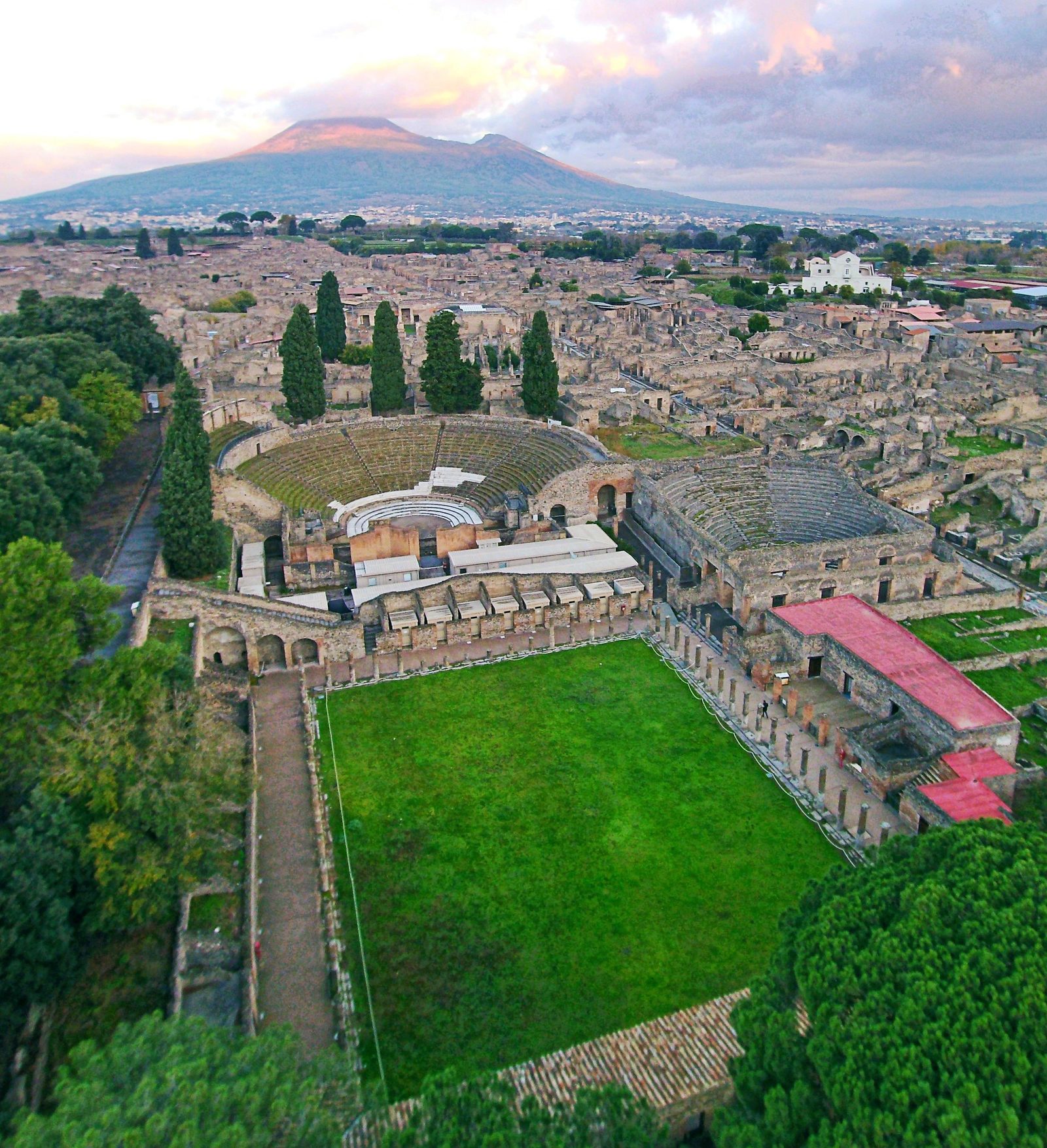
Pompeii is one of those rare places where a catastrophe became a gift to history. A thriving Roman town of perhaps 12,000 people was smothered in a single day and sealed under metres of volcanic debris, and there it sat, more or less untouched, for the better part of seventeen centuries. When people finally dug it out, they didn't find ruins so much as a paused moment: loaves of bread still in ovens, election slogans painted on walls, a dog straining at its chain. To walk through Pompeii is to walk through an ordinary day that never ended.
A town that didn't know what it was sitting on
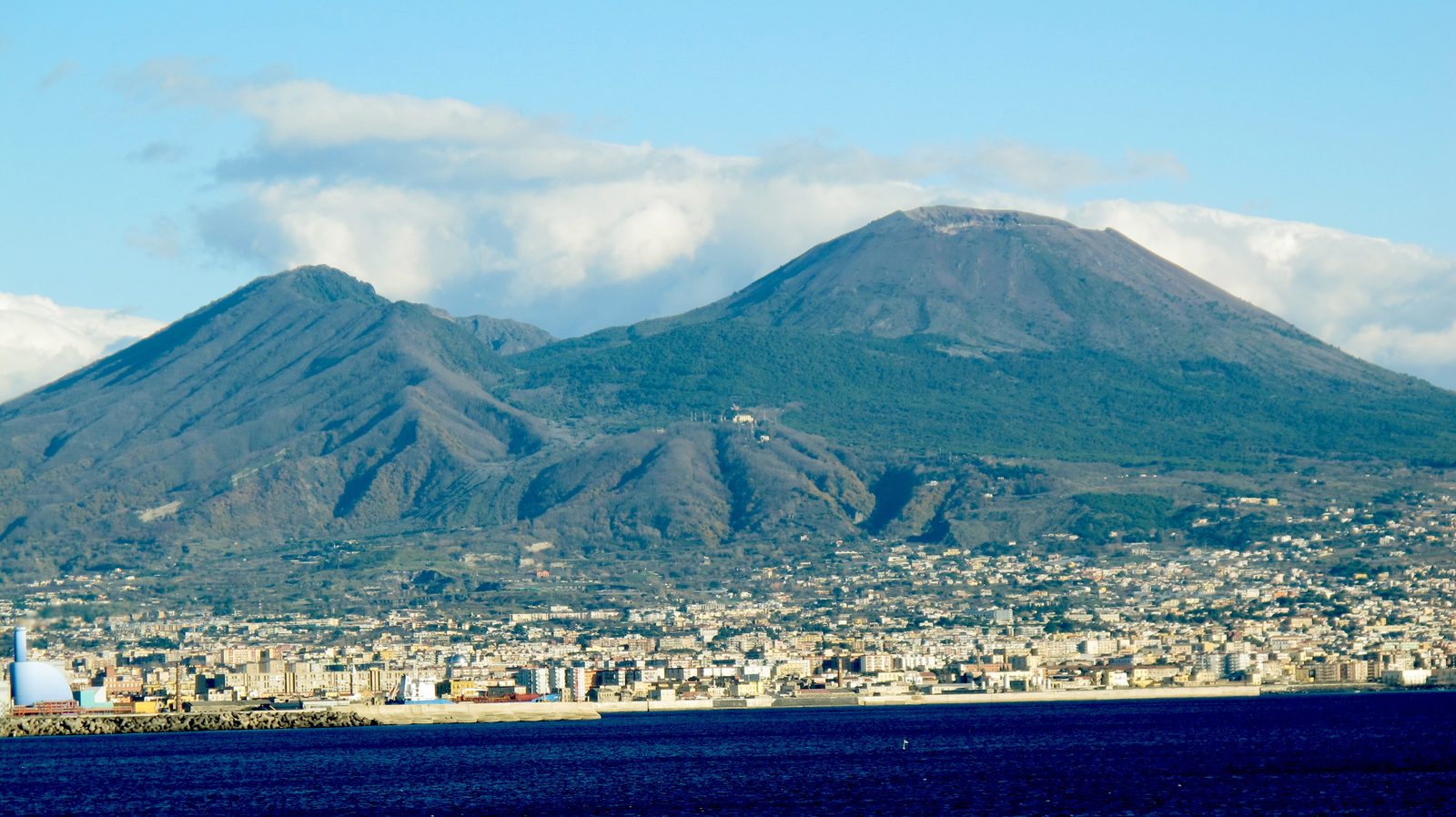
Pompeii lay in Campania, in the fertile country at the foot of Mount Vesuvius, near the Bay of Naples. By the first century CE it was a comfortable, prosperous place — not grand like Rome, but busy and well-off, full of bakeries, laundries, taverns, brothels, bath-houses and fine private homes decorated with the vivid wall-paintings we still admire today. The volcanic soil made the region rich for vines and crops. That was the cruel irony nobody understood at the time: the very thing that made the land so fertile was the mountain that would destroy them.
The Romans did not really grasp that Vesuvius was a volcano in the sense we mean. There had been no eruption in living memory, and the peak was green and cultivated to its summit. There had been a serious earthquake in 62 or 63 CE that damaged buildings across the town — repairs were still underway when the end came — but nobody seems to have connected those tremors to the mountain looming above them. They lived, quite literally, on top of a sleeping danger they had no name for.
Pliny the Younger, watching from across the bay
Most of what we know about the eruption as an event — rather than as an archaeological layer — comes from two letters written by Pliny the Younger to the historian Tacitus, decades after the fact. Tacitus had asked him about the death of his uncle, Pliny the Elder, who commanded the Roman fleet at nearby Misenum and died during the disaster. The younger Pliny's reply is so careful and observant that volcanologists named an entire category of violent, column-forming eruptions "Plinian" in his honour.
He describes his uncle noticing a strange cloud rising from across the bay, shaped, he said, like an umbrella pine — a tall trunk of smoke spreading into branches at the top. That image is now textbook: it's exactly how a major explosive eruption looks as it punches ash and pumice kilometres into the sky. Pliny the Elder, scientist to the last, ordered ships out to get a closer look and to rescue people trapped along the shore, and he never came back.
"Its general appearance can best be expressed as being like a pine tree, for it rose to a great height on a sort of trunk and then split off into branches… in places white, elsewhere dark and dirty from the ash and cinders it carried with it."— Pliny the Younger, Letters VI.16, describing the cloud over Vesuvius (written c. 107 CE, recounting events of 79 CE)
The younger Pliny's second letter describes his own experience back at Misenum: the ground heaving with repeated shocks, the sea sucked back from the shore, a black cloud rolling toward them split by great forks of flame, and a darkness, he wrote, not like a moonless night but like a sealed room with the lamp put out. People called for their parents, their children, their gods; some, he admits with disarming honesty, prayed for death simply because they were so afraid of dying. It is one of the most human pieces of writing to survive from the ancient world.
Pumice first, then the surges
Modern volcanology, combined with Pliny's account and the evidence in the ground, lets us reconstruct the eruption in grim detail. It came in two broad phases. First, for many hours, the towering eruption column rained pumice and ash down on Pompeii — light, frothy stones piling up on roofs and streets. This buried the town slowly and collapsed many roofs under the weight, and it killed people, but it was survivable if you fled early. Many did escape during this phase.
The real killer came later. When the eruption column eventually lost energy and collapsed, it sent searing avalanches of hot gas, ash and rock racing down the mountain at tremendous speed — what we now call pyroclastic surges and flows. These were the fatal blow. A surge of superheated gas and debris, possibly several hundred degrees, swept over Pompeii and killed everyone still there almost instantly, then buried what remained. Herculaneum, a wealthier town on the other flank of Vesuvius, was hit by these flows even earlier and entombed under far deeper deposits.
Worth knowing: The famous plaster "bodies" of Pompeii are not bodies, and not really plaster casts of bodies either. The victims' soft remains decayed inside the hardened ash, leaving hollow voids in the exact shape of the person at the moment of death. In the 1860s the excavator Giuseppe Fiorelli realised he could pour liquid plaster into those cavities and let it set — casting the empty space where a human being used to be. What you see in the photographs is, in effect, a sculpture made by the void a person left behind.
Lost, then found by accident
After 79 CE, Pompeii effectively vanished. The buried town slipped out of memory; later generations farmed the land above it without quite knowing what lay beneath. The rediscovery was slow and partly accidental. Herculaneum was stumbled upon first, in the early 18th century, when workers digging a well struck ancient marble. Pompeii itself began to be properly excavated from 1748 under the Bourbon kings of Naples, who were at least as interested in hauling out treasures for the royal collection as in understanding the site.
For a long time the digging was closer to looting than archaeology — tunnels chasing statues and frescoes, with little record kept of where things were found. The shift toward something more careful came in the 19th century, above all under Fiorelli, who imposed system on the chaos: dividing the town into regions and blocks, recording findings, and pioneering the body-cast technique that made the human tragedy suddenly, unbearably visible. Pompeii helped turn antiquarian treasure-hunting into the discipline of archaeology.
An entire Roman world, frozen mid-sentence
What makes Pompeii priceless is the ordinariness of what survived. Most of what we know about the ancient world comes from temples, monuments and the writings of the elite. Pompeii gives us the rest: the daily texture of a real Roman town. There are bakeries with their millstones and ovens, bars with counters and the round holes where jars of food and wine were set, public latrines, voting notices, and graffiti scratched everywhere by ordinary people — lovers' boasts, insults, tallies, jokes, a line of Virgil copied out, crude drawings. It is the unglamorous, gossiping, living voice of antiquity, the part that usually rots away.
The wall-paintings, preserved by the very ash that buried them, are among the finest to survive from the Roman world, and they keep teaching us about colour, technique and daily life. The frozen contents of houses — furniture, jewellery, surgical instruments, foodstuffs, a strongbox, a basket of figs — let archaeologists reconstruct how people actually lived, ate, worked and decorated their homes with a precision available almost nowhere else in the ancient record.
"Everyone in Pompeii was caught by surprise and instantly buried, frozen exactly where they stood."
Many residents did flee during the long opening phase of falling pumice, which lasted hours. The roughly 1,000 victims found so far were largely those who stayed too long or sheltered indoors and were caught by the later pyroclastic surges. The "frozen in time" image is real, but it captures the ones who didn't get out — not the whole town at once.
The argument over the date
For centuries the eruption was confidently dated to 24 August 79 CE, the date given in most manuscripts of Pliny's letter. But that date has come under real pressure. Archaeologists have long noticed details that fit autumn better than late summer: braziers set up as if for heating, the remains of autumn fruits like pomegranates and walnuts, fermenting wine sealed in jars, and victims found wearing heavier clothing than an August day in Campania would call for.
When did Vesuvius actually erupt? In 2018 excavators announced a charcoal inscription at Pompeii apparently dated to mid-October — written, it seems, just days before the disaster — which would push the eruption to roughly 24 October 79 CE rather than 24 August. Combined with the autumn produce and warm clothing, many scholars now favour an autumn date, arguing that Pliny's manuscripts were simply miscopied over the centuries. Others urge caution. The traditional August date still appears in plenty of sources, and the debate isn't fully settled — but the evidence has tilted noticeably toward autumn.
Pliny the Elder: the scientist who didn't run
It's worth pausing on the man who died. Pliny the Elder was one of the great minds of his age, author of the sprawling Natural History, an encyclopaedia attempting to gather all known facts about the world. When the cloud appeared, his instinct was the scientist's instinct: get closer, observe, record. But he was also a naval commander, and when a message arrived begging for rescue, his mission turned from curiosity to a relief operation.
According to his nephew, he sailed straight toward the danger, calmly dictating notes on what he saw even as ash and pumice fell on the ships. He reached the shore near Stabiae, tried to reassure terrified friends, even bathed and dined to keep up morale, and slept — or pretended to. By morning the fumes and falling debris had made the area impossible, and he collapsed and died on the beach, probably from the toxic gases, though his weight and apparent breathing trouble may have played a part. His body was found later, intact, looking, his nephew wrote, more asleep than dead. He is one of history's first recorded casualties of scientific curiosity in the face of a natural disaster.
Three million people in its shadow
Vesuvius did not finish with the world in 79 CE. It has erupted many times since, most recently in 1944, and it remains one of the most dangerous volcanoes on Earth precisely because around three million people now live in its shadow, in the sprawl of greater Naples. Pompeii is not only a window into the past; it is a standing warning about the present. The same fertile slopes that drew the Romans draw people still.
But the deepest reason Pompeii grips us is simpler and more human. Most of the ancient dead are abstractions to us — names on monuments, lines in chronicles. The people of Pompeii are not abstractions. We have their bread, their graffiti, their dogs, the casts of their bodies curled against the ash. We can stand in their streets, read their walls, and feel, with a jolt, that they were exactly as alive as we are. A disaster erased a town, and in erasing it, preserved it more completely than any normal survival ever could. That is the strange double gift of Pompeii: it shows us death, and in the same breath, it shows us life — caught mid-sentence, and never quite finished.
Image: a plaster cast of a victim of the 79 CE eruption of Vesuvius, Pompeii (public domain, Wikimedia Commons).
Further reading
- Pliny the Younger, Letters VI.16 and VI.20 (written c. 107 CE) — the only surviving eyewitness account of the eruption.
- Mary Beard, Pompeii: The Life of a Roman Town (Profile Books, 2008).
- Pliny the Elder, Natural History — the encyclopaedic work of the commander who died in the disaster.
- Giuseppe Fiorelli, excavation reports of the 1860s, on the body-cast technique and the systematic survey of the site.
- Encyclopaedia Britannica, "Pompeii" and "Vesuvius"; Archaeological Park of Pompeii, official site reports including the 2018 charcoal-inscription dating evidence.