Of all the figures in Greek mythology, Prometheus might be the one who feels most modern. He's not a hero in the sword-swinging sense. His weapon is cleverness, his crime is generosity, and his punishment is one of the most vivid images of suffering the ancient world ever produced. Strip the myth down and it's a story about a single dangerous idea: that knowledge, once given to ordinary people, can never be taken back — and that the powerful will make you pay for handing it over.
The trickster among the Titans
Prometheus belonged to the Titans, the older generation of gods who ruled before Zeus and the Olympians overthrew them. His name is usually translated as "forethought," and he's paired in the myths with a slow-witted brother, Epimetheus, whose name means "afterthought" — the one who acts first and thinks later. Between them they were said to have had a hand in shaping living creatures, and in some versions Prometheus moulds the first humans out of clay. From the start, then, he's tied to humanity in a way most gods simply aren't. He's on our side.
That sympathy is the engine of the whole story. The Olympian gods, in these tales, don't particularly care about mortals. Prometheus does. And caring about humans, in a universe ruled by a jealous king of the gods, turns out to be a very expensive habit.
The trick at Mecone
Before the famous theft of fire, there's a sly little episode that sets it up. According to the poet Hesiod, gods and mortals met at a place called Mecone to settle how sacrifices should be divided between them. Prometheus, acting as humanity's advocate, prepared two portions and let Zeus choose. One was the good meat, hidden unappealingly inside an ox's stomach. The other was just bones, dressed up in glistening fat to look delicious.
Zeus chose the shiny fat-covered bones — whether genuinely fooled or, as some versions hint, choosing to be fooled so he'd have a reason to be angry. Either way, the deal was set: from then on, humans would burn the bones and fat for the gods in sacrifice and keep the nourishing meat for themselves. Prometheus had tricked the king of the gods on behalf of mortals. Zeus, furious, retaliated by hiding fire from humankind, leaving people cold and unable to cook, to forge, to build.
Prometheus wasn't only a story — he had an actual cult. In Athens he was honoured with torch races, runners carrying live flame across the city in his name. Fitting, for the god who supposedly smuggled fire to humanity inside a hollow fennel stalk — a real plant whose dry inner pith really can carry a smouldering ember for hours.
Stealing fire
And that's where Prometheus commits the act he's remembered for. He steals fire back — in the classic telling, smuggling a glowing ember inside the hollow stalk of a fennel plant — and gives it to humanity.
It's easy to read past how big this is. Fire here isn't just warmth. It's the foundation of civilisation itself: metalworking, cooking, pottery, light against the dark, the whole technological ladder that lifts humans above other animals. In a later, magnificent treatment of the myth by the playwright Aeschylus, Prometheus claims to have given mortals not only fire but the arts that flow from it — number and writing, medicine, the reading of the seasons, the taming of animals. He is, in that version, the patron of human progress as a whole.
"I hunted out the secret spring of fire, that has proved to mortals a teacher in every art and a means to mighty ends." — Prometheus, in Aeschylus' Prometheus Bound
"I caused mortals to cease foreseeing their doom… I planted firmly in their hearts blind hopefulness."— Prometheus, in Aeschylus, Prometheus Bound (5th century BCE). Beyond fire, he claims to have given humans hope itself.
The price
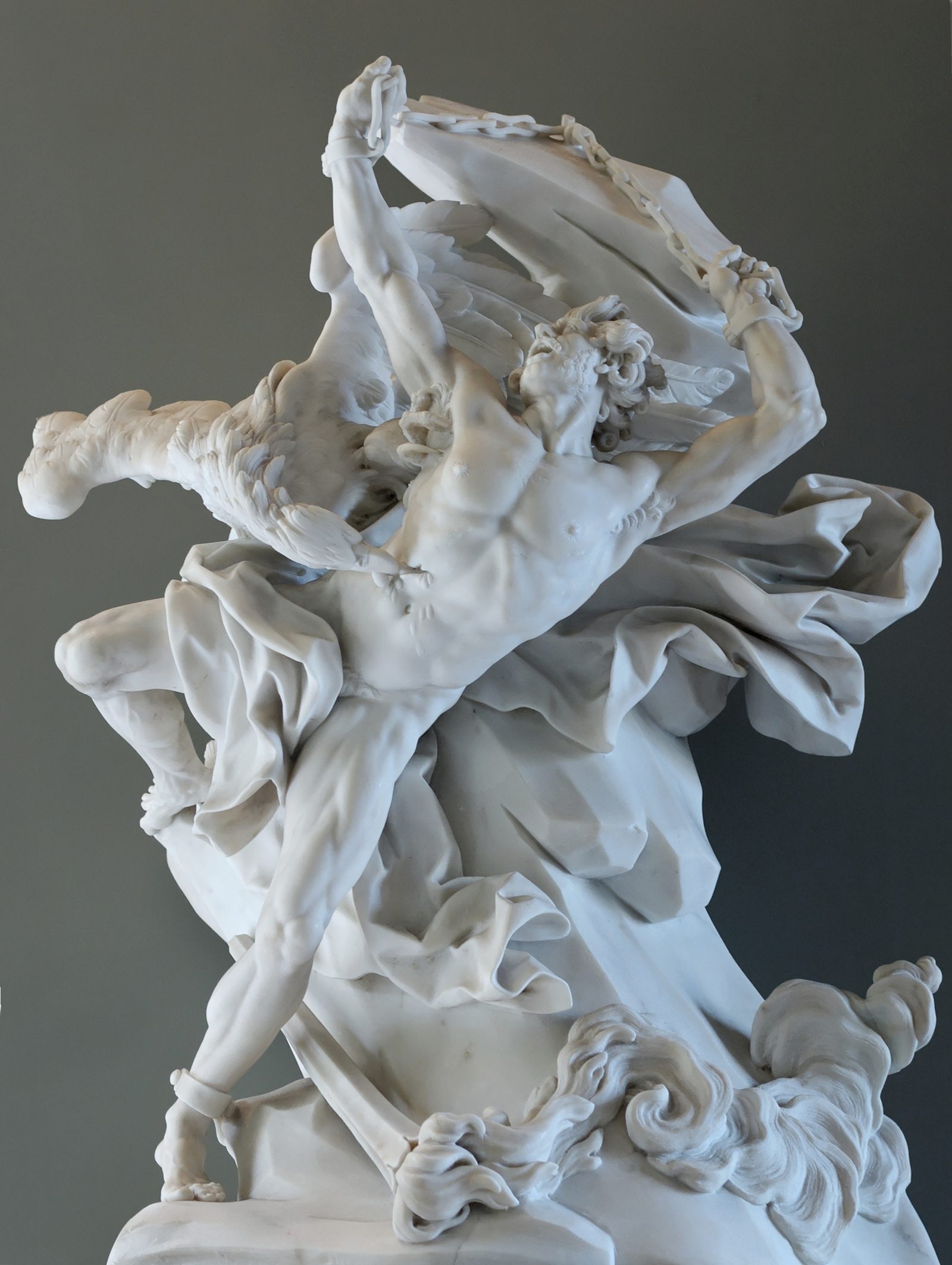
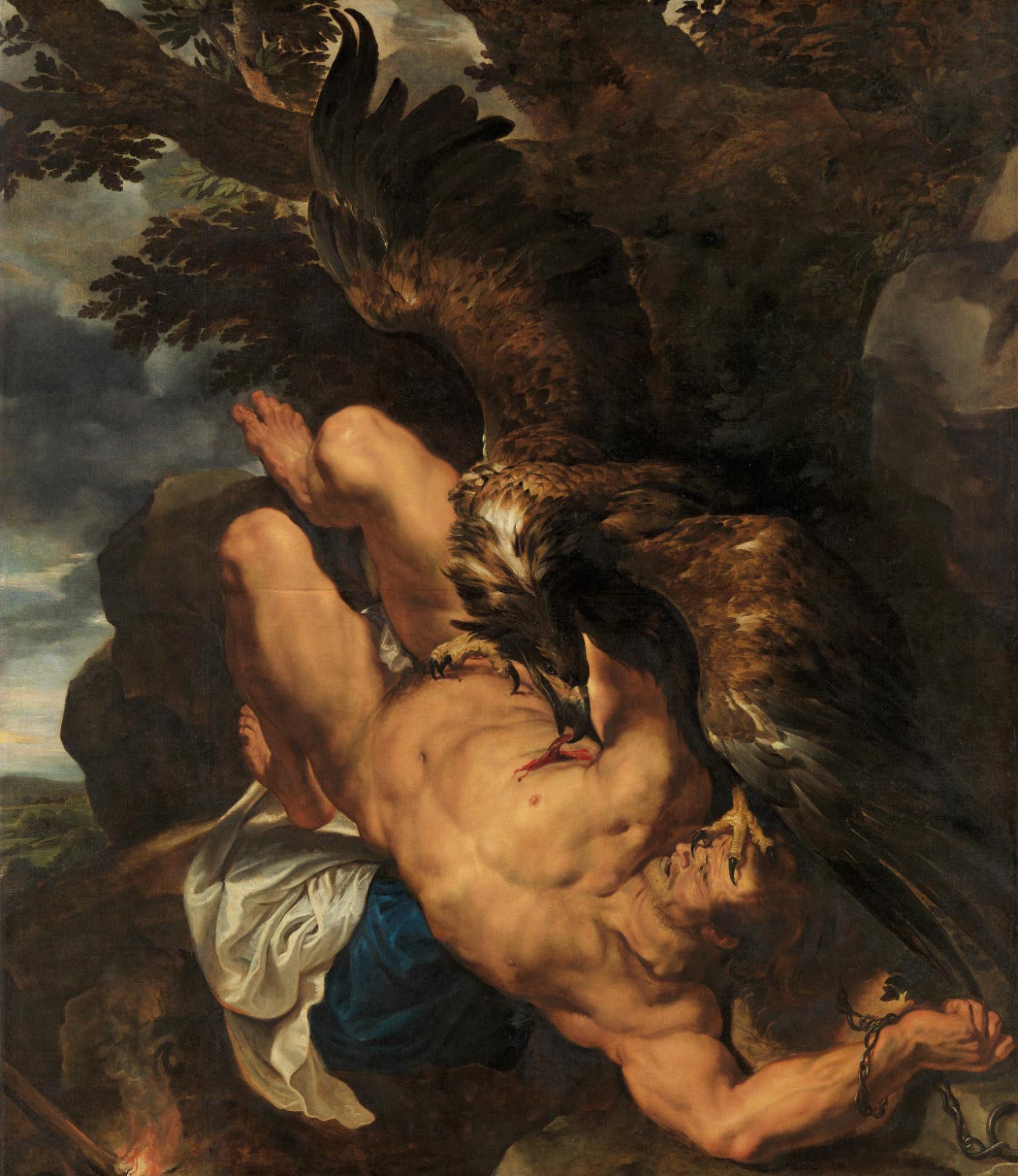
Zeus's revenge is famous for good reason. Prometheus was chained to a rock — usually placed in the remote Caucasus mountains, at the edge of the known world — and each day an eagle came and tore out and ate his liver. Because he was immortal, the liver grew back every night, and the torture began again the next day. Forever. It's one of mythology's most unforgettable images precisely because it's eternal and pointless: pain without release, repeated without end.
There's a second half to Zeus's punishment, aimed at humans rather than at Prometheus. To balance the gift of fire, Zeus has the gods create Pandora, the first woman in Hesiod's account, sent down with a sealed jar (later mistranslated as a "box"). When it's opened, all the sorrows and hardships of human life — sickness, toil, grief — escape into the world, with only hope remaining inside. So the myth frames the dawn of human technology and the dawn of human suffering as two sides of the same moment. Progress and pain arrive together. That's a remarkably grown-up idea to find at the root of an ancient story.
"Pandora opened a box and let all the evils loose on the world."
In Hesiod's original it's a large storage jar (a pithos), not a box. The "box" crept in centuries later through a mistranslation usually pinned on the Renaissance scholar Erasmus — a small slip that quietly rewrote one of the most famous images in Western culture.
What the myth is doing
You don't have to dig very hard to see why this story has never stopped resonating. Prometheus is the original defiant benefactor — the one who challenges absolute authority not for personal glory but to lift up the powerless, and who suffers terribly for it. He's been read as a symbol of human reason against superstition, of the rebel against tyranny, of the scientist who hands people knowledge the authorities would rather keep locked away.
That reading runs straight through Western culture. When Mary Shelley wanted a subtitle for her novel about a man who steals the divine power to create life and is destroyed by the consequences, she called Frankenstein "The Modern Prometheus." The element of the story that survives is the warning and the admiration held together at once: we honour the one who brings us fire, and we never quite stop arguing about whether the gift was worth the cost.
In the oldest versions there's even a way out. Prometheus, who can see the future, knows a secret about Zeus's own fate, and eventually — generations later — the hero Heracles comes to the Caucasus, shoots the eagle, and frees him. The rebel is not destroyed forever after all. Maybe that's the most hopeful note in the whole grim tale: that defiance in a good cause, however brutally it's punished, is not the end of the story.
The cosmic backstory: why a Titan helping humans was so dangerous
To feel the full weight of Prometheus's choice, you have to know the war that came just before it. The Greeks imagined an older order of gods, the Titans, who were overthrown by a younger generation, the Olympians, led by Zeus, in a colossal ten-year conflict called the Titanomachy. Zeus won and became the new, absolute king of the cosmos — and like a lot of newly victorious rulers, he was insecure and watchful, alert to any challenge to a throne he had only just seized by force.
Prometheus is interesting precisely because he doesn't fit neatly on either side. He was a Titan by birth, but in most versions he sided with Zeus during the war, or at least didn't oppose him. So he isn't a defeated enemy taking revenge — he's an insider, someone who helped Zeus to power and then defied him anyway, on a point of principle, for the sake of creatures far beneath them both. That makes his rebellion sharper and more troubling. It isn't a grudge. It's a moral stand against a king he himself had helped to crown, and that's a far more dangerous kind of defiance.
The philosophers' Prometheus
The Greeks didn't just tell this story; they thought hard with it. In Plato's dialogue Protagoras, the myth is retold as a parable about the very nature of human beings. In that version, when the gods are handing out survival traits to all the animals, the scatterbrained Epimetheus does the distributing and uses up everything — claws, fur, speed, wings — before he gets to humans, leaving us naked, soft and defenceless. Prometheus's theft of fire and the practical arts is what compensates for that nakedness. We survive not because we're strong, but because we're equipped — with technology and skill, the gifts of Prometheus.
It's a strikingly clear-eyed piece of philosophy dressed up as a story. Humans, it says, are the animal that has no natural place and so must build one. Everything that makes civilisation possible is, in this telling, borrowed fire. And the dialogue goes on to argue that technical skill alone isn't enough — that humans also needed a sense of justice and mutual respect to live together in cities without tearing each other apart. Even in antiquity, people understood that the Promethean gift of raw capability was a double-edged thing that needed wisdom to wield.
Fire-bringers around the world
Here's something that makes the Prometheus story feel even bigger: cultures with no contact with ancient Greece told remarkably similar tales. The idea of a clever trickster figure who steals or smuggles fire from a jealous power and gives it to humanity shows up across the globe. In Polynesian mythology, the demigod Maui pulls fire-related feats among his many tricks. Numerous Indigenous North American traditions tell of fire being stolen for people by animal tricksters — Coyote, Raven, or others — who snatch it from those hoarding it and pass it along, often suffering or being scorched in the process.
You don't need to believe these stories all descend from one source to find the pattern meaningful. Fire really was the technology that separated human life from animal life, and cultures everywhere seem to have felt that such a gift was too important to have simply been handed over freely. It had to be taken — won by cunning from a power that wanted to keep it. The Prometheus myth is the most famous version of a story humanity seems compelled to tell itself, over and over, about the dangerous, stolen, world-changing nature of knowledge.
Across continents that never met, the same instinct: the fire that made us human was too precious to be given. It had to be stolen.
The Romantic rebirth and the "Modern Prometheus"
For the Romantic poets and artists of the late 18th and 19th centuries, Prometheus became almost a patron saint. They saw in him everything they admired — the lone genius, the noble rebel, the defiance of tyranny in the name of human freedom and creativity. Goethe wrote a blazing poem in Prometheus's voice, hurling contempt at Zeus. Percy Bysshe Shelley wrote an entire lyrical drama, Prometheus Unbound, reimagining the Titan as a symbol of humanity throwing off oppression. Beethoven wrote music for a ballet about him. The chained benefactor became the age's ultimate image of the heroic individual against arbitrary power.
And the myth never stopped working. When Mary Shelley subtitled Frankenstein "The Modern Prometheus," she pointed the old story straight at the dawning age of science — at the thrilling, terrifying idea that humans were now the ones stealing divine fire, reaching for powers that might not be ours to hold. That framing has only grown more relevant. We reach for it instinctively whenever a new technology feels too powerful for its makers to fully control — nuclear weapons, artificial intelligence, the editing of life itself. The man who built the atomic bomb was memorialised in a biography titled American Prometheus, and the choice of name needs no explanation. Three thousand years on, we are still using a chained Titan to talk about our own most dangerous gifts. That's the mark of a myth that found something permanently true.
That's ultimately why Prometheus outlasts the gods he defied. We don't tell his story because we believe in Zeus or eagles or fennel stalks. We tell it because it captures, more cleanly than almost anything else, the central bargain of being human: that every fire we steal lights the dark and burns the hand at the same time. The Greeks looked at human progress — at all our cleverness and all the suffering it dragged in behind it — and they personified the whole tangled deal in one defiant figure chained to a rock, who would do it all again without hesitation. We're still chained to the same rock, and still, on balance, glad we took the fire.
Image: 'Prometheus Bound' by Nicolas-Sebastien Adam, 1762, Louvre (public domain, Wikimedia Commons). This article retells a Greek myth, not a historical event.
Where the story comes from
- Hesiod, Theogony and Works and Days (c. 700 BCE) — the earliest surviving accounts of the Mecone trick, the theft of fire, and Pandora.
- Aeschylus, Prometheus Bound (5th century BCE) — the great dramatic treatment, source of Prometheus as benefactor of all the arts.
- Plato, Protagoras — retells the Prometheus and Epimetheus myth as a parable about human civilisation.
- Later echoes: Mary Shelley, Frankenstein; or, The Modern Prometheus (1818); Percy Bysshe Shelley, Prometheus Unbound (1820).