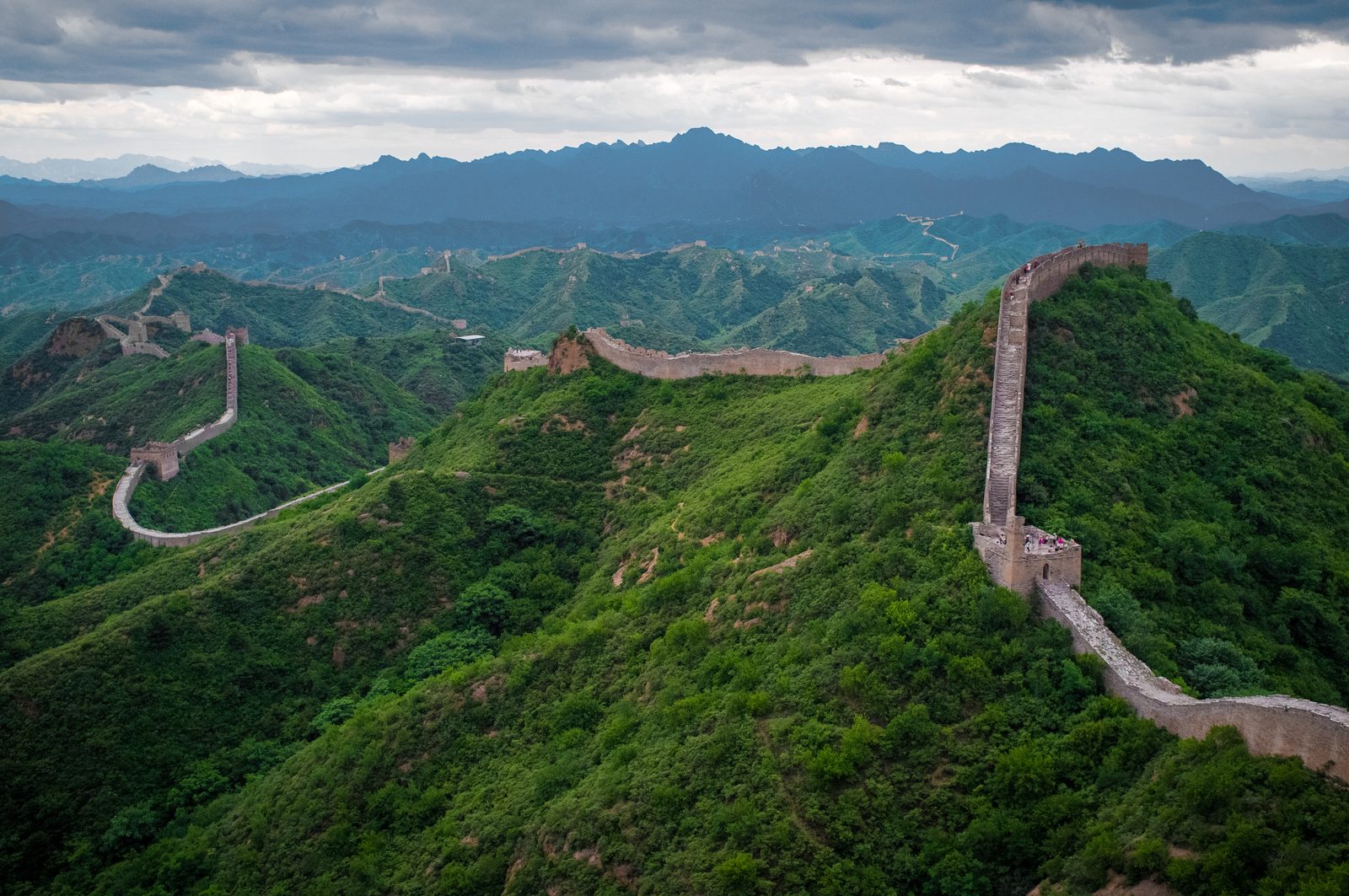
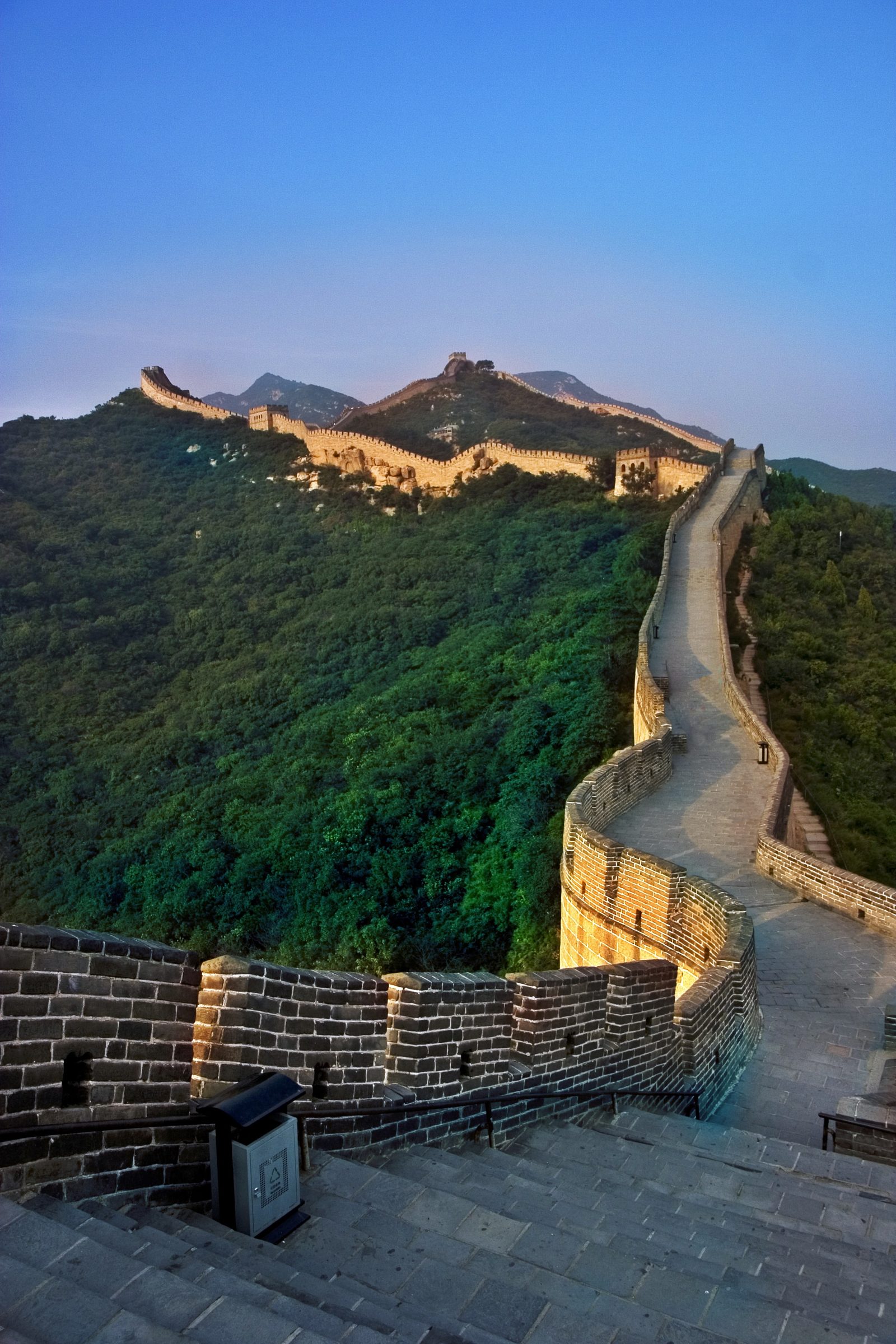
There's a moment that almost everyone who climbs the Great Wall seems to share. You haul yourself up a steep, broken section north of Beijing, lungs burning, and you turn around, and the wall just keeps going, riding the spine of the mountains until it dissolves into haze. It doesn't look built so much as grown, like the rock itself decided to grow battlements. And then a guide says the thing you've heard a hundred times: that astronauts can see it from space. They can't, as it happens. But standing there, you understand exactly why people want it to be true.
The Great Wall of China is one of those landmarks so famous that the legend has almost swallowed the history. We know the silhouette, the watchtowers, the postcard. What gets lost is that there was never really one wall, built by one emperor, in one heroic burst. The thing we call "the Great Wall" is the accumulated work of more than two thousand years, many dynasties, and an enormous amount of forgotten labour, and most of what tourists photograph today is only about six hundred years old.
Not one wall, but many
The first thing to get straight is that "the Great Wall" is a convenient name for a sprawling network of fortifications built and rebuilt over many centuries. The Chinese term most often used today, Wanli Changcheng, means roughly "the ten-thousand-li long wall", and "ten thousand" here is the old poetic way of saying "an enormous number," not a survey measurement. There are stretches of rammed earth, stretches of stone, stretches of fired brick. There are sections that run parallel to each other, sections that branch, and long gaps where the "wall" was really just a line of beacon towers or a convenient mountain ridge that needed no wall at all.
The motive behind nearly all of it was the same, though: the long, anxious frontier between the settled, agricultural civilisation of China proper and the mobile, horse-borne peoples of the northern steppe. For Chinese dynasties based in the fertile heartland, the nomads to the north (Xiongnu, later Mongols and others) were a recurring nightmare. They raided fast, hit hard, and vanished before a slow infantry army could respond. A wall was one answer to that problem: not an impenetrable barrier, but a way to slow raiders down, channel them toward defended gates, and buy time for signals to travel and troops to gather.
Qin Shi Huang and the first unification of the walls
The figure most popularly tied to the wall is Qin Shi Huang, the ruler who unified China into a single empire in 221 BCE and became its first emperor. He didn't build the Great Wall from scratch; that's a persistent simplification. Several of the rival states he conquered had already built their own defensive walls during the chaotic Warring States period. What Qin Shi Huang did was order these existing northern walls connected and extended into a more continuous line, while having the old walls between the former states torn down.
The human cost of this and later wall-building was horrific, and Chinese tradition never let later generations forget it. Conscripted labourers, soldiers and convicts were marched to the frontier in huge numbers; many died of cold, exhaustion, hunger and accident, and were, by tradition, sometimes buried near where they fell. The Qin wall was made largely of rammed earth, soil and gravel pounded layer by layer between wooden frames, because that's what the northern terrain offered. Very little of that original Qin construction survives in any recognisable form today. The grand stone-and-brick wall in the tourist photographs is much, much later.
The smooth grey brick battlements that define the Great Wall in nearly every famous photograph are not ancient at all. They are mostly Ming dynasty work, built from roughly the late 1300s into the 1600s, closer in age to Shakespeare than to the first emperor. The wall Qin Shi Huang ordered, more than 1,600 years earlier, was mainly rammed earth, and barely survives.
The Ming wall: the one we actually picture
If a single dynasty deserves the credit for the Great Wall as a tourist now experiences it, it's the Ming (1368–1644). The Ming came to power by overthrowing the Mongol-led Yuan dynasty, and they remained preoccupied, you might even say traumatised, by the threat of renewed invasion from the steppe. After a disastrous defeat in 1449, when a Mongol force captured a Ming emperor in the field, wall-building became a central pillar of frontier policy.
Over the following two centuries the Ming poured staggering resources into a new generation of fortifications, especially the stretches guarding the approaches to their capital at Beijing. This is the wall of fired brick and dressed stone, with crenellated parapets, drainage channels, and regularly spaced watchtowers that could store weapons, shelter troops, and pass signals by smoke or fire. The sections most visitors know (Badaling, Mutianyu, Jinshanling, the wild crumbling stretches at Jiankou) are nearly all Ming work. It was sophisticated military architecture, and it represented a colossal, sustained investment by the state.
A wall is only as strong as the will to man it. The Ming learned this the hard way: their great barrier did not save the dynasty in the end.
Did it work?
This is where the story gets interesting, and where historians have real disagreements. The romantic version says the Great Wall kept the barbarians out for two thousand years. The deflating version says it was a costly failure, since China was repeatedly conquered or raided by northern peoples anyway: the Mongols under Kublai Khan in the 13th century, and the Manchus in 1644, despite all those walls.
The truth sits in between. A wall in this kind of warfare was never meant to be a magic force field. At its best it worked as part of a system: it slowed raiders, forced them toward defended choke points, gave defenders a platform and a head start, and let signals race ahead of the enemy. When that system was well garrisoned, supplied and led, it could be quite effective at reducing the small, constant raids that bled a frontier. When the state weakened, the soldiers went unpaid, and the political will collapsed, the same wall became just a long pile of bricks. Famously, the Ming wall did not stop the Manchu conquest in 1644, but that had as much to do with a Ming general opening a gate amid civil war as with any failure of the masonry.
Where opinion splits: Was the Great Wall a strategic triumph or an expensive symptom of weakness? Some scholars see it as a sensible, cost-effective frontier system that managed a chronic raiding threat. Others, influenced by historian Arthur Waldron's work, argue that heavy reliance on wall-building often reflected political dysfunction, a defensive crouch chosen when bolder strategy and diplomacy had failed. Most now accept it was effective in some periods and a costly liability in others.
The most famous "fact" that isn't true
And now the claim that haunts every guidebook: that the Great Wall is the only human-made structure visible from space, or even from the Moon, with the naked eye. It is not, and the physics make this fairly easy to see once you think about it. The wall is enormously long, but it is also very narrow, at most a handful of metres wide, and it's usually built of local materials that blend into the colour of the surrounding land. Length doesn't help you spot something from orbit; width and contrast do. A single thread laid across a football field is long, but you won't see it from the far stands.
"The Great Wall of China is the only human structure you can see from space, or even from the Moon, with the naked eye."
You cannot see it from the Moon at all. From there the entire Earth is a small bright marble. From low Earth orbit it is, at best, extremely hard to pick out with the naked eye, because it is narrow and the same colour as the ground around it. Astronauts have said far wider human works, like cities, roads and airports, are easier to spot. The claim predates spaceflight entirely; it was being printed in the 1930s, before anyone had ever been to space to check.
The myth is surprisingly old. Versions of it appeared in print in the West well before any human had left the planet, including a widely repeated claim from the 1930s, which means it was never based on an actual observation. It was a guess that sounded grand, got repeated until it felt like common knowledge, and then proved very hard to kill. Astronauts and cosmonauts who have looked have generally reported that the wall is, at best, barely discernible under ideal conditions and easily confused with rivers and other natural lines, while broad features such as airports and big cities are far more obvious.
The labour, the legends, and the bones
Whatever else it is, the Great Wall is a monument to human labour on an almost unimaginable scale, and Chinese culture has long remembered its dark side as well as its grandeur. The most famous folktale attached to it is the legend of Meng Jiangnü, a woman whose husband was conscripted to build the wall and died there. The story tells that her weeping at the wall was so anguished that a section of it collapsed, revealing the bones of the dead labourers so she could bury her husband. It's a folktale, not history, but it lasts precisely because it carries an emotional truth about the cost of imperial ambition, the families broken to build something that would outlast them all.
For centuries the wall also fed grim rumours that the dead were entombed within the structure itself, their bodies used as building material. There's no good evidence the Chinese deliberately built corpses into the wall as mortar (that part appears to be legend rather than fact), but there is little doubt that vast numbers of workers died during construction and were buried in the vicinity. The line between memory and myth here is blurry, which is itself very fitting for a structure this old.
From defensive line to national symbol
For long stretches of later Chinese history, the wall was oddly neglected, even a little embarrassing, a reminder of dynasties that had fallen anyway. Sections were quarried by local people for building stone; others simply melted back into the hills. Its transformation into a beloved national emblem is, in large part, a modern story. As foreign travellers and photographers spread images of it in the 19th and 20th centuries, and as a unified Chinese state in the 20th century looked for symbols of endurance and identity, the Great Wall was reframed as the emblem of Chinese civilisation: ancient, vast, unbroken.
That reframing is so successful that it's now hard to see past it. The wall appears on visas and banknotes and in the opening shots of countless films, almost always presented as a single, timeless thing. The reality (patchwork, rebuilt, abandoned, restored, partly imagined) is in some ways more impressive, because it reveals not one moment of genius but two thousand years of a civilisation worrying about the same frontier and answering the worry, again and again, in earth and brick.
What survives, and what we're still losing
Today only a fraction of the historic wall network survives in good condition. Thorough surveys in recent years, drawing on modern mapping, have put the total length of all the walls built across all dynasties at well over 20,000 kilometres when every branch, spur and earthen rampart is counted. That figure is far larger than older estimates, because it includes long-lost and ruined sections traced by archaeology. But large portions of that total are heavily eroded, reduced to low mounds, or have vanished entirely. The photogenic restored stretches near Beijing are the exception, not the rule.
Preservation is a real and ongoing struggle. Erosion, weather, tourism, and the removal of bricks by locals for building have all taken a toll on the wilder, unrestored sections. There's a real tension at the heart of the wall's modern life: the parts that draw millions of visitors are heavily reconstructed, sometimes to the point that purists grumble they're more replica than relic, while the authentically ancient stretches crumble in remote hills with few people to protect them. The Great Wall, in other words, is still being negotiated between memory and decay, which, after two and a half thousand years, feels entirely in character.
Stand on it again, then, and the haze-swallowed ridgeline means something slightly different. Not one emperor's triumph, and certainly not a thing you could spot from the Moon, but the layered, half-ruined, endlessly rebuilt record of a civilisation that spent two millennia answering the same hard question about where it ended and the wilderness began. That's a stranger and a grander thing than the postcard. It usually is.
Image: a restored section of the Ming-era Great Wall winding across the mountains north of Beijing (public domain, via Wikimedia Commons).
Read next: Zheng He: The Treasure Fleet the Ming Tried to Erase and Shimao: The Stone City in China That Was Not Supposed to Exist.
Sources & notes
- Arthur Waldron, The Great Wall of China: From History to Myth (Cambridge University Press, 1990).
- Julia Lovell, The Great Wall: China Against the World, 1000 BC – AD 2000 (Atlantic Books, 2006).
- William Lindesay, The Great Wall Revisited: From the Jade Gate to Old Dragon's Head (Harvard University Press).
- Encyclopaedia Britannica, "Great Wall of China."
- UNESCO World Heritage Centre, "The Great Wall" inscription documentation.