Quick question: name the great Bronze Age civilisations. Most people get to Egypt and Mesopotamia and stop. But there was a third one, as big as both of them put together, and far fewer people can name it. The Indus Valley Civilisation, sometimes called the Harappan Civilisation, covered a huge swathe of what's now Pakistan and north-west India, and at its height it may have been the largest of all the early urban cultures. And we still can't read a word it wrote.
A civilisation hiding in plain sight
For a long time, nobody even knew it was there. In the 1800s, British engineers building railways in the Punjab cheerfully dug up ancient fired bricks from a mound called Harappa and used them as track ballast, destroying part of a 4,000-year-old city without realising what it was. It wasn't until the 1920s that archaeologists, led by figures working under the Archaeological Survey of India, properly excavated Harappa and a second great site, Mohenjo-daro, and grasped that they were looking at an unknown civilisation older than almost anything in the region's recorded history.
The mature phase of this civilisation runs roughly from 2600 to 1900 BCE, contemporary with the pyramid-builders of Egypt and the city-states of Sumer. It stretched across more than a million square kilometres and included several substantial cities plus hundreds of smaller towns and villages. By the standards of its day, it was enormous.
The first city planners
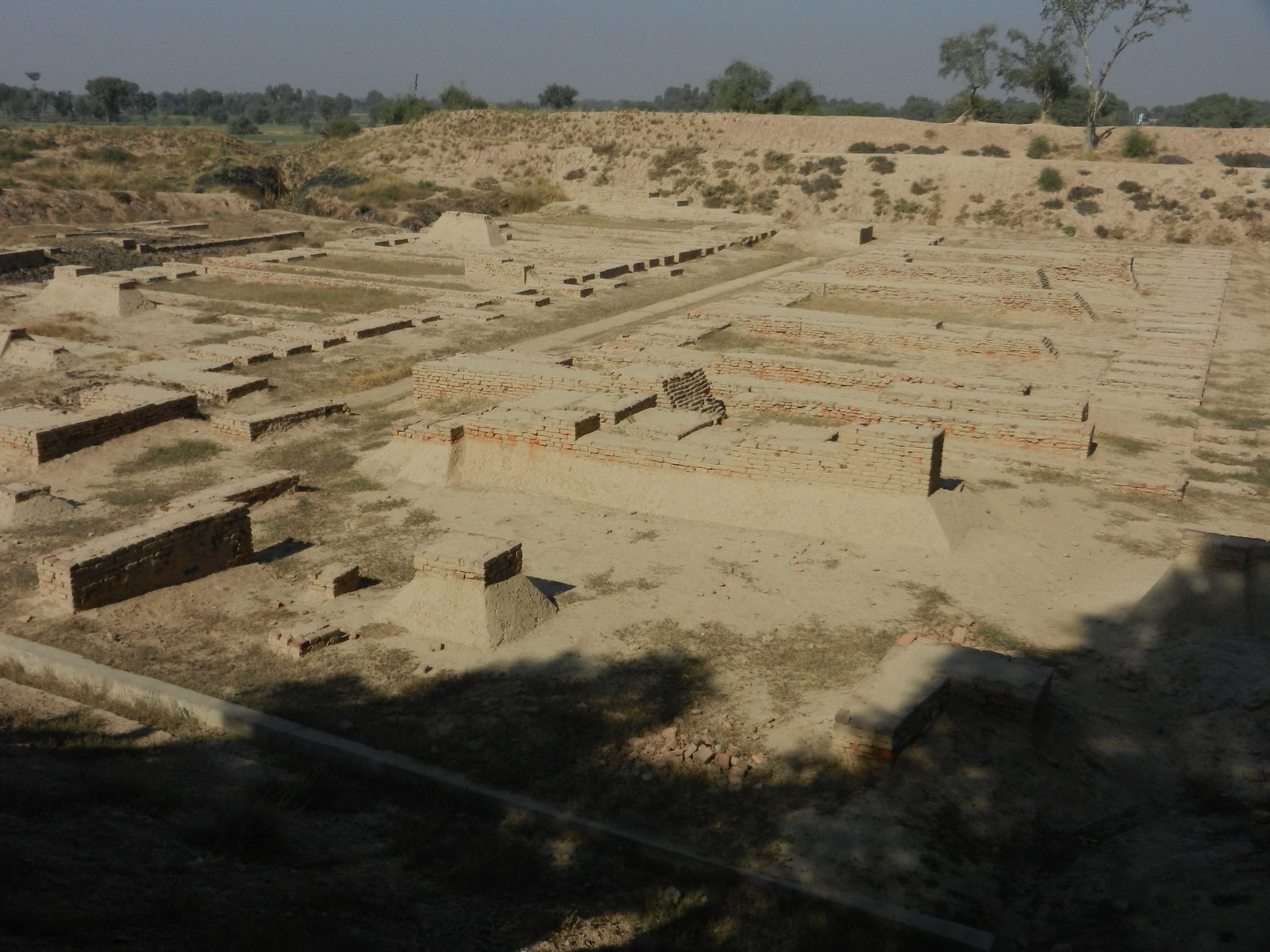
What makes the Indus startling is that the cities were planned. We're not talking about a tangle of alleys that grew over time. Mohenjo-daro and Harappa were laid out on something close to a grid, with major streets running roughly north–south and east–west, dividing the city into neat blocks. There was a raised "citadel" area with large public buildings on one side and a lower residential town beside it.
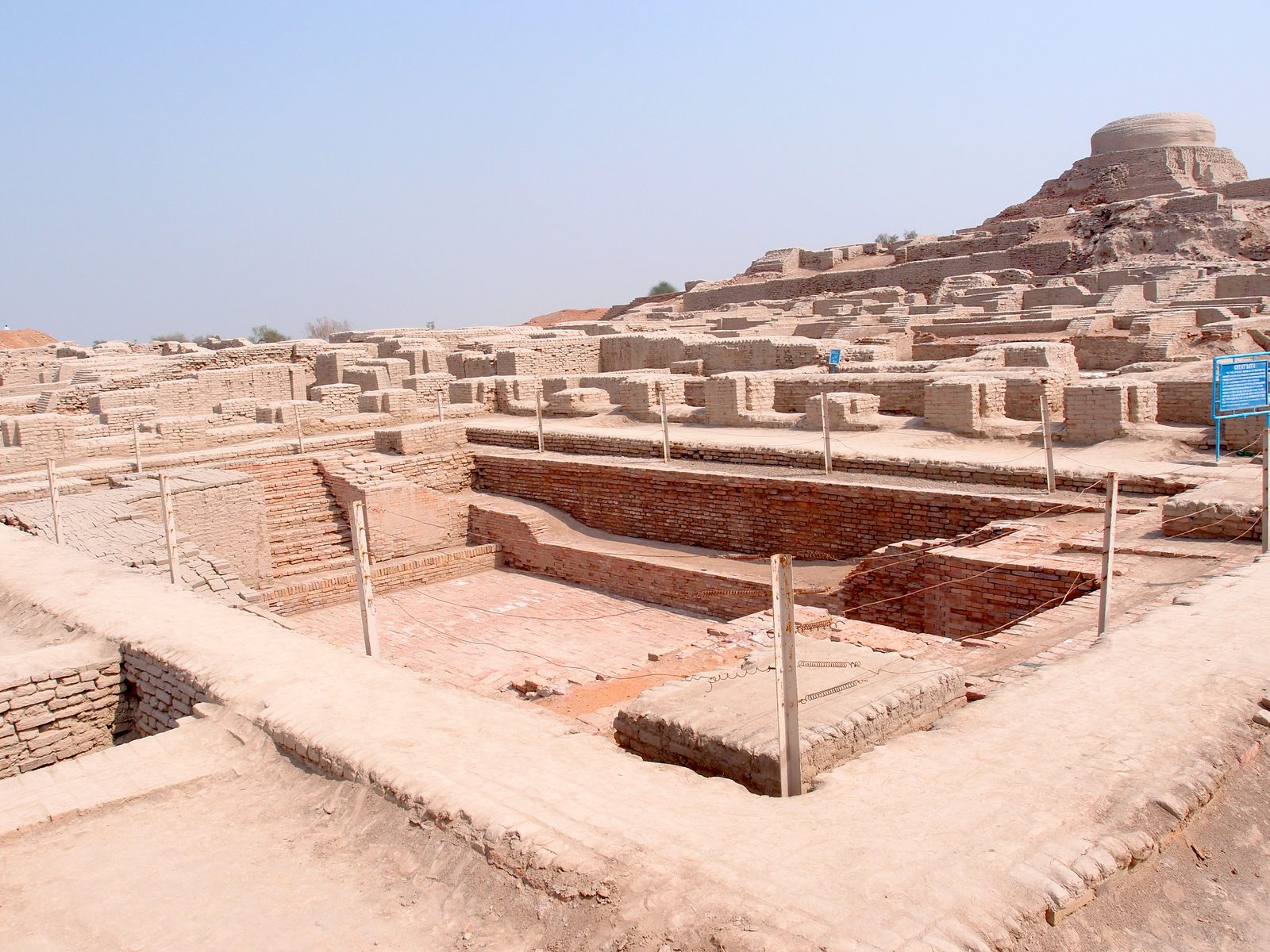
And then there's the plumbing, which is honestly the detail that converts people. Many houses had their own wells and bathing areas, and waste water drained out through covered brick channels that ran along the streets: a municipal drainage system more sophisticated than what a lot of the world would have for thousands of years afterward. They built with standardised fired bricks made to consistent proportions across different cities hundreds of kilometres apart. Mohenjo-daro even had a "Great Bath," a large watertight brick basin that most archaeologists think was used for some kind of ritual bathing.
Standardised bricks, grid streets and covered sewers across a million square kilometres: this was a culture that cared, consistently, about order.
Worth knowing: Indus homes had private bathing areas and drains that fed into covered street sewers around 2500 BCE, municipal sanitation that much of the world wouldn't match again for thousands of years. The same people were also among the earliest anywhere to grow and weave cotton.
Trade, weights, and a quiet kind of power
The Indus people were traders. Their distinctive seals (small carved stone squares, often showing animals like bulls and a famous "unicorn"-type creature, along with rows of script) have turned up as far away as Mesopotamia, which tells us they were plugged into long-distance trade networks across the Arabian Sea. Mesopotamian texts mention trade with a place called "Meluhha," which many scholars believe refers to the Indus region.
They used a standardised system of weights, beautifully cut from stone in regular ratios, the kind of thing you only develop when you have organised commerce and want everyone measuring grain or metal the same way. Their craftspeople produced fine jewellery, carnelian beads, and bronze work, including the small, astonishingly relaxed bronze figure known today as the "Dancing Girl."
And here's a contrast that fascinates me. Unlike Egypt with its pharaohs and Mesopotamia with its warrior-kings, the Indus left behind almost no obvious monuments to rulers. No giant royal tombs. No palaces we can confidently identify. No clear depictions of kings or grand military scenes. Whoever ran these cities seems to have done it without the usual loud propaganda of power. Some researchers think authority may have been more collective, or tied to merchants and priests rather than a single god-king. We don't know, and that uncertainty is part of what makes them so intriguing.
Who actually ran these cities? With no palaces, no royal tombs, and no clear images of kings, scholars are split: some imagine priestly rulers, some a class of powerful merchants, some a surprisingly decentralised society held together by shared culture rather than a single throne. The absence of obvious rulers is one of the Indus's deepest and most debated puzzles.
The script we still can't read
This is the great frustration. The Indus people wrote. We have thousands of short inscriptions, mostly on those seals and on pottery. But the Indus script has never been deciphered. The inscriptions are maddeningly brief, usually just a handful of symbols, which makes them very hard to crack, and unlike with Egyptian hieroglyphs, there's no "Rosetta Stone" bilingual text to give us a way in. We don't even know for certain what language they spoke.
That single gap shapes everything. Because we can't read them, we don't know their kings' names, their gods' names, their laws, their stories, or what they called themselves. An entire literate civilisation of millions of people is, in a sense, still silent. If the script is ever cracked, it would be one of the great breakthroughs in the study of the ancient world.
"The Indus cities were wiped out by invading Aryan armies."
There's little evidence of widespread violent destruction. The picture most scholars now favour is a slow decline driven by climate change and shifting rivers undermining the farming the cities depended on: less an apocalypse than a gradual letting-go.
Why did it fade?
Around 1900 BCE, the great cities began to decline. The old, dramatic theory was an invasion by incoming peoples, but that idea has largely fallen out of favour; there's little evidence of widespread violent destruction. The picture most scholars now lean toward is environmental and gradual. Climate change appears to have weakened the monsoon and dried up or shifted important rivers over centuries, undermining the agriculture the cities depended on. As the water and trade networks faltered, the big urban centres were slowly abandoned and the population dispersed into smaller villages further east.
It wasn't a sudden apocalypse, in other words. It was more like a slow letting-go. The civilisation didn't so much die as dissolve, its people and some of its traditions feeding into the later cultures of the subcontinent. But the cities, the seals, and the script sank out of memory so completely that the whole civilisation had to be rediscovered, almost by accident, in the modern age.
For a society that built the first planned cities and the first municipal sewers, that's a strange and slightly poignant fate: to have been one of the largest civilisations on Earth, and then to be the one nobody can name.
What everyday life looked like
Strip away the mystery for a moment and picture the ordinary texture of an Indus city. The people were farmers at heart, even the city-dwellers depending on the surrounding fields. They grew wheat and barley, peas and sesame and cotton. In fact the Indus people were among the earliest in the world to cultivate cotton and weave it into cloth, an enormous contribution to human history that rarely gets mentioned. They kept cattle, sheep, goats and water buffalo, and the humped Indian bull appears again and again on their seals, suggesting it carried real cultural weight.
Their craftwork was superb and surprisingly delicate for a Bronze Age society. They made fine pottery on the wheel, elaborate jewellery, and long, slender beads of carnelian that required an advanced drilling technique to produce. They worked copper and bronze, gold and silver. The famous little bronze "Dancing Girl" from Mohenjo-daro, hand on hip, head tilted, utterly self-possessed, feels weirdly modern and alive for an object more than four thousand years old. These were not crude people scraping by; they were skilled, comfortable, and clearly proud of beautiful things.
Gods we can only guess at
Because we can't read their writing, the religion of the Indus people is almost entirely a matter of educated guesswork, but the guesses are fascinating. Many small terracotta figurines of women have been found, which some archaeologists interpret as mother-goddess figures linked to fertility, though that's debated. Most intriguing is a seal showing a figure seated in what looks like a cross-legged, yoga-like posture, surrounded by animals. Early excavators nicknamed it the "Pashupati seal" and speculated it might be an early form of the Hindu god Shiva as "lord of the animals."
That interpretation is controversial and probably reaches too far (we don't know), but it points at a bigger and more responsible idea: that some threads of Indus culture may have woven into the later religious traditions of the subcontinent. The reverence for cattle, the possible ritual bathing suggested by the Great Bath, the seated meditative posture: these are tempting hints of continuity. Tempting, but unprovable, at least until somebody cracks the script.
More than two cities
Harappa and Mohenjo-daro get the headlines, but the civilisation was a whole network of settlements, and some of the others are just as remarkable. Dholavira, in modern Gujarat, is famous for an astonishing system of water management, with reservoirs, dams and channels carved to capture and store every drop of seasonal rain in a dry landscape. That is exactly the kind of large-scale public engineering that hints at organised, cooperative authority.
Lothal, also in Gujarat, has what many archaeologists believe was a dockyard, a large brick basin connected to a river channel, which would make it one of the earliest known structures of its kind and underline how seriously these people took maritime trade. Rakhigarhi, in India, has turned out to be one of the largest sites of all. Put them together and you stop seeing a couple of isolated ruins and start seeing what it really was: an integrated, far-flung civilisation with shared standards in brick sizes, weights, and town planning stretching across an area larger than Western Europe.
The same brick proportions, the same weights, the same urban logic, repeated across hundreds of kilometres - whatever held the Indus world together, it was remarkably consistent.
The seals: a signature we still can't read
If one object sums up the whole tantalising civilisation, it's the seal. Thousands have been found: small, flat squares usually carved from a soft stone called steatite, then fired hard. Most show a single animal in beautiful, confident profile: a humped bull, an elephant, a tiger, a rhinoceros, or the strange single-horned creature that scholars cautiously call the "unicorn." Above the animal runs a short line of the Indus script, a handful of neat symbols.
What were they for? The best guess is commerce and administration. Pressed into wet clay, a seal leaves a raised impression, and such clay sealings have been found stuck to the remains of goods and bundles, so the seals probably marked ownership, identified merchants or officials, or tagged shipments moving through that long-distance trade network. In other words, these little carvings may be the closest thing we have to the names and signatures of individual Indus people. We are holding their business cards in our hands and cannot read a single one of them. There's something almost unbearably close about that: a whole society reaching out across four thousand years, and the message just out of focus.
The Aryan question, and why people still argue about it
One reason the Indus Civilisation generates such heated debate is that its story collides with one of the most politically charged topics in South Asian history: the origins of the people, languages and religions of the later subcontinent. An older theory held that the cities were destroyed by invading Indo-Aryan peoples migrating in from the northwest around the second millennium BCE. As I mentioned, the evidence for a violent invasion is thin, and most scholars have moved toward a picture of gradual migration and cultural mixing rather than conquest, set against the backdrop of the environmental decline that was already emptying the cities.
But because this touches on questions of who the "original" inhabitants were and how Hindu traditions and Indo-European languages arrived, it remains contested, and not only among archaeologists. Recent ancient-DNA studies have added new layers, and new arguments, to the discussion. It's a good reminder that history isn't only about the distant past; the way we tell the story of the Indus is tangled up with very modern questions of identity.
Image: ruins of Mohenjo-daro, Sindh, Pakistan (public domain, Wikimedia Commons).
Read next: Dilmun: The Land Sumer Called Deathless, and Its 11,774 Tombs.
Sources cited
- Jonathan Mark Kenoyer, Ancient Cities of the Indus Valley Civilization (Oxford University Press).
- Gregory Possehl, The Indus Civilization: A Contemporary Perspective (AltaMira Press).
- Andrew Robinson, The Indus: Lost Civilizations (Reaktion Books).
- UNESCO World Heritage Centre, "Archaeological Ruins at Moenjodaro"; Harappa.com research archive; Encyclopaedia Britannica, "Indus civilization."