Picture the morning of a games day in imperial Rome. Before dawn, the streets around the great amphitheatre are already filling: fifty thousand people, give or take, funnelling through eighty numbered entrances, clutching little pottery or bone tokens that told them exactly which staircase to climb and which seat to take. There were awnings overhead, worked by a detachment of sailors, to keep the sun off. There was a system for everything. The Romans, whatever else you think of them, knew how to run a crowd. And what that crowd had come to see was, by any honest measure, organised killing turned into a public spectacle.
We call it the Colosseum, though the Romans didn't. To them it was the Flavian Amphitheatre, the Amphitheatrum Flavium, named for the dynasty that built it. The nickname "Colosseum" came later, and probably refers not to the building's own size but to a colossal bronze statue of the emperor Nero that once stood nearby. Names drift. The structure stayed.
Why an emperor builds a stadium
The Colosseum was a political project before it was an architectural one. The emperor Vespasian, who took power in 69 CE after a brutal year of civil war, needed to do two things at once: stabilise his shaky new dynasty and erase the memory of his unpopular predecessor, Nero. Nero had built himself an enormous private pleasure palace, the Domus Aurea, complete with a private boating lake, right in the heart of the city: a vast chunk of Rome turned into one man's playground.
Vespasian's answer was pointed. He drained the lake and, on that very spot, began building a colossal amphitheatre for the people. The message could hardly have been clearer: where Nero took the city's land for himself, the Flavians give it back as public entertainment. It was propaganda you could walk into.
Construction began around 72 CE. Vespasian didn't live to see it finished; his son Titus inaugurated it in 80 CE with a hundred days of games, and a second son, Domitian, added the finishing touches. Three emperors, one building. Roman historians tell us the work was partly funded by the spoils and the labour drawn from the crushing of the Jewish revolt and the sack of Jerusalem in 70 CE, a reminder that the grandeur was paid for, as grandeur usually is, by somebody else's catastrophe.
The machine itself
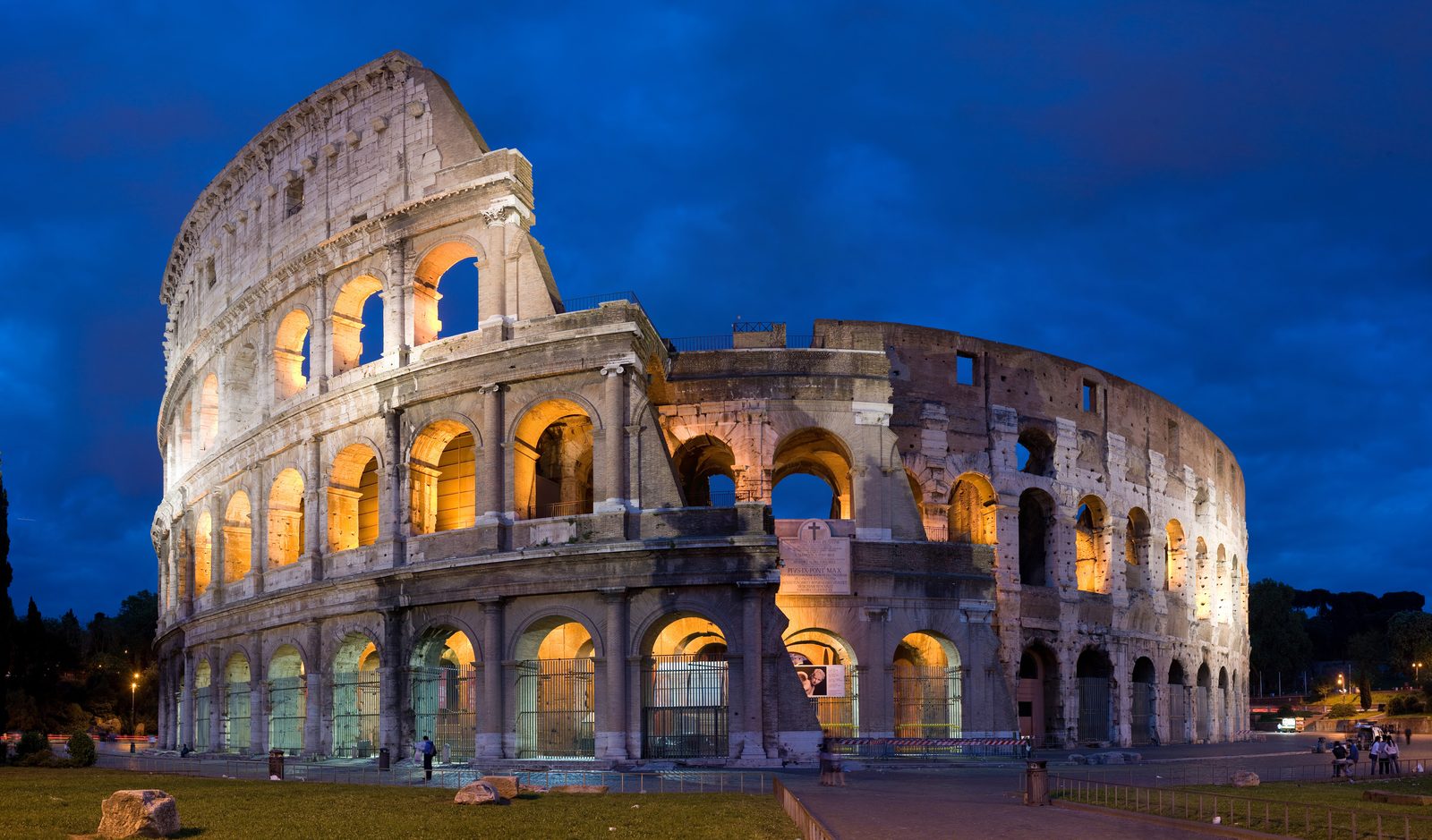
It's easy to lose the building behind the bloodshed, but the Colosseum is one of the great feats of ancient engineering, and it deserves a moment on its own terms. It's an enormous free-standing oval, roughly 189 metres long, 156 wide, and around 50 metres tall, built mostly of travertine limestone, tuff, brick and an awful lot of Roman concrete. Unlike a Greek theatre dug into a hillside, this thing stands up entirely by itself, held aloft by a web of arches and vaults.
The seating was rigidly segregated by class, because Roman society was rigidly segregated by class and the games were a place to perform that order. The emperor and senators sat ringside on marble. Behind and above them came the knights, then ordinary male citizens, and right at the top, farthest from the action and baking in the cheap seats, were the poor, the enslaved, and women, with a few pointed exceptions like the Vestal Virgins, who got good seats. Where you sat told everyone who you were.
Worth knowing: Beneath the arena floor lay the hypogeum, a two-level underground labyrinth of cells, corridors and ramps, fitted with some thirty-odd vertical lifts worked by capstans and counterweights. Animals and scenery could be hoisted up and made to appear, as if by magic, through trapdoors in the sand. Roman spectacle had stage machinery a modern theatre would recognise.
That word "arena," by the way, is itself a clue. It comes from the Latin harena, meaning sand: the sand that was spread across the wooden floor of the fighting space. It was there for grip, and for the grimmer practical reason that sand soaks up blood and can be raked over between bouts. The very name of the place is a quiet admission of what it was for.
Who fought, and why
The fighters who gave the Colosseum its dark fame were a mixed group, and not all of them were there against their will. Many gladiators were enslaved people, prisoners of war, or condemned criminals, bought up and trained in special schools called ludi under the iron discipline of a manager called a lanista. But, and this surprises people, a number were free men who volunteered, signing away their legal freedoms in exchange for the chance at fame, prize money, and the strange celebrity that a successful gladiator could command.
And it was real celebrity. Surviving graffiti from Pompeii gushes over star fighters the way modern fans talk about athletes. One scratched inscription calls a gladiator the man who makes the girls sigh. Successful gladiators had fan followings, endorsements of a sort, even children named after them. They occupied a peculiar social slot: legally disgraced and degraded (gladiators were infames, stripped of normal civic standing), yet adored, desired, and at the top end, rich.
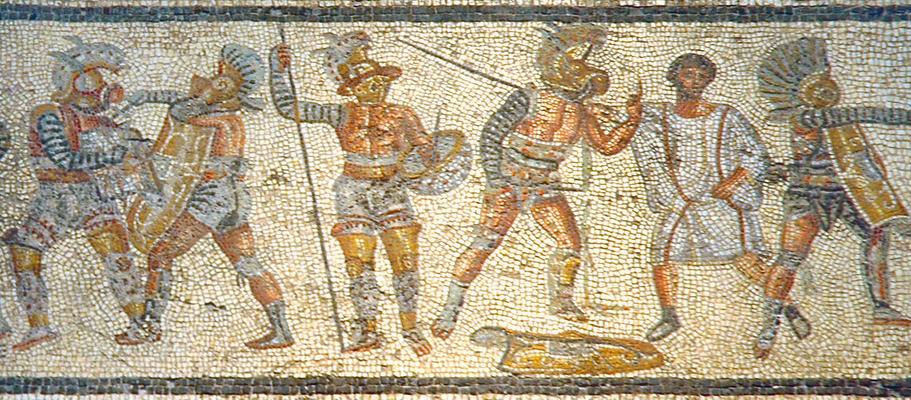
They fought in distinct styles, almost like character classes, and the pairings were designed for drama rather than fairness. A retiarius with his net and trident, lightly armoured and quick, would be matched against a secutor, heavily armed and helmeted but slower, the helmet's tiny eyeholes deliberately designed to be hard to aim a net at. The contrast was the point. Romans appreciated these fights as a connoisseur appreciates a sport, with a technical vocabulary and strong opinions.
The myth that everyone believes
Now to the thing the movies got most wrong, and it's a big one.
"Every gladiator fight was a fight to the death, and the crowd or the emperor decided who lived by turning a thumb up or down."
Most gladiator bouts did not end in death. Trained fighters were expensive investments, and a lanista expected to be compensated heavily if one was killed. Many matches ended in a draw or an honourable submission, with both men walking out alive. And the famous "thumbs down for death" gesture is, frankly, a modern guess. The Latin sources are maddeningly vague about which way the thumb pointed.
It's worth dwelling on why the fight-to-the-death image is wrong, because the truth is more interesting. A skilled gladiator represented years of training and serious money. Killing him casually was like setting fire to a racehorse. When a fighter was defeated but had fought well, he could appeal for mercy (missio) by raising a finger, and the sponsor of the games, reading the mood of the crowd, would usually grant it. The economic incentive and the entertainment incentive pulled in the same direction: keep the good ones alive to fight another day.
But we shouldn't sanitise it. Death was absolutely a real outcome, and over a career the odds caught up with many fighters; skeletal evidence from a gladiator cemetery at Ephesus shows healed and unhealed combat wounds and some clearly fatal blows delivered in a standardised way. And outside the gladiator bouts proper, the midday executions, where condemned prisoners were thrown to beasts or forced to kill each other with no skill and no mercy, were straightforwardly lethal. The arena had tiers of violence, and the bottom tier was pure butchery.
"In the morning men are thrown to lions and bears, at noon they are thrown to their spectators... 'But this man is a highway robber, he killed a man.' Because he killed, he deserved to suffer this; but you, you wretch, what have you done that you should have to watch it?"— Seneca, Letters to Lucilius (Letter 7), recoiling from the lunchtime executions
I find that passage striking. Seneca was no soft-hearted modern; he was a Roman Stoic writing to other Romans. And even he came away from the noon show disturbed, not so much by the killing as by what watching it did to the watchers. The arena, he thought, made cruelty contagious.
About that thumb
The "thumbs down means death" image is so embedded that it feels like fact, so it's worth being honest about how little we actually know. The Roman writers refer to a gesture called pollice verso, "the turned thumb," and to a contrasting gesture of "pressed thumb," but they never clearly explain which direction meant what. Our modern certainty traces largely to a single hugely influential 19th-century painting: Jean-Léon Gérôme's Pollice Verso (1872), showing a crowd of vestals jabbing their thumbs downward at a fallen fighter. The painting shaped Hollywood, and Hollywood shaped us. The honest position is that the precise gesture is lost.
When the floor became a sea, maybe
One of the most famous claims about the Colosseum is that it could be flooded to stage mock naval battles, called naumachiae. The ancient sources, including the poet Martial writing about Titus's inaugural games, do describe water spectacles in the amphitheatre, so something aquatic clearly happened early on.
Could the Colosseum really be flooded? The early sources say yes, and it likely was staged with water in its first years, before the underground hypogeum was built. But once that maze of cellars and lift shafts was installed beneath the floor, large-scale flooding would have been impractical at best. Historians still argue over exactly how the water shows worked, how deep they were, and whether the grand naval battles described weren't actually held at purpose-built flooded basins elsewhere in Rome.
The slaughter of animals
If gladiatorial combat is the part everyone pictures, the venationes, the wild beast hunts, were arguably more relentlessly deadly, and on a scale that's hard to stomach. These staged hunts pitted specialist fighters called venatores against lions, leopards, bears, elephants, rhinoceroses, ostriches and more, hauled to Rome from across the empire and beyond at vast expense.
The numbers the sources give us are staggering, and even allowing for ancient exaggeration they describe an ecological event. The historian Cassius Dio reports that during Titus's hundred days of inaugural games, some nine thousand animals were killed. Later emperors boasted of similar tallies. Whole regions, it's been argued, saw their populations of big game thinned by the empire's appetite for the arena, with lions and elephants vanishing from areas where they had once been common. The Colosseum didn't just consume people. It consumed the wildlife of three continents.
How long did it all last
The games were not a brief Roman fad; they ran, in various forms, for centuries. But they did fade. As Christianity rose within the empire, the moral mood shifted, and emperors came under increasing pressure to curb the bloodshed. Gladiatorial combats seem to have died out in the fifth century, while the animal hunts limped on a little longer, into the sixth.
There's a famous and rather moving tradition, recorded by the church historian Theodoret, that an Eastern monk named Telemachus leapt into the arena to try to stop a gladiatorial fight and was killed (in some versions by the enraged crowd, in others stoned), and that his death so shamed the emperor Honorius that he banned the games. It's a good story, and it captures a real shift in sentiment, even if the details are hard to verify and historians treat it with caution.
After the games ended, the building had a long, strange afterlife. It was damaged by earthquakes, and for centuries it served Rome as a convenient quarry, its marble seating and metal clamps stripped out and recycled into churches, palaces and bridges across the city. The pockmarks you can still see all over the surviving stone are the holes left where iron clamps were dug out for scrap. The Colosseum we admire today is, in a real sense, the ruin of a ruin, the core that was too big and too stubborn to fully cart away.
Why it still stops us in our tracks
Stand inside the Colosseum now and you feel two things at once, and they don't sit comfortably together. There's awe at the sheer human achievement: the scale, the engineering, the audacity of a society that could conceive and build something like this two thousand years ago. And there's a kind of moral vertigo at remembering what it was for.
Because that's the uncomfortable truth the building insists on. This wasn't a hidden horror practised by a few cruel men. It was a mainstream public entertainment, civic, sponsored by emperors, attended by ordinary families, regarded as a normal and even admirable feature of a great civilisation. The same culture that gave us Roman law and Roman roads and Virgil also packed the stands to watch people and animals die for fun. The Colosseum doesn't let you split the Romans into the admirable bits and the monstrous bits. It holds both, in one oval of weathered stone, and asks you to look at the whole thing honestly.
And honestly, maybe that's the most useful thing it does. Every age believes its own spectacles are civilised. The Romans believed it of theirs.
Image: the Colosseum (Flavian Amphitheatre) in Rome, exterior view (public domain, via Wikimedia Commons).
Read next: The Kailasa Temple of Ellora: The Mountain Carved Into a Temple and The Sun Gate of Nineveh: A King's Stele Buried Between Two Destructions.
Sources & notes
- Keith Hopkins and Mary Beard, The Colosseum (Harvard University Press / Profile Books, 2005).
- Alison Futrell, Blood in the Arena: The Spectacle of Roman Power (University of Texas Press, 1997).
- Donald G. Kyle, Spectacles of Death in Ancient Rome (Routledge, 1998).
- Seneca, Letters to Lucilius (Letter 7); Cassius Dio, Roman History, Book 66, on the inaugural games — primary sources.
- Encyclopaedia Britannica, "Colosseum"; the Soprintendenza / official Parco archeologico del Colosseo resources.