Everybody knows the monster: a woman with living snakes for hair and a stare that turns men to stone. She's been a Gorgon mask on ancient Greek shields, a severed head in Renaissance bronze, a logo on a fashion house, and a thousand tattoos. But here's the part most people never learn. In the most famous version of her story, Medusa wasn't born a monster at all. She was a beautiful young woman who was assaulted in a goddess's temple — and then punished, by that same goddess, for the crime committed against her. Strip away the snakes and Medusa becomes one of the oldest and most uncomfortable stories we have about who gets blamed when something terrible happens.
That's why she has never stopped being reinterpreted. Medusa is a monster, a victim, and a symbol all at once, and which one you see says as much about your era as it does about her.
Where did Medusa come from?
Medusa is so woven into Greek myth that it's easy to assume she was always purely Greek. But her roots may run deeper and stranger than that. The terrifying Gorgon face — round, glaring, fanged, tongue out — closely resembles protective monster-faces found across much older Near Eastern and Mesopotamian art, used in the same way: to ward off evil. Some scholars see echoes of demonic guardian figures like the Mesopotamian Humbaba or various apotropaic grotesques that long predate Greek civilisation. The ancient Greeks themselves sometimes placed Medusa's homeland in the far west or in Libya, on the edges of the world they knew — a common way of locating the monstrous and the foreign safely "out there."
In other words, Medusa may be less a single invented character than a very old, very widespread human idea — the frightening face that protects by frightening — that the Greeks personified, named, and eventually gave a tragic biography. That deep ancestry helps explain her staying power. She taps into something almost pre-rational: the instinct to fight fear with fear, to put a monstrous guardian at the threshold. Long before she was a woman with a story, she was a face humans reached for whenever they needed to feel protected.
The three Gorgons
In the oldest Greek sources, Medusa is one of three sisters known as the Gorgons — Stheno, Euryale, and Medusa. The first two were immortal; Medusa, fatefully, was not. They were monstrous beings, often described with serpents, fearsome faces, and a gaze that petrified anyone who met it. The very word "Gorgon" comes from a Greek root suggesting something grim and terrible.
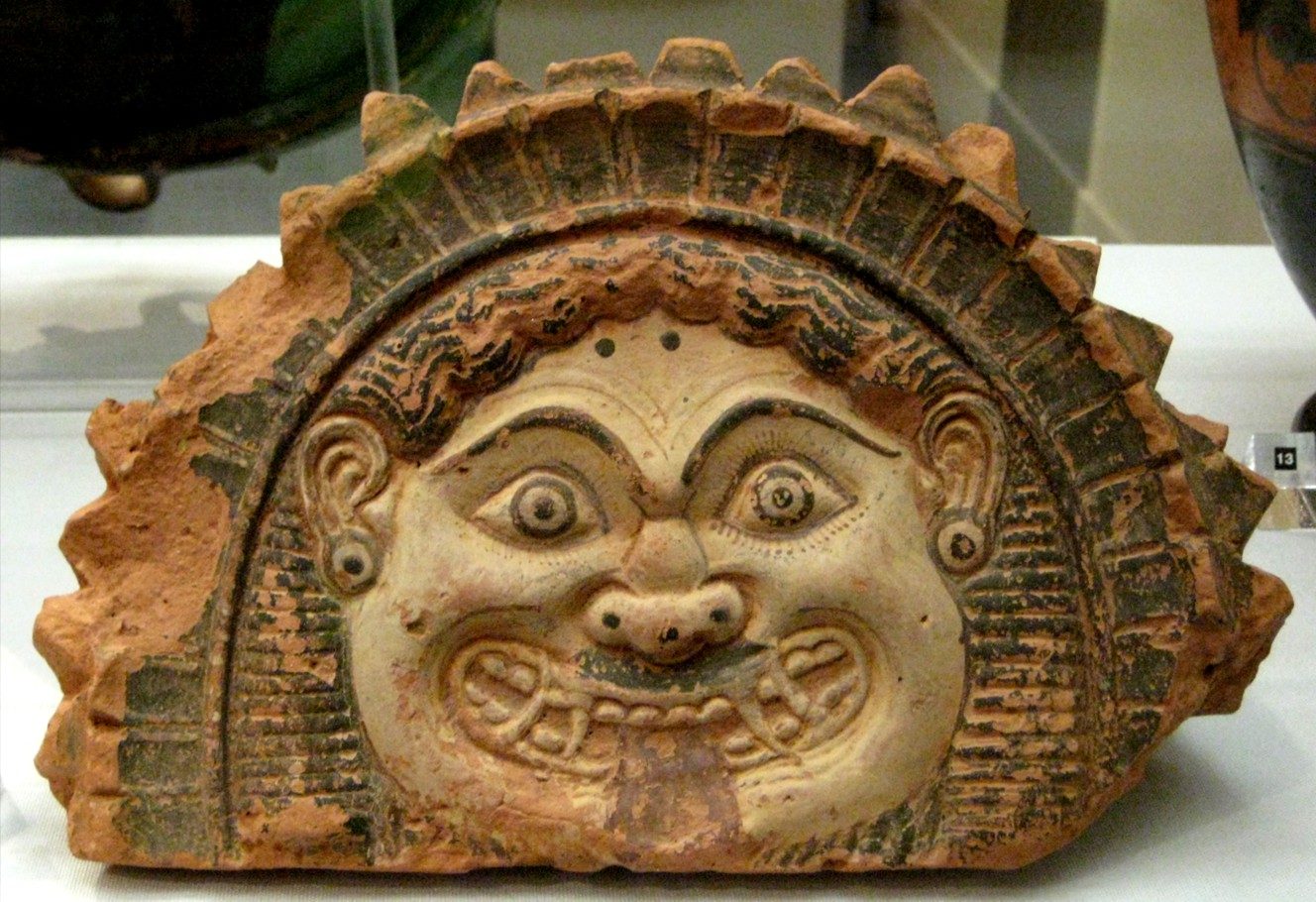
For the early Greeks, the Gorgon's face — the gorgoneion — was less a character than a protective symbol. They painted and carved that wide-eyed, fanged, tongue-out face onto shields, armour, temple roofs, and pottery as an apotropaic device: an image so frightening it would ward off evil and enemies. In other words, before Medusa was a tragic woman or a slain monster, she was essentially the ancient world's "beware" symbol, a face designed to stop harm in its tracks.
The version that changed everything
The detail that makes Medusa so resonant today comes mainly from the Roman poet Ovid, writing in his Metamorphoses around the year 8 CE — centuries after the early Greek myths. Ovid gives Medusa a backstory the older versions don't emphasise.
In his telling, Medusa was once a stunningly beautiful young woman, famous above all for her glorious hair. The sea god Poseidon desired her and assaulted her in the temple of the goddess Athena. Athena, enraged that her sacred temple had been defiled, directed her fury not at the powerful god who committed the act — but at Medusa, the victim. The goddess transformed Medusa's beautiful hair into a nest of serpents and cursed her so that anyone who looked at her face would turn to stone.
Read it slowly and the horror lands. A woman is attacked, and a second, more powerful woman punishes her for it — turning her beauty into a weapon that isolates her completely, since now no one can even look at her without dying. It is a myth about violation, blame, and exile, dressed in the costume of a monster story.
"She was once most beautiful… and the jealous hope of many suitors. Of all her beauties none was more admired than her hair… [Athena] changed the Gorgon's lovely hair to loathsome snakes."— Ovid, Metamorphoses, Book IV (8 CE), giving Medusa her tragic origin
Why a hero came hunting her
Medusa's death wasn't random — it grew out of a cruel trap set for someone else. The hero Perseus was the son of Danaë, a mortal princess, and Zeus. A local king, Polydectes, wanted Danaë for himself and saw her grown son as an obstacle. So he hatched a scheme: he pretended he was going to marry someone else and demanded gifts from everyone, knowing the poor young Perseus had nothing to give. When Perseus rashly promised to bring anything instead, the king pounced and demanded the one thing he assumed would get the boy killed — the head of the Gorgon Medusa.
It was meant to be a death sentence dressed as a quest. No one was supposed to survive an encounter with a creature whose gaze turned flesh to stone. That the gods chose to equip Perseus instead — Athena with her mirrored shield, Hermes with winged sandals, and others with a cap of invisibility and a special pouch — turned a setup into a legend. So the famous beheading is really the climax of a story about a powerful man abusing the weak, and it's worth remembering that Medusa, already a victim in Ovid's version, dies as a pawn in yet another man's scheme.
The hero and the severed head
The most famous chapter of the myth is Medusa's death at the hands of the hero Perseus. Sent on a seemingly impossible quest to bring back a Gorgon's head, Perseus was helped by the gods: winged sandals to fly, a cap of invisibility, a special pouch to hold the head, and — most cleverly — a polished, mirror-like shield from Athena.
That shield is the key to the whole tale. Knowing that meeting Medusa's gaze meant instant petrification, Perseus never looked at her directly. He approached watching only her reflection in the polished bronze, and beheaded her while she slept. From her severed neck, in the strange logic of myth, sprang the winged horse Pegasus. Perseus then used the head itself as a weapon — its petrifying power outlived its owner — before finally giving it to Athena, who fixed it onto her shield or breastplate. The protective Gorgon face had come full circle.
Worth knowing: Medusa's power didn't end with her death - it arguably got stronger. Her severed head kept its ability to turn onlookers to stone, and Perseus used it as a superweapon, petrifying enemies (including, in some versions, a sea monster and a rival king). Drops of her blood were said to become venomous snakes, and her blood was even believed to be both a deadly poison and a miraculous healing agent, depending on which side it was taken from. Few mythological figures are more dangerous dead than alive.
Monster or victim?
Is Medusa a villain or a victim? For most of history she was simply the monster - the obstacle the hero overcomes, her face a trophy. But modern readers, especially since the 20th century, have seized on Ovid's origin story to recast her as a symbol of a wronged and silenced woman, punished for her own assault. Feminist writers and artists have reclaimed her as an emblem of female rage and survival. Classicists caution that this reading leans heavily on one Roman poet and reads modern values into an ancient symbol whose original meaning was protective, not political. Both are true at once: Medusa means something different in every age that looks at her - which is precisely why she endures.
The myth behind the "monster"
"Medusa was always a hideous snake-haired monster who deserved to be killed."
It depends entirely on the source. In the earliest Greek tradition she's a monstrous Gorgon, yes - but in Ovid's hugely influential Roman version she's a beautiful woman cursed into monstrousness as punishment for being assaulted. The "she was always a monster" idea flattens a figure who, in the version that shaped Western art, is far more tragic than evil.
Why Medusa never dies
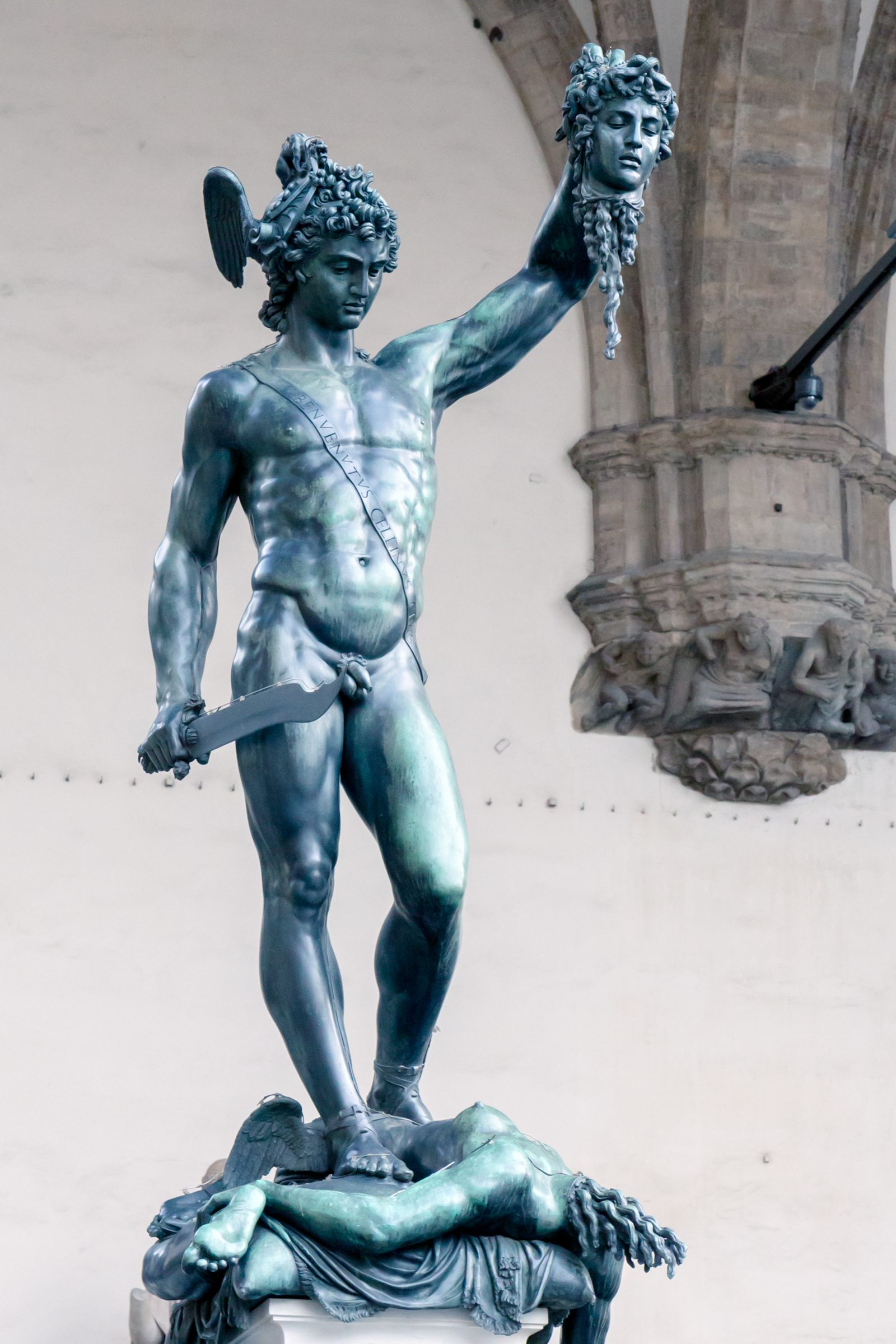
Medusa has had an astonishing afterlife. The Renaissance loved her: Cellini cast Perseus triumphantly holding her dripping head, and Caravaggio painted her face frozen in the very instant of her death, mouth open in a scream. Centuries later she became a fashion emblem and a pop-culture staple. And in recent decades she has been reclaimed yet again — a 2020 statue in New York controversially reversed the classic image, showing Medusa holding the severed head of Perseus, turning the trophy myth on its head.
That endless reinvention is the real point. Medusa survives because she is a mirror — fittingly, given how Perseus defeated her. Look at her and you see whatever your culture fears or champions: a protective ward, a monster to be slain, a cautionary tale, a victim blamed for her own suffering, or a symbol of righteous fury finally given a voice. The snakes and the stone-turning stare are unforgettable special effects. But the reason a three-thousand-year-old face is still everywhere you look is that her story keeps asking the same hard question — who do we turn into monsters, and why? — and every age answers it a little differently. The beautiful woman, the punished victim, the slain monster, the protective guardian, the symbol of fury reclaimed: they are all Medusa, layered one over another like the sediment of everyone who ever told her tale. Perhaps that is the truest curse Athena laid on her — not the snakes or the deadly gaze, but the fate of never being allowed to rest as just one thing.
What sprang from her blood
Medusa's death is one of the strangest "birth" scenes in mythology. When Perseus beheaded her, two beings sprang from her body or her spilled blood: Pegasus, the famous winged horse, and Chrysaor, a giant or warrior often described as wielding a golden sword. In the logic of the myth these were the offspring of her union with Poseidon, finally released by her death — life and beauty erupting, incongruously, from an act of decapitation.
Her blood, too, was potent in opposite directions. According to the myths, the blood from the left side of her body was a deadly poison, while the blood from the right side could heal and even raise the dead — a gift later associated with the healer-god Asclepius. And the drops of her blood that fell on the deserts of Libya as Perseus flew home were said to have bred the venomous snakes that infest the region. Even in death, Medusa kept generating — monsters, miracles, and poisons all at once. It's a fittingly contradictory legacy for a figure who is herself never just one thing.
From a protective mask to a modern icon
It's worth returning to where Medusa began, because it frames everything she later became. Long before the tragic backstory, that Gorgon face — bulging eyes, fangs, protruding tongue — was carved over doorways and painted on shields not to frighten us but to frighten away evil on our behalf. She was a guardian. The same petrifying gaze that made her a monster also made her the ultimate protective charm, which is why Athena, her killer, ends up wearing Medusa's head on her shield: the hero claims the monster's power for defence.
That deep ambiguity is why thinkers and artists never let her go. Sigmund Freud wrote a short, famous essay reading the severed, snake-fringed head in psychological terms. Renaissance masters made her a showpiece of dramatic horror. A luxury fashion house took her face as its logo, turning the ancient ward against evil into a symbol of glamour. And in the 21st century, activists and artists reclaimed her once more — the assaulted woman punished for her own attack became a rallying image during the #MeToo era, her rage reframed as righteous rather than monstrous. Three thousand years on, Medusa is still doing exactly what that first carved mask was meant to do: commanding our attention and refusing to be looked away from. We just keep changing our minds about what we see.
Image: 'Perseus with the Head of Medusa' by Benvenuto Cellini (via Wikimedia Commons). This article retells a Greek myth, not a historical event.
Where the story comes from
- Hesiod, Theogony (c. 700 BCE) — the earliest account of the Gorgons and Medusa's death.
- Ovid, Metamorphoses, Book IV (8 CE) — the origin story of Medusa's transformation, the version most influential on later art.
- Apollodorus, The Library — a useful ancient summary of the Perseus myth.
- For the afterlife: the sculptures of Benvenuto Cellini and the paintings of Caravaggio; modern reinterpretations in feminist criticism and art.