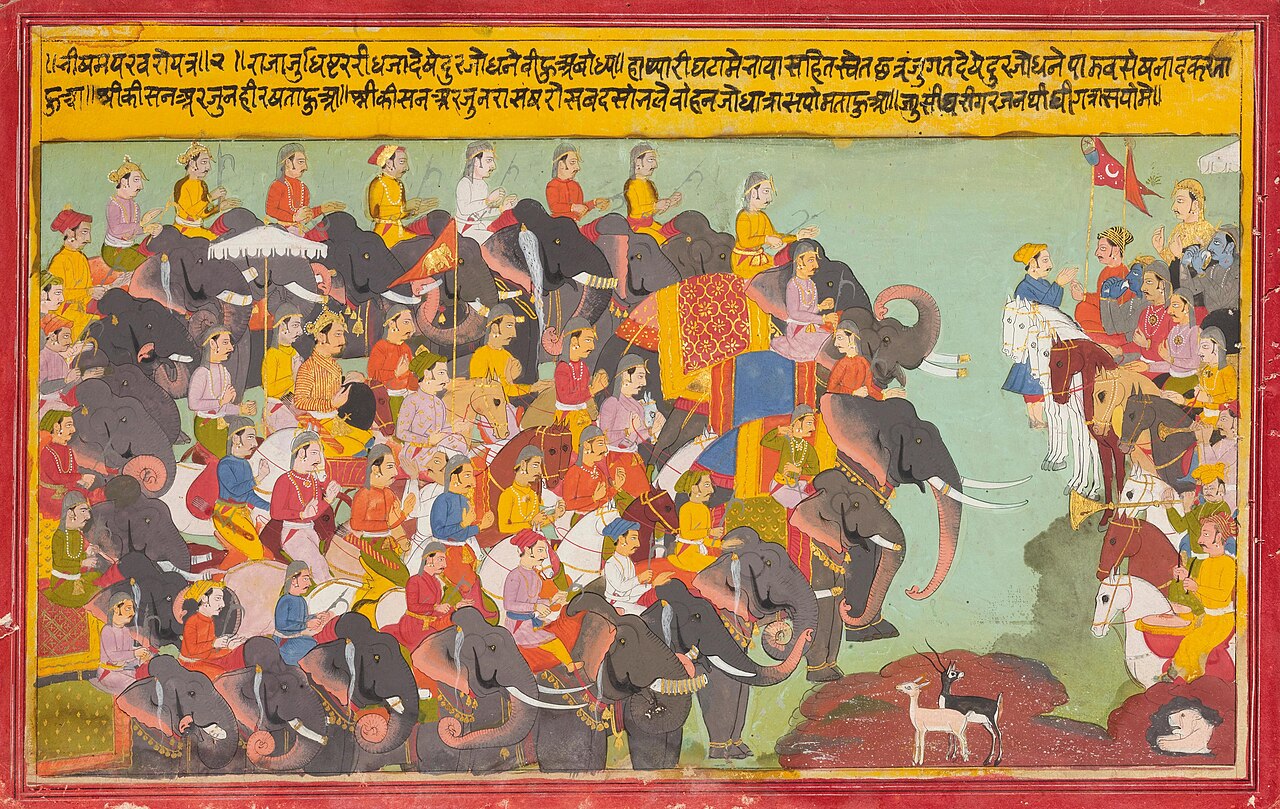
At the very end of the great war of the Mahabharata, two warriors face each other with weapons that should never be used. Arjuna, the greatest archer of the age, and Ashwatthama, a warrior half-mad with grief, each invoke the Brahmastra, a weapon of the god Brahma so terrible it can scorch the earth, poison the rain, and wither the unborn in the womb. The sky darkens; the world itself seems to hold its breath. The sages Vyasa and Narada rush between them, begging them to withdraw the weapons before creation is unmade. Arjuna, who has been taught how, recalls his. Ashwatthama never learned, and can only redirect his to a horrifying target. This is the world of Hindu weaponry: an arsenal of divine arms whose power is measured not in metal, but in the fate of the cosmos.
The weapons of Hindu mythology are among the most vivid and imaginative in any tradition: spinning discs that never miss, tridents that hold up the universe, thunderbolts forged from a sage's bones, and god-given missiles that read almost eerily like weapons of mass destruction. But they are also frequently misunderstood, flattened in modern retellings into either "ancient nukes" or simple magic swords. So let's do this properly: what these weapons actually were, who wielded them, and what they meant.
Astra vs shastra: two kinds of weapon
The first thing to understand is that Hindu tradition draws a clear line between two categories of arms, and confusing them muddles everything.
A shastra is a handheld, physical weapon: a sword, a mace, a spear, a bow used in the ordinary way. You hold it, you swing or throw it, and its power comes from your own strength and skill. A astra, by contrast, is a supernatural weapon: a force invoked by a sacred incantation, a mantra, and presided over by a particular deity. To use an astra you did not simply carry it. You had to be taught the mantra that summoned it, usually by a god or a great guru, and you had to be worthy of that knowledge. Once invoked, an astra unleashed the power of its patron deity: fire, water, wind, serpents, or the raw destructive will of a god. Many astras also had to be withdrawn by a second incantation, and a warrior who knew how to summon one but not how to recall it was a danger to everyone, himself included.
The requirement to recall an astra drives some of the most tragic moments in the epics. In the Mahabharata, the young warrior Abhimanyu knew how to enter a deadly battle formation but not how to get out, and was killed inside it. Ashwatthama could invoke the world-ending Brahmastra but not withdraw it. Knowledge of these weapons was treated as sacred and dangerous precisely because half-knowledge was lethal, a strikingly modern anxiety about power without wisdom.
The personal arms of the gods
Before the invoked astras, there are the great signature weapons carried by the gods themselves, the divine equivalents of a hero's named sword, each loaded with meaning.
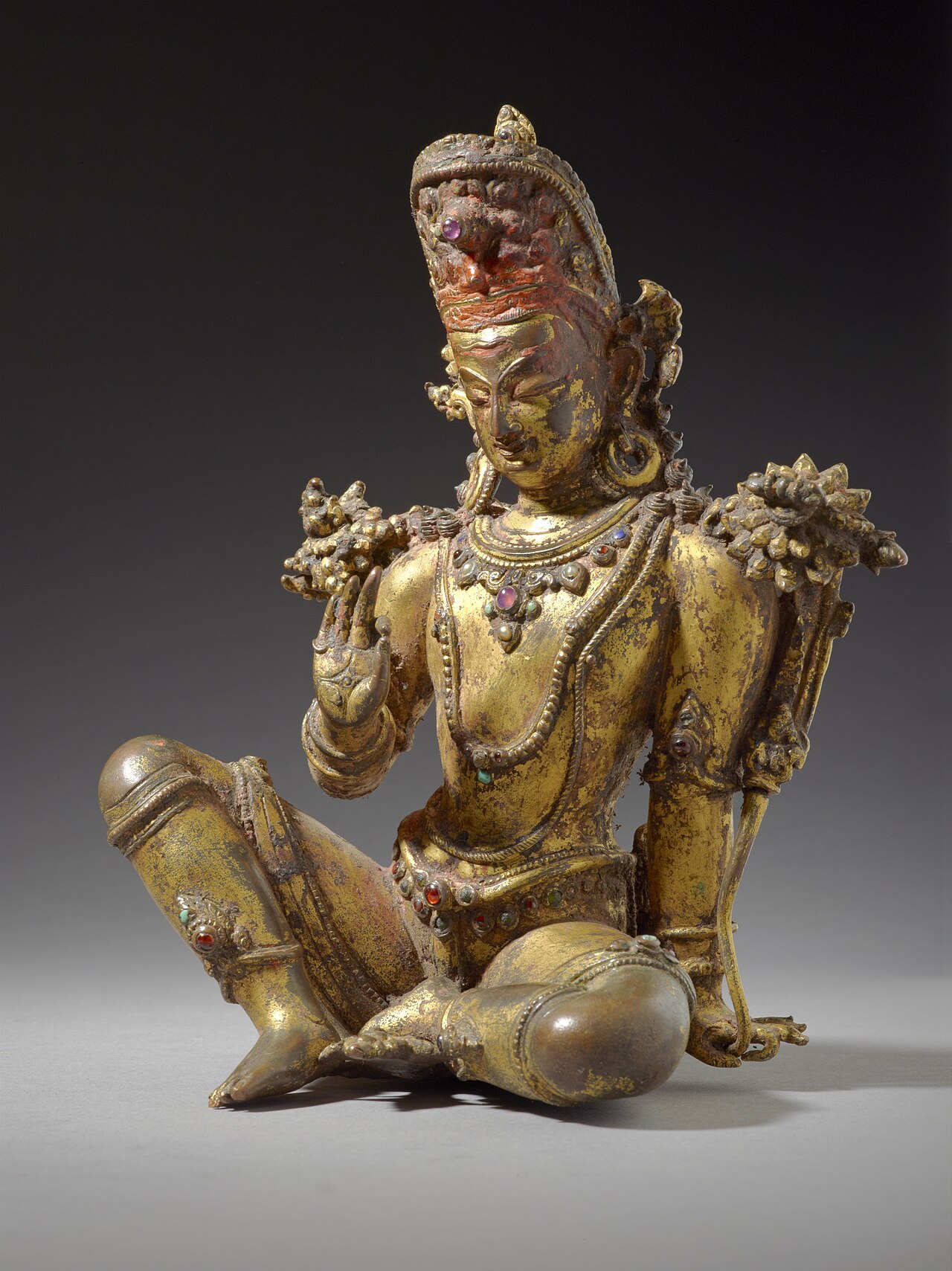
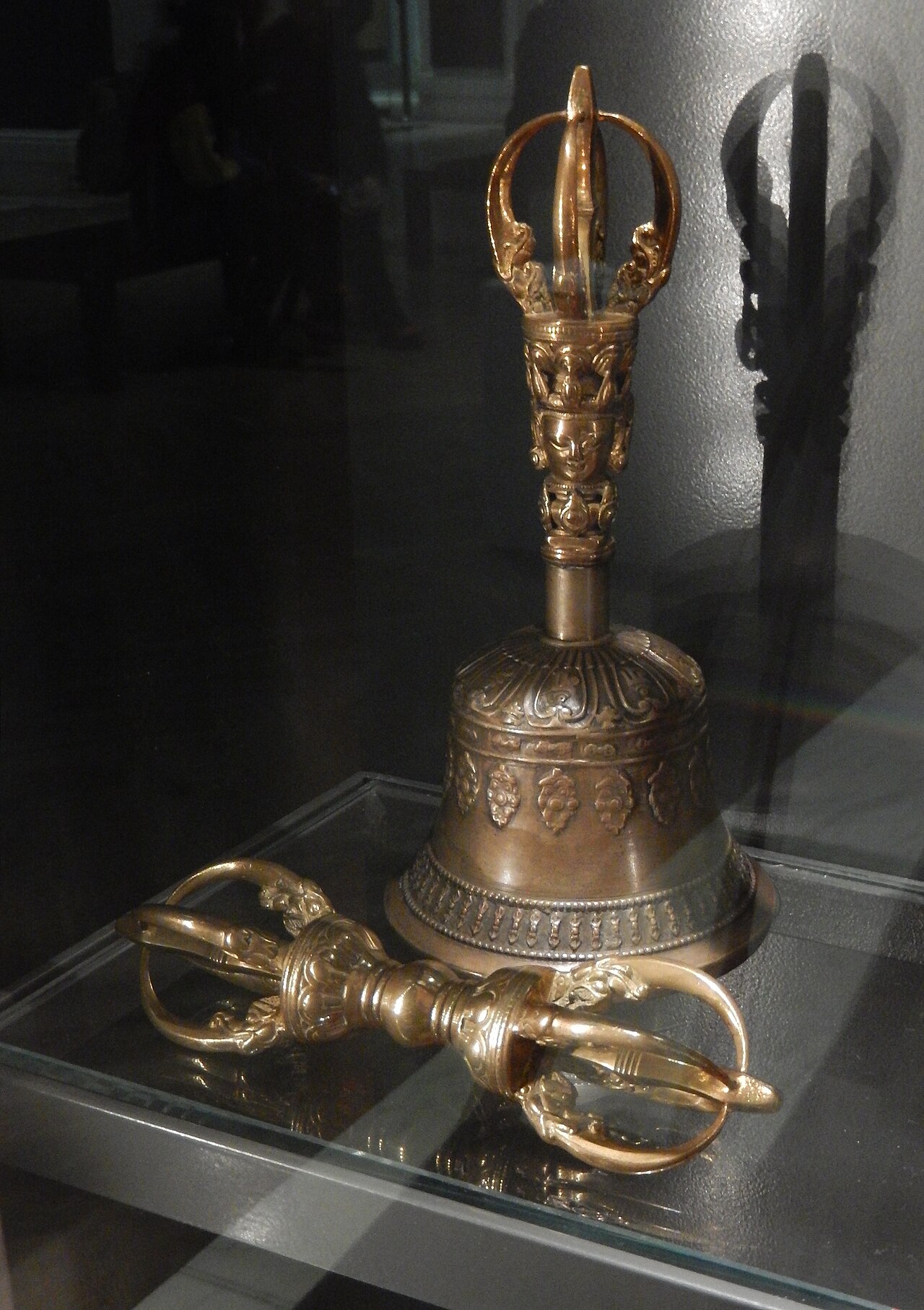
The Vajra is the thunderbolt of Indra, king of the gods and lord of storms. Its origin story is extraordinary: the gods needed a weapon to slay a near-invincible demon, and a sage named Dadhichi gave up his own life so that his indestructible bones could be forged into it. The Vajra represents the irresistible force of the lightning strike, and it became such a potent symbol of indestructibility that the word itself came to mean both "thunderbolt" and "diamond." It spread far beyond Hinduism; the vajra is a central ritual object in Buddhism across Asia.
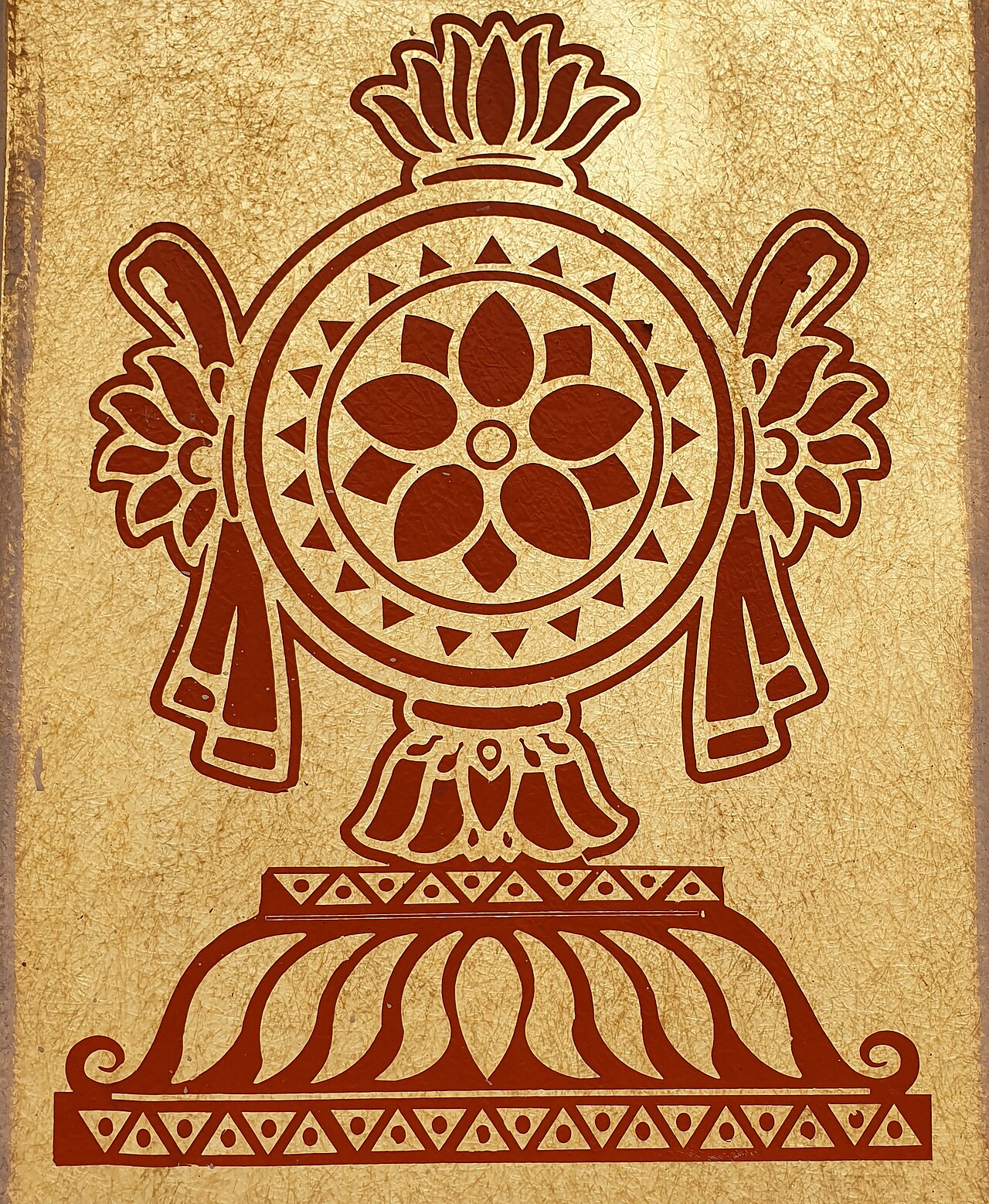
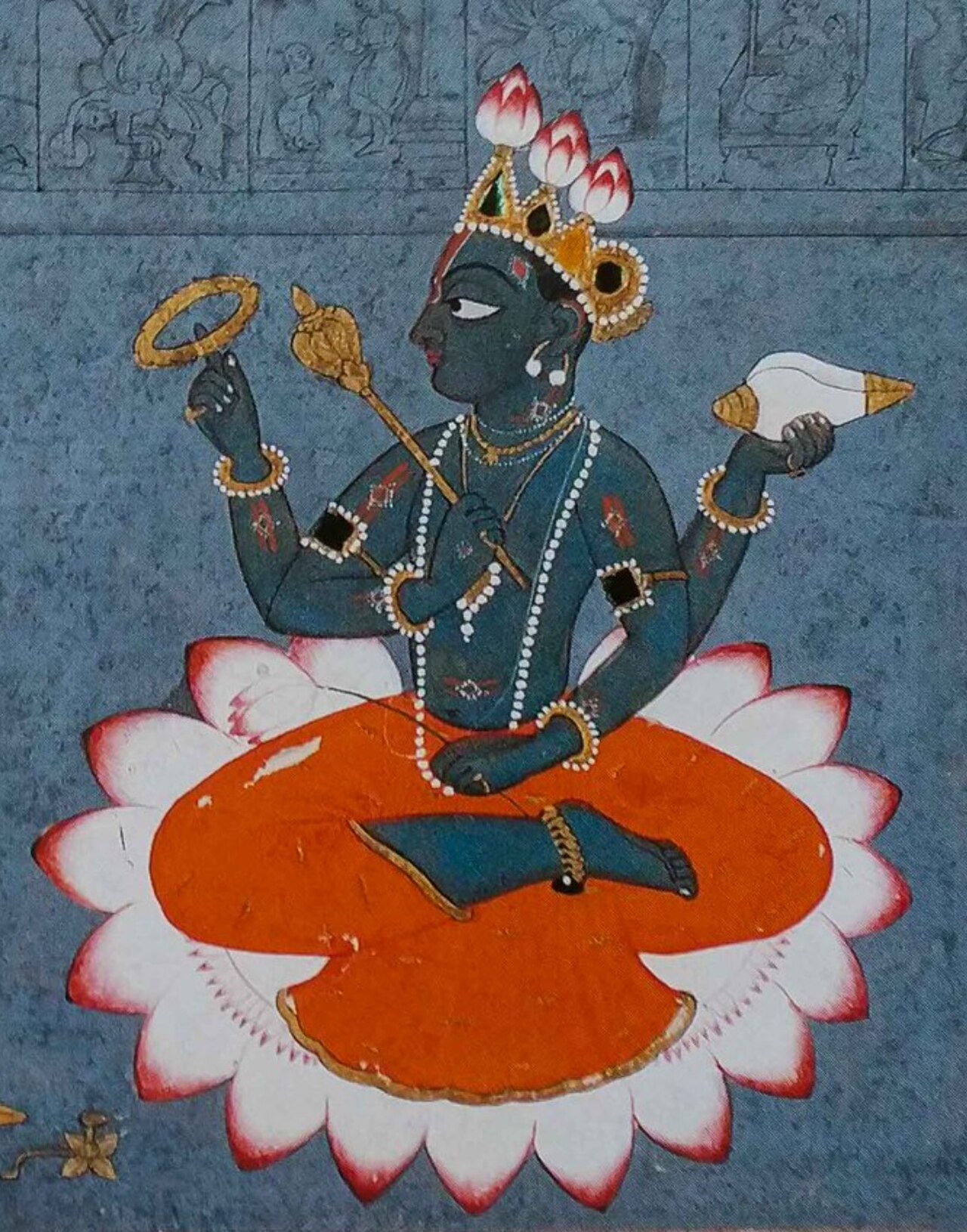
The Sudarshana Chakra is perhaps the most famous of all: the spinning, razor-edged discus of Vishnu. Depicted as a whirling wheel with 108 serrated edges, it flies at the command of its wielder, destroys its target, and returns, never missing, unstoppable once loosed. It is the ultimate expression of divine order enforcing itself against chaos, and Vishnu (and his avatar Krishna) deploy it at moments when the cosmic balance must be restored by force.
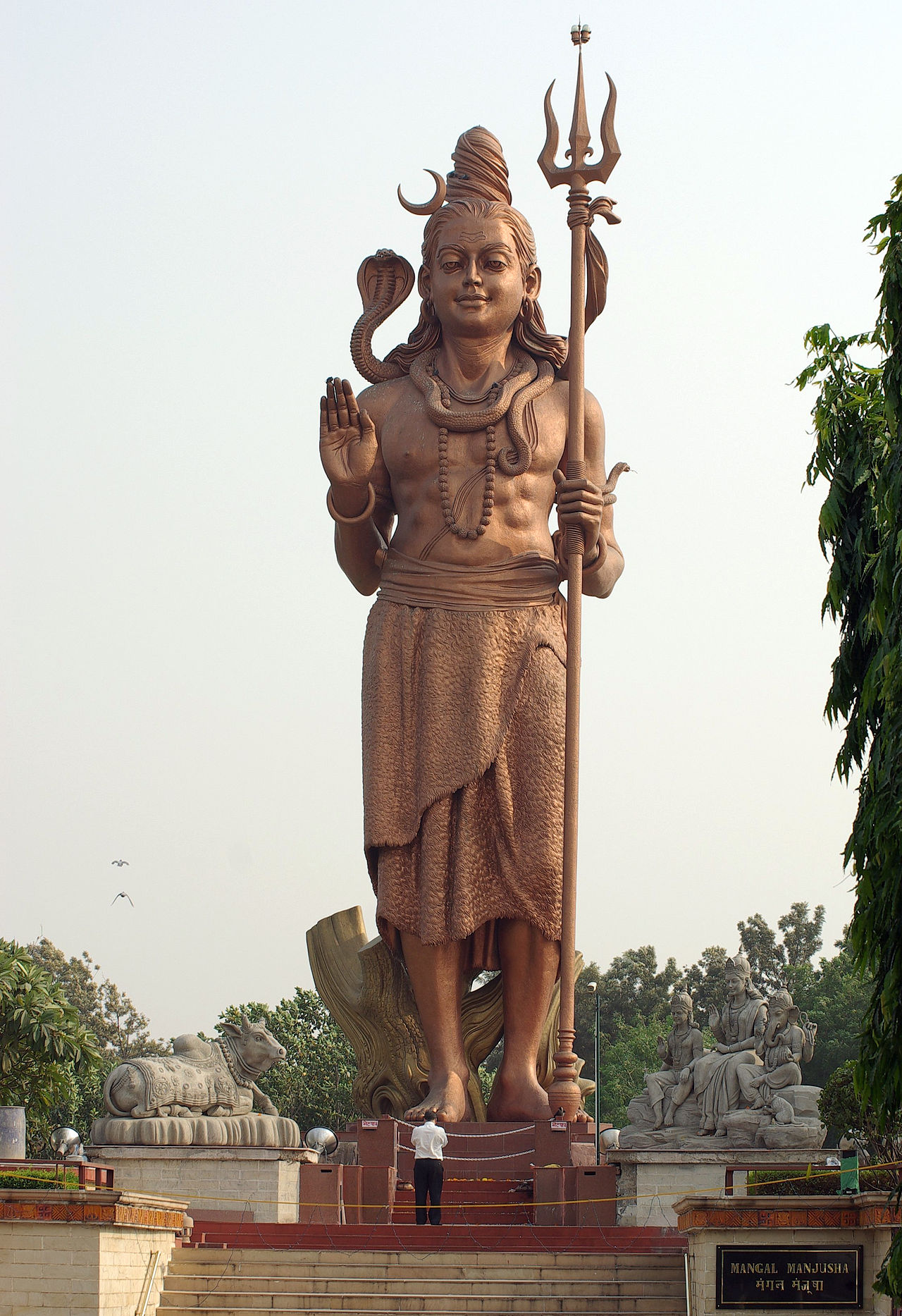
The Trishula, the trident, belongs to Shiva. Its three prongs are read in many ways (creation, preservation, and destruction; the three fundamental qualities of nature; past, present, and future), and it embodies Shiva's role as the god who both destroys and transforms. Where the Sudarshana enforces order, the Trishula represents the deeper power over the cycle of existence itself.
Alongside these are the great divine bows, for archery is the noble art of the epics. Shiva's bow is the Pinaka; Vishnu's is the Sharanga; the hero Arjuna wields the Gandiva, a celestial bow of tremendous power given to him by the fire god Agni; and Rama, the avatar-prince of the Ramayana, carries the Kodanda. And there is the Gada, the heavy mace. Vishnu's is named Kaumodaki, and it is the signature weapon of the mighty Bhima and of Hanuman, symbol of raw, loyal strength.
The great astras: weapons that end worlds
Now to the invoked weapons, and this is where Hindu mythology reaches a scale unlike almost any other. The astras are graded, roughly, by the power of the deity behind them, and at the top sit weapons that threaten all of creation.
The Brahmastra, the weapon of Brahma the creator, is the most famous. Once invoked against a target, it is said never to fail and never to be countered except by another Brahmastra; its blast brings devastation, and its aftermath is described in terms that unsettle modern readers: scorched land, failed rains, poisoned wombs, and lasting barrenness. Above it are even more terrible versions: the Brahmashirsha, said to be several times more powerful, and the almost unthinkable Pashupatastra.
"If the radiance of a thousand suns were to burst at once into the sky, that would be like the splendour of the Mighty One… Now I am become Death, the destroyer of worlds."— the Bhagavad Gita (part of the Mahabharata), the lines J. Robert Oppenheimer famously recalled on witnessing the first atomic bomb test in 1945
The Pashupatastra is Shiva's ultimate weapon, and the texts are clear that it operates on a different level entirely: it can destroy all of creation, and it is so dangerous that it must never be used against a lesser foe. Arjuna undertook fierce penance to earn it from Shiva himself. The Narayanastra, Vishnu's astra, has one of the cleverest mechanics in any mythology: it rains down a countless storm of weapons, and the harder its victims fight back, the stronger it grows. The only way to survive it is to stop resisting entirely, to lay down your arms and submit, at which point it passes over you. It is a weapon that punishes aggression and spares surrender.
Below these apocalyptic weapons sit the elemental astras, each commanding a force of nature: the Agneyastra unleashes inextinguishable fire; the Varunastra commands water and floods (and can quench the Agneyastra); the Vayavyastra summons devastating winds; the Nagastra and Nagapasha take the form of serpents that bind or poison, countered in turn by the Garudastra, invoking the eagle Garuda, eternal enemy of snakes. The logic of counter and counter-counter runs all through the epics, turning their great duels into something like a cosmic game of move and countermove.
Kavacha and Kundala: the armour that could not be pierced
Not every legendary item in the epics is a weapon of attack. Some of the most famous are defensive, and one story in particular shows how central divine protection could be. The warrior Karna, one of the great tragic heroes of the Mahabharata, was born with a natural armour, the kavacha, fused to his skin, and a pair of divine earrings, the kundala. Together they made him effectively invulnerable: as long as he wore them, no weapon could kill him, and he was therefore the deadliest obstacle standing in the way of Arjuna and the Pandavas.
Knowing this, Indra himself, disguised as a poor brahmin, came to Karna and begged the armour and earrings as a gift, exploiting Karna's famous, unbreakable vow never to refuse a request made of him. Karna saw through the disguise, knew the request would cost him his life, and cut the armour from his own body and handed it over anyway, rather than break his word. It is one of the most moving moments in the whole epic, and it makes the point that in this tradition the greatest "equipment" of all is not a weapon or a shield, but a person's character. Karna is undone not by a sharper blade, but by his own refusal to compromise his honour.
Durga's arsenal: a weapon from every god
One of the most beautiful ideas in Hindu weapon-lore surrounds the goddess Durga. When the buffalo-demon Mahishasura became invincible to all men and gods and threatened to overthrow heaven, the gods combined their energies to create Durga, and then each of them gave her his own signature weapon to fight with. Vishnu gave her his discus, Shiva his trident, Indra his thunderbolt, Vayu his bow, Varuna his conch, Agni his spear, and so on, until she bristled with the combined arsenal of the entire pantheon, wielding a different divine weapon in each of her many arms.
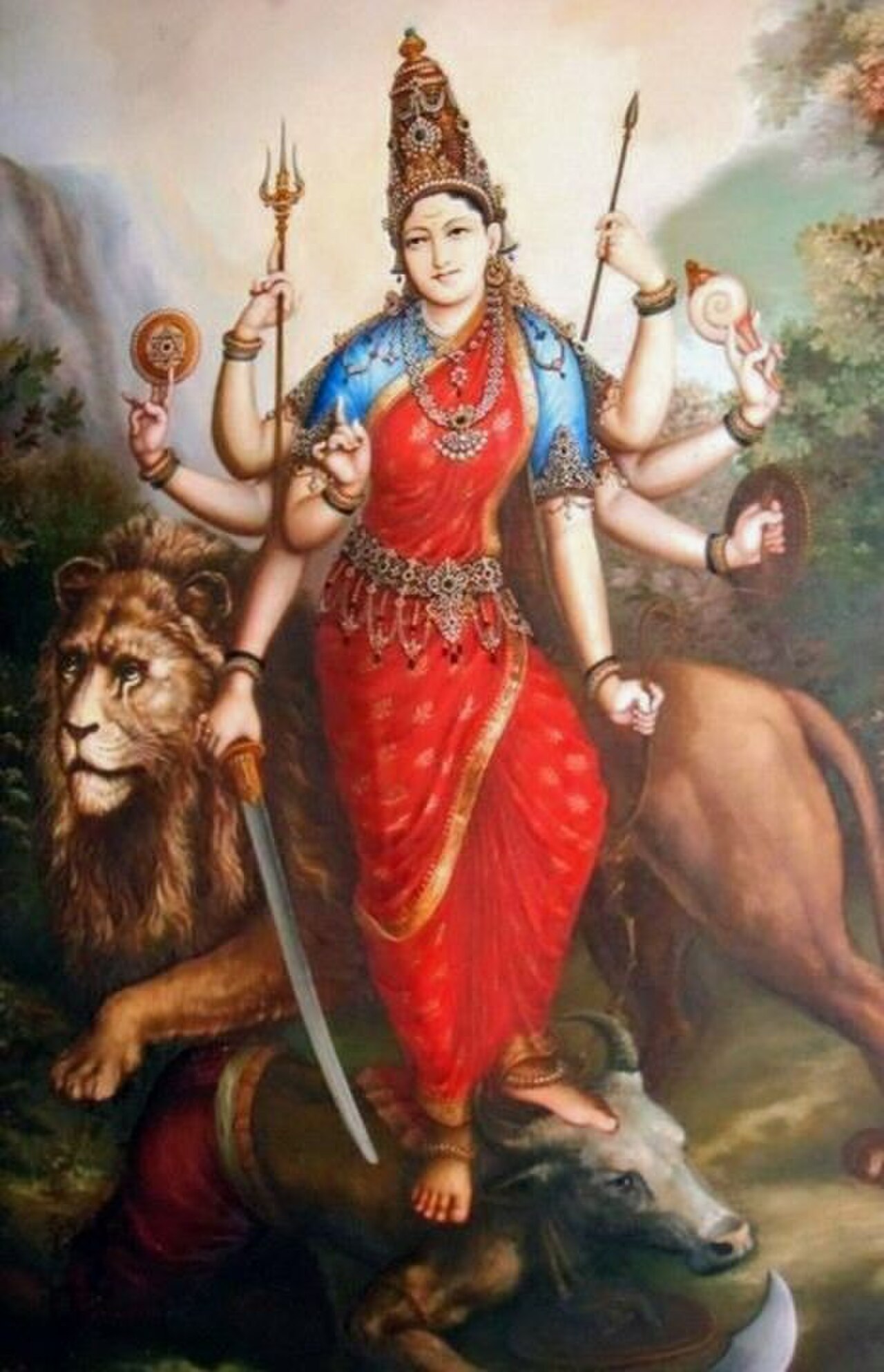
It's a gorgeous piece of symbolism: the divine feminine as the concentrated might of all the gods at once, and her victory over Mahishasura is celebrated to this day in the festival of Durga Puja. The image of the many-armed goddess, each hand holding a different weapon, is one of the lasting icons of Hindu art precisely because it packs the whole mythology of divine arms into a single figure.
Vishnu's four emblems
The god Vishnu is almost always shown holding four objects, and together they form a kind of summary of divine power and its purpose. In his hands are the Sudarshana Chakra (the discus, for the destruction of evil and the turning of time), the Kaumodaki (the mace, for strength and authority), the Panchajanya (a conch shell, whose sound is the primordial vibration of creation), and the Padma (a lotus, for purity and spiritual liberation). Two weapons and two symbols of peace: a deliberate balance, reminding the devotee that divine force exists to protect and uphold, not merely to destroy.
"The Brahmastra proves ancient India had nuclear weapons — the descriptions of blinding light, scorched earth, and radiation sickness are eyewitness accounts of atomic bombs, maybe given by aliens."
This is a modern reading projected backwards, popular on the internet but rejected by historians. The Mahabharata and Ramayana are epic poems and sacred literature, not technical logs; their power lies in symbol and meaning, not in engineering. The resemblance of the Brahmastra to a nuclear blast shows how far the human imagination can go in picturing ultimate destruction, the same imagination that later made Oppenheimer reach for the Gita to describe a real bomb. It says something profound about the poetry; it is not evidence of ancient super-weapons or "ancient astronauts."
Were the astras "real"?
So how should we read these weapons? Not as history, and not as a coded record of lost technology, but as something arguably more interesting. The astras are the moral and philosophical machinery of the epics. Again and again, the great weapons are used to explore questions that still matter: who deserves to hold ultimate power? What happens when knowledge outruns wisdom? Is it right to use a weapon that could destroy the innocent along with the guilty? The Narayanastra spares those who surrender; the Brahmastra must be recalled by anyone worthy to wield it; the Pashupatastra is forbidden against a weaker foe. These are not just cool magic items. They are the ancient world thinking hard, in the language of story, about the ethics of overwhelming force.
Readers have always argued over how literally to take the astras. Traditional devotees may regard the epics' events as sacred truth; some modern enthusiasts insist the descriptions encode real ancient technology; most historians and literary scholars read them as mythology and poetry, symbolic and meaningful, and not meant as engineering manuals. These readings reflect very different frameworks for what the texts are. What everyone can agree on is the imaginative power of the arsenal, and the seriousness of the moral questions the weapons are used to ask.
Still in the sculpture and the comics
The divine weapons of Hindu mythology never became museum pieces. They are alive in the culture: in temple sculpture and festival, in the many-armed goddess and the discus-bearing god, in the names parents give their children, and in a busy modern universe of comics, films, and animation that reimagines the astras for new audiences. When a blockbuster hero wields a Brahmastra on screen, it is drawing on an unbroken imaginative tradition thousands of years old.
And they endure because they were never really about the hardware. A weapon that must be recalled by the wise, that grows stronger the more violently you resist it, that a god will only grant to someone who has earned it through penance: these are stories about power and responsibility dressed in fire and lightning. That is why, long after the sages stepped between Arjuna and Ashwatthama, we are still telling them.
Read next: The Nine Worlds of Norse Mythology and The Vijayanagara Empire: The Hindu Kingdom That Held the South for 300 Years.
Sources & further reading
- The Mahabharata and the Ramayana — the great Sanskrit epics in which the astras appear; accessible modern renderings include those by C. Rajagopalachari and the abridged translations of the Bhagavad Gita.
- The Bhagavad Gita — the philosophical heart of the Mahabharata, source of the "thousand suns" verse.
- Wendy Doniger, The Hindus: An Alternative History, and standard reference works on Hindu iconography for the symbolism of divine weapons.
- Encyclopaedic and museum sources on the iconography of Vishnu, Shiva, Durga, and Indra, and on the vajra in Hindu and Buddhist art.