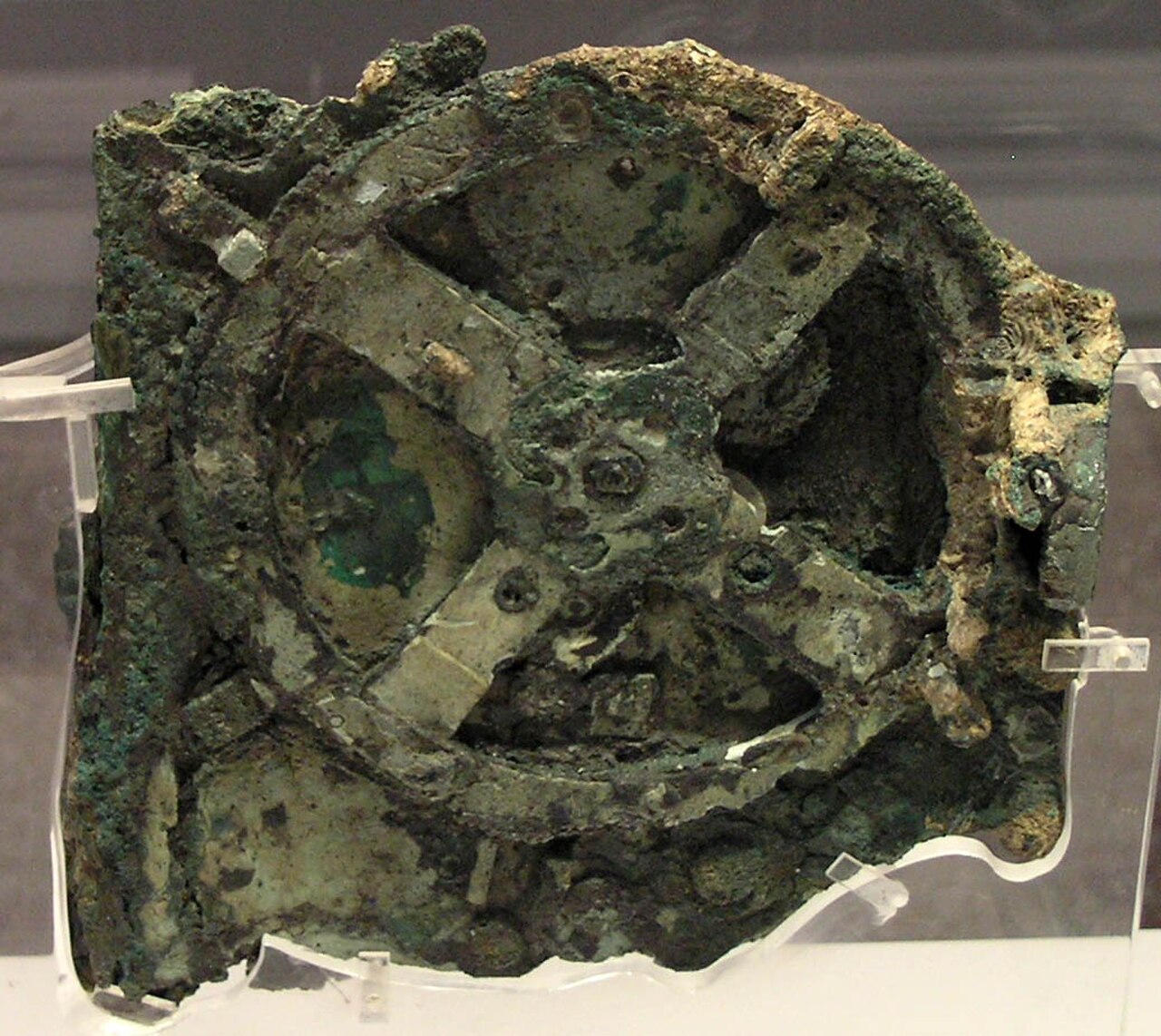
In the spring of 1901, a crew of Greek sponge divers sheltering from a storm dropped anchor off the tiny island of Antikythera, halfway between Crete and the Peloponnese. When the weather cleared, one diver went down in his heavy canvas suit and copper helmet, and surfaced babbling about a heap of dead bodies on the seabed. They were not bodies. They were bronze and marble statues, scattered across the wreck of a Roman-era ship that had gone down some two thousand years earlier. Over the following months the divers hauled up a museum's worth of treasure. And among the corroded statues and amphorae, almost overlooked, was a shoebox-sized lump of bronze and rotted wood. It did not look like much. It would turn out to be the single most astonishing object to survive from the ancient world.
Here's the thing that still unsettles historians of science: that lump was a machine. A geared, hand-cranked, astronomical calculating device of such complexity that nothing remotely like it appears again in the historical record for well over a thousand years. We have, in effect, found a computer in a shipwreck older than the fall of Rome — and we are still working out exactly how it was built and who built it.
A storm, a shipwreck, and a lump of bronze
The wreck itself dates to roughly the middle of the first century BC; the cargo suggests a large merchant ship, probably sailing west toward Rome and loaded with Greek luxury goods, that foundered against the cliffs of Antikythera. The statues alone would have made the find famous. But in 1902 the archaeologist Valerios Stais, examining the unremarkable bronze lump in the National Archaeological Museum in Athens, noticed something protruding from the corrosion: a gear wheel, with precisely cut teeth, embedded in the metal.
That should have been impossible. Toothed gear-trains of that delicacy were not supposed to exist in the Greek world — they belonged, as far as anyone knew, to the medieval clockmakers more than a millennium later. For decades the object sat in an awkward limbo, too sophisticated to fit the textbooks, too real to dismiss. Some scholars quietly assumed it must be an intrusion, something that had fallen into the wreck later. It took most of the twentieth century, and a succession of increasingly powerful imaging technologies, to prove that the machine was exactly as old as the ship that carried it, and to begin reading what it was for.
What it does
Strip away the corrosion and the centuries, and the Antikythera mechanism was a bronze model of the cosmos as the Greeks understood it. It originally sat in a wooden case roughly the size of a thick book, with dials on the front and back and a side crank to drive it. Turn the crank, and an interlocking train of more than thirty bronze gears moved a set of pointers that reproduced the motions of the heavens.
On the front face, a large dial carried two scales: the twelve signs of the Greek zodiac, and a ring marked with the 365 days of the Egyptian calendar. Pointers tracked the position of the Sun and the Moon against the stars, and a clever little rotating ball, half silver and half black, showed the phase of the Moon. There is strong evidence the front also displayed the positions of the five planets known to antiquity — Mercury, Venus, Mars, Jupiter and Saturn — turning the whole face into a working orrery, a hand-cranked map of the sky for any chosen date.
The back was, if anything, more impressive. Two large spiral dials dominated it. The upper spiral was a Metonic calendar, laying out the 19-year cycle in which the solar year and the lunar month fall back into step — 235 lunar months spiralling around five turns. The lower spiral was a Saros dial of 223 months, used to predict eclipses of the Sun and Moon, with little glyphs marking the months in which an eclipse was expected and even, in some cases, the hour. Subsidiary dials handled the longer corrections astronomers needed: a Callippic dial and an Exeligmos dial that refined the eclipse predictions across 54-year stretches.
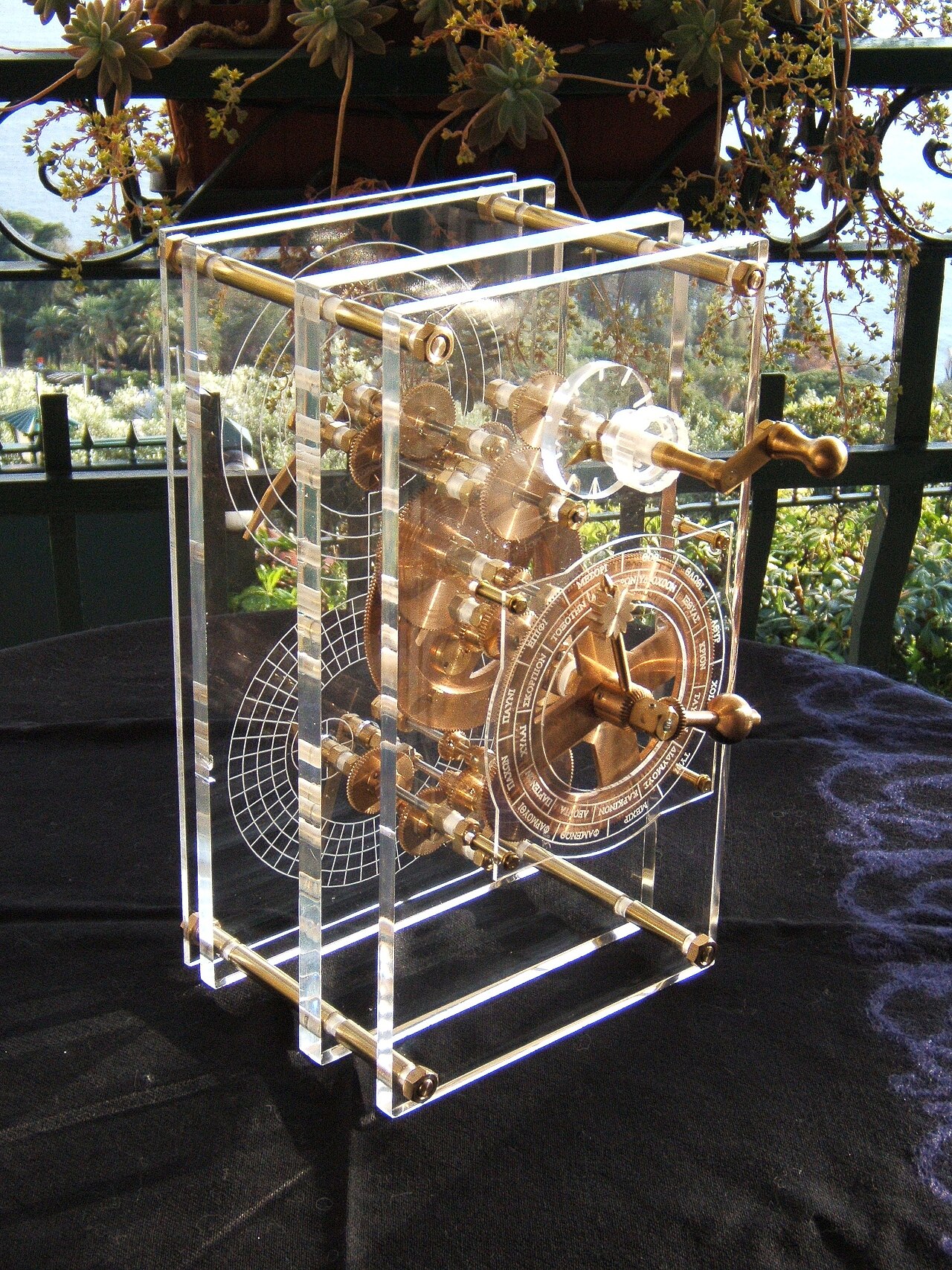
And then there is the detail that delights everyone who hears it: one small subsidiary dial tracked the four-year cycle of the great Panhellenic games, naming the Olympics among them. A 2,000-year-old astronomical computer that also told you when the next Olympic Games were due. It is the kind of human touch that collapses the distance between us and the people who made it.
Worth knowing: Nothing of comparable mechanical sophistication survives — or is even described — anywhere in the world for roughly the next 1,400 years. Geared astronomical devices on this level reappear only with the great astronomical clocks of fourteenth-century Europe. The Antikythera mechanism is, quite literally, a piece of technology that arrives a millennium and a half "too early," a peak of engineering that was reached, lost, and not climbed again until the Renaissance was on the horizon.
The genius in the gears
What makes the mechanism a genuine marvel of engineering, rather than just an elaborate set of dials, is hidden in how the gears are arranged. The Greeks knew perfectly well that the Moon does not move across the sky at a constant speed — it runs faster when closer to Earth and slower when farther away, an effect later astronomers would explain with elliptical orbits. The maker of the Antikythera mechanism reproduced that varying speed mechanically.
He did it with a startlingly modern trick: two gear wheels mounted slightly off-centre from one another, connected by a pin on one that rides in a slot on the other. As the pair rotates, the pin-and-slot coupling makes the output gear speed up and slow down over each cycle, mimicking the Moon's real motion almost exactly. This is epicyclic gearing — gears mounted on other moving gears — and the device uses it to embody a sophisticated lunar theory of the kind associated with the astronomer Hipparchus. To find the same idea executed in bronze again, you would have to wait the better part of two thousand years. It is not an exaggeration to say that whoever built this understood, and could manufacture, mechanical solutions that would not be reinvented until the modern era.
"Our friend Posidonius has recently made a globe which in its revolutions shows the movements of the sun and stars and planets, by day and night, just as they appear in the sky."— Cicero, On the Nature of the Gods, written c. 45 BC, describing a planetary device built in his own lifetime (standard translation)
That passage matters enormously. For a long time the mechanism looked like an orphan with no context — a single freakish object with nothing around it. But Roman writers, Cicero chief among them, casually mention bronze "spheres" that modelled the motions of the heavens, including ones attributed to Archimedes and, as above, to the philosopher Posidonius on Rhodes. The literary record told us such machines existed; the Antikythera mechanism is the physical proof, the one survivor of a lost tradition of Greek precision instruments that the texts had been describing all along.
A century of decoding
Reading a machine that has spent two millennia corroding on the seabed is not easy, and the story of decoding it is almost as remarkable as the device itself. The first person to take it seriously as a scientific instrument was the British-American historian of science Derek de Solla Price, who studied the fragments from the 1950s onward. Using early X-ray and gamma-ray images to peer inside the metal and count the hidden gear teeth, Price published a landmark study in 1974 titled Gears from the Greeks, arguing that this was a true calendrical and astronomical computer. He was right about the essentials, even where later work corrected his details.
Through the 1990s and 2000s the engineer and curator Michael Wright, often working with the mathematician Allan Bromley, took the analysis further, building physical models to test how the gear-trains could actually mesh — and showing, against the prevailing assumption, that the front very likely displayed the planets too. Then, in 2005 and 2006, an international collaboration called the Antikythera Mechanism Research Project brought the heaviest machinery yet to bear: a custom-built eight-tonne microfocus X-ray CT scanner hauled to Athens, plus advanced reflectance imaging that made the faint surface inscriptions leap out of the bronze.
The results, published in the journal Nature in 2006 by Tony Freeth, Mike Edmunds and their colleagues, transformed the field. The CT scans let researchers count gear teeth that no human eye could see and read thousands of characters of Greek text hidden inside the fragments — a kind of built-in instruction manual and astronomical description, sometimes called a parapegma. We can now identify the Metonic, Saros, Callippic and Olympiad dials with confidence precisely because the machine, in a sense, labels itself.
Who built it — and when?
For all that we have learned, the two most human questions remain genuinely open: who made this thing, and exactly when? The mechanism carries no signature. What it carries instead are clues that scholars have argued over for decades.
The astronomical theory built into the gears — especially the lunar anomaly — points strongly toward the tradition of Hipparchus of Rhodes, working in the second century BC. The ship appears to have been sailing from the eastern Mediterranean, and Rhodes was a famous centre of both astronomy and instrument-making; Cicero's mention of Posidonius's globe on Rhodes fits neatly. Many researchers therefore place the device's construction somewhere around 150 to 100 BC, the product of a Rhodian school of astronomy at its height. Others have looked further back, toward the long shadow of Archimedes of Syracuse, who died in 212 BC and whom ancient sources credit with building planetary spheres of his own.
The dating is genuinely contested. The mainstream view, anchored in the astronomy and the inscriptions, puts the mechanism in the second century BC. But in 2014 researchers Christián Carman and James Evans argued that the eclipse predictions on the Saros dial are best fit by a starting date around 205 BC — which would push the design back toward the era of Archimedes himself. The calendar inscriptions, meanwhile, seem to match the region of Corinth or its colonies such as Syracuse, Archimedes' home city. Is it a Rhodian instrument in the line of Hipparchus, or an heirloom of the Archimedean tradition? The same fragments are read both ways, and honest experts still disagree.
The "ancient computer" and the alien myth
Whenever an object is this far ahead of its apparent time, a particular kind of mythology grows up around it — and the Antikythera mechanism has attracted more than its share. It turns up constantly in "ancient aliens" television and on the wilder corners of the internet as a supposed out-of-place artifact: proof, the argument runs, that the ancient Greeks could not possibly have built something so advanced, so it must have come from somewhere — or someone — else.
It is worth being blunt about this, because the truth is more impressive than the fantasy. There is nothing alien or anachronistic about the mechanism once you take Greek science seriously. Its gear ratios encode Babylonian and Greek astronomical cycles that we can independently document. Its inscriptions are in ordinary Hellenistic Greek. Its design assumptions — an Earth-centred cosmos, the zodiac, the Metonic and Saros cycles — are exactly the assumptions of the astronomers we know were working in that era. Roman authors describe comparable devices by name. The mechanism is not evidence that the Greeks had help; it is evidence that we have badly underestimated how good Greek engineering actually was.
"The Antikythera mechanism is too advanced for its time — an out-of-place artifact that proves lost super-technology or ancient alien contact."
Every part of the mechanism fits comfortably within known Greek astronomy and Hellenistic metalworking. The cycles it computes are documented in Babylonian and Greek sources; its text is plain Greek; ancient writers describe similar geared "spheres." It is not out of place — it is a rare physical survival of a sophisticated tradition that mostly perished. The only thing genuinely lost was the tradition itself, not some impossible technology.
How much has simply vanished
The deepest lesson of the Antikythera mechanism is not really about gears at all. It is about how much of the past has simply vanished, and how easily we mistake the silence of the record for the limits of the people in it. Bronze gets melted down and reused; wood rots; workshops leave no trace. Had this one ship not sunk where it did, and had a few divers not sheltered from a storm two thousand years later, we would have no physical evidence whatsoever that the Greeks could build geared computers — and most historians would confidently tell you they could not. One shipwreck rewrote the history of technology.
It also reframes what we mean by "primitive" and "advanced." The same civilisation that produced this exquisite instrument never developed the steam engine or the printing press; the same medieval world that forgot how to build it went on to invent the mechanical clock and, eventually, everything that followed. Progress, the mechanism quietly insists, is neither steady nor inevitable. Knowledge can be concentrated in a handful of workshops and a few brilliant minds, and when those are gone — scattered by war, fire, conquest or simple neglect — it can drop out of the world for a thousand years, waiting in a corroded lump on a museum shelf for someone to notice the teeth of a gear.
Research on the mechanism is, fittingly, still going on. In 2021 a team at University College London led by Tony Freeth published a detailed new reconstruction of the front "Cosmos" display, attempting to show how all five planets, the Sun and the Moon could have been driven from a single input — a model that is elegant and persuasive, though, like everything about this object, not the final word. New scans, new models and new arguments keep arriving. More than a century after a sponge diver mistook it for the dead, the machine from Antikythera is still talking, and we are still, slowly, learning to listen.
Images: the surviving main fragment of the Antikythera mechanism, National Archaeological Museum, Athens; and a modern reconstruction of the front panel (both via Wikimedia Commons).
Further reading
- Derek J. de Solla Price, Gears from the Greeks: The Antikythera Mechanism — A Calendar Computer from ca. 80 B.C. (1974) — the pioneering scientific study.
- T. Freeth, Y. Bitsakis, X. Moussas, et al., "Decoding the ancient Greek astronomical calculator known as the Antikythera Mechanism," Nature 444 (2006) — the landmark CT-imaging paper.
- T. Freeth et al., "A Model of the Cosmos in the ancient Greek Antikythera Mechanism," Scientific Reports (2021) — the UCL reconstruction of the planetary front display.
- C. C. Carman & J. Evans, "On the epoch of the Antikythera mechanism and its eclipse predictor," Archive for History of Exact Sciences (2014) — the case for a 205 BC date.
- Jo Marchant, Decoding the Heavens: A 2,000-Year-Old Computer — and the Century-Long Search to Discover Its Secrets (2008) — accessible narrative history.
- Cicero, On the Nature of the Gods and On the Republic — ancient testimony to Greek planetary "spheres"; the Antikythera Mechanism Research Project (antikythera-mechanism.gr) for ongoing findings.