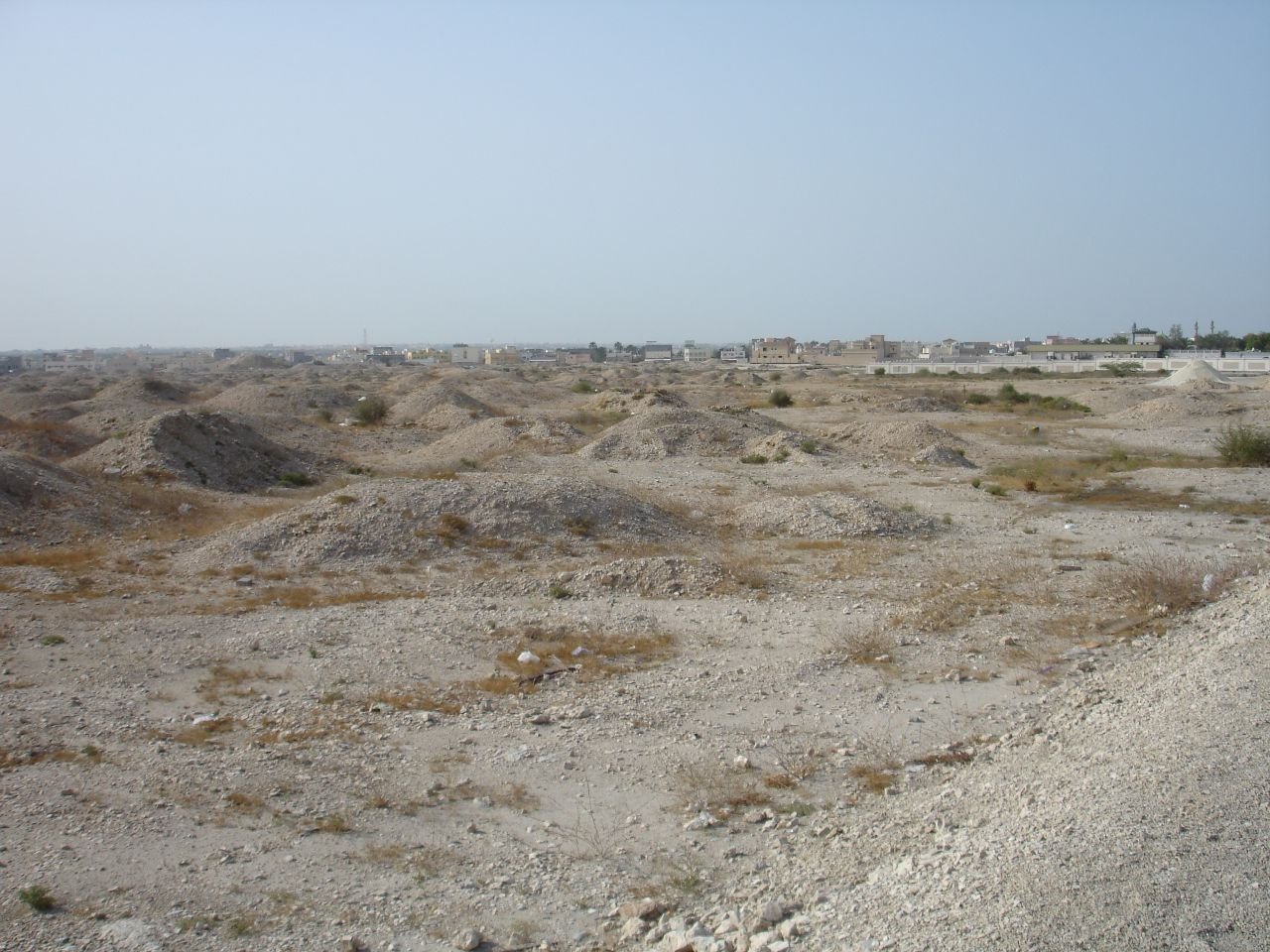
In the winter of 1889 an English traveller called Theodore Bent paid a gang of local men to cut into the biggest burial mound he could find in the north of Bahrain. It stood higher than a house, one of a field of them that ran off in every direction. His diggers worked for days. Near the centre they broke into a chamber of dressed stone, roofed with heavy slabs and built with a care that surprised him, and empty. Robbers had reached it long before, perhaps thousands of years before. Bent climbed back out into a view that unsettled him more than the looted grave had. Mounds stood everywhere, tens of thousands of them, a whole horizon handed over to the dead. No town rose among them. It looked, he wrote, like an island that existed for no reason but to be a graveyard.
A short sail to the north, in the cities of southern Iraq, scribes had written about this same low island more than a thousand years before Bent set foot on it. They did not call it a graveyard. They called it Dilmun, and they made it a paradise: a pure, bright country where no one fell ill and no one grew old, the place their own Noah was sent to live for ever after the Flood. The oldest earthly paradise we know of, older than the Garden of Eden, was not a dream of somewhere unreachable. It was a real address on the trade routes of the Persian Gulf. And on the ground, that blessed island turns out to be one of the largest fields of graves the ancient world ever raised. The whole story of Dilmun sits inside that contradiction, and the strange thing is that the two halves belong together.
A paradise written in clay
Start with the poem. A Sumerian myth we call Enki and Ninhursag, copied out on clay tablets early in the second millennium BC, opens with a description of Dilmun so calm it almost stops the story before it begins. In Dilmun, the poet says, the raven does not croak and the lion does not kill. The wolf does not carry off the lamb. The sick-eyed does not say “I am sick-eyed” and the sick-headed does not say “I am sick-headed.” Its old woman does not say “I am an old woman” and its old man does not say “I am an old man.” No widow, no wailing, no one walking the riverbank in mourning. It is a land with the pain filed off.
There is one thing missing from this paradise at the start, and it is the thing that makes the rest possible: fresh water. The god Enki fixes that. He orders the sun to bring up sweet water from the earth, and the springs fill, and the fields turn green, and Dilmun becomes a garden. That single detail is worth holding on to, because it is not a poet's invention. Bahrain really does have sweet water welling up out of the ground, and even out of the seabed offshore, in the middle of a salt gulf. Anyone who had crossed the deserts of Arabia to reach it would have understood at once why the place felt god-touched.
Dilmun turns up again in the flood story that later grew into part of the Epic of Gilgamesh. When the gods decide to drown the world and one man survives in a boat (Ziusudra in the Sumerian telling, Utnapishtim in the Babylonian one), his reward is not to go home. He is granted eternal life and settled far away, at the mouth of the rivers, in Dilmun, where the sun rises. This is the deathless land in its plainest form: the one place a human being was allowed to stop dying. The Mesopotamians, who buried their own dead in the floors of their houses and imagined a grim, dusty underworld for everyone else, put their single exception to mortality on a real island they traded with every year.
An island that was mostly graves
Now stand where Bent stood. The mounds of Bahrain are not a scatter. They are a population. Early travellers and surveyors, counting across the north of the island before the modern city ate into it, produced numbers that climb into the tens and then hundreds of thousands; some nineteenth- and twentieth-century estimates ran past a hundred thousand mounds. A great many have since been flattened for roads and housing. What survives is still staggering: the twenty-one protected sites inscribed by UNESCO in 2019 hold about 11,774 mounds between them, and even that is a remnant.
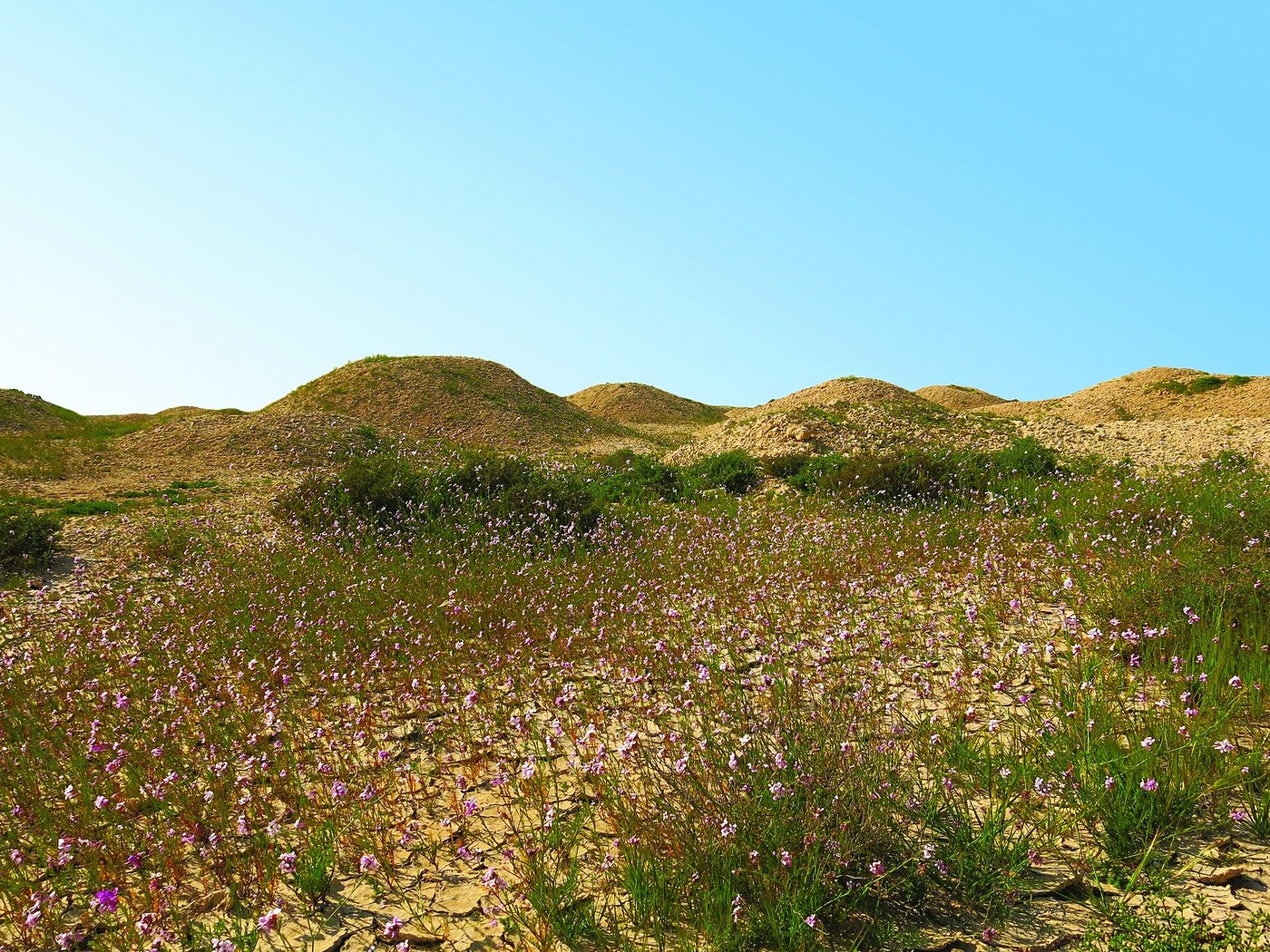
Most of them are not grand. The typical mound is a low cylinder of earth and stone, roughly nine metres across and a metre or two high, raised over a single stone burial chamber. Open one and you tend to find the same quiet scene: one person laid on their side with the knees drawn up, and a small handful of things to go with them. There might be a pottery jar or two, a stone stamp seal, sometimes a copper spearhead or a few beads, occasionally the bones of a lamb left as food. These are not pharaohs' tombs. They are the graves of a whole society, rich and poor, over roughly four and a half centuries between about 2200 and 1750 BC, each person given a stone room and a hill of their own.
A short walk from the village of A'ali the pattern changes. Here the mounds swell into something else: the Royal Mounds, a cluster of giants up to fifteen metres tall, some built as two-storey chambers, standing over the rest like cathedrals over parish churches. These held the people at the top, the rulers of Dilmun, buried with more room and more care, though the robbers reached most of them too. It was these that first drew diggers like Bent, hunting for the treasure a big mound seems to promise and rarely keeps.
Faced with all this, an obvious and wrong idea took hold. There were, people reasoned, simply too many graves. A small, dry island could never have held enough living people to fill them. So the dead must have been brought in from somewhere else. Bahrain, the theory went, was a holy burial island: a Mesopotamian cemetery in the sea, where mainlanders shipped their corpses to lie for ever in the paradise their poems described. It was a tidy story. It fit the myth almost too well. And it sent archaeologists looking, for decades, for a country of the dead with no living city attached.
The men who went looking for a country
The first hard evidence that the island had a name, and that the name was Dilmun, came from a stone. In 1879 a British political officer, Captain E. L. Durand, recorded a lump of black basalt near Bilad al-Qadim carved with a cuneiform inscription. Translated, it named the palace of a man called Rimum, “servant of the god Inzak.” Inzak was the chief god of Dilmun, known from Mesopotamian texts. For the first time the island on the map and the country in the clay tablets were pinned to the same spot of ground.
Durand's black stone is a small object doing enormous work. Before it, Dilmun was a word in Sumerian and Babylonian records that could have pointed anywhere down the Gulf. The inscription, a local ruler declaring himself the servant of Inzak, Dilmun's own deity, on Bahraini soil, tied the myth-country to this island. The original stone was later lost in transit to London, but Durand's careful drawing survived, and every excavation since has been, in a sense, following up on it.
Bent's dig in 1889 came next, and then, in 1925, the Egyptologist Ernest Mackay excavated a run of mounds and leaned hard into the necropolis idea. It was Peter Bruce Cornwall, an American working in the 1940s, who first argued in print that the mounds were not imported at all but the ordinary dead of an ordinary resident population. The argument could only be won one way: by finding where those people had lived.
That job fell to a Danish team. From 1953 a large expedition arrived under the archaeologist P. V. Glob, with a young Englishman named Geoffrey Bibby among its leaders, and set to work across the island season after season. Bibby later wrote the whole adventure up in a book, Looking for Dilmun, whose title says exactly what they were doing. They were not chasing a single tomb. They were hunting for a lost country that most experts had already decided was only a graveyard.
A living city under the fort
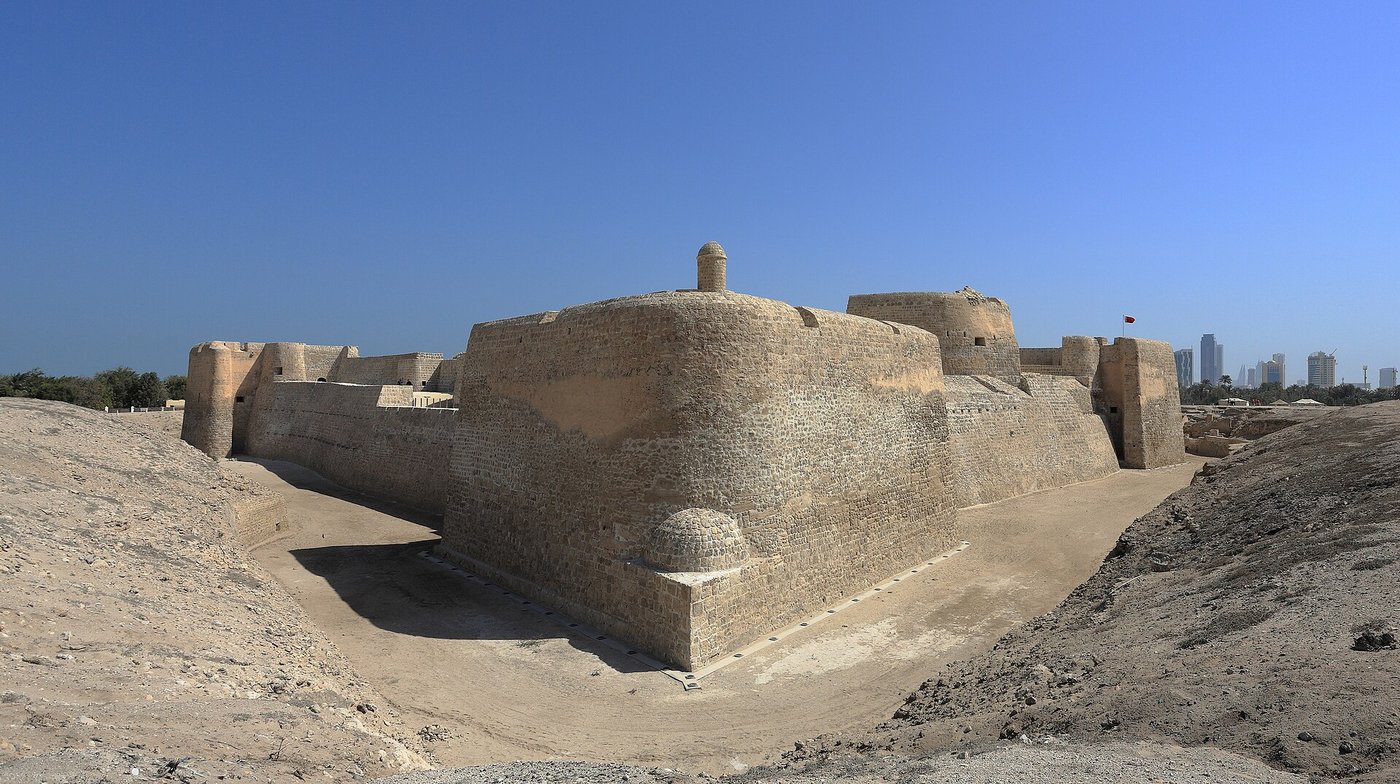
They found it, and it had been hiding in plain sight. On the north coast stood a great mound crowned by a Portuguese fort, Qal'at al-Bahrain. Everyone knew the fort. Almost no one had asked what the hill under it was made of. When the Danes cut into it, the answer came up in layers: a city, built and rebuilt for thousands of years, with the levels of Dilmun itself (streets, houses, storerooms, a defensive wall) reaching back to around 2300 BC. This was no cemetery. This was the capital, a working town by a harbour, exactly the missing city the necropolis theory said could not exist.
Then, decades later, a second site closed the case for good. In the 1990s a British and Bahraini team excavated Saar, a Dilmun town laid out on a low ridge: a planned settlement with a grid of houses, a small temple, and, right beside it, its own field of burial mounds. Here was a community you could stand inside, with its cemetery a few minutes' walk from its front doors. The people in those graves were not ferried across the sea. They had lived in the houses next to them.
Bahrain was a sacred burial island, a graveyard in the sea, where the peoples of Mesopotamia shipped their dead to be laid to rest in the paradise their myths described. No living society on so barren an island could ever have produced so many tombs; the corpses had to have come from the mainland.
Excavation found the living. Qal'at al-Bahrain gave up a Dilmun capital; Saar gave up a whole town sitting next to its own mounds. A resident population buried over twenty generations, each person under a stone chamber, adds up to precisely the numbers that once looked impossible. The mounds are not imported dead. They are the islanders themselves, and the sheer count is a measure of how long and how densely people lived here, not proof that no one did.
What made a barren island rich
Which leaves the real question. Where did a small island with almost no farmland and no metal of its own find the wealth to give every last one of its people a stone tomb? The answer is geography. Dilmun sat in the middle of the Gulf, halfway along the sea road between the cities of Mesopotamia to the north and the sources of the goods those cities craved to the south and east. It got rich the way a good harbour always gets rich: by standing in the middle and taking a cut.
The Sumerian and later records let you almost read the manifest. Ships came up from Magan (the coast of modern Oman) loaded with copper, the metal that made the Bronze Age work. From Meluhha, the Indus cities far to the east, came carnelian beads, ivory, hardwood and other luxuries. All of it flowed through Dilmun, where it was gathered, stored and sent on to Ur and the other Mesopotamian markets in exchange for barley, wool, textiles, oil and silver. Bahrain also had one product of its own that needed no import: pearls, from the oyster beds in its warm shallow water, prized in Mesopotamia for thousands of years. The island was a warehouse and a customs post rolled into one.
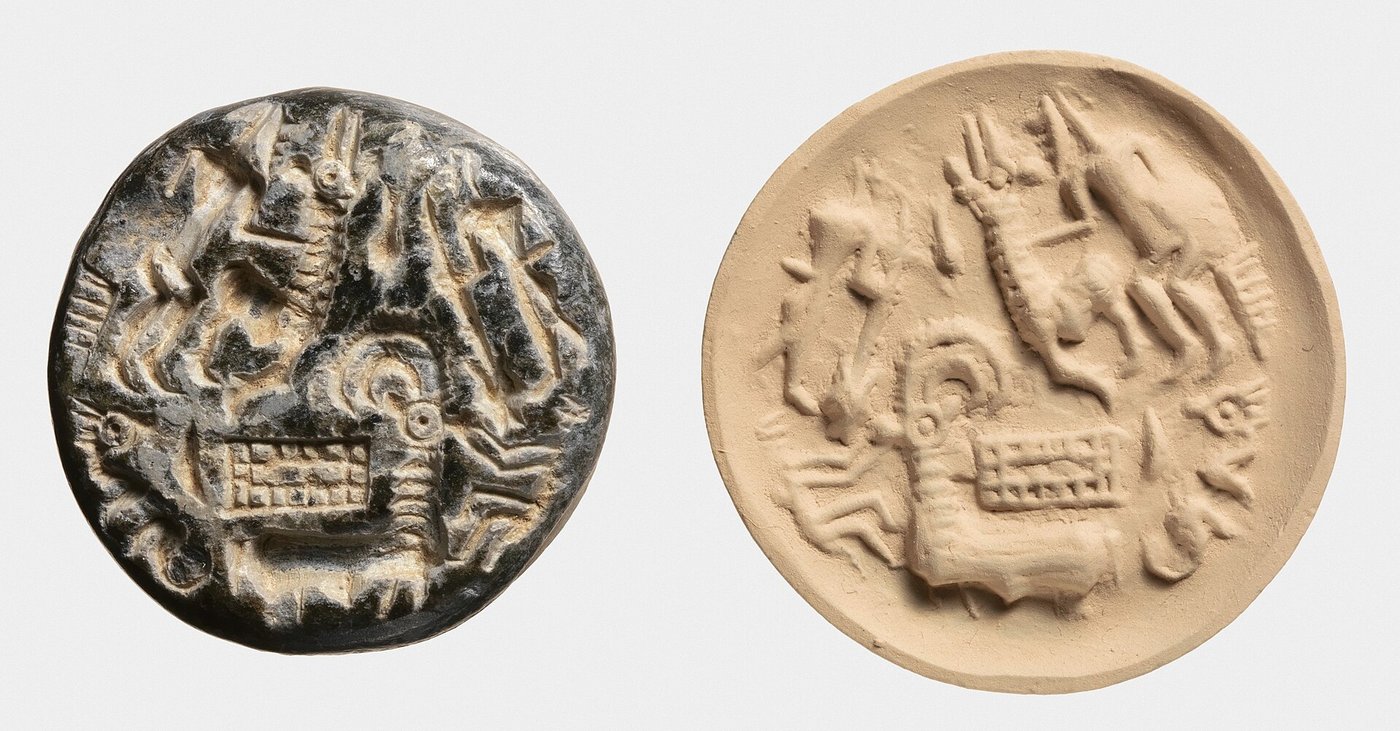
You can see the trade in two small things the diggers keep finding. The first is the seal. Dilmun's merchants used round stamp seals, carved with animals and figures and pressed into wet clay to close a jar or mark a bale: the signatures of a mercantile people, scattered from Bahrain across the Gulf and beyond. The second is quieter still, and it is the strongest proof of all that this was a serious commercial hub.
Among the finds are small polished stone weights. Measured, they do not follow the Mesopotamian system. They follow the standard used a thousand miles east, in the Indus cities of Harappa and Mohenjo-daro. A weight is only useful if both sides of a bargain agree on what it means, so a Dilmun trader carrying Indus-standard weights was doing business the Indus way. That tiny stone proves the island was not just near the trade route between Mesopotamia and the Indus but working inside it, keeping accounts both partners could trust.
The temple over the spring
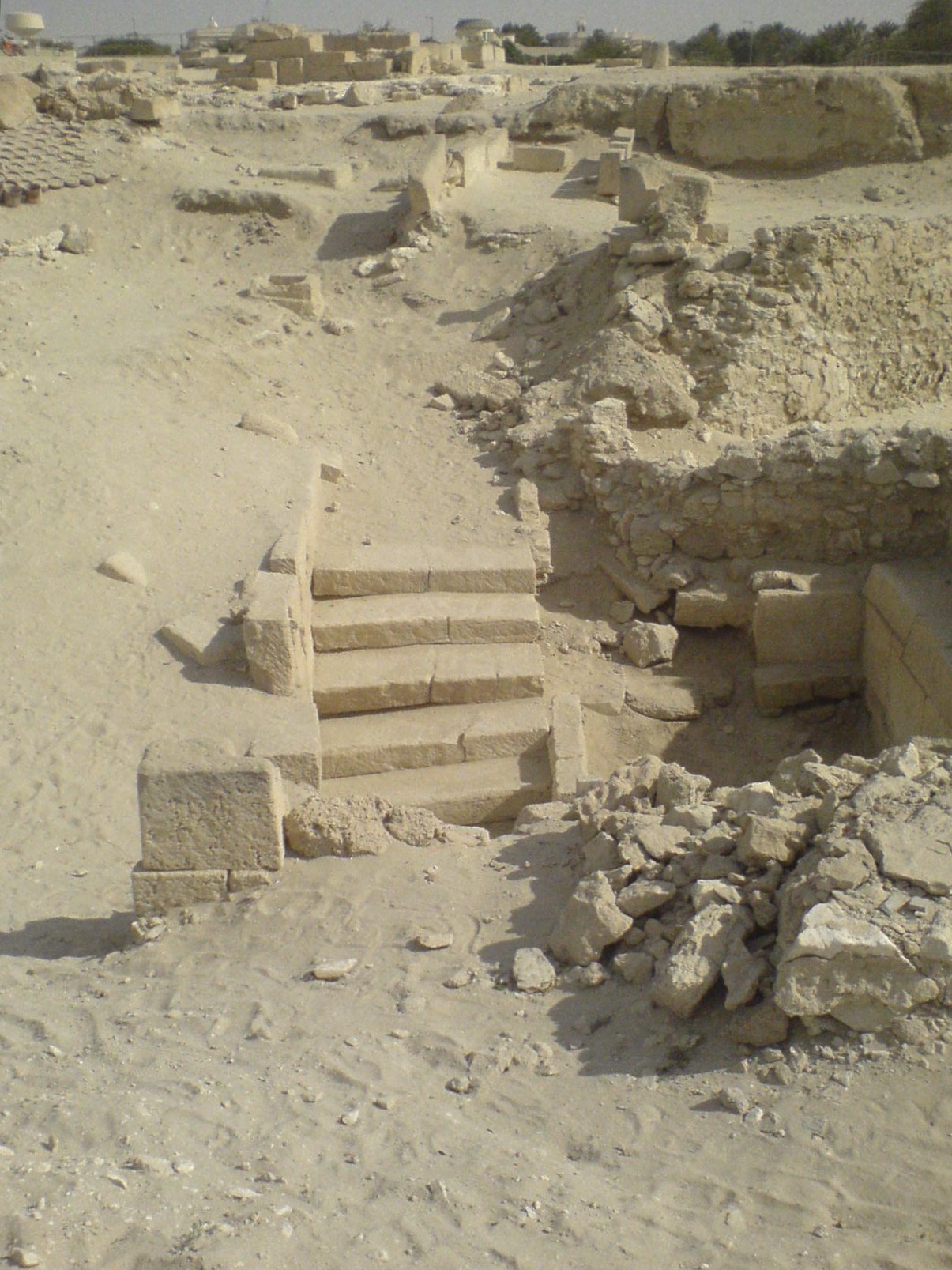
The wealth built a town. The water built a religion. Near the modern village of Barbar the Danes uncovered a temple that had been raised, torn down and raised again in three phases across roughly a thousand years, from about 3000 BC. At its heart, sunk into the ground and reached by a stair, was a stone-lined basin fed by a natural freshwater spring. People had built a temple around a place where sweet water came up out of the earth.
Set that beside the poem. In Enki and Ninhursag it is exactly this, sweet water rising from below, that turns Dilmun from a bare island into paradise. The Barbar temple looks like that belief made solid: a shrine wrapped around the miracle the myth describes. Enki was the god of the fresh underground water, the abzu, and here on his blessed island his people knelt at a spring and called it holy. The paradise story was not written about somewhere far off. It was written about the thing coming out of the ground under their feet.
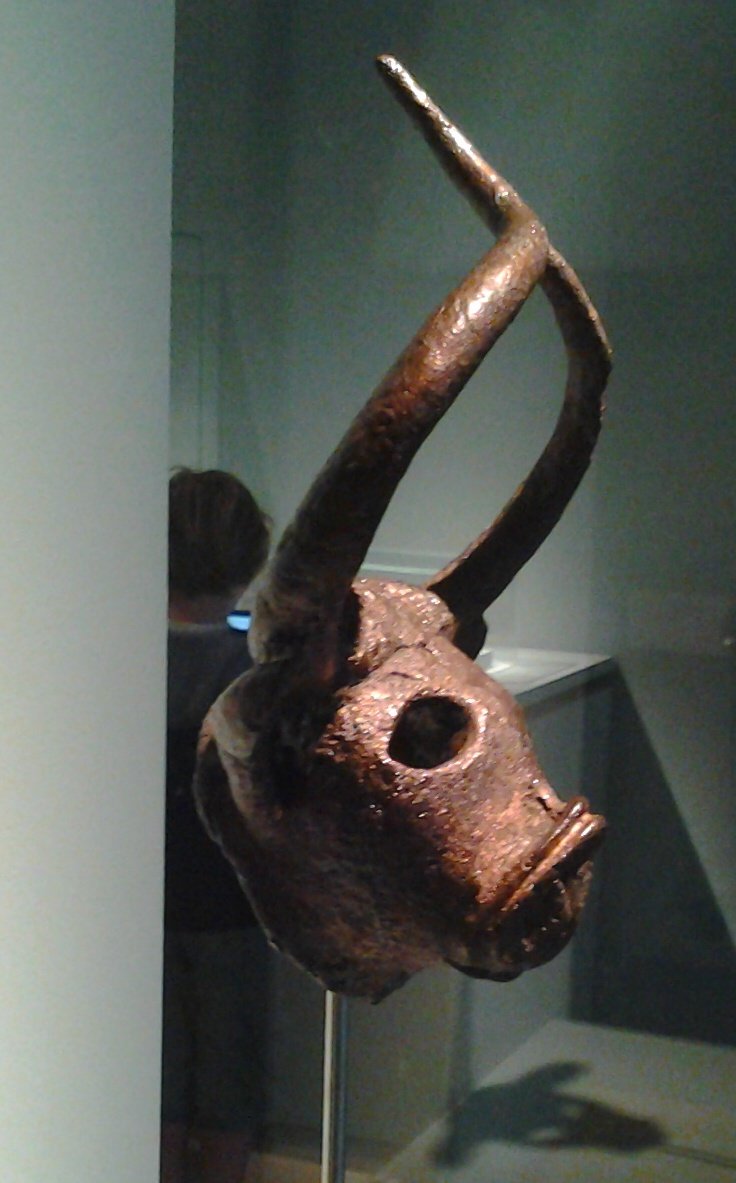
The temple gave up beautiful things, too. The best known is a small copper head of a bull, its curved horns and calm face startlingly alive after four thousand years, the kind of object that tells you the people who made these graves were not a grim death-cult but craftsmen with an eye and a hand. It is easy, walking a field of tombs, to forget that everyone in them was once as ordinary and unfinished as anyone alive. A bull's head cast in copper puts them back.
How a paradise fades
Paradises run on their springs, and Dilmun ran on its trade. When the trade faltered, so did the island. Around 1750 BC the long-distance system that had made Bahrain rich began to come apart: the Indus cities went into decline, the old Mesopotamian order shifted, and the neat flow of copper and carnelian through the Gulf thinned. An entrepôt with less to handle is just a small island again.
Dilmun did not vanish overnight. Under the Kassite kings who came to rule Babylon it entered a second, quieter life (what archaeologists call Middle Dilmun), governed for a time as an outpost of a foreign power, its great age of mound-building behind it. Centuries later the name still carried a faint glamour. Around 709 BC the Assyrian king Sargon II recorded tribute from a certain Uperi, king of Dilmun, who sent gifts from his island “in the middle of the sea”: a distant, half-legendary place to an Assyrian court, no longer the busy hinge of the world. By the time Greek sailors reached it they had a new name for the island, Tylos, and the old country of Dilmun had slid out of memory almost completely.
Not every scholar puts all of Dilmun on Bahrain. The earliest Sumerian mentions may point to a broader stretch of the Gulf: the eastern coast of Arabia around modern al-Hasa and the island of Tarut, or Failaka off Kuwait, which also has a Dilmun-era temple to Inzak. The likeliest answer is that “Dilmun” was never one fixed dot. It was a region, and perhaps a name whose centre drifted over the centuries as trade and power moved. Bahrain, with its springs, its capital and its extraordinary mounds, was its heart for the longest, but the edges of the deathless land are still argued over.
The graves that answered the poem
The mounds have not had a peaceful modern life. As Manama and its suburbs spread across the north of the island through the twentieth century, tens of thousands of them were levelled: scraped flat for roads, houses and factories, sometimes over the objections of archaeologists, sometimes with barely a record made. The fight to save what remained was long and often lost. The 2019 World Heritage listing fenced off the survivors at last, the 11,774 in their twenty-one sites, but they are a fraction of the country the dead once covered.
Stand among them now, with everything the diggers have learned, and Bent's uneasy island reads the other way round. He saw a landscape given over to death and thought it must be unnatural, a graveyard with no life to explain it. The truth is the opposite. Every mound is a person who lived on this island, traded its pearls, drank its sweet water, grew old (the very thing the poem promised no one here would do), and was carried up by neighbours onto a small stone tower of their own. The Sumerians called Dilmun the land where no one dies. Its people answered by leaving behind, in plain earth and stone, the largest and most patient record of ordinary dying anywhere in the ancient world. The paradise and the graveyard were never two different islands. They were the same people, seen from two sides of the same warm, shallow sea.
Read next: The Indus Valley Civilisation: Planned Cities and a Script No One Can Read and Jiroft: The Civilisation Looters Reached Before the Archaeologists.
Sources & further reading
- Geoffrey Bibby, Looking for Dilmun (Alfred A. Knopf, 1969) — the first-hand account of the Danish expedition's search for the lost country.
- Harriet Crawford, Dilmun and its Gulf Neighbours (Cambridge University Press, 1998).
- Steffen Terp Laursen, The Royal Mounds of A'ali in Bahrain (Moesgaard Museum / Aarhus University Press, 2017).
- Samuel Noah Kramer's translation of Enki and Ninhursag, and the Electronic Text Corpus of Sumerian Literature (ETCSL), University of Oxford.
- “Dilmun Burial Mounds,” UNESCO World Heritage Centre (inscription, 2019); and D. T. Potts, The Arabian Gulf in Antiquity (Oxford University Press, 1990).
Image credits (via Wikimedia Commons): A'ali royal burial mounds — Step (CC BY 2.0); field of burial mounds — Think Heritage / Melanie Münzner (CC BY-SA); Qal'at al-Bahrain — Martin Falbisoner (CC BY-SA 4.0); Dilmun stamp seal — Metropolitan Museum of Art (CC0); Barbar Temple — Graeme (CC BY-SA 2.0); copper bull's head — Ciacho5 (CC BY-SA 3.0). Featured image: A'ali royal burial mounds — Step (CC BY 2.0).