Press a small toothed comb into wet clay and lift it away, over and over, and you leave a line of tiny dots. Do it in bands and loops and interlocking hooks, and you build a design so exact it looks machine-made. Around three thousand years ago a potter on a beach somewhere in the south-west Pacific did just that, then fired the pot and, in time, broke it. The dots survived. When Edward Gifford dug them out of the sand of a New Caledonian beach in 1952, he was holding the fingerprint of a people who had crossed more open ocean than anyone before them, and who had left almost nothing else behind but this.
The pottery is called Lapita, and for a long time it was the only handle scholars had on one of the strangest chapters in human movement. There was no writing, no monuments, no roads, no names of kings. There was clay, decorated in a way so distinctive that a single broken sherd, found on an island a thousand kilometres from the last one, could tell an archaeologist: the same people reached here too. Follow the dots across the map and you are tracing the fastest long-distance migration in the ancient world, a dash into empty sea that peopled a third of the planet's surface.
The signature in the clay
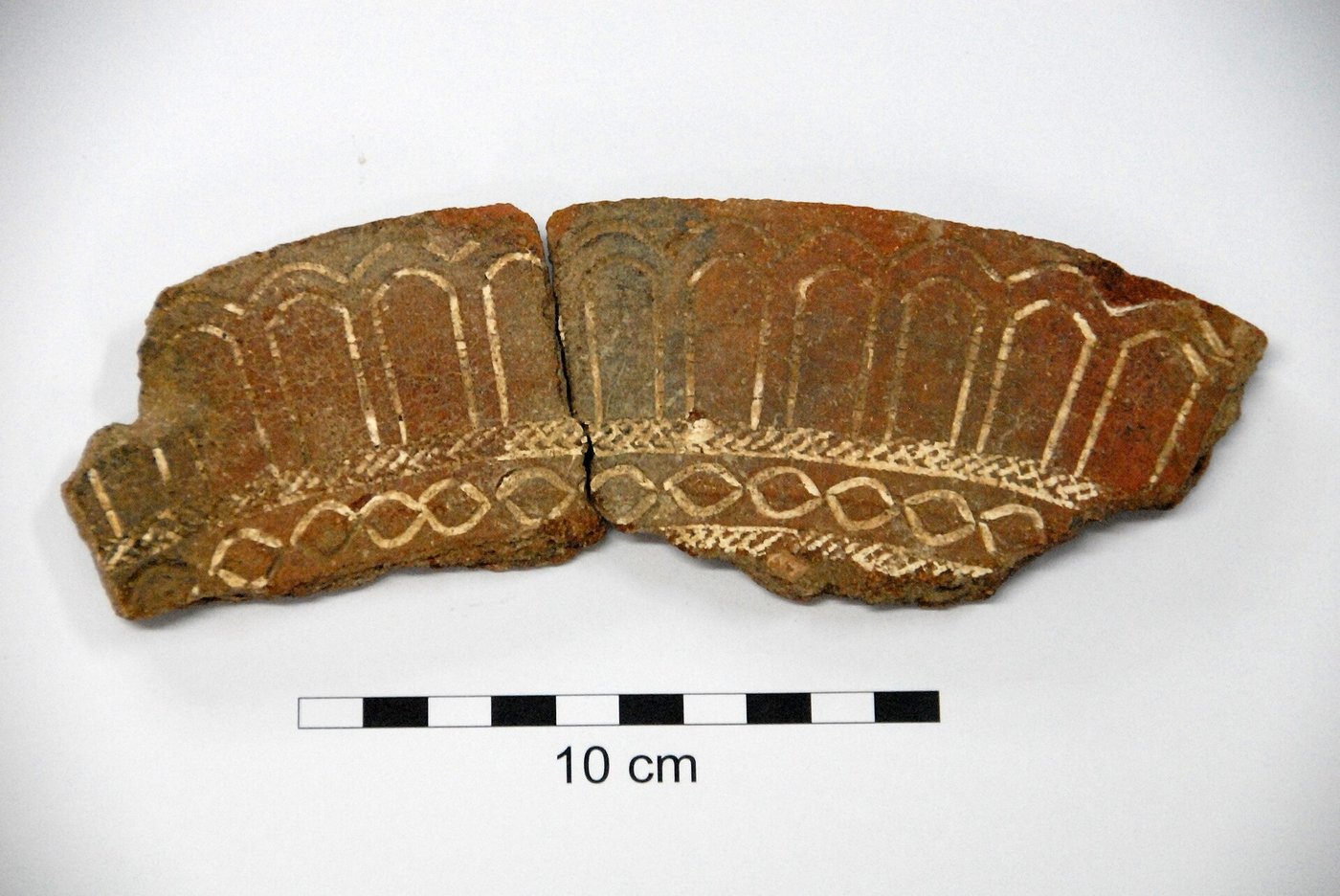
What makes Lapita pottery Lapita is the way it is decorated. The technique is called dentate stamping, from the Latin for tooth. The potter used a stamp with a comb-like edge, cut from bone, shell or wood, and pressed it into the soft clay before firing to leave rows of fine impressed points. Those points were arranged into complicated geometric bands: chevrons, arcs, hatching, spirals, and running motifs that repeat around the shoulder of a vessel with the discipline of printed cloth.
Some of the designs are not abstract at all. Look closely and faces appear: wide eyes, a nose, a headdress of stacked curves, stylised human features built entirely out of dots. The same face motifs turn up on sherds separated by enormous distances, which tells you the people carried more than a technique across the water. They carried a shared idea of what a proper pot should say. This was not decoration for its own sake. It was a visual language, and everyone in the network could read it.
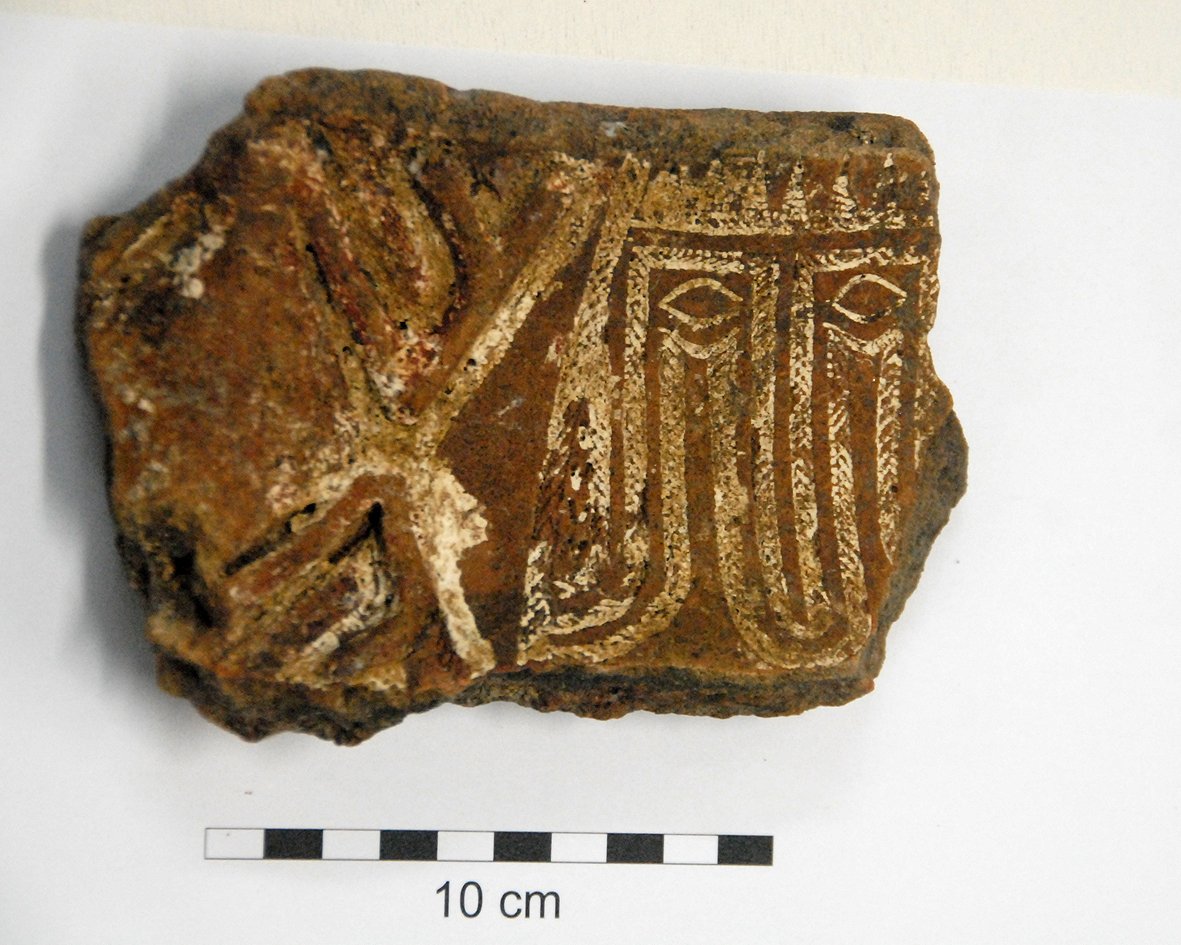
The pots themselves came in many shapes: flat-bottomed dishes, jars with everted rims, tall stands and carinated bowls with a sharp shoulder. The finest were slipped with red and sometimes had white lime rubbed into the stamped lines so the pattern jumped out. A vessel like that took skill and time. It was not the sort of thing you made to boil roots in. Much of the decorated ware seems to have been for display, for feasting, perhaps for the dead, and that guess turned out to matter a great deal, as a cemetery on a Vanuatu hillside would later show.
A word that came from a misunderstanding
The name itself is an accident. When Gifford and his team worked the Foue peninsula in New Caledonia in 1952, they asked local Kanak people what the place was called. The answer sounded to their ears like "Lapita". The likelier original is a Kanak phrase, xapeta'a, meaning roughly the place where one digs, or a hole. The archaeologists wrote down what they thought they heard, and the mishearing stuck. An entire ancient culture, spread across dozens of island groups, now carries a name that is really a misremembered word for a pit in the ground.
That accident points at something real about how the Lapita were found. Nobody set out to discover a lost civilisation. The pottery was noticed first, on scattered beaches, and only slowly did anyone grasp that the identical style turning up in New Caledonia, the Bismarck Archipelago, Fiji, Tonga and Samoa was the trace of one connected world. The pots defined the people, rather than the other way round. Change the definition of the pottery and you change the shape of the whole story, which is exactly what happened when scientists stopped looking only at the clay and started looking at the bones.
Four thousand kilometres in a dozen generations
The heart of the story is the speed. Human beings had lived in the western Pacific for tens of thousands of years. People reached the Bismarck Archipelago and the northern Solomon Islands deep in the Ice Age, island-hopping along a chain where the next shore was usually visible from the last. Then, for a very long time, the frontier stopped. Beyond the Solomons the sea opened out. The gaps between islands grew to hundreds of kilometres of nothing, and nobody crossed them.
Around 1500 BCE something changed. Lapita pottery appears in the Bismarcks, off the coast of New Guinea, and within a few centuries the same style has leapt across the open water barrier and reached Fiji, more than four thousand kilometres to the east. By about 2,800 years ago the makers had pushed on to Tonga and Samoa, the far edge of the pottery's range. From the first Lapita site to the last, the whole spread took something like three to four centuries: a dozen or so human generations.
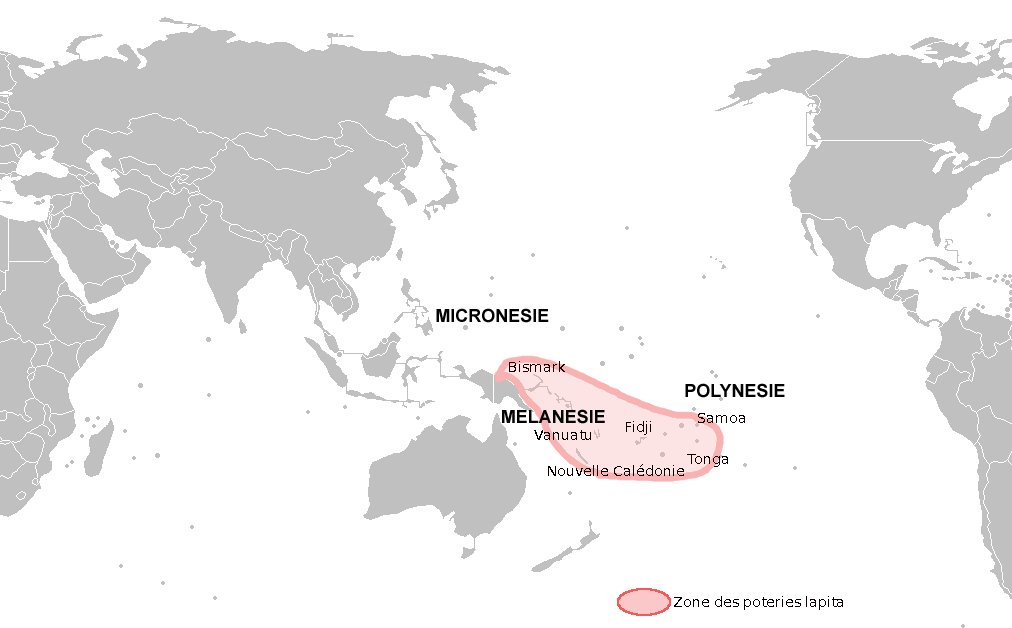
To feel how strange that is, set it beside what it required. These crossings were not drift voyages, people blown off course and washed up by luck. The islands they reached lie downwind of the prevailing trade winds, which means the voyagers were sailing into the wind, deliberately, out past the point where land dropped below the horizon behind them, gambling that more land lay ahead. They did it in double-hulled and outrigger canoes they built themselves, navigating by swell, star and bird. And they did it not once but again and again, a whole society leaning eastward into the empty ocean.
The leading edge of Lapita settlement moved east at a pace that has been compared to a fast train. Between roughly 1050 and 750 BCE the pottery jumps from the Bismarcks all the way to Samoa, crossing the open-ocean gaps that had held the frontier for tens of thousands of years. Some of the sea passages ran to more than 800 kilometres out of sight of land. No earlier people anywhere had settled new country so fast, over so much water, on purpose.
A farm carried in the hull
You cannot settle a bare tropical island by turning up. Many of these islands had almost nothing a person could eat: a few birds, some shellfish, no useful land plants, no animals worth the name. The Lapita solved that by bringing the whole system with them. Their canoes carried a travelling farm: pigs, dogs and chickens, and a garden of taro, yam, breadfruit, banana, coconut and other crops, along with the tools and knowledge to plant them. Archaeologists call it the transported landscape. When a canoe made landfall, it was carrying the raw material of a working economy.
Some passengers came uninvited. The Pacific rat travelled with them, island to island, and its bones now help mark where the voyagers went. So do the shells and the fish hooks and, above all, the obsidian. Lapita sites are littered with flakes of volcanic glass, and glass from a single source has a chemical signature as good as a postmark. Much of it came from Talasea, on the island of New Britain in the Bismarcks. Finding Talasea obsidian on a beach in Fiji, thousands of kilometres away, is a hard fact of long-distance contact: proof that the islands were not merely settled and forgotten but kept in touch, at least for a while, by canoes moving goods back and forth across the new frontier.
The cemetery on the hill at Teouma
For half a century the Lapita were a people known almost entirely from their rubbish and their pots. Then, in 2004, a bulldozer clearing ground for a prawn farm on the island of Efate, in Vanuatu, cut into a low terrace at a place called Teouma and turned up human bone tangled with Lapita sherds. What the excavators uncovered over the next years was the oldest cemetery ever found in the Pacific islands, and the first real chance to meet the potters face to face.
The graves were strange. Many of the dead had been buried and then, some time later, dug back up so that the skull could be removed. In several cases the skulls were taken away entirely; in others they were carefully replaced, set on the chest of the headless body. One man was found with three skulls laid in a row across his torso. Whatever this meant, it was ritual, deliberate and repeated, a way of keeping the dead present and handling them long after death.
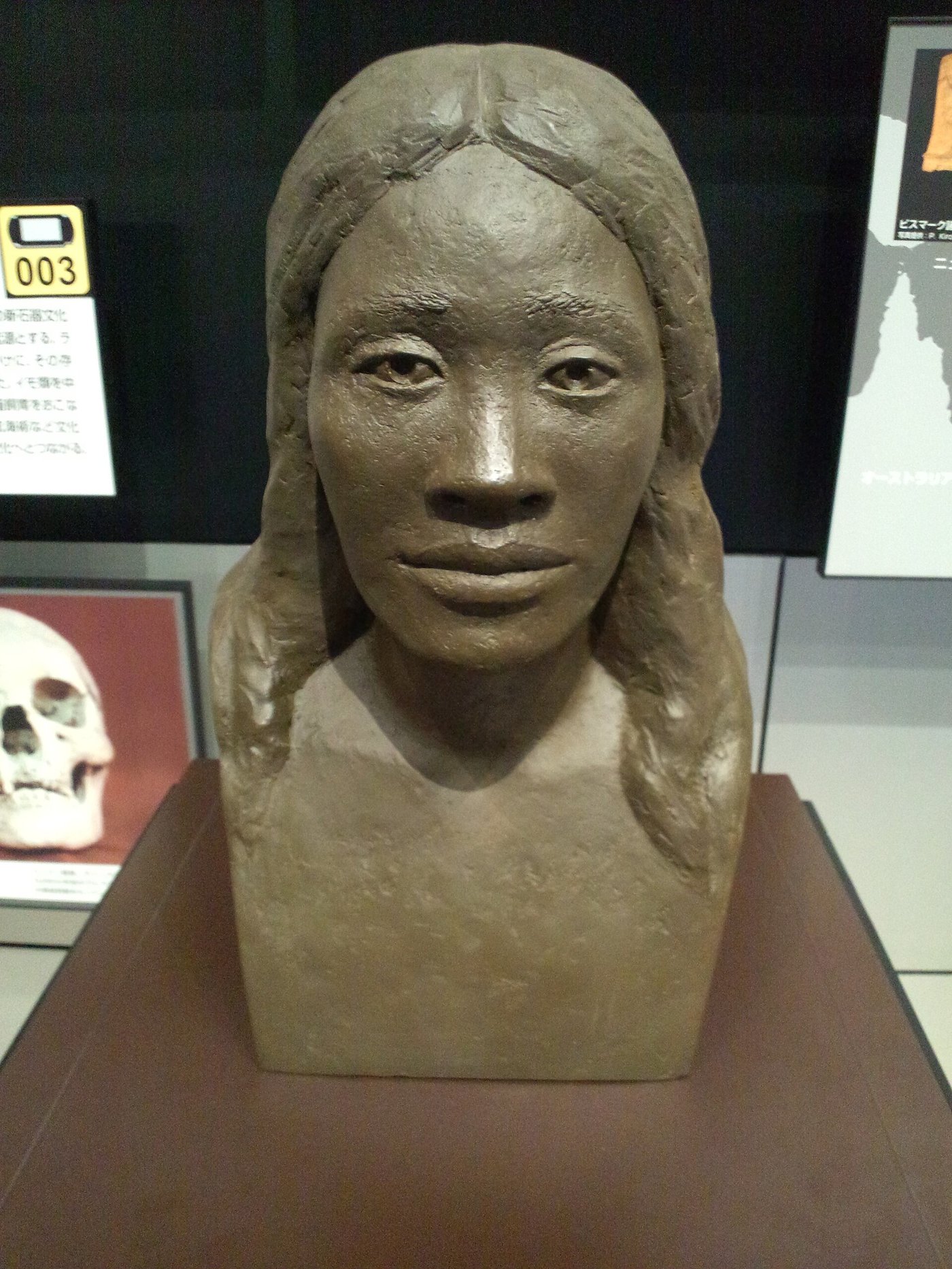
And there was a pot. Among the burials the team found a large jar with four faces modelled around its rim, looking outward in four directions: the finest single piece of Lapita art ever recovered, sitting in a grave with the ancestors it may have been made to watch over. The Teouma dead were laid to rest with their pottery. The link between the fine decorated ware and the treatment of the dead, long suspected, was now sitting in the ground in front of the excavators. And because the bone survived, so did something the pots could never give up on their own: DNA.
Who the potters were, and were not
Here the story turns. For decades a tidy model held the field. It was called, half in joke, the express train to Polynesia, and it ran like this: a single population, ultimately from island South-East Asia and speaking early Austronesian languages, swept out through the Pacific carrying the pottery, the crops and the language all together, and their descendants became the Polynesians. Neat, linear, and driven by the pots.
The long-standing picture: the Lapita were a single migrating people, out of South-East Asia, who carried their pots, their farm and their Austronesian language east in one movement, and who are the direct ancestors of today's Pacific Islanders. One culture, one population, one clean sweep across the ocean.
Ancient DNA broke the story open. When the Teouma skeletons and other early burials in Vanuatu and Tonga were sequenced, from 2016 onward, the first Lapita settlers of these remote islands turned out to carry almost purely East Asian ancestry, with little or none of the older Papuan lineage of nearby New Guinea. The heavy Papuan ancestry that marks Pacific Islanders today arrived later, sweeping in after the first settlement and largely replacing the founders' genes while the languages and much of the culture carried on. A 2025 study of Lapita-era genomes on the New Guinea coast added another wrinkle, showing mixed ancestry and local mingling from early on. The pots moved as one clear signal; the people behind them did not. Culture and ancestry had come uncoupled.
That reversal matters because it changes what the pottery was. If genes and pots do not track together, then the Lapita style was not simply the badge of one bloodline moving east. It was a shared culture (a way of making, decorating, feasting and burying) that could be carried, adopted, blended and passed on by people of different descent. The dotted pots mark a network, not a race. What spread across the Pacific was partly an idea.
When the dots stopped
The pottery that defines the culture did not last. The elaborate dentate stamping is a relatively short-lived thing, brightest in the early centuries of the expansion and then fading. Over a few hundred years the fine stamped ware gives way to plainer pots, the detailed faces and bands drop away, and in many parts of the Pacific pottery-making eventually stops altogether. By around two thousand years ago the signature that let archaeologists trace the whole migration had gone quiet.
Why is not fully settled. Part of it may be distance: as communities settled in and the long-range canoe contact thinned, the shared visual language had less reason to hold together, and each island group drifted its own way. Part may be that the effort of the finest ware only made sense in a particular social world of feasting and display that did not outlast the frontier. Whatever the cause, the far eastern edge of the Lapita world, Tonga and Samoa, became a pause. People stayed there for a thousand years or more before the next great leap, out into the central and eastern Pacific, that would carry their descendants to Tahiti, Hawaii, Rapa Nui and finally New Zealand, the last large habitable landmass on Earth to be reached by people.
The hardest question is not how the Lapita crossed the ocean but why. Pushing a loaded canoe into open water, against the wind, towards no known land, is a colossal risk. Population pressure alone does not explain it; the islands were far from full. Some researchers point to social drivers: the prestige of being a founder, younger sons seeking their own ground, the pull of discovery itself. A 2025 study argued that shifting climate and resources helped set the timing of the pushes east. The truth is nobody yet knows what made a whole society decide, generation after generation, that the answer to the horizon was to go and look.
The handwriting on the water
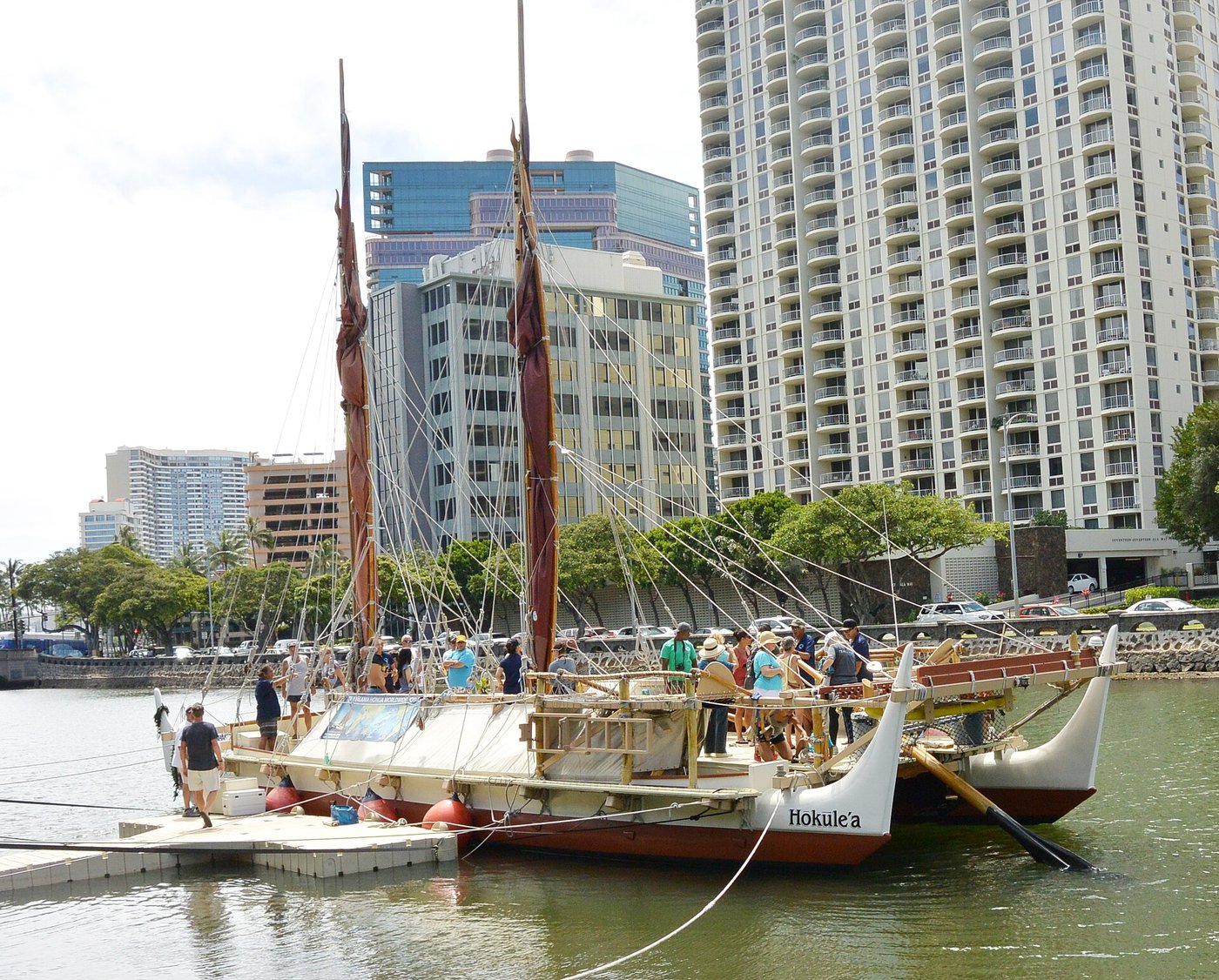
The descendants of that decision never lost the sea. The double-hulled voyaging canoe and the art of navigating by star path, swell and bird carried on in the Pacific long after the pottery fell silent, and in the last fifty years it has come roaring back. When the canoe Hokulea sailed from Hawaii to Tahiti in 1976 with no instruments, guided only by traditional wayfinding, it proved that the old crossings were skill, not luck, and that the Lapita and their heirs had known exactly what they were doing.
What the potters left behind was thin: broken clay, a scatter of glass, a hillside of headless graves. From that little, a whole migration has been read. The dotted pots turned out to be a kind of handwriting, pressed dot by dot into wet clay on beaches now scattered across a quarter of the globe, and legible still. They do not tell us the names of the people who made them, or quite why those people sailed. But hold one sherd against another from an island a thousand kilometres away, match the pattern, and you are looking at proof that someone, three thousand years ago, was brave or restless enough to point a canoe at the open sea and keep going.
Read next: The Tarim Mummies: The Desert Dead Who Were Not Who Anyone Expected and Trypillia: The 6,000-Year-Old Cities That Burned Themselves Down.
Sources & further reading
- Patrick Vinton Kirch, On the Road of the Winds: An Archaeological History of the Pacific Islands (University of California Press, revised ed. 2017) — the standard synthesis of Pacific prehistory, Lapita included.
- Matthew Spriggs, The Island Melanesians (Blackwell, 1997) — on the Lapita cultural complex and its Melanesian setting.
- Stuart Bedford, Matthew Spriggs and colleagues, reports on the Teouma cemetery, Efate, Vanuatu (from 2006) — the excavation of the oldest cemetery in the Pacific.
- Pontus Skoglund et al., "Genomic insights into the peopling of the Southwest Pacific," Nature (2016) — the ancient-DNA study that overturned the single-migration model.
- Cosimo Posth et al., "Language continuity despite population replacement in Remote Oceania," Nature Ecology & Evolution (2018) — on the later Papuan ancestry sweep and language survival.
- Recent (2025) genomic and site work on the New Guinea coast, including the Giligilina Late Lapita deposits, refining the picture of early mixing and the timing of the expansion.
Image credits (via Wikimedia Commons): decorated Lapita pottery from Bourewa, Fiji — Patrick Nunn (CC BY-SA 4.0); Lapita face-design potsherd, Fiji — Patrick Nunn (CC BY-SA 4.0); map of the Lapita expansion — Christophe Cage (CC BY-SA 3.0); reconstructed Lapita vessel, National Museum of Ethnology, Osaka — Yanajin33 (CC BY-SA 3.0); double-hulled voyaging canoe Hokulea — Miliefsk (CC BY-SA 4.0).