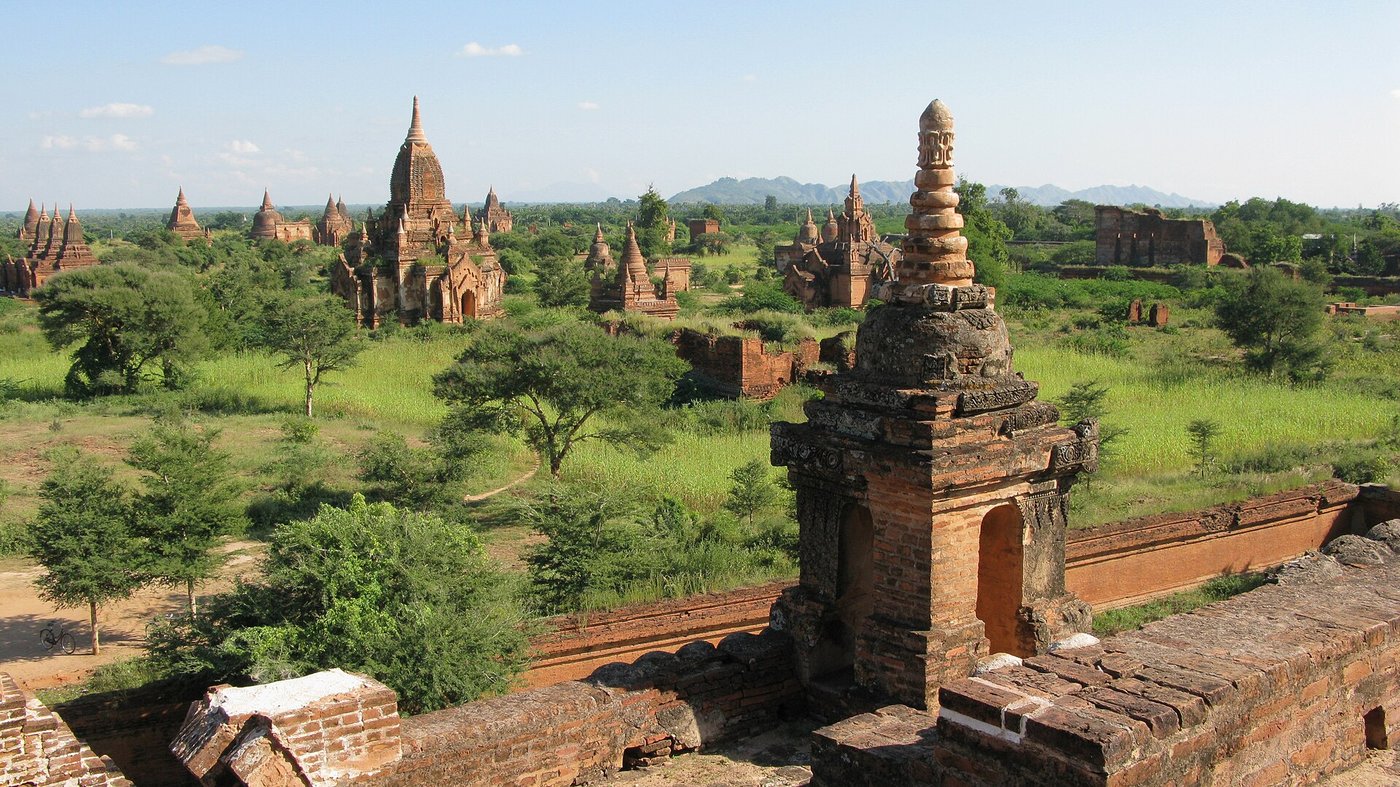
Just after four in the afternoon on 24 August 2016, the ground under central Myanmar shifted, and on the plain at Bagan the spires began to fall. The shock measured 6.8. Across roughly forty square miles of dry riverside country stood thousands of brick temples, some of them nine hundred years old, and in a few violent seconds close to four hundred of them were cracked, split or beheaded. Finials snapped off. Vaults sagged. Dust rose over the whole plain. And when the survey teams climbed into the wreckage over the following weeks, they found something that embarrassed a nation: many of the towers that had come down were not medieval at all. Under the fallen brick was modern concrete, poured within living memory, and it was the concrete that had failed first.
That is the strange thing about Bagan. It is one of the largest concentrations of religious buildings ever raised by a single culture, a city of temples on the east bank of the Irrawaddy, and almost everything most people believe about it is slightly wrong. The number is wrong. The ruin is wrong. Even the ending is wrong. The plain is usually sold as a lost civilisation the Mongols came and smashed, a Buddhist Angkor left to the lizards and the balloon tours. The truth is quieter and far more interesting. Bagan was not destroyed. It gave itself away, acre by acre, prayer by prayer, until the kingdom that built it could no longer pay for itself.
A plain, a river, and a very ambitious king
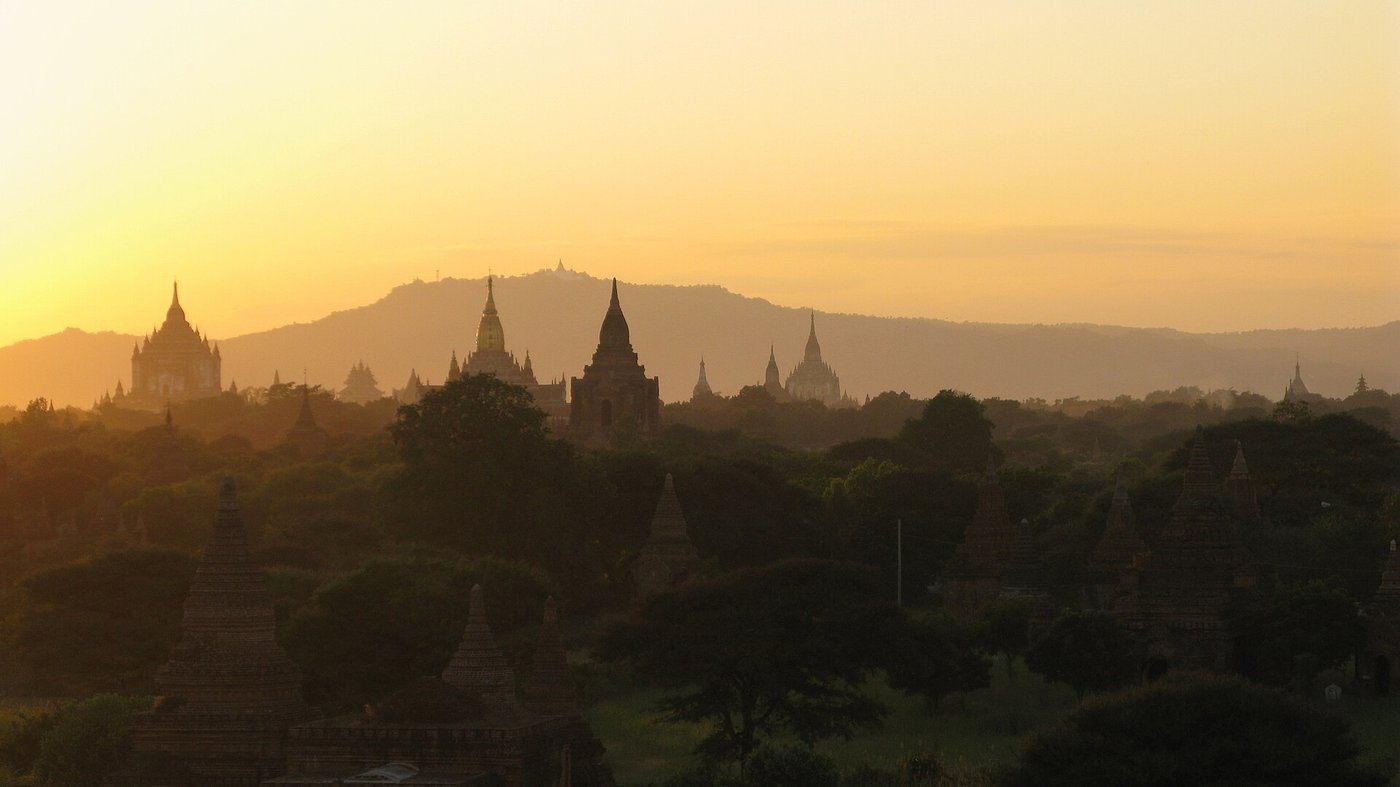
Bagan sits in the dry zone of central Myanmar, on a great bend of the Irrawaddy. It is hot, low on rain, and dusty for much of the year, which is exactly why it survived. Wet jungle eats brick; this country preserves it. The river gave the town water and a highway, and the flat land around it gave it room to build without limit.
For a long time it was a small place among many. Then, in 1044, a prince named Anawrahta took the throne after killing his foster brother in single combat, and the small place stopped being small. Within a generation he had pulled the scattered towns of the Irrawaddy valley into the first kingdom that can really be called Burmese, stretching from the northern hills down towards the sea. He is the hinge on which the whole story turns, and he did two things that counted for far more than any battle.
The first was religious. Anawrahta threw the weight of the crown behind Theravada Buddhism, the older, austere school that reveres the Pali scriptures, and he did it with a convert's zeal. Tradition says a monk from the south, Shin Arahan, arrived at his court and turned him, and that in 1057 the king marched on the Mon city of Thaton to seize its copies of the Buddhist canon, carrying the sacred texts, the monks and the craftsmen back to his capital on elephants and carts. Historians argue about how much of that campaign is later legend. What is not in doubt is the result. Bagan became the beating heart of Theravada Buddhism in mainland Southeast Asia, and it would build like it.
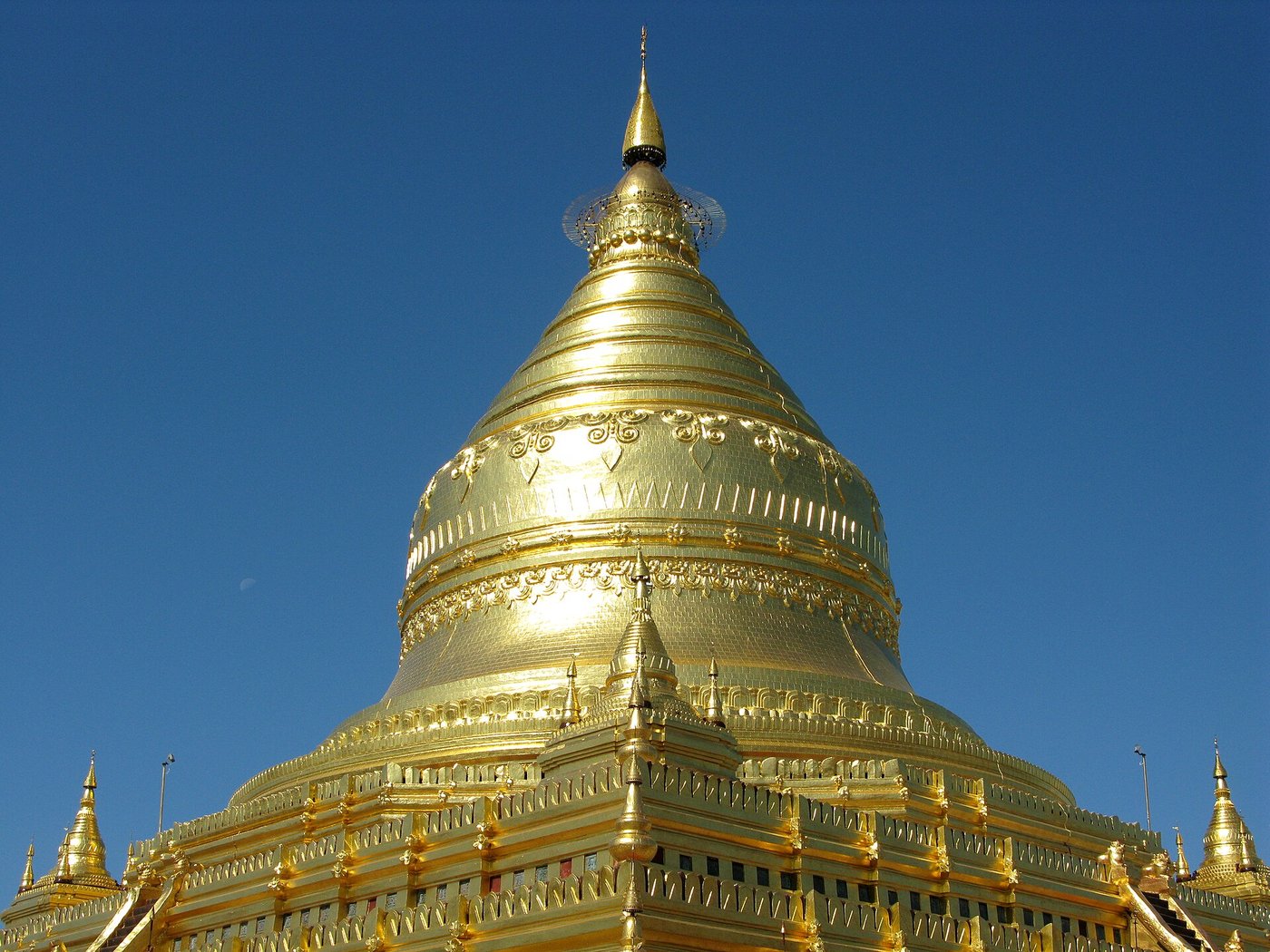
The second thing Anawrahta did was start the habit. He raised the Shwezigon, a vast bell-shaped golden stupa meant to enshrine relics of the Buddha and anchor the new faith to the new capital. It set the pattern for everything that followed. A great king built a great monument, and merit followed the money.
Merit you could measure
To understand why one small plain ended up with more temples than it could ever fill, you have to understand what a temple was for. It was not only worship. In the Buddhism of Bagan, a person's fate across countless future lives depended on the merit they gathered now, and few acts earned more merit than giving to the sangha, the community of monks. You could give robes or food or your own son to the robe. Or, if you were rich, you could give land.
And so they gave land. A donor would dedicate a field, a village, sometimes hundreds of workers with it, to support a monastery or to maintain a temple they had built. The gift was recorded, often carved in stone so that no one could quietly take it back, and the key feature of the gift was this: land given to religion, and the people who worked it, became permanently free of tax. Forever. Not for a reign, not for a lifetime. The merit was eternal, and so was the exemption.
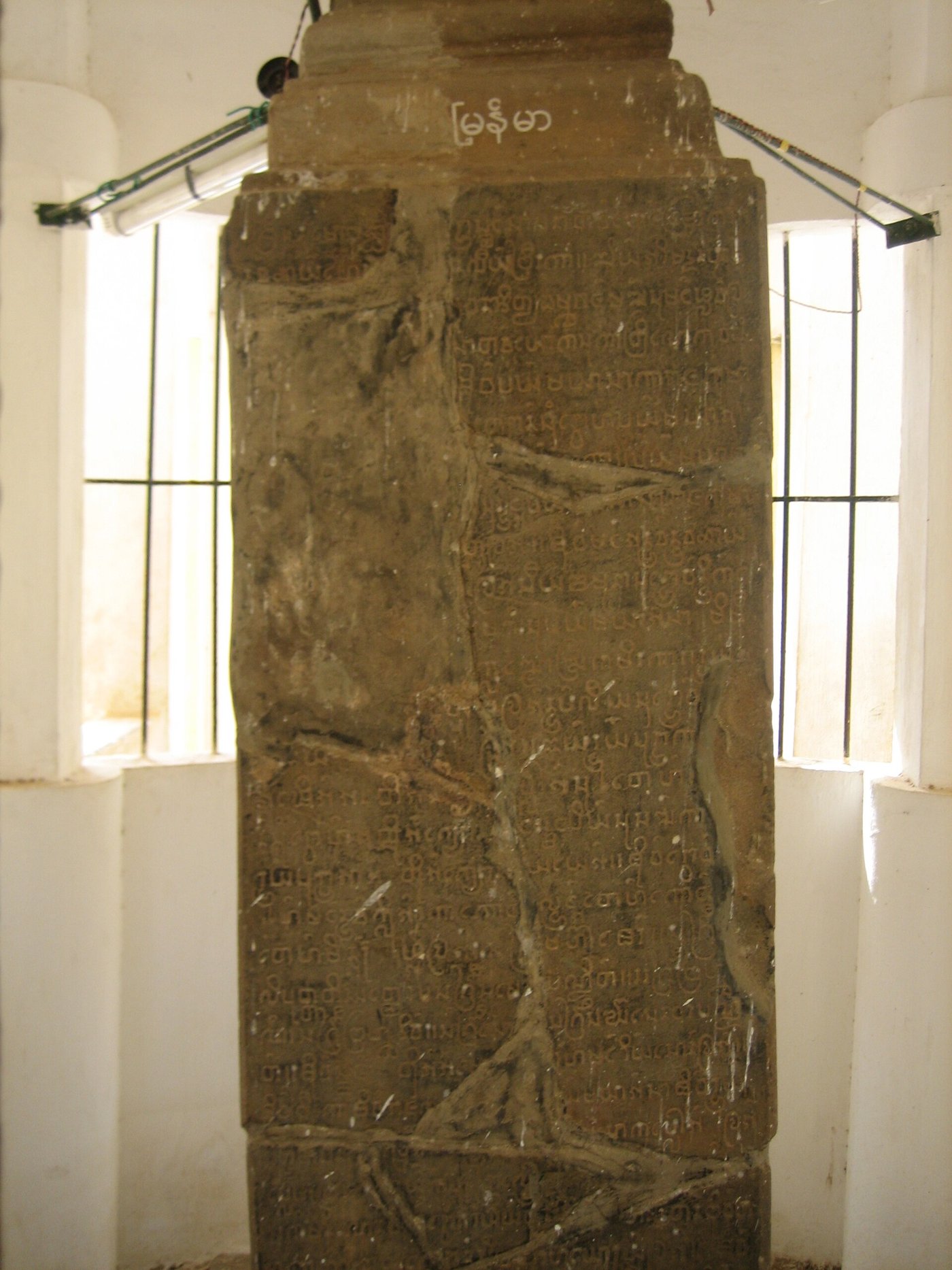
We know all this because the donors wrote it down. Thousands of dedication inscriptions survive, and they are the real archive of Bagan, worth more to a historian than any temple wall. They name the giver, the land, the workers, the animals, the oil for the lamps. They call down curses on anyone who interferes. Read enough of them and you stop seeing a religious wonder and start seeing an economy, one in which the surest investment a wealthy family could make was to move wealth permanently out of the king's reach and into the hands of the Buddha.
The most famous of the dedication stones is the Myazedi inscription, set up around 1113 by a prince named Yazakumar for his dying father, King Kyanzittha. It records the gift of a golden Buddha image and the villages and labour to maintain it, and it does so four times over, in Pyu, Mon, Old Burmese and Pali. That repetition was practical, not decorative: the point was that everyone who mattered, in every tongue spoken at court, should read the terms and honour them. It is often called the Burmese Rosetta Stone, because the four parallel texts let scholars recover the long-dead Pyu language.
The great builders
The kings who followed Anawrahta competed in brick. Each wanted a monument larger, taller or holier than the last, and for about two hundred years the plain filled up.
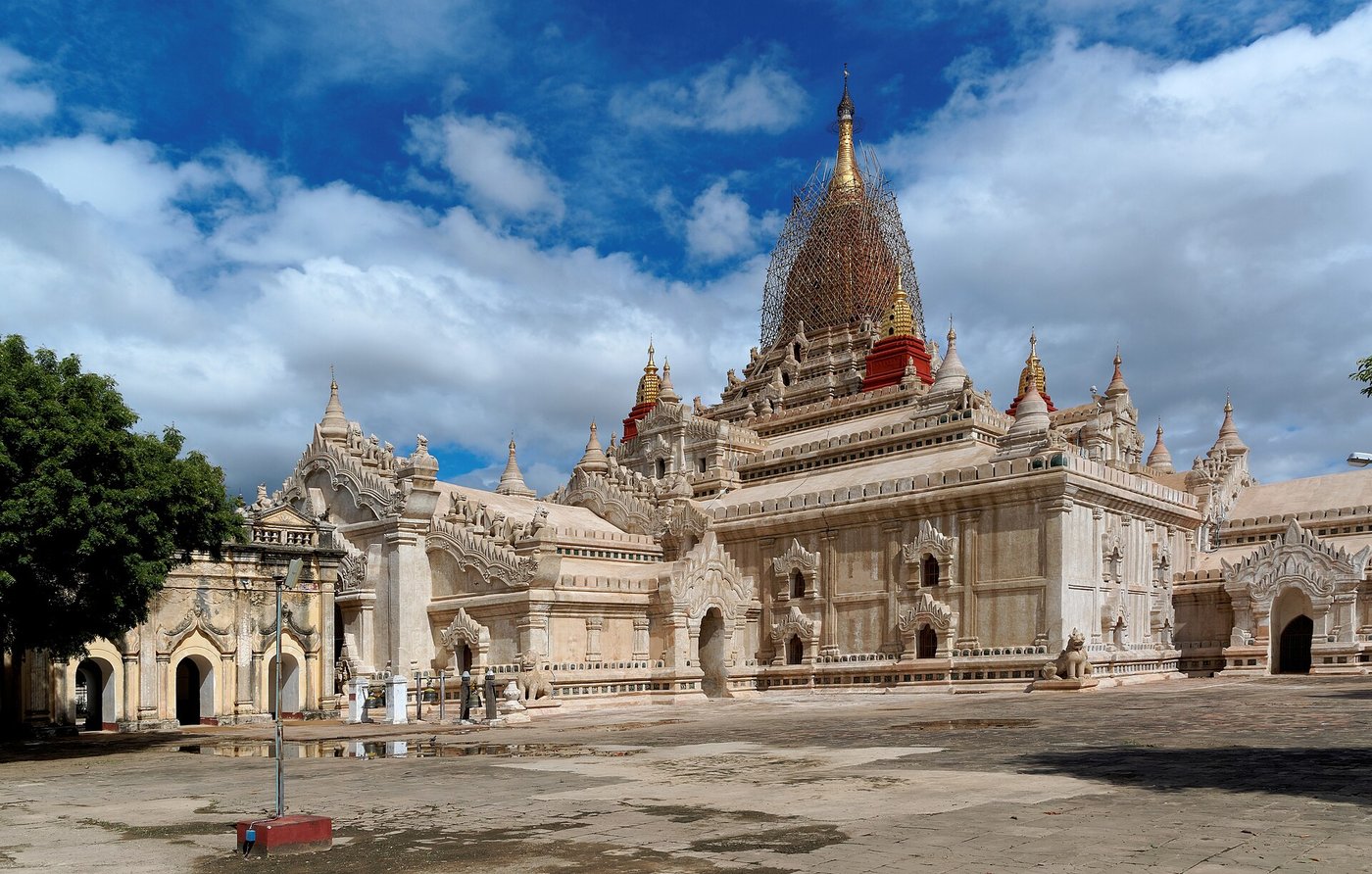
Kyanzittha, who came to the throne in 1084, built the one most visitors still remember. The Ananda is a cool white cruciform temple with a gilded spire, its four inner corridors each holding a standing Buddha nearly ten metres tall. Legend says the king had eight monks describe a mythical Himalayan cave temple, built something like it, and then had the architects put to death so the design could never be copied. The story is almost certainly untrue. It has clung to the Ananda for centuries anyway, because a building that perfect seems to demand a dark price.
His successors kept climbing. Alaungsithu raised the Thatbyinnyu, a great white monastery-temple that pushed past sixty metres and remains the tallest thing on the plain. Others built the Sulamani, the Gawdawpalin, the Htilominlo, each a small mountain of brick and stucco. From a distance they read as a forest of towers. Up close they are astonishingly varied, no two quite alike, the work of masons improvising across generations.
Then there is the strangest of them all. In the 1160s a king named Narathu murdered his own father and brother to take the throne, and to wash the blood off his reign he ordered the largest temple Bagan would ever see. The Dhammayangyi is a colossal, brooding pile, its outer brickwork so tight the joints seem to vanish. But its heart is a mystery. The inner ring of corridors was deliberately filled with brick and rubble in the king's own time, sealing off the core, and no one has ever fully explained why. Narathu was assassinated before the temple was finished, and it was never consecrated. It broods over the plain to this day, the most perfect masonry in Bagan wrapped around a walled-up secret.
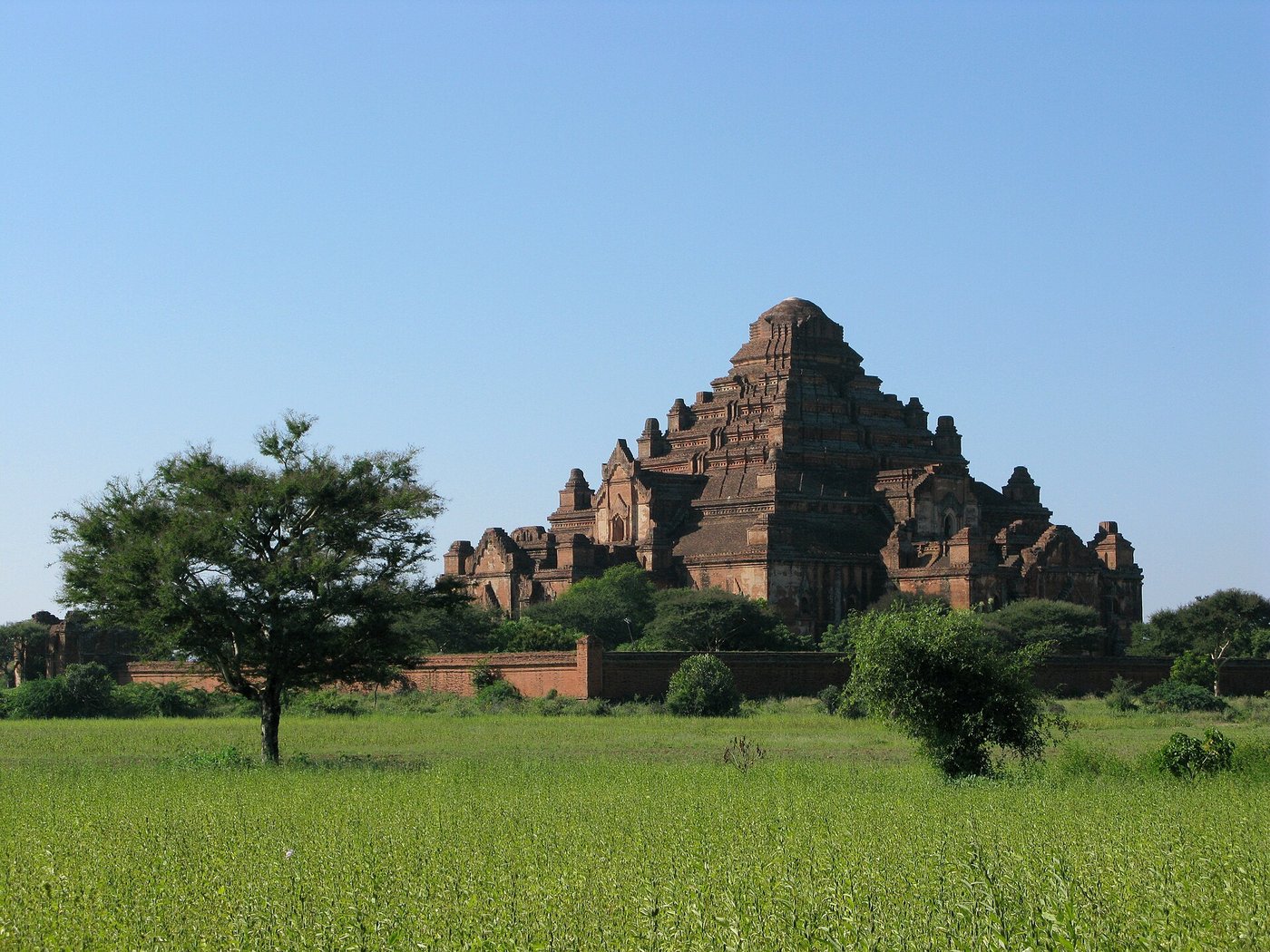
The Dhammayangyi is famous for the finest brickwork at Bagan, and a grim story explains it. Narathu, the tale goes, tested the masons by trying to push a needle or a pin into the seams between their bricks. If it went in, the wall was not tight enough, and the offending workman lost a hand. Whether or not any of that happened, the joints really are extraordinarily close, mortarless in places, ground flat so that great sheets of wall look almost seamless. Cruelty makes a better story than skill, but it was skill that raised the wall.
The arithmetic of holiness
Here is where the beauty turns into a problem. Every temple on that plain, every gilded stupa and whitewashed hall, sat on an endowment. And every endowment was land and labour that would never be taxed again.
For a long time it did not hurt. A growing kingdom clears new fields, conquers new valleys, brings fresh taxable land under the plough faster than the monks can absorb the old. The giving even helped the economy along, opening farmland and settling workers in the dry zone. But growth cannot outrun a permanent exemption forever. The land is finite. The plain is finite. And the sangha never gave anything back.
By the early thirteenth century the sums had turned against the crown. Reconstructing the inscriptions, the historian Michael Aung-Thwin estimated that over the two centuries of the kingdom, religious donations had swallowed a great share of the cultivable land of Upper Burma, well over half of it by some counts, all of it beyond the taxman. The king still had a court to feed, an army to pay, canals and reservoirs to maintain, and a shrinking base of taxpayers to squeeze for it. Each new act of royal piety, each new temple raised to outshine the last, made the arithmetic slightly worse.
The reign of Htilominlo, early in the 1200s, is often read as the moment the strain shows. The building goes on, grander than ever. But the crown is starting to run short of the free land and free workers it needs to function, and the men who administer the great monasteries are becoming a power in their own right. A kingdom had, in the most literal sense, prayed away its own tax base.
Not every scholar buys the tidy story. Aung-Thwin argued that the endless flow of tax-free land and labour to the monasteries created a structural contradiction that hollowed the state from within and set up its fall. Others, among them the historian Aye Chan, think that has been pushed too far, that the religious economy was more flexible than the numbers suggest and did not cripple the kingdom on its own. Drought, the loss of frontier land, court intrigue and a growing military threat all crowd into the same window. The safest thing to say is that Bagan did not die of one wound. But the giving is the wound no one saw coming, because it looked like devotion.
The king who ran from the Chinese
Into that weakened kingdom came the largest empire the world had yet seen. To the north, Kublai Khan's Mongols had swallowed China and were pressing on every frontier, and in the 1270s they began demanding that Bagan submit and send tribute. The king at the time, Narathihapate, refused. By one account he had the Mongol envoys executed, which was not a survivable kind of pride.
The war that followed was uneven. Mongol columns broke Bagan's armies on the northern border, and over the next decade the kingdom came apart. Narathihapate did not die defending his capital. He abandoned it and fled south, and the Burmese chronicles remember him by a name that drips with contempt: Tarokpyemin, the king who ran from the Taruk. In time that word came to mean the Chinese, and the insult stuck. He was murdered in 1287 by one of his own sons, poisoned, the story goes, and the central authority he had failed to hold simply dissolved.
Here is the reversal the postcards never mention. The Mongols did not level Bagan. There was no great sack, no burning of the ten thousand temples. Modern historians now doubt the Mongols ever seriously occupied the city at all; they came, they broke the kingdom's field armies, they installed a puppet and largely withdrew. What actually finished Bagan was slower and sadder. Without a strong king, the plain fragmented into a scatter of small warring statelets, the tax revenues collapsed, the court moved elsewhere, and the reason to keep raising temples went away. The city was not destroyed. It was abandoned by history, left as a shrinking town among its own giant monuments.
The myth: a desperate Narathihapate pulled down thousands of Bagan's temples to build a wall against the coming Mongols, gutting the sacred plain to save his skin, and it did him no good.
The reality: the chronicles do carry a line about monuments demolished for fortifications, but there is little archaeological sign of any such wholesale demolition, and historians read the tale as a later moral fable, a way of saying an impious, panicking king brought ruin on himself. The temples that fell at Bagan fell to earthquakes and to time, not to their own frightened king.
What the earthquake gave back
For seven centuries the plain drowsed. Pilgrims kept coming to the living shrines, the Shwezigon and the Ananda, tending them and regilding them, while hundreds of lesser temples stood empty and slowly softened in the heat. Then the modern state took an interest, and not always a gentle one.
In the 1990s the ruling military government launched a huge campaign to rebuild Bagan's temples, and it did so with more enthusiasm than care. Ruined stubs were topped with brand-new spires. Concrete was poured where craftsmen had once laid brick. Whole structures were reinvented from guesswork, in styles their original builders would not have recognised. A viewing tower and a golf course went up in the archaeological zone. Preservation experts abroad were appalled, and for years that damage kept Bagan off the list of World Heritage Sites, even though almost everyone agreed it belonged there.
The 2016 earthquake, for all its harm, forced an honest reckoning. As the modern additions cracked and fell, they exposed how much of the recent work had been wrong, and the clean-up that followed brought in careful conservation instead of confident reinvention. Three years later, in July 2019, Bagan was finally inscribed as a World Heritage Site, more than two decades after the first attempt, once the country had begun undoing some of what the concrete years had done.
Walk the plain now and you are standing inside an argument that has never really ended. The old kings believed that giving to the Buddha was the surest thing a person could do, safer than any coin, an investment that paid out across every life still to come. They were not fools, and they were not wrong about the beauty. Ten thousand acts of that faith made one of the most extraordinary landscapes on earth. The same ten thousand acts, added up on a ledger no donor ever saw, slowly emptied the treasury that made them possible. Bagan is what devotion looks like when nobody stops to do the sums. The spires still catch the last light every evening, and out among them, someone is still building a small shrine, still buying a little merit, still giving.
Sources & further reading
- Michael Aung-Thwin, Pagan: The Origins of Modern Burma (University of Hawaii Press, 1985).
- Michael Aung-Thwin & Maitrii Aung-Thwin, A History of Myanmar Since Ancient Times (Reaktion, 2012).
- Than Tun, Essays on the History and Buddhism of Burma (Kiscadale, 1988).
- Bob Hudson, “The Origins of Bagan,” and the tDAR survey of Bagan’s monuments (University of Sydney).
- UNESCO World Heritage Centre, inscription of Bagan (2019), whc.unesco.org.
- Reports on the 24 August 2016 Bagan earthquake and the 1990s restorations, ICOMOS and contemporary press coverage.
Image credits (via Wikimedia Commons): Bagan plain panorama and sunset, Dhammayangyi Temple and Shwezigon Pagoda — Vyacheslav Argenberg (CC BY 4.0); Ananda Temple — Jakub Hałun (CC BY-SA 4.0); Myazedi inscription — Hybernator (public domain).