The blade of the spade struck something that did not sound like earth. It rang. It was the dry season of 1938, and Isaiah Anozie was deepening a pit behind his house in the village of Igbo-Ukwu, in the forest country east of the Niger, hoping to reach water. What he lifted out instead was metal: green with age, heavy, worked all over with patterns too fine to have grown there by accident. He dug out more. Bowls, pendants, a strange knotted vessel. He handed some to neighbours, kept some, and let the rest sit. Nobody who saw them that year had any idea that the man had put his spade through the roof of a treasury more than a thousand years old, or that the objects in his hands would one day force historians to rewrite the age of an entire art.
The bronzes of Igbo-Ukwu are among the finest metal castings the ancient world produced anywhere. That sentence is easy to write and was, for a long time, very hard to believe. The trouble was never the quality of the work. The trouble was the date the work turned out to carry, a date so early that respectable scholars looked at it, looked at the objects, and decided the calendar had to be wrong.
A spade in a compound, and twenty years of quiet
Isaiah Anozie was not looking for anything. He wanted a cistern. Igbo-Ukwu sits in the heart of Igbo country in what is now Anambra State, a landscape of red soil and thick bush where the water table drops away in the dry months, and a household that wanted a reliable store dug for it. His spade found the edge of a buried deposit of bronzes packed close together, as if they had been laid down on purpose and then forgotten.
Word of the find reached a colonial administrator, who gathered a handful of the pieces and passed a note along to the authorities. A short account appeared. Then the war came, and Europe had other things to attend to, and the bronzes of a small Nigerian village slid off the edge of everyone's desk. For two decades the objects Isaiah had pulled from the ground were scattered among houses and offices, admired as curiosities, their real weight unguessed. The ground that had held them stayed exactly where it was, waiting.
It is worth sitting with that gap. The most important early bronzes in West Africa spent twenty years as ornaments on shelves because the timing of their discovery was inconvenient. When someone finally came to look properly, he came not to a fresh site but to a village that had already lived with its own buried past for a generation.
Three pits, three brothers, one lost court
The someone was Thurstan Shaw, a British archaeologist teaching at the university in Ibadan, invited by Nigeria's antiquities service to excavate the ground around Isaiah's original find. He dug in 1959 and 1960, and returned in 1964. What he uncovered turned a curiosity into one of the most important sites on the continent.
There were three separate deposits, and by a neat accident they lay in the compounds of three Anozie brothers, so the archaeology took their names. Igbo Isaiah, where the first spade had struck, was a store of ceremonial bronzes: a shrine repository, its regalia stacked and buried together. Igbo Jonah was a pit filled with objects and pottery, a deliberate deposit of ritual gear. And Igbo Richard was a grave.
Taken together the three pits held hundreds of bronze, copper and iron objects and something on the order of 165,000 glass and stone beads. This was not a workshop's leftovers or a trader's stock. It was the equipment of a court: the vessels, ornaments and insignia of someone who ruled, or served the powers that ruled, in a society rich enough to bury a fortune in the ground and skilled enough to make that fortune out of metal.
How do you cast a rope in bronze?
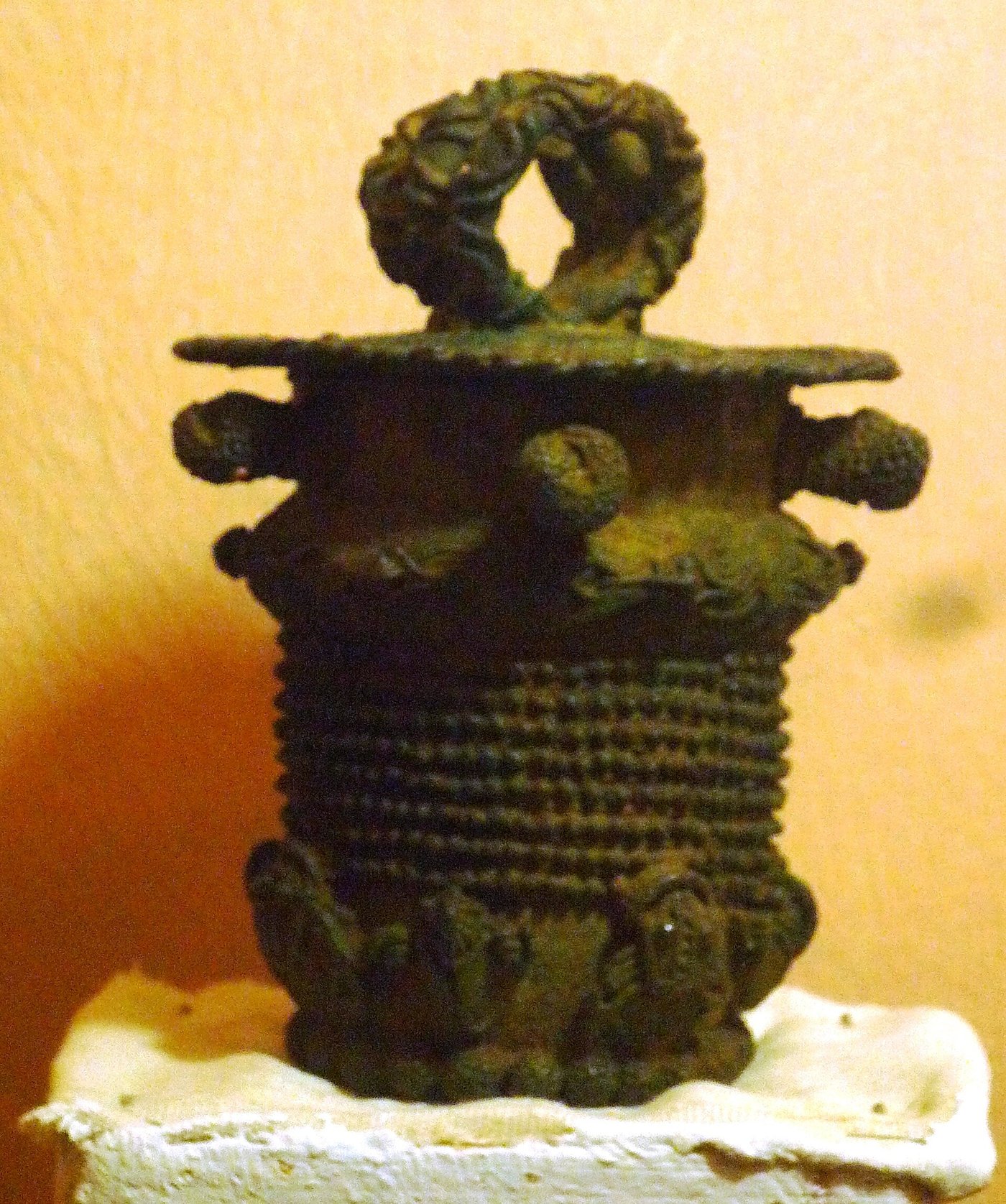
Pick up the most famous object from the site and the question answers itself with another question. It is a rounded pot resting on a tall openwork stand, and the whole thing is wrapped in what looks like a net of knotted cord, tied off in neat square knots where the strands meet. The rope is not real. It is bronze, cast in place, every knot and every twist of fibre reproduced in metal that was once poured as a single glowing mass. It was the first thing Shaw's team lifted, and it remains one of the most technically alarming objects anyone has recovered from the early second millennium.
The method was lost-wax casting, known by its French name, cire perdue. You model the object in wax, coat it in clay, heat the mould until the wax runs out through a channel, and pour metal into the space the wax leaves behind. Break the clay and the metal object stands there, a perfect negative of a thing that no longer exists. Every good bronze in the world from Benin to Florence was made this way. What sets Igbo-Ukwu apart is how far its casters pushed the wax before it ever became metal.
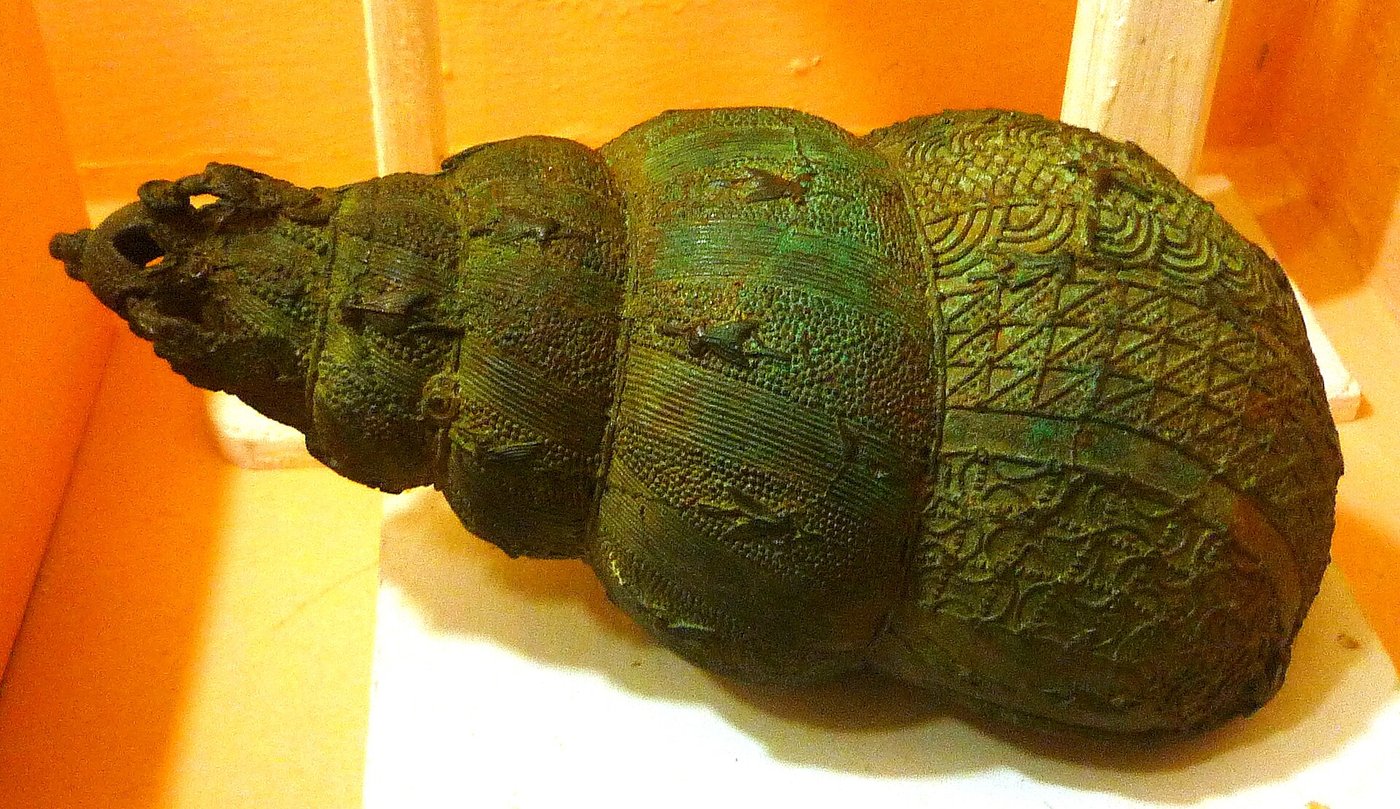
The surfaces crawl with detail. Ropes and beadwork are rendered thread by thread. On some vessels the founders added insects (a fly here, a cricket there, a tiny beetle set on the rim as if it had just landed), each one cast in the round and no bigger than the real thing. They cast snail shells, gourds, a coiled snake with a frog halfway down its throat. Some of the pieces are not bronze at all but nearly pure copper, a metal so reluctant to flow into a mould that most ancient smiths avoided casting it entirely. The Igbo-Ukwu founders cast it anyway, into shapes fine enough to shame a jeweller. To get that much detail they seem to have used a wax with the working qualities of latex, softer and truer than beeswax, holding an edge the mould could copy.
The roped pot on its stand is cast as one object, not assembled from parts. The bowl, the pedestal beneath it, the pierced openwork of the stand and the web of “cord” knotted across the whole surface all came out of a single act of pouring. To manage that, the wax original had to be built in one continuous piece, with channels planned so the molten metal reached every knot before it cooled. A modern foundry, with modern alloys and controlled furnaces, would think hard before attempting it. It was done in a Nigerian forest before England had a cathedral in stone.
The man on the stool
Igbo Richard, the third deposit, was the strangest and the most human. Under the soil lay the remains of a man who had been buried sitting up, placed on a stool inside a small wood-lined chamber, dressed for an audience that would never end. He wore a crown and a breastplate. A bronze-mounted fan or fly-whisk had been set in his hand, the emblem of authority across much of West Africa. Copper anklets circled his legs. Around and above him hung a fortune in beads: tens of thousands of them, so many that the strings had once formed a kind of beaded curtain or garment enclosing the body.
He did not lie alone. The excavation found signs of other bodies placed in the chamber and in the fill above it, most naturally read as attendants who went into the ground with their lord, whether in ritual sacrifice or from some other cause the bones cannot settle. The seated posture, the regalia, the escort of the dead: everything about the burial says this was a person of high sacred standing, not merely a wealthy one. Someone whose office demanded that he leave the world upright, still holding the fan, still crowned.
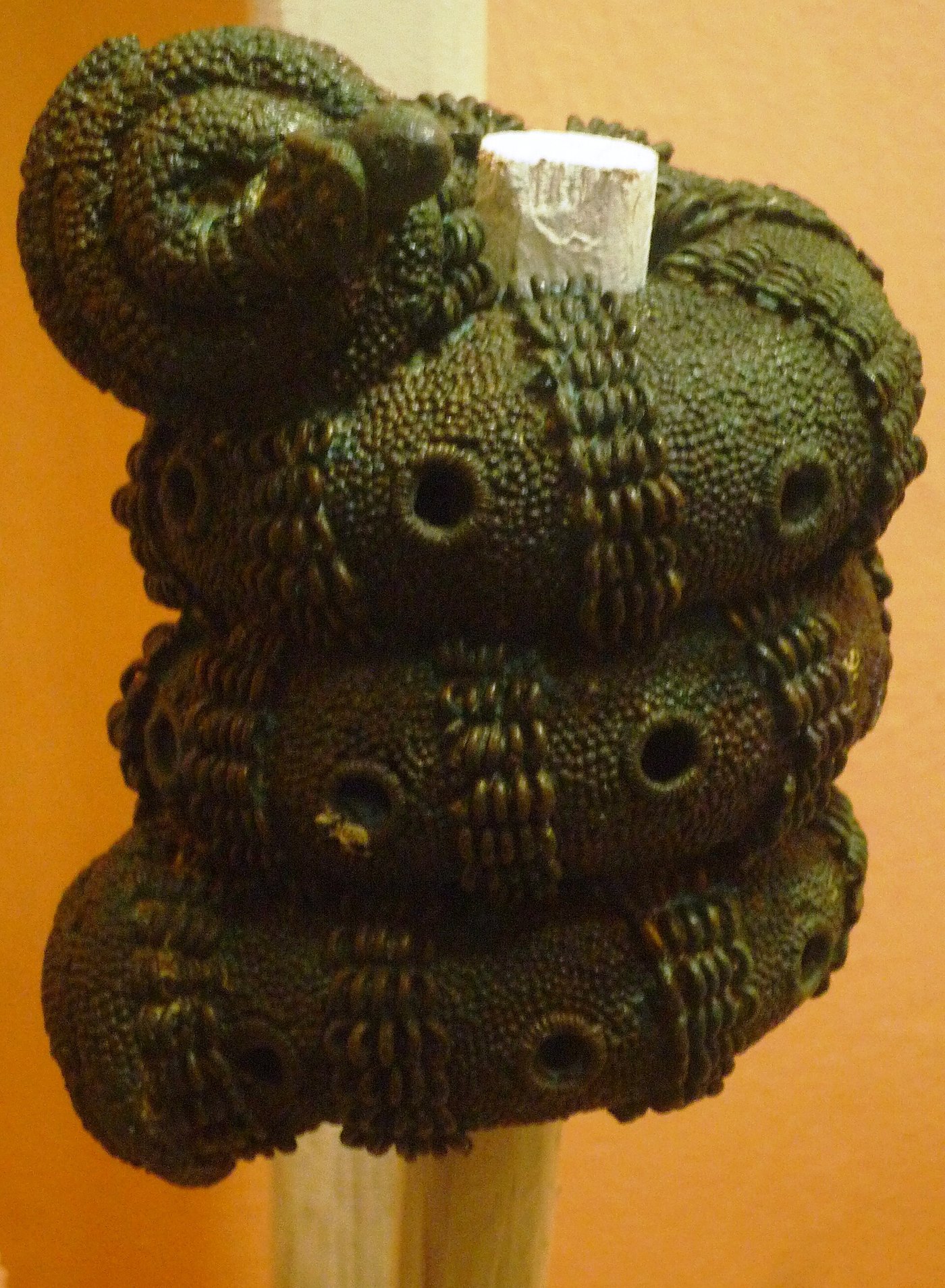
The dead man's beads are their own quiet marvel. Counting is imprecise across the site, but the burial alone accounted for something over a hundred thousand of them, in glass and carnelian, in blues and greens and dull reds. A forest court that could drape a single corpse in a hundred thousand imported beads was not poor, and it was not isolated. It was plugged into something much larger than itself, and the beads are the wire that traces the connection.
The date that would not behave
When Shaw sent his samples for radiocarbon dating, the numbers came back pointing at the ninth century AD. Not the fifteenth, not the thirteenth, but the ninth. Four of five dates clustered there, in the 800s, give or take. Only one wandered off toward much later. The bronzes Isaiah had lifted from his water pit were, on the evidence, well over a thousand years old, and older than almost anyone had been prepared to imagine.
To see why that landed like a slap, you have to know the map people carried in their heads. West Africa's great casting traditions were supposed to have a clear order. Ife, the sacred Yoruba city with its serene brass heads, was placed somewhere after the twelfth century. Benin, whose famous plaques and heads flooded the museums of Europe after the looting of 1897, came later still, learning its craft (so the story went) from Ife. Casting of this quality was a late achievement, a thing that arrived once kingdoms were mature and outside contact was well established.
Igbo-Ukwu tore that tidy sequence in half. Here was bronze work as fine as anything from Ife or Benin, arguably finer, and it was sitting in the ground three or four centuries before either of them existed as a casting centre. The tradition that was meant to be the culmination turned out to have a rival at the very start, in a village that had no famous kings, no monuments, no place in the story at all. A history that ran neatly downhill from source to masterpiece suddenly had a masterpiece at the top of the hill, in the wrong place, at the wrong time.
The quarrel over five hundred years
Not everyone accepted it. The refusal is understandable and, looked at honestly, instructive. The objects were so accomplished that the early date felt impossible, and there were real reasons to hesitate as well as bad ones.
The best case against was made carefully. The art historian Babatunde Lawal argued in the early 1970s that the dates rested on too few samples drawn from too narrow a set of contexts, and that charcoal buried in a hot, wet, biologically busy soil can be contaminated and skewed. Others pointed to the finds themselves: certain beads and metal objects looked, to some eyes, like the products of trade routes that only opened up centuries later. If those goods reached Igbo-Ukwu through late trade, the argument ran, the whole deposit had to be late: fifteenth century, perhaps, in comfortable reach of the European ships then arriving on the coast.
Five measurements survive from Shaw's work. Four fall in the ninth century; one falls around the fifteenth. Critics leaned on the outlier and on the humid-soil problem to argue for the later date across the board. Shaw held that the cluster was the signal and the stray the noise, exactly as a scientist should read a set of dates. Later reappraisals, and a better understanding of how the trade in beads and copper actually worked, have moved the weight of opinion firmly back toward Shaw. Most specialists now accept a ninth- to eleventh-century range for the deposits. The exact span is still argued over, but the shock has worn off. The bronzes really are that old.
Shaw defended his numbers, and time has largely proved him right. The clustering of four dates in one narrow window is not the kind of thing contamination usually produces; contamination scatters. And the trade goods, studied more closely, no longer demand a late date. Once you accept that the beads and the copper could reach a forest town in the ninth century (and there is now good reason to think they could), the objection dissolves, and the calendar stands. The lesson underneath the quarrel is an old one. When a date and an assumption collide, it is worth asking which of the two you actually measured, and which you merely inherited.
A forest village on a very long road
The beads turned out to be the key to more than the argument about the date. Sent for chemical analysis, they refused to tell a simple story. Some are made of a soda-lime glass whose ingredients point east and north: to Egypt, to the Levant, to the old glassmaking regions of the Near East, carried across the Sahara by the trade in salt and copper and cloth that laced the medieval African interior together. A forest village had a share in a network that reached the Mediterranean world.
But not all of them travelled so far. A large group of the Igbo-Ukwu beads belong to a distinct chemical family, high in lime and alumina, that was made in West Africa itself: glass produced somewhere in the region, quite possibly around Ife, and traded down the Niger corridor. Even the imported glass appears to have been reworked and finished close to home. So the picture is not a passive village receiving treasures from clever outsiders. It is a place embedded in two overlapping economies at once, one stretching across the desert to another continent, one humming along the rivers and paths of West Africa, with local hands remaking foreign material into local ornament.
The copper tells the same story. There is no copper worth mining in the immediate country around Igbo-Ukwu. The metal for all those bronzes had to come from a distance, quite possibly from sources across the Sahara or in the wider region, hauled in as ingots or objects to be melted down and recast. A community that could import its raw metal, employ master founders, and sink the results into shrines and graves was a node on the map, not a blank space between the famous kingdoms. The famous kingdoms simply came later and wrote the map to leave it out.
The kingdom of the man who carried no sword
If the objects are so early and so local, the obvious question is who made them and for whom. There is no inscription to name a king, because the society left no writing. But it did leave descendants, and their institutions read like a living commentary on the buried court.
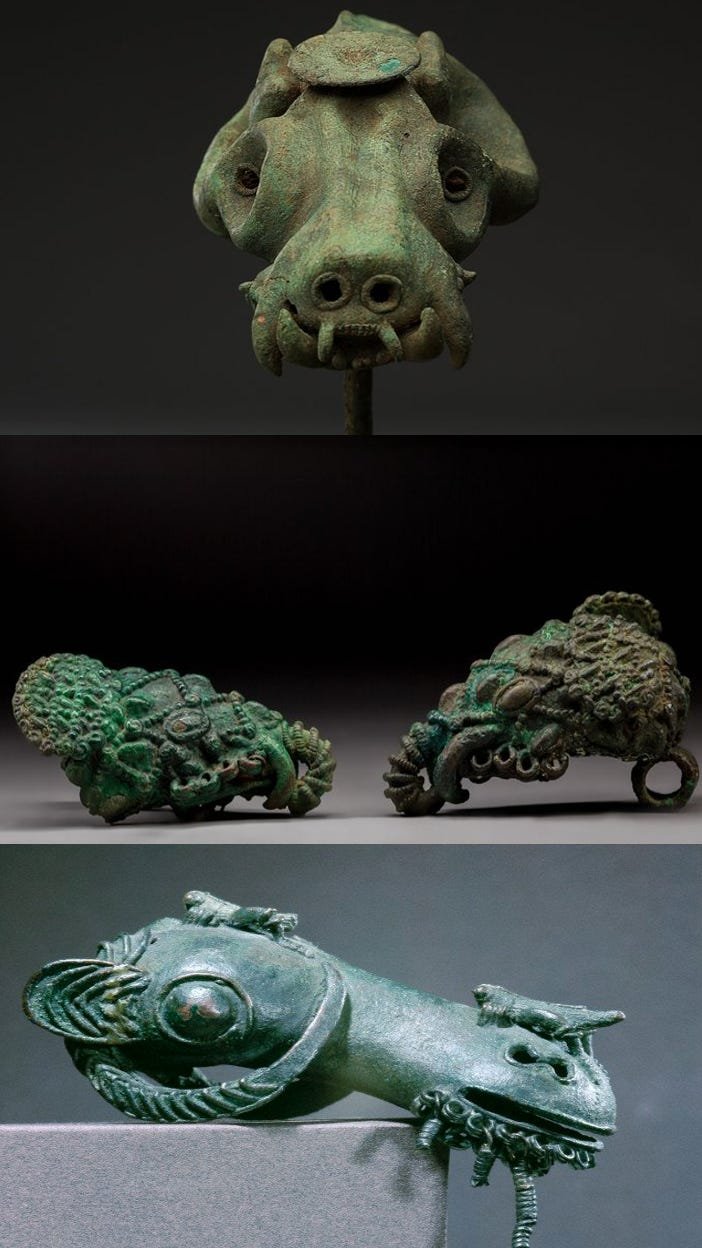
Igbo-Ukwu lies in the country later associated with Nri, a remarkable Igbo polity built not on armies but on ritual authority. Its priest-king, the Eze Nri, held sway across a wide region of Igbo towns without conquering them. His power was religious and moral: he cleansed abominations, sanctioned the yam harvest, conferred titles, and sent his agents out on long circuits to bless and to bind. It was hegemony by sacred prestige rather than by force, a kingdom whose weapon was legitimacy. The regalia buried at Igbo-Ukwu (the fan of office, the crown, the pectoral, the beads, the animal-headed pendants) look very much like the material world of exactly that kind of ritual kingship, seen at an early stage of its long life.
For a long time the instinct, spoken and unspoken, was that work this refined could not be the product of an early West African village, and that the technique, or the objects, or at least the inspiration, had to have come from somewhere more “advanced”: the Mediterranean, the Arab world, a later and more familiar kingdom. The early date was resisted partly because it left no room for a foreign teacher to arrive first.
Every serious thread of evidence runs the other way. The style is local through and through: the leopards and rams and snakes, the shrine vessels, the beaded regalia all belong to the region's own visual language, with no Mediterranean models behind them. The casting is not a diluted copy of some outside tradition but a peak the outside world could not match at the time. Foreign glass and copper reached the village as raw material, and local founders turned them into something wholly their own. The genius was home-grown, and it was early. That, not any borrowed brilliance, is the thing worth being astonished by.
None of this makes Igbo-Ukwu a fully solved site. Whether the seated man was himself an early Eze Nri, or a priest of some related office, or a figure whose title has no later echo at all, the ground cannot yet say. The link to historic Nri is strong but not signed and sealed. What is beyond argument is that the objects grew out of the region's own soil of belief and rank, and answered to no master across any sea.
What is still in the ground
Isaiah Anozie's bronzes are now spread between the National Museum in Lagos and a scatter of collections abroad, the British Museum among them, and casts and photographs have carried the roped pot and the shell vessels into books all over the world. The village that gave them up is still there, a working town living on top of its own buried history. Only a few small areas have ever been excavated. Most of whatever lies beneath Igbo-Ukwu (more shrines, more graves, the workshops where the casting was actually done, which have never been found) is still down there under the houses and the yam plots, untouched.
That is what stays with you. We have this astonishing court on the strength of one man wanting water in one dry season, and a few careful trenches opened decades later. The furnaces that poured near-pure copper into moulds shaped like knotted rope have not been located. The full reach of the trade that fed the village its glass and metal is only now being pieced together, bead by analysed bead. Every fresh study narrows the argument a little and widens the wonder.
The bronzes were called too fine to be so old, and the charge was exactly backwards. They are not suspicious because they are early and beautiful. They are proof, poured knot by cast knot into metal that has kept its edges for eleven hundred years, that a small place the histories forgot was, for a while, one of the most skilled on earth. Isaiah went looking for water. He found a civilisation that had been waiting under his feet the whole time.
Read next: Benin Bronzes: The Loot That Paid for the War That Seized It and Nok: The Terracotta Head That Spent Years as a Scarecrow.
Sources & further reading
- Thurstan Shaw, Igbo-Ukwu: An Account of Archaeological Discoveries in Eastern Nigeria (Faber & Faber / Institute of African Studies, Ibadan, 1970).
- Thurstan Shaw, Unearthing Igbo-Ukwu: Archaeological Discoveries in Eastern Nigeria (Oxford University Press, 1977).
- Babatunde Lawal, “Dating Problems at Igbo-Ukwu,” Journal of African History, vol. 14 (1973).
- Abidemi Babatunde Babalola et al., “Chemical analysis of glass beads… new light on raw materials, production, and interregional interactions,” Journal of Archaeological Science (2018), with related work on Igbo-Ukwu bead provenance.
- “Igbo-Ukwu (ca. 9th century),” Heilbrunn Timeline of Art History, The Metropolitan Museum of Art.
- Recent reappraisals in the African Archaeological Review, including the “Igbo-Ukwu at 50” symposium papers.
Image credits (via Wikimedia Commons): ceremonial bronze pot — Ochiwar (CC BY-SA 3.0); snail-shell vessel — Ochiwar (CC BY-SA 3.0); ornamental staff head — Ochiwar (CC BY-SA 3.0); leopard and ram pendants — National Commission for Museums and Monuments, Nigeria (public domain).