In the winter of 1218 a Baghdad scholar named Yaqut al-Hamawi sat in a library in Merv and did not want to leave. He was a geographer, a former slave who had bought his way into books, and he had come east to the great oasis city of Khorasan to work. What he found undid him a little. Merv held libraries the way other cities held markets: ten of them, by his count, one attached to a mosque with twelve thousand volumes on its shelves, and the librarians let him take two hundred books home at a time without so much as a deposit. “But for the Mongols I would have stayed and lived and died there,” he wrote afterwards, “and hardly could I tear myself away.” He got out in time. Within three years the libraries, the shelves, the librarians and most of the people who had ever walked past them were gone.
Merv is one of the great vanished cities, and it vanished twice over: once in the killing, and once in the forgetting. For a stretch of the twelfth century it was, by some counts, the largest city on earth: a place travellers called Marw al-Shahijan, Merv the Great, the mother of the world. Then a Mongol army arrived in the spring of 1221, and a chronicler set down a number so large it has been argued over ever since. This is the story of how a city on a muddy river became the centre of an empire's learning, and how thoroughly it was erased.
Four cities on one plain
Start with the ground, because the ground explains everything. Merv sat where the Murghab river runs down out of the Afghan mountains and spends itself in the sand of the Karakum desert, spreading into a delta before it dies. That fan of water made an island of green in a sea of nothing, and people had farmed it for four thousand years. The Bronze Age settlement of Gonur Depe lies a short way north; by the time our story begins it was already ancient history to the people of Merv, buried and forgotten under its own dust.
What makes the site strange is that Merv is not one city but several, laid side by side like coins dropped in a row. The oldest, Erk Kala, went up around the seventh century BC as a round fortress guarding the oasis: a ring of mud-brick walls enclosing a mound you can still climb today. It appears in the record early and grandly: when Darius the Great had his victories carved into the cliff at Behistun around 515 BC, the province of Margu, the land of Merv, was among the rebels he crushed and listed. The same oasis, the same name, two and a half thousand years ago.
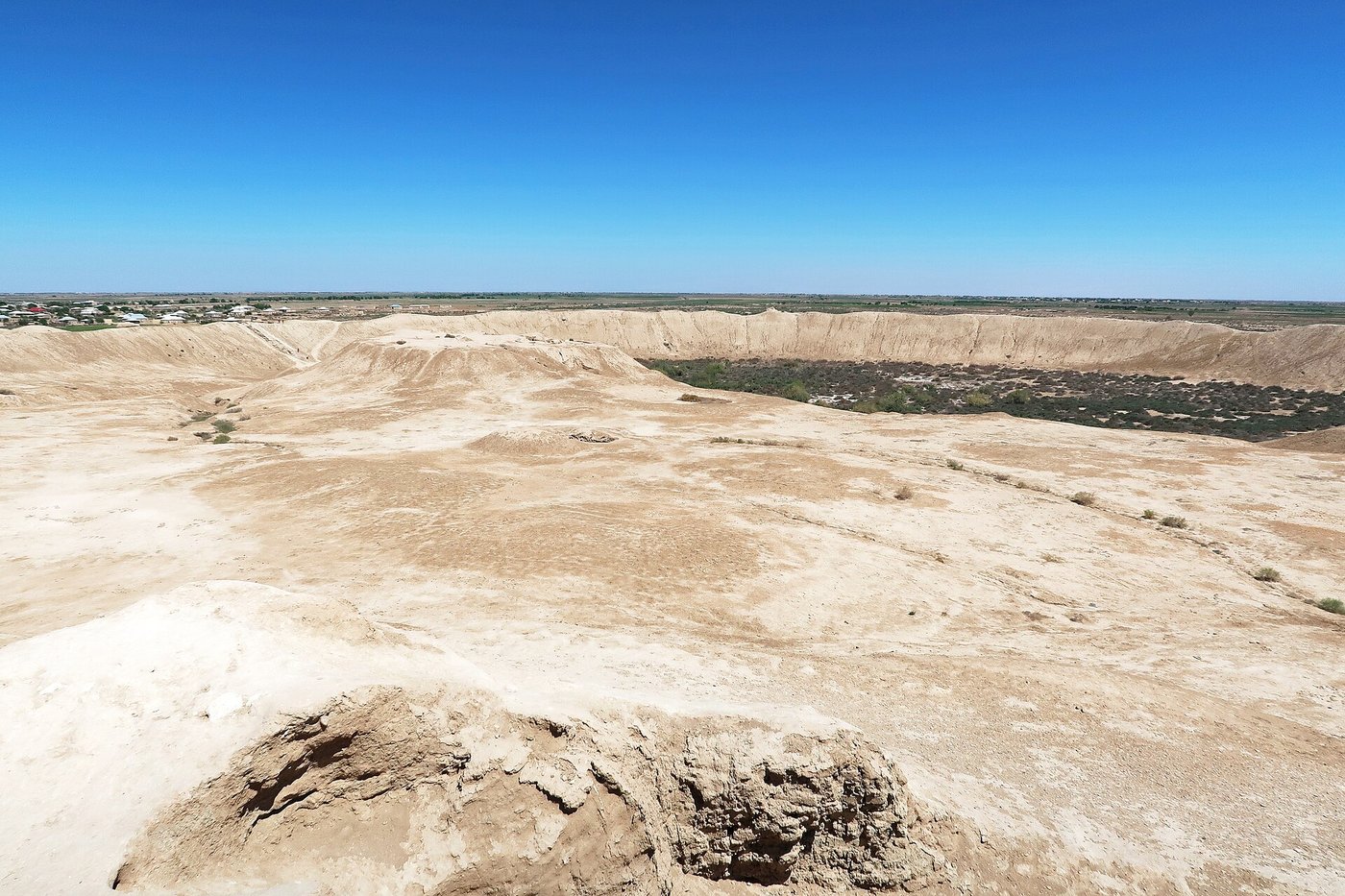
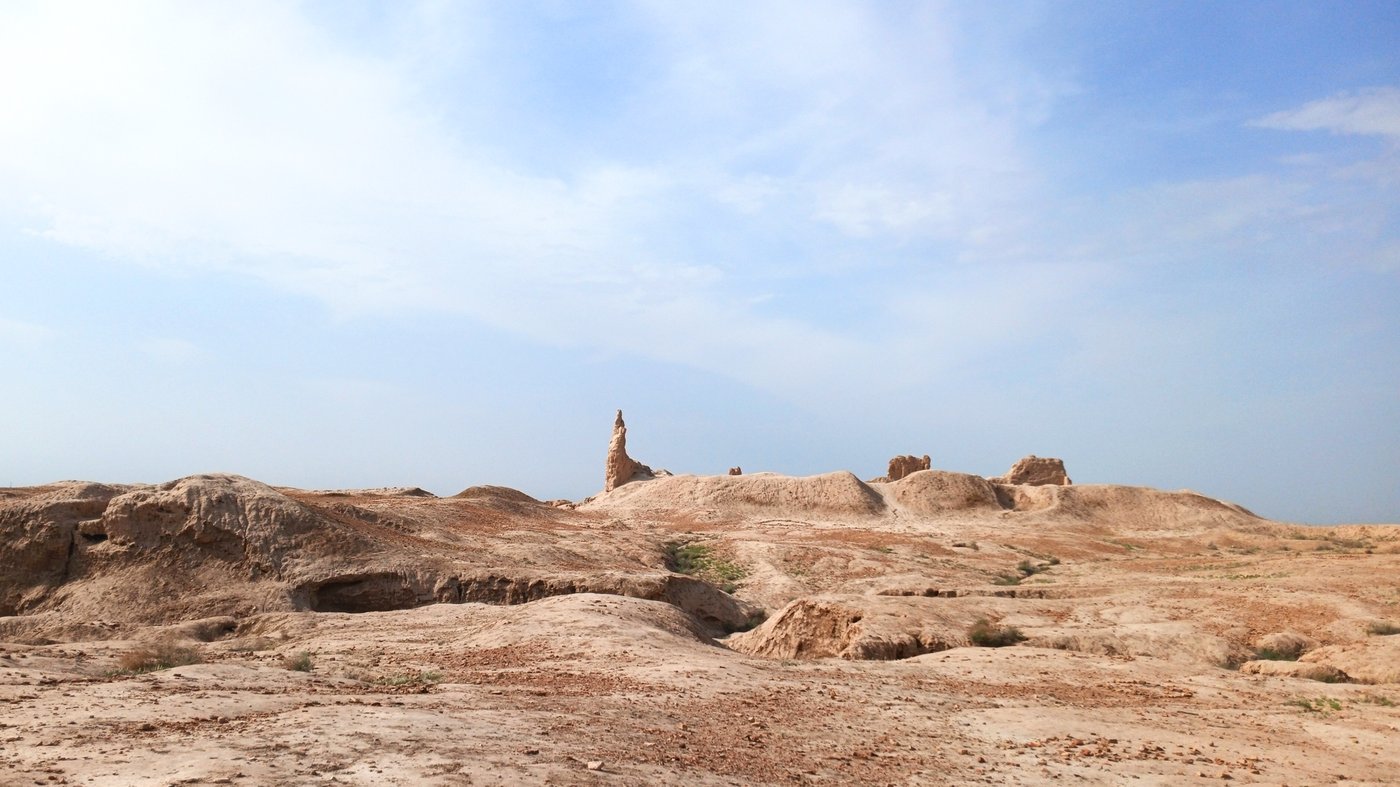
Next to Erk Kala the Greeks built a bigger square. After Alexander's armies passed through, one of his successors, Antiochus, enclosed the oasis in fresh walls and gave the place a Greek name, Antiochia Margiana; locals kept calling it by older words that survive as Gyaur Kala, the fortress of the unbelievers. This was the Merv of the Parthians and the Sasanian Persians, a Silk Road stop where caravans changed hands and faiths brushed past one another. Then, in the eighth century, the Muslim governors laid out a third city to the west, Sultan Kala, and the centre of gravity moved with them. Each new Merv rose on clean ground beside the old one, so that today the ruins read like tree rings: walk west and you walk forward in time, from Iron Age fort to Greek square to medieval metropolis, each abandoned rather than rebuilt.
The water that made it possible
None of it could have existed without a fight against thirst that never let up. The Murghab carried water but also silt, and the channels that fed Merv's fields clogged as fast as they were dug. Medieval accounts describe an official whose whole job was the river: he commanded a small army of ten thousand men who cleaned the canals, and he held the dam upstream that parcelled the flow out to the farms. A diver with a measuring rod checked the water level each spring, and the reading decided how much every district would get. Get the dam wrong and the desert came back.
When they got it right, the desert bloomed in ways that startled visitors. Merv grew cotton so fine that Arab geographers wrote it up by name, soft stuff sold across the Islamic world as Merv cotton, and silk beside it. Its melons were famous enough to be packed in snow and carried to distant courts as gifts. And to keep that snow, the people of Merv built structures that still stand: tall conical chambers of mud brick, thick-walled and shaded, where winter ice was stacked and kept frozen through the furnace of a Karakum summer. From a distance the surviving ice house looks like a giant clay beehive dropped in the flat. It is one of the few things at Merv that a modern eye reads at once: a fridge, essentially, six or seven hundred years before the machine.
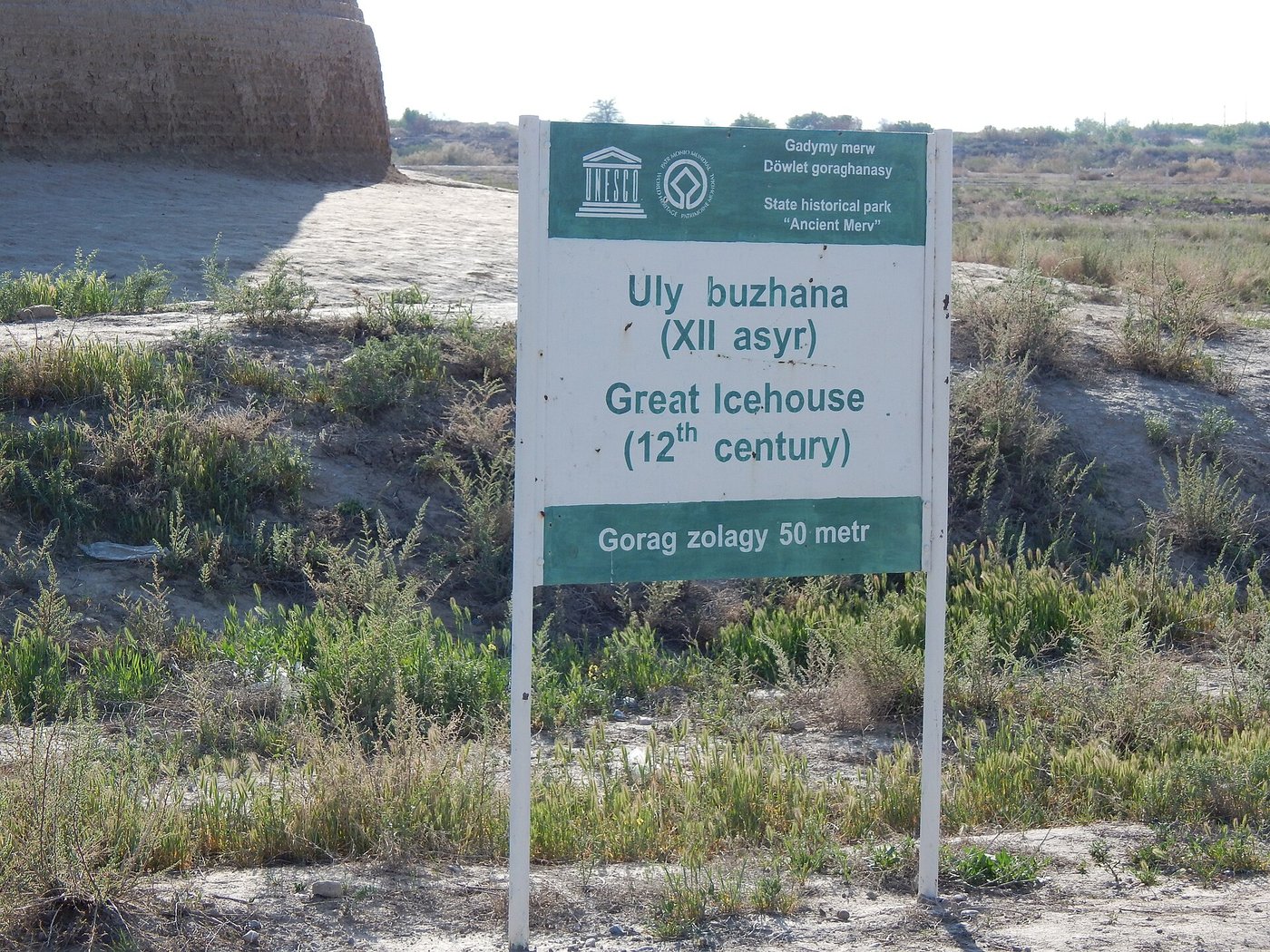
Merv's real rulers, in a sense, were the men who managed the water. The workshops of the old town have also given up something unexpected: crucibles used to make high-grade steel by melting cast iron and wrought iron together, exactly the process Arab writers credited to Khorasan. A city that could keep ice in the desert and pour steel in its yards was not a backwater. It was a piece of high technology sitting in the sand.
The capital nobody remembers
Merv's century of greatness came in two acts. The first began in 748, when a rebel named Abu Muslim raised the black banners of revolution in the city and set in motion the fall of one dynasty of caliphs and the rise of another. For a while afterwards Merv was as close to a capital as the Muslim world had: the caliph al-Ma'mun ran his affairs from there for several years before he moved on to Baghdad. Governors and generals came out of Khorasan, and Khorasan's chief city grew rich on the traffic.
The second act, and the greater one, belonged to the Seljuk Turks. In the twelfth century Sultan Ahmad Sanjar made Merv the seat of his power, and under him the city swelled to a size that is hard to picture now. One estimate puts it above two hundred thousand people by 1150 and larger still in the decades after: on that reckoning the biggest city anywhere on the planet at that moment, ahead of Constantinople, ahead of Baghdad. The figures are guesses, argued over by people who count old cities for a living, but even the cautious ones describe somewhere vast.
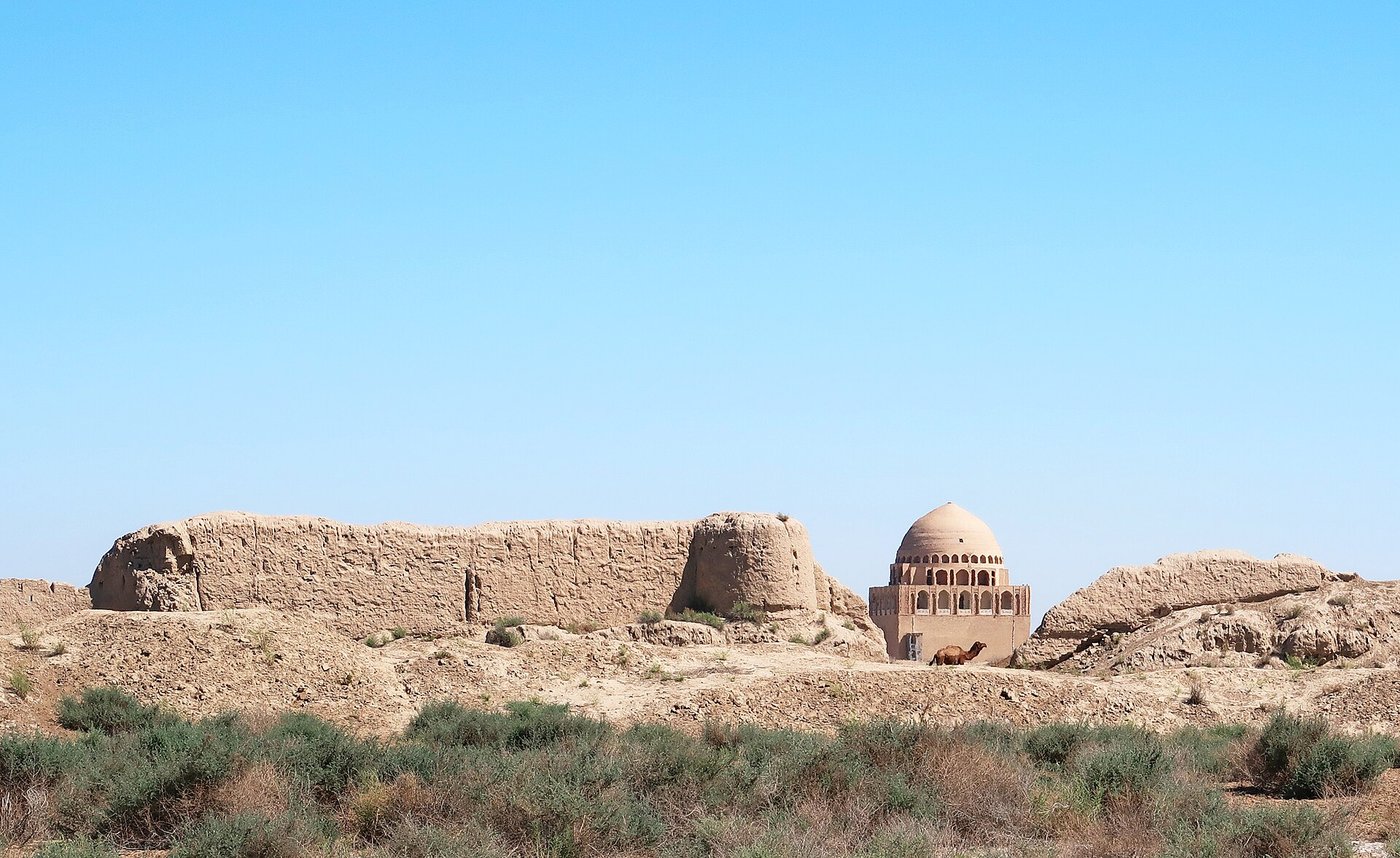
Sanjar left the city its most famous building. When he died in 1157 he was laid in a square mausoleum in the heart of Sultan Kala, a cube of brick twenty-seven metres to a side, roofed with a great dome that was once faced in turquoise tile. Chroniclers said the dome could be seen by a caravan still a full day's march from the walls, a blue point burning on the horizon over the flat brown land. The turquoise is long gone and the outer shell has fallen, but the inner dome held. Eight centuries and one Mongol army later, Sanjar's tomb is still standing, which is more than can be said for almost anything else his city built.
Ten libraries and a borrowed book
Wealth bought books, and Merv spent freely. This was the city that pulled Yaqut al-Hamawi in and would not let him go, and he was not alone in his awe. The mathematician and poet Omar Khayyam worked at an observatory here, measuring the length of the year with a precision Europe would not match for centuries. Scholars came for the libraries and stayed for the company. The city ran on more than one god, too. For six hundred years Merv was the seat of a Christian bishop of the Church of the East, whose missionaries carried their faith along the Silk Road towards China; Buddhist monks had raised a stupa in the old town before them; Zoroastrians held the oasis to be one of the good lands their god had made, and Jews and Muslims did their trade in the same streets. It was the kind of place where a Nestorian metropolitan, a Sufi teacher and a Buddhist relic could all have a claim on the same square mile.
Yaqut al-Hamawi did not only borrow Merv's books; he used them. Much of what he learned in those libraries went into his great geographical dictionary, the Mu'jam al-Buldan, an alphabetical description of the known world that he finished after fleeing the Mongol advance. When he praised Merv's collections and its generous librarians, he was writing an obituary without knowing it. His pages are among the fullest records we have of a library that no longer existed by the time the ink was dry: the memory of a place, salvaged by the last scholar to use it in peace.
The cracks before the storm
Greatness did not fall in one blow; it was already cracking before the Mongols were a rumour. In 1153 a confederation of Oghuz Turkmen nomads, pushed to breaking point by taxes and heavy-handed officials, rose against Sanjar, beat his army and took him prisoner. They held the old sultan for years and let their followers loose on Merv, stripping the rich city they had just conquered. Sanjar escaped at last but died soon after, a broken man, and the Seljuk order he had held together frayed behind him. Merv passed from hand to hand: to the Ghurids, then to the shahs of Khwarazm, an aggressive new power on the Amu Darya who gathered Khorasan into a wide, brittle empire.
It was the Khwarazm-shah who, in 1218, made the mistake that doomed them all. His governor on the eastern frontier seized a Mongol trade caravan and killed the merchants as spies. When Genghis Khan sent envoys to demand justice, the shah had them killed too. There was no coming back from that. The Mongol ruler turned his whole war machine west, and one by one the great cities of Khorasan (Bukhara, Samarkand, Nishapur, Herat) were stormed, emptied and burned. Yaqut, working in his beloved libraries, saw the shape of what was coming and ran for the west, carrying his notes. Merv waited its turn.
Thirteen days
The turn came in the spring of 1221. Tolui, the youngest son of Genghis Khan, brought an army to the walls of Merv: somewhere between thirty and fifty thousand horsemen, by the estimates. Inside were the city's own people and a flood of refugees from other broken towns, defended by a garrison far too small for the length of wall it had to hold. For six days the two sides fought over the ramparts. On the seventh, the defenders threw the Mongols back once and then could do no more. The city's commander rode out to negotiate, and Tolui promised that if Merv opened its gates the lives of its people would be spared.
Merv opened its gates. The promise was a trap. The Mongols drove the whole population out onto the plain: men, women and children sorted into groups, a handful of craftsmen picked out to be kept alive and sent east, and the rest condemned. What followed was industrial. The Persian historian Ata-Malik Juvayni, writing a generation later from inside the Mongol administration, says each soldier was handed the killing of three or four hundred people. Ibn al-Athir, an Arab chronicler alive at the time, wrote that the dead were then gathered and counted, and that the count ran on for thirteen days. The figure he recorded was around seven hundred thousand. Juvayni's number was larger still: more than one million three hundred thousand.
The chronicle: over a million people died at Merv, the corpses so many that the tallymen needed thirteen days simply to count them. It stands in the sources as one of the deadliest sacks of a city in all of history.
The arithmetic: a million dead counted in thirteen days means roughly a hundred thousand a day, more than one a second without pause, day and night, and Merv, for all its size, is unlikely to have held anything like a million people even swollen with refugees. Medieval chroniclers used vast round numbers to mean “a horror beyond counting,” not to report a census. The true toll was catastrophic and may well have reached six figures. It was almost certainly not what the page says.
The number and the silence
So what actually happened? The honest answer is that Merv was destroyed as a living city, and that the exact scale of the killing is lost inside numbers that were never meant to be trusted to the digit. The chroniclers who recorded seven hundred thousand or one and a third million were not lying so much as reaching for a size their language had no better way to hold. Modern historians treat the figures as symbols: real slaughter, wildly inflated bookkeeping. What is not in doubt is the outcome. A city that had been one of the largest on earth was, within a season, a field of the dead and a scatter of survivors.
And then came the quieter killing, the one that finished the job. Merv did not live on rain; it lived on the dam and the canals and the ten thousand men who kept them clear. Break that system and the oasis strangles. In the chaos after 1221 the waterworks failed, the channels silted, the fields went back to sand. People drifted back over the following centuries and raised smaller towns nearby, and there was one last spasm of violence in 1789 when the ruler of Bukhara sacked what was left and marched its people away. But the great Merv, Marw al-Shahijan, never came back. The desert it had held at bay for four thousand years simply moved in and stayed.
Historians still weigh how Merv really died. One view puts the weight on the massacre itself: a population butchered so completely that the city could not repopulate. Another argues the sword did less than the silt: that many people survived or returned, and that it was the wrecking of the irrigation, and the loss of the skilled hands who maintained it, that turned a wounded city into an empty one. Both are probably true at once. Merv was killed, and then it was allowed to die.
What the mounds keep
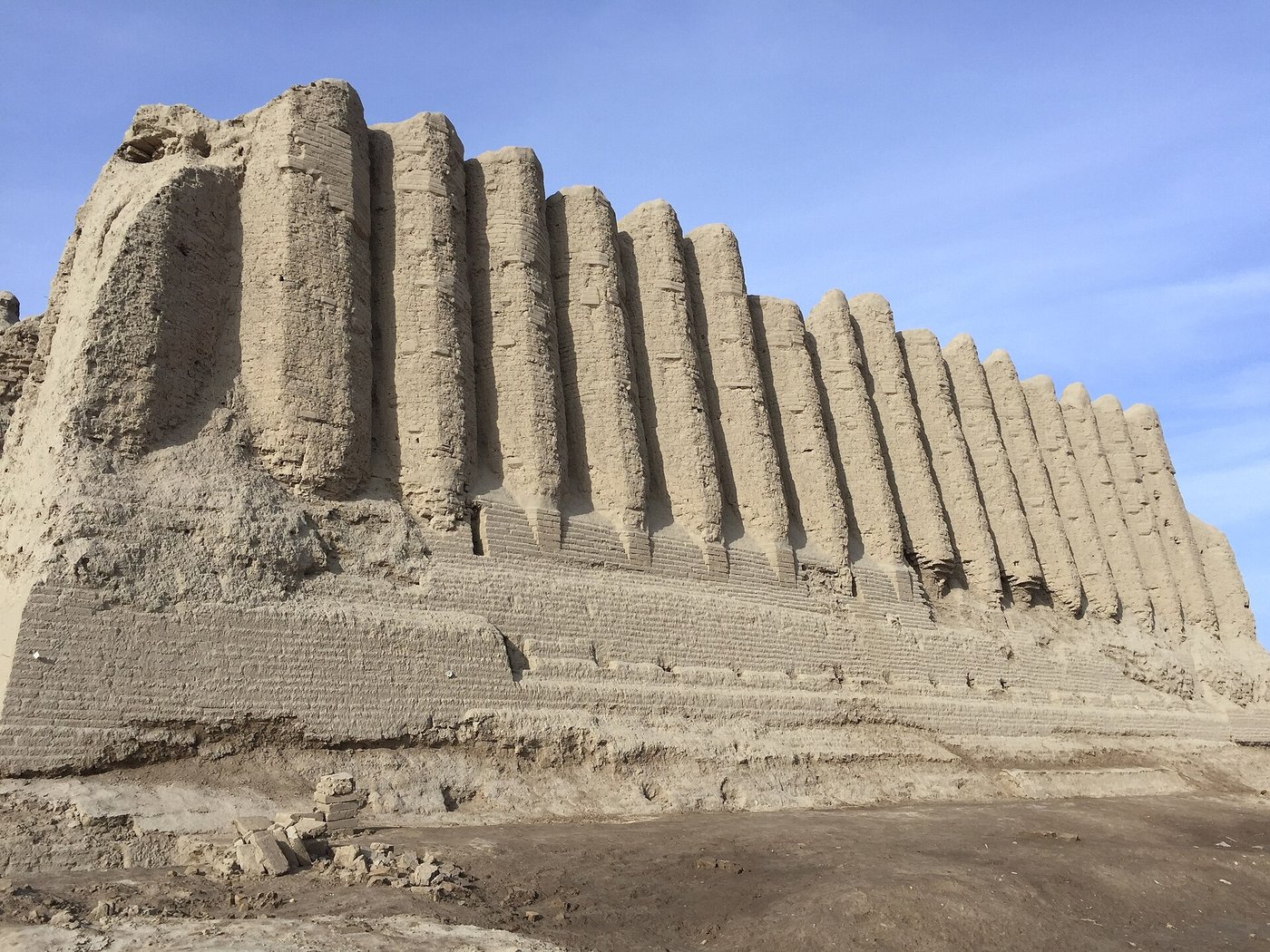
Go to Merv now and you find a landscape that refuses to look like a catastrophe. It is quiet and enormous, thirty kilometres east of the modern town of Mary in Turkmenistan: a plain of grassy ridges and eroded walls under a huge sky, grazed by the odd camel. The ridges are the cities. Erk Kala is a hollow ring you can walk the rim of; the corrugated kushks stand like weathered organ pipes; the ice house holds its cone against the wind. And rising over all of it, visible from a long way off just as the chroniclers said, is the pale drum of Sultan Sanjar's dome: the tomb the Mongols left standing, because there was no one left to defend it and nothing inside worth burning.
The site became a Turkmen state park in the 1980s and a UNESCO World Heritage Site in 1999, and since the early 1990s archaeologists working with Turkmen colleagues have been mapping the mounds, tracing the canals and shoring up what erosion keeps trying to take. They have found the crucible workshops, the water channels, the outlines of houses that once held that impossible crowd. What they cannot recover is the sound of the place: the twelve thousand books, the librarians who let a stranger walk off with two hundred at a time, the traffic of a city that thought it would go on forever. Yaqut al-Hamawi got his notes out and turned them into a description of the world. It is a strange kind of luck: the fullest portrait we have of Merv at its height was written by a man looking back over his shoulder as he fled, at a city he already suspected he would never see whole again.
Sources & further reading
- Herrmann, Georgina, Monuments of Merv: Traditional Buildings of the Karakum — the standard survey of the site's architecture, drawn from the Ancient Merv Project.
- Juvaini, Ata-Malik, The History of the World-Conqueror (trans. J. A. Boyle) — the near-contemporary Persian account of the Mongol conquest, including the sack of Merv.
- Ibn al-Athir, al-Kamil fi al-Tarikh (The Complete History) — the Arab chronicler's account of the Khwarazmian campaign and the death toll at Merv.
- Yaqut al-Hamawi, Mu'jam al-Buldan (Dictionary of Countries) — the geographer's own description of Merv and its libraries, written after his flight.
- Le Strange, Guy, The Lands of the Eastern Caliphate — on Merv, the Murghab irrigation and the cities of Khorasan.
- UNESCO World Heritage Centre, “State Historical and Cultural Park ‘Ancient Merv’” — inscription documents and site history.
Image credits (via Wikimedia Commons): Mausoleum of Sultan Sanjar with camel — John Pavelka (CC BY 2.0); Erk Kala citadel — John Pavelka (CC BY 2.0); the Great Ice House at Merv — 13299achan (CC BY-SA 4.0); the Greater Kyz Kala — Dr. Alexey Yakovlev (CC BY-SA 2.0); walls of Gyaur Kala — Azotochka (CC0).