In the 1440s a Persian ambassador named Abdur Razzaq, sent by the court of Timur's son to the far south of India, rode through a series of massive concentric fortifications and into a city that left him groping for words. There was nothing like it, he wrote, in the whole world he knew: markets heaped with rose-water and pearls and roses, a citadel of palaces, an audience hall blazing with gold, and crowds beyond counting. Eighty years later a Portuguese horse-trader, Domingo Paes, climbed a hill to take in the same city and concluded it was "as large as Rome and very beautiful to the sight," perhaps "the best-provided city in the world." That city was Vijayanagara, the City of Victory, capital of the greatest Hindu empire of the late medieval age. Today it is a field of magnificent ruins called Hampi, because in 1565 the city was deliberately, methodically destroyed, and never rebuilt.
Here is what makes Vijayanagara such a remarkable story: it rose at the exact moment it should have been impossible. For two centuries Islamic armies from the north had been pushing relentlessly into the Indian peninsula, and the great Hindu kingdoms of the south were falling one after another. And then, against that tide, a new Hindu empire appeared, planted itself across the whole of southern India, and held the line for three hundred years.
Two brothers and an improbable beginning
The empire was founded in 1336 by two brothers, Harihara and Bukka, the first kings of what became the Sangama dynasty. The traditional account of how they did it is so strange it sounds invented, and historians argue about how much of it is true. The story goes that the brothers were officers in a southern Hindu kingdom that was crushed by the armies of the Delhi Sultanate under Muhammad bin Tughlaq. Captured and carried off to Delhi, they converted to Islam and were sent back south as the Sultanate's governors. But once back in their homeland, under the influence of a revered sage named Vidyaranya of the Sringeri monastery, they reconverted to Hinduism, threw off Delhi's authority, and founded a kingdom of their own to defend the south.
Whether or not every detail of that conversion-and-return is literal history, the underlying situation is real. The Delhi Sultanate's southern expansion had shattered the existing Hindu powers and then largely withdrawn, leaving a vacuum. Into that vacuum stepped Harihara and Bukka, and they built something durable where others had collapsed. They chose a near-perfect spot for a capital: a wild landscape of giant granite boulders on the southern bank of the Tungabhadra River, a natural fortress that a river guarded on one side and ranges of stone hills on the others.
The City of Victory
What they raised there over the following two centuries was, by the testimony of everyone who saw it, astonishing. Vijayanagara grew into one of the largest cities on earth, its population estimated in the hundreds of thousands: a metropolis to rival any contemporary city in Europe or Asia. It was ringed by seven lines of fortification, with irrigated fields and reservoirs between the outer walls so the city could withstand a siege. Inside were temples, palaces, bazaars where gems were sold openly in the streets, a vast network of aqueducts and tanks bringing water across the dry Deccan, and a royal centre of audience halls and pleasure pavilions.
The wealth came from controlling the rich agricultural south and dominating trade. Vijayanagara exported cotton textiles and spices, sat near the diamond mines that made the Deccan famous, and ran a brisk and strategically vital trade in war horses, imported from Arabia and Persia through the coastal ports. Its kings poured that wealth into temple-building on a colossal scale, and into patronising poets, musicians and scholars in Sanskrit, Telugu, Kannada and Tamil. The empire became the great custodian of southern Hindu temple culture at a time when, further north, that world was under pressure.
We know what Vijayanagara looked like at its height largely because of foreigners. A Persian envoy (Abdur Razzaq), an Italian merchant (Niccolò de' Conti), and two Portuguese visitors (Domingo Paes and Fernão Nunes) all left detailed eyewitness accounts of the city's size, markets and ceremonies. Paes thought it rivalled Rome; Razzaq counted its concentric walls and marvelled at its bazaars. Much of what historians know about this Hindu empire's golden age comes from the notebooks of Muslim and Christian travellers who simply could not believe what they were seeing.
Krishnadevaraya and the golden age
The empire reached its peak under its most celebrated ruler, Krishnadevaraya, who reigned from 1509 to 1529 and belonged to the third of Vijayanagara's four dynasties, the Tuluvas. He was that rare combination: a brilliant general and a serious patron of culture. On the battlefield he defeated the Deccan sultanates to his north, broke the Gajapati kingdom of Odisha to his east, and in 1520 stormed the great fortress of Raichur from the Sultanate of Bijapur in one of the signal victories of the age.
Off the battlefield he presided over a literary golden age. His court was said to be adorned by the ashtadiggajas, the "eight elephants" who held up the world of Telugu poetry, and Krishnadevaraya was himself a serious author, composing the Telugu epic poem Amuktamalyada. Popular memory across the south still fills his court with stories, above all the tales of the witty poet-jester Tenali Rama, whose cleverness outfoxes everyone around him. Under Krishnadevaraya the empire was wealthy, confident, militarily dominant and culturally radiant all at once, the high-water mark of three centuries.
"The size of this city I do not write here, because it cannot all be seen from any one place... I say it is as large as Rome and very beautiful to the sight; there are many groves of trees within it... and many channels of water which flow into the midst of it. It is the best-provided city in the world."— Domingo Paes, Portuguese visitor to Vijayanagara, c. 1520 (from his chronicle of the city)
The long duel with the Deccan
For most of its history Vijayanagara was locked in a grinding struggle with the Muslim states on its northern frontier. First this meant the Bahmani Sultanate, founded in 1347 just a decade after Vijayanagara itself, and for over a century the two powers fought repeatedly across the rivers and forts of the Deccan. The prize endlessly contested was the Raichur Doab, the fertile land between the Krishna and Tungabhadra rivers.
Then, around the turn of the sixteenth century, the Bahmani Sultanate broke apart into five successor states: Bijapur, Golconda, Ahmadnagar, Bidar and Berar. For Vijayanagara this was at first an opportunity: five rival sultanates, often at one another's throats, were easier to play off than one united power. And the empire's later strongman, Aliya Rama Raya (the de facto ruler in the mid-sixteenth century, governing through a puppet king of the fourth, Aravidu, line), became a master of exactly that game, allying now with one sultanate, now with another, intervening in their wars, and keeping them divided. It worked brilliantly. Until it didn't.
Vijayanagara is often told as a simple story of Hindu resistance against Muslim invasion, a "Hindu bulwark." Historians push back on how clean that picture is. Vijayanagara's kings adopted Islamicate court styles, titles and military techniques (one scholar famously called their ruler a "Sultan among Hindu kings"), and they employed Muslim cavalry and soldiers. The Deccan sultanates, for their part, used Hindu commanders and at times allied with Vijayanagara; Rama Raya himself spent years allied to Muslim sultans. The wars were driven as much by land, trade and power as by faith. Vijayanagara really did champion Hindu temple culture, but the neat "Hindu versus Muslim" frame flattens a far messier and more interesting reality.
Talikota: the day the city died
Rama Raya's clever manipulation of the sultanates eventually did what nothing else had managed: it frightened them into uniting. Resentful of his interference and his growing power, four of the Deccan sultanates (Bijapur, Golconda, Ahmadnagar and Bidar) set aside their own bitter rivalries and combined against Vijayanagara. The armies met in January 1565 near two villages, in the battle known as Talikota (also called Rakkasa-Tangadi).
It was a catastrophe of the first order. The traditional accounts describe the battle turning when Muslim commanders within Vijayanagara's own army defected at the critical moment, but whatever the precise cause, the empire's forces were broken. The aged Rama Raya was captured and beheaded on the field, and the sight of his head reportedly shattered what remained of his army's morale. The road to the capital lay open and undefended.
What followed is one of the most complete acts of urban destruction in history. The victorious armies entered the fabulous, unprotected city and gave it over to plunder and demolition that, by many accounts, went on for months. Temples were smashed, palaces burned, the great markets gutted. The richest city in southern India was reduced, deliberately and thoroughly, to the broken stone landscape that visitors wander today. Vijayanagara, the City of Victory, was never reoccupied.
"The Battle of Talikota in 1565 was the end of the Vijayanagara Empire."
Talikota destroyed the capital and broke the empire's power, but the empire itself limped on for another eighty years. The Aravidu dynasty regrouped and ruled a shrinking territory from new capitals (Penukonda, then Chandragiri, then Vellore) until the line finally faded out around 1646. The 300-year span people cite for Vijayanagara (1336–1646) only works if you count this long, diminished afterlife. The great empire effectively ended in 1565; the name survived much longer.
The afterlife, and the ruins of Hampi
The shattered empire did not vanish overnight. The surviving Aravidu rulers pulled the remnants together and governed a much-reduced realm from a succession of southern capitals for several more generations, even as their former provincial governors, the nayakas of places like Madurai, Tanjore and Gingee, broke away to become independent powers in their own right. By the mid-seventeenth century the imperial line had dissolved, absorbed into the swirl of new Deccan and southern states. Three centuries after two brothers raised a fort by the Tungabhadra, the empire was gone.
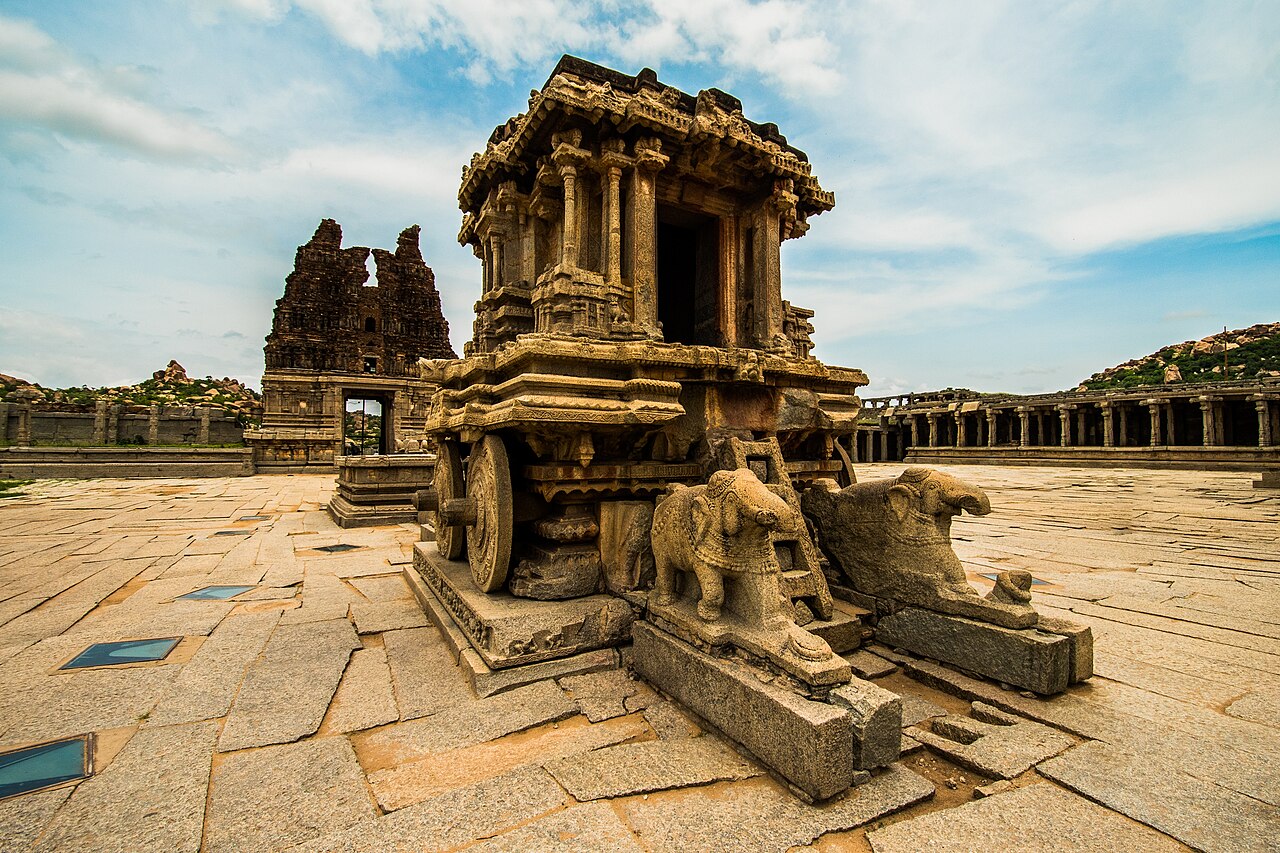
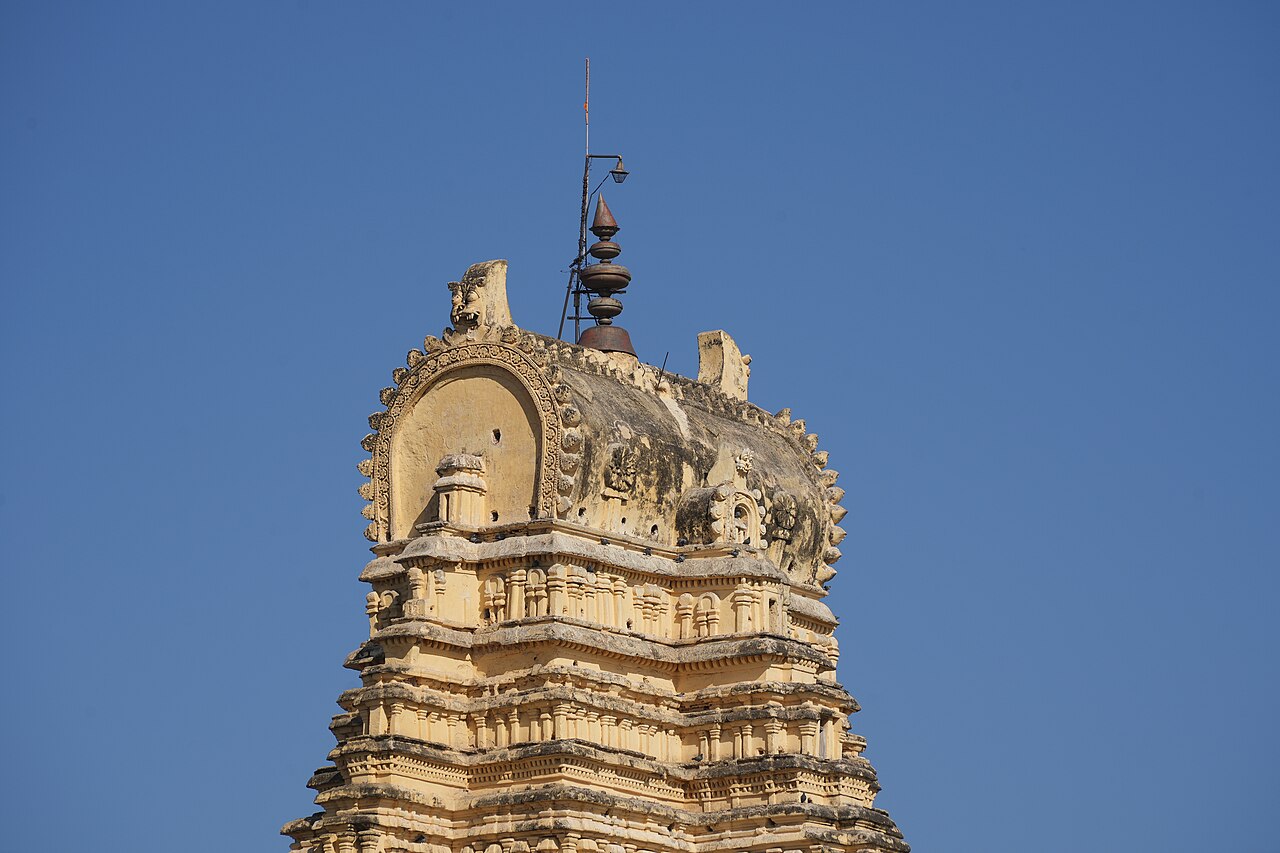
But the stones remained. The ruined capital at Hampi survived as one of the most extraordinary archaeological sites in the world, and in 1986 the Group of Monuments at Hampi was inscribed as a UNESCO World Heritage Site. Walk it today and the lost grandeur is everywhere: the soaring tower of the Virupaksha temple, still ringing with worship after seven hundred years; the Vittala temple with its famous stone chariot and its "musical" pillars; the Lotus Mahal and the great Elephant Stables; the giant monolithic statue of Narasimha; aqueducts and tanks and the endless boulder-strewn horizon. It is a city frozen at the moment of its violent end, and it remains the most eloquent witness to what Vijayanagara once was.
Walking the ruins: a tour of Hampi
To grasp what Vijayanagara was, it helps to walk through what is left of it, because the ruins of Hampi are unusually varied: not just temples, but palaces, waterworks, markets and military buildings spread across some twenty-five square kilometres of boulder-strewn landscape. The royal centre alone tells you how cosmopolitan this Hindu court really was.
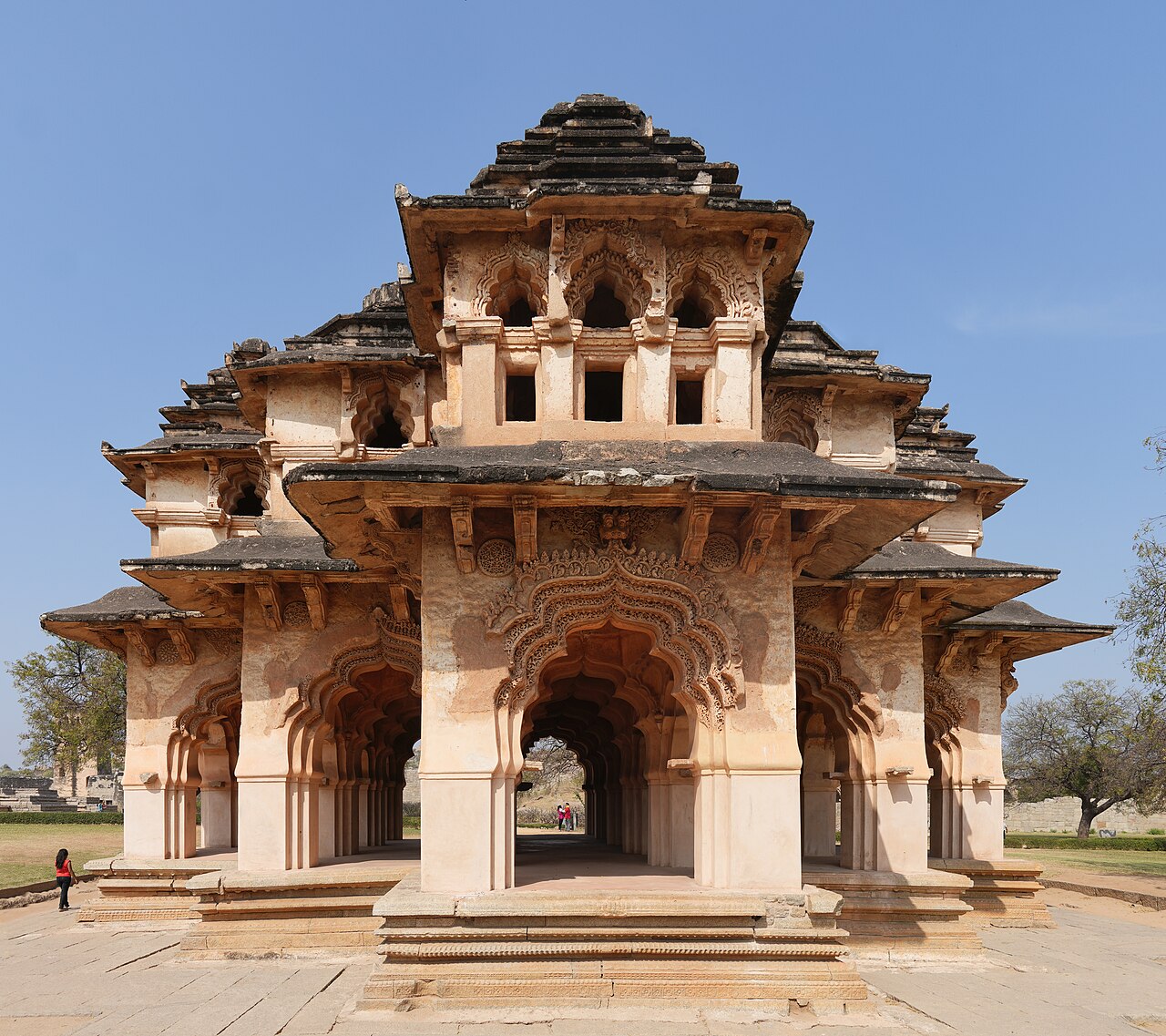
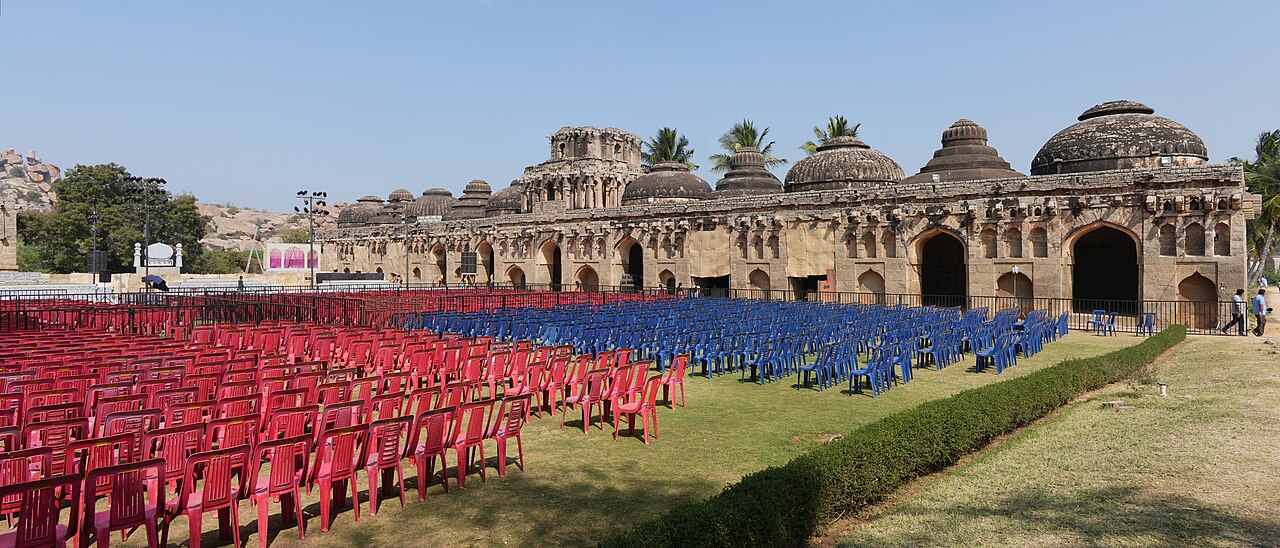
The Lotus Mahal, named for its lotus-bud arches, is a perfect emblem of the empire's hybrid taste: a Hindu royal pavilion built in a style clearly influenced by the Islamic architecture of the Deccan sultanates. A short walk away stand the Elephant Stables: eleven grand domed chambers, raised to house the royal war elephants in more splendour than most people of the age were ever housed themselves.
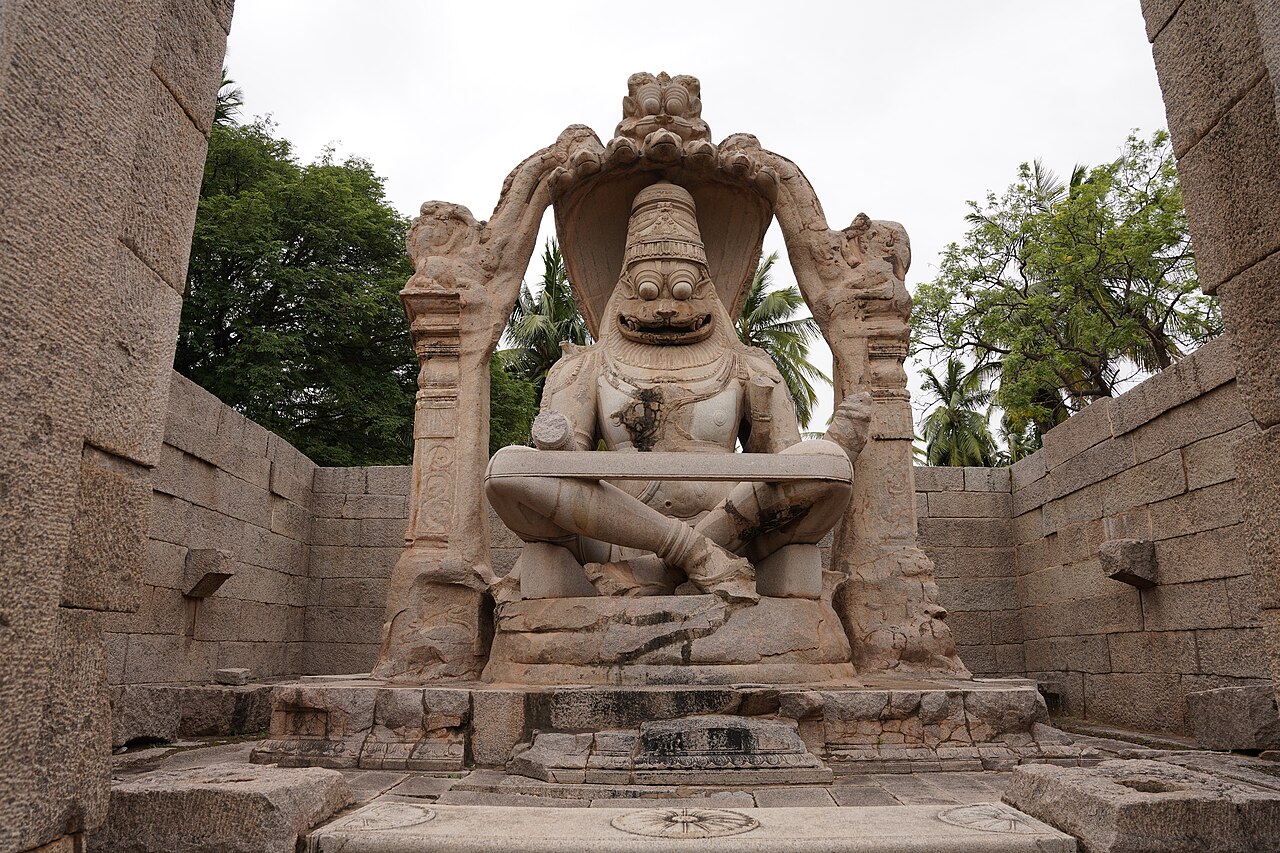
And then there are the temples and the colossal sculptures. The Vittala temple complex, with its famous stone chariot and its slender "musical" pillars that ring like instruments when struck, is the artistic high point. Elsewhere, single boulders were carved into gods on a giant scale, none more striking than the great monolithic statue of Narasimha, the man-lion avatar of Vishnu, hewn from one enormous stone.
Pomp, power and the great festival
The foreign visitors did not just describe buildings; they described spectacle. The grandest was the annual Mahanavami festival, the great nine-night Dasara celebration, when the whole machinery of the empire was put on display. Paes and Razzaq both left awed accounts of it: a vast arena, thousands of soldiers and horses and richly caparisoned elephants, wrestlers and dancers and musicians, processions of the nobility, and the king enthroned amid an almost unimaginable display of gold, jewels and ceremony.
These festivals were not mere entertainment. They were politics made visible: a yearly reaffirmation of the king's power, his wealth, his armies and his sacred role, witnessed by his nobles and his subjects and, conveniently, by foreign ambassadors who would carry the impression home. In an empire held together as much by prestige and loyalty as by administration, the spectacle was the statecraft. To watch the Mahanavami at Vijayanagara was to understand, in a single overwhelming display, exactly why this kingdom had lasted while others fell.
Three hundred years against the odds
The deepest reason Vijayanagara endures in memory is not just its wealth or its dramatic fall. It is that the empire did something against the odds. For three hundred years, at a time when so much of the subcontinent was being reshaped by powers from the north, this southern state held together a vast, prosperous, culturally rich Hindu kingdom, and in doing so it became the great patron and protector of South Indian temple architecture, language and learning. Much of the classical culture of the Telugu, Kannada and Tamil south flowered or was preserved under its umbrella.
And yet the more closely you look, the more human and complicated the story becomes: a kingdom that borrowed freely from the very Islamic world it fought, that won and lost on shifting alliances rather than simple holy war, and that fell in the end not to an alien invasion but to its own neighbours uniting against an over-clever statesman. The popular image of a lone Hindu bulwark against the tide is too simple. The truth, a brilliant, worldly, ambitious empire that rose where it shouldn't have, dazzled everyone who saw it, and was then erased almost overnight, is far more compelling. You can still feel the whole arc of it, standing among the warm red stones of Hampi at sunset, in the silence where a city of half a million people once roared.
Images: the Stone Chariot of the Vittala temple, and the gopuram of the Virupaksha temple, both at Hampi, Karnataka (via Wikimedia Commons).
Read next: The First Battle of Panipat: How Babur Founded the Mughal Empire and The Koh-i-Noor: How One Diamond Passed Through Five Empires.
Sources & further reading
- Robert Sewell, A Forgotten Empire (Vijayanagar) (1900) — the classic study that collected the Portuguese chronicles of Domingo Paes and Fernão Nunes.
- Burton Stein, Vijayanagara (The New Cambridge History of India) — a standard scholarly overview.
- Phillip B. Wagoner, "Sultan among Hindu Kings" (The Journal of Asian Studies, 1996) — on Vijayanagara's adoption of Islamicate court culture.
- Abdur Razzaq, Matla-us-Sadain, and the chronicles of Niccolò de' Conti — contemporary eyewitness accounts of the city.
- UNESCO World Heritage Centre, "Group of Monuments at Hampi"; Encyclopaedia Britannica, "Vijayanagar."