On 17 July 2026, in a museum built into a seventeenth-century Spanish fort in Campeche, Mexico, archaeologist Daniel Salazar Lama stood in front of a small, invited audience and clicked to a slide most of them had never seen: a painted figure crouched over a spear, wading through swirling blue water inside an artificial cave buried beneath one of the largest pyramids ever built in the Americas. He had spent three years photographing every centimetre of it in the dark, half-collapsed vault where it had survived for perhaps two thousand years. The talk was called, plainly, "Hunting in the Water, Fishing in the Cave." What he was describing, his research team believed, was the oldest known portrait of one of the most famous characters in Mesoamerican mythology, painted centuries before anyone wrote his story down.
The figure is known in Classic Maya inscriptions as Juun Ajaw, "One Lord," one half of the pair we usually call the Hero Twins. Most people who have heard of the Hero Twins know them from the Popol Vuh, the K'iche' Maya sacred book that was first written down in the Latin alphabet in the 1550s, generations after the Spanish conquest. That text tells how twin brothers outwitted the lords of the underworld through trickery, courage and a rigged ball game, then rose into the sky as the sun and the moon. What the Calakmul mural suggests is that people were already painting this story, or something very like it, a thousand years or more before the Popol Vuh existed as a book, and that they were doing it inside a chamber built, quite deliberately, to feel like a cave.
The city that rivalled an empire
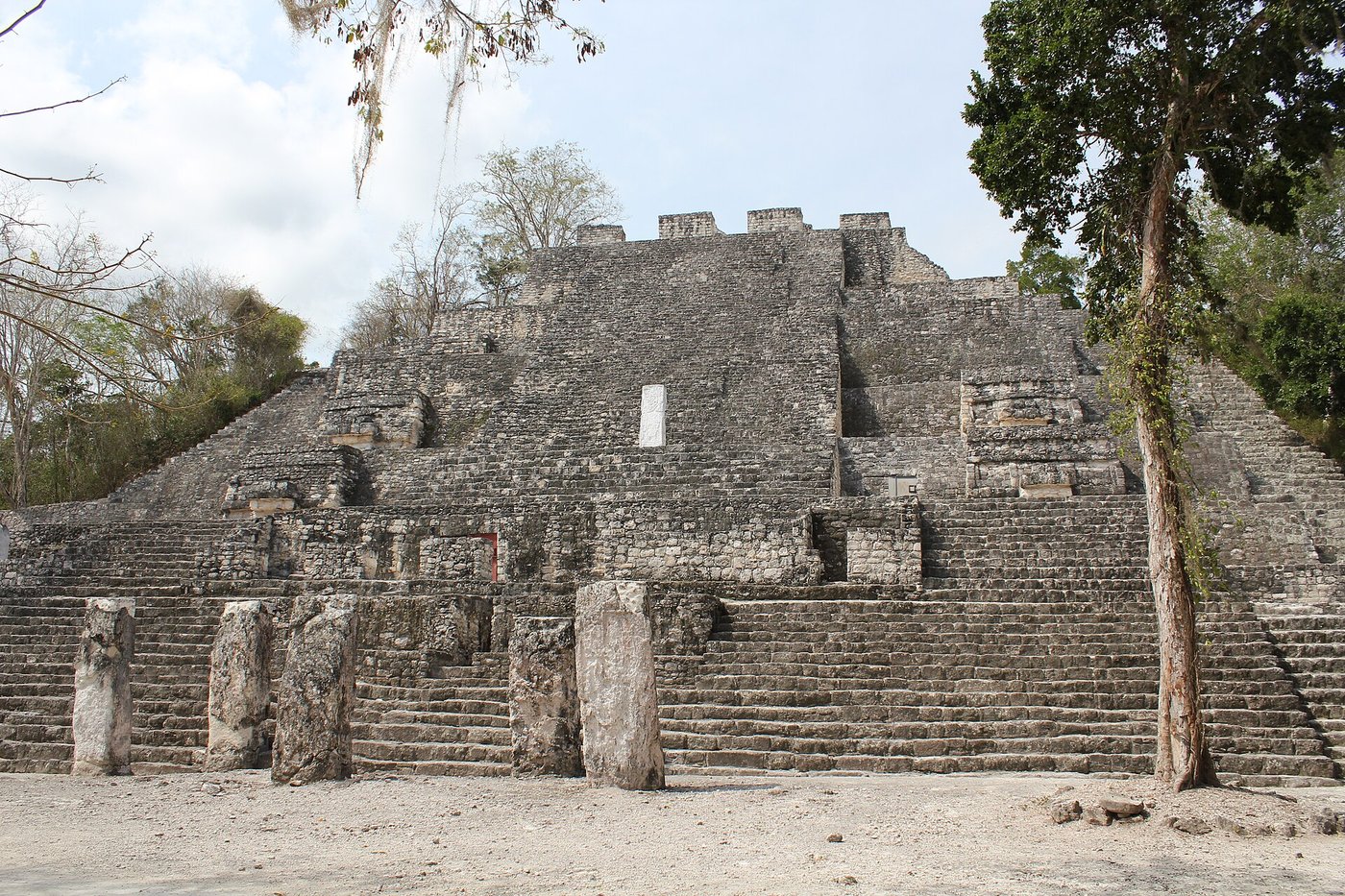
Calakmul sits deep in the Yucatán jungle of Campeche state, close enough to the Guatemalan border that howler monkeys are a more common sound than traffic. For most of the twentieth century it was known mainly to looters and a handful of aerial surveyors who spotted its pyramids poking through the canopy in 1931. Today archaeologists have mapped more than 6,750 structures across the site, and estimate that at its height the city held around 50,000 people under the rule of a dynasty whose emblem glyph was a snake's head, read "Kaan." Historians now call it the Kingdom of the Snake, and for the better part of two centuries it was the fiercest rival of Tikal, the other great superpower of the Classic Maya world, a rivalry that played out in wars, marriages and shifting alliances across the whole of the southern lowlands.
At the heart of Calakmul stands Structure II, one of the tallest pyramids in ancient Mesoamerica at around 55 metres, built up over more than a thousand years in at least seven distinct construction phases stretching from the Middle Preclassic period, before 400 BC, into the Late Classic era after AD 600. Every few generations, instead of tearing down the old temple at the summit, Maya builders simply buried it and built a new one on top, like a nesting doll of sacred architecture. It is inside one of the very earliest of those buried layers, deep within the pyramid's core, that the mural in question was found, sealed away, in effect, by the city's own growth.
The Snake Kingdom's story is one of the great rise-and-fall arcs of the ancient Americas. In the sixth and seventh centuries AD its kings ran what amounted to a network of client states and marriage alliances across the southern lowlands, hemming in Tikal and even engineering the defeat and, on one occasion, the capture and sacrifice of a Tikal king. Then the tide turned: in AD 695 Tikal beat Calakmul in a decisive battle, and over the following century the whole Classic Maya lowland system slid into the collapse that emptied these cities one after another. By around AD 900 Calakmul was largely abandoned, its plazas returning to forest, its inscriptions falling silent. The mural, buried centuries before any of that drama unfolded, is a survivor from the city's very beginnings, a glimpse of what its people believed long before they became a superpower.
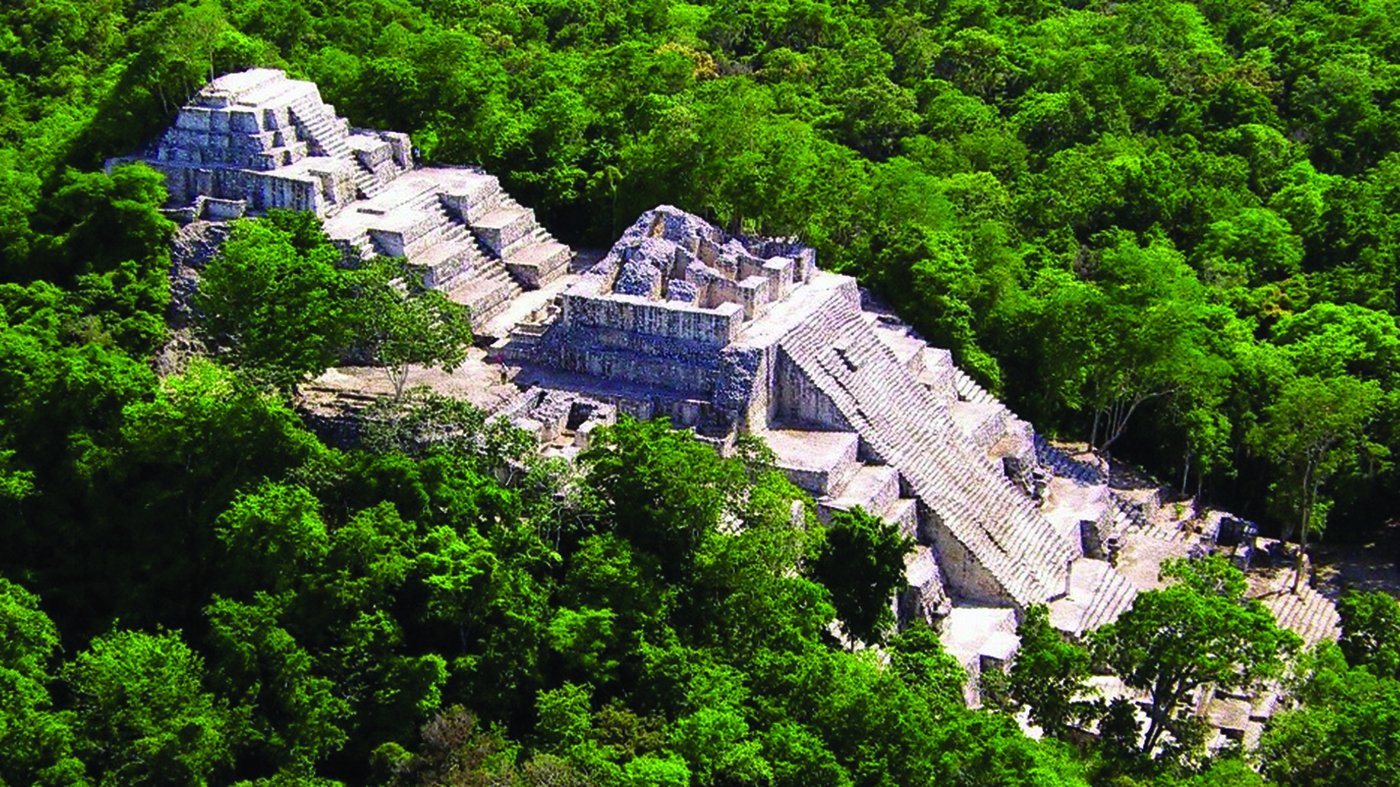
The room around the mural was built as carefully as the painting. Researchers found that the small underground vault housing it had been finished with stucco moulded and textured to imitate the rough, dripping interior of a natural cave: an artificial grotto built on purpose, several storeys inside a pyramid, so that a mythical hunting scene could be re-enacted in a space that felt like the real thing.
A vault built to feel like the underworld
Caves held enormous weight in Maya cosmology. They were doorways into Xibalba, the underworld, and into the deep, damp, dark spaces where rain, maize and ancestors were all believed to originate. Actual caves and sinkholes across the Yucatán are full of ancient offerings (pottery, jade, incense burners) left by pilgrims who travelled into the earth to petition rain gods and ancestral spirits. Building an artificial cave inside a temple, rather than trekking to a real one, let the rulers of Calakmul bring that same charged, otherworldly geography into the very centre of their city.
Salazar Lama's team believes the chamber's design went further still. Interior corridors in the structure appear to have been engineered to channel rainwater down a staircase and into the vault, so that during a downpour, the artificial cave would briefly fill with real water, turning the painted scene of Juun Ajaw hunting in a watery landscape into something the priests standing in front of it could feel underfoot. It is architecture built to be experienced, not just looked at, and it turns a static image into what was, in effect, a piece of working ritual machinery.
Who is Juun Ajaw?
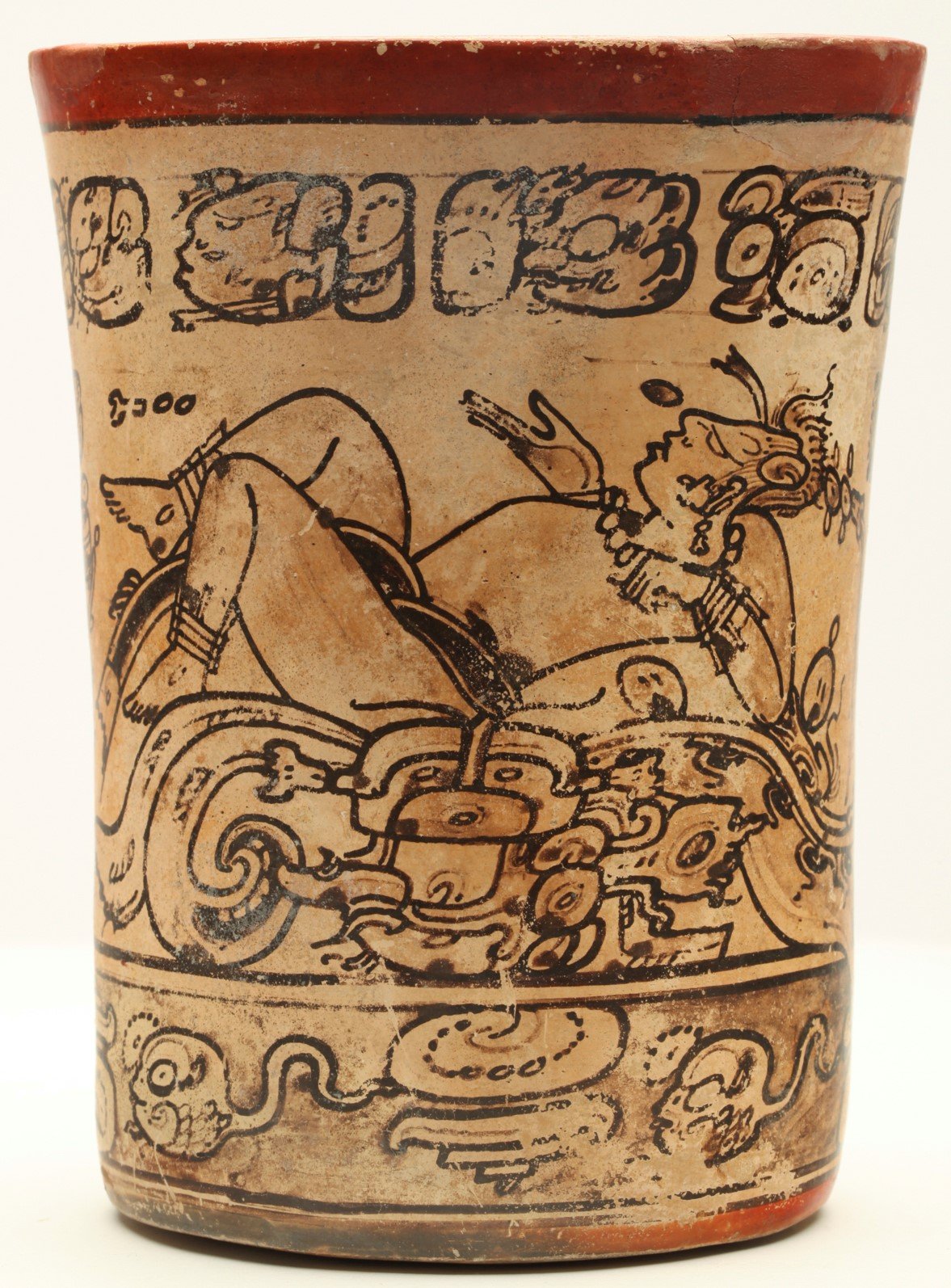
Long before Spanish friars ever set foot in Mesoamerica, Maya scribes and painters across the Classic period, roughly AD 250 to 900, were decorating pottery, carved bones and stone monuments with a recurring pair of young men: expert hunters, ballplayers and tricksters, one of them often marked with jaguar-spotted patches of skin. Epigraphers reading the hieroglyphic captions on these objects identified one of the pair by the title Juun Ajaw, "One Lord" or "One Ajaw," a name that lines up closely with Hunahpu, one half of the Hero Twins duo in the much later Popol Vuh.
That book, dictated in the K'iche' Maya language and transcribed into the Latin alphabet around 1554 to 1558 by unnamed K'iche' nobles, and later copied by the Spanish priest Francisco Ximénez, tells the twins' full story: how their father and uncle were lured into the underworld and killed by its lords after a noisy ball game annoyed them; how their father's severed head, hanging in a calabash tree, impregnated a young underworld woman named Blood Moon through nothing more than a spat of saliva into her palm; and how the resulting twins, Hunahpu and Xbalanque, grew up to avenge their father by outwitting Xibalba's lords one trick at a time, surviving houses full of jaguars, bats and knives, before finally besting them at their own ball game and rising into the sky as the sun and the moon.
"And here we shall write the ancient word... concerning the sowing and dawning of all the sky and earth... concerning the sun and the moon, that they are twins born to grow up as our light and lodestar."— paraphrased from the Popol Vuh, Dennis Tedlock's English translation
What has always puzzled scholars is the gap between the written Popol Vuh, a colonial-era document, and the far older Classic Maya pottery that seems to show the same characters and stories nearly a thousand years earlier, with no surviving text to confirm it was the same myth. The Calakmul mural, if the dating holds, closes a good part of that gap from the other direction, pushing recognisable imagery of Juun Ajaw all the way back into the Preclassic period, the centuries before 250 AD when Maya civilisation was still assembling its first great cities. That would make it not a late echo of a already-old story, but very nearly a witness to its formation.
"The Popol Vuh is where the Hero Twins story comes from."
The Popol Vuh is our fullest written account of the story, but it is a sixteenth-century transcription of a much older oral and pictorial tradition, not its origin. Painted pottery, carved monuments and now the Calakmul mural show the Hero Twins being depicted a thousand years or more before the Popol Vuh was ever put into Latin script. The book preserved the myth for us; it did not invent it.
Hunting in the water, fishing in the cave
The specific scene Salazar Lama's team reconstructed shows Juun Ajaw engaged in an activity not spelled out in the surviving Popol Vuh text at all: hunting in water, in a setting the researchers read as a symbolic fusion of hunting and fishing, two skills the Hero Twins are celebrated for throughout the wider mythic tradition. That detail matters, because it means the mural may be doing more than illustrating a scene we already know from the written myth. It may be preserving an episode, or a regional variation of the story, that never made it into the version the K'iche' scribes wrote down centuries later in highland Guatemala, hundreds of kilometres from Calakmul.
Maya myth was never a single, fixed script recited the same way in every city. It travelled across the lowlands in the way any oral tradition does: retold, elaborated and locally flavoured by different courts, different scribes, different ritual specialists, each adapting the core story to their own temple, their own political needs, their own gods. The Calakmul painters may have been showing their audience a version of Juun Ajaw's adventures that belonged specifically to their city, tied to their own artificial cave and their own understanding of what happened when the rains came.
Not every specialist is equally confident about reading a Preclassic mural through the lens of a myth first written down some 1,800 years later. Some argue that continuity across such a vast span of time, political change and geography should not be assumed just because the imagery looks similar; jaguar-spotted hunters and watery underworld scenes appear in more than one Mesoamerican tradition. Others counter that the consistency of the "One Ajaw" name and iconography across Preclassic, Classic and colonial sources is itself remarkable evidence of a long-lived, widely shared core myth, one of the most durable religious narratives anywhere in the ancient world. The debate says less about whether the Calakmul painters knew a Hero Twins story, and more about exactly how much of the later, fuller Popol Vuh narrative they already knew.
A story that outlived the burning of the books
It would be easy to file this away as a curiosity for specialists in pre-Columbian iconography, but the discovery says something broader about how myths survive. The Hero Twins story endured the collapse of the Classic Maya cities, the Spanish conquest, the burning of Maya books by colonial authorities, and five centuries of colonial and post-colonial disruption, and it is still told today among Maya communities in Mexico and Guatemala. The Calakmul mural is a reminder that stories like this are not fragile things that need a book to survive; for most of their existence, sacred stories lived in paint, stone, performance and memory, passed down through generations who never saw a single page of scripture.
It is also a story about how much of the ancient world is still waiting to be found in plain sight. Structure II had already been excavated, studied and climbed by tourists for decades before this particular vault, buried inside one of its earliest layers, gave up its secret, and it took three years of painstaking, unglamorous work with photogrammetry and digital reconstruction software to turn a faded, half-collapsed painting into a publishable discovery. The techniques are new. The patience required to use them on a two-thousand-year-old mural, in the dark, underground, is exactly as old as archaeology itself.
Image credits (via Wikimedia Commons): Structure II, Calakmul — Arian Zwegers (CC BY 2.0); Calakmul pyramid — Lugares INAH (CC BY-SA 4.0); Calakmul codex-style vase — Repositorio INAH (CC BY-SA 4.0); Maya ballcourt marker, Lubaantun, Peabody Museum — Daderot (public domain); Cenote Ik Kil, Yucatán — Shinya Suzuki (CC BY 2.0).
Read next: Teotihuacan: The City Whose Builders Left No Name and Monte Albán: The Stone ‘Dancers’ That Are Really the Slain.
Sources & further reading
- HeritageDaily, "Calakmul mural identified as mythical Maya hero Juun Ajaw," July 2026.
- Instituto Nacional de Antropología e Historia (INAH), conference announcement, "Cazando en el agua, pescando en la cueva: Juun Ajaw, un héroe mítico en un mural preclásico de Calakmul," 17 July 2026.
- Dennis Tedlock (trans.), Popol Vuh: The Definitive Edition of the Mayan Book of the Dawn of Life.
- Simon Martin and Nikolai Grube, Chronicle of the Maya Kings and Queens: Deciphering the Dynasties of the Ancient Maya — on Calakmul and the Kaan dynasty.
- Karl Taube, "The Classic Maya Maize God: A Reappraisal," on Juun Ajaw and Hero Twins iconography in Classic Maya art.