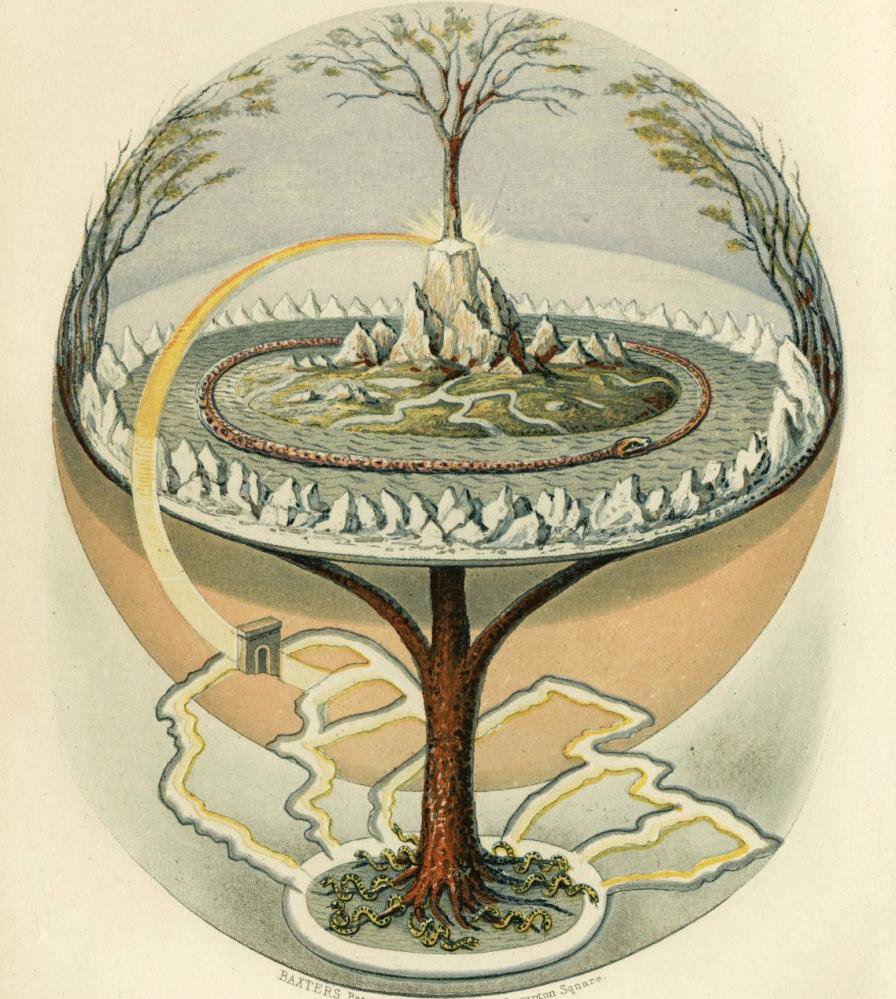
At the centre of the Norse universe stands a tree. Not a metaphor for a tree, but an actual, cosmic ash so vast that its roots and branches hold up everything that exists. Its name is Yggdrasil, the World Tree, and woven through its limbs and buried beneath its roots are nine worlds: the shining halls of the gods, the frozen land of the dead, the burning south where a fire giant waits with a flaming sword, and, somewhere in the middle, the small and ordinary world of human beings. To the people who told these stories a thousand years ago, this was the shape of reality itself. Let's take the tour.
A warning before we climb in, though, and it matters: the tidy list of "nine worlds" you're about to read is partly a modern reconstruction. The medieval Norse sources, chiefly the Poetic Edda and the Prose Edda written down in 13th-century Iceland, mention the nine worlds and name many realms, but they never sit down and give us a neat, labelled map. We've assembled the standard nine from fragments. Keep that in mind as we go: this is a cosmos glimpsed through cracks, not read off a chart.
Yggdrasil: the tree that holds it all together
Everything hangs on the tree. Yggdrasil is an immense ash whose branches stretch over all the worlds and reach above the heavens, and whose three great roots run down into three of the realms, drawing up water from sacred wells. At the Well of Urd sit the Norns, the three weavers of fate, who tend the tree and carve the destinies of gods and men. The tree is alive in every sense, and it is suffering. A dragon, Níðhöggr, gnaws at its roots; deer crop its highest leaves; a squirrel named Ratatoskr races up and down its trunk carrying insults between the eagle at the top and the dragon at the bottom. Yggdrasil is the axis of the universe, and it is being eaten alive even as it holds everything up. That tension, endurance under constant decay, runs right through Norse myth.
"An ash I know there stands, Yggdrasil is its name, a tall tree, showered with shining loam. From there come the dews that drop in the valleys; ever green it stands over the Well of Urd."— the Völuspá ("The Prophecy of the Seeress"), from the Poetic Edda, in the standard reading
The wells beneath the roots, and the weavers of fate
Before we tour the worlds, it's worth lingering at the foot of the tree, because the most important ideas in Norse myth are buried among Yggdrasil's roots. Beneath them lie sacred wells, and the wells are about knowledge and destiny. At the Well of Urd sit the three Norns, Urd, Verdandi, and Skuld (roughly "what was," "what is becoming," and "what shall be"), who carve the fates of every being into the wood and water the tree each day to keep it living. Even the gods are subject to the Norns. Fate, in this cosmos, is not a suggestion; it binds Odin himself.
At another root lies Mímir's Well, a spring of wisdom guarded by the wise being Mímir. The price of a single drink was steep: Odin, already the relentless seeker of knowledge, sacrificed one of his eyes for one draught of its water. It is the perfect Odin story: a god who will trade a piece of himself for understanding, and who knows that wisdom always costs something. Between the Norns and the well, the whole Norse attitude to life is laid out at the base of the tree: the future is fixed, knowledge is dearly bought, and what matters is how you meet a fate you cannot escape.
Fire, ice, and the body of a giant
Before the worlds, there was a gap. In the beginning, the Norse creation story tells us, there existed only Niflheim, a world of freezing mist and ice in the north, and Muspelheim, a world of pure fire and heat in the south, separated by a vast void called Ginnungagap. Where the ice of one met the sparks of the other, the melting frost took shape and life began: the first being, a primordial giant named Ymir, and a great cow, Auðumbla, who licked the ice and freed the ancestor of the gods.
The gods who descended from that line, led by Odin and his brothers, eventually killed Ymir, and from his enormous body they built the world. His flesh became the earth, his blood the seas, his bones the mountains, his skull the dome of the sky, held up at four corners by four dwarves. So two of our nine worlds, Niflheim and Muspelheim, are older than creation itself, and the very ground we'll walk on is the corpse of a murdered giant. The Norse cosmos is not a gentle place.
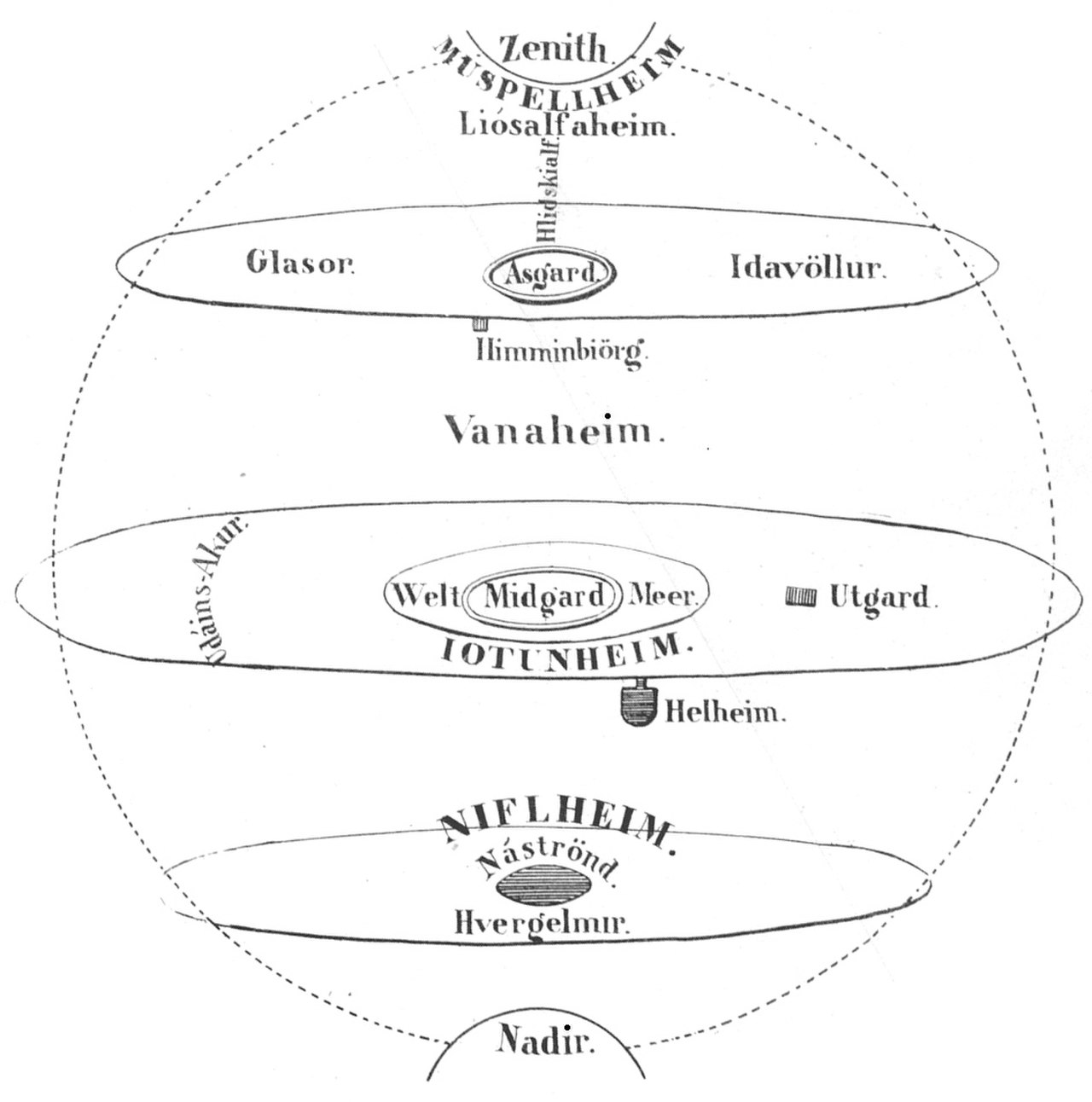
The worlds of the gods: Asgard, Vanaheim, Alfheim
Asgard is the realm everyone knows: the fortified home of the Æsir, the principal Norse gods, Odin the all-father, Thor the thunderer, Frigg, Baldr, and the rest. Within Asgard stands Valhalla, Odin's vast hall of the slain, roofed with shields, where warriors who die bravely in battle are carried by the Valkyries to feast, fight, and prepare for the final war. To be chosen for Valhalla was the highest honour a warrior could imagine, though, as we'll see, it came with a grim purpose.
But the Æsir are not the only gods. Vanaheim is home to the Vanir, an older family of deities tied to fertility, wealth, the sea, and the cycles of nature, among them Njörðr and his children Freyr and Freyja. In the deep past the Æsir and the Vanir fought a war that ended not in conquest but in truce, sealed by an exchange of hostages; that's how Freyr and Freyja came to live among the Æsir. It's a striking detail: even the gods of this mythology are a coalition of former enemies who learned to share power.
Alfheim, the third of the upper worlds, is the land of the light elves (ljósálfar): radiant, beautiful beings "fairer than the sun to look at," and associated with the god Freyr. The elves are shadowy in the surviving texts; we know they were revered, sometimes sacrificed to, and clearly thought of as powerful spirits of light, but much of their world is lost to us. They are a reminder of how much Norse belief we'll never recover.
Midgard: our world, and the bridge to heaven
Midgard (literally "middle enclosure," the original "Middle-earth" that inspired Tolkien) is us. It's the world of human beings, set in the centre of the cosmos and ringed by an impassable ocean. Coiled in that ocean is one of the great monsters of the mythology: Jörmungandr, the Midgard Serpent, so enormous it encircles the entire world and bites its own tail. Thor's deadly enmity with this serpent is one of the running threads of Norse myth, and it will be settled, fatally, at the end of all things.
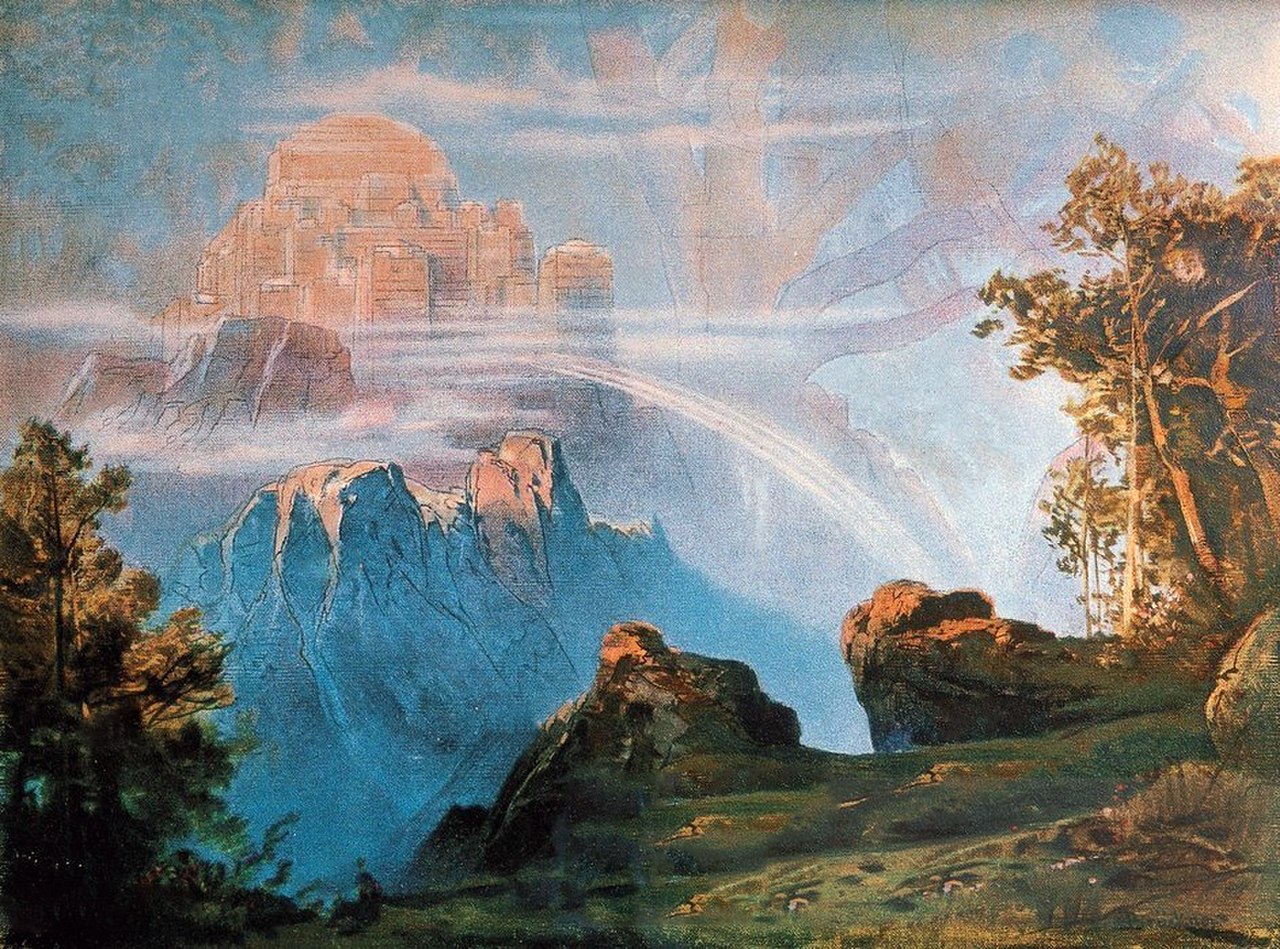
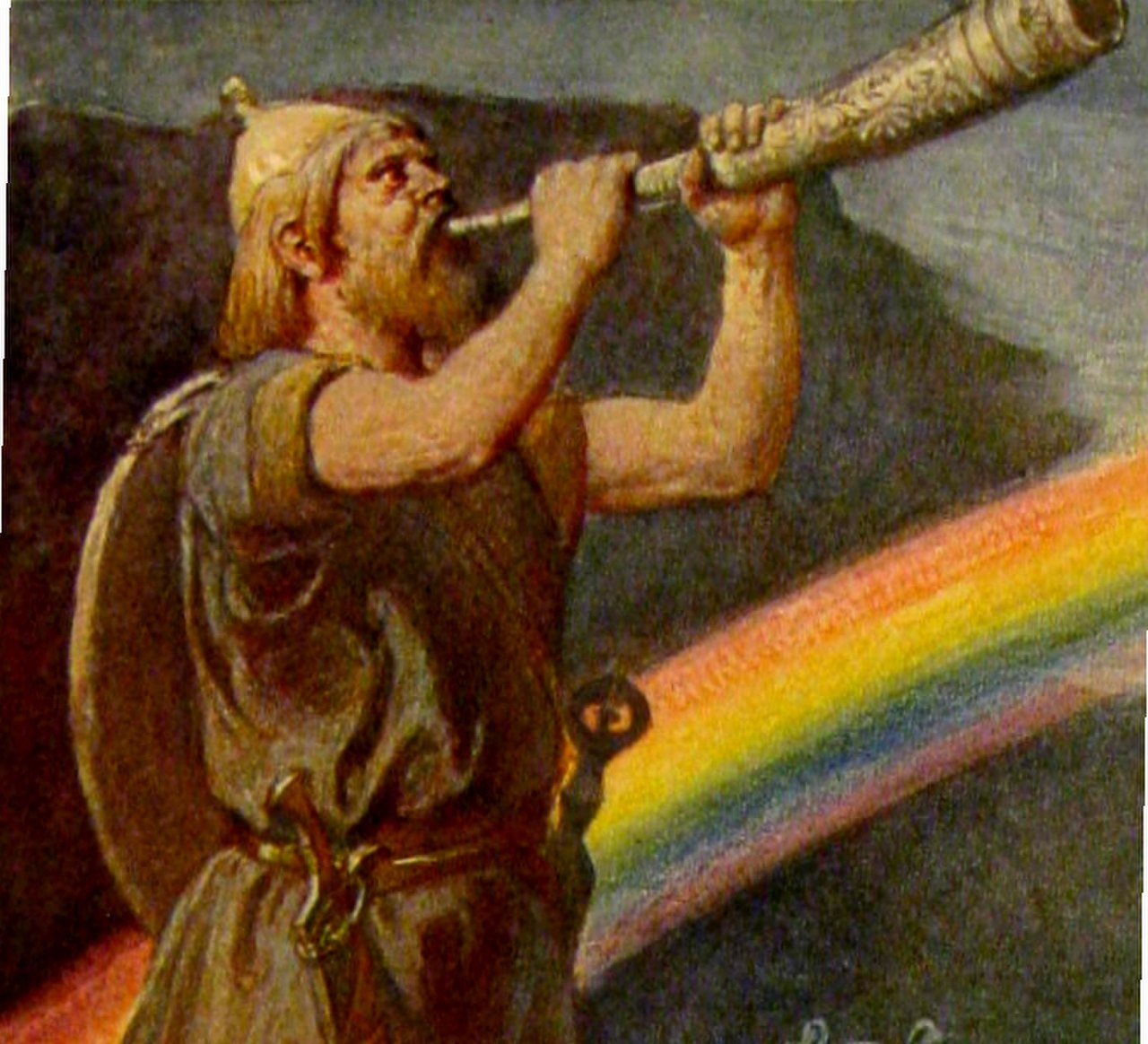
Midgard is linked to Asgard by Bifröst, the burning rainbow bridge, watched over by the god Heimdall, the ever-vigilant sentinel who needs less sleep than a bird, can see for hundreds of miles, and can hear the grass grow. Heimdall holds the Gjallarhorn, the horn whose blast will summon the gods to their final battle. The rainbow bridge is beautiful, but it is also a frontier under guard, because the gods know what is coming for them across it.
Jötunheim and the dwarven deeps
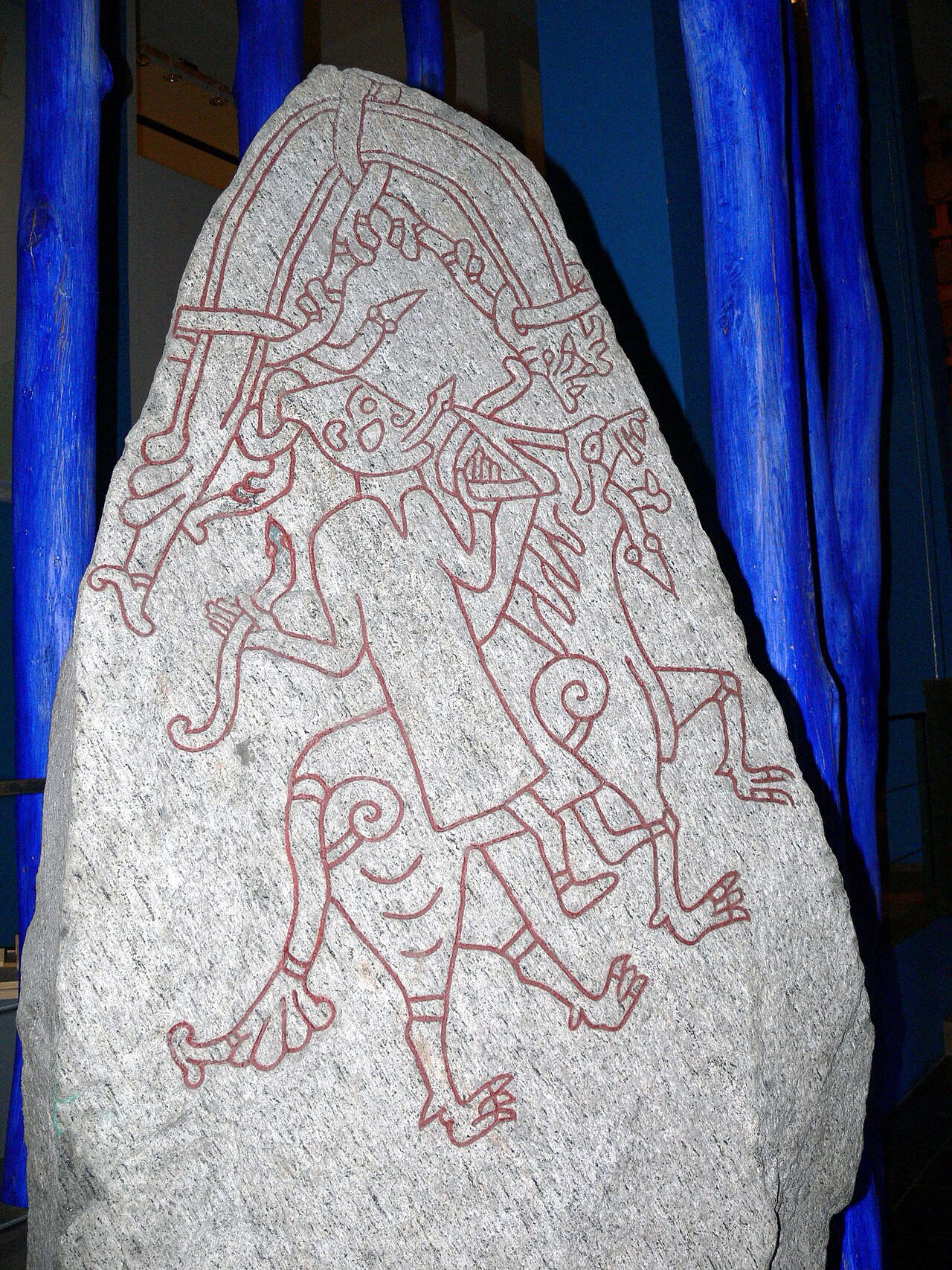
Across the boundaries of the ordered worlds lies Jötunheim, the land of the giants (the jötnar): the wild, chaotic, often hostile forces that the gods are forever struggling against. The giants embody the untamed powers of nature: frost and stone, storm and sea, the things that resist order. Yet the relationship is more tangled than simple enmity. The gods constantly travel into Jötunheim on adventures, contests, and quests; they trick and battle the giants, but they also marry them. Odin, Thor, and Freyr all take giantesses as lovers or wives, and Loki, the great trickster who lives among the gods, is himself of giant blood. The line between god and monster in this mythology is porous, and that's the point.
Beneath the worlds lies Svartalfheim (also called Niðavellir), the subterranean home of the dwarves, and these are arguably the most underrated beings in the whole system. The dwarves are the master craftsmen of the cosmos, and nearly every great treasure of the gods came from their forges: Thor's hammer Mjölnir, Odin's spear Gungnir and his self-multiplying ring Draupnir, Freyr's ship Skíðblaðnir that folds into a pocket, and the golden hair of the goddess Sif. Without the dwarves, the gods would be all but disarmed.
Almost every iconic object in Norse myth was made by dwarves, not gods, and several were forged as the prize in a bet that Loki engineered, with his own head as the stake. When Loki lost, the dwarf Brokkr was denied the head (you can't take it without harming the neck, which wasn't part of the deal) and settled for sewing Loki's lips shut instead. The gods owe their greatest weapons to underground smiths and a trickster's bad gamble.
Helheim: the cold country of the dead
Finally there is Helheim, the realm of the dead, and Norse death is not one-size-fits-all. Warriors who fall gloriously in battle go to Valhalla (or to Freyja's field, Fólkvangr). But the great majority of people, those who die of sickness, old age, or accident, go down to Hel, a cold, misty land beneath the roots of the world. It is ruled by a goddess also named Hel, a daughter of Loki, described as half living flesh and half corpse-blue. Her realm is not a place of fiery torment like the Christian hell that borrowed its name; it is simply grey, quiet, and final, the destination of the ordinary dead.
"The Vikings had a clear, fixed map of nine worlds arranged like planets around the World Tree, and everyone agreed on it."
The sources are fragmentary, sometimes contradictory, and were written down centuries after the beliefs flourished, often by Christians recording a fading pagan tradition. "Nine worlds" is named, but never neatly listed and located. The familiar diagram is a modern scholarly best-guess assembled from scattered poems. The real Norse cosmos was almost certainly looser, stranger, and more locally varied than any chart suggests.
Ragnarök: the worlds end, and begin again
You cannot understand the nine worlds without understanding that they are doomed, because the Norse, almost uniquely, built the destruction of their universe into its very mythology. This is Ragnarök, "the doom of the gods." The signs are foretold: a terrible winter, the breaking of all bonds, the sun and moon devoured by wolves. Heimdall sounds the Gjallarhorn. The monstrous wolf Fenrir breaks free; the Midgard Serpent rises from the sea; the fire giant Surtr rides out of Muspelheim with a sword brighter than the sun and crosses the rainbow bridge, which shatters beneath him.
In the final battle, the great powers destroy one another. Odin is swallowed by Fenrir. Thor kills the Midgard Serpent and then drops dead from its venom. Surtr's fire engulfs the worlds, and the earth sinks into the sea. It is the end of everything: Asgard, Midgard, the gods themselves. And yet it is not the end. From the water a new, green earth rises again. A handful of gods survive, and two humans, Líf and Lífþrasir, who sheltered inside the World Tree itself, emerge to repopulate the world. Yggdrasil shudders through the fire but endures. The cosmos dies and is reborn, and that, more than any single hall or world, is the deepest idea in Norse mythology: that even the gods are mortal, and that the only thing that lasts is the tree, and the turning of the cycle.
How much of the Ragnarök story is authentically pagan, and how much was shaped by the Christian writers who recorded it? Some scholars see the death-and-rebirth, the surviving righteous pair, and the coming of a new order as motifs coloured by Christian apocalypse. Others argue the cyclical doom is thoroughly Norse. As with so much here, we're reading an oral pagan world through a literate Christian pen, and we'll never be entirely sure where one ends and the other begins.
The view from the tree
Nine worlds, one tree. Gods who can die, giants who become family, treasures forged underground, a rainbow bridge built to be broken, and a universe designed from the start to burn down and grow back. The Norse cosmos isn't a comfortable place (it's cold, fated, and full of monsters), but it has a strange grandeur and an unusual honesty about endings. Its gods know they are doomed and ride out to fight anyway. Perhaps that's the most human thing in all of it. We may never recover the full, true map of the nine worlds, but even the broken pieces we have still hold up a whole sky. And perhaps that's fitting for a mythology whose central image is a single battered tree, gnawed and burning and somehow still green, lasting, like the stories themselves, long after the world that grew them has passed.
Read next: Hindu Weapons Explained: The Astras of Gods and Heroes and The Viking Age: More Farmers and Traders Than Raiders.
Sources & further reading
- The Poetic Edda — especially Völuspá and Grímnismál; a fine modern translation is by Carolyne Larrington (or Jackson Crawford).
- Snorri Sturluson, the Prose Edda (13th century) — the single most important source for the structure of the cosmos, written by an Icelandic Christian preserving the old tales.
- Neil Gaiman, Norse Mythology — an accessible modern retelling for newcomers.
- John Lindow, Norse Mythology: A Guide to the Gods, Heroes, Rituals, and Beliefs — for the scholarship behind the stories and the limits of what we can know.