Rain had been falling on Gongju for two days when, on 5 July 1971, a labourer’s spade struck something too flat and too straight to be a stone. He was cutting a drainage channel behind two old burial mounds on a wooded slope called Songsan-ri, trying to keep the summer damp out of tombs the country had known about for years. What the spade had found belonged to no tomb anyone had counted. It was the top of a wall: grey brick, laid in neat courses, curving back into the hillside. Nobody had touched it in living memory. Nobody had touched it in fifty generations. Behind it lay a sealed room, and inside that room, still lying where mourners had left him, was a Korean king whose name the country was about to hear for the first time in fourteen centuries.
The find was, and still is, the greatest single discovery in Korean archaeology. It was also its worst. Those two sentences describe the same three days in July, and the story of the Tomb of King Muryeong is really the story of how they came to be true at once.
A kingdom that had mislaid its own kings
To understand why one tomb mattered so much, you have to know how little Baekje had left behind. Ancient Korea was shared by three rival states: Goguryeo in the north, Silla in the south-east, and Baekje in the south-west. Baekje was the cultured one, the sea-facing one, the kingdom that traded with China and carried Buddhism and craftsmen across the water to Japan. In 475 it very nearly died. A Goguryeo army stormed its capital near modern Seoul, killed its king, and sent the survivors fleeing south. They regrouped at a river town called Ungjin (today Gongju) and tried to rebuild a kingdom from the wreck.
Muryeong ruled that shaken state from 501 to 523. He steadied it, pushed the northern border back, and reopened the old lines to the Liang court in southern China and to the islands of Japan. Then Silla won the long game, swallowed its rivals, and wrote the history. Baekje became the ghost of the Three Kingdoms. Much of what later Koreans knew of it came filtered through the chronicles of its enemies or through Japanese court records with their own reasons to shade the truth. Its royal cemetery at Songsan-ri had been picked clean in antiquity; every tomb the archaeologists opened had been robbed centuries before they arrived. They numbered the mounds one to six and expected nothing new from the hill.
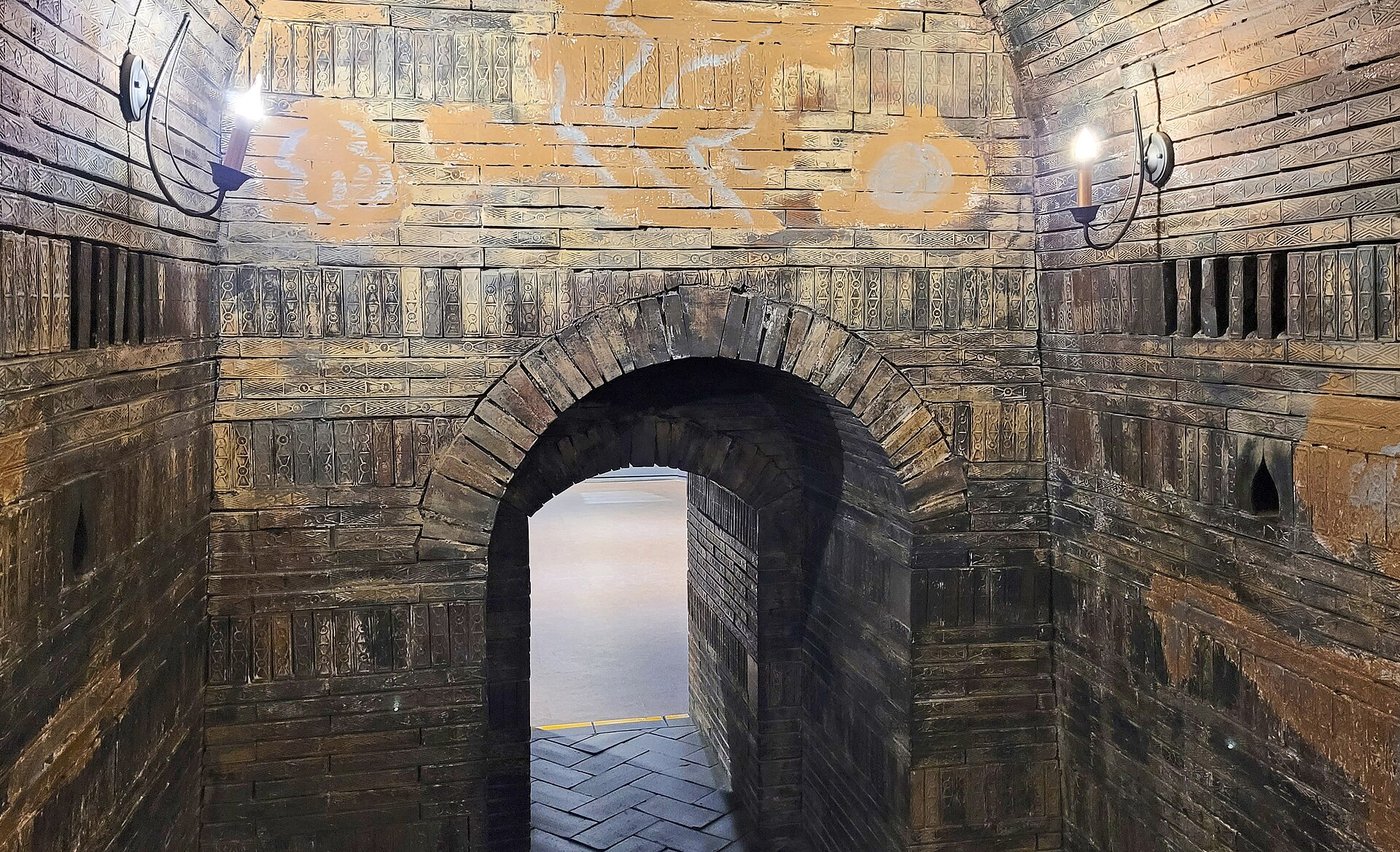
Tomb 6 was the odd one out. Instead of the usual stone chamber it was built of brick, in a manner copied straight from the southern Chinese fashion of the day, and it was to protect Tomb 6 and its neighbour from seeping rainwater that the drainage trench was being dug at all. The wall the spade struck was not part of Tomb 6. It was the arch of a doorway into a chamber that had never been given a number, because nobody had known it was there.
The night they should have taken a month
Word of an intact royal tomb cannot be kept quiet. By the time the senior archaeologists reached Gongju from Seoul, the hillside was filling with reporters, officials and curious townspeople, and the monsoon was still coming down. On the evening of 7 July the rain flooded the trench faster than it could be bailed; part of a wall had to be broken to let the water out. The crowd pressed in. Photographers wanted their shots. Everyone wanted to be the first to see a king.
The man in charge was Kim Won-yong, director of the National Museum of Korea and the most respected archaeologist in the country. Faced with a mob, a downpour and a tomb that had been sealed and dry for fifteen hundred years, he made the decision that has haunted Korean archaeology ever since. Rather than fence the site off and dig it slowly over weeks, recording every object exactly where it lay, he chose to clear the whole chamber at speed before the crowd or the weather could ruin it. A short ceremony was held at the entrance, an offering laid out to ask the dead king’s pardon. Then, working through the night by emergency lamplight, the team began lifting everything out.
The removal of the grave goods began around midnight and was essentially finished by eight the next morning. Close to three thousand objects that had rested in fixed positions since the 520s were gathered up in a single overnight shift. The exact placement of most of them (which piece lay against which, how the offerings were arranged around the two coffins) was lost as it was lifted. An intact tomb is priceless partly because nothing has moved. By the time the sun came up, almost everything had.
Kim never forgave himself. In later years he wrote that the excavation of Muryeong’s tomb was the greatest shame and the biggest mistake of his life. He had recovered the treasure and lost the information: the unglamorous record of position and layering that turns a pile of beautiful things back into a working account of a funeral. That record can never be dug again. It is the one thing an untouched tomb offers that a robbed one cannot, and at Muryeong it was spent in a night.
A name written on stone
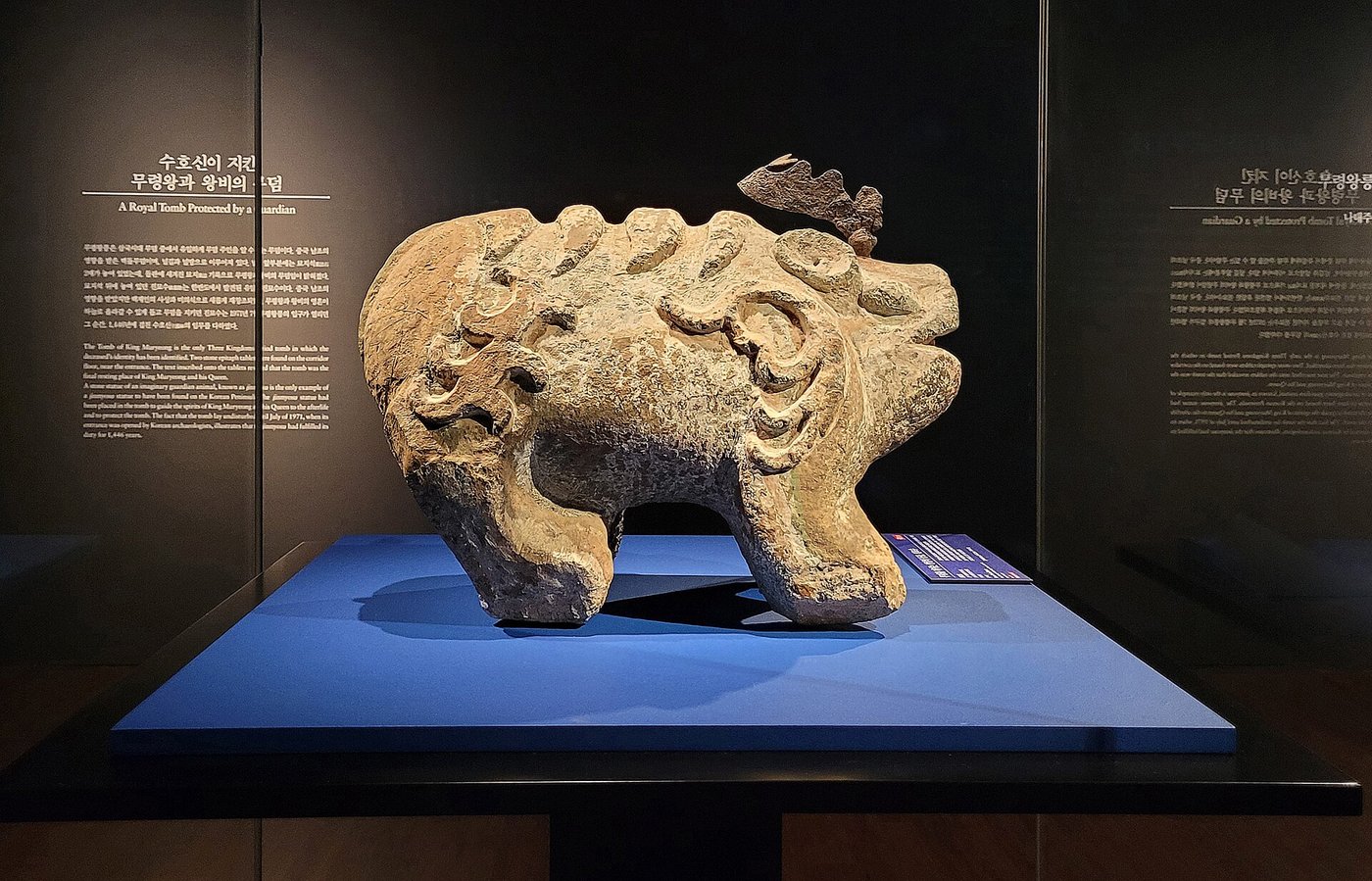
And yet the tomb gave up something no rushed dig could quite destroy, because it was written down. Just inside the entrance, set on the floor of the passage, lay two flat stone tablets. Beside them crouched a small stone beast with an iron horn, a guardian figure of a kind never found in a Korean tomb before, copied from Chinese practice to frighten off whatever might disturb the dead. The tablets were the thing that changed everything.
One tablet carried an epitaph. It named the man in the chamber as King Sama (the personal name by which Muryeong was known) and recorded that he had died in the fifth month of 523, aged sixty-two, and been laid in this tomb after the customary period of mourning. A companion inscription did the same for his queen, who followed him into the chamber years later. For the first time, archaeologists were standing in a Three Kingdoms royal tomb and could say, from the tomb’s own words, exactly whose it was. To this day it is the only one. Every other royal grave from the age is known by a mound number and a guess; Muryeong’s is known by name, sealed with a date, checked against the written histories and found to match.
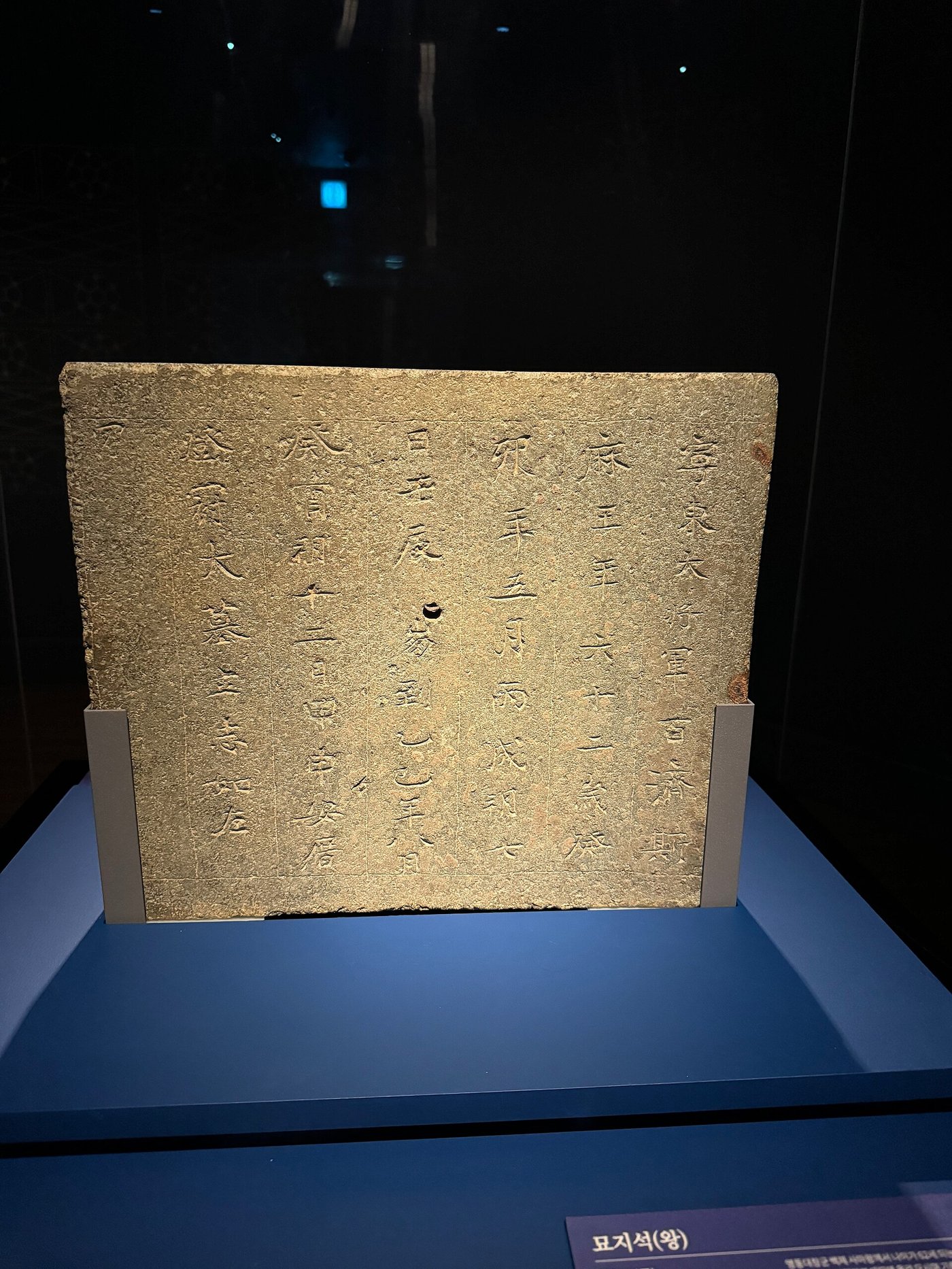
The second tablet is stranger than the first. It is a land-purchase contract. It records that the king’s family bought the plot for the tomb from the earth gods for a sum of money, and a scatter of Chinese iron coins was left on the stone as the symbolic payment. A living dynasty, worried about doing things correctly, drew up paperwork with the underworld and filed the receipt beside the body. It is the sort of detail no history book preserves and no robber bothers to steal: a court’s private anxieties, written out and left in the dark.
What the king was wearing
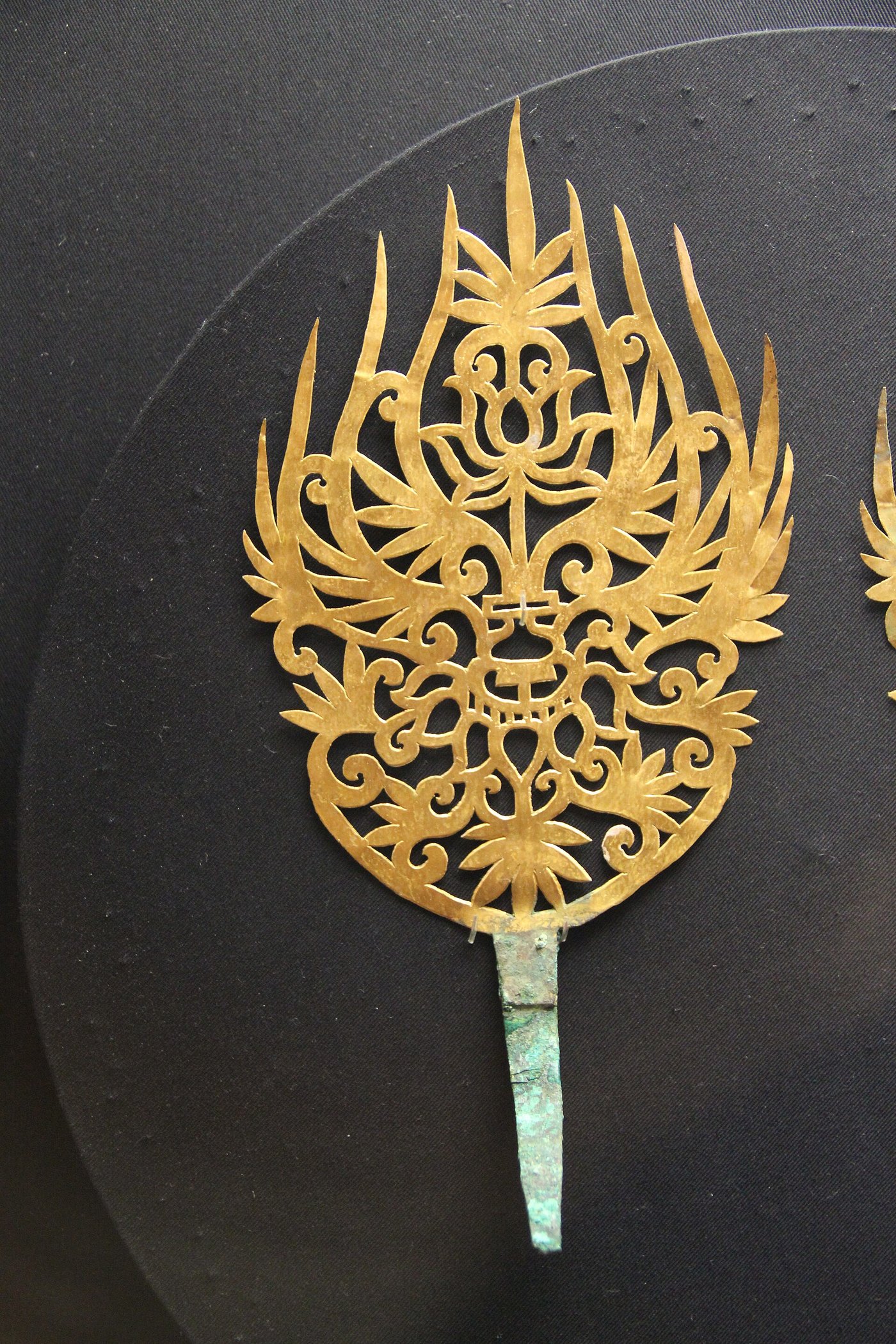
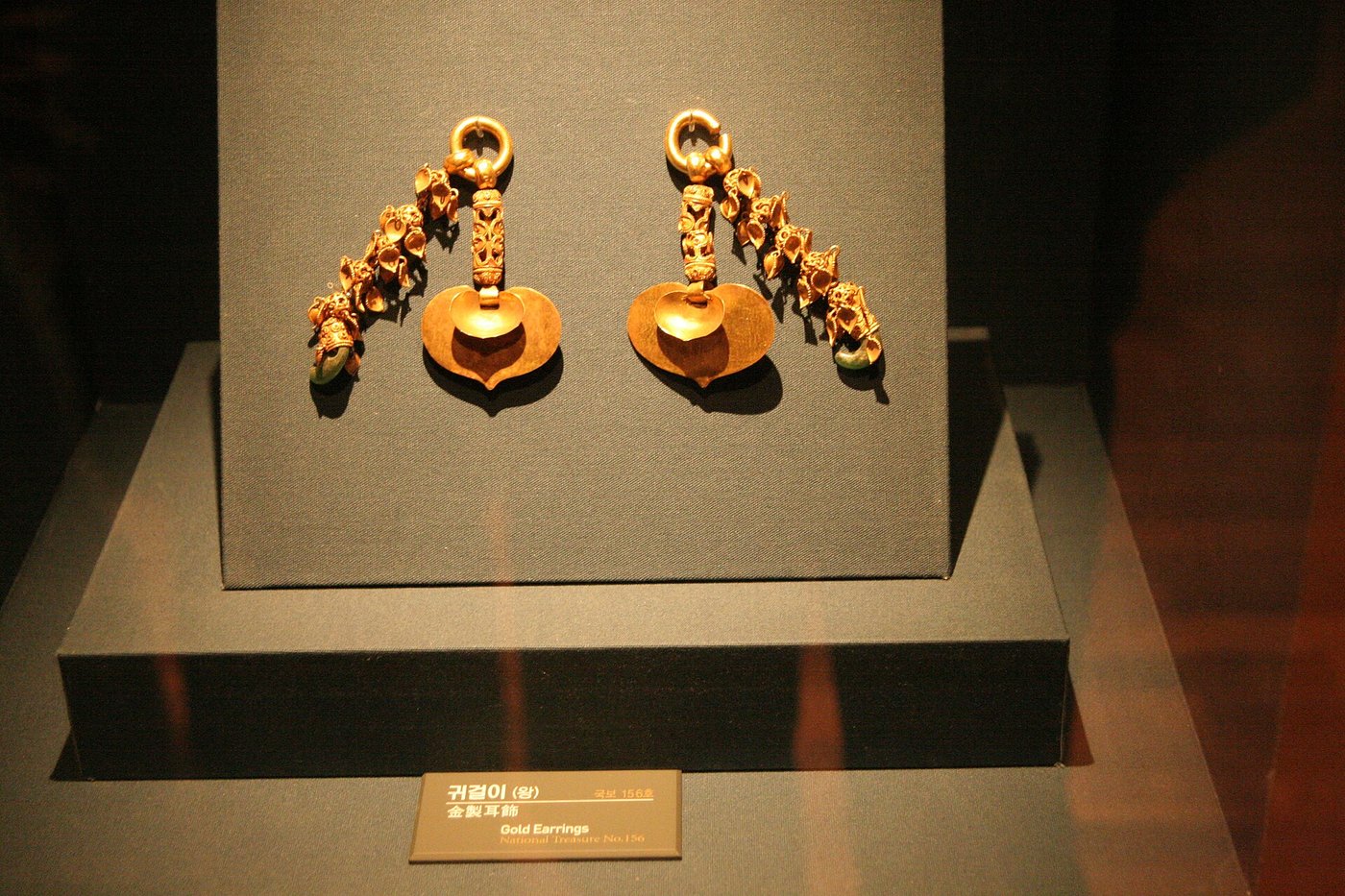
The grave goods, once they were catalogued, ran to well over a hundred kinds of object, many of them now among Korea’s designated national treasures. On and around the king lay a pair of gold ornaments cut into a rising, flame-like shape, made to be mounted on a cap of cloth or leather that had long since rotted away. The queen had her own pair, quieter in design. There were gold earrings of astonishing delicacy, chains of tiny linked drops ending in leaf and spear shapes, the sort of work that takes a master a very long time and a steady hand.
There was a great ring-pommel sword laid by the king, its handle sheathed in gold and silver, a weapon meant for show rather than war. There were bronze mirrors of Chinese pattern, jade and glass beads, a silver cup on a bronze stand worked with mountains and beasts. One of the queen’s silver bracelets carried an inscription naming the craftsman who made it (a man called Dari) and the year he finished it. Even the pair of them had headrests and footrests of lacquered wood, painted red and black and picked out in gold leaf, so that the king and queen could lie in comfort with their heads raised and their feet supported, as if only sleeping.
A coffin cut from a Japanese forest
The two bodies had lain in wooden coffins, and when specialists finally studied the timber they got a surprise. The wood was not Korean at all. It was koyamaki, the Japanese umbrella pine, a tree that grows in the wild only on the southern islands of Japan. Someone had chosen that particular wood, felled it across the sea, and shipped the great boards to Gongju to hold a Baekje king. You do not do that by accident. It was a deliberate choice, and it says something about how tightly Baekje and the courts of Japan were bound together: close enough that a king’s coffin could be an import.
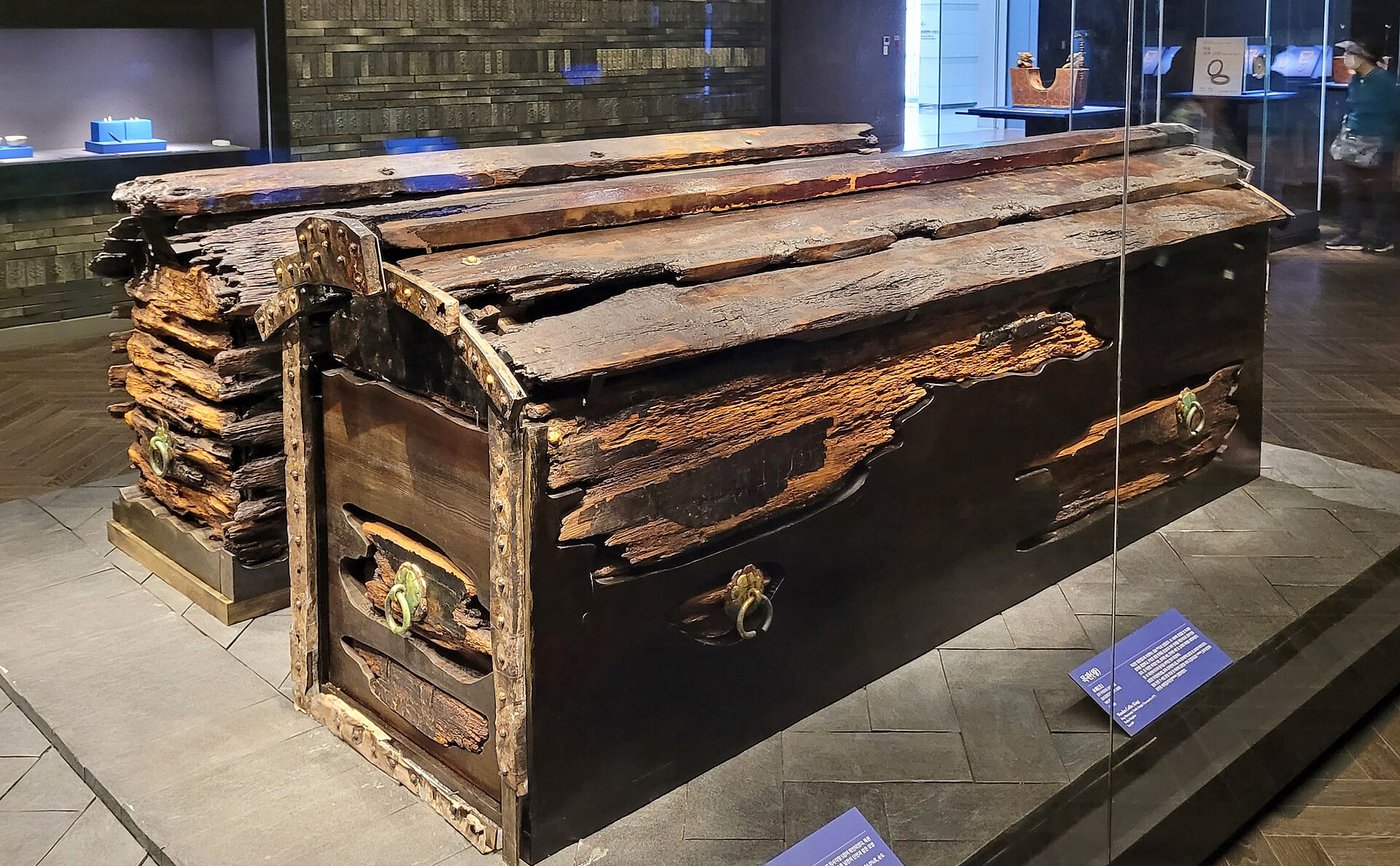
The whole tomb reads like that once you start looking. The brick vault copies southern China. The guardian beast and the land deed copy Chinese ritual. The celadon jars and cups in the chamber were made in Liang China and carried east. The coffin wood came from Japan. The gold and the swords were Baekje’s own. This was not the grave of a backwater. It was the grave of a hub: a kingdom sitting at the crossing point of a whole region’s trade in goods, ideas and craftsmen, and showing it off in the one room it expected no living stranger ever to see.
Nobody can say for certain why a Baekje court reached to Japan for coffin timber when Korea has fine trees of its own. Some read it as pure practicality: koyamaki is dense, straight and rot-resistant, good wood for a coffin meant to last. Others see politics in it: a chosen symbol of the alliance that kept Baekje safe, or even a gift sent from the islands for the burial. The tomb cannot settle the argument. What it proves is only that the choice was made, and that the sea between Korea and Japan in the sixth century was less a border than a road.
The wrong story about a weak kingdom
For a long time Baekje was written up as the loser of the Three Kingdoms: the state that fell, whose culture survived mainly as an influence on someone else. Muryeong’s tomb took that story apart.
The myth: Baekje was a minor, fragile kingdom, culturally thin, remembered only because it passed Chinese learning and Buddhism along to Japan before Silla swept it away.
The reality: the tomb shows a court operating at the height of sixth-century East Asian fashion, commissioning Chinese-style architecture, importing Liang ceramics and Japanese timber, keeping goldsmiths whose work rivals anything from its neighbours, and doing all of it a generation after its capital had been sacked and its king killed. Baekje was not thin. It was cosmopolitan, connected and confident. The kingdom that lost the war was not the weak one; it was simply the one that did not get to write the ending.
The find also did something subtler. Because the tablets gave a firm name and a firm date, everything in the chamber became a fixed point. Historians could take an object of known style, tie it to the year 523, and use it to date lookalike objects dug up elsewhere with no inscription at all: in other Baekje sites, in Silla, in Japan. A single dated tomb becomes a ruler you can lay against a whole region’s undated finds. Muryeong’s grave is now one of the anchor points for the archaeology of three countries.
The tomb that no one is allowed to enter
Korea learned its lesson the hard way. The chamber that was cleared in a night is now sealed for good; since the late 1990s no one has been allowed inside, because the changes in air and humidity brought by decades of visitors were slowly damaging the brick and the paintwork. What tourists see at Songsan-ri today is a careful replica, built alongside the real mounds so the originals can be left in the dark and the damp they were built for. The treasures are in the museum at Gongju. The king is where he always was.
There is a hard symmetry to it. The most complete royal tomb Korea has ever found was also the one it handled worst, and the two facts cannot be separated. Everything the country gained (a named king, a dated court, a window onto a kingdom its rivals had all but erased) it gained in the same reckless hours that destroyed the record it will now never have. Kim Won-yong spent the rest of his career teaching younger archaeologists to do the opposite of what he did that night. The best-known thing he ever excavated became a warning about how not to excavate.
The stone deed is still down there in spirit, filed with the earth gods, its iron coins paid over for a plot the king was meant to keep forever. He has kept it. The one promise the tomb has managed to hold, through robbers who never came and archaeologists who came too fast, is the oldest one written on the stone: that this ground belongs to King Sama, and that he is not to be moved.
Read next: Silla Gold Crowns: The Korean Regalia Too Fragile to Wear and Tripitaka Koreana: The Wooden Library That Beat a Concrete Vault.
Sources & further reading
- Best, J. W., A History of the Early Korean Kingdom of Paekche, Harvard University Asia Center — the standard English account of Baekje and King Muryeong.
- International Journal of Korean Art and Archaeology, vol. 16, National Museum of Korea — a special issue on the excavation, contents and East Asian connections of the tomb.
- Cartwright, M., “The Tomb of King Muryeong”, World History Encyclopedia.
- Gongju National Museum — the standing collection of the Muryeong tomb finds, including the epitaph stones, diadems and guardian beast.
- Portal, J., Korea: Art and Archaeology, British Museum Press — on Baekje metalwork and its regional context.
Image credits (via Wikimedia Commons): gold diadem ornament — Gary Lee Todd (CC0); brick burial chamber — Bernard Gagnon (CC0); stone guardian beast — Bernard Gagnon (CC0); inscribed stone tablets — ChongDae (CC BY 4.0); gold earrings — mentaldesperado (CC BY-SA 2.0); wooden coffins — Bernard Gagnon (CC0).