In the late summer of 1951, a South Korean airman named Kim Young-hwan flew over a valley on the slopes of Mount Gaya and did not drop his bombs. His orders were plain. North Korean fighters had fallen back into the halls of an old mountain temple called Haeinsa, and the temple was to be levelled from the air. Kim knew what stood behind those wooden walls. He banked away, flew home, and took the reprimand that followed. What he would not burn was a library made of wood: more than eighty thousand printing blocks, cut and carved seven hundred years before, holding the most complete record of an entire religion that has come down to us anywhere on earth.
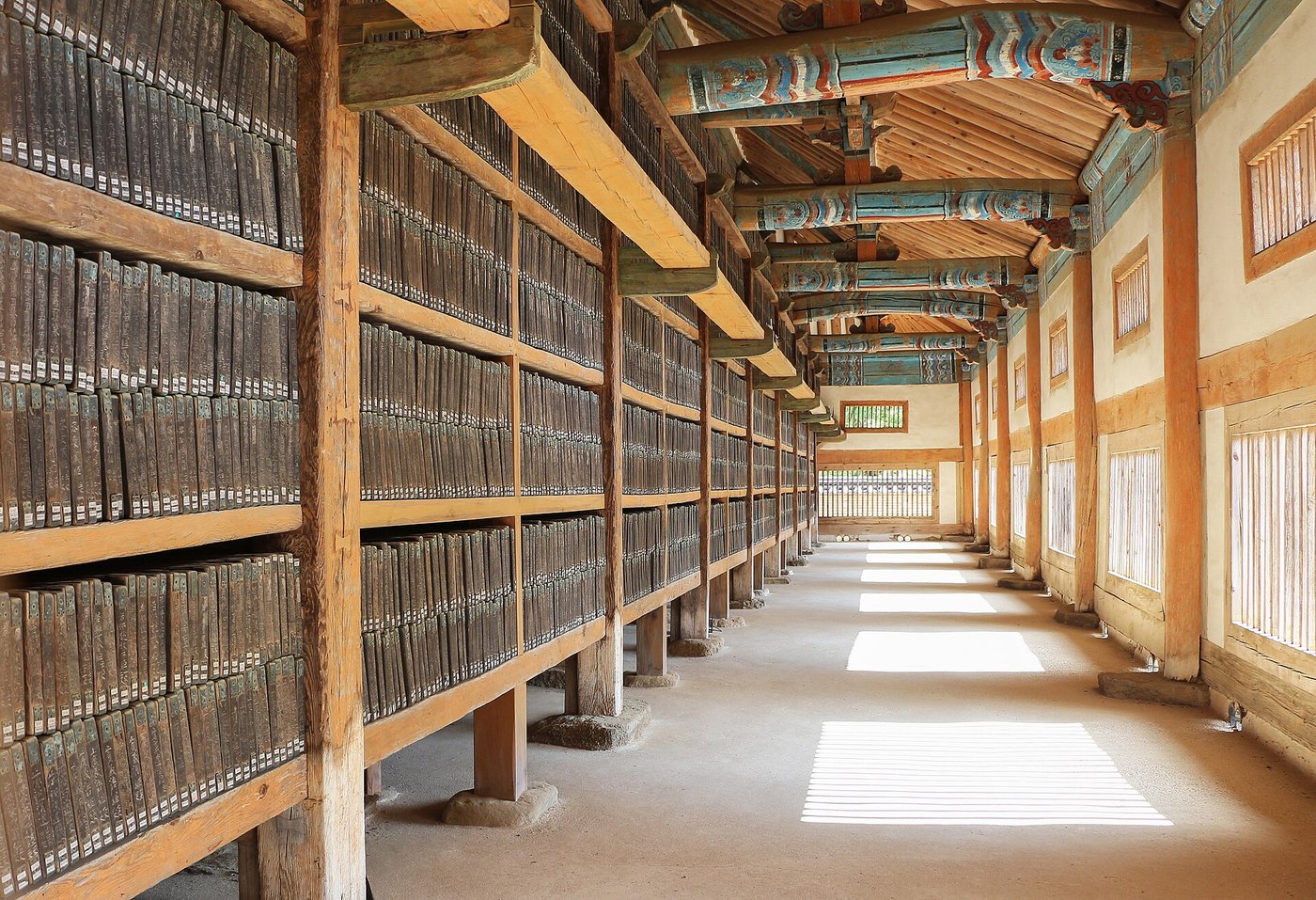
The library is called the Tripitaka Koreana, and almost everything about it sounds like an exaggeration until you check. Eighty-one thousand blocks. Fifty-two million Chinese characters. Both faces of every block carved, so a stack the length of a bus becomes a canon you could read for a lifetime. It was made in the thirteenth century, by hand, during an invasion that was going very badly for the people making it. And it is still there, on the same mountain, kept not by air conditioning or nitrogen or steel but by a pair of long wooden sheds that a Joseon carpenter would recognise at a glance.
That last part is the strange one. In the 1970s a modern government tried to give the blocks something better than a wooden shed. It did not go the way anyone expected.
The canon that burned first
To understand why a kingdom would spend twelve years carving a library in the middle of a war, you have to know that it had done it once before, and watched it go up in smoke.
Korea in the eleventh century was the kingdom of Goryeo, the name that reaches us, worn smooth, as “Korea”. It was Buddhist to its bones, and it shared a border with enemies who kept crossing it. When the Khitan armies of the Liao invaded in 1011, the court did something that tells you how these people thought about faith and defence in the same breath: it vowed to carve the entire Buddhist canon onto woodblocks, believing that the sheer merit of the act would move the Buddha to turn the invaders back. The carving took most of a century. It was finished around 1087, tens of thousands of blocks, and it was kept at a temple near Daegu.
Then the Mongols came. In 1232, in the middle of a war that would grind on for decades, a Mongol army reached the temple and burned the first Tripitaka to ash. A century of work was gone in an afternoon.
What the court decided to do next says a great deal about the people who ran Goryeo. The kingdom was losing. The king, Gojong, had fled with his court to an island off the coast to escape the horsemen. The real power lay with a military family, the Choe, who governed through the throne rather than from it. And it was in this position (hunted, cornered, half the country under Mongol hooves) that they resolved to carve the whole canon again, from the beginning.
It was partly a prayer and partly a statement. A prayer, because the logic was the same as in 1011: complete this enormous act of devotion and the Buddha will lift the invasion. A statement, because a kingdom that can carve fifty million characters while it is losing a war is telling its own people, and perhaps itself, that it has not broken. Work began in 1237 and finished in 1248, twelve years later. The Mongols were not driven out; Goryeo eventually made its peace with them and endured. But the blocks were done, and they were flawless enough that people would spend the next seven centuries insisting, wrongly, that they contained no mistakes at all.
Birch, brine, and six years of waiting
Before a single character could be cut, there was the wood, and the wood is where the patience of the thing begins to show.
The blocks were cut mostly from birch grown on the islands and coasts of southern Korea, with some cherry and other close-grained timbers in the mix. Green wood is useless for this work. It warps as it dries, it splits along the grain, and it plays host to every insect and fungus that finds it. A block that twists even slightly will not print, and a canon that cannot be printed is just very heavy furniture. So the wood was seasoned in a way that reads more like a recipe than a carpentry note.
First the cut timber was soaked in sea water. Not for a day or a week, but for three years. Then each log was boiled in salt water, set in the shade, and left to the wind for another three years. Only after six years of this was the wood stable enough to be sliced into planks, planed smooth, and handed to the carvers. The salt drew out the sugars that insects feed on and slowed the wood as it dried, so that it gave up its moisture evenly instead of tearing itself apart. Six years of waiting bought seven hundred years of survival. Nobody who started seasoning a log in 1237 could be sure they would live to carve it.
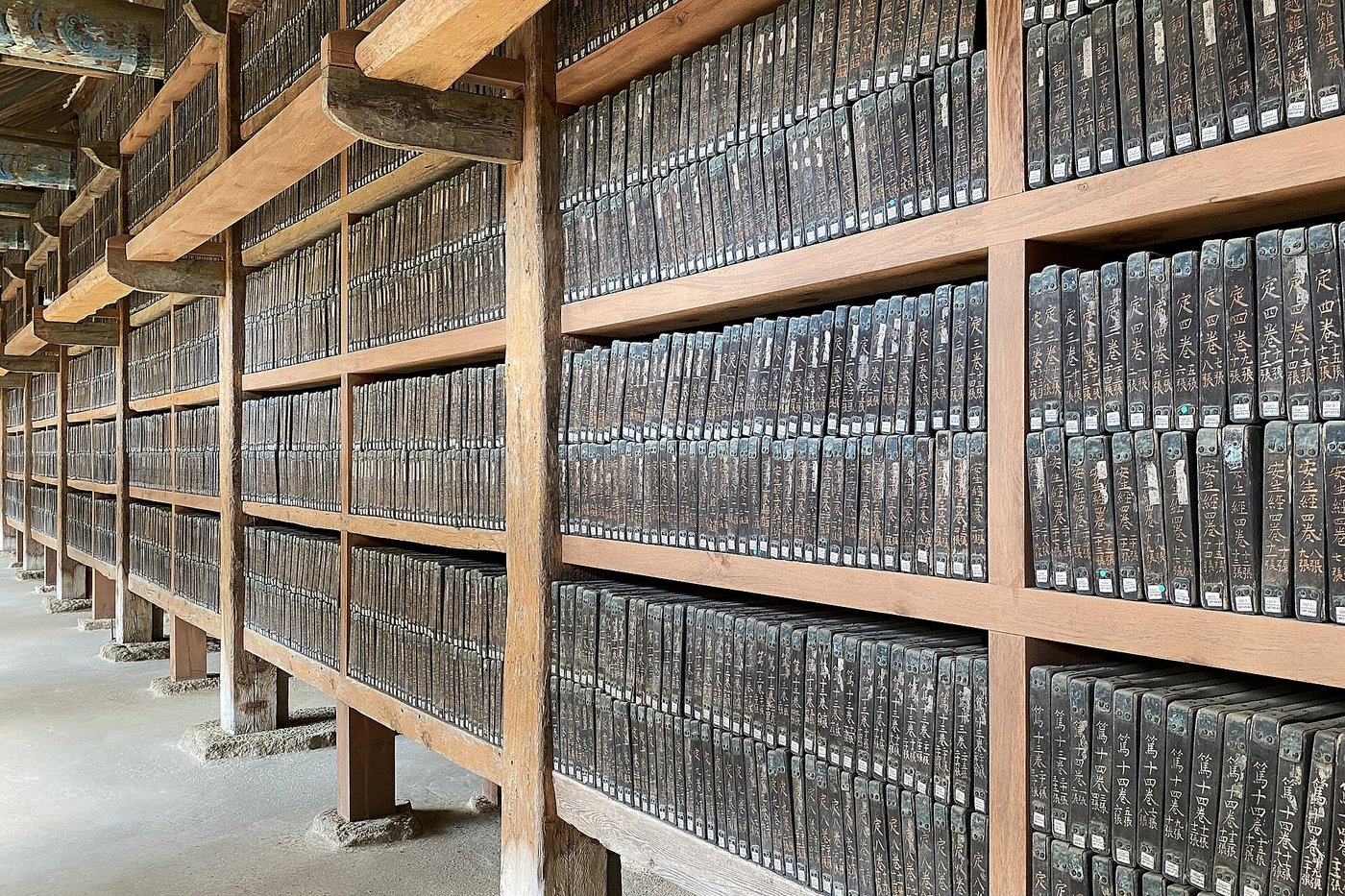
The finished set runs to roughly 81,350 blocks. Each is about 70 centimetres long and 24 high, a few centimetres thick, and weighs three to four kilograms. Both faces carry text (twenty-three lines to a face, fourteen characters to a line), which comes to more than 52 million characters in all. Stacked, the blocks weigh about 280 tons. Laid end to end they would run for something over 60 kilometres. Every character was cut in reverse, so that it would print the right way round.
One hand for fifty million letters
Pick up a printed page from the Tripitaka Koreana and the first thing that strikes scholars is not the content but the handwriting. Across fifty-two million characters, carved on eighty thousand blocks, the script barely changes. The strokes fall the same way on block one and block eighty thousand. It looks, impossibly, like the work of a single disciplined hand.
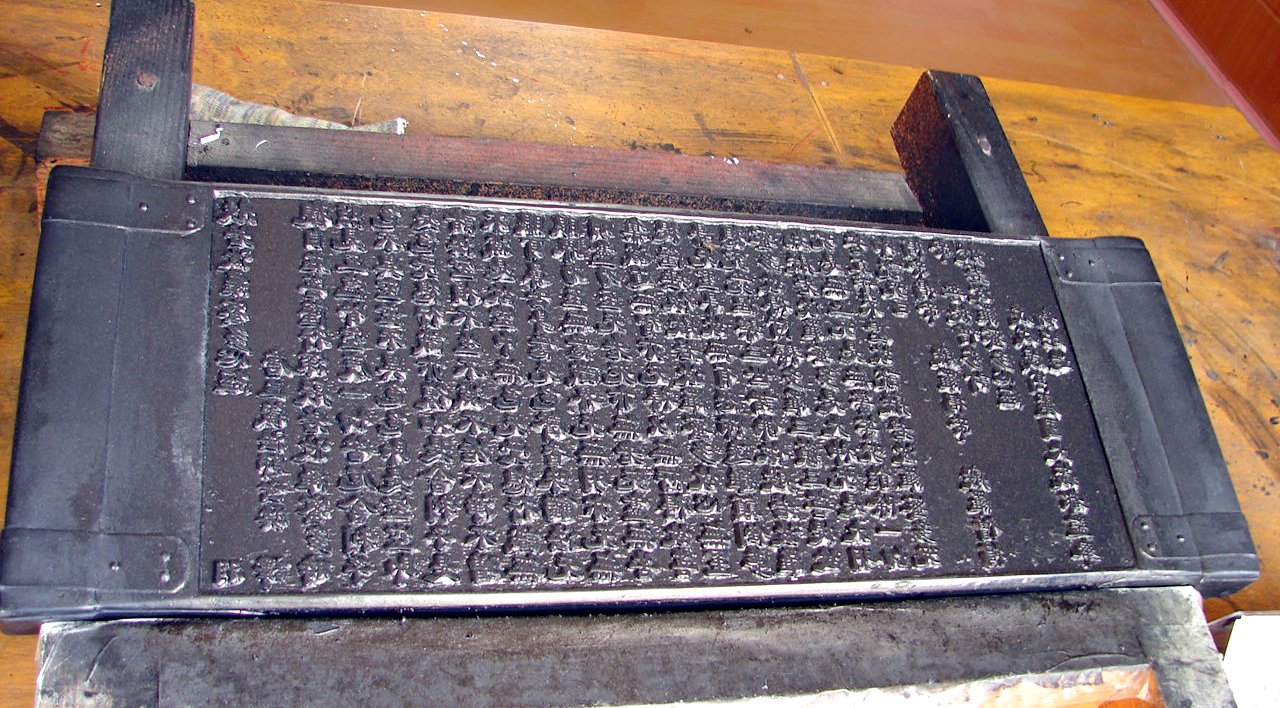
It was not one hand. The best reconstruction is that a team of around thirty carvers did the cutting, working from a single agreed style so tightly that individual habits were sanded out of the result. There is a story, loved by guides at the temple, that each carver bowed once after cutting every character, as a small act of devotion. Whether or not any carver really did that, the discipline it describes is real. To keep fifty million characters this uniform, the men who made them had to give up the thing most craftsmen most want to leave behind: a recognisable personal mark. Not one carver signed the canon. We know almost none of their names.
For a long time the uniformity of the script fed a romantic idea: that a single monk had carved the whole canon over a lifetime. The numbers rule it out. Fifty-two million characters at even a brisk pace would take one person many lifetimes. Analysis of the strokes points instead to a workshop of roughly thirty carvers who trained themselves to a shared hand. The marvel is not that one person did it. It is that thirty people managed to look like one.
The mistakes the legend leaves out
Here is the claim you will hear at the temple, in guidebooks, and in a hundred breathless articles: that in all fifty-two million characters, not a single error has ever been found. It is a wonderful line. It is also not true, and the man who proved it was working eight hundred years ago.
The popular story holds that the Tripitaka Koreana is perfect: fifty-two million characters carved without one mistake, an act of devotion so complete that error simply never entered it. The uniformity of the script is offered as proof: no human hand this steady could have slipped.
The canon was not carved blind. A monk named Sugi was put in charge of checking it, comparing the Korean text against older Chinese and Khitan editions line by line. He found mistakes (wrong characters, missing passages, garbled readings), and he corrected them before the blocks were cut. Then he wrote up what he had done in some thirty volumes of collation notes. The Tripitaka Koreana is astonishingly accurate precisely because it was proofread, not because it was untouched by error. Its reliability is a human achievement, not a miracle.
Sugi’s work is the reason the Korean canon matters so much beyond Korea. When Japanese scholars assembled the standard modern edition of the Chinese Buddhist canon in the early twentieth century (the Taisho edition, still the one researchers reach for), they used the Tripitaka Koreana as their base text, because it was the cleanest and most complete they could find. A thirteenth-century Korean proofreader set the ground rules for how the world reads these scriptures today. That is a better story than the flawless one, and it has the advantage of being real.
What is actually in it
The name is a clue to the shape of the thing. Tripitaka means “three baskets” in Sanskrit, the oldest way of sorting the Buddha’s teaching: the discourses attributed to the Buddha himself, the rules that govern monastic life, and the later scholarly analysis of doctrine. The Korean canon gathers all three, close to 1,500 separate texts running to more than 6,500 volumes: not one book but a whole library, copied and checked and cut into a form that would not decay.
Printing from the blocks was slow, physical work. A sheet of paper was laid over an inked block and rubbed by hand until the characters lifted, one face at a time. A full run of the canon on paper is a stack you measure in the thousands of sheets, and complete printed sets were valuable enough to be sent abroad as royal gifts; Japan asked Korea for copies more than forty times over the centuries. The blocks were never meant to be admired behind glass. They were a master copy, kept ready so that the words could be made again whenever they were needed, which is exactly why keeping the wood alive mattered as much as carving it in the first place.
A building that does the work of a machine
Carving the blocks was half the problem. Keeping them was the other half, and it is the half that turns out to be a small miracle of engineering dressed up as a plain wooden shed.
Wood rots. It swells in damp and cracks in drought, it feeds mould, it houses beetles. To hold eighty thousand wooden blocks steady for centuries, in a country of hot wet summers and cold dry winters, ought to demand exactly the sort of sealed, humidity-controlled room a modern archive uses. The blocks have never had one. Since 1398 they have lived at Haeinsa in a set of long, simple halls called the Janggyeong Panjeon, and the halls do the work of a climate machine with nothing but timber, clay and a careful reading of the weather.
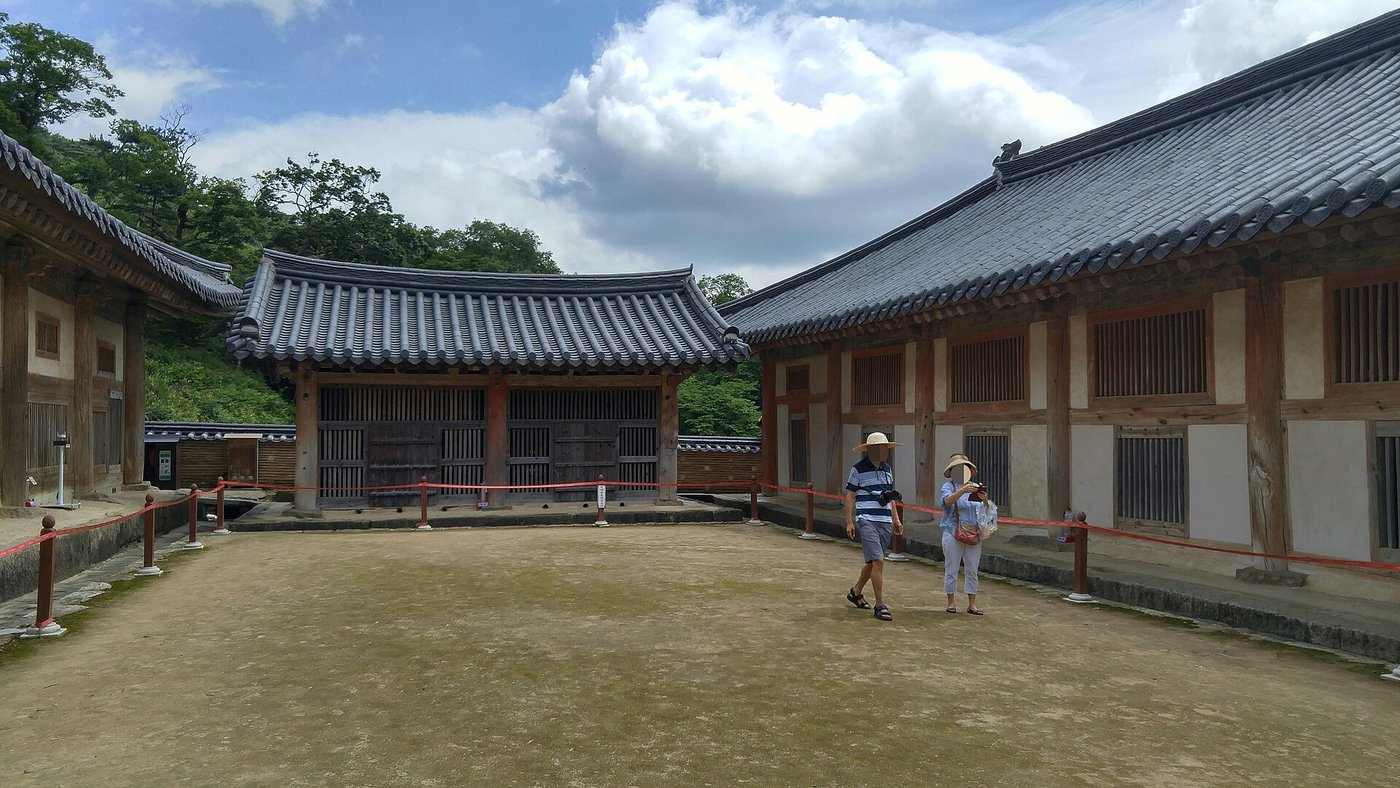
Look at the windows and you see the trick. On each long wall there is a large opening and a small one, and their arrangement is reversed on the opposite wall: big-over-small on one side, small-over-big on the other. Air drawn in low on one face is forced up and across the racks of blocks and pushed out high on the other, so the hall breathes slowly and constantly and no pocket of damp is allowed to settle. The buildings sit on a slope, facing the right way to catch the mountain airflow and to keep the fierce afternoon sun off the blocks.
Underfoot, the floor is the other half of the system. When the halls were built the clay floor was packed with a mixture of charcoal, salt, lime and sand. In the wet months the charcoal and clay drink the excess moisture out of the air; in the dry months they give it slowly back. The room holds itself at a humidity the blocks can live with, year after year, without a dial or a switch. Measured with modern instruments, the interior stays remarkably close to what a curator would choose on purpose. The carpenters who built it in the fifteenth century had no instruments. They had observation, and a very long memory of how weather moves on that mountain.
What the concrete vault could not do
By the 1970s the old halls looked, to a modern eye, hopelessly fragile. Here was a national treasure, irreplaceable and priceless, sitting in unheated wooden sheds that any stray fire or storm could take. Under the government of Park Chung-hee, the state resolved to do the obvious, responsible thing. It would build a modern storehouse: concrete, sealed, climate-controlled, everything the fifteenth century could not offer. The blocks would finally be safe.
A new concrete building went up, and a batch of blocks was moved in as a trial. Within a short time the trial blocks began to spoil. Sealed away from the mountain air, the wood could not shed its moisture; damp gathered where nothing moved it, and mould took hold. The modern vault, built to protect the canon, was slowly killing the sample it had been given. The blocks were carried back to the old wooden halls, and the concrete building was closed. Whatever the fifteenth-century carpenters understood, the twentieth century had just paid to relearn: for this particular problem, the shed was the technology.
That is the reversal at the centre of the whole story. We tend to assume that older means cruder, that a wooden hall is a thing to be upgraded as soon as we can afford to. The Janggyeong Panjeon is a standing argument that sometimes the old solution is not a stopgap but the answer, arrived at by people who had watched their particular corner of the world for a very long time.
Eight hundred years of standing still
The blocks have been threatened more than once. Fire has come close, invasions have swept the peninsula, and in 1951 a single pilot decided their survival was worth his career. Each time, they have stayed where they are: on their edges in the open racks, air sliding around them, characters facing out in reverse, waiting to be read.
What lingers is not the size of the thing, though the size is hard to hold in the mind. It is the anonymity of it. Thirty carvers gave up their own hands to make one steady voice. A proofreader spent years hunting errors and never claimed the canon as his triumph. Carpenters built a machine out of clay and mismatched windows and did not think to sign it. A kingdom that was losing a war carved fifty million characters as a way of saying it was still standing, and then the men who did the carving stepped back and let the work speak without them. The Tripitaka Koreana has outlived the war it answered, the dynasty that ordered it, and the modern vault built to replace its home. It is still on the mountain, still breathing, still legible. You could ink a block tomorrow and read a thirteenth-century page today.
Read next: King Muryeong: The Intact Tomb Korea Excavated in a Single Night and Bagan: The Temple Boom That Helped Bankrupt a Kingdom.
Sources & further reading
- UNESCO World Heritage Centre, “Haeinsa Temple Janggyeong Panjeon, the Depositories for the Tripitaka Koreana Woodblocks” (inscription and description).
- UNESCO Memory of the World Register, “Printing woodblocks of the Tripitaka Koreana and miscellaneous Buddhist scriptures” (2007).
- Korea Heritage Service, national treasure and world-heritage records for Haeinsa and the woodblocks.
- Robert E. Buswell Jr., The Korean Approach to Zen and related writings on Goryeo Buddhism and the carving of the canon.
- The Korea Herald, “Visual History of Korea: Wooden block printing perfection of Tripitaka Koreana” (on carving, seasoning and the Sugi collation).
- Lewis R. Lancaster, The Korean Buddhist Canon: A Descriptive Catalogue (on the text’s structure and its use as the base of the Taisho edition).
Image credits (via Wikimedia Commons): Haeinsa temple on Mount Gaya — Bernard Gagnon (CC0); carved Tripitaka Koreana woodblock — Steve46814 (CC BY-SA 3.0); Janggyeong Panjeon depository hall — SpongeFan0304 (CC BY-SA 4.0); shelved woodblocks in the depository — Bernard Gagnon (CC0); rows of woodblocks (featured) — Bernard Gagnon (CC0).