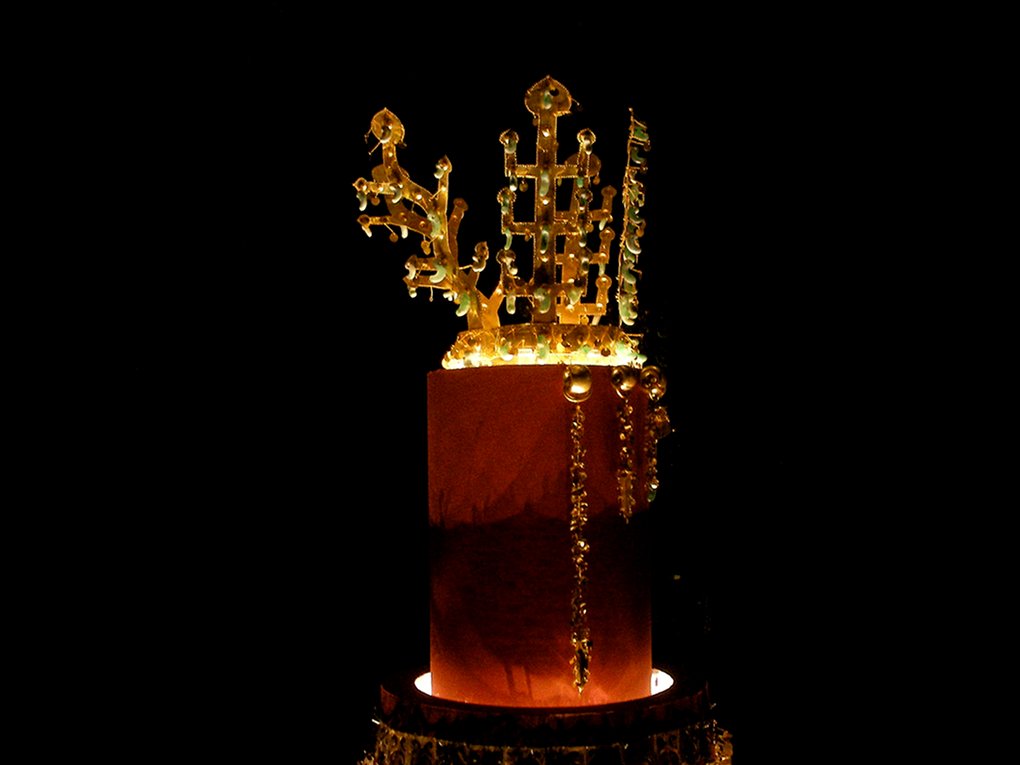
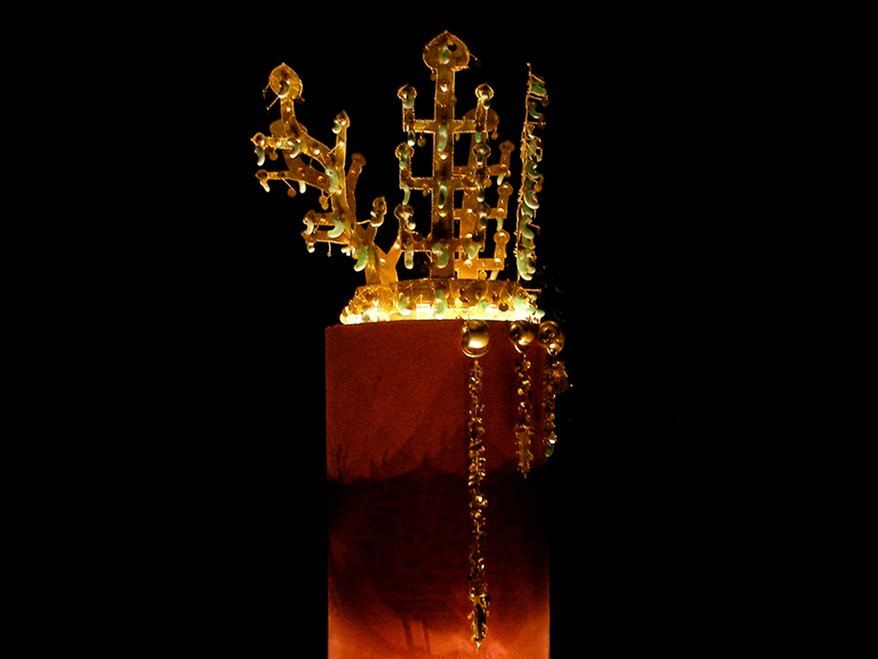
In September 1921, a work crew was digging foundations for a house extension in the Noseo quarter of Gyeongju, the old capital of Korea, when the soil began to give up gold. Beads first, then thin gold ornaments, spilling out of what everyone had taken for an ordinary grassy hill. Word reached the Japanese authorities who then ruled Korea, and a salvage dig was thrown together in haste. It lasted four days. In that time the mound was emptied of thousands of objects, and near the centre, crushed under the weight of collapsed timber and earth, lay a band of gold with branches and antlers rising from it. It was the first crown of pure gold ever recovered from a Silla tomb. The hill got a new name on the spot: Geumgwanchong, the Gold Crown Tomb.
Nobody in 1921 knew quite what they were looking at. Silla was a name from old chronicles, a kingdom that had ruled the south-eastern corner of the Korean peninsula for the better part of a thousand years and then faded. Its royal tombs were grassy domes scattered through the modern town, walked past and built around for centuries. The four-day dig behind the house changed that. It showed that under those quiet mounds sat some of the richest burials anywhere in the ancient world, and that the people who filled them had a taste for gold that few kingdoms have ever matched.
Five more crowns of solid gold have come out of the Gyeongju mounds in the century since. They are among the most recognisable objects to survive from early Korea, and they carry a puzzle that scholars are still arguing over: for all their splendour, they may be too flimsy to have ever sat on a living head.
Four days behind a house
The Geumgwanchong dig was fast because it was not really archaeology. Korea in 1921 was a Japanese colony, and the mound had been breached by accident during building work. What followed was closer to a rescue than a study: get the objects out, catalogue them roughly, move on. The records that survive are thin. We do not know for certain who was buried there, or exactly how the crown sat in the grave, because no one recorded the small details that a careful excavation would now treat as essential.
What did survive was the haul itself, and it was staggering. Gold earrings, a gold belt hung with pendants, gold bracelets and rings, weapons, imported glass, and the crown. Silla had been a footnote in the chronicles. Now it was a kingdom that had put a fortune in worked gold into the ground with a single person and sealed it over. The find set off a rush. Through the 1920s and 1930s more mounds were opened, and the pattern held: the largest tombs of Gyeongju were treasure houses, and gold ran through all of them.
It took decades, and Korean independence, before anyone dug one of these tombs the slow way. When they finally did, the crowns turned out to be even stranger than the rushed colonial digs had let on.
What the goldsmith actually made
Strip a Silla crown down to its parts and it is a simple thing built into something wild. The base is a headband, a circlet of thin gold sheet cut from a beaten plate. Rising from the front and sides are uprights shaped like a stack of branches, three or more tiers of right-angled twigs climbing off a central stem, a form Korean scholars name after the character that it echoes. At the back stand two more uprights, and these are not trees. They curve and fork like antlers.
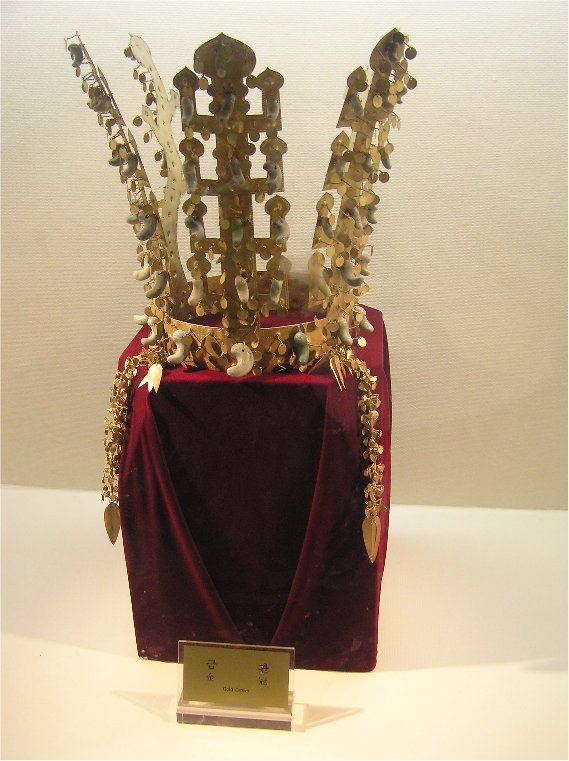
Then the goldsmith loaded the frame. All over the band and the uprights hang small spangles of gold, each fixed by a twist of wire so that it trembles and flashes at the slightest movement. Among the spangles hang curved jade beads, blunt-headed and tapering to a point, the shape Koreans call gogok. From the rim, long chains of gold drop down where the ears would be, some ending in more jade, some in gold leaf. Worn or displayed, the whole thing would have shivered and glittered with every breath of air.
The gold is the catch. It is sheet, not casting: hammered thin, cut with shears, the branches barely rigid on their own. The heaviest crown, with all its pendants and jade, tips past a kilogram, but the metal that holds the shape is wafer-light. Set one upright and it wants to lean. This is regalia built for the eye, not for hard wear, and that fact sits at the centre of every argument about what these crowns were for.
Only about six crowns of solid gold are known, and all of them come from the great mounds of the old Silla capital at Gyeongju, never from anywhere else on the peninsula, never from a lesser town. Dozens of humbler crowns in gilt-bronze survive from Silla and its neighbours, but pure gold was the mark of the very top of one kingdom, in one city, across roughly a century and a half from the late fifth century onward.
Why the gold was still there to find
Most royal graves in the ancient world were robbed, often within a generation of being sealed. The pharaohs, the Scythian chiefs, the kings of neighbouring Korean states: their tombs were found already gutted, the gold long gone. Silla is the great exception, and the reason is not luck. It is engineering.
A Silla royal grave of this age was not a stone room you could walk into. The dead were laid in a wooden chamber, the coffin and the grave goods packed around them. Over that timber box the builders heaped a vast mound of river cobbles (tonnes of loose, fist-sized stones), and only then piled earth and turf over the lot. There was no door, no passage, no corridor. To reach the burial, a robber would have to dig down through metres of earth and then through a shifting hill of stone that pours back into any hole as fast as it is dug. Tunnel into it and the cobbles bury you.
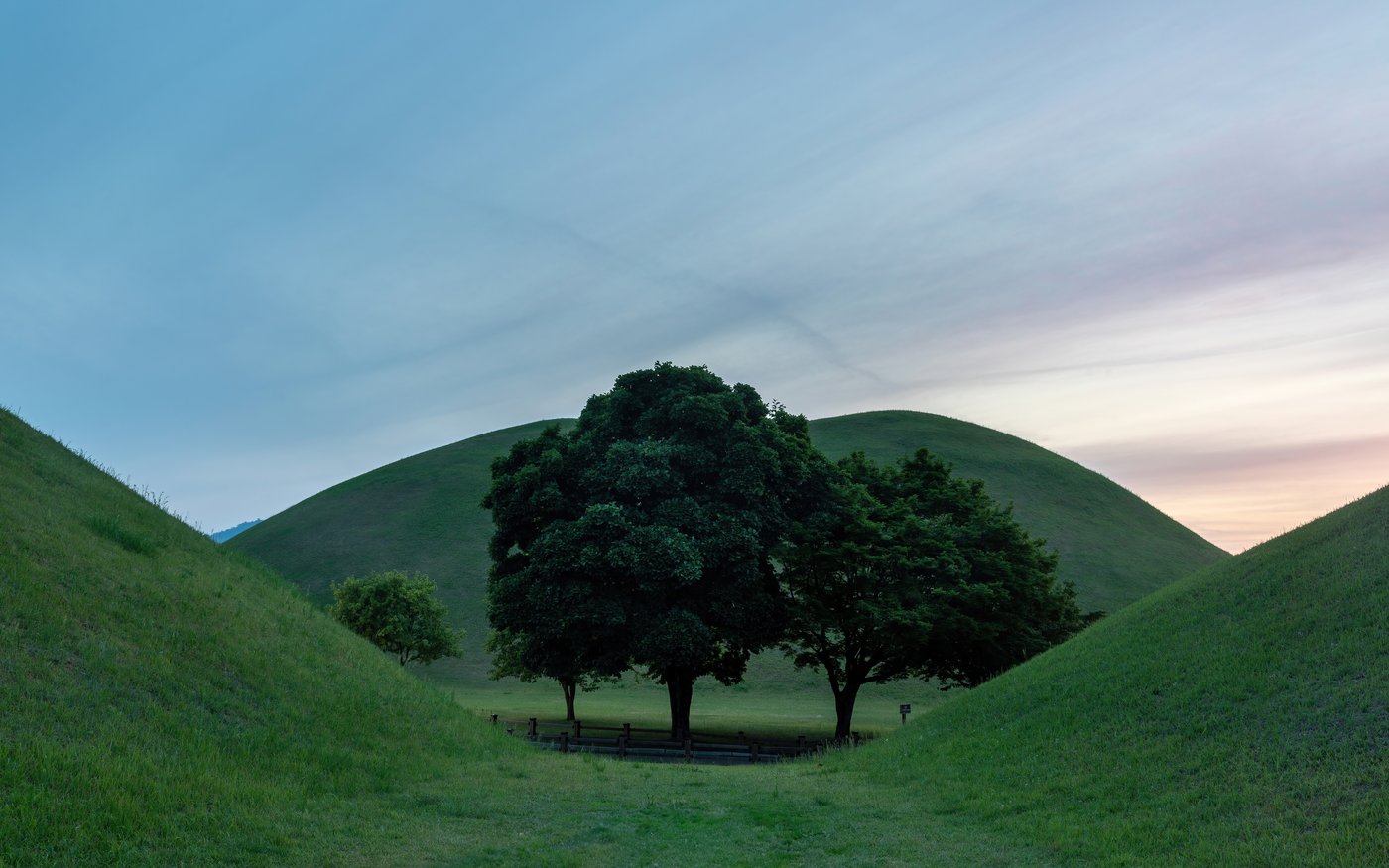
So the gold stayed. The timber chamber eventually rotted and collapsed under the weight, crushing and flattening much of what it held (which is why so many Silla crowns come out of the ground bent and pressed), but nothing was stolen. When archaeologists finally reached these chambers, they found the grave exactly as it was left, minus the collapse. The mound design that makes Silla so frustrating to excavate is the same design that handed us the only unlooted royal gold of early East Asia. Take away the loose-stone mound and there would be no Silla crowns to argue about.
Trees, antlers, and a road out of the north
Why a tree, and why antlers? The answer most scholars reach for looks north, away from China and towards the open grassland that runs from Manchuria across to Siberia. Among the herding and hunting peoples of that world, a sacred tree joined the earth to the sky, and a shaman climbed it in spirit to carry messages to the gods. Deer and their antlers carried the same charge: the antler that falls and grows again, the animal that runs between worlds. A crown that puts a tree at the front and antlers at the back is speaking that language. It marks its wearer as the one who stands at the meeting point of earth and heaven.
The materials point the same way. The love of thin, trembling gold sheet, of spangles and dangling ornaments, is a steppe taste, shared with the golden gear of nomad chiefs far to the north and west. Some scholars have gone further and argued that Silla's ruling house itself came, at some remove, from that northern world, arriving among the older peoples of the peninsula with its horses, its gold and its sky-religion intact. That last claim is disputed and probably too neat. What is not in doubt is that the visual language of the crowns (tree, antler, bird, glitter) belongs to a belief system with deep roots outside China, in a world where the ruler was also the chief intermediary with the divine.
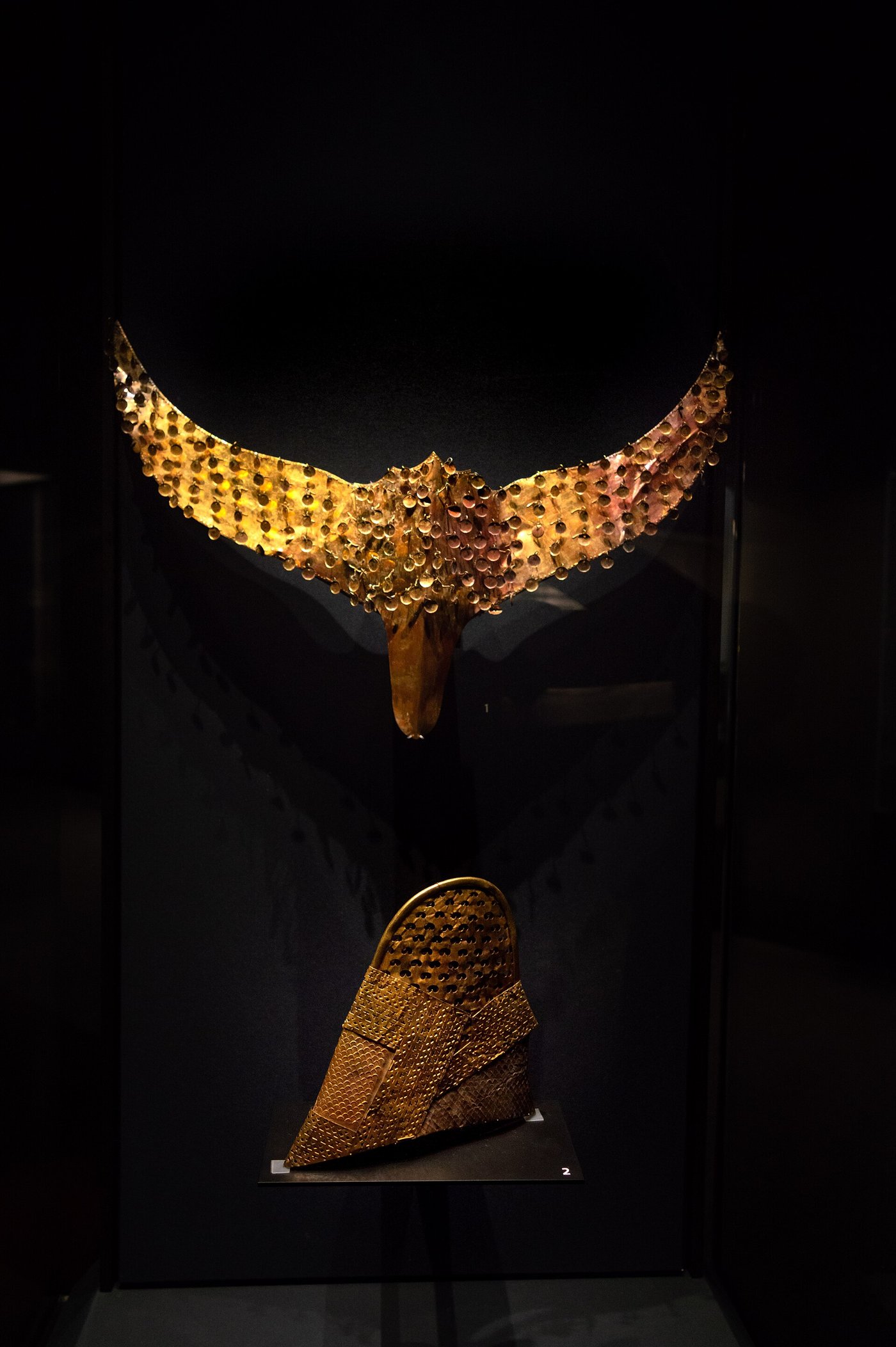
There is a second layer to the headgear that the famous crowns tend to hide. Inside or beneath the branching crown, Silla nobles wore caps and separate gold ornaments, some shaped like a pair of outstretched wings, some like a butterfly. The wing shapes tug at the same thread: flight, the upward journey, the sky as the home of power. Put the whole assembly together on a head and you have a tree, a set of antlers, a pair of wings and a shower of gold, every part of it saying the same thing about who the wearer was meant to be.
Picture a Silla monarch on a throne under a great branching crown of gold, ruling in the full weight of the regalia. The museum photographs almost force that image on you.
The metal argues against it. The uprights are cut from thin sheet and barely stand on their own; the tall branches would sway and buckle on a moving head, and the side chains would swing into the wearer's face. Nobody could have done a day's business in one. Many specialists think the grandest gold crowns were never everyday royal wear at all, but regalia for the greatest occasions, and above all for the grave. The living king may have worn something sturdier, in gilt-bronze, and kept the pure-gold tree for the last journey.
The horse that named a tomb
The slow, careful dig that the crowns had been waiting for came in 1973. The government of the day wanted to turn Gyeongju into a display of the national past, and the plan was ambitious: open the largest royal mound of all, the vast double hill now called Hwangnamdaechong, and put its treasures on show. Excavating a mound that size had never been tried. So the archaeologists chose a smaller neighbour to practise on first, a mound then known only by a number.
The practice tomb turned out to be a marvel in its own right. Inside sat a gold crown, the largest and heaviest of them all, dripping with fifty-eight curved jades. Around it lay some eleven thousand objects. And propped among the grave goods was something almost unheard of from Silla: a painting. On a saddle flap made of layered birch bark, a white horse strode through the air, mane flying, with what look like wings at its legs and a scatter of curling flames along its edge. The excavators named the horse Cheonma, the heavenly horse, and gave its name to the tomb: Cheonmachong.
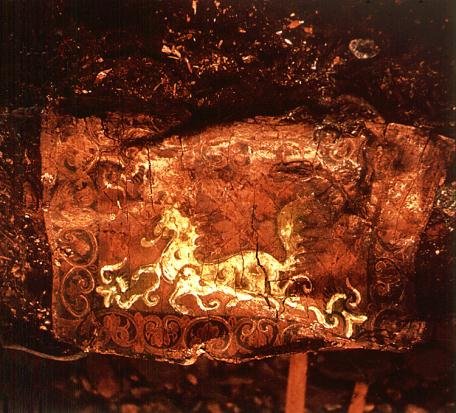
Painting almost never survives from this world; cloth and wood and pigment rot away, and the loose-stone mounds crush what the damp does not destroy. That a Silla artist's own brushwork came through at all is a small miracle, and it gave the crown a companion: a rare glimpse of the imagination behind the gold, a flying horse that belongs to the same sky the tree and the antlers were built to reach. The trial dig had done its job. Two years later the team moved on to the giant next door.
The woman in the north mound
Hwangnamdaechong was not one tomb but two, a pair of mounds run together into a single figure-of-eight hill, the largest burial mound in Silla. The south mound held a man. He was buried with weapons and armour and the trappings of a warrior, and with a crown of gilt-bronze, gold over base metal.
The north mound held a woman. Her grave was, if anything, the richer of the two. She wore a crown of solid gold, one of the six, along with gold bracelets stacked up both arms and a gold belt at her waist. Among her ornaments was a silver-and-gold belt-end carrying a short inscription, and it named her rank plainly.
Read the two mounds side by side and something jumps out. The woman had the gold; the man beside her had the gilded copy. In a burial ground where pure gold marks the very top of the kingdom, the higher-ranking person in this pair was the woman. Silla was a society that, alone among the Korean states, would later crown three reigning queens, the first of them Seondeok in the seventh century. The north mound is a hint, centuries earlier, that women could stand at the summit of Silla rank, buried under the same great stone hill as the finest gold the kingdom could make.
"A belt for the lady."— inscription on a belt-end from the north mound of Hwangnamdaechong, naming the rank of the woman buried with the gold crown (excavated 1973–75)
Wings of a beetle, and a grave still open
The crowns keep giving up surprises. In a tomb in the Jjoksaem district of Gyeongju, opened in 2020 and studied for years afterward, conservators cleaning a gilt-bronze crown noticed dull brown flakes tucked behind its openwork. Under the microscope the flakes were wings: the wing-cases of jewel beetles, the metallic insect whose shell burns emerald and gold in the light. Fifteen of them had been set behind the heart-shaped holes cut in the crown, so that the green-gold shimmer of the beetle glowed through the metal. The colour had faded to brown over fifteen centuries, which is why no one had spotted the trick before. It is the first Silla crown known to use it, and it fits everything else about these objects: a people in love with surfaces that catch and throw the light, willing to farm iridescence from an insect to get it.
The digging has not stopped. In 2025, in the same field of mounds, archaeologists working down into a tomb they have been excavating since 2018 reached a wooden chamber holding a man in a full suit of armour, his horse's armour beside him, a ring-handled sword, and the crushed remains of a headpiece. Close by lay a second set of bones that may belong to someone buried with him rather than in a grave of their own. Each of these tombs is a sealed room from the fifth or sixth century, opened for the first time. The crowns we argue over are not a closed set. Gyeongju is still handing them up.
The oldest reading was blunt: the gold crowns are grave goods, too weak to wear, made to be laid over the head of a dead ruler and buried. Some scholars picture them pulled down over the face like a mask, the tall branches folded around the skull. Others push back. Wear marks on a few examples, and the sheer trouble taken over them, suggest to some that a monarch really did wear the gold crown, briefly and carefully, at a coronation or a great rite, before it followed them into the mound. The honest position holds both: everyday power probably sat on a sturdier gilt-bronze crown, while the pure-gold tree was for the rarest moments and, in the end, for the grave. Which crown did which job, and whether any king wore gold while breathing, is still unsettled.
What the thin gold keeps
A Silla gold crown is one of those objects that looks like it should answer questions and instead multiplies them. We can weigh the gold and count the jades. We can trace the tree and the antler back to a religion of the northern grasslands, and the beetle wings to a taste for shimmer, and the loose-stone mounds to the reason any of it survives. We know a woman outranked the man beside her under the largest hill in the kingdom. What we cannot quite pin down is the simplest thing of all: whether a living Silla king ever felt the weight of one of these on his head, or whether the gold was always meant for the dark.
Maybe that uncertainty is the right note to end on. These crowns were built to be seen and to tremble, to mark a person as the point where the earth reached up to the sky. They did their brightest work, perhaps, on a body being sent out of the world, glittering by torchlight before the timber was closed and the stones poured down. Fifteen centuries later the light still catches them. The gold is as thin as ever, and it still will not tell us the one thing we most want to know.
Read next: King Muryeong: The Intact Tomb Korea Excavated in a Single Night and Tillya Tepe: The Bactrian Gold Everyone Thought the Wars Had Melted.
Sources & further reading
- Gyeongju National Museum — permanent Silla galleries and the 2025–26 special exhibition reuniting six gold crowns, marking the museum's eightieth anniversary.
- National Museum of Korea, Seoul — collection notes on the crowns and belts from Geumgwanchong, Cheonmachong and Hwangnamdaechong.
- Sarah Milledge Nelson, The Archaeology of Korea (Cambridge University Press) — on Silla wooden-chamber-and-stone-mound tombs and their contents.
- Reports on the 1921 Geumgwanchong salvage dig and the 1973–75 excavations of Cheonmachong and Hwangnamdaechong, summarised by the National Research Institute of Cultural Heritage (NRICH).
- Archaeology magazine and the Korea Heritage Service, coverage of the jewel-beetle-wing crown from the Jjoksaem tomb (announced 2025) and the ongoing Gyeongju mound excavations.
- Smarthistory and the Metropolitan Museum of Art — essays on the tree-and-antler crown form and its shamanic and steppe connections.
Image credits (via Wikimedia Commons): gold crown from Geumgwanchong, the Gold Crown Tomb (featured) — Seon Kwang Haengja (CC BY-SA 2.0); gold crown from the Heavenly Horse Tomb (Cheonmachong) — NW-Photos.com (CC BY 2.0); royal tomb mounds at Daereungwon, Gyeongju — Basile Morin (CC BY-SA 4.0); gold inner cap and winged crown ornament, National Museum of Korea — Tristan Surtel (CC BY-SA 4.0); the Cheonma heavenly-horse painting — unknown Silla artist, photograph public domain; gold crown from the north mound of Hwangnamdaechong — Seon Kwang Haengja, derivative by Caspian blue (CC BY 3.0).