In the late summer of 1834 an Italian doctor stood on top of a pyramid in the Sudanese desert and gave the order to take it apart. His name was Giuseppe Ferlini, and he had not come to measure or to draw. He had come to dig, and when digging proved too slow he set his workers to levering the stone blocks off the summit and rolling them down the sides. Course by course the pyramid of a long-dead queen came down under his hands. Somewhere inside it, he was certain, there was gold.
He was right. What he pulled out of that ruined pyramid was one of the richest hoards of ancient jewellery ever found south of Egypt: armlets thick as a wrist, rings by the dozen, gold worked with a delicacy that would soon get it called a fake. To reach it he wrecked the tops of dozens of the finest monuments the Kingdom of Kush ever raised. The story of Meroë is partly the story of that vandalism. It is also the story of a black African kingdom that ruled Egypt, fought Rome to a standstill, buried an emperor’s head under a doorstep, and left behind a written language we can still read aloud and still cannot understand.
The doctor who came for gold
Ferlini was from Bologna, trained as a surgeon, and restless. He had drifted through the medical service of one army after another before taking a post as a physician with the Egyptian forces that Muhammad Ali had sent to conquer Sudan. Soldiering in the south was hard and badly paid, and like a good many Europeans in Egypt at the time, Ferlini had caught the fever for antiquities. Mummies and papyri were selling well in Paris and London. A man who found the right tomb could go home rich.
Meroë lay about two hundred kilometres north of modern Khartoum, on the east bank of the Nile, in country the outside world barely knew. Travellers had reported clusters of steep little pyramids rising out of the sand there, far more of them than anyone could count from the river. To Ferlini they were not history. They were locked boxes. He got leave, gathered workers, and went up to the ruins with the single aim of opening as many as it took.
Thirty-five days to the top
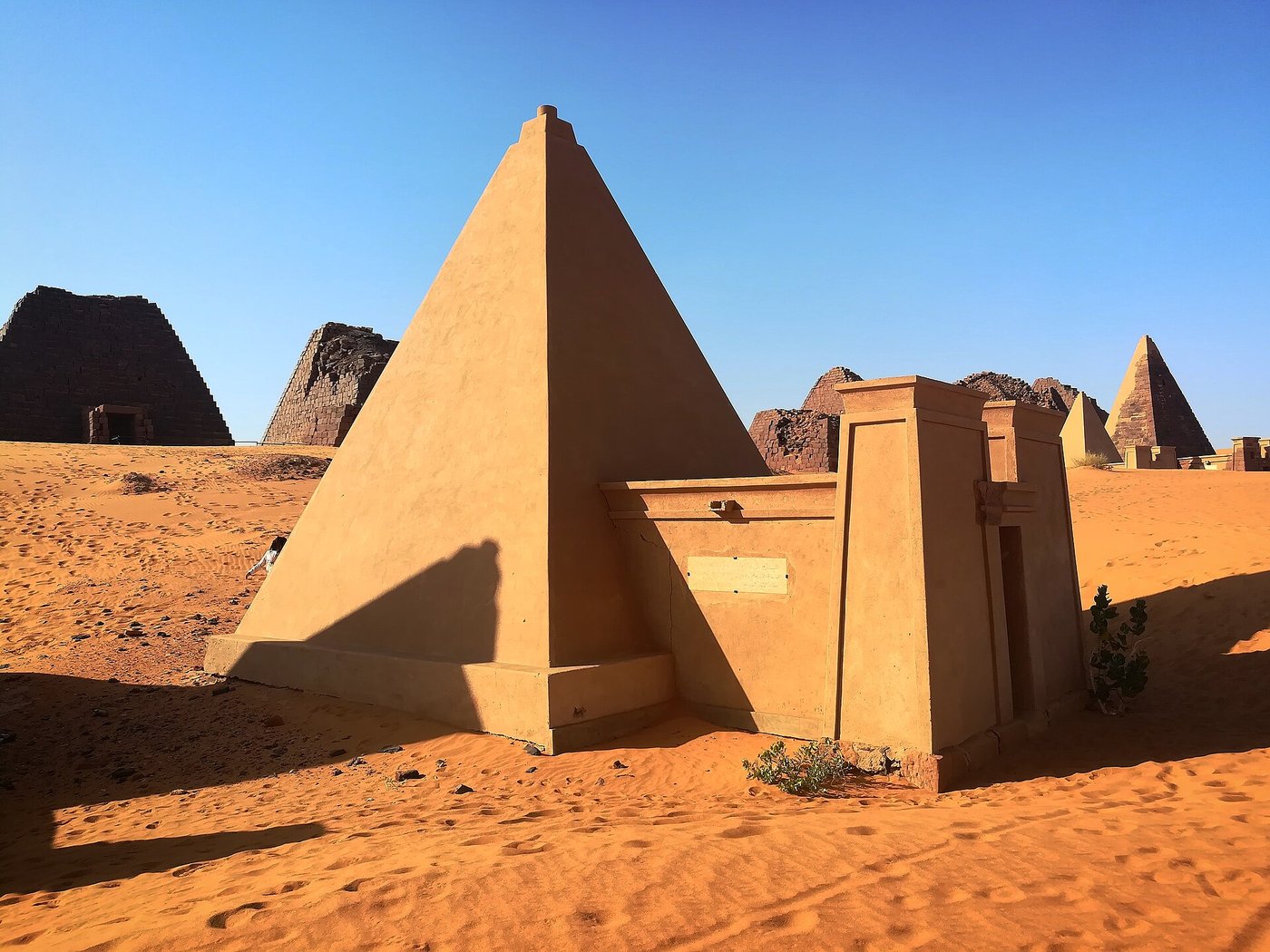
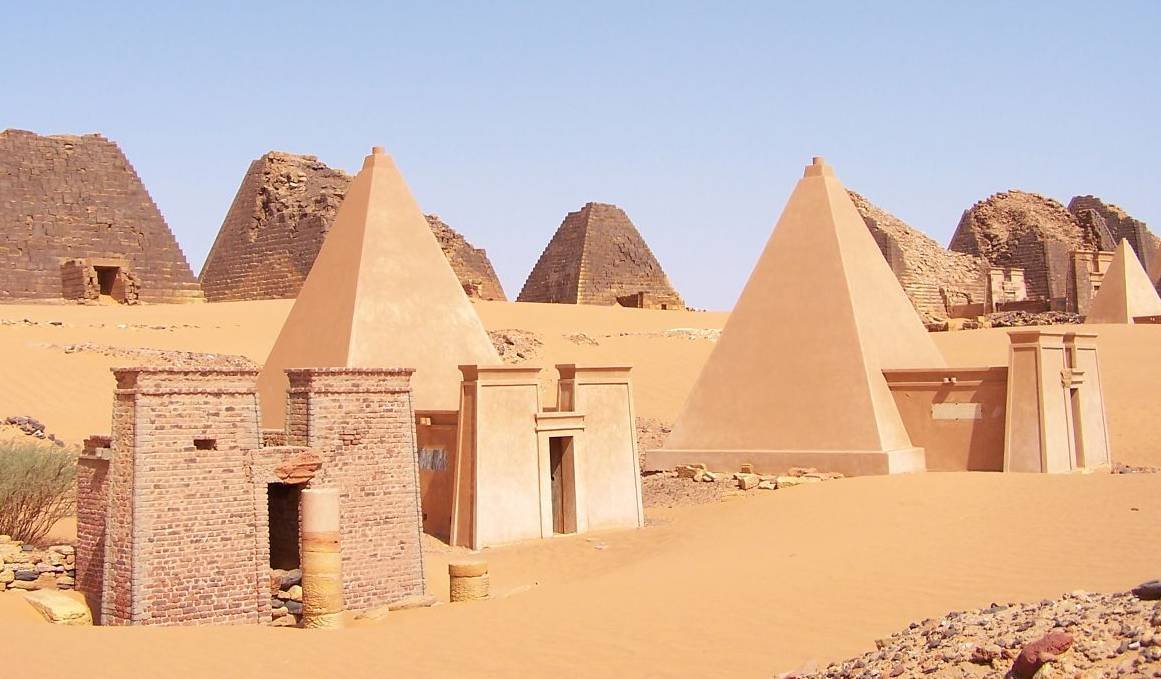
He began at the northern cemetery, on the ridge where the largest royal pyramids stood. These are not the broad, gentle monuments of Giza. A Nubian pyramid is tall and narrow, its sides pitched at a steep angle, some of them no wider at the base than a small house yet rising to twenty or thirty metres. In front of each one stood a chapel where offerings were once left for the dead, its walls carved with the king or queen who lay behind it.
Ferlini worked the way a man works when he does not care what he breaks. Rather than search for the buried chamber beneath a pyramid, he took the pyramid itself apart from the top down, block by block, looking for a hidden cache in the body of the stone. One monument, the tomb of a queen, took his crews about thirty-five days to dismantle. By the time he left the desert he had damaged something on the order of forty pyramids across the site, snapping the tops off royal tombs that had stood, more or less whole, for eighteen centuries. The flat and broken profiles you see in photographs of Meroë today are, in large part, his signature.
Sudan holds more ancient pyramids than Egypt does: by most counts well over two hundred against Egypt’s hundred-odd. At Meroë alone three royal cemeteries hold around forty of them, built for the kings and queens of Kush across some six centuries. They are smaller and steeper than their Egyptian cousins and they came centuries later, but there are simply far more of them, packed close on the desert ridges east of the Nile.
The chamber near the sky
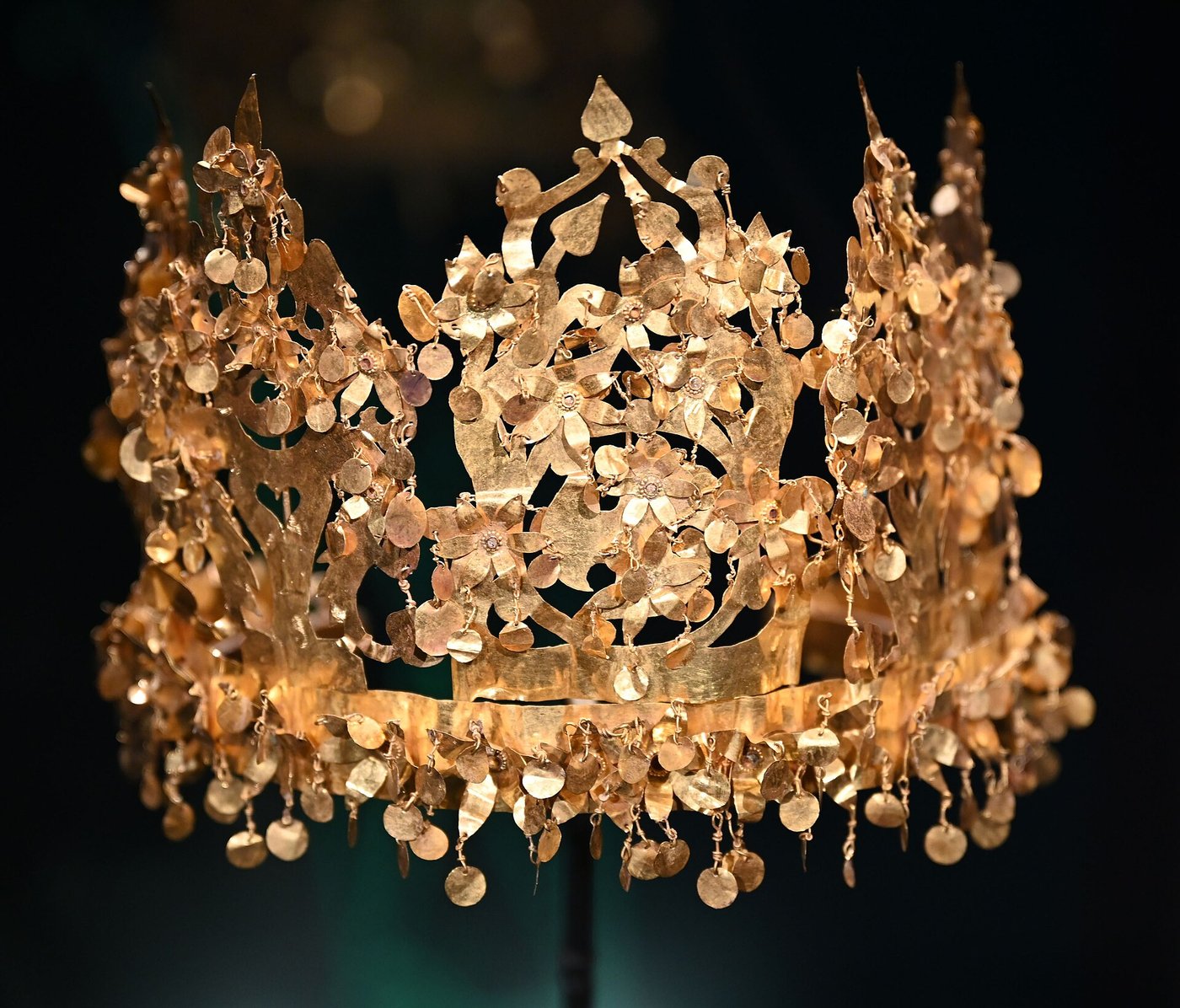
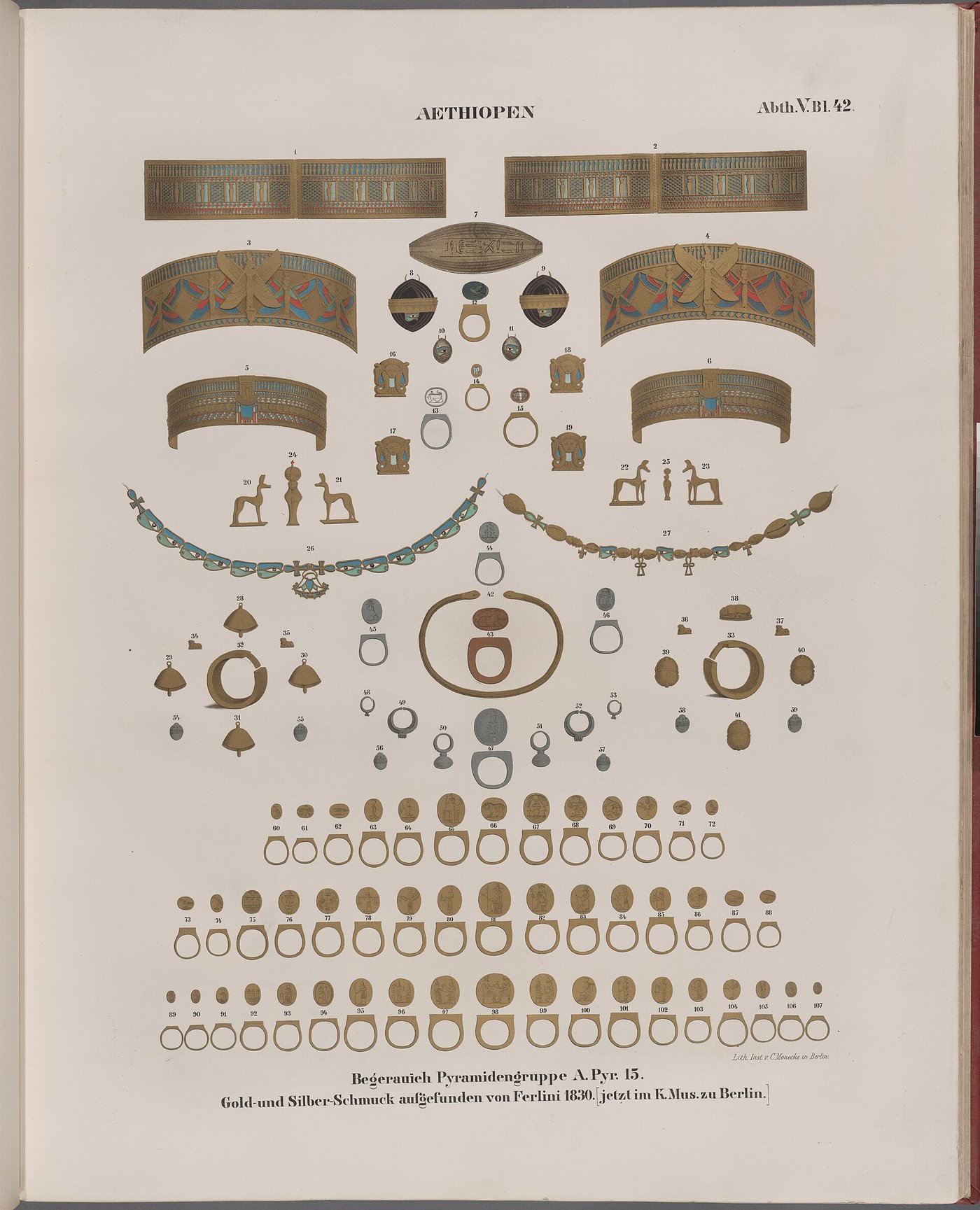
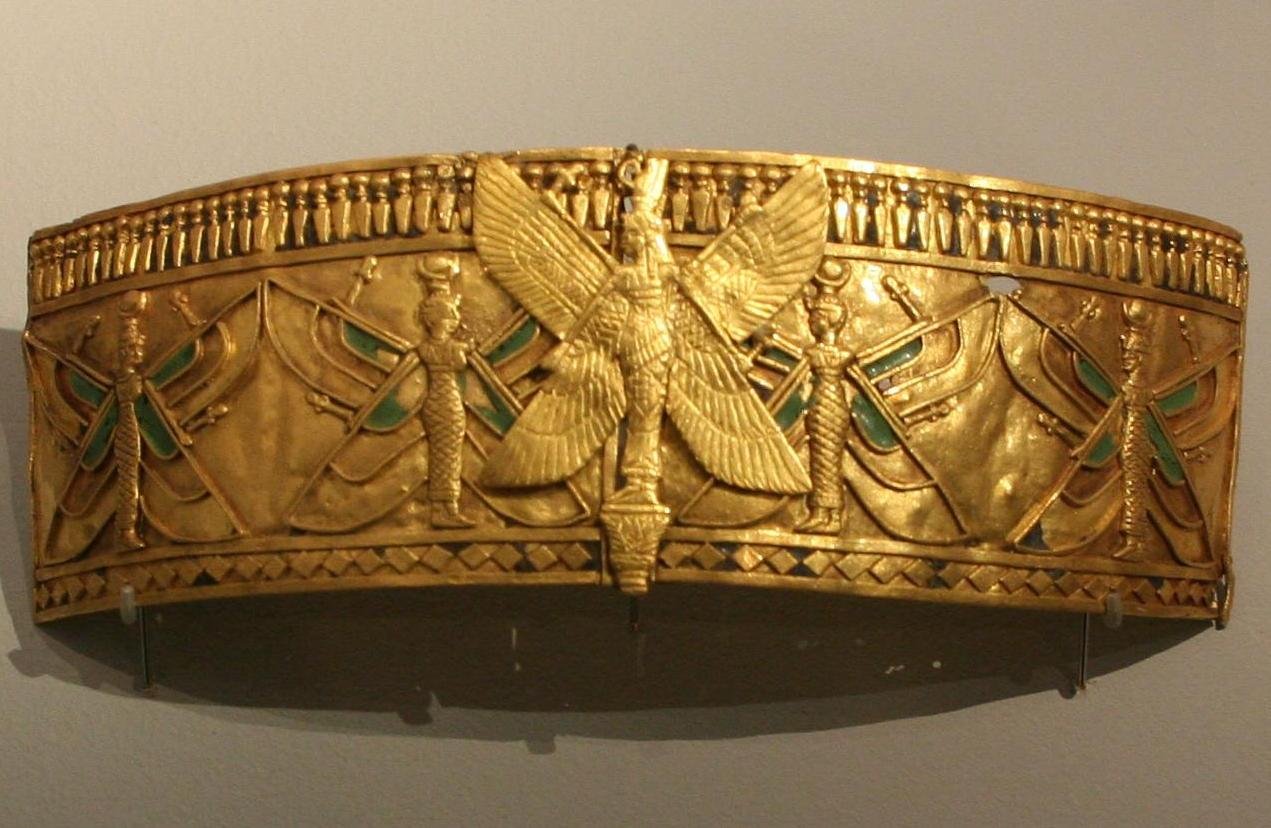
In the queen’s pyramid he struck it rich. Sealed away, by his own account, in a chamber high in the upper part of the monument rather than in a burial vault below, was a hoard of more than a hundred and fifty pieces of gold and silver: heavy hinged armlets, broad shield-shaped rings, signet rings by the score, amulets, necklaces and pendants worked with tiny figures of gods. The queen was Amanishakheto, one of the ruling women of Kush, and the jewellery had lain with her for roughly nineteen hundred years.
Where exactly Ferlini found it has never been fully settled, and it matters more than it sounds. Kushite royals were normally buried in rock-cut chambers dug beneath the pyramid, reached by a stair, not tucked into the masonry near the summit. That his greatest find supposedly came from the top has made some scholars wonder whether his account can be trusted at all: whether the cache was really hidden up high, or whether he simply muddled, or dressed up, a story he did not want anyone able to check. The pyramid he took apart cannot be asked. He had already destroyed it.
Ferlini insisted the treasure sat in a concealed room in the pyramid’s upper body. Almost every other royal burial at Meroë was placed in a chamber cut into the rock below. Either Amanishakheto’s people broke with their own custom and hid her jewels near the sky, or the one man who could describe the find had every reason to tidy the tale. Because he levelled the evidence as he went, both readings are still on the table.
The gold nobody would buy
Ferlini carried his treasure back to Europe expecting to be made. Instead he ran into a wall of disbelief. He offered the jewellery for sale and was told, more or less politely, that it could not be genuine. The work was too fine, the gold too pure, the design too assured. Everyone knew, or thought they knew, that nothing made in the African interior could look like this. Buyers suspected he had commissioned modern fakes and invented the desert to explain them. The great hoard sat unsold, year after year.
What broke the deadlock was not a change of heart but a witness. In the early 1840s the Prussian scholar Karl Richard Lepsius led an expedition up the Nile and saw Meroë for himself: the pyramids, the reliefs, the style of the royal ornament still carved on the chapel walls. His verdict, published on his return, confirmed that jewellery of exactly this kind belonged to exactly this place. Only then did the doubts lift. King Ludwig I of Bavaria bought a share of the hoard, and it went to Munich; the rest was acquired for the royal collection in Berlin. The pieces sit in those two German museums to this day, and Sudan has asked, more than once, for them to come home.
When the hoard reached Europe the reflex was instant: such delicate, confident jewellery must be a forgery, because no ancient people of inner Africa could have produced it. The gold was judged fraudulent on sight, and Ferlini spent years unable to sell what he had ripped from a queen’s tomb.
The pieces were real, and they were Kushite through and through. Meroë sat on gold-bearing country and had its own goldsmiths, its own royal style, its own gods worked in miniature on ring and pendant. The same disbelief would later greet Great Zimbabwe and the bronzes of Igbo-Ukwu: the assumption that African skill had to be borrowed or faked. The jewellery in Munich and Berlin is the plain refutation of it, sitting in glass cases where anyone can go and look.
Kush, and the pharaohs from the south
To understand why a queen was buried under a pyramid with a hoard like that, you have to leave Ferlini behind and go back more than a thousand years before him. Kush was the kingdom of Nubia, upriver from Egypt, and the two lands had circled each other (trading, raiding, conquering by turns) for as long as there had been kingdoms on the Nile at all. For long stretches Egypt ruled Nubia. Then, once, the order flipped.
Around 730 BCE a Kushite king named Piye marched north out of Nubia and took Egypt. He and his successors ruled the whole Nile valley as pharaohs, the line Egyptologists count as the Twenty-fifth Dynasty and later writers sometimes call the black pharaohs. They restored old temples, revived old rites, and styled themselves the true guardians of a tradition Egypt itself had let slip. Their reign lasted only a few generations before the Assyrians, armed with iron and numbers, drove them back south. But the memory of having worn the double crown never faded from Kush.
Pushed out of Egypt, the kingdom turned inward and endured for centuries more. After an Egyptian army sacked the old northern capital of Napata early in the sixth century BCE, the centre of Kushite power settled further south at Meroë, in savannah country where the rains reached and cattle and iron could make a kingdom rich. It is the Meroë phase, roughly the third century BCE to the fourth century CE, that raised the pyramids Ferlini would one day pull apart.
The queens they called Candace
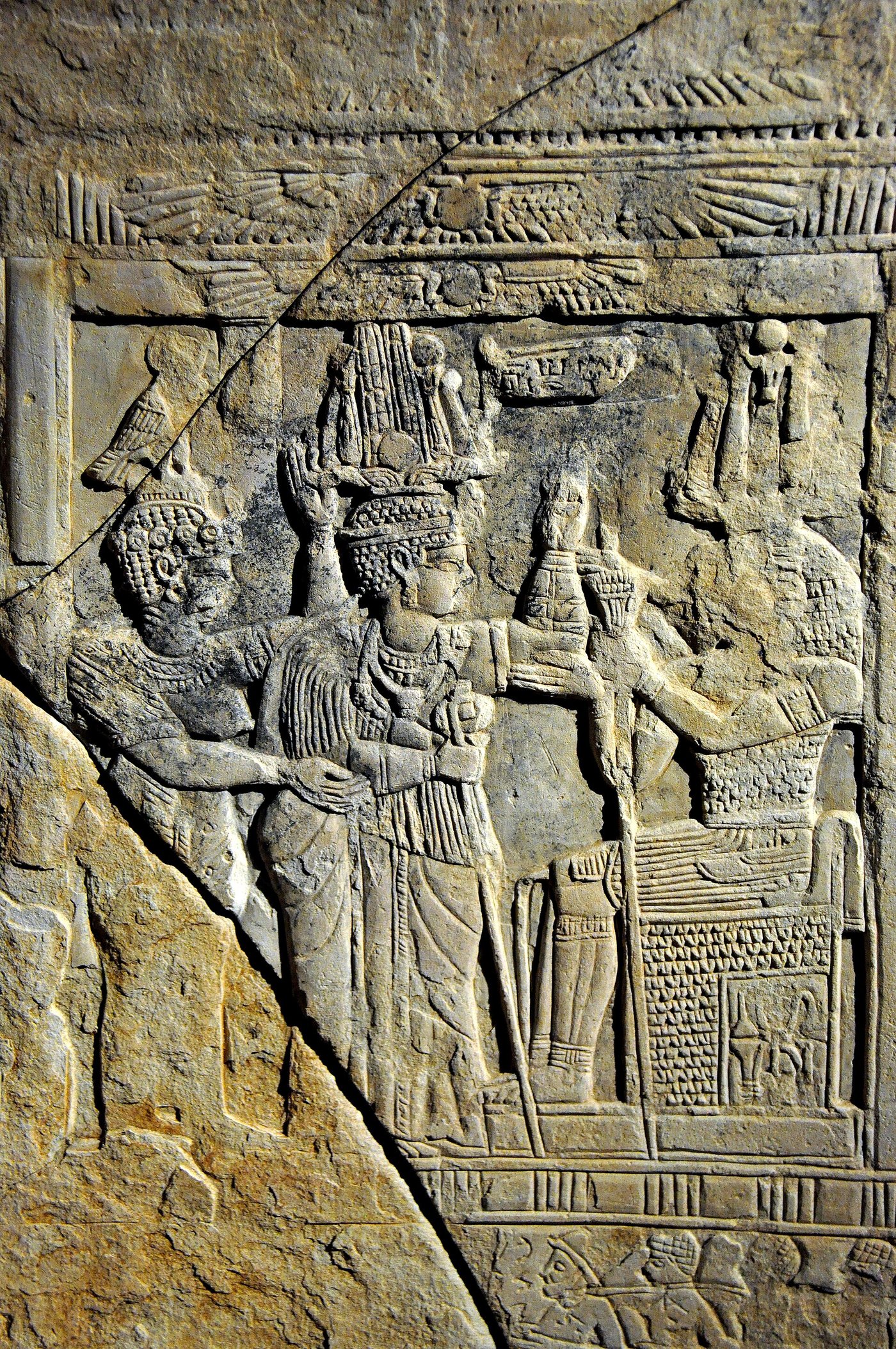
Kush did something few ancient states did: it let women rule in their own right. The royal women held a title the Greeks and Romans wrote down as Candace, from the Meroitic kandake, and it was no mere honour for a king’s wife. Several kandakes governed as sovereigns, led armies, and were buried under pyramids of their own. Amanishakheto, whose gold ended up in Ferlini’s hands, was one of them. So was Amanirenas, who did something no neighbouring kingdom managed in her age: she fought Rome and did not lose.
When Rome swallowed Egypt after the death of Cleopatra, its border pushed up against Kush at the first cataract of the Nile. In the 20s BCE the two powers came to blows. Kushite forces under Amanirenas struck north, sacked the Roman frontier towns and carried off booty, including bronze statues of the emperor Augustus that had been set up to mark Roman authority. Rome hit back and burned the old capital at Napata. But the war ground to a draw, and the treaty that followed was generous to Kush: the tribute Rome wanted was waived, and the frontier settled on terms the queen could live with.
The emperor’s head in the doorway
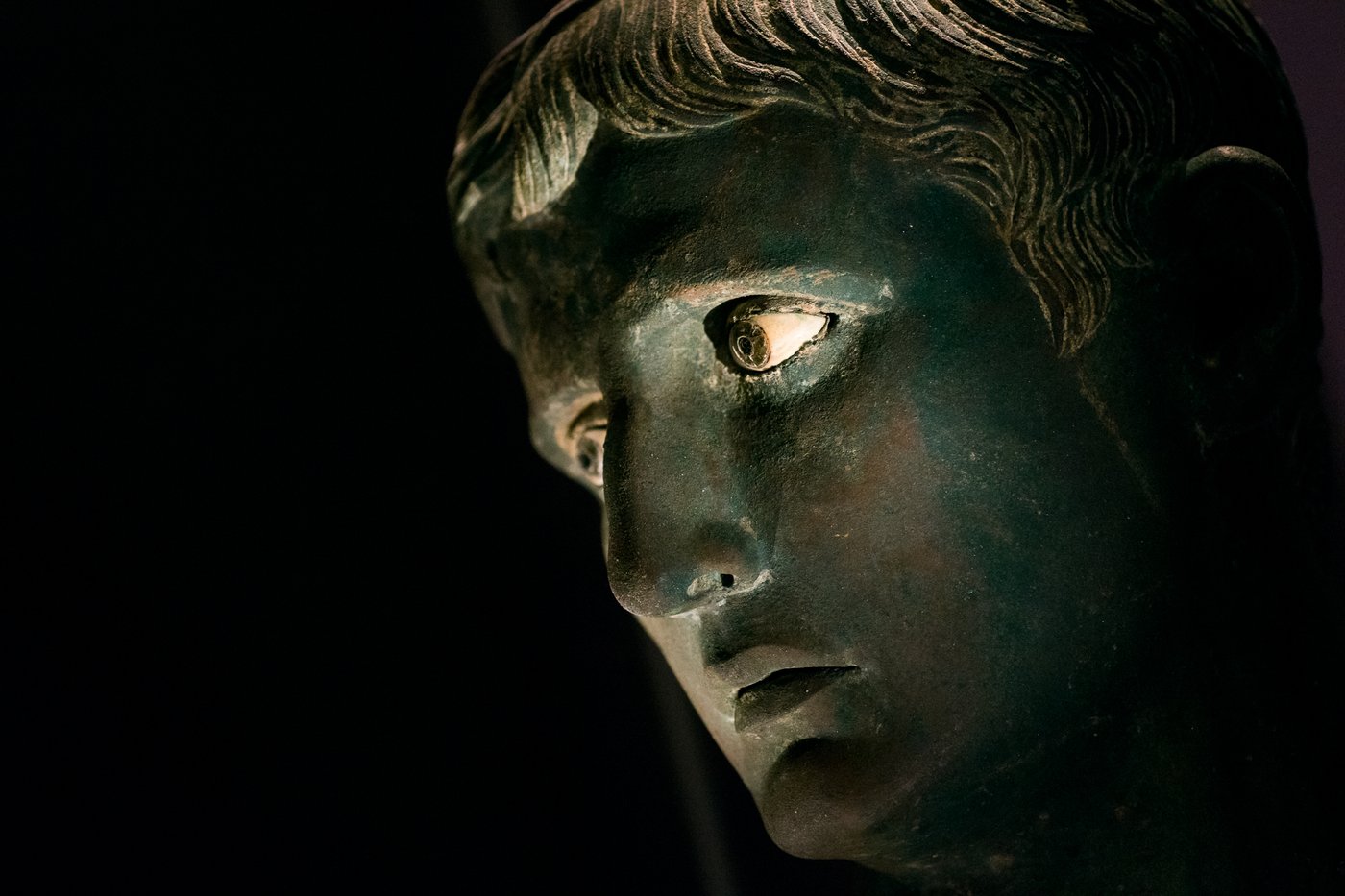
One of those looted statues of Augustus never made it into a Roman museum, because the Kushites made sure of it. Back at Meroë they took the bronze head from the body, and instead of melting it down or setting it up as a trophy, they buried it, deliberately, face upward, beneath the threshold of a shrine. Every worshipper who crossed into that building walked over the face of the most powerful man in the world. It was a small, patient revenge, repeated with each footstep, for nineteen hundred years.
The head came to light in 1910, when the British archaeologist John Garstang dug into the sand in front of the temple and found the emperor staring up at him, the eyes still set with their rings of glass and stone. It is one of the finest surviving portraits of Augustus anywhere, and it survives precisely because it was treated as a doormat rather than a treasure. Today it sits in the British Museum, another Meroitic object a long way from Meroë.
The Meroë Head is a bronze from an over-life-sized statue of Augustus, made around 27–25 BCE. Kushite raiders carried it south after the frontier war and set it beneath the steps of a temple so that all who entered trod on the emperor’s face. Garstang’s team unearthed it in 1910; the desert sand had kept the surface, and even the inlaid eyes, almost intact.
A city that lived on iron
Gold and defiance make the best stories, but what kept Meroë going day to day was humbler and heavier. The city sat in reach of the summer rains, with grazing for cattle and stands of trees for fuel, and it worked iron on a large scale. Around the ruins lie great mounds of black slag, the waste of furnaces that ran for centuries. An early excavator, struck by the sheaps of cinder, called Meroë the Birmingham of Africa, after the great English iron town.
Later scholars think he oversold it: iron was made in many places, and the slag heaps at Meroë may loom larger in our imagination than they did in its economy. But the trade was real, and so was the reach. Kushite goods moved along the Nile and out across the desert; Kushite gods were carved on temple walls in a distinctly local key. Chief among them was Apedemak, a lion-headed war god with no true parallel in Egypt, honoured at temples where the old Egyptian deities stood beside him. Meroë borrowed from the north for a thousand years and never stopped being itself.
The script we can sound out but cannot read
The clearest sign of that independence is written on the walls, and it is the thing about Meroë that most unsettles anyone who studies it. The Kushites gave up writing in Egyptian and invented a script of their own to record the Meroitic language: a compact set of a couple of dozen signs, far simpler than Egyptian hieroglyphs, with a cursive form for everyday use and a formal one for monuments.
A century ago the British scholar Francis Llewellyn Griffith worked out what the signs sounded like. That is the strange part. We can look at a Meroitic inscription and pronounce it, sign by sign, with fair confidence. We just do not know what almost any of it means. Meroitic is related to no well-understood language, and the texts are too few and too repetitive to crack by comparison. So the writing of a kingdom that lasted the better part of a thousand years sits there, legible and mute, one of the last scripts on earth that can be read out loud and not translated.
What the sand gave back
Kush faded in the fourth century CE. An Aksumite king campaigned in the region as the kingdom weakened, trade routes shifted, and the pyramids stopped being built. The desert took the city back, and for centuries the tombs stood in the sand with only the local people for company, until a Bolognese doctor arrived with crowbars and a plan.
What he left is a site that carries its wounds in plain sight. The queen’s gold is in Munich and Berlin. The emperor’s head is in London. The pyramids at Meroë stand on their ridge with their tops broken flat, now a UNESCO World Heritage Site and, since war returned to Sudan in 2023, once again a place where the past is at the mercy of events. The inscriptions on the chapel walls can still be read aloud by anyone who learns the signs. Nobody yet can tell you what the queen was called by her own people, or what she asked the lion god for, or what she thought was worth carrying with her into the dark near the top of a pyramid a treasure hunter would one day tear down to find.
Sources & further reading
- László Török, The Kingdom of Kush: Handbook of the Napatan-Meroitic Civilization (Brill) — the standard scholarly survey of the whole span of Kushite history.
- Derek A. Welsby, The Kingdom of Kush: The Napatan and Meroitic Empires (British Museum Press) — a readable account of the kingdom, its cities and its pyramids.
- Salah Mohamed Ahmed and others, publications of the excavations of the Archaeological Sites of the Island of Meroe — on the royal cemeteries and their condition today.
- Thorsten Opper, The Meroë Head of Augustus (British Museum, Object in Focus) — on the bronze head, the frontier war and Garstang’s 1910 find.
- UNESCO World Heritage Centre, “Archaeological Sites of the Island of Meroe” — the inscription file and site description.
- Karl Richard Lepsius, Denkmäler aus Aegypten und Aethiopien — the nineteenth-century record that confirmed Ferlini’s hoard was genuinely Meroitic.
Image credits (via Wikimedia Commons): pyramids of Meroë at Bajrawiya (featured) — Ahmed Amir (CC BY-SA 4.0); the Meroë cemetery — Fabrizio Demartis (CC BY-SA 2.0); Ferlini’s hoard as drawn for the Lepsius expedition — scan by the New York Public Library (public domain); gold armlet of Amanishakheto, Munich — Sailko (CC BY-SA 3.0); the Meroë Head of Augustus, British Museum — Paul Hudson (CC BY 2.0); stele of Amanishakheto from Naqa, Munich — Osama Shukir Muhammed Amin (CC BY-SA 4.0).