Around 520 BCE, a team of stonemasons hung from a limestone cliff in the western mountains of Persia, some sixty metres above the road, cutting a message into rock that almost no one below could read. When they were done they smoothed away the ledge and the footholds behind them, so that the panel could not be reached, or altered, or answered. Then the scaffolding came down. For the next twenty-three centuries, carts and camels and armies passed along the road beneath it, and the great carved wall of figures and wedge-shaped script looked down on all of them and told its story to nobody.
The mountain is Behistun (Bisotun, on modern maps), and the message on it is the single most useful thing anyone ever carved into a rock. It did two jobs at once, both of them enormous. It gave a king named Darius the chance to explain, at monstrous scale and in three languages, exactly how he came to sit on the throne of the largest empire the world had yet seen. And, more than two thousand years later, because it said the same thing three ways, it handed a handful of obsessed scholars the key that unlocked the whole written world of ancient Mesopotamia. The catch is that the first job may be a lie, and the second job nearly killed the man who pulled it off.
A road, a spring, and a wall of rock
Behistun sits in the Zagros mountains of Kermanshah province, in what is now western Iran. It was not a random cliff. The rock rises straight up beside one of the oldest roads in the region, the highway that ran between Babylon on the plains of Mesopotamia and Ecbatana, the summer capital in the highlands. Every merchant, messenger and marching column that wanted to cross between the two worlds came this way. At the foot of the mountain there is a spring, so travellers stopped here to water animals and rest. Whoever chose this spot chose an audience.
The panel is carved high: the standard figure is about a hundred metres up the face, though the working surface is lower, well above any reach from the ground. It is large in the way that only a state can afford: the relief and its text cover something like fifteen metres in height and twenty-five across. From the road it reads as a band of pale figures under a mass of close-packed lines. You can see that it is important. You cannot, from down there, see what it says. That was the point. A monument you can approach is a monument you can deface. This one was built to be seen and never touched.
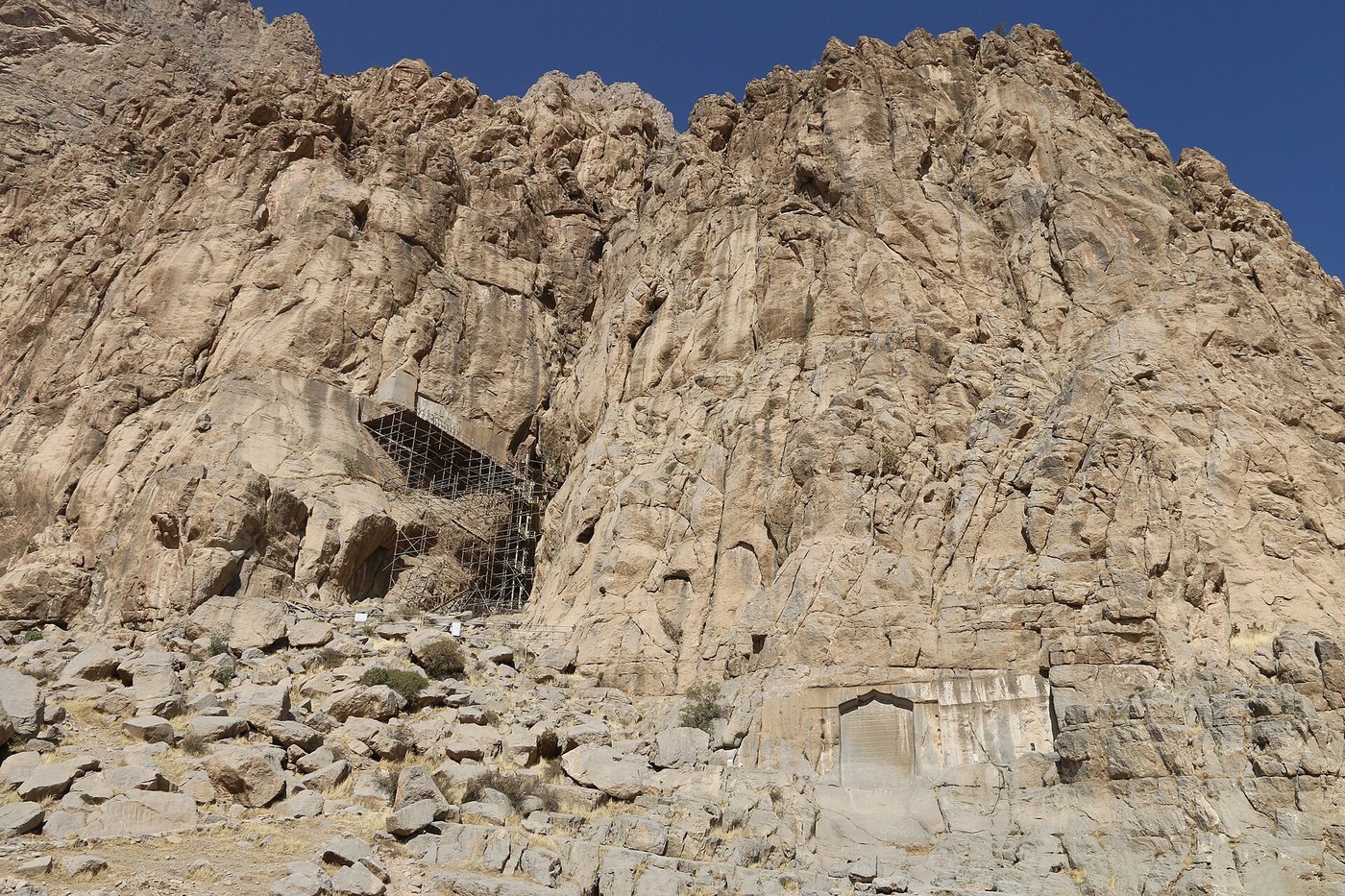
The year everything came apart
To understand why a king would go to such trouble, you have to know what he was trying to bury. In 522 BCE the Persian empire built by Cyrus the Great was barely a generation old and already tearing itself in half. Cyrus was dead. His son Cambyses had marched off to conquer Egypt and had done it, but while he was away trouble grew at home, and on the way back he died, suddenly, and in circumstances no one could quite pin down.
What happened next is where the trouble starts. According to the story carved at Behistun, a man rose up in Persia claiming to be Bardiya, the younger son of Cyrus and Cambyses' own brother. The claim worked. Provinces went over to him. The empire acknowledged him as king. But he was, the inscription insists, a fraud: not Bardiya at all, but a magus, a priest, named Gaumata, who merely looked like the dead prince and seized the throne on the strength of the resemblance. The real Bardiya, the text says, had been secretly murdered by Cambyses years before, and nobody knew.
Into this stepped Darius. He was a Persian nobleman, a spear-carrier in Cambyses' guard, related to the royal house but not remotely next in line. With six other conspirators he broke into the usurper's stronghold and killed him. And then, having removed the man the whole empire had accepted as king, Darius took the crown himself. That is the account he wanted carved into a mountain, in letters as tall as a person, above the road where the world walked past.
The king with his foot on a corpse
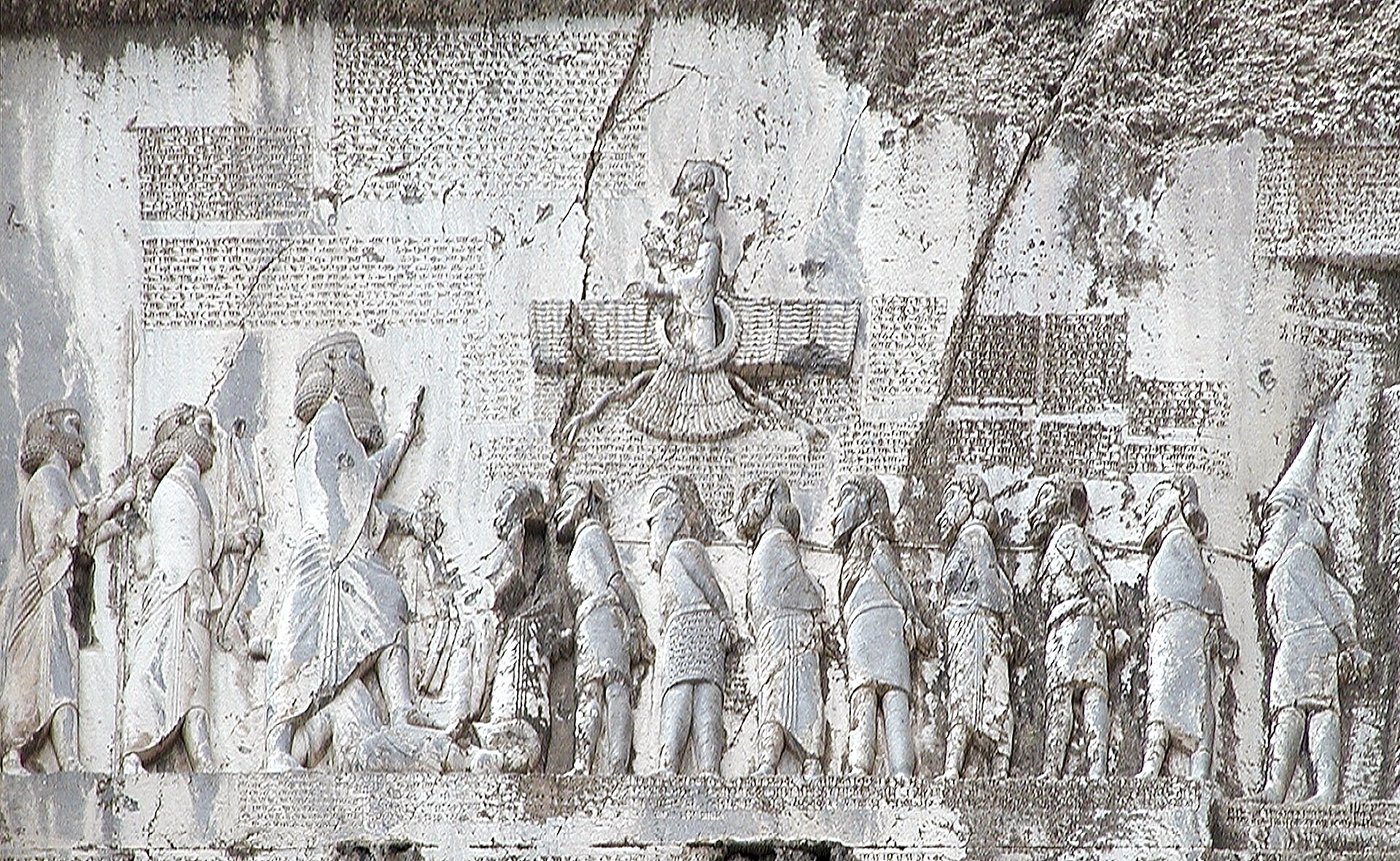
The picture makes the argument before the words do. In the centre of the relief stands Darius, larger than everyone around him, a bow in his hand as the mark of a true king. He has raised one arm towards a winged disc that floats above the scene: the symbol later readers call the faravahar, a sign of divine favour, of Ahura Mazda, the great god Darius credits with putting him where he stands. Behind the king wait two attendants with his weapons.
And under his left foot lies a man on his back, arms raised in a useless plea. That is Gaumata, the usurper, trampled into the rock for as long as the rock lasts. It is one of the oldest surviving images of a ruler standing on the body of the enemy he has beaten, and it does not need translating. Power, the picture says, looks like this.
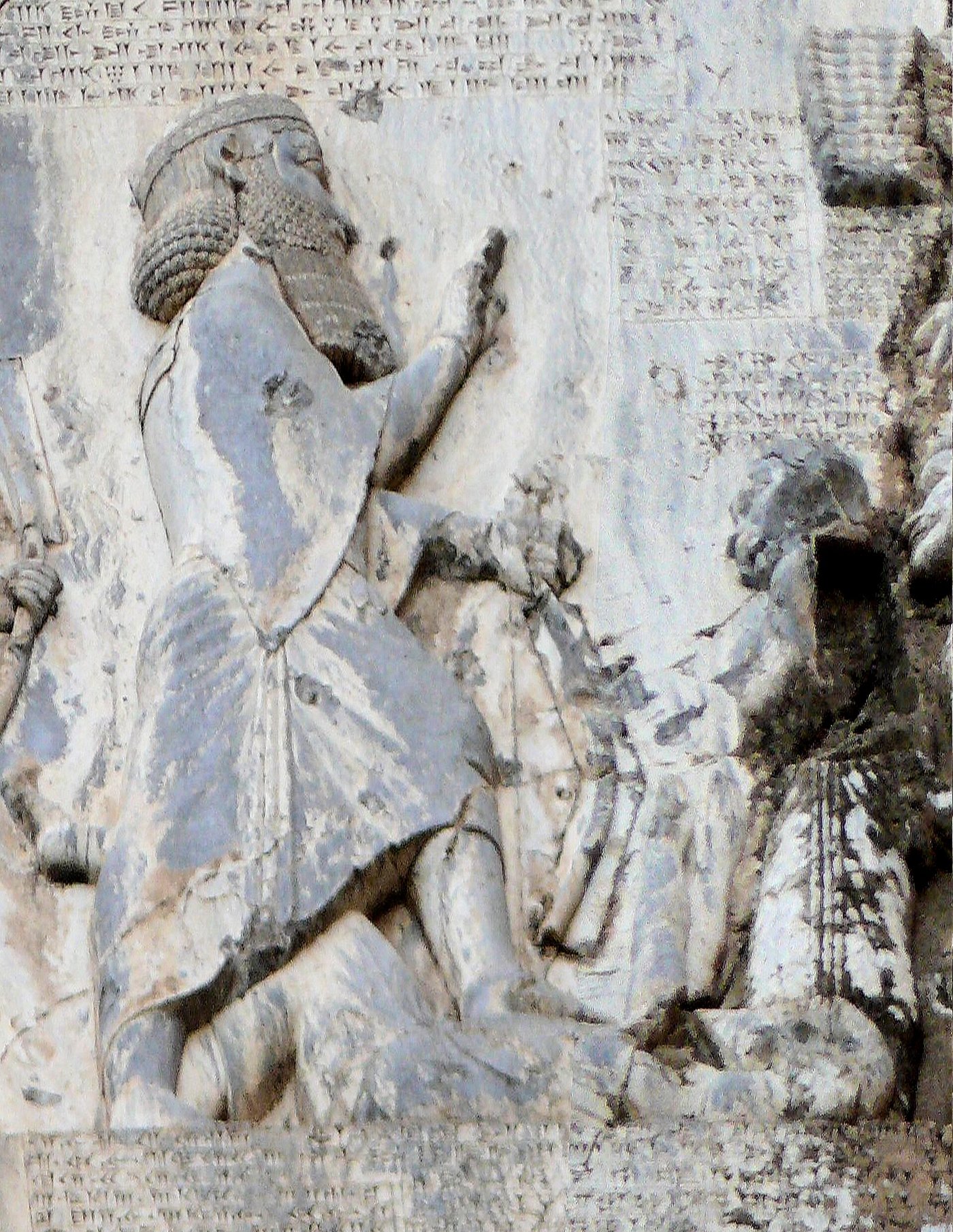
Not everyone believes Darius. The trouble is neat: the only man with a strong motive to invent an impostor is the man who killed the sitting king and took his place. If the ruler Darius struck down really was Bardiya, the true son of Cyrus, then Darius was not a rescuer of the realm but a usurper, and the whole tale of the magus Gaumata is a cover story carved to last. Some historians point out how convenient it all is: a secret murder years earlier that no one witnessed, a fraud so perfect that even the dead man's household was fooled, and a saviour who just happened to end up wearing the crown. Others defend the account, noting that Greek writers who had no reason to flatter Darius tell a version close to his. There is no document to settle it. What survives is one side of the story, told by the winner, cut into stone before anyone could write the other.
Nineteen battles in a single year
Killing the usurper did not hand Darius a quiet empire. It set it on fire. The moment the throne changed hands, province after province rose in revolt: Babylon, Media, Elam, Persia itself, Parthia, the lands out towards the Aral Sea. Each rebellion threw up its own king, and several of those kings, like Darius's own enemy, claimed to be someone they were not: a lost heir, a returned prince, a name with a right to rule. For a man who had just taken power by exposing one impersonator, the empire was suddenly full of them.
The inscription counts the reckoning coldly: nineteen battles in a single year, nine rebel kings defeated, captured and dealt with. They stand in a row along the relief to the right of Darius, roped together at the neck, hands bound behind them, each labelled so there could be no doubt who he had been. Some are shown in the moment before a brutal end. The message to any future rebel reading the picture (or, more likely, hearing it described) was exact. This is the line you would join.
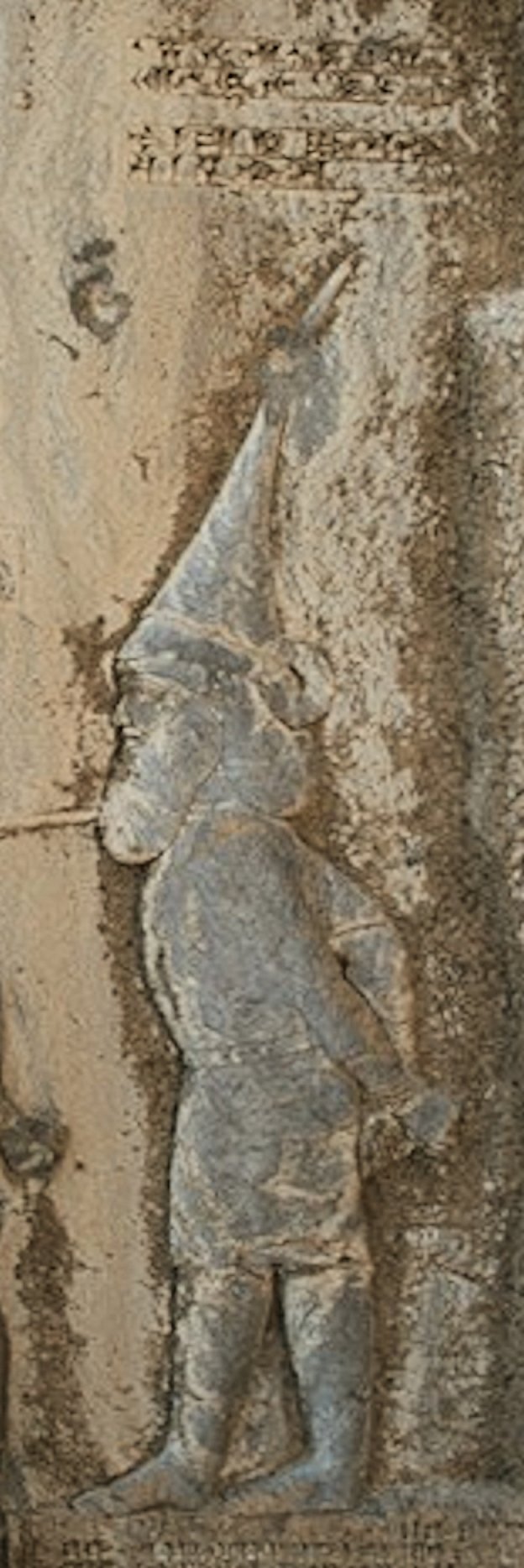
Look at the far end of the roped line and one captive does not match the others. He wears a tall pointed cap and stands slightly apart. This is Skunkha, a leader of the Saka (Scythian nomads from beyond the empire's edge), and he was an afterthought. Darius defeated him a year or two after the panel had, it seems, been finished. Rather than leave the victory off the mountain, the carvers went back and squeezed Skunkha in at the end. To fit him they had to destroy part of the inscription already there, cutting away a block of the Elamite text and re-carving it elsewhere. The monument, in other words, was edited. The record we treat as fixed and ancient was updated at least once, to keep the list of the beaten complete.
Why say it three times?
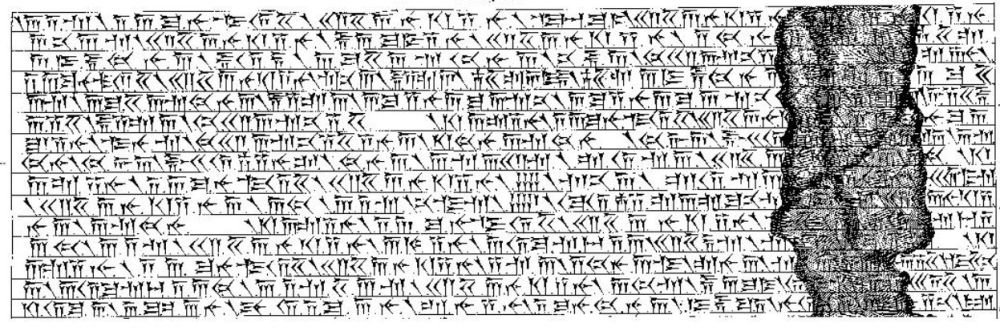
Darius did not carve his story once. He carved it three times over, in three different languages and three different cuneiform scripts, stacked and wrapped around the figures. There is Old Persian, the tongue of the ruling house; Elamite, the old administrative language of the region; and Babylonian, the Akkadian of Mesopotamia, the language of the empire's richest and most rebellious province. It was a message aimed at every literate audience that mattered.
The Old Persian version carries a small revolution of its own. The script it uses appears to have been more or less brand new: a simplified, partly alphabetic cuneiform that may have been devised on Darius's own order, perhaps for this very inscription. In the text, Darius seems to boast that he had created a written form of the language that had not existed before. If that is right, then one of the first things ever written in Old Persian was this: an account of how he took the throne. A new alphabet, invented to tell you the king was in the right.
The man on the ropes
By the early nineteenth century, Europe knew that cuneiform existed and had no idea how to read it. The wedge marks turned up on bricks and cylinders brought back from the East, beautiful and blank. A German schoolteacher named Georg Friedrich Grotefend made the first real crack around 1802, working from short royal inscriptions and a clever guess: that certain repeated groups of signs were the names and titles of known Persian kings. He worked out a handful of Old Persian characters from a desk in Göttingen, without ever seeing Persia. It was a start, and it stalled. To go further, someone needed a long text, a very long text, and someone had to go and get it.
That someone was Henry Rawlinson, a young officer of the East India Company posted to Persia, part soldier, part scholar, wholly obsessed. From about 1835 he set himself to copy Behistun. This meant climbing. The Old Persian panel could be reached only from a narrow ledge at the foot of the inscription, and to read the upper lines he stood on the top rung of a ladder, one arm hooked for balance, notebook in the other hand, copying wedge by wedge with the drop falling away beneath him. He went back year after year. It cost him, by his own account, the better part of a decade.
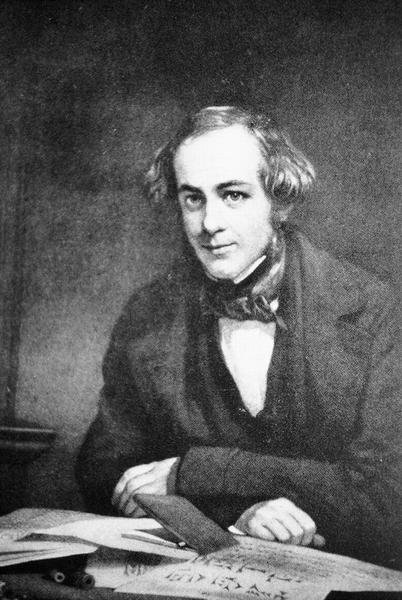
The hardest part was the Babylonian text, carved on a face so smooth and overhanging that no ladder would serve. Rawlinson's answer, in the 1840s, was to hire help. A local Kurdish boy, agile and fearless, worked his way up the bare rock where a grown man could not, drove pegs, slung a rope, and swung across the face to press damp paper into the carved signs. When the paper dried it held the shape of every wedge: a squeeze, a mould of the text in reverse. The boy brought down what Rawlinson could not reach. Much of what the West first learned to read of Babylonian came off that cliff on sheets of paper carried by a child.
Before cameras could handle the job, the surest way to copy a carving was to make a squeeze. You lay wet, tough paper (several layers of it) over the inscription and press it into every groove with a brush or a stiff bristle, forcing the fibres down into each cut wedge. Left to dry against the stone, the paper sets into a firm cast, a mirror image of the surface that you can peel away and carry off. For a text a hundred metres up a cliff, it meant the writing could be studied at a table in London instead of from a ladder in the Zagros. The squeezes were fragile, and many later crumbled, but for a while they were the closest thing the world had to the original.
One side of the story, carved to last
With a long text in hand and Grotefend's foothold to build on, the reading came. Through the 1840s and 1850s Rawlinson and a scattered group of rivals and collaborators, among them the Irish clergyman Edward Hincks and the French-German scholar Jules Oppert, turned the wedges into words. Old Persian fell first. Then, using the same content in the harder scripts, they cracked Elamite and, hardest of all, Babylonian. To prove they were not fooling themselves, four scholars were once given the same unseen inscription to translate independently; their versions agreed closely enough that the doubters went quiet. Cuneiform was readable. Everything written in it (the laws, the letters, the epics, the accounts of empires no one had been able to hear from directly for millennia) was suddenly open. Behistun had done for Mesopotamia what the Rosetta Stone did for Egypt.
Which leaves the awkward question of what, exactly, it says. It is tempting to read a royal inscription as a report, a thing that tells you what happened. Behistun is not that. It is an argument, the oldest piece of political spin to survive at full length, and it survives precisely because it was carved by the side that won.
The easy reading: Behistun is a historical record, a first-hand account, written at the time by the man at the centre of events, of how Darius put down an impostor and saved the Persian empire from a year of chaos.
The harder truth: it is a first-hand account, and that is exactly the problem. Everything in it serves Darius. The god is on his side, the enemies are all liars and frauds, the killings are all justice. We have almost no independent voice from the losers, the nine roped kings, or the man beneath his foot. Behistun is priceless not because it is neutral but because it is so nakedly not: a record of what one powerful man needed the future to believe, cut where the future could not ignore it.
What the mountain kept
The monument outlasted the empire that made it by a very long way. The Achaemenid dynasty fell to Alexander two centuries later; Persia was conquered and reconquered; the road below carried Parthians, Sasanians, Arab armies, Mongols, and eventually motor traffic. Through all of it the carving stayed where it was, too high to reach and, for most of history, too strange to read. Later travellers guessed at it wildly: a school of teachers, a portrait of the twelve apostles, anything but what it was.
It has not come through untouched. During the Second World War, soldiers passing through Iran reportedly used the ancient figures for target practice, and there are bullet scars on the rock to show for it. Water seeping through the limestone has done slower damage. In the twentieth century, expeditions from the British Museum and from American universities went back with cameras, casts and better ladders to record what Rawlinson had risked his neck for, filling in the lines he had missed. In 2006 the site was made a UNESCO World Heritage monument, protected at last.
Stand on the road today and the panel is still there, still high, still watching the traffic. A king cut it to win an argument he was having in 520 BCE, and in the narrow sense he won it: his version is the one that survived, and for a long time it was the only one anyone could read. But the cliff kept something he never meant to leave. It kept the seams where the story was edited, the late-added rebel, the boastful new alphabet, the trampled man with his arms raised. Read closely, the monument built to end all doubt is the thing that lets us doubt it. That is the strange gift of writing that lasts. It preserves the lie exactly as carefully as the truth, and hands both to whoever finally learns to read.
Read next: Cyrus Cylinder: The Clay Barrel Sold as the First Bill of Rights.
Sources & further reading
- Herodotus, The Histories, Book 3 — the Greek account of Cambyses, the false Smerdis and the seven conspirators, written within a century of the events.
- Kuhrt, Amélie, The Persian Empire: A Corpus of Sources from the Achaemenid Period — the Behistun text in translation, with commentary on its reliability.
- Briant, Pierre, From Cyrus to Alexander: A History of the Persian Empire — the standard modern history, weighing the Gaumata story against the case for Darius as usurper.
- Adkins, Lesley, Empires of the Plain: Henry Rawlinson and the Lost Languages of Babylon — a full narrative of the copying of the cliff and the race to read cuneiform.
- Encyclopaedia Iranica, “Bisotun” entries — detailed scholarly treatment of the relief, the inscriptions and the site's later history.
- UNESCO World Heritage Centre, “Bisotun” listing — the site description and the grounds for its 2006 inscription.
Image credits (via Wikimedia Commons): the Behistun relief panel — public domain; the cliff at Behistun — Mahdimanavimvi (CC BY-SA 4.0); Darius and the fallen Gaumata — Patrick C (“dynamomosquito”) (CC BY-SA 2.0); the rebel Skunkha — Leen van Dorp (CC0); Old Persian cuneiform, Behistun column 1 — public domain; Sir Henry Creswicke Rawlinson — portrait by Henry Wyndham Phillips, public domain.