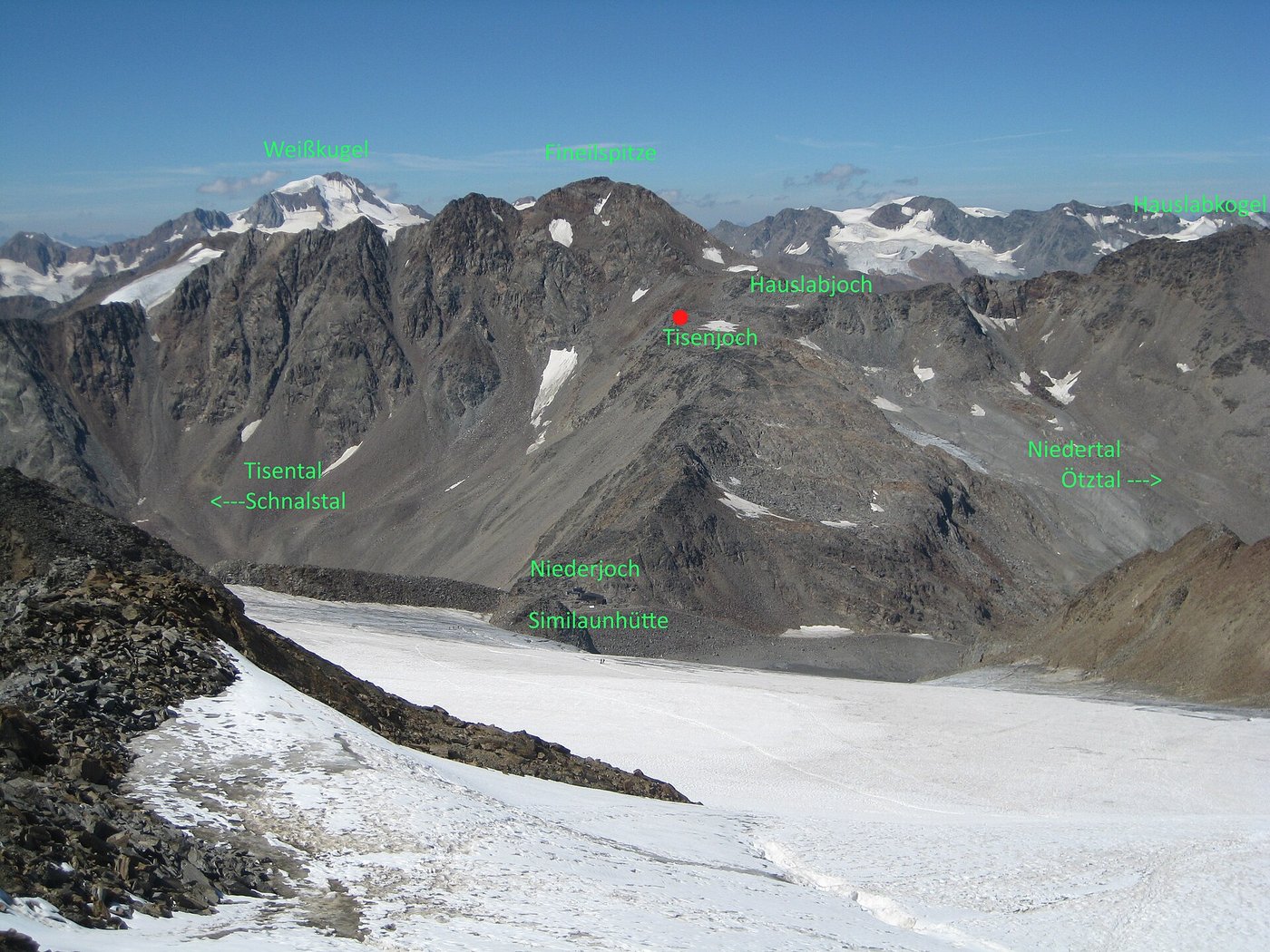
On 19 September 1991, two German hikers named Helmut and Erika Simon left the marked path on their way down from a peak in the Ötztal Alps, hoping to save a little time. At about 3,210 metres, on a rocky saddle called the Tisenjoch, they saw something brown sticking out of the meltwater at the edge of the ice. Erika thought it was a doll. It was a head and a pair of shoulders, face down, the skin the colour and texture of old leather. The Simons assumed they had found a climber who had died a few years earlier; the Alps give up such bodies every summer. They photographed him, walked on, and reported the find at their guesthouse that evening. Nobody realised for another two weeks that the dead man on the Tisenjoch had been lying there since roughly 3,300 BC.
He is known now as Ötzi, after the valley where he was found, and he is the most closely examined human being who has ever lived. More than 5,300 years after his death, we know what he ate for his last meal, what illnesses he carried, the shape of his family tree, the source of the copper in his axe, and, because it took a decade for anyone to look in the right place, the fact that he did not die of exposure at all. Someone shot him in the back.
A very badly handled recovery
Almost everything about the first few days went wrong. Because everyone assumed the body was modern, it was treated like a routine mountain recovery rather than an archaeological site. An Austrian police officer arrived with a pneumatic drill and tried to chip the corpse free of the ice. The drill tore through the man's left hip and destroyed part of his clothing. Ski poles and an ice axe were used to lever him out. Curious hikers wandered over to look; at least one picked up items lying nearby.
By the time the body reached the Institute of Forensic Medicine in Innsbruck on 24 September, a small pile of objects had come out of the ice with it: scraps of leather and grass, a copper-bladed axe, a wooden frame that nobody could identify. It was the axe that finally set off alarms. The archaeologist Konrad Spindler examined it and said, within minutes, that the find was at least four thousand years old. Radiocarbon dating soon pushed the figure further still, to somewhere between 3350 and 3100 BC. The man on the Tisenjoch had died in the Copper Age, a thousand years before the first stones went up at the centre of Stonehenge.
Then came the second problem: nobody was sure which country he belonged to. The Tisenjoch straddles the Italian–Austrian frontier, and the border here follows the watershed rather than a surveyed line. A formal survey settled it in October 1991. The body had been lying 92.56 metres inside Italy. Austria had done the excavating and the early study; Italy owned the man. After several years of negotiation and preservation work in Innsbruck, he was moved in 1998 to the South Tyrol Museum of Archaeology in Bolzano, where he lies today in a purpose-built cold cell held at about −6°C and 99 per cent humidity, visible through a small window roughly the size of a paperback.
The ice that preserved Ötzi did not freeze him solid in the usual sense. He came to rest in a shallow rock gully that filled with snow, and the glacier flowing above passed over the top of that hollow rather than through it. For 5,300 years the ice ground its way across the mountain a few metres above his body without ever crushing or carrying it away. Had he fallen thirty metres in almost any direction, he would have been milled into fragments and scattered down the valley.
The man in the ice
He was between about 40 and 50 years old when he died, which in his world made him comfortably middle-aged rather than old. He stood around 1.60 metres and weighed perhaps 50 kilograms, small by modern standards, though not unusually so for his time. His body has been X-rayed, CT-scanned, sampled and sequenced so many times that the museum now has strict rules about how long he may be out of the cold.
The medical picture is grim in a very ordinary way. His joints were worn. His arteries were already hardening, and the calcification is visible on scans. He had the cardiovascular profile of a man at real risk of a heart attack, despite a life of walking mountains and a diet with no processed food in it. He had gallstones, whipworm in his gut, and Lyme disease: the bacterium Borrelia burgdorferi turned up in his DNA, making him the earliest known human case by several thousand years. He was lactose intolerant, like most adults of his period. His fingernails show three separate lines of arrested growth, the kind left by illness or serious stress, in the last six months of his life.
He also carried 61 tattoos. They are not pictures. They are simple lines and crosses, made by cutting the skin and rubbing charcoal into the wound, and they cluster in a way that has interested researchers for decades: on the lower back, the knees, the ankles, the wrist, largely over joints that the scans show were arthritic and painful. Whether this was medical treatment, ritual, or both is still argued about, but the correlation with his sore joints is hard to dismiss as coincidence.
What the genome revised
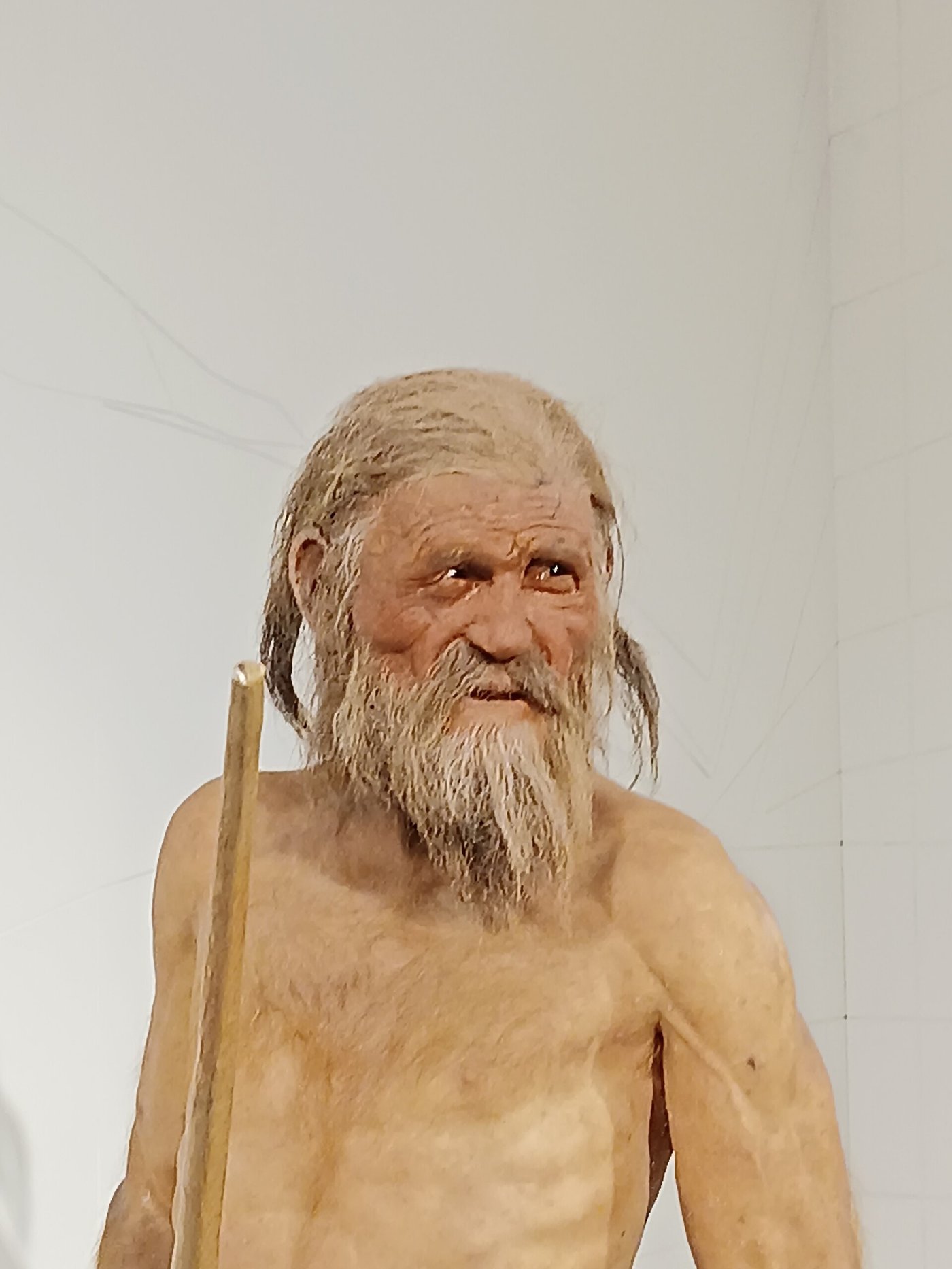
The first attempt at Ötzi's full genome, published in 2012, produced a portrait that was widely reproduced: a pale-skinned, shaggy-haired European. In 2023 a team led by Johannes Krause of the Max Planck Institute for Evolutionary Anthropology, working with Albert Zink at Eurac Research in Bolzano, sequenced him again at far higher coverage, and found that the earlier result had been contaminated with modern human DNA. The corrected genome changed the picture in two noticeable ways.
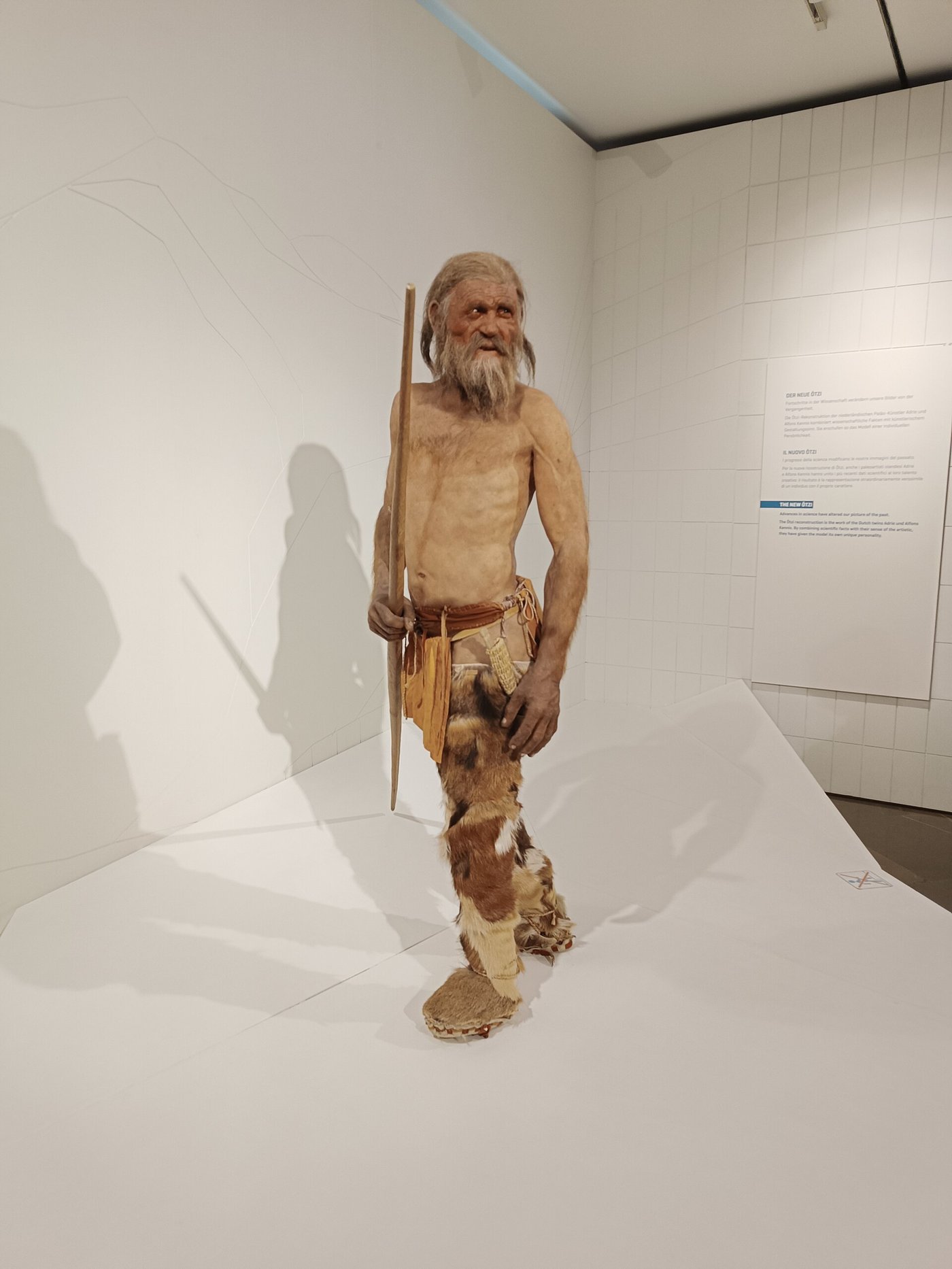
First, his skin was considerably darker than any museum model had shown. Not African-dark, but distinctly darker than modern northern Europeans, and closer to the skin tone of present-day people around the Mediterranean. Light skin spread through Europe later than the popular story suggests, and Ötzi sits before that shift. Second, he was going bald. He carried the genetic variants for male-pattern hair loss and was probably well advanced in it by 45, which neatly explains something that had puzzled the museum for years, namely that almost no hair was found with the body.
The ancestry result was the strangest part. Roughly 92 per cent of Ötzi's ancestry traces to early Anatolian farmers, the population that carried agriculture into Europe from what is now Turkey. That is a higher proportion than in any other European genome yet recovered from his period. There is essentially no Steppe herder ancestry in him at all, and very little from Europe's older hunter-gatherers. His farming ancestors appear to have arrived in the Alps and stayed put, marrying among themselves, in a valley system that acted like a genetic cul-de-sac. A 2025 study of 47 genomes from people who lived in the Tyrol between 6400 and 1300 BC found the same pattern across the whole region: 80 to 90 per cent Anatolian farmer ancestry, holding steady for millennia while the rest of Europe churned.
"Ötzi was a pale, hairy, fur-clad caveman — the standard image of a primitive European ancestor, frozen mid-struggle against a hostile wilderness."
He was a dark-skinned, balding, middle-aged farmer's descendant with heart disease and arthritis, wearing carefully tailored clothing made from five different animals, carrying a copper axe worth a small fortune. He was not fighting the wilderness. He lived in a settled, connected, technologically sophisticated world, and he died in it, at the hands of another person.
The kit
What he was carrying tells you more about his society than his bones do. The axe is the headline object: a blade of 99.7 per cent pure copper, hafted to a yew handle with birch tar and leather binding. In 2017, lead-isotope analysis matched the metal not to any Alpine source but to ore from southern Tuscany, several hundred kilometres away. Copper of that quality in 3300 BC was rare and expensive. Whatever Ötzi was, he was not poor, and the trade networks reaching his valley were long.
The rest of the equipment is oddly unfinished. He carried a yew longbow 1.82 metres long, taller than he was, that had not been completed. His quiver held fourteen arrow shafts, of which only two were fitted with flint heads and fletched, and the quiver itself had a broken strap. He had a small flint dagger with a woven grass sheath, a retoucheur for sharpening flint, and a copper-age first-aid kit of sorts, including two pieces of birch polypore fungus threaded on leather strips. The fungus has antibacterial and antiparasitic properties, and he had whipworm. He also carried an ember carrier lined with maple leaves for transporting fire, and two birch-bark containers.
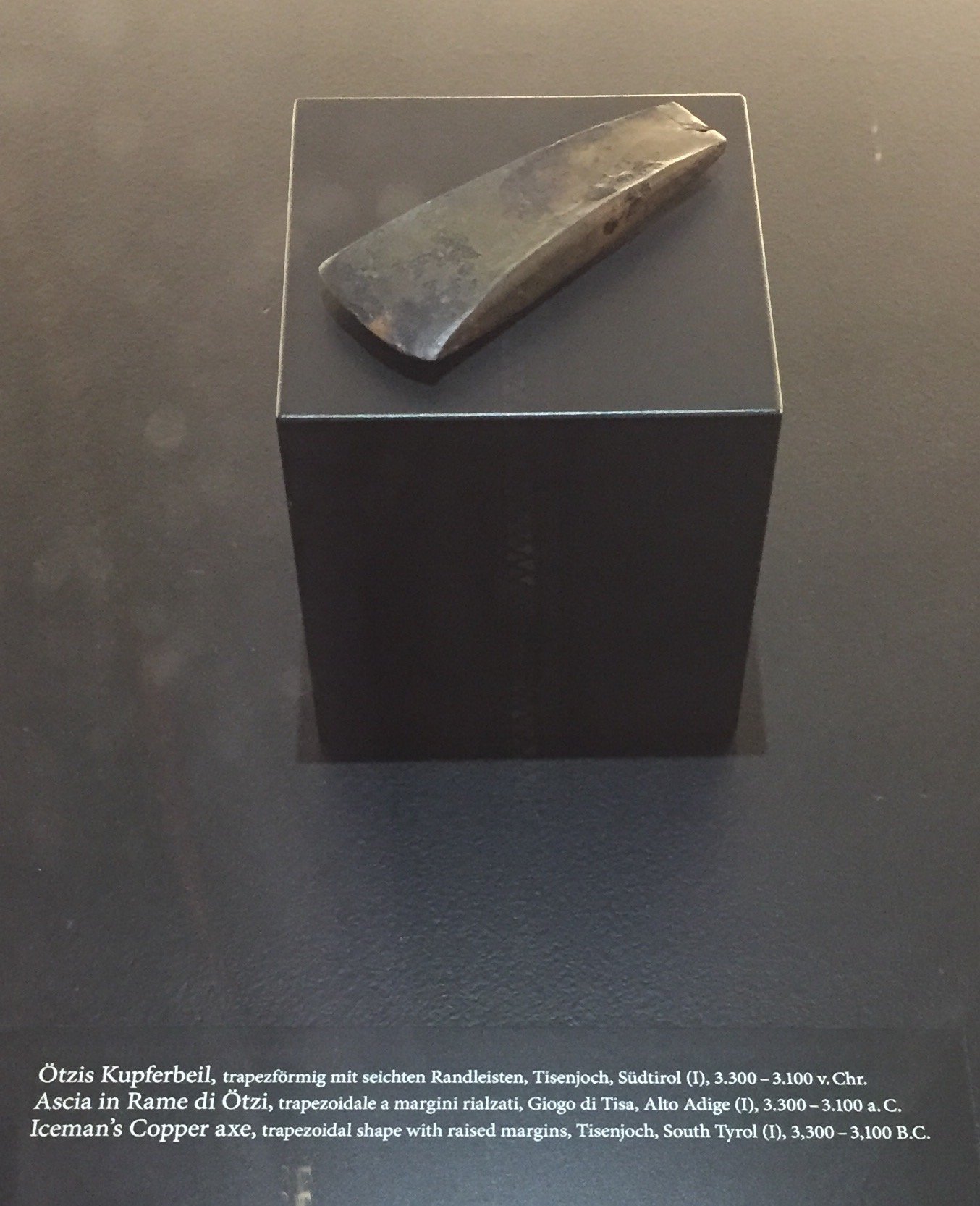
His clothing was equally considered. A coat of alternating light and dark goat and sheep hide, stitched in panels. Goatskin leggings. A loincloth and a belt with a pouch. A bearskin cap with a chin strap. A cloak of woven grass or bast that would have shed rain and doubled as a mat. Shoes with bearskin soles, deer-hide uppers and an inner net of bast string, packed with grass for insulation; reconstructions of them perform surprisingly well on ice and snow. Five different species went into his outfit, some domestic and some hunted.
"Ötzi has more ancestry in common with early Anatolian farmers than any of his European counterparts. The genome analysis revealed phenotypic traits such as high skin pigmentation, dark eye colour, and male pattern baldness that are in stark contrast with previous reconstructions."— from the 2023 high-coverage genome study of the Iceman, published in Cell Genomics
The arrowhead nobody found for ten years
For the first decade after his discovery, the assumption was that Ötzi had died of cold and exhaustion: caught by weather high on the pass, lying down in the gully, and never getting up. Konrad Spindler's influential early theory had him fleeing some kind of disaster in his home village. It was a sad story, but not a criminal one.
In June 2001, a radiologist in Bolzano named Paul Gostner was reviewing the CT scans and noticed something dense in the left shoulder that had been photographed but never interpreted. It was a flint arrowhead, roughly two centimetres across, buried in the muscle beneath the shoulder blade. It had entered from behind, torn through the subclavian artery, and lodged near the lung. The shaft had been pulled out, either by Ötzi himself or by whoever shot him, leaving the head inside.
That injury is not survivable. Damage to the subclavian artery causes massive internal bleeding; a modern patient would need a surgeon within minutes. Ötzi would have lost consciousness quickly and died shortly after, which fits the position his body was found in: he was lying face down but had probably fallen onto his left side, and the hollow filled with snow around him.
Once anyone was looking for violence, more of it appeared. He had a deep cut across the base of his right thumb, running almost to the bone: a defensive wound, the sort you get grabbing at a blade. It had begun to heal, so it was inflicted a day or two before he died. He had bruising and broken ribs. A 2012 re-examination of the scans found evidence of a blow to the back of the head, and some researchers now argue that this, rather than blood loss, was the immediate cause of death, and that someone finished him off after the arrow struck him. Earlier work also reported traces of blood from up to four different people on his gear: on the dagger, on two arrowheads, and on his coat. That analysis has been questioned since, but if it holds, Ötzi's last days involved more than one other body.
His last meal
The most human detail of all came out in 2018, when researchers finally located his stomach. It had been missed for years because the contents had pushed upwards under the ribcage during mummification, and nobody had looked that high. The stomach was full; he had eaten a substantial meal within an hour or two of dying.
He had eaten ibex meat and fat, some red deer, einkorn wheat, and traces of bracken fern. The fat content was extraordinary, close to half the meal by weight, which makes complete sense for someone working at altitude in autumn. The meat had been dried or lightly cured rather than cooked fresh. Pollen recovered from his gut adds a final touch of precision: hop hornbeam pollen, still intact and from a tree that flowers in a narrow window, places his death in spring or early summer, and shows that he had descended into the valley and climbed back up to over 3,000 metres in the space of his final day or two.
So the last hours look something like this. A man in his forties, already hurt, with a cut hand and cracked ribs, climbs from the valley floor to a high pass carrying an unfinished bow and a quiver of mostly unfinished arrows. Near the top he stops and eats well, a proper meal, not a snack, which does not suggest panic. Then somebody standing below and behind him puts an arrow through his shoulder from perhaps thirty metres away. He goes down. His axe, a valuable object, is left beside him rather than taken.
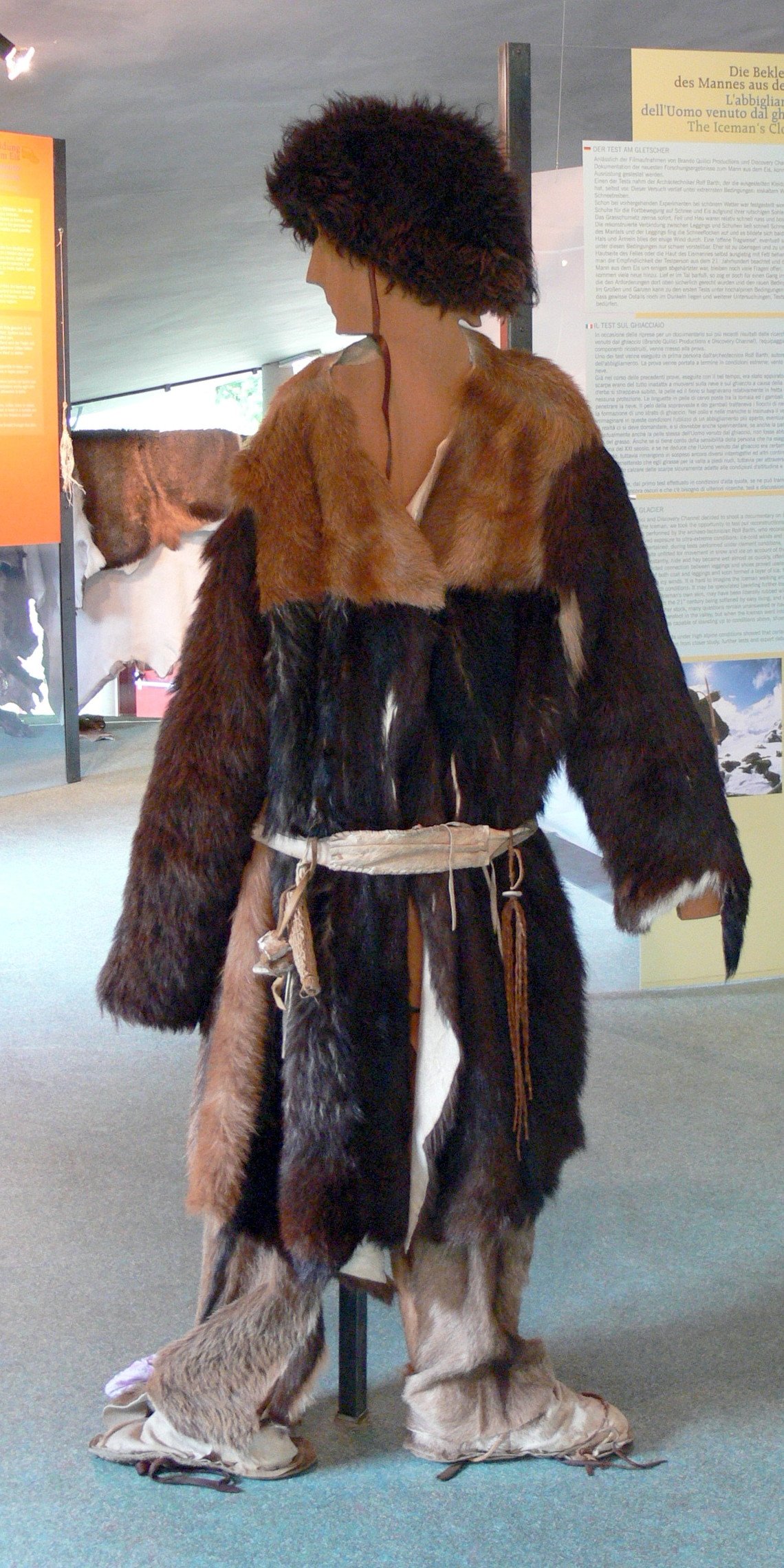
Nobody agrees on the motive, and the physical evidence points in awkward directions. That the killer left the copper axe behind argues strongly against robbery. It was the single most valuable thing on the mountain that day. Some researchers read that as a personal killing, a feud or a revenge attack, where the point was the man rather than his property. Others suggest a ritual or judicial execution, or that the axe was left deliberately as part of a burial. A minority still argue the site was a formal grave rather than the place he fell, though the body's position and the scattering of his gear make that a hard case. There is also no consensus on whether the arrow or the head injury actually killed him. Five thousand years on, the forensics are astonishingly good and the story around them is still guesswork.
A body that is still doing things
Ötzi keeps producing new results, which is unusual for a corpse. In June 2026, a study in the journal Microbiome reported that the mummy is not an inert object at all but what the authors called a dynamic ecosystem. Several species of cold-adapted yeasts (Glaciozyma, Goffeauzyma, Mrakia and Phenoliferia) were found both on his skin and inside the body. These almost certainly colonised him on the mountain and froze along with him, and their natural cold tolerance kept them dormant rather than killing them.
The surprise was that when samples were brought into laboratory conditions, some of these organisms were still metabolically active. The authors suggested they may not be dormant relics but slow-growing populations living in tiny pockets of moisture within the mummy. For the museum in Bolzano this is a preservation headache; for microbiologists it is a rare look at how life survives thousands of years of freezing. It also raises an odd question about what "dead" means for a specimen that has been under continuous scientific observation since 1991.
One man, on one afternoon
The reason Ötzi has held public attention for thirty-five years is not that he is old. Older human remains exist. It is that he is specific. Archaeology usually deals in populations, averages, and centuries. Ötzi gives us one man on one afternoon: the meal in his stomach, the sore knee he had tattooed, the shoes he packed with grass that morning, the argument he presumably had a day or two earlier that left a knife wound across his thumb.
He also complicates the story we like to tell about the deep past. His world had long-distance copper trade, tailored multi-species clothing, effective medicine, and specialist toolmaking. It also had someone willing to shoot a man in the back at 3,200 metres and walk away without taking anything. The technology of 3300 BC turns out to be more impressive than most people expect, and the behaviour entirely familiar.
The case will probably never be closed. But it is worth remembering how it was nearly lost altogether: two hikers taking a shortcut, a police drill through the hip, a decade before anyone thought to look for an arrowhead. The most thoroughly studied human being in history spent his first ten years in a museum being misdiagnosed as a man who simply got cold.
Image credits (via Wikimedia Commons): reconstruction of Ötzi — Mannivu (CC BY-SA 4.0); the Tisenjoch discovery site — Mai-Sachme (CC BY-SA 4.0); facial reconstruction detail — Mannivu (CC BY-SA 4.0); the Iceman's copper axe — АлександрЛаптев (CC BY-SA 4.0); reconstructed clothing at the Archeoparc museum — Wolfgang Sauber (CC BY-SA 3.0).
Read next: Tollund Man: The Bog Body Still Wearing the Noose That Hanged Him and Siberian Ice Maiden: The Tattooed Mummy Blamed for the Earthquakes.
Sources & further reading
- Ke Wang, Johannes Krause, Albert Zink et al., "High-coverage genome of the Tyrolean Iceman reveals unusually high Anatolian farmer ancestry," Cell Genomics (2023).
- South Tyrol Museum of Archaeology, Bolzano — official Iceman research and conservation pages (iceman.it).
- Frank Maixner et al., "The Iceman's Last Meal Consisted of Fat, Wild Meat, and Cereals," Current Biology (2018).
- Research published in Microbiome (2026) on persistent and metabolically active cold-adapted microorganisms in the Iceman mummy, reported June 2026.
- Konrad Spindler, The Man in the Ice (1994) — the standard account of the discovery and the early years of study, though several of its conclusions have since been overturned.
- Gilberto Artioli et al., lead-isotope analysis tracing the copper of the Iceman's axe to southern Tuscan ore, PLOS ONE (2017).