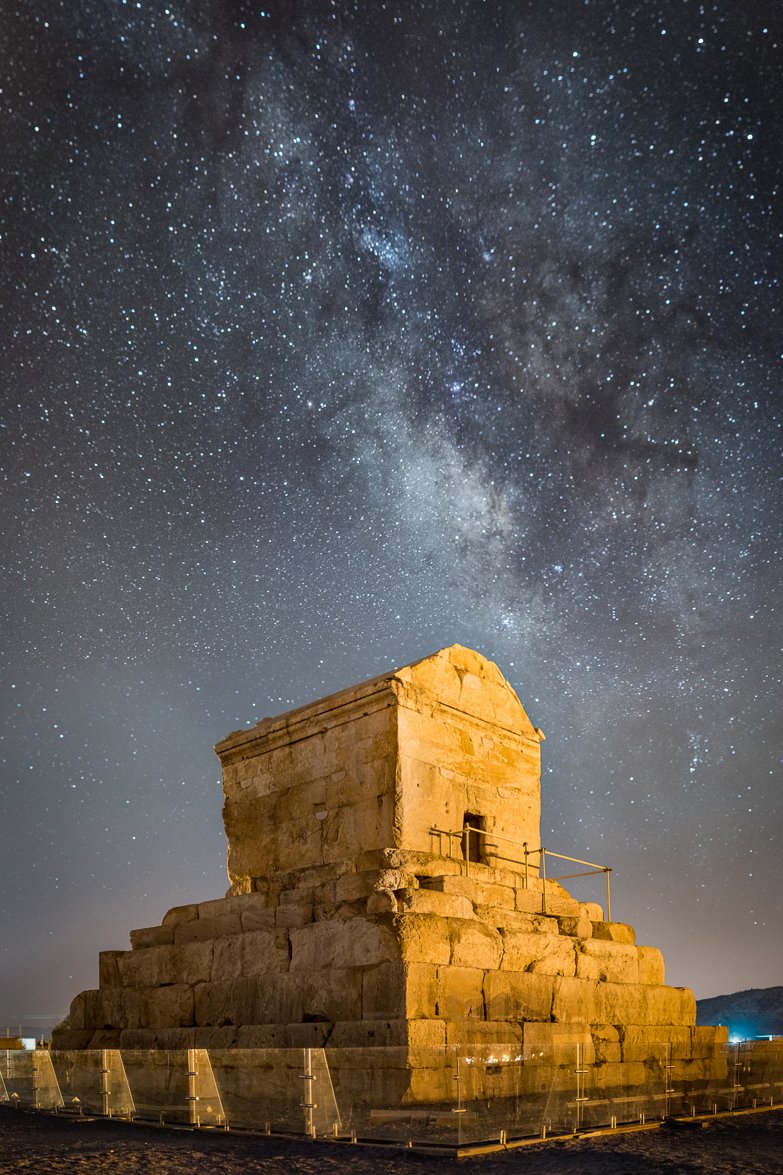
In October 1971, in the desert near Persepolis, the Shah of Iran threw a party for a dead king. Heads of state ate off Limoges china under air-conditioned tents while a recorded voice addressed the tomb of Cyrus the Great: “Sleep easily, for we are awake.” At the centre of the story Iran was telling about itself sat a small, broken cylinder of baked clay. The government called it the first charter of human rights in history. A few days later, in New York, the Shah’s sister handed a replica of it to the Secretary-General of the United Nations, who accepted it for the organisation. It is still there.
The object they were talking about is real, and it is remarkable. Almost nothing said about it that day was true.
A barrel of clay, not a decree on a wall
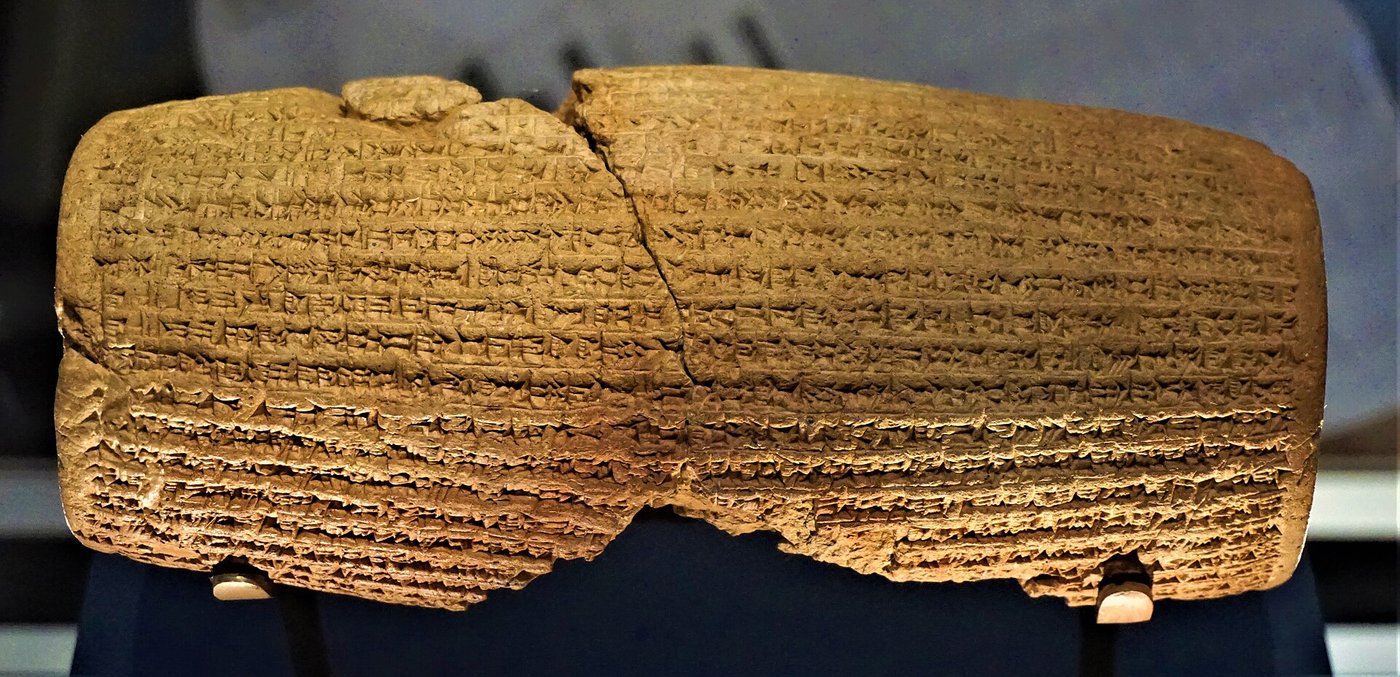
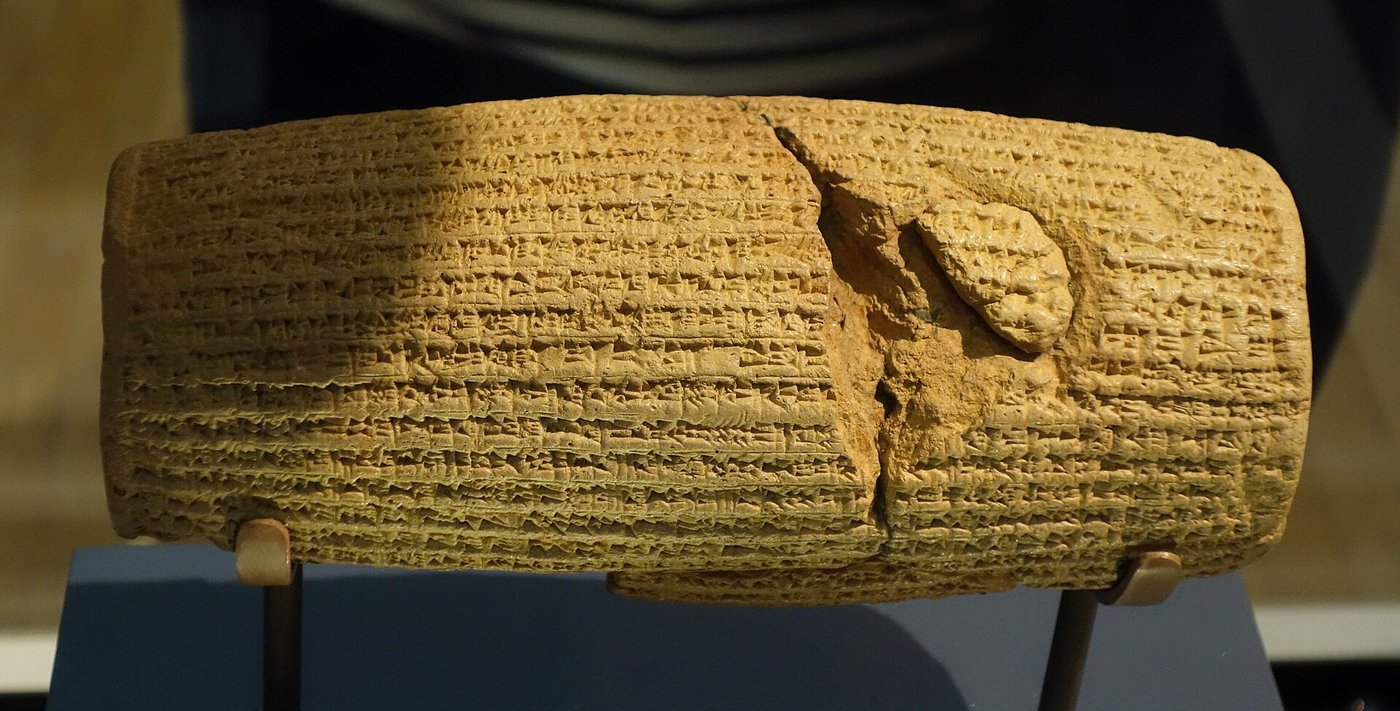
Start with the thing itself, because the thing itself is modest. The Cyrus Cylinder is a lump of baked clay shaped like a rugby ball with the ends knocked off, about twenty-two centimetres long. Around it run forty-five lines of tight Babylonian cuneiform, the wedge-shaped script pressed into the wet clay with a cut reed before firing. It is cracked across the middle and a corner is gone. It looks like what it is: something old, dug out of the ground, handled by a lot of people who did not know what they had.
Here is the first surprise. It was never meant to be seen. A charter is a public thing: you carve it on a monument, you read it aloud, you nail it to a door. This was a foundation deposit. Mesopotamian kings had a habit of burying inscribed objects inside the walls and platforms of the temples they rebuilt, sealed away where no living person would read them. The audience was the gods, and perhaps some future king who might dig down to the old footings. Cyrus’s cylinder was pushed into a wall of Babylon and left in the dark. It stayed there for roughly twenty-four centuries.
Rassam’s trench at Babylon
The man who found it was not looking for a manifesto either. Hormuzd Rassam was an Assyrian Christian from Mosul, one of the few nineteenth-century excavators of the ancient Near East who actually came from the region he was digging. He had learned the trade under Austen Henry Layard at Nineveh, and by 1879 he was working across Mesopotamia for the British Museum, shipping crates of tablets and sculpture back to London by the hundred.
That spring his workmen were digging in the ruins of Babylon, in the mound that covered the Esagila, the great temple of Marduk, the city’s chief god. Somewhere in the old brickwork the cylinder came up. It went into a crate, crossed a continent and an ocean, and landed in Bloomsbury, where a scholar could finally turn it over and read it. Only then did anyone realise that the little barrel carried the words of Cyrus, the Persian who had swallowed the Babylonian empire whole.
Marduk’s version of events
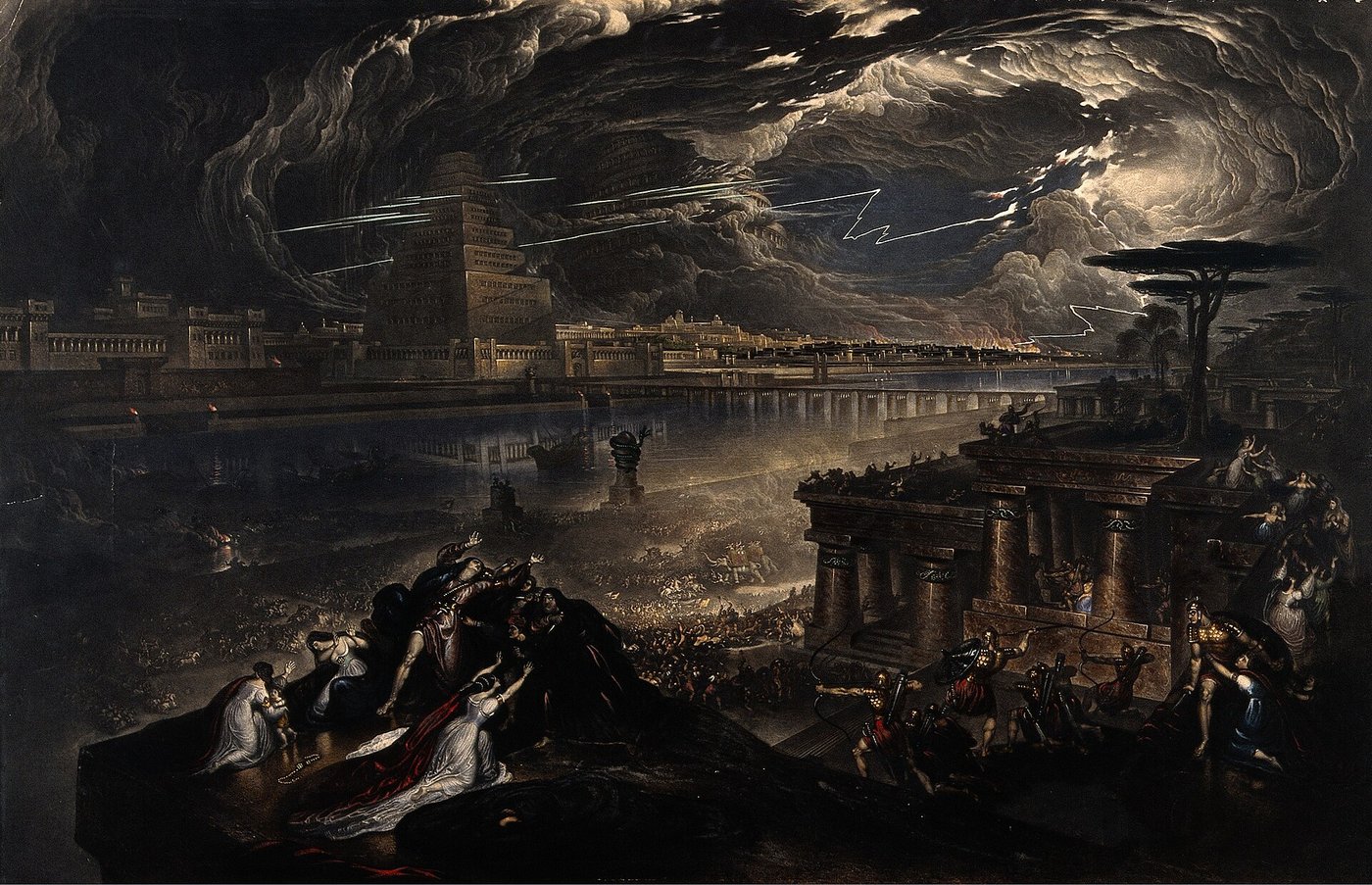
Read the text and the human-rights charter dissolves in your hands. It opens not with Cyrus but with an attack on the man he replaced: Nabonidus, the last king of Babylon, painted as an impious ruler who neglected Marduk and imposed hardship on his own people. The god, disgusted, goes looking for a better man. He finds Cyrus, takes him by the hand, and marches him into Babylon “without battle,” the city gates opening to a liberator.
Then the voice changes. Halfway through, the inscription slips into the first person, and it is Cyrus speaking: king of the world, king of the four quarters, son and grandson of kings of Anshan. He lists what he has put right. He has let the gods that Nabonidus dragged into Babylon go home to their own cities. He has returned displaced people to their settlements. He has restored ruined sanctuaries and resumed the offerings. He asks Marduk to bless him and his son Cambyses. He ends, as these things always end, with a note about the building work he has done on the city walls.
Every line of that has a purpose, and the purpose is not liberty. It is legitimacy. A foreign conqueror is telling the priesthood and people of Babylon that he is not a foreign conqueror at all. He is Marduk’s own choice, the restorer of a proper order that the previous regime had broken. It is a brilliant piece of political theatre. It is also completely conventional.
Neil MacGregor, who ran the British Museum while it toured the cylinder round the world, put it bluntly: rulers in ancient Iraq had been making comparable declarations on succeeding to the throne “for two millennia before Cyrus.” Restoring temples, sending stolen gods home, releasing forced labour: this was the standard script a new king used to show the gods were on his side. The Assyrian kings Cyrus was copying had said much the same, centuries earlier, in the same buried genre.
How a foundation brick became a charter
So how did a buried building inscription turn into a Bill of Rights? Slowly, and then all at once, and for reasons that had far more to do with the twentieth century than the sixth century BCE.
The reading grew up around one clause. Because the cylinder speaks of sending exiled peoples and their gods back home, it chimed with a story people already knew: the Hebrew Bible’s account of Cyrus letting the Jews return from their Babylonian exile to rebuild the temple in Jerusalem. From there it was a short step to recasting Cyrus as an early champion of tolerance, and the cylinder as the proof.
Mohammad Reza Pahlavi took that step and kept walking. In his 1967 book the Shah tied the cylinder to “humane principles, justice and liberty.” In 1968 he opened a United Nations human-rights conference in Tehran by linking the old clay barrel to the modern Universal Declaration. Then came the vast, ruinously expensive 1971 celebration of two and a half thousand years of Persian monarchy, with the cylinder as its emblem. His sister, Princess Ashraf, presented a replica to Secretary-General U Thant, calling Cyrus’s legacy one of “tolerance, courage, compassion and, above all, human liberty.” The UN took it, and the phrase “first charter of human rights” stuck to the object like a label that would not peel off.

The claim: the cylinder is the world’s first declaration of human rights, in which Cyrus abolished slavery and guaranteed freedom of religion for all peoples.
The reality: it is a foundation inscription in the voice of a Babylonian god, praising a new king in the terms every Mesopotamian king used. It grants no rights, names no universal principle, and abolishes nothing. The “abolition of slavery” line comes from a mistranslation that circulated with the UN replica; the word in question refers to forced labour on the city, not slavery as such.
The British Museum’s own keeper of cuneiform, who has spent a career with tablets like this one, refuses to soften it: “There are no human rights in antiquity. There were never human rights in antiquity.” The concept did not exist to be written down. Reading it into the cylinder tells you what the twentieth century wanted, not what the sixth century BCE said.
The name that is missing from the clay
The biblical thread deserves a closer look, because it is the strongest card the traditional reading holds, and it is weaker than it looks.
The Book of Ezra says Cyrus issued a decree freeing the Jews to go home and rebuild. That is a real tradition, and later Jewish writers honoured Cyrus for it; the prophet in Isaiah even calls him God’s anointed. But the cylinder does not mention Jews. It does not mention Jerusalem, or Judah, or a temple in the west at all. The peoples and gods it describes returning are Mesopotamian: cities and shrines in the old Babylonian heartland, the places a Babylonian document would naturally list.
Some scholars think the cylinder still reflects a general Persian policy that the Jews benefited from, one part of a wider habit of letting conquered peoples keep their customs. Others, like Bob Becking, argue the passage “has nothing to do with Judeans, Jews or Jerusalem” and that we have simply glued two separate stories together because we wanted them to fit. The honest position is that the clay is silent on the one point everyone most wants it to speak to.
One camp reads the cylinder as physical confirmation of the Ezra decree, proof that Cyrus really did send exiles home, Jews included. The other camp points out that the text is a Babylon-facing document about Babylonian gods and never leaves Mesopotamia. Both are working from the same forty-five lines. The gap between them is the gap between what a source says and what we need it to have said.
The text that kept turning up
There is a final twist, and it cuts against the idea of the cylinder as a unique, sacred proclamation.
For decades the object was incomplete; a corner of the text was simply missing. Then, in 1970, a scholar in Germany recognised that a small inscribed fragment held at Yale (bought years earlier from a dealer, catalogued as something else) was a broken-off piece of the very same cylinder. The two halves of the text were reunited in 1972, filling in lines nobody had been able to read.
The bigger surprise came in 2010. Two small clay tablets in the British Museum’s stores, dug up near Babylon in the 1880s and never connected to Cyrus, turned out to carry the same inscription. That changes the picture. A one-off foundation deposit is buried and forgotten. A text copied onto more than one object, in more than one place, looks instead like a proclamation that was written out and circulated: a piece of imperial messaging, produced in numbers, of which the famous barrel is only the copy that happened to survive whole.
Why the wrong reading stuck
None of this makes Cyrus a tyrant or the cylinder a fake. Cyrus really did build an empire that ran, by ancient standards, on a light and tolerant touch; letting subject peoples keep their gods and customs was smart policy, and he was good at it. The cylinder really is a superb witness to how a conqueror sold himself to the conquered. Those are interesting truths. They are just not the truth on the label.
You can measure how much people want it to be true. When the British Museum lent the cylinder to Tehran in 2010, roughly half a million people filed past it in a few months, with queues around the National Museum to see a cracked barrel of clay. It travelled on to draw crowds across the United States in 2013. Almost none of them came to study a foundation inscription about temple offerings. They came to see the charter, the thing the twentieth century had promised them was there.
The odd thing is how little the correction has changed anything. The replica still sits at the United Nations. The phrase still appears in speeches and schoolbooks and tourist captions. A modest object made to flatter a god and reassure a nervous city has been asked to carry a meaning it was never built to hold, and it carries it anyway, because we find the meaning more useful than the facts.
That is the real lesson of the barrel in the case. An object survives; the stories we tell about it do not stay still. The clay keeps its forty-five lines exactly as they were pressed in, twenty-five centuries ago, in the dark, for no one. What those lines are made to mean has always belonged to the living, not the dead.
Read next: Behistun: The Cliff Carving That Cracked Cuneiform and The Sun Gate of Nineveh: A King's Stele Buried Between Two Destructions.
Sources & further reading
- Irving Finkel (ed.), The Cyrus Cylinder: The King of Persia’s Proclamation from Ancient Babylon (I.B. Tauris, 2013).
- Neil MacGregor, “The whole world in our hands,” and British Museum commentary on the cylinder’s international tour, 2013.
- The British Museum, collection entry and translation for the Cyrus Cylinder (museum no. 90920).
- Bob Becking, “Cyrus’ Cylinder and the Return of the Exiles,” on the biblical connection.
- Amelie Kuhrt, “The Cyrus Cylinder and Achaemenid Imperial Policy,” Journal for the Study of the Old Testament (1983).
Image credits (via Wikimedia Commons): the Cyrus Cylinder — Joyofmuseums (CC BY-SA 4.0); cuneiform detail — Daderot (CC0); the fall of Babylon — Wellcome Collection (CC BY 4.0); the Processional Way of Babylon — Google Art Project (public domain); Shahyad/Azadi Tower, 1971 — unknown author (public domain); tomb of Cyrus at Pasargadae — Mohammad Reza Domiri Ganji (CC BY-SA 4.0).