In the summer of 1897 a London saleroom put a strange lot under the hammer. The catalogue called them curios: brown metal plaques crusted with figures, cast heads with staring eyes, carved tusks the colour of old teeth. Buyers from the great museums of Europe leaned in. What almost none of them said out loud was where the objects had come from, or that the money raised in that room and others like it was meant, in part, to help cover the cost of the soldiers who had taken them. A British force had marched on a West African city that February, burned it, and carried its royal art back to the coast in crates. Now the empire was selling the loot to pay for the raid that seized it.
The objects had a name already, though it fitted them badly. People called them the Benin Bronzes. Most were not bronze. Most were brass, some were ivory, a few were wood and iron and coral. And they had not come from the country called Benin today, the slim republic on the Gulf of Guinea that was once Dahomey. They came from Benin City, the old Edo capital in what is now southern Nigeria, several hundred miles to the east. Almost everything the label told you was wrong. Almost everything the objects themselves could tell you was extraordinary.
A city that wrote in metal
Benin City was not a village that stumbled into greatness. By the fifteenth century it was the seat of a kingdom that had held its corner of the forest for hundreds of years, ruled by a sacred king called the Oba. Around the city ran earthworks so vast that they are still argued over: a network of banks and ditches that, added together, may run to thousands of miles, one of the largest things human beings have ever built by hand. A Dutch visitor in the seventeenth century described broad straight streets and a palace the size of a town, its wooden pillars sheathed in cast brass from top to bottom.
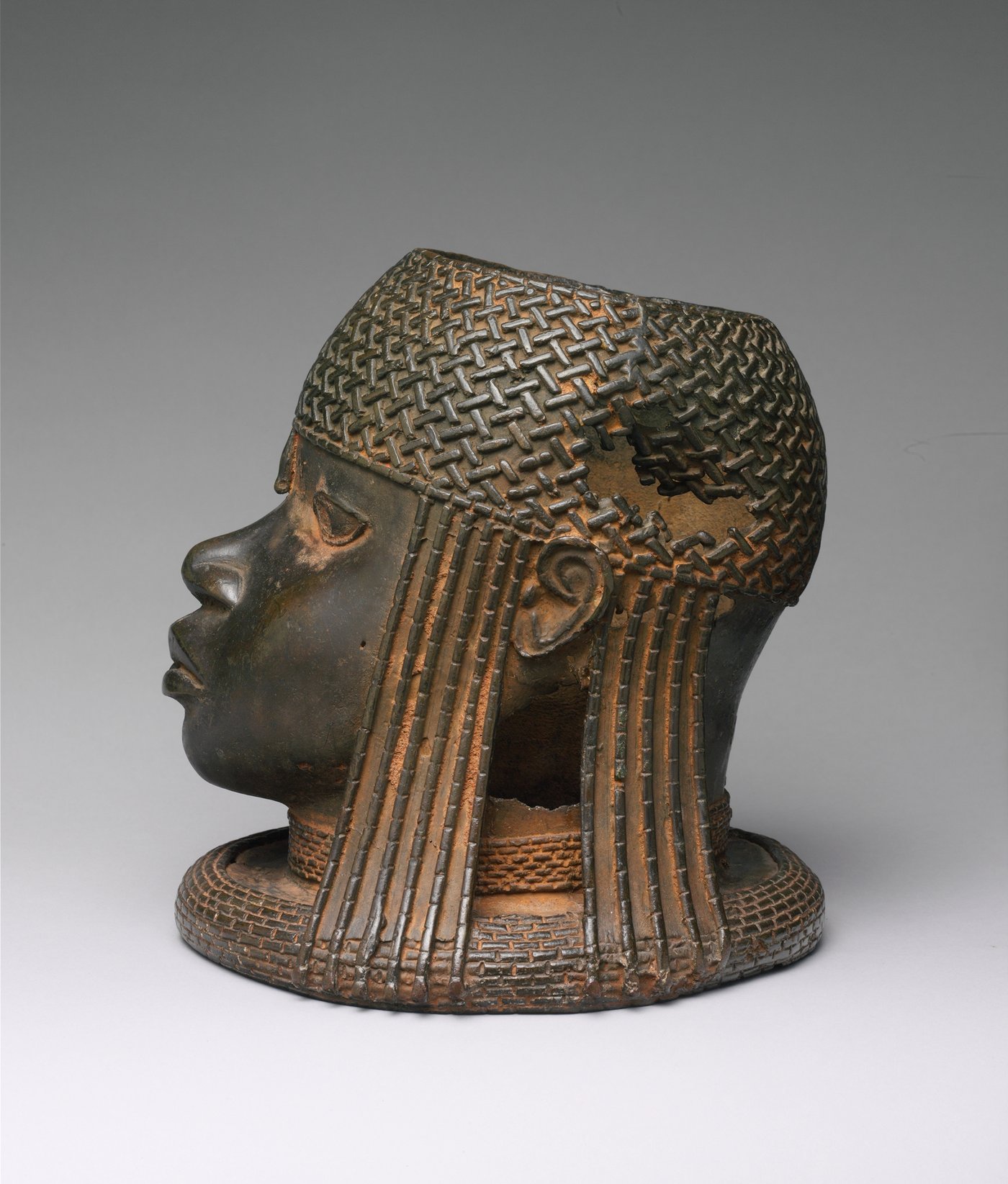
That brass was the point. The Edo had no alphabet, no written chronicle of kings and battles. What they had instead was the palace itself, and the palace remembered in metal. The plaques nailed to its pillars showed Obas in their coral regalia, warriors with shields and spears, court officials, musicians, hunters, the leopards and mudfish and pythons that stood for royal power. Cast brass heads sat on the altars of dead kings, each new Oba commissioning one for his father. To walk through the palace was to walk through the recorded history of the dynasty. The bronzes were not decoration hung on the state. They were the state's archive, written in a language of relief and symbol that the court could read.
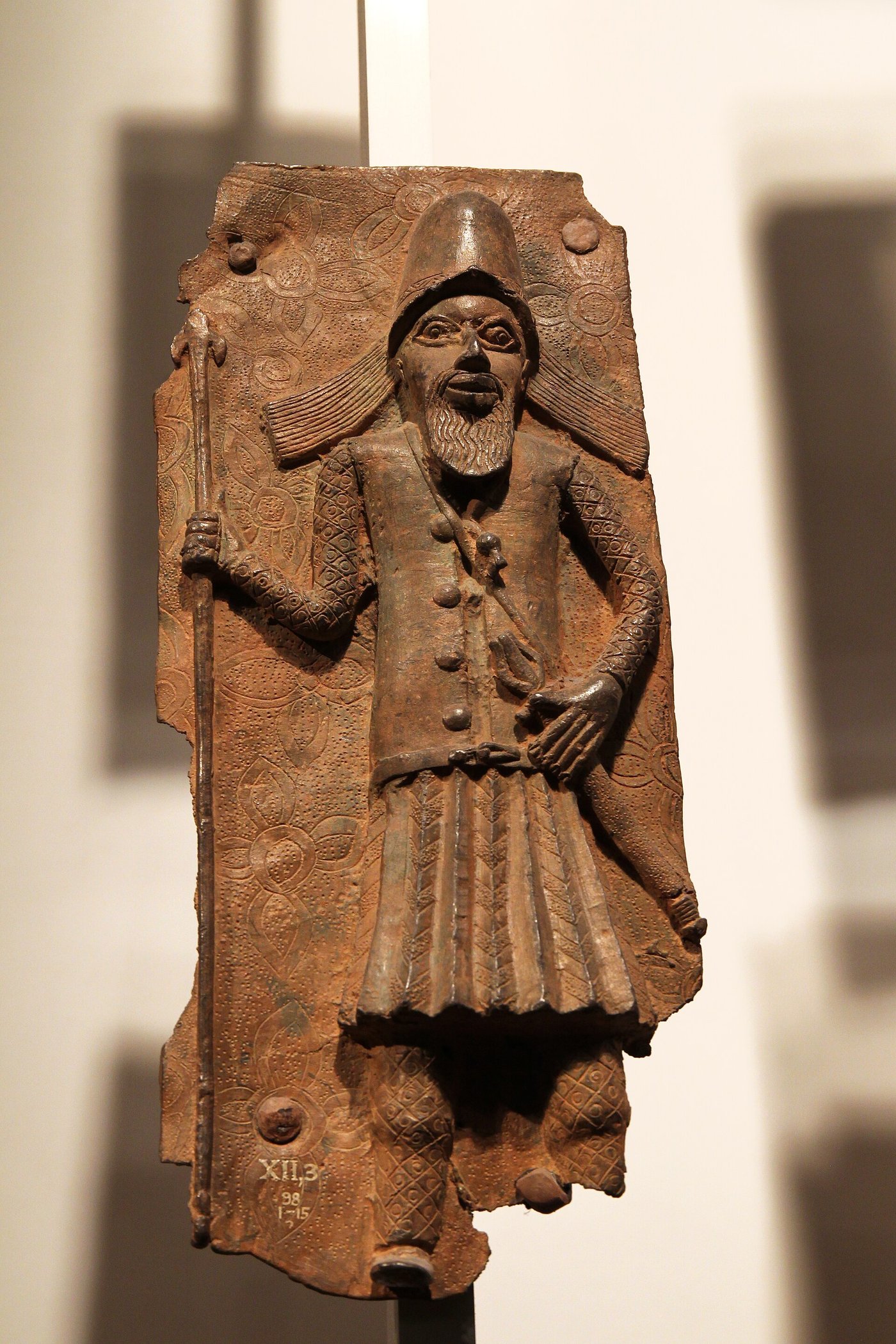
Reading them takes patience. A figure's size shows his rank, not his height. The largest man on a plaque is the most important, whatever the scale would say. Coral beads at the throat and a particular cap mark an Oba; a leopard-tooth necklace marks a war chief. Even the background matters: the river-leaf pattern stamped across the empty brass is a symbol of Olokun, god of the waters and of wealth. Nothing on these surfaces is idle. They were made to be understood.
The street that still smells of wax
Who made them is not a mystery at all, which is part of what makes the later confusion so telling. The casters belonged to a guild, the Igun Eronmwon, who worked under the direct control of the Oba. Their craft was lost-wax casting, an old and demanding method. The maker models the object in wax over a clay core, coats it in more clay, then heats the mould so the wax runs out through a channel and leaves a hollow. Molten brass is poured into the space the wax left. When the metal cools the outer clay is broken away, and the wax model is gone forever, having given its exact shape to the metal. Every cast is unique, because making it destroys the pattern.
This is not a technique you improvise. It is handed down, guarded, refined over generations. The Igun guild held a royal monopoly, and casting brass without the Oba's leave was a crime. The knowledge stayed inside a lineage of families on a single street. That street is still there. Igun Street in modern Benin City is a lane of workshops where descendants of the palace casters still pour brass by the same method, for tourists now as much as for the court. The hands that made the bronzes never stopped working. They were three streets away the whole time the museums of Europe were wondering aloud whether Africans could have made such things.
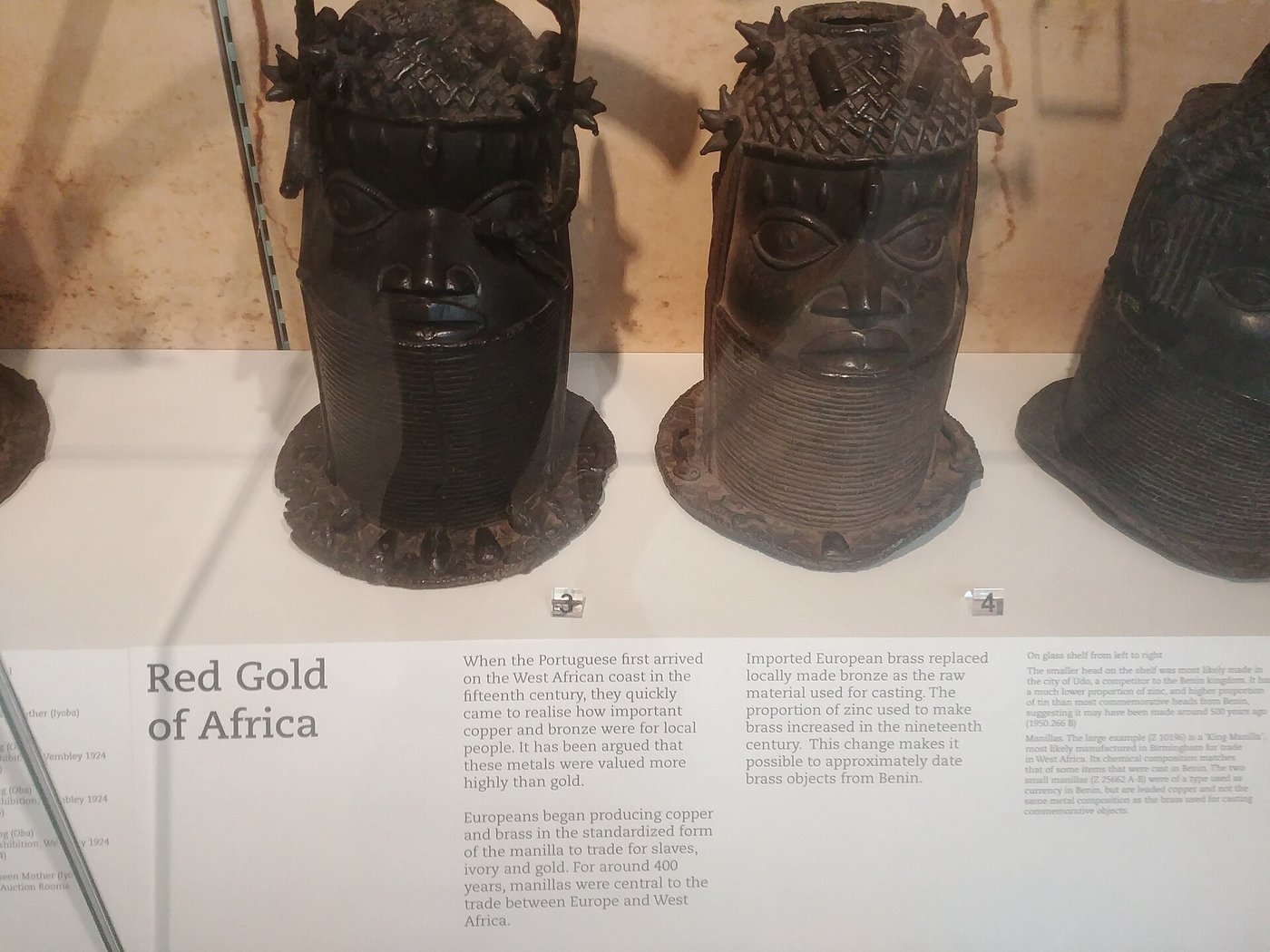
Benin did not mine its own brass. The metal came in as manillas: horseshoe-shaped bracelets that European ships brought by the ton to buy palm oil, ivory and enslaved people along the West African coast. The casters melted this trade currency down and poured it into art. In 2023 a study of the metal itself, matching its chemical fingerprint, traced much of the brass to manillas cast in the German Rhineland and shipped south. The plaques on the Oba’s pillars were, in a hard and literal sense, made from the money of the Atlantic trade: the same coinage that bought human beings, reshaped into the memory of a kingdom.
Portuguese ghosts on the pillars
Look closely at some of the plaques and you find strangers. Men with long straight hair and beards, in helmets and doublets, carrying muskets: Portuguese soldiers and traders, who reached Benin in the 1480s and became part of the court's visual world. The Edo put them on the walls the way they put everything of consequence on the walls. The Portuguese brought the brass, in the form of those manillas, and they brought guns, and for a while Benin traded with them as an equal power, selling pepper and cloth and ivory, controlling the terms.
The kingdom was strong enough to set those terms for a long time. It expanded, fought, absorbed its neighbours, and at its height in the sixteenth and seventeenth centuries it was one of the more formidable states in West Africa. The bronzes belong mostly to this era of confidence, the plaques above all, made in their hundreds when the court had metal to spare and a history worth recording. When European visitors described the city then, they wrote of order and scale and wealth. The contempt came later, and it came with the men who wanted the land.
The lie the craftsmanship forced
When the bronzes reached Europe in bulk after 1897, they caused a problem their new owners had not expected. The prevailing view of Africa in the museums and learned societies of the day held that the continent south of the Sahara had produced nothing of high art, nothing that required a long civilisation to make. And here were objects of such technical command that European casters studied them with envy. The facts on the table did not fit the theory in the room. So the theory bent the facts.
Scholars proposed that the bronzes could not really be African work. Perhaps the Portuguese had made them, or taught the skill. Perhaps they were the relics of a lost Mediterranean colony, or of ancient Egypt reaching improbably far south. Some reached for Atlantis. Anything served, so long as it kept the credit away from the Edo. It took decades for this to fall apart under its own weight, and it fell apart in part because of a German anatomist and curator named Felix von Luschan, who handled more of the bronzes than almost anyone and refused to lie about what his eyes told him.
The early experts insisted that work this fine must have a foreign source: Portuguese teachers, Egyptian ancestors, a vanished white civilisation. The perfection of the casting was treated as evidence against African authorship, because the framework of the day could not hold both the quality and the maker in the same thought.
There was never any doubt to be had. The Igun casters were a living, named lineage in Benin City, working in an unbroken tradition that stretched back centuries and continues today. The bronzes were commissioned by the Oba, made by Edo hands, for Edo purposes. The mystery of their origin was not a real question. It was a wish, dressed as scholarship.
Of the Benin casters the German curator declared that Benvenuto Cellini, the greatest of the Italian Renaissance metalworkers, could not have made better casts, nor could anyone else, before him or since, to the present day. He put the bronzes at the very summit of what casting could achieve. Coming from a man of his time and his assumptions, it was less a compliment than a surrender, an admission that the objects had beaten the prejudice out of him.
The road to Benin City, 1897
The end came out of trade and impatience. By the 1890s Britain wanted full control of the trade in the Niger delta (the palm oil, the rubber, the ivory), and the Oba's kingdom stood in the way, taxing and regulating on its own terms. In January 1897 an acting consul-general named James Phillips set out for Benin City with a small party to force a meeting with the Oba, Ovonramwen. He had been warned not to come. The Oba was deep in the rites of a sacred annual festival, during which he could receive no outsiders, and word was sent asking Phillips to wait. Phillips came on anyway.
His column was ambushed on the road. Most of the party were killed, including Phillips; only two British officers survived to reach the coast and tell the story. In the language of the newspapers that followed, it became the Benin Massacre, an unprovoked slaughter of a peaceful mission. Whether it was ordered by the Oba or carried out by chiefs against his wishes is still argued; Ovonramwen himself seems to have feared exactly the reprisal it would bring. What is not in doubt is what Britain did with it.
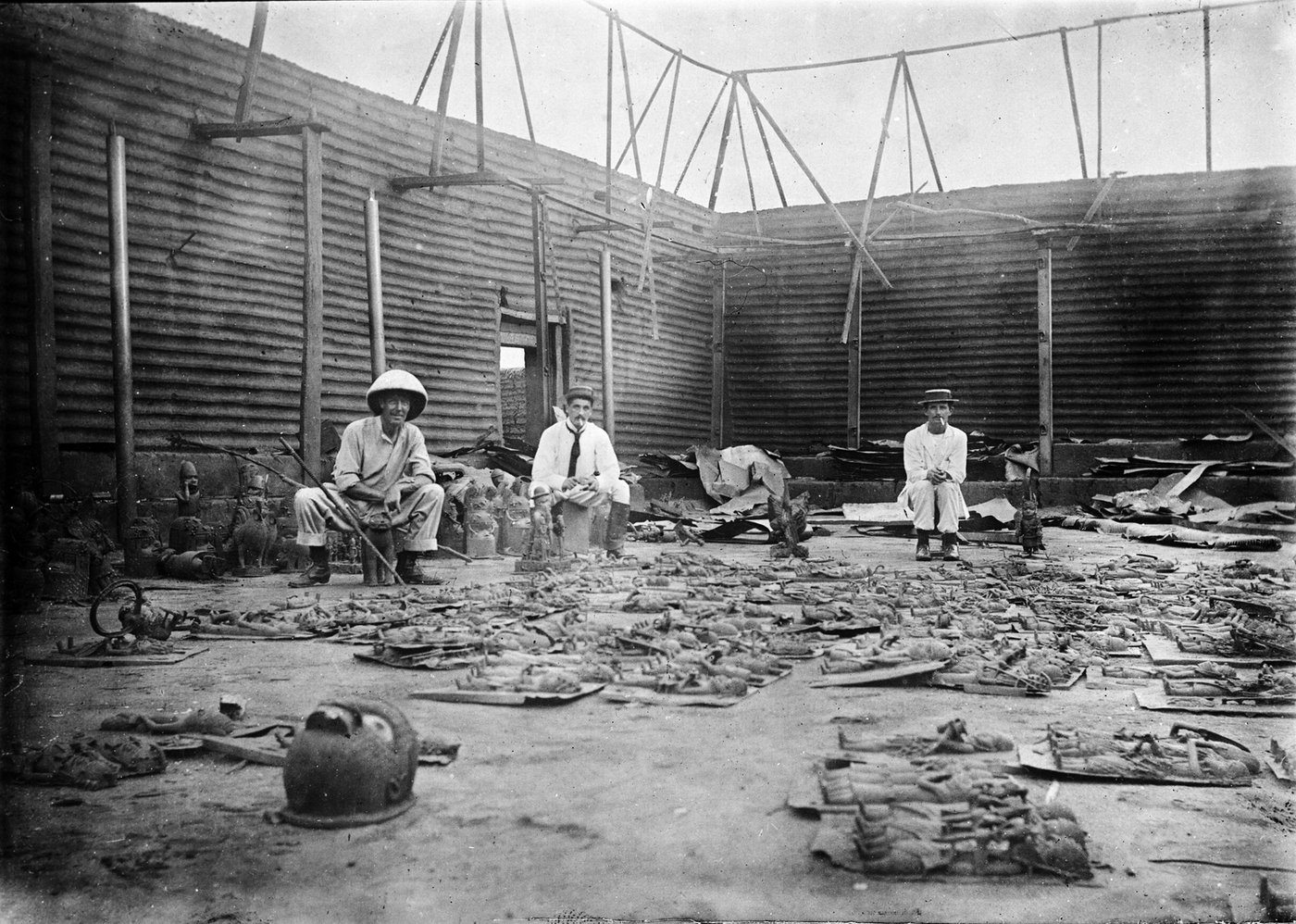
Within weeks a punitive expedition sailed: some twelve hundred men under Rear-Admiral Harry Rawson, with rockets and the new machine guns. They fought their way inland through February and took Benin City on the eighteenth. The troops found the palace and the altars, the pillars in their brass, the heads of dead kings, the carved tusks, and they gathered it all up. Then much of the city burned. The Oba was hunted down, deposed and sent into exile at Calabar, where he died in 1914, never allowed home. A kingdom that had ruled for six centuries ended in a fortnight, and its memory was packed into crates.
Scattered to two hundred rooms
What happened next set the pattern for the century to come. The Foreign Office claimed the loot and much of it was auctioned in London, the proceeds set against the cost of the expedition, the detail that gives this whole story its bitter symmetry. Officers kept pieces as trophies and sold them privately for years afterward. Dealers moved them across Europe and America. The result was a diaspora of objects: the world's largest single kingdom's worth of court art, broken up and spread across a hundred and more institutions in a dozen countries.
The British Museum took the largest share, more than nine hundred pieces. Berlin's ethnological museum gathered some five hundred, in part because von Luschan was buying hard. There are Benin bronzes in Vienna and Dresden and Stockholm, in Boston and New York and Chicago, in Oxford and Cambridge and Glasgow. Estimates of the total looted run somewhere between three and five thousand objects. For most of the twentieth century they sat in glass cases labelled with the polite word “acquired,” and the manner of the acquiring went mostly unmentioned on the card.
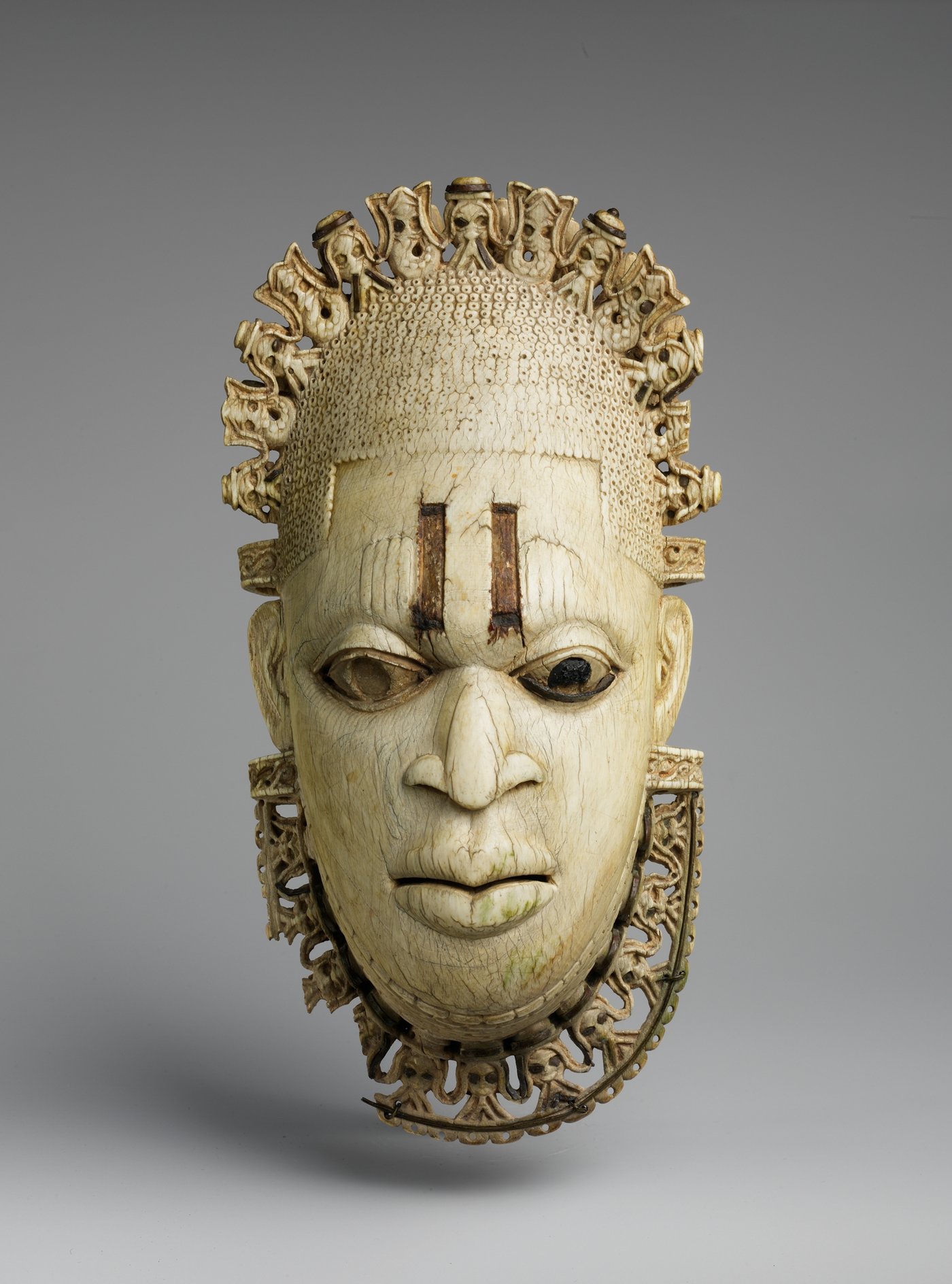
Nigeria never accepted the arrangement. The demand for return is older than most people think. When Nigeria staged a great pan-African arts festival in 1977, it wanted the ivory mask of the Iyoba, the Queen Mother, as the event's emblem: the very mask its ancestors had carved. The British Museum would not lend it. Nigeria used a replica, and the insult sat there for everyone to read: a nation asking to borrow, for a few weeks, the face its own artists had made, and being told no.
The long way home
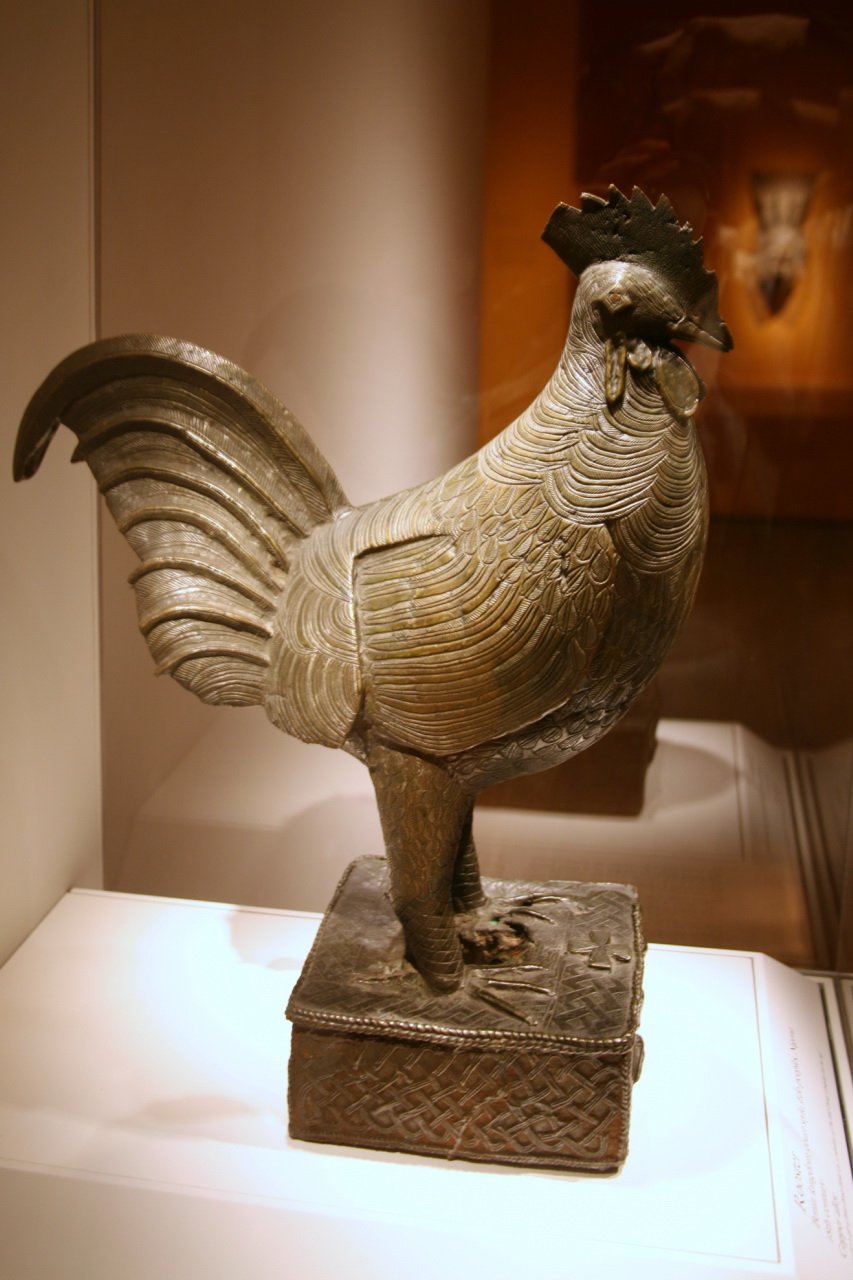
For a long time the museums held firm behind a wall of arguments: that the objects were safer where they were, that they belonged to a shared human heritage, that returning one thing would empty every gallery in the West. Then, quite fast, the wall started to come down. In 2021 Jesus College, Cambridge, handed back a brass cockerel called the Okukor that had stood for years in its dining hall until students objected to eating beneath stolen art. The same autumn the University of Aberdeen returned a fine cast head it had come to see as impossible to keep in good conscience. Small acts, but the first cracks.
Then the dam. In 2022 Germany agreed to transfer ownership of well over a thousand bronzes held in its museums, and began sending them physically to Nigeria. The Smithsonian in Washington returned twenty-nine. London's Horniman Museum agreed to give back seventy-two. In 2025 the Netherlands returned a hundred and nineteen in a single act, one of the largest restitutions yet. And the pace has held into 2026: in February the University of Cambridge transferred ownership of a hundred and sixteen objects held in its archaeology museum, and in the spring museums in Switzerland signed over twenty-five more, with further returns from Sweden, Germany and Britain moving through the pipeline as this is written.
The British Museum, holder of the largest collection, remains the great holdout, bound by a law that forbids it from permanently giving away its objects. It has talked of long-term loans instead, an offer Nigeria has been wary of, since a loan concedes that the museum still owns what it took. So the biggest hoard of all stays in Bloomsbury for now, while smaller and braver institutions send their pieces home one crate at a time.
Return raises a question the looting had frozen for a century: whose are they now? In 2023 the Nigerian government declared the repatriated bronzes the property of the current Oba of Benin, heir to the kings who first commissioned them, a decision some welcomed as justice and others feared would move the objects from public museums into a private palace. Meanwhile a new Museum of West African Art has been rising in Benin City itself, built to receive and show the returns. Where the bronzes should finally live (palace, national museum, or a new home built for them) is being worked out now, by Nigerians, which is arguably the point.
What the walls hold again
It is easy to tell this as a story about property, about who has legal title to a set of valuable things. That misses what the bronzes were for. They were never only beautiful. They were a record: the way a people without writing kept the account of who they had been, cast in a metal meant to outlast the men it portrayed. When the pillars were stripped in 1897, Benin did not just lose its treasures. It lost the pages of its own history, and had to watch them read by strangers who for years would not even name the authors.
Bringing them back is not a tidy ending. The city they return to is not the city they left; the kingdom is a memory, the empire that took them is gone, and the objects come home into a modern nation still deciding what to do with them. But something does close. A history written in brass is being handed back to the people who can read it, by an increasing number of those who held it, however slowly and however late. And on Igun Street the casters are still at their moulds, breaking the clay off a fresh head, pouring the wax out of a new plaque: proof, if anyone still needed it, of exactly whose hands these were always in.
Read next: Igbo-Ukwu: The Bronzes Too Fine to Be as Old as They Are and Mansa Musa: The Richest Man in History and the Hajj That Crashed a Currency.
Sources & further reading
- Barnaby Phillips, Loot: Britain and the Benin Bronzes (Oneworld, 2021).
- Dan Hicks, The Brutish Museums: The Benin Bronzes, Colonial Violence and Cultural Restitution (Pluto Press, 2020).
- Kathryn Gunsch, The Benin Plaques: A 16th Century Imperial Monument (Routledge, 2018).
- T. Skowronek et al., “German brass for Benin Bronzes: Geochemical analysis insights into the early Atlantic trade,” PLOS ONE (2023).
- National Commission for Museums and Monuments (Nigeria) and Digital Benin (digitalbenin.org), catalogue and provenance of the dispersed collection.
- Contemporary restitution coverage, 2021–2026: the British Museum, the University of Cambridge, the Netherlands Wereldmuseum and Swiss museum agreements.
Image credits (via Wikimedia Commons): memorial head of an Oba — Edo artist, Kingdom of Benin, via the Metropolitan Museum of Art (CC0); cast brass palace plaque — Vassil (CC0); the burnt royal compound, 1897 — Reginald Kerr Granville (public domain); the Iyoba (Queen Idia) ivory pendant mask — Edo artist, via the Metropolitan Museum of Art (CC0); Benin bronzes in a Cambridge museum case — Lajmmoore (CC BY-SA 4.0); brass cockerel (okukor) — cliff1066 (CC BY 2.0).