In July 1324, the people of Cairo watched a caravan come in off the desert road and struggled to describe what they were looking at. Five hundred men walked at the front, each carrying a staff of solid gold. Behind them came thousands of attendants dressed in Persian silk, and behind those, camels (scores of them, by some counts a hundred), each carrying sacks of gold dust. At the centre rode a man most Egyptians had never heard of: Musa, the mansa of Mali, on his way to Mecca. He stayed about three months. He handed out gold to almost everyone who asked. And by the time he left, according to the Egyptian officials who wrote it down afterwards, the price of gold in Cairo had collapsed and would not recover for more than ten years.
That story has had an extraordinary second life. Mansa Musa is now a fixture of internet lists, usually under a headline calling him the richest human being who ever lived, with a price tag of four hundred billion dollars attached. The number is invented. But the strange thing about the Mansa Musa story is that stripping out the invented parts does not make it smaller. What is left is a fourteenth-century West African emperor who ran a state built on the largest gold supply in the medieval world, walked four thousand miles across the Sahara with a moving city behind him, distorted an economy he was only passing through, and came home to build mosques and libraries in a town that would become a byword for the ends of the earth. The real version is better than the meme. It is also much less flattering to the idea that Africa had no history before Europeans turned up to write it.
Where the gold came from
Mali sat on top of the medieval world's gold problem. Europe and the Islamic world both ran on gold coinage, and neither had enough of it. Their mines were thin. The solution lay in West Africa, in the goldfields of Bambuk and Bure along the upper Senegal and Niger rivers, and later in the Akan fields further south. Somewhere between half and two-thirds of the gold circulating in the Old World in this period is thought to have come out of West Africa. It travelled north across the Sahara by camel, through Saharan trading towns, and into the mints of Cairo, Tunis, Fez and eventually Florence and Genoa.
This is what gets flattened in the retellings: Mali did not own those mines. The gold was dug by communities who guarded their sources fiercely and had no interest in being absorbed by anyone's empire. Arab writers repeat a story of "silent trade": traders leaving goods at an agreed spot, withdrawing, and returning to find gold left in exchange, with the two sides never meeting. Whether or not that is literally accurate, it captures something true. The miners kept their independence. Mali's power came from controlling the roads, the river traffic and the market towns that the gold had to pass through, and from taxing it as it went. Musa was rich the way a state that sits astride a trade route is rich, not the way a man with a vault is rich.
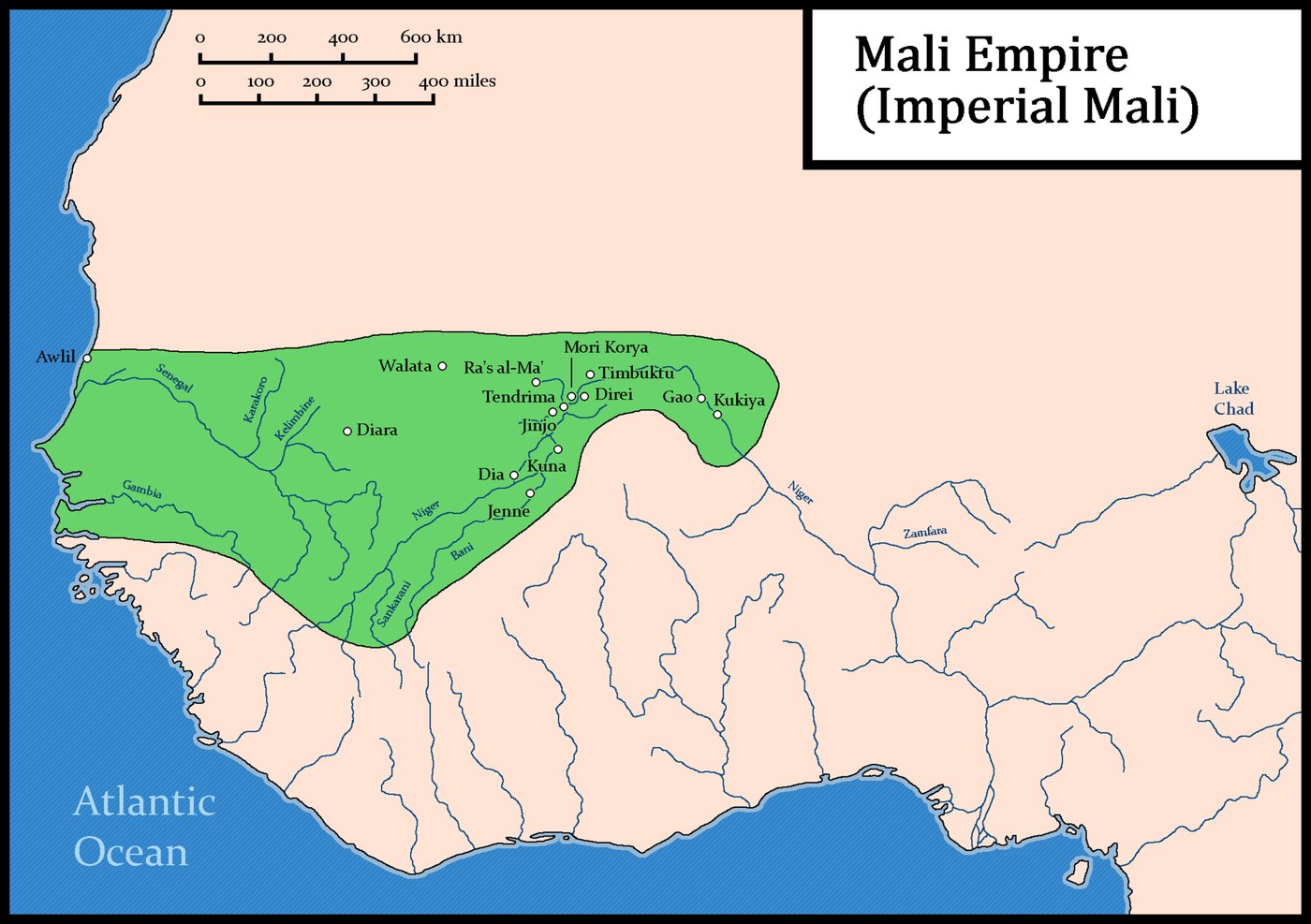
Mali also controlled the other half of the trade, which is easy to forget because it sounds so ordinary: salt. Salt came south from Saharan mines in slabs and was worth carrying enormous distances, because people in the tropics need it and cannot easily get it. Gold going north, salt coming south, copper and cloth and books moving in both directions, and Mali taxing the traffic. That was the machine.
The emperor who arrived by an odd route
Musa came to the throne around 1312, and the story of how is one of the oddest things in the record. According to the Egyptian scholar al-Umari, who later spoke to people in Cairo who had met Musa, the mansa himself explained that his predecessor had become obsessed with the question of what lay on the far side of the Atlantic. He sent out a fleet of two hundred ships. One returned. Unsatisfied, he fitted out a second, larger expedition, appointed Musa as his deputy, sailed west himself, and was never heard from again.
It is a remarkable passage, and it has been seized on ever since as evidence that West Africans reached the Americas before Columbus. There is no archaeological support for that, and the account comes to us third-hand at best. What it does tell us reliably is something else: Musa took power as a stand-in for a man who vanished, which is not the same as inheriting it cleanly. Historians including Michael Gomez have argued that this matters for everything that follows. A ruler with a question mark over his legitimacy has a very strong reason to stage the most spectacular display of piety and wealth the Islamic world has ever seen.
"This man spread upon Cairo the flood of his generosity: there was no person, officer of the court or holder of any office of the sultanate who did not receive a sum of gold from him. The people of Cairo earned incalculable sums from him, whether by buying and selling or by gifts."— al-Umari, Masalik al-absar fi mamalik al-amsar, written in the 1330s from the accounts of Cairenes who had met Musa and his party
A caravan the size of a town
The hajj is an obligation for any Muslim who can manage it, and Musa was a devout ruler of a Muslim state. But the journey he assembled in 1324 was also a diplomatic mission, a trade delegation and a piece of political theatre, moving as one enormous body across the desert.
The figures in the Arabic sources vary and should be treated as impressions rather than headcounts. Sixty thousand people is the number most often repeated. Twelve thousand of them were servants or enslaved attendants. Five hundred heralds carried gold staffs weighing several pounds each. Eighty camels, or a hundred, carried up to three hundred pounds of gold dust apiece. Even at the low end of these estimates, this was a column of people that would take most of a day to pass a fixed point, crossing terrain where a wrong turn kills you. Musa's wife Inari Konte is said to have travelled with him, along with hundreds of her own attendants.
Consider what that actually requires. Water, for tens of thousands of people and animals, across a desert. Food. Guides who know which wells are dry this year. Security against raiders who now have the richest target in Africa moving slowly in front of them. Whatever else Musa's hajj proves, it proves that fourteenth-century Mali had the logistical capacity to move a small city across the Sahara and keep it alive. That, more than the gold, is the achievement historians find impressive.
The bow that did not happen
In Cairo, Musa met his match in the person of al-Nasir Muhammad, the Mamluk sultan of Egypt, and the two of them had a stand-off over etiquette that tells you a great deal about how Musa saw himself.
Protocol required a visiting ruler to kiss the ground before the sultan. Musa refused. He was a sovereign, not a subject, and he would not prostrate himself before another man. The Mamluk court was not used to being told no. The deadlock was broken by a piece of diplomatic footwork that satisfied everyone: Musa announced that he would bow, but that he was bowing to God, who created him, and not to the sultan. Honour was preserved on both sides. Al-Nasir gave up his own place at the head of the audience and seated Musa beside him.
It is a small scene, but it is worth pausing on, because it is the opposite of the picture that later centuries painted of Africa. This is not a chieftain being received as a curiosity. This is one head of state negotiating with another over precedence, and largely winning.
What happens when you flood a market
Musa gave gold away in Cairo on a scale nobody had planned for. Court officials received it. Merchants were paid well over the odds. Alms went to the poor. Members of his party spent freely in the markets, and Cairo's traders, spotting an unrepeatable opportunity, marked everything up and sold it to them anyway.
The result was a straightforward lesson in supply and demand delivered several centuries before anyone wrote the theory down. Gold is only valuable because it is scarce. Pour enough of it into a single city over three months and it stops being scarce there. Contemporary and near-contemporary sources describe the value of gold in Cairo falling sharply (later estimates put the drop at around a quarter) and staying depressed for something like twelve years. Al-Umari, writing more than a decade afterwards, reported that the market still had not righted itself.
Musa's spending spree is sometimes described as the only time in recorded history that one person single-handedly wrecked a region's economy. That framing is too strong. Cairo's currency troubles in this period had several causes, and the Mamluk state was already struggling with debased coinage. But the direction of the effect is not in dispute. A visiting king made gold measurably cheaper in one of the world's great commercial cities, and it stayed cheaper long after he had gone home.
The part of the story nobody memes
And one detail demolishes the "richest man in history" headline. On the way back from Mecca, Musa ran out of money.
He had given away or spent so much that his party could not fund the return leg. So he borrowed, from the same Cairo merchants who had just made fortunes off him, and he borrowed on bad terms, reportedly paying back far more than he took. Some accounts suggest this buying-back of gold at inflated rates helped drag the Cairo price back up towards normal, which would make Musa responsible for both halves of the crash and the recovery.
Whatever the mechanism, the basic fact is hard to square with the legend. A man with bottomless wealth does not run short halfway through a single trip and take out a high-interest loan to get home. What the episode suggests instead is that Musa had spent years stockpiling gold specifically for this journey, and that he spent very nearly all of it on purpose. The hajj was not a display of casual surplus. It was a budget, and he blew the entire thing on the impression it would make.
"Mansa Musa was worth four hundred billion dollars, making him the richest person who has ever lived."
The four-hundred-billion figure came from a celebrity net-worth website in 2012 and has no scholarly basis whatsoever. There are no Malian account books. There is no way to convert a fourteenth-century tributary empire's gold flows into modern dollars, because "wealth" in that world meant control of land, trade routes and people, not a bank balance. Historians who work on Mali are consistent on this point: Musa was extraordinarily rich by any measure of his time, and any specific number you see attached to him is fiction.
What he built when he got home
Musa did not come back from Mecca with only souvenirs. He came back with people. Scholars, jurists, architects and poets returned with him from Cairo and the Hijaz, recruited to staff and adorn his empire. The most famous was Abu Ishaq al-Sahili, a poet and legal scholar from Granada whom Musa is said to have paid a fortune to come south.
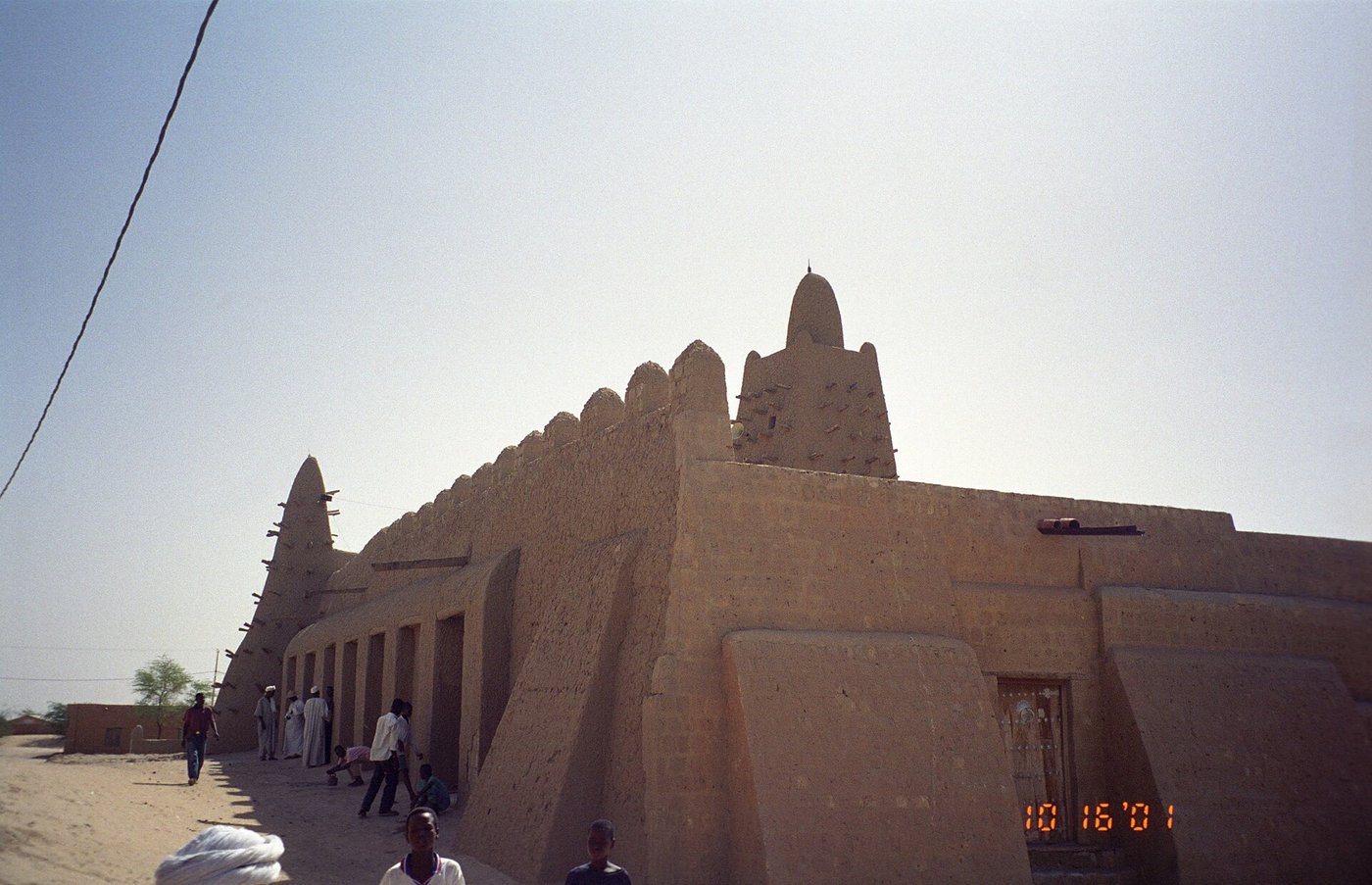
Then Musa built. A grand audience hall at the capital. Mosques at Gao and Timbuktu. The Djinguereber Mosque in Timbuktu, commissioned in 1327 and still standing, is the most visible survivor. It is made of mud brick packed over a wooden frame, with the timbers left protruding from the walls, which is what gives Sahelian architecture its distinctive spiny silhouette. Those protruding beams are not decoration. They are permanent scaffolding, so that each year, after the rains, the community can climb the building and replaster it by hand. Djinguereber has been maintained this way for close to seven hundred years.
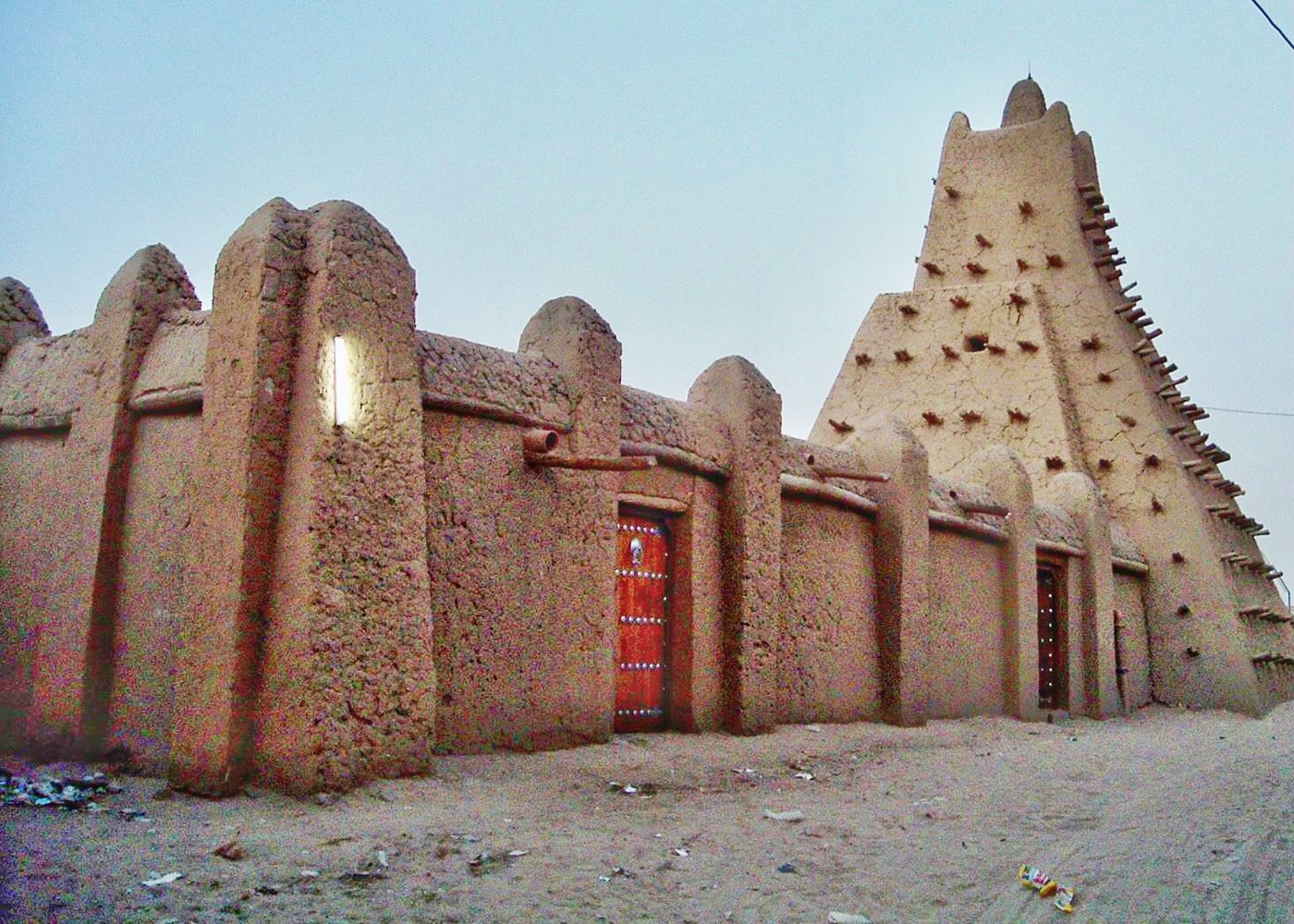
One caution about al-Sahili. Older accounts credit him with inventing this whole architectural style, as though the Sahel had been waiting for a man from Spain to show it how to build. Archaeologists have long since abandoned that idea. Mud-brick construction on this pattern is indigenous to the region and predates Musa considerably. Al-Sahili was a talented import who worked within an existing tradition. The tradition was already there.
Timbuktu was a library before it was a metaphor
In English, "Timbuktu" became shorthand for anywhere impossibly remote. That usage is a fossil of European ignorance. For several centuries the town was one of the most connected places in the world, sitting where the Niger river traffic met the Saharan camel routes, and its main export after gold was scholarship.
Around the Sankore Mosque grew a dense community of teachers and students. It is usually called a university, though that word imports assumptions that do not fit. There was no single institution with a registrar and a syllabus, but rather a network of scholars, each gathering students who studied with them, earned their certification, and moved on to the next master. They worked on Islamic law and theology, but also astronomy, mathematics, medicine, poetry and history. Books were copied, traded and collected. Manuscripts were serious commercial goods; families built libraries and passed them down as inheritances.
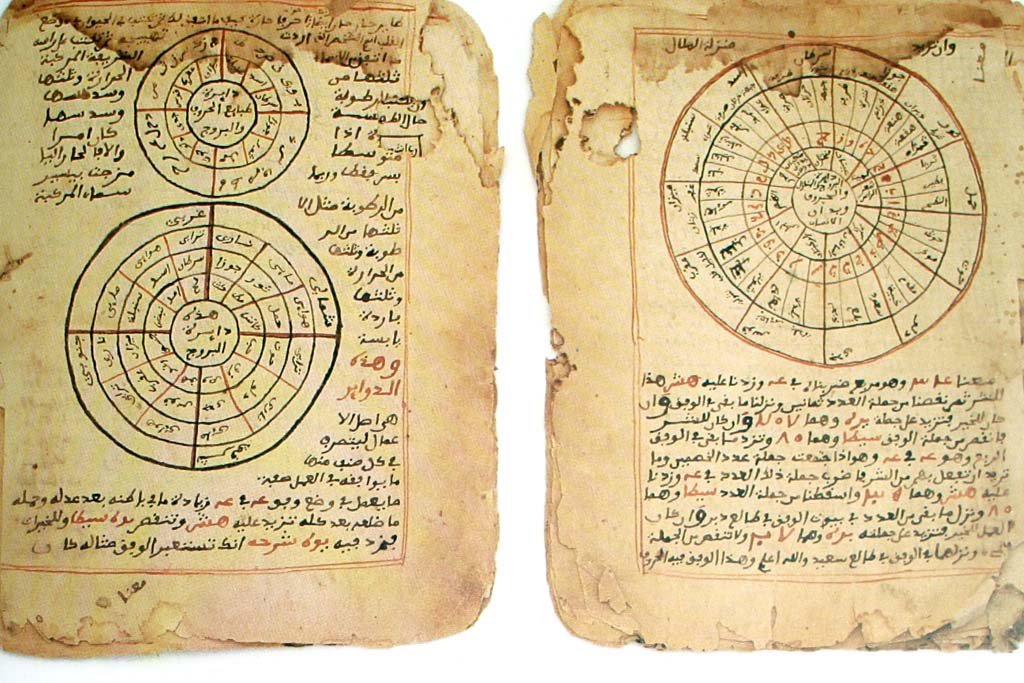
Hundreds of thousands of those manuscripts still exist. Most were never in museums at all; they stayed in family collections, in trunks and back rooms, through centuries of upheaval. They are the plainest possible refutation of the claim that pre-colonial West Africa had no written record. The record exists. It is in Arabic and in African languages written in Arabic script, and a great deal of it has still not been read by modern scholars.
The sources are the sticking point. Nearly everything we know about Musa comes from outsiders: al-Umari, who collected Cairene gossip a decade after the fact; Ibn Battuta, who reached Mali in 1352 when Musa was already dead; Ibn Khaldun, writing later still and working from informants. There are no Malian state records from Musa's reign. So historians argue about how much of the spectacle was real and how much was Egyptian storytelling, about whether the gold crash was as severe as reported or a good anecdote that grew with retelling, and about how far the oral traditions preserved by West African griots (which barely mention the hajj at all) should be weighted against the Arabic texts that make it the centre of everything. The griots remember Musa as a pious but unremarkable ruler. Cairo remembered him as a spectacle. Both memories are evidence, and they do not agree.
The map that made him a legend in Europe
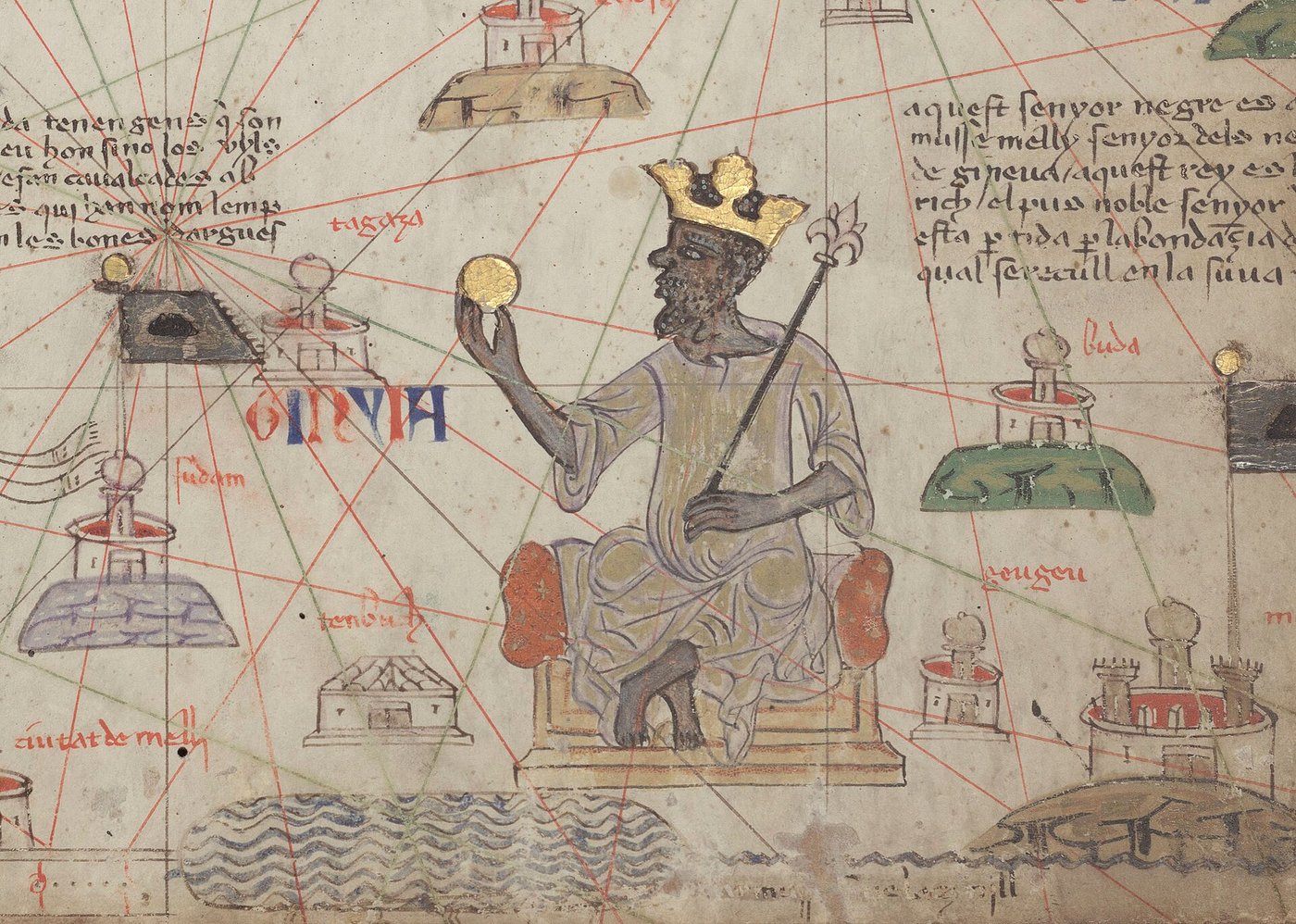
In 1375, roughly forty years after Musa's death, a workshop in Majorca produced the Catalan Atlas, one of the great cartographic objects of the Middle Ages. On the sheet covering North Africa, below the Atlas Mountains and the Saharan caravan routes, sits a Black king on a throne. He wears a gold crown, holds a gold sceptre in one hand and, in the other, a large gold nugget. The caption identifies him as the lord of the Africans of Guinea, and notes that the abundance of gold in his country makes him the richest and most noble king in the region.
This is the image of Musa that everyone has seen, and it is worth understanding what it represents. Nobody in Majorca had met him. The mapmaker was working from the reports of Saharan traders and the durable memory of a caravan that had passed through Cairo two generations earlier. Musa had been dead for decades, and Europeans were still drawing him on their maps as the man made of gold. His pilgrimage did exactly what it was designed to do: it put Mali on the mental map of the Mediterranean world, permanently.
There is a darker footnote. That reputation was also an advertisement. European interest in reaching West African gold directly, rather than paying Saharan middlemen for it, is part of what pushed Portuguese ships down the Atlantic coast in the following century, voyages that opened the sea routes and, before long, the Atlantic slave trade.
What was left
Musa died around 1337, and Mali did not hold together for long afterwards. His son Maghan reigned briefly and badly; Timbuktu was raided and burned during his reign. Musa's brother Sulayman restored some stability, and it was during his reign that Ibn Battuta visited and left the only eyewitness description of the empire we have from a traveller who actually went there. After Sulayman came succession disputes, and then the slow arithmetic of decline: provinces breaking away, Tuareg pressure from the desert, and finally the rise of Songhai, which took Timbuktu in 1468 and inherited Mali's position on the river.
Mali survived as a shrunken kingdom into the seventeenth century. But the empire Musa ruled, the one that ran from the Atlantic to beyond the Niger bend and taxed the gold of the medieval world, did not outlast him by more than a few generations.
The librarians who smuggled out the manuscripts
In 2012, armed groups took control of northern Mali and occupied Timbuktu. They began destroying the mausoleums of the town's saints, and it became clear that the manuscript collections were at risk. What happened next deserves to be as famous as the hajj. Librarians, families and volunteers, led by the archivist Abdel Kader Haidara, packed manuscripts into metal footlockers and rice sacks and moved them out of the city by car, by donkey cart and by boat down the Niger: around three hundred and fifty thousand of them, smuggled south to Bamako under the noses of the occupiers. In 2016 the International Criminal Court convicted a man for the destruction of the Timbuktu shrines, the first time the court had treated the deliberate destruction of cultural heritage as a war crime in its own right.
That is the real reason the Mansa Musa story is worth more than its meme. The gold is a good hook, and the number attached to it is nonsense. What the hajj of 1324 actually recorded, in the writing of people who had no reason to flatter him, was the existence of a large, organised, literate, wealthy West African state at a moment when Europe was still recovering from famine and about to be halved by plague. That state left buildings that are still standing and books that are still being read, and in living memory people risked their lives to carry those books to safety. The empire is gone. The archive is not.
Read next: Timbuktu Manuscripts: The Trunks of Books Smuggled Past al-Qaeda and Kilwa Kisiwani: The African Coins Found on an Australian Beach.
Sources & further reading
- Michael A. Gomez, African Dominion: A New History of Empire in Early and Medieval West Africa (Princeton, 2018) — the standard modern scholarly account, and sceptical about the popular wealth narrative.
- Al-Umari, Masalik al-absar fi mamalik al-amsar (1330s) — the principal contemporary source on the hajj, translated in Levtzion and Hopkins, Corpus of Early Arabic Sources for West African History.
- Ibn Battuta, Rihla — the only surviving eyewitness account of the Mali empire by a visiting traveller, from his journey of 1352–53.
- Nehemia Levtzion, Ancient Ghana and Mali — a foundational study of the West African empires and their trans-Saharan trade.
- Joshua Hammer, The Bad-Ass Librarians of Timbuktu — on the manuscript collections and the 2012–13 evacuation.
- The Catalan Atlas (1375), attributed to Abraham Cresques, held at the Bibliothèque nationale de France.
Image credits (via Wikimedia Commons): Mansa Musa in the Catalan Atlas — attributed to Abraham Cresques (public domain); map of the Mali Empire — HetmanTheResearcher (CC BY 4.0); Djinguereber Mosque, Timbuktu — upyernoz (CC BY 2.0); Sankore Mosque, Timbuktu — Anne and David (public domain); Timbuktu manuscripts on astronomy and mathematics — Elias Altmimi (public domain).