In the winter of 2001 the Halil River came up harder than the old men could remember. It runs down out of the mountains of Kerman, in the dry south-east of Iran, and most of the year it is a modest thing. That year it tore at its own banks, and when the water dropped it had cut the soil away from a low rise near the village of Mahtoutabad and left something showing in the mud: bones, and beside the bones, stone. Not river stone. Bowls and cups of dark green rock, carved all over with scorpions and humped bulls and eagles, laid in the ground beside people who had been dead for four thousand years. Within days the word had spread, and within weeks the diggers came: not archaeologists, but families with spades, working by night, lifting a lost civilisation out of the earth and carrying it away to sell.
Most ancient cultures are met the right way round. A site is found, it is dug slowly, the objects come up one at a time with a note of exactly where each lay, and only then does the art reach the world: explained, dated, tied to a place. The people of the Halil valley were met backwards. Their art reached the world first, in a flood of beautiful looted things with no home and no date, and the place they came from was worked out afterwards, from the holes the robbers left behind. By the time anyone with a trowel and a notebook stood on that ground, the graves were empty and the bones were gone.
The name that stuck is Jiroft, after the nearest town. It belongs to one of the strangest recoveries in modern archaeology: a Bronze Age society, possibly as old and as organised as anything in Mesopotamia, that the twenty-first century first came to know as contraband.
The river that opened the graves
Kerman province is a hard place to make a living. The land is stony, the summers punishing, the water scarce, and the villages along the Halil are poor. When the flood of 2001 laid bare a cemetery packed with fine objects, it laid bare something close to buried treasure, and people who had very little did the obvious thing with it.
What followed was not a dig but a gold rush. Hundreds of men worked the graves along the river, hauling out vessels, weapons, beads and inlaid boxes and passing them up a chain of middlemen that ran from the valley to the dealers of the Gulf and, from there, to the salerooms and private collections of Europe, America and the Emirates. Whole cemeteries were emptied in a season. Archaeologists who came later described ground so thoroughly turned over that not a single skeleton was left in place, every body lifted, shaken out for its grave goods, and thrown aside.
Iranian authorities were slow to grasp the scale, then moved hard. Police investigations traced the smuggling routes; there was a notable seizure at Bandar Abbas, on the coast, of crates waiting to be shipped abroad. Some pieces were recovered and taken to the National Museum in Tehran and to a museum in Jiroft itself. Many were not. They are scattered now through the world’s antiquities market, handsome and homeless, cut forever from the one thing that would have made them speak: the knowledge of who was buried with them, and when.
That loss is the wound at the centre of the whole Jiroft story. A grave is not just its contents. It is the arrangement (this cup by the head, that dagger at the hip, these beads at the throat), and the layer of earth that dates it, and the body that tells you the age and sex and health of the person it honoured. Rip the objects out and you keep the beauty and lose the meaning. The looters of the Halil kept the beauty. The meaning went into the spoil heaps with the bones.
The art that had no country
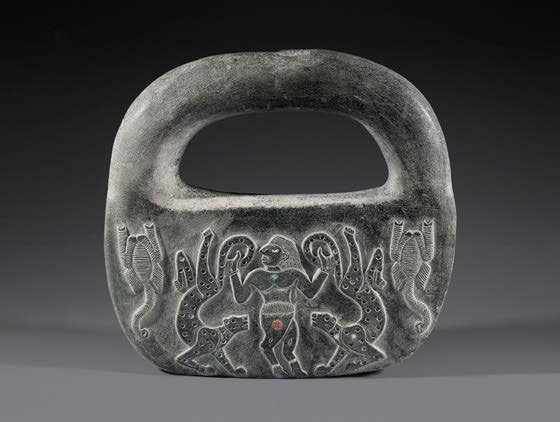
This is what makes archaeologists sit up. The objects pouring out of Jiroft were not a total surprise. Museums had owned things like them for decades: dark chlorite vases and bowls, carved in low relief with a very particular cast of characters: men with scorpion tails, bulls with humped backs, snarling big cats, eagles gripping snakes, date palms, and a curious flat-topped shape that looks for all the world like a handbag. These pieces had turned up since at least the 1960s in places as far apart as the temples of Mesopotamia, the cities of the Indus, and the islands of the Gulf. They plainly belonged together. They plainly came from one tradition. And nobody knew where that tradition lived.
Scholars had a name for the puzzle but not an answer. The archaeologist Philip Kohl studied these vessels in the 1970s and called them the “intercultural style”: a body of luxury stoneware shared across the ancient Near East by peoples who did not share a language or a homeland, the way a fashion can cross borders. The style was real. Its country was blank. The vases were like a signature with no name attached.
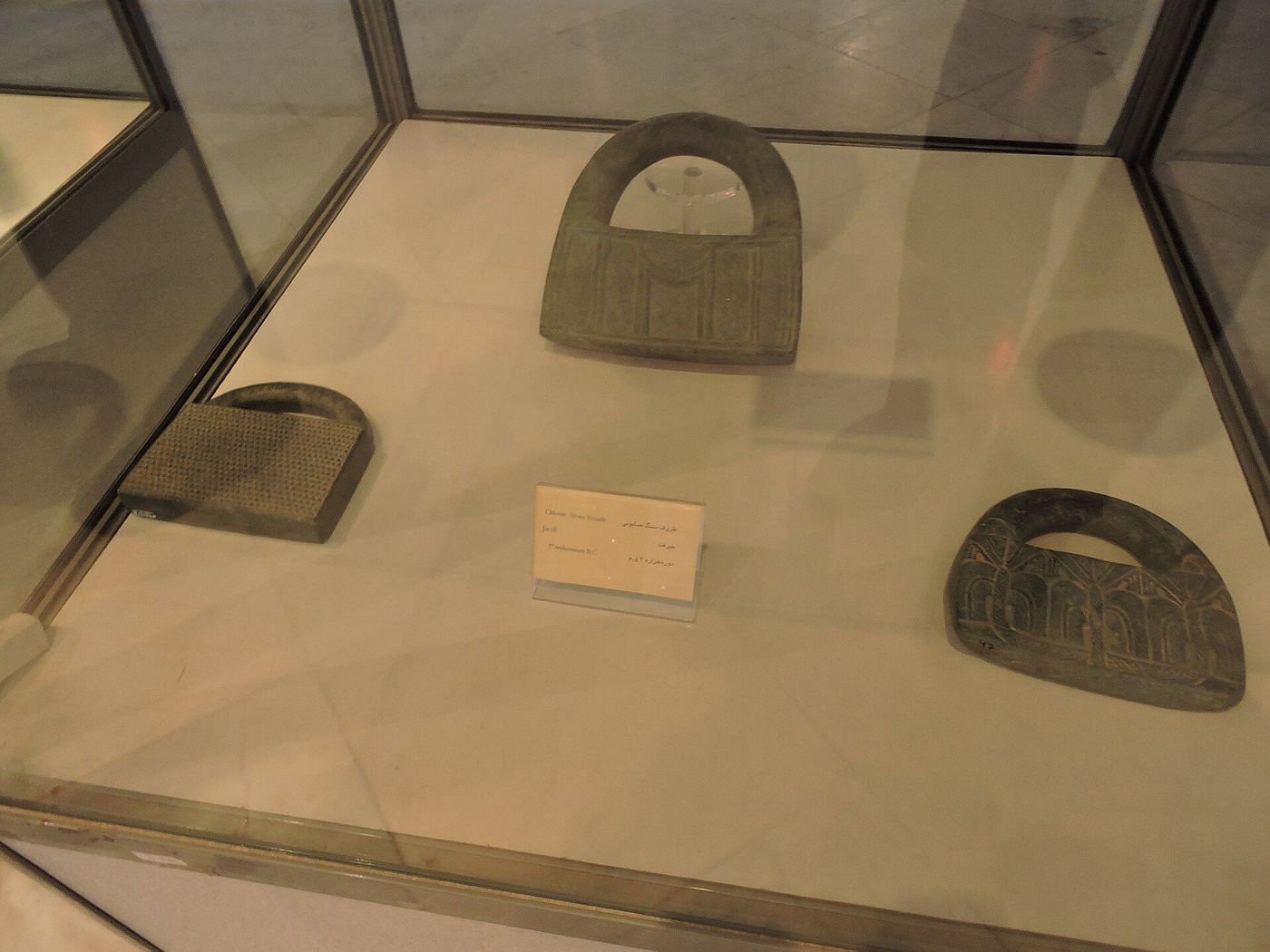
Jiroft filled in the name. The flood of looted material, and then the excavations that followed, pointed hard at the Halil valley as the place where the intercultural style was actually made: where the raw stone came out of the ground and the workshops turned it into art for export. Chlorite is a soft, dense stone, dark green to grey, that carves like hard cheese and takes a fine line. It occurs in quantity in the mountains of Kerman. The valley had the material, the skill and, it now seemed, the customers strung out across a thousand miles of the Bronze Age world.
Chlorite is soft enough to cut with a copper tool and hard enough to keep a crisp edge once carved. The hills of Kerman are full of it. The Jiroft workshops turned it into vessels, weights and inlaid boxes and sent them out along the trade routes, which is why a vase quarried in south-east Iran can be dug up in a temple in southern Iraq. The stone is the fingerprint: it ties the scattered “intercultural” pieces back to a single source.
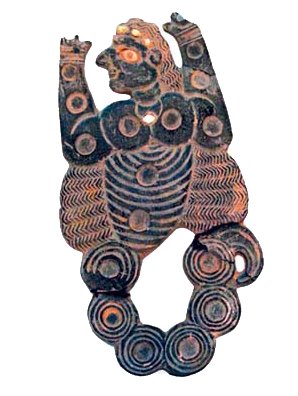
The imagery is worth lingering on, because it is where the culture speaks most clearly. The scorpion-man appears again and again, half insect and half person, a guardian figure who turns up centuries later in the myths of Mesopotamia. Bulls kneel and rear. Eagles spread their wings over rows of snakes. Zebu cattle with high shoulders stand among palm trees. These are not idle decorations. They read like a settled language of symbols, a mythology carved in stone, shared by an elite who wanted the same monsters on their shelves whether they lived in the Halil valley or a Sumerian city.
The man who went to the mound
Into this mess of beauty and theft stepped Yousef Madjidzadeh, a veteran Iranian archaeologist, who was put in charge of the first official excavation in early 2003. His job was unenviable: to make sense of a civilisation whose cemeteries had already been gutted. He turned away from the emptied graves and towards two great artificial mounds a little south of Jiroft, on either side of the river, known as Konar Sandal.
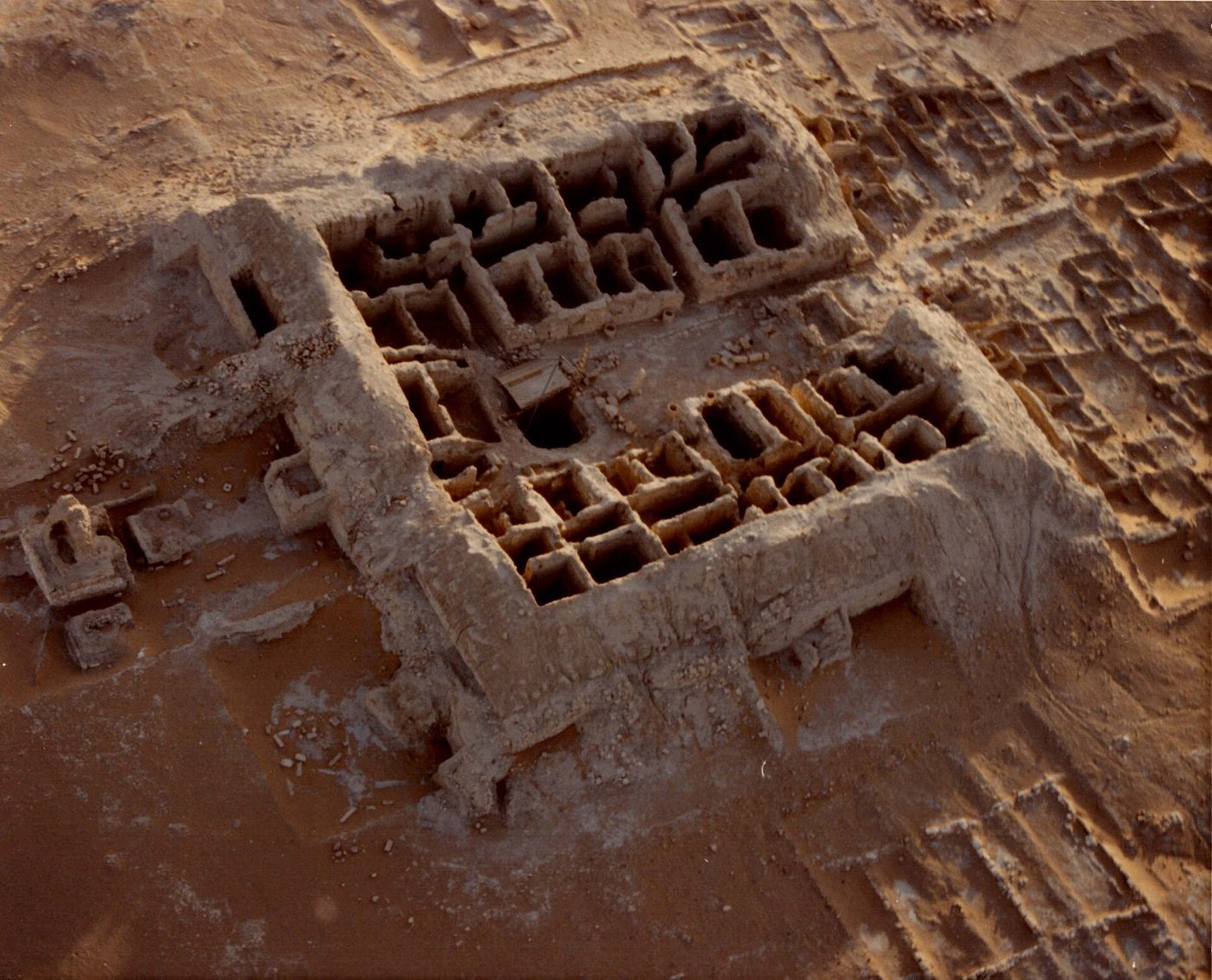
The southern mound, Konar Sandal B, held a citadel. Under it lay a huge platform of mud-brick carrying a fortified building, its ramparts in places some eleven metres thick, its base spreading across more than a dozen hectares. This was not a village. It was the seat of a state, a monument raised by a society that could command a great deal of labour and feed it while it worked. Radiocarbon dates from the rooms cluster in the centuries around 2500 to 2200 BCE, squarely in the age of the Sumerian city-states and the pyramids of Egypt.
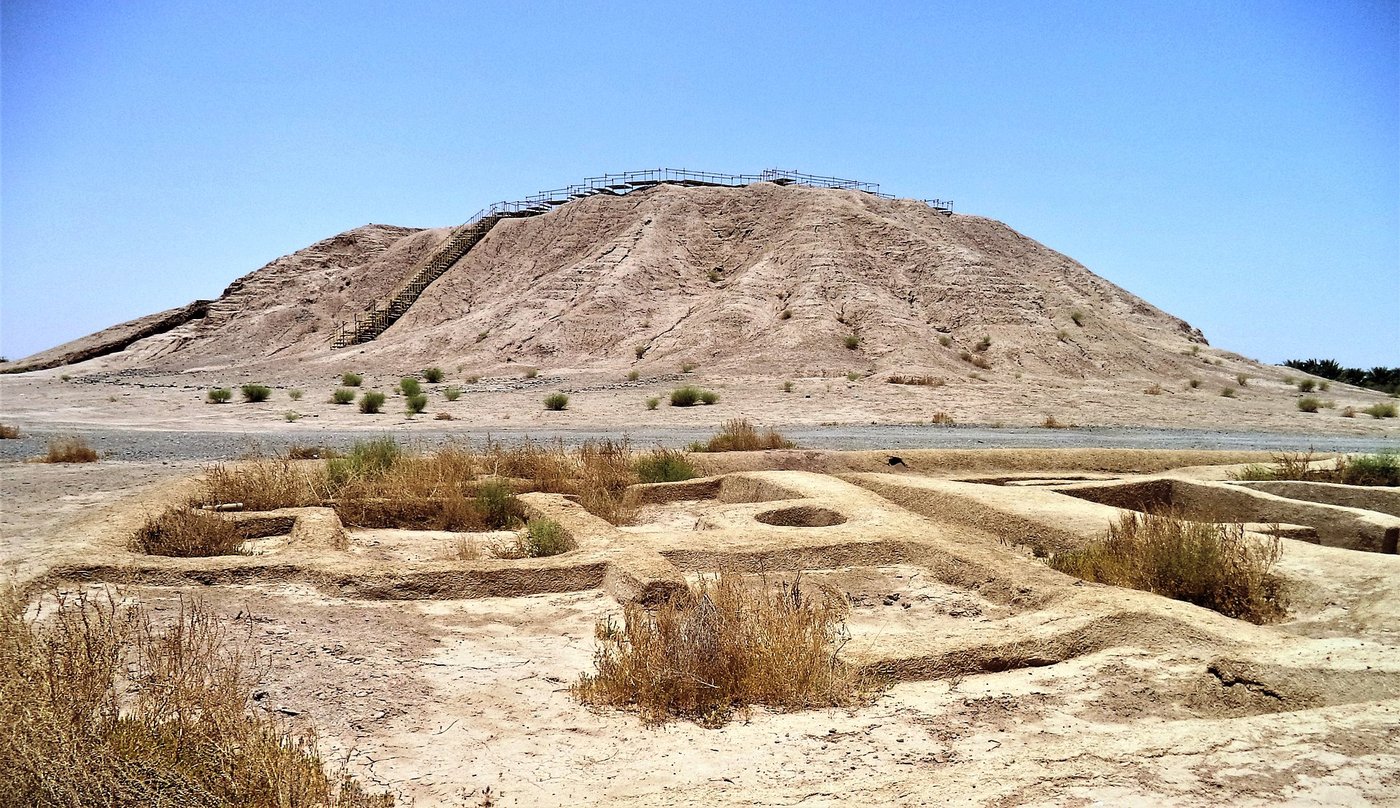
The northern mound, Konar Sandal A, carried a stepped structure that Madjidzadeh described as a great terraced platform, built of millions of bricks. In the more excited reports it became “one of the oldest ziggurats in the world”, older than the famous stepped temples of Mesopotamia. Other archaeologists have been more careful with that word, and with that race. What is not in doubt is that the people of the Halil built big, in brick, on a plan, and did it early.
The American scholar Holly Pittman, of the University of Pennsylvania, joined the work and brought a specialist’s eye to the seals and sealings, the little carved stones and the clay lumps they were pressed into, which are the bureaucracy of the Bronze Age. Seals mean administration. Administration means an economy worth controlling: goods counted, stores locked, ownership marked. The Halil valley was not a backwater that happened to make pretty vases. It was a working power, with officials and accounts.
With the graves gutted, the dig had to lean on what the looters ignored: the architecture of the mounds, the charcoal in the walls for radiocarbon, and the seals and clay sealings that record who controlled what. These humble things carry the dates and the sense of a working state, and they are exactly the material a treasure-hunter steps over. A plundered site is not a dead one. It just forces you to read the margins the robbers thought were worthless.
The tablet that started a fight
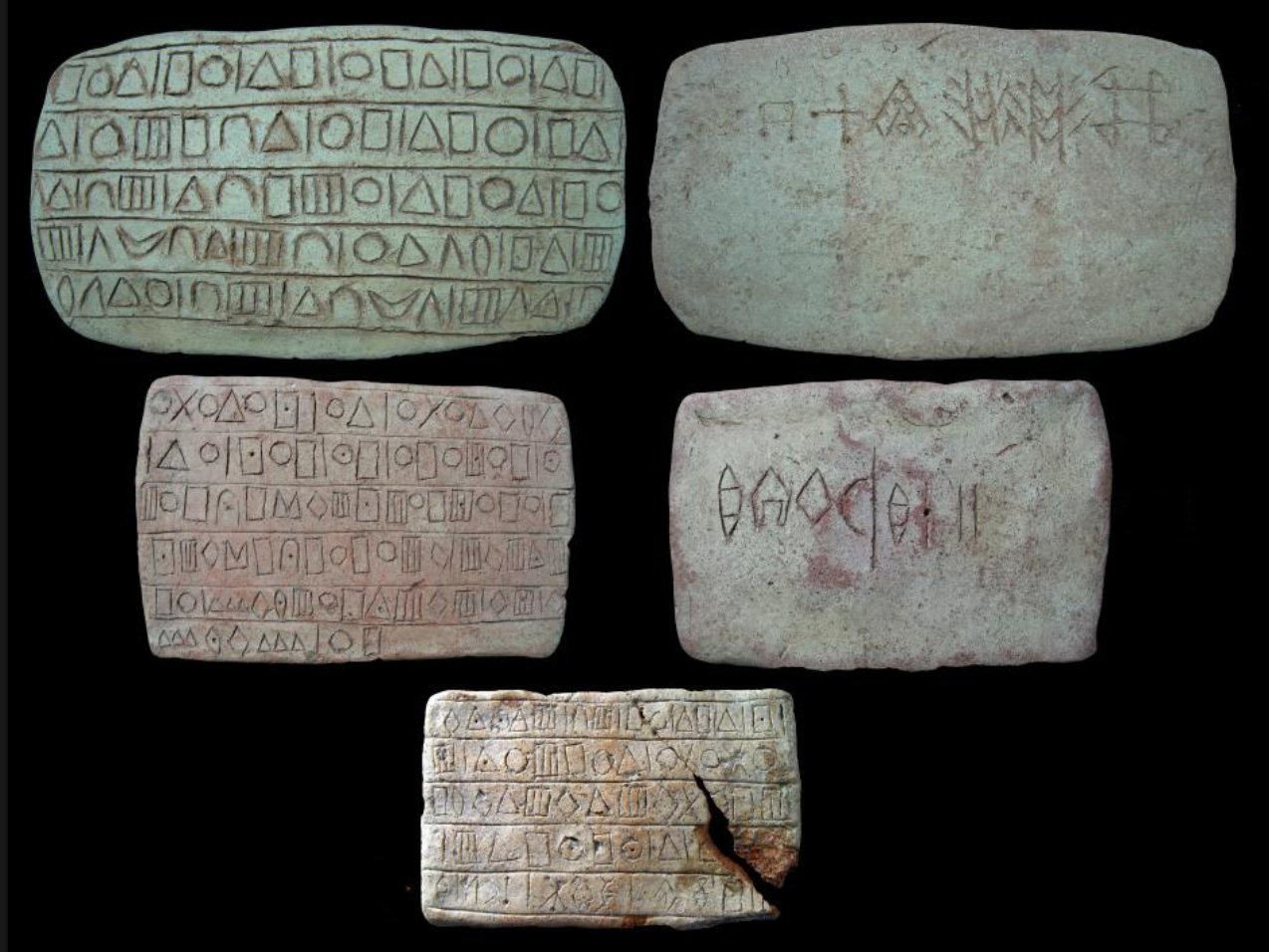
Then came the object that turned an interesting dig into an argument. In the citadel, Madjidzadeh’s team reported finding inscribed clay: tablets and a brick bearing rows of signs. Some of the marks looked a little like the linear Elamite script of later Iran. Others belonged to no writing system anyone had seen: a geometric script, boxes and strokes, unread and unreadable.
If those inscriptions are what they seem, the implications are large. It would mean the Halil valley was writing at the same time as Mesopotamia, or close to it, and the boldest voices went further, and suggested that writing itself might have a second cradle here, in south-east Iran, and not only between the Tigris and the Euphrates. That is a claim to make headlines, and it did.
It is also a claim to handle with tongs, and this is where the looting comes back to poison everything. When a flood of unprovenanced objects hits the market, forgeries follow, because a fake with no find-spot is impossible to catch out on context. The Jiroft boom produced fakes by the crate: modern carvings dressed up as ancient, sometimes clumsy, sometimes very good. So when inscribed pieces appear, sceptics ask the hard question first: is this really ancient, really from a sealed layer, or is it a clever modern hand feeding a hungry market? For unprovenanced Jiroft material, that question can rarely be answered with confidence.
The eye-catching version runs like this: the Halil valley was scratching out a full script while Sumer was still learning to, so the story of writing needs a new opening chapter set in Iran. A few tablets, a geometric alphabet, and the “cradle of civilisation” shifts east.
The honest version is smaller and stranger. There are a few inscribed pieces, some from the excavation and some off the market. The signs are real marks, but they are few, undeciphered, and impossible to line up into a system. Because the looting spawned so many forgeries, the authenticity and dating of some inscribed objects are openly disputed. Jiroft may have written something. It has not yet been shown to have written before anyone else, and until more turns up in a controlled dig, the claim stays a maybe, not a milestone.
Aratta, or a story we want to be true
Madjidzadeh reached for something even more romantic than the oldest writing. He suggested the Halil valley was Aratta, a fabled land from Sumerian poetry: a distant, mountainous, fabulously rich place beyond Iran’s western edge, full of gold and lapis and skilled craftsmen. In the epic tales, the lord of Uruk and the lord of Aratta trade boasts and riddles across the mountains, each trying to master the other. Aratta was to the Sumerians roughly what El Dorado was to the Spanish: a real-sounding country at the edge of the known world, glittering and never quite reached.
You can see the appeal. Aratta was famous for worked stone and precious materials, exactly the trade the Halil valley ran. It lay east of Sumer, in the mountains, exactly where Jiroft sits. Give the legendary kingdom a real address and the whole thing turns from archaeology into a found myth. Reporters loved it.
Most scholars do not buy it, or at least will not sign it. Aratta is known only from poems, and poems are not maps. There is no inscription from Konar Sandal that says “Aratta”, no king’s name to match the epics, nothing but a good fit between a story and a place that happens to be roughly where the story points. It might be true. It cannot, on present evidence, be shown to be true. And the very glamour of the idea is a warning sign: it is the answer a headline wants, which is not the same as the answer the ground has given.
The identification of Jiroft with the Sumerian Aratta is the neatest possible ending, and that is precisely why it is treated with caution. It rests on a match between a poem and a landscape, not on a text found in the soil. The Halil valley was clearly a rich, stone-working power that traded west, the sort of place Sumerian tales of Aratta could remember. Whether it is the Aratta of the epics, or one of several such places, or a kingdom the poets never heard of, is not something a chlorite vase can settle.
The world it traded with
Whatever its name, the Halil valley did not stand alone, and that may be the truest thing the objects tell us. The intercultural-style vessels are, by definition, evidence of reach: they were made here and used there, from Mesopotamia to the Indus. Around 2500 BCE the region between the Iranian plateau and the Indian subcontinent was busier than the old textbooks allowed, a web of city-states and trading peoples moving stone, metal and ideas along the routes that later feed into the Silk Road.
Lapis lazuli, the deep blue stone the ancient world craved, came from a single valley in what is now Afghanistan and travelled west to end up on the throat of an Egyptian queen. Some of that traffic passed through eastern Iran. Carnelian from the Indus was set into Halil-valley boxes. The seals at Konar Sandal speak to peoples further east; the vessels speak to peoples further west. Jiroft looks less like an isolated marvel and more like a hinge: a wealthy middle place between the great river civilisations, taking a cut of the trade and stamping its own mythology onto the luxury goods that crossed it.
That is a quieter claim than a lost Aratta or a rival cradle of writing, but it is better supported, and in some ways more interesting. It means the Bronze Age “cradle of civilisation” was never a single spot in Iraq. It was a spread of connected centres, and one of the bright ones sat on the Halil, making the vases everyone else wanted.
What the drones found, and what the graves kept
The work has not stopped, though it has grown careful. In 2025 archaeologists carried out the first aerial mapping of the Jiroft sites, flying imaging surveys over the ancient city and a smaller fortress nearby to trace the buried outlines that are hard to read from the ground. Bioarchaeologists have gone back over the bones and seeds that survive, rebuilding what people ate and how the valley lived. Genetic studies across the Iranian plateau, published in the same period, have begun to sketch the deep ancestry of the region and the movements of people through it in the Bronze Age. Slowly, the culture is being given back some of the context the looters tore away.
Slowly, and against a running threat. The graves that were emptied cannot be un-emptied. And the pressure that emptied them, poverty pressing on a landscape full of sellable history, has not gone. Iranian archaeologists still warn, publicly, that the conditions for another round of looting have never really lifted, that a site is only as safe as the guard on it and the price of its contents on a market that keeps paying.
So Jiroft sits oddly among the world’s ancient cultures. We have shelves of its art and hardly any of its dead. We have a citadel, a stepped platform, seals and a few contested signs, and a legendary kingdom that may or may not be its true name. We know it was rich, and connected, and old, and that it made some of the most beautiful worked stone of its age. We do not know what it called itself. A civilisation was pulled out of the Kerman mud by the wrong hands, sold before it was studied, and it is still, twenty years on, being pieced back together from the things the thieves happened to drop: a portrait assembled from the frame after the picture was carried away.
Read next: Gonur Depe: The Lost Capital That Brewed the Drink of the Gods and Dilmun: The Land Sumer Called Deathless, and Its 11,774 Tombs.
Sources & further reading
- Yousef Madjidzadeh and Holly Pittman, “Excavations at Konar Sandal in the Region of Jiroft in the Halil Basin: First Preliminary Report,” Iran (Journal of the British Institute of Persian Studies) — the official account of the citadel and the stepped platform.
- Holly Pittman, Penn Museum, “The Jiroft Civilization: A New Bronze Age Culture on the Iranian Plateau” — on the seals, the iconography and the trade connections.
- Oscar White Muscarella, “Jiroft and ‘Jiroft–Aratta’: A Review Article,” Bulletin of the Asia Institute — the sceptic’s case on forgeries, provenance and the Aratta claim.
- Philip L. Kohl, studies of the “intercultural style” chlorite vessels — on the art without a homeland that Jiroft helped to place.
- Encyclopaedia Iranica, entries on Jiroft and the Halil Rud — on the region, its geography and its archaeology.
- National Geographic History Magazine, “Buried for 4,000 Years, the Jiroft Culture Could Expand the ‘Cradle of Civilization’” — an accessible overview of the discovery and the debates.
- Tehran Times, “Aerial mapping of Jiroft archaeological sites conducted for first time” (2025) — on the recent survey work in the valley.
Image credits (via Wikimedia Commons): chlorite object of the Jiroft culture, National Museum of Iran — Nationalmuseumofiran (CC BY-SA 4.0); chlorite vessels in the Jiroft museum — Rayeshman (CC BY-SA 4.0); Jiroft scorpion motif — Behnam0o (public domain); the Konar Sandal B mound — Mhsheikholeslami (CC BY-SA 4.0); Jiroft culture inscriptions — Uuyyyy (CC BY-SA 3.0).