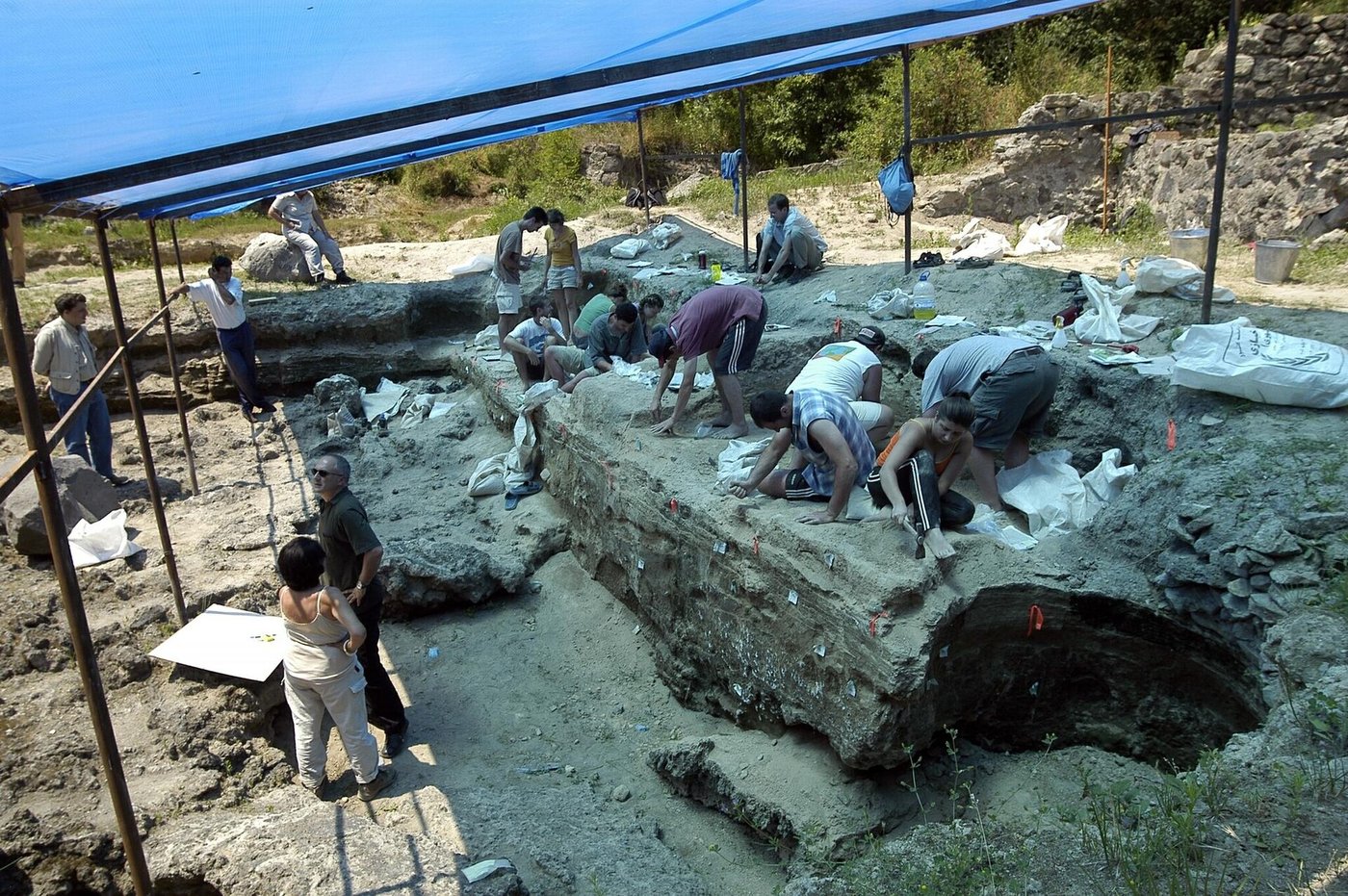
On 25 September 1991, a Georgian dig that was supposed to be about the Middle Ages turned up something a million and a half years too old. The team at Dmanisi, a ruined hilltop town in the south of the country, had spent seasons clearing medieval grain pits and the stones of an old church. Below all that, in soil the colour of rust, a worker lifted out a human lower jaw. It was heavy, complete, and wrong for its surroundings. When the dating came back it read close to 1.8 million years: older than any human bone ever found outside Africa. A cathedral town had been sitting, unknowingly, on the oldest Europeans anyone had met.
That jaw was only the start. Over the next fifteen years the same few square metres of hillside gave up five skulls, several jaws, arm and leg bones, thousands of stone tools, and the scattered remains of the animals that had lived and died alongside these people. It is the richest early human site in the world outside the African rift. And it has spent the years since arguing with itself, because the five skulls do not look like one kind of creature. They look like several.
A hill with two histories
Dmanisi sits about 85 kilometres south-west of Tbilisi, on a rocky spur where two rivers meet. For most of recorded history it was known for the town on top: a medieval trading centre with a fine stone cathedral, fought over and finally abandoned. Archaeologists came in the 1980s to dig the medieval layers. What they did not expect was for their grain pits to cut down into a much older world.
The reason the old bones survived is a matter of luck and geology. Beneath the site runs a thick sheet of basalt, lava that hardened around 1.85 million years ago. On top of that hard floor, wind-blown ash and river mud built up quickly, burying bones and tools before they could rot or wash away. Later argon dating of the volcanic grains put the human layer at about 1.81 million years, give or take thirty thousand. The tools scatter across a narrow band, roughly 1.85 to 1.78 million years old. In geological terms the people of Dmanisi arrived, lived, and were buried almost in a single breath.
Set that date beside the map and it becomes strange. The textbook story once held that early humans stayed in Africa for a very long time before anyone wandered out, and that the first to leave were tall, long-limbed, big-brained toolmakers of the kind called Homo erectus. Dmanisi broke the timing. These people were at the gates of Europe and Asia almost as soon as our genus existed, and, as the skulls would show, they were neither tall nor especially big-brained.
Five heads that will not agree
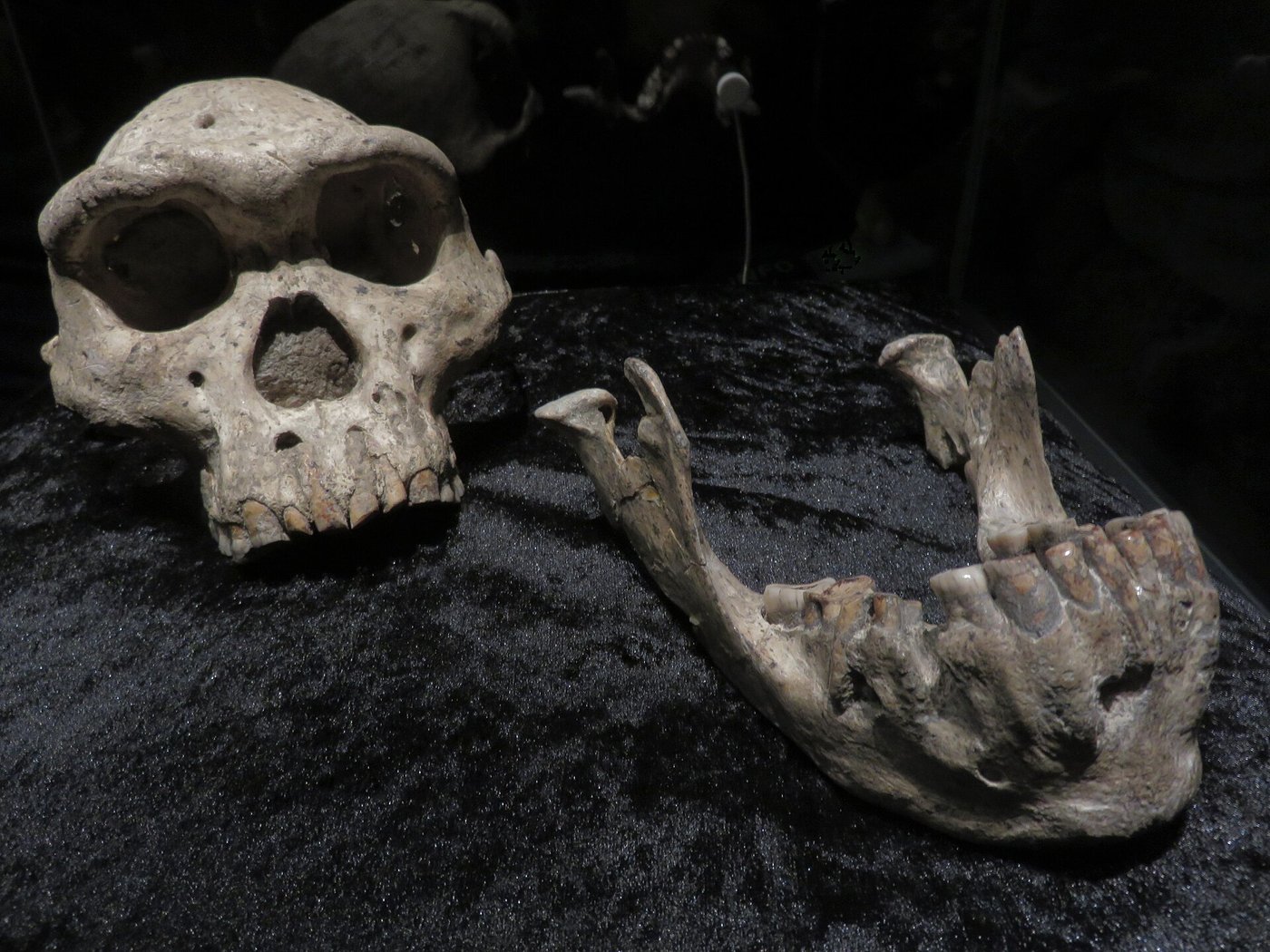
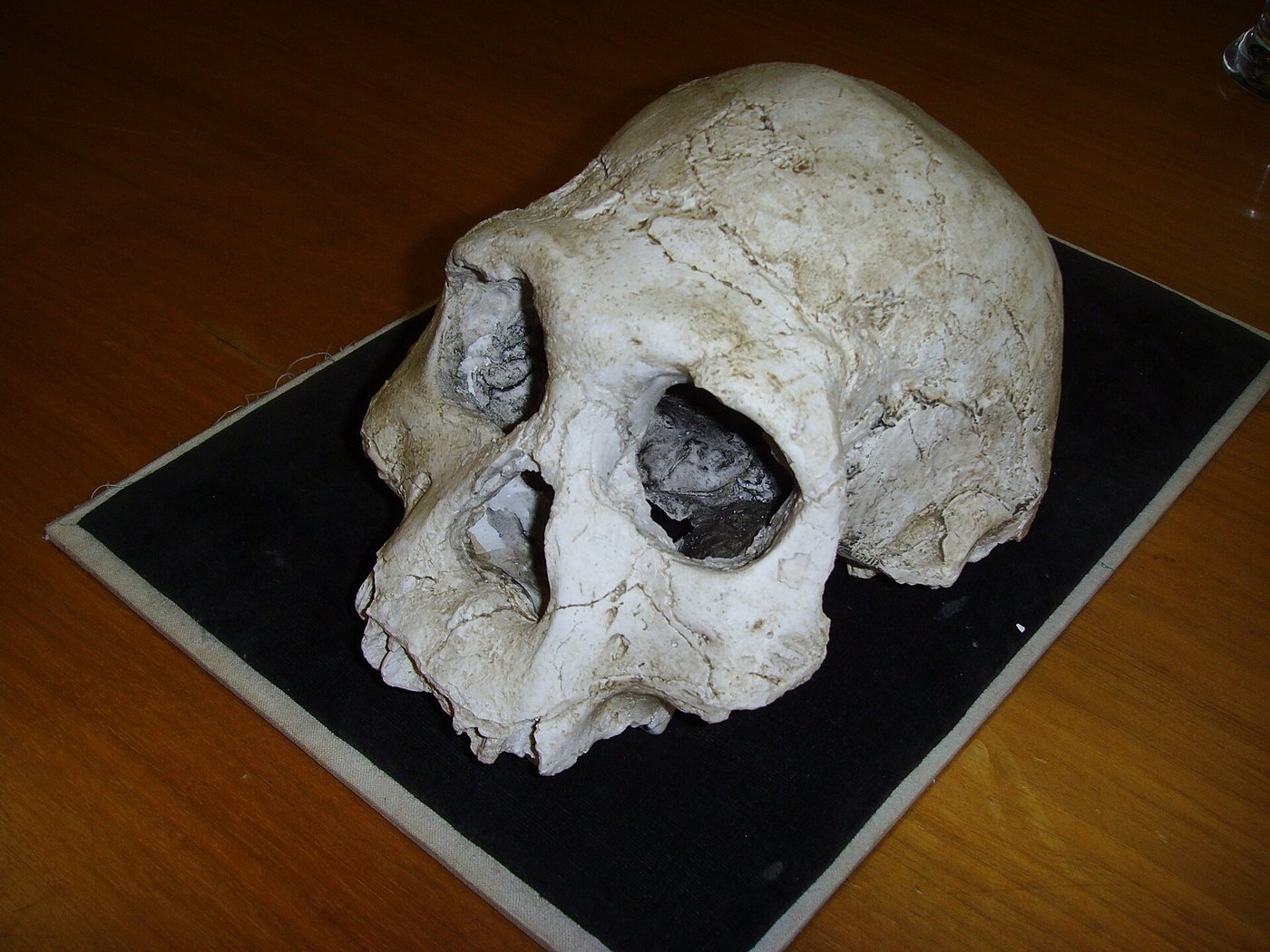
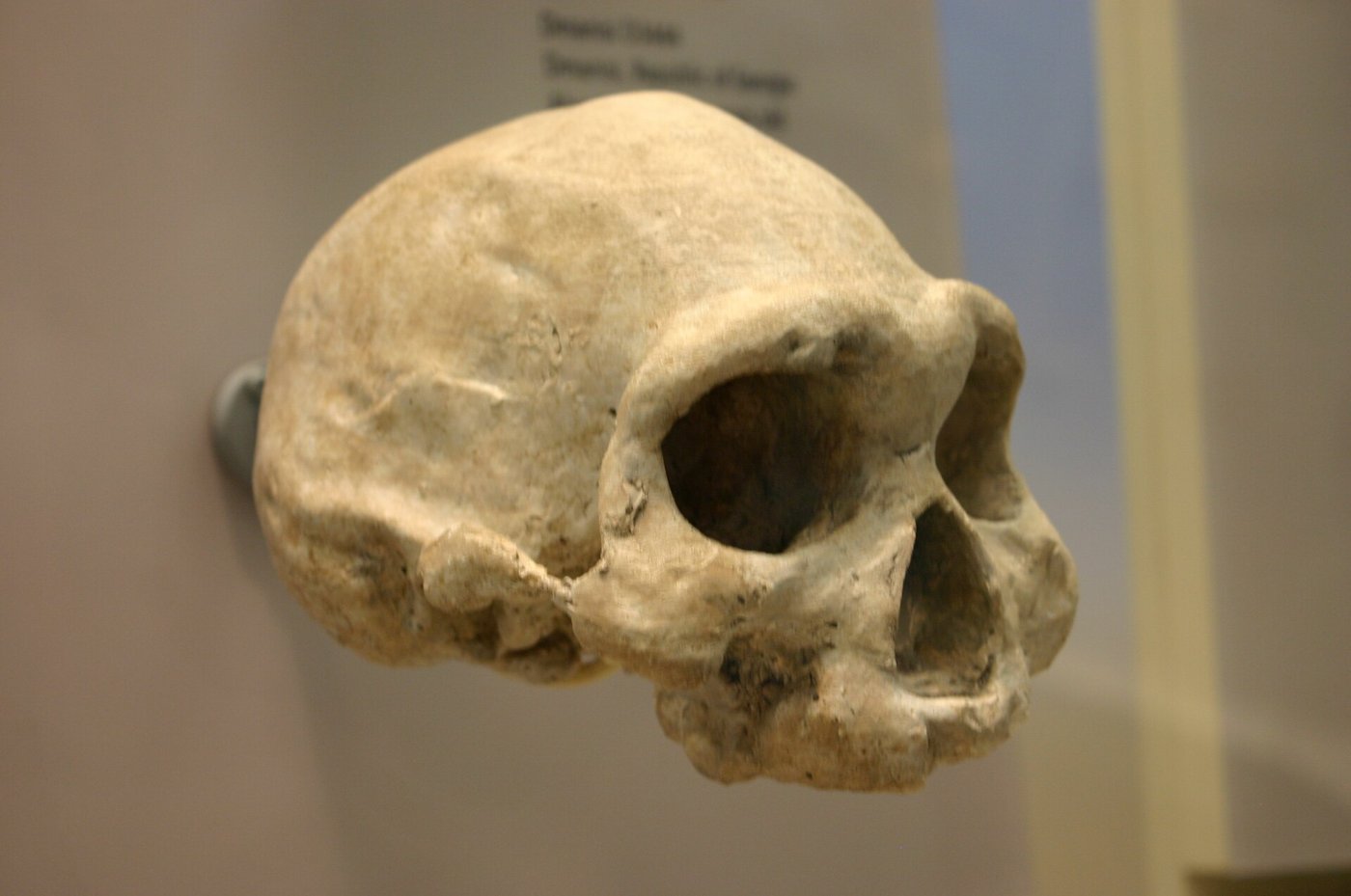
Count the skulls and the trouble begins. The first, catalogued D2280, is a fairly robust adult braincase. The second, D2282, is lighter and finer, thought to belong to a young person, and it pairs with that original 1991 jaw. The third, D2700, is the one that appears in every textbook: a nearly perfect young skull, teeth still bright, so well preserved it looks recent. The fourth, D3444, is an old individual with almost no teeth left. The fifth, D4500, is a complete adult skull (the earliest wholly intact adult human skull known anywhere), and it is joined to a huge, jutting jaw, D2600, that had been found lower in the ground years before.
Now measure their brains. The smallest, inside Skull 5, holds about 546 cubic centimetres. The largest, Skull 1, reaches roughly 775. The rest sit between. The average is close to 631: smaller than a modern human brain, which runs near 1,350, and squarely in the range of the older, more ape-like Homo habilis back in Africa. These were people with brains a little larger than a chimpanzee's, walking out of a continent on legs already built like ours.
Skull 1 (D2280), an adult, about 775 cc. Skull 2 (D2282), gracile, younger, about 650 cc. Skull 3 (D2700), a superbly preserved youth, about 600 cc. Skull 4 (D3444), an old, near-toothless individual, about 625 cc. Skull 5 (D4500), a complete adult with a small braincase and a massive face, about 546 cc; the average of the group is around 631 cc. All five came from the same thin layer, within metres of each other. That closeness is the heart of the argument: whatever they were, they were together.
The bodies matched the modest heads. The Dmanisi people stood between roughly 1.45 and 1.66 metres and weighed perhaps 40 to 50 kilograms. Their legs were long and their feet arched, good for covering ground on two feet over long distances. Yet their shoulders and arms kept older, more primitive proportions, closer to those of their African forebears than to us. They were a mixture, part ancient and part modern, caught in the act of becoming something new.
The old man who lived without teeth
Skull 4 tells the most human story in the collection. This was an old individual by the standards of the time, and by the end of life the mouth had lost all but a single tooth. That much a dentist could see at a glance. The telling part is what happened to the empty sockets. When a tooth falls out and the person keeps living, the bone slowly fills the gap and smooths over. In this jaw the sockets had closed almost completely. The teeth had been gone for years before death.
Years is a long time to survive with no teeth in a cold, open country full of large predators, eating food you cannot chew. It set off one of the warmest debates in the whole science of human origins. Some researchers read it as the oldest sign of care we have: that others in the group must have brought this person soft food, perhaps mashed plants or marrow and brains scooped from bone, so that a toothless elder could go on living. If so, it pushes simple compassion back nearly two million years, long before big brains or language as we know it.
Not everyone is moved. A toothless mouth can gum ripe fruit, soft plants and the fatty insides of animals without help, and a determined old primate might have fed itself. The sockets prove survival; they do not prove that anyone lifted a finger. The honest position sits in between: the old individual of Dmanisi lived a long time after losing the tools of eating, in a place where that was hard, and we cannot yet say for certain whether the answer was a caring group or a stubborn body. Either way, it is the earliest time the question can even be asked.
Tools that were already old-fashioned
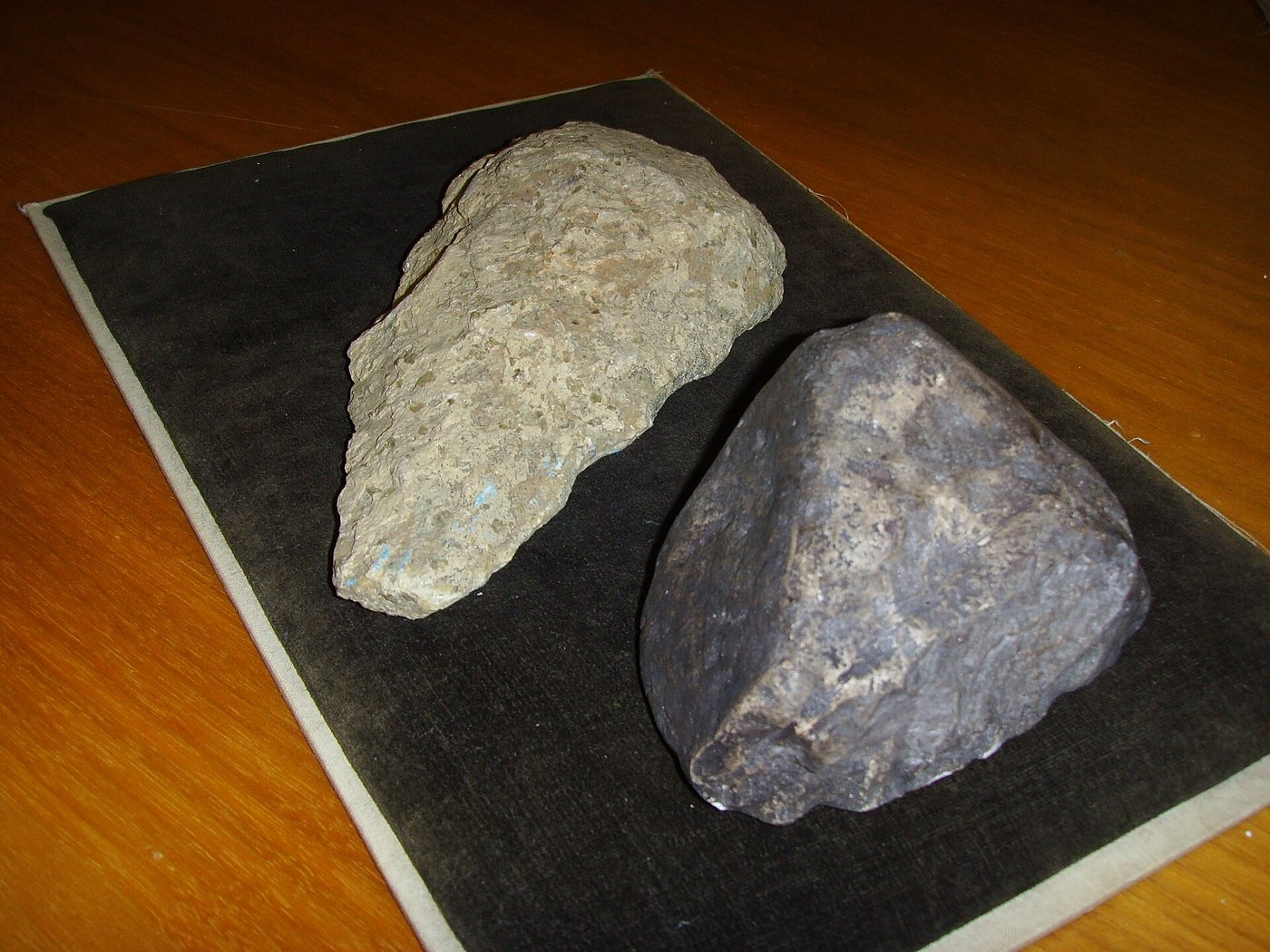
More than ten thousand stone pieces came out of the ground with the bones. They are simple: sharp flakes struck from river cobbles, the cobble cores left behind, chunky choppers, and plain stones carried in from elsewhere to serve as raw material. Toolmakers call this the Oldowan, the oldest known way of working stone, first made in Africa hundreds of thousands of years before Dmanisi.
Here is the odd thing. Back in Africa, around the same time or soon after, some human groups had begun making the teardrop-shaped hand axe, a bigger, more demanding tool that took planning and skill. None turned up at Dmanisi. Not one. The people who reached the edge of Europe were carrying the older, plainer kit. Perhaps they left Africa before the hand axe was invented. Perhaps they never learned it, or had no need. Either way it undercuts a neat idea: that clever new technology drove the first humans out of Africa. Dmanisi's travellers made the journey with a small brain and a simple flake.
They were not the top animal in the landscape, either. The same soil holds sabre-toothed cats of two kinds, a giant hyena, an Etruscan rhinoceros, wild horses, deer by the thousand, and a giant flightless ostrich. Some of the human bones carry the marks of teeth. The very fact that five skulls ended up crowded into so small a space may be down to carnivores dragging remains into a den or gully. These were people who could be hunted, sheltering at the wet meeting point of two rivers, one predator among many.
The story most of us grew up with is clean. One kind of early human, Homo erectus, grew tall and clever in Africa, and then in one great wave marched out to fill the rest of the Old World. A single species, a single exit, a straight road from there to us.
Dmanisi keeps refusing to fit that line. The people here were small and small-brained, they carried the oldest tools rather than the newest, and their five heads vary so wildly that reasonable scientists cannot agree whether they are one species or two. The way out of Africa now looks less like a single march and more like a slow, messy leaking of several kinds of human into a new world, at least one of which looked nothing like the tall toolmaker of the textbooks.
One species, or many?
This is the fight Dmanisi started, and it has run for more than twenty years. When that enormous jaw, D2600, first came up in 2000, some researchers thought it so different from the other Dmanisi bones that they named a whole new species for it, Homo georgicus. Others folded everything back into Homo erectus, treating the site as a slightly odd early branch of a familiar tree.
The boldest move came in 2013. David Lordkipanidze, the Georgian scholar who has led the work for decades, and his colleagues published the complete Skull 5 in the journal Science and turned the problem on its head. Yes, they said, these five skulls differ enormously, but they come from one small population, one moment, one hillside. If a single group of early humans can vary this much, then perhaps the separate species palaeontologists had named back in Africa (habilis, rudolfensis, ergaster) are not separate species at all. Perhaps they are just the normal spread of one variable, evolving line. It was an argument for lumping the messy early human family down into a single trunk.
It did not go unanswered. Other researchers pushed straight back, insisting that you cannot wave away real differences in bone by calling them variation, and that the giant jaw at least still deserved its own name. To erase those distinctions, they argued, is to give up on reading anatomy at all. The site sat at a stand-off: one team saw a single wildly varied species, another saw more than one kind of human sharing the same ground.
A study published in PLOS ONE at the start of 2026 tried to settle it with enamel rather than eye. Tooth enamel keeps its shape better than a crushed braincase, so the team measured the crown areas of premolars and molars from three Dmanisi individuals and set them inside a huge comparison of 583 fossil teeth, from australopiths through several early Homo species. The teeth split cleanly. One Dmanisi individual sat closest to the older, more ape-like australopiths; two others fell in with early Homo. The gap between them was wider than the difference between male and female in even the most lopsided living apes, such as gorillas. Their reading: at least two kinds of human, standing on the same Georgian hillside around 1.8 million years ago.
If that holds, it pulls the argument back toward the splitters, and toward a far stranger picture of the first journey out of Africa. Not one species stepping out, but a small crowd of them, more than one sort of human leaving the continent, meeting at the same rivers, perhaps overlapping and perhaps ignoring one another, each finding its own way to live in a colder world. The lumpers are not beaten; a study of enamel is not the last word, and the same bones will be measured again by other hands. But the tidy single line has not looked convincing for a long time.
The hill is still open
What makes Dmanisi rare is not just the age of its bones but how many there are and how close together they lie. Most of what we know about the first two million years of the human story comes from single teeth and broken fragments, each found alone, each easy to imagine as its own species. Dmanisi handed over a group (old and young, robust and slight, big-jawed and small-brained), all from one place and one time. That is why it is so useful, and why it will not settle. A single skull can be whatever you need it to be. Five skulls together have to be explained.
The dig has not finished. New bones and new methods keep arriving, and each one is measured against the same worn question the site posed on the day that first jaw came out of the ground. How many kinds of human made the first walk out of Africa? Dmanisi has spent thirty-five years refusing to give a clean answer, and in refusing, it has told us the honest thing: that our beginnings were never a single figure on a road, but a crowd, and we are still learning to count it.
Read next: Tollense: How One Arm Bone Uncovered Europe's Oldest Battle and Lake Mungo: The Oldest Known Cremation on Earth, and Why It Was Reburied.
Sources & further reading
- David Lordkipanidze et al., “A Complete Skull from Dmanisi, Georgia, and the Evolutionary Biology of Early Homo,” Science (2013) — the Skull 5 paper and the single-lineage argument.
- Leo Gabunia, Abesalom Vekua et al., “Earliest Pleistocene Hominid Cranial Remains from Dmanisi,” Science (2000) — the first skulls and the site's age.
- Jeffrey H. Schwartz, Ian Tattersall and Zhang Chi, response in Science (2014) — the case that more than one species is present.
- “New Dmanisi fossil study suggests multiple human species left Africa 1.8 million years ago,” reporting the 2026 PLOS ONE dental analysis — Archaeology News Online Magazine, January 2026.
- Georgian National Museum, Dmanisi research pages — excavation history, the toothless individual (D3444) and the fauna of the site.
- Ann Gibbons, “Meet the frail, small-brained people who first trekked out of Africa,” Science news — a readable overview of the Dmanisi people and the debate.
Image credits (via Wikimedia Commons): Dmanisi Skull 5 (D4500 and jaw D2600), featured — Gerbil (CC BY-SA 4.0); the Dmanisi excavation site — Georgian National Museum (CC BY-SA 3.0); the cranium D2700 — Gerbil (CC BY-SA 3.0); the near-toothless skull D3444 — Ryan Somma (CC BY-SA 2.0); an Oldowan stone tool from Dmanisi — Gerbil (CC BY-SA 3.0).