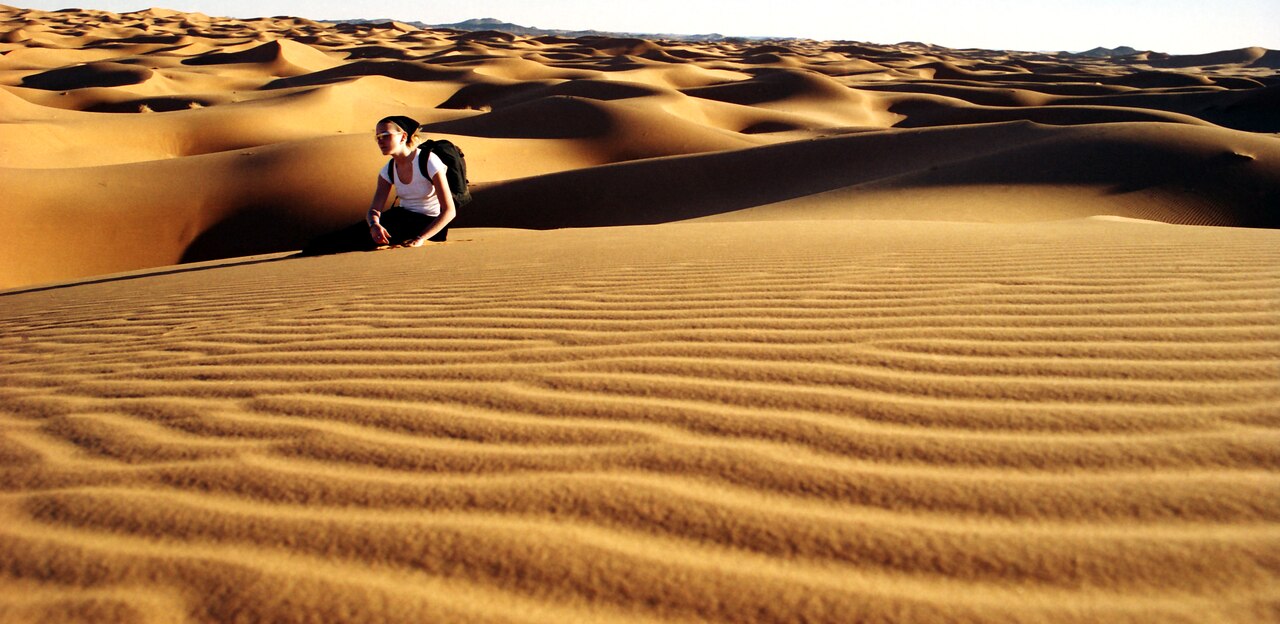
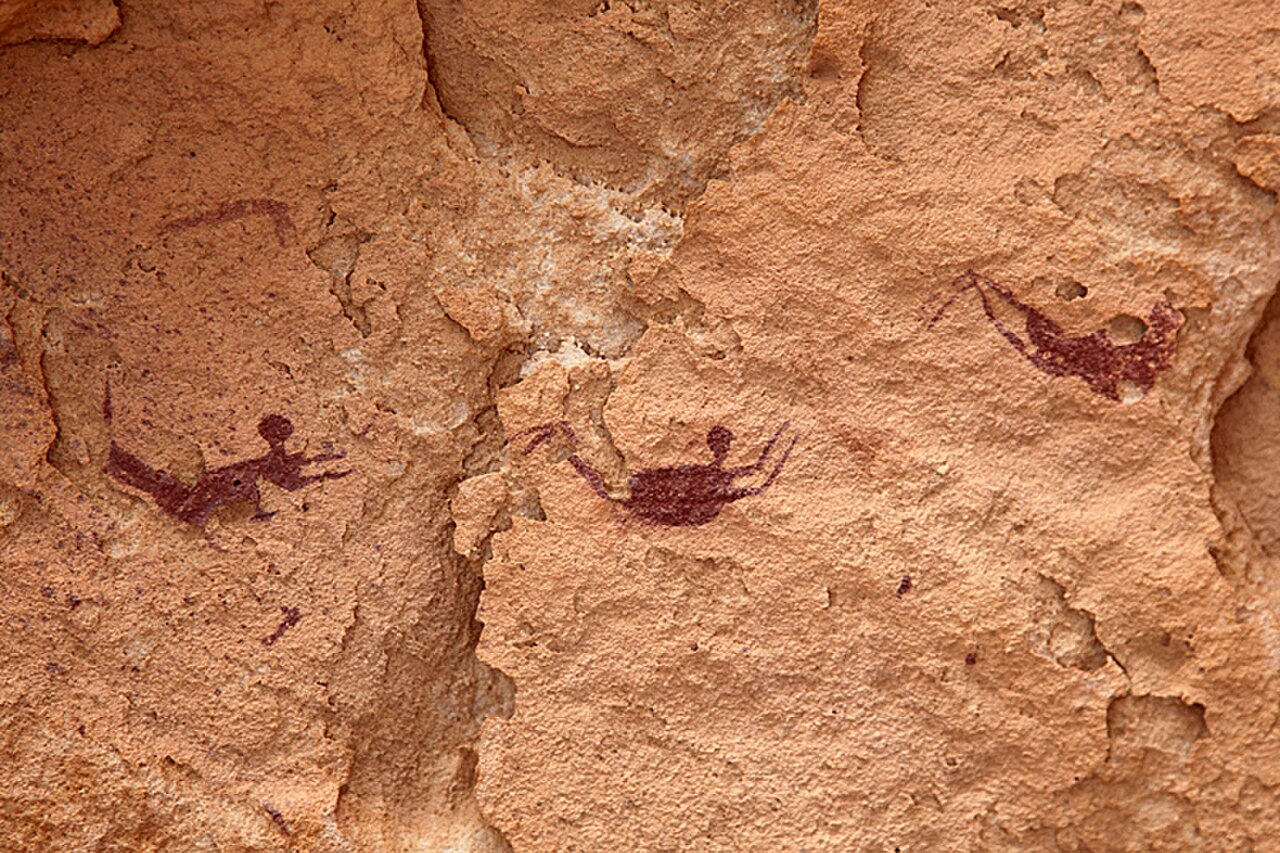
In 1933, a Hungarian explorer named László Almásy was crossing one of the most lifeless places on Earth, the Gilf Kebir plateau in the hyper-arid heart of the Sahara, where it may not rain for years at a time, when he found a cave wall covered in paintings. The figures on it were unmistakable: little human forms, arms and legs outstretched, apparently swimming. Swimming, in a place with no water for hundreds of kilometres in any direction. It seemed impossible, almost a hallucination. But it was not. Those ancient painters really had swum there, thousands of years earlier, because the desert around them had not always been a desert. It had once been green: dotted with lakes and rivers, grazed by herds, and home to people who lived, fished, and buried their dead where now there is only sand.
The idea of a "lost civilisation beneath the Sahara" conjures visions of Atlantis and pyramids buried under the dunes. The truth is stranger and better documented than any of that. Hidden in the world's greatest desert are two extraordinary lost worlds: an entire green landscape full of prehistoric peoples that the sand swallowed, and, on top of it, a real ancient civilisation that engineered its survival by pulling water from deep beneath the dead desert, until the water ran out.
When the Sahara was green
Start with the biggest and most astonishing fact: the Sahara has not always been a desert, and it will not always be one. The great desert breathes on a long, slow cycle driven by the wobble of the Earth itself. Small, regular changes in the tilt and orientation of our planet's axis (the same orbital rhythms that pace the ice ages) periodically shift the path of the seasonal monsoon rains northward, drenching North Africa and turning the Sahara green. Then, thousands of years later, the rains retreat and the desert returns.
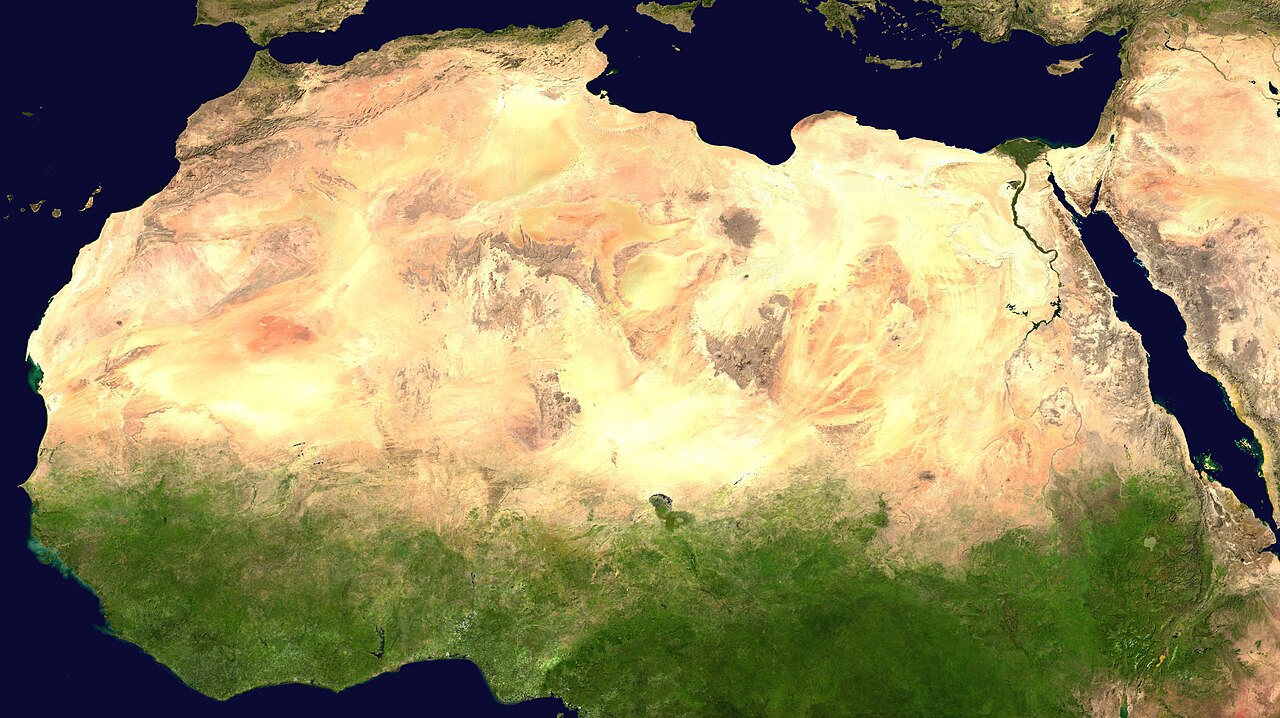
The most recent green phase, which scientists call the African Humid Period, ran from roughly eleven thousand to about five thousand years ago. During it, the Sahara was not a sea of sand but a vast savanna, grasslands and woodlands laced with rivers and freshwater lakes. Some of those lakes were enormous. Lake Mega-Chad, in the central Sahara, at times swelled to become one of the largest freshwater lakes on the entire planet, bigger than any lake alive today. Where satellites now show endless dunes, there were once hippos wallowing, crocodiles basking, and elephants, giraffes, and antelope moving across open green country.
Because the greening is driven by predictable orbital cycles, the Sahara has swung between desert and grassland many times over hundreds of thousands of years, and, on the same logic, it is expected to turn green again in roughly fifteen thousand years' time. The lifeless desert of today is not the Sahara's permanent state. It is one phase of a slow planetary rhythm, and we simply happen to be living in the dry half of it.
The world's greatest art gallery
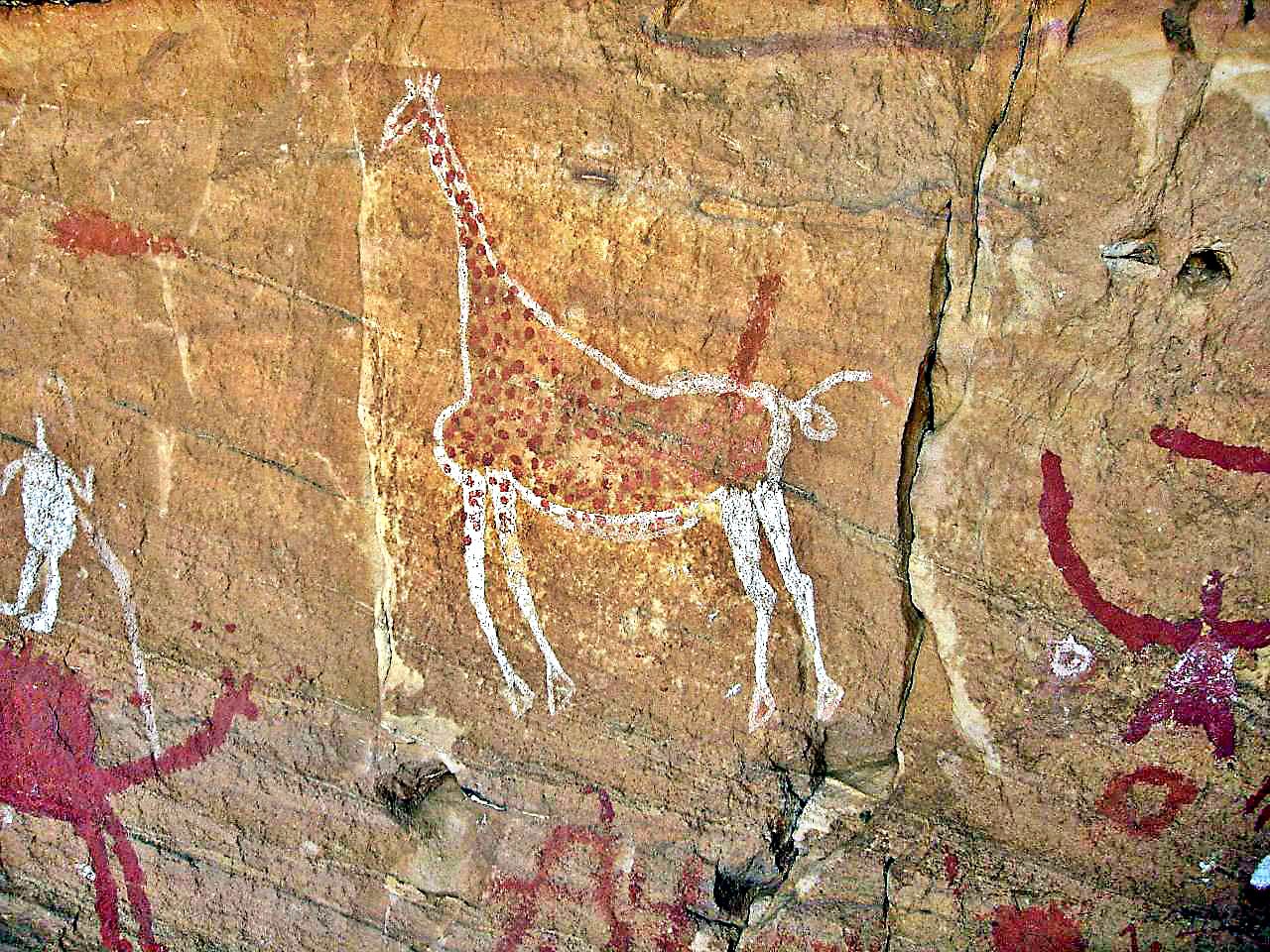
How do we know all this? Partly from science: from the ancient lakebeds, fossil pollen, and sediment cores that record the vanished water. But partly from the people who lived through it, because they left us the greatest open-air art gallery on Earth. Across the Sahara, on rock walls and in caves at places like Tassili n'Ajjer in Algeria, the Tadrart Acacus in Libya, and the Gilf Kebir in Egypt, tens of thousands of paintings and engravings record a green world in astonishing detail.
The images change as the climate changes, and reading them in sequence is like watching a time-lapse of a dying paradise. The oldest show wild animals of the savanna (elephants, rhinos, giraffes, hippos) and hunters among them. Later come vivid scenes of cattle: great herds, herders tending them, a whole pastoral society built around livestock that could never survive in today's desert. And there are the swimmers of the Gilf Kebir, paddling through water that vanished so completely that when a modern explorer found their portrait, he could scarcely believe his eyes.
The people the sand swallowed
These were not myths or scattered wanderers; they were real, settled populations, and archaeology has found them. At a site called Gobero, in what is now the utterly barren Ténéré desert of Niger, excavators uncovered an ancient lakeside cemetery used across thousands of years by two successive green-Sahara peoples. The earlier group were tall hunter-fishers who speared fish and hippos in the lake with barbed bone harpoons; the later were cattle-herders. Their graves, including one hauntingly tender burial of a woman and two children laid together, hand in hand, sit today amid nothing but sand and wind. A green, watered, living community once thrived on a spot where nothing at all can now survive.
This was the human Sahara at its height: fishers and herders around great lakes, painters decorating the rock shelters, a network of peoples spread across a continent-sized grassland. For thousands of years, one of the emptiest places on the planet was one of its more inviting.
The great drying
And then it ended. Beginning around five thousand years ago, the orbital cycle turned, the monsoon slipped back south, and the rains that had fed the lakes and grasslands failed. The Sahara dried out (in some regions gradually, in others with startling speed): the lakes shrank and vanished, the grass died, the animals moved on or died off, and the sand advanced. The green Sahara became the desert we know.
The people had to go somewhere, and where they went may have changed history. Many scholars argue that as the Sahara dried, its populations were pushed toward the last reliable water in the region, above all the valley of the Nile. The concentration of people, cattle, and knowledge along that narrow ribbon of green in a hardening desert is widely thought to have helped set the stage for one of the world's first great civilisations: ancient Egypt. If so, the pharaohs owed something to the drying of the Sahara that drove their ancestors to the river.
The Garamantes: a civilisation on the dead desert
Here the story takes its second extraordinary turn. Long after the green Sahara had died, when the region was already the harsh desert of today, a true civilisation arose in its midst, and for centuries historians barely believed it existed. These were the Garamantes, who flourished in the Fezzan region of what is now southern Libya from around 1000 BCE to 700 CE, with their heartland at a capital city called Garama, on the site of modern Germa.
The Greek and Roman writers who mentioned them, including Herodotus, dismissed the Garamantes as a troublesome tribe of desert barbarians. For a long time that verdict stuck. But modern archaeology, above all the excavations led by David Mattingly and his colleagues, has completely overturned it. The Garamantes were not nomads. They built towns and villages of mudbrick, farmed the desert, raised monumental cemeteries with thousands of tombs, manufactured goods, and ran a trans-Saharan trade network centuries before the famous camel caravans of the Middle Ages. In the middle of the Sahara, they built a state.
"The Garamantes… hunt the Ethiopian hole-men, or troglodytes, in four-horse chariots, for these troglodytes are exceedingly swift of foot."— Herodotus, Histories (5th century BCE), one of the earliest outside mentions of the Garamantes — long dismissed as fantasy, now taken more seriously in light of chariot rock art found across the Sahara
They were also far from isolated. The Garamantes sat astride the trade routes crossing the Sahara, and they grew wealthy as middlemen, moving goods between sub-Saharan Africa and the Mediterranean world: carrying gold, salt, exotic animals, and enslaved people north, and receiving Roman wine, oil, glass, and fine pottery in return. Roman goods turn up in Garamantian tombs, and the two powers alternately fought and traded across the desert frontier; Rome mounted military expeditions deep into Garamantian territory, and later treated them as a trading partner. Far from being the isolated savages of the old stereotype, the Garamantes were a connected, commercial society that helped knit the ancient Mediterranean to the heart of Africa.
The empire of underground water
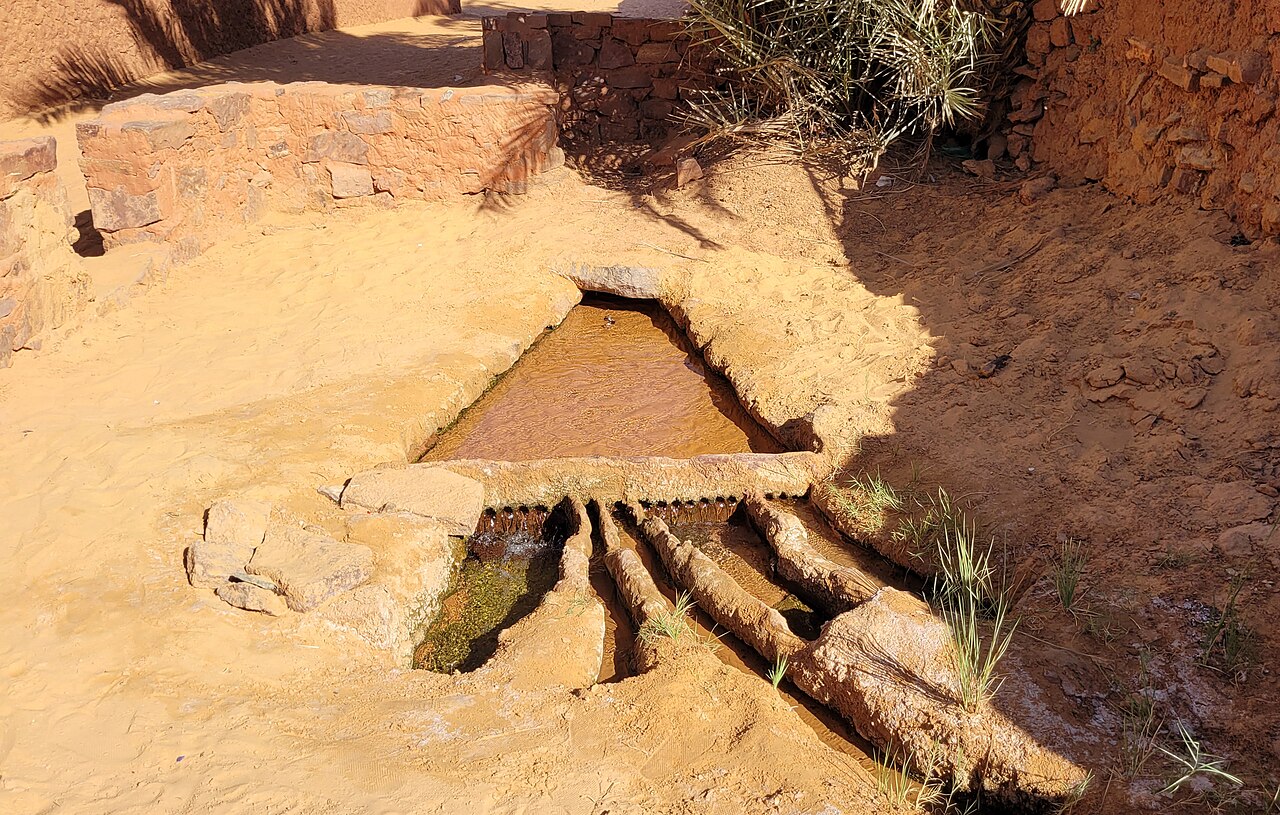
The obvious question is how. How does a civilisation feed itself in a desert where it barely rains? The Garamantes' answer was a feat of engineering as impressive as anything in the ancient world, and it is the key to their whole story. Beneath the Sahara lies a vast reserve of "fossil water": groundwater that had soaked into the rock during the green periods thousands of years earlier and been sealed underground ever since. The Garamantes found it, and they built an ingenious system to bring it to the surface.
Their tool was the foggara (a close cousin of the Persian qanat): a gently sloping tunnel, dug by hand deep underground, running for kilometres from the water-bearing rock beneath the hills out to the fields, using gravity alone to carry the water without pumps. Along each tunnel, a line of vertical shafts let the diggers remove spoil and gave access for maintenance. The Garamantes constructed hundreds of these foggaras, adding up to many hundreds, by some estimates thousands, of kilometres of hand-dug tunnel. It was backbreaking, dangerous labour, much of it done by slaves captured in their raids and trade. But it worked: it turned patches of the Sahara green again, artificially, and watered the fields that fed a civilisation.
Why they fell
And here is the tragedy built into their triumph. The fossil water the Garamantes relied on was, in effect, a one-time inheritance, laid down during the ancient green periods and not being replenished in the dry desert climate. Every foggara was draining a bank account that received no new deposits. For centuries the withdrawals were sustainable enough. But as the population grew and the tunnels multiplied, the water table beneath the Fezzan began to fall. The foggaras had to be dug ever deeper and longer to reach it, requiring ever more labour, until eventually the effort could no longer keep pace. The water sank out of reach.
By around the seventh century CE, the Garamantian civilisation had declined and largely faded, its fields returning to desert, its towns emptying. There were other pressures, such as shifting trade and political change, but at its heart the fall of the Garamantes is a stark parable of a society that built its prosperity on a finite, non-renewable resource, and could not survive its exhaustion. They had, quite literally, drained the desert dry.
"There's a lost advanced civilisation under the Sahara — Atlantis, or a high-tech precursor culture — and the 'Eye of the Sahara' (the Richat Structure) is the ruins of its capital."
The Richat Structure is a well-understood eroded geological dome, not the ruins of a city, and there is no evidence of any "advanced lost civilisation" beneath the sands. But you don't need one. The true stories are more remarkable than the fantasy: real prehistoric peoples living on real vanished lakes, and the very real Garamantes engineering a kingdom from fossil water. The fringe theories rob the Sahara of its documented lost worlds by replacing them with a fake one.
A debate still running
None of this is fully settled, and that's part of what keeps it fascinating. Scientists still argue over exactly how fast the green Sahara died: whether the drying was a relatively abrupt collapse over a few centuries, as some lake records suggest, or a slower, patchier retreat that varied from region to region. And archaeologists are still reconstructing the Garamantes, whose story keeps growing as more of their tombs, tunnels, and towns are surveyed, often under difficult conditions in a politically unstable region.
How suddenly did the green Sahara end? Some evidence points to a rapid tipping point, with vegetation and rainfall collapsing within a few centuries as the system crossed a threshold, while other records suggest a more gradual, regionally uneven drying spread over a couple of thousand years. The distinction matters far beyond archaeology: it feeds directly into modern debates about whether large climate systems change smoothly or lurch abruptly between states. The Sahara's past is being studied partly to understand our planet's future.
A landscape that flipped within human memory
The lost worlds beneath the Sahara are more than a curiosity, because they speak directly to the anxieties of our own age. Here is a landscape that flipped, within human memory and human art, from green abundance to lethal desert as the climate shifted: a vivid, real example of how dramatically an environment can change, and how the people living on it are forced to adapt, migrate, or vanish. And here is a civilisation, the Garamantes, that solved its water crisis brilliantly but unsustainably, prospering on a resource it was steadily using up, until the reckoning came. In an era of drying aquifers and changing climates, both stories read less like ancient history and more like warnings.
So the swimmers on the cave wall are not a riddle after all. They are a memory of a Sahara that lived, and drowned its dead in real lakes, and grew green and dried again as it has done many times before and will do again. The greatest desert on Earth is also one of its greatest graveyards of lost worlds, and the sand is still keeping most of their secrets.
Read next: Lake Mungo: The Oldest Known Cremation on Earth, and Why It Was Reburied and Qaryat al-Faw: The Three-Storey Market on the Empty Quarter's Edge.
Sources & further reading
- David J. Mattingly (ed.), The Archaeology of Fazzan — the major scholarly account of the Garamantes and their foggara irrigation, based on decades of fieldwork.
- Research on the African Humid Period and the "Green Sahara," including the work on Lake Mega-Chad and Saharan palaeoclimate; and Paul Sereno et al. on the Gobero cemetery in Niger.
- Herodotus, Histories — the earliest outside notice of the Garamantes.
- Surveys of Saharan rock art at Tassili n'Ajjer, the Tadrart Acacus, and the Gilf Kebir (including the Cave of Swimmers); and general references on the Richat Structure for the debunking of the "Atlantis" claims.