In the summer of 1996 an amateur archaeologist was walking the bank of a small river in north-east Germany, at a spot where the water had dropped and left the mud exposed. He was looking for whatever the current turns up. What he picked out of the silt was a human upper-arm bone, brown with age, and driven straight through the shaft, its tip still buried in the old bone, was a flint arrowhead. Someone had shot this man dead, and the river had kept the proof for three and a quarter thousand years.
That single bone opened the largest and oldest battlefield anyone has ever found in Europe. It sits in the Tollense valley, a quiet stretch of marsh and meadow in Mecklenburg-Vorpommern, about 140 kilometres north of Berlin. The men who fell there died around 1250 BCE, in the middle of the Bronze Age, in a fight so large that historians had assumed nothing like it was even possible that far north, that early. For a long time the story of prehistoric northern Europe was a story of scattered farms, cattle and quiet trade. The Tollense took that story apart.
A bone at low water
The find sat almost unremarked at first. A stray bone in a river is not, by itself, a battlefield; bones wash out of old graves and eroding banks all the time. But this one had an arrowhead in it, and that changed the question from “who was buried here” to “who was killed here.” The regional heritage office sent people to look. In the same stretch of riverbank and shallow water they began pulling out more bone, and then wooden weapons: a club cut from ashwood, shaped rather like a modern baseball bat, and a second club of blackthorn with a heavier head, the sort of thing made to break a skull.
None of it fitted a cemetery. Cemeteries are tidy. Bodies are laid out, grave goods are placed, the dead are arranged by the living. Here the bones were jumbled together with animal remains, smashed and scattered, mixed in with weapons that had been used and lost. Whatever happened in the Tollense, the dead had not been buried by anyone who loved them. They had been left where they fell, or dragged and dropped, and the river had done the rest.
Serious, systematic excavation did not begin until 2007, once it was clear how much lay under the water and the peat. Teams from the University of Greifswald, the state heritage service and a squad of underwater archaeologists started working the riverbed and the banks together, metre by metre. What they found kept getting bigger.
Twelve thousand bones, and only the edge of it
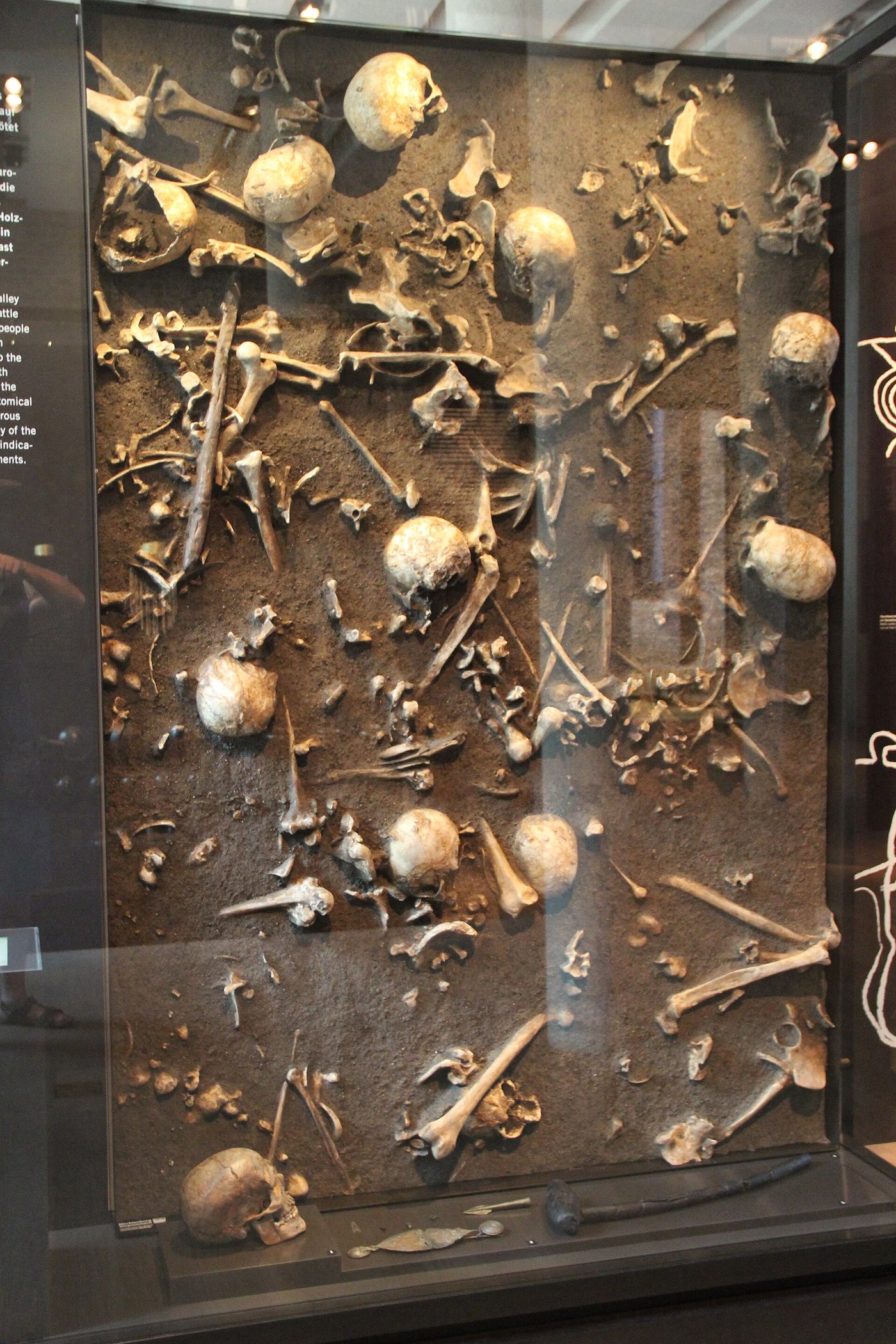
By 2018 the diggers had recovered something in the order of 12,000 to 13,000 fragments of human bone. Pieced back together, these belonged to at least 140 individuals, and that number is not the size of the battle. It is the size of the small patch that has been dug. Researchers reckon they have opened only a fraction of the site, perhaps a tenth or less; the bone-bearing layer runs on for hundreds of metres in both directions along the valley, most of it still untouched under farmland and marsh.
The people in the mud were overwhelmingly young men, most between about twenty and forty. That alone is telling. A plague, a famine or a flood kills the old and the very young first, and leaves a spread of ages and both sexes behind. The Tollense dead are the wrong shape for a disaster. They are the right shape for an army. A few women have turned up among those tested, but the crowd is male, fit and in its fighting years.
They were not raw farm boys, either. Roughly a quarter of the skeletons carry healed injuries from earlier violence: old skull fractures that had knitted back together, breaks that had mended before the man died here. These were people who had been in fights before and survived them. Somebody had a body of experienced, hardened men, and brought them to this river.
The bone that started everything, the humerus with the flint point still lodged in it, turned out to say more than “a man was shot.” From the angle the arrow entered, the archer was standing on the ground and the target was higher up, most likely on horseback. So the very first find already hinted at two different kinds of fighter meeting here: men on foot with bows, and men who rode.
In one place the bones were packed tight: nearly 1,500 of them crammed into about 12 square metres. It may be a spot where bodies piled up as the current dropped them, snagged in a bend. It may be a place where a knot of men made a last stand and went down together. Either way it is a concentration of death in a very small space, and it is only one square of a battlefield that runs far beyond the trench edges.
Working out how big
How many fought? The honest answer is that nobody can count them, because most of the field is still buried and the river carried an unknown number of the dead away downstream for good. But archaeologists have tried to reason toward a figure. If the excavated bones represent the usual small sample of a much larger whole, and if the share of men killed in a Bronze Age fight sat somewhere around a fifth to a quarter, the total force starts to look enormous: estimates run from a couple of thousand up past four thousand men on the day.
To feel why that number stuns archaeologists, look at how empty the land was. The Bronze Age north German plain held maybe three to five people per square kilometre. You could walk a long way between settlements. To put a thousand or more armed men in one valley at one time, someone had to reach across a huge area, call in fighters, feed them on the march and move them to a single point on a single river. That is not a squabble between two villages. That takes something like a chief, or an alliance of chiefs, with the pull to raise and supply an army: a level of organised power the textbooks did not grant to this time and place.
Two kinds of fighter
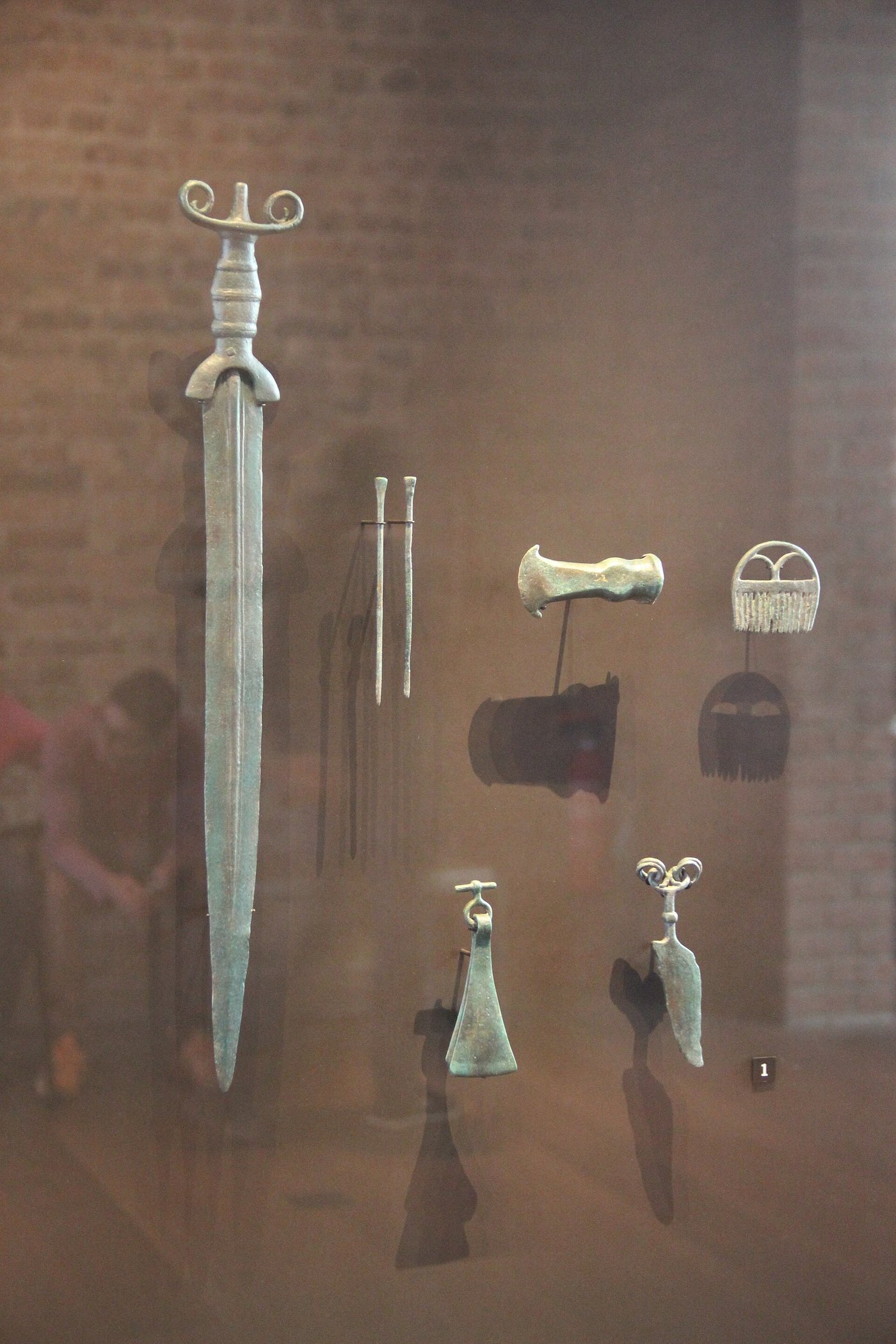
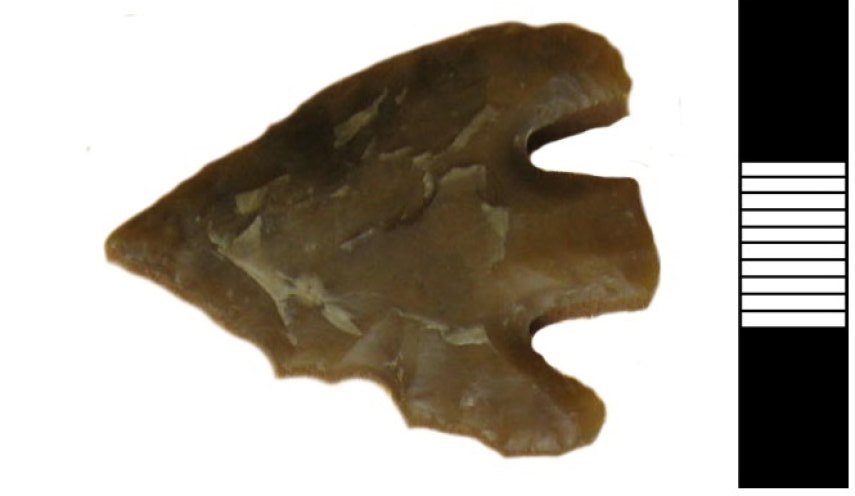
The wounds tell you how they died, and the weapons tell you who they were. Arrowheads sit in bone and lie loose in the mud: over fifty of bronze and a good number of flint. Skulls show the round dents of wooden clubs. Long bones and ribs carry the clean slice of bronze blades. More than forty skulls bear battle injuries; one still has a bronze arrowhead stuck in it.
What is missing is as loud as what is there. Almost no swords have been recovered, even though the cut marks prove swords were swung. The same goes for most of the fine metalwork. The likeliest reason is grim and simple: the winners looted the field. Bronze was wealth (a sword, a knife, an ornament could be melted, traded, worn or handed on), so the victors stripped the dead of anything valuable and left the cheap flint arrows and the shattered clubs behind. What we dig up is the rubbish they did not bother to carry away.
Two grades of equipment show up in the debris. There is the simple kit: flint-tipped arrows, wooden clubs, the gear of a levy of ordinary men. And there is the expensive kit: standard bronze arrowheads, bronze blades, the weapons of people who could afford metal. Add the horses (at least five have been found) and a picture forms of a fighting force with a spine: mounted, bronze-armed leaders steering a mass of foot soldiers with cheaper weapons. This was not a mob. It had shape.
Strangers on the river
Who were they, and where did they come from? This is where the Tollense gets strange, and where the science has swung back and forth. Early attempts to read the chemistry of the bones (strontium isotopes locked into teeth from the water and food of childhood) hinted that the fighters came from more than one region. Later, more careful work pushed back. A study of ancient DNA from fourteen of the skeletons found them broadly similar to one another and to the wider population of central Europe. On present evidence the isotope and genetic tests have not handed over a clean answer about origins.
But the objects have their own tale, and one find in particular refuses to be local. Divers working the riverbed brought up a tight cluster of about thirty bronze items (a curved-bladed knife, an awl decorated with tiny ladders and triangles, a worn chisel, scraps and small ingots of bronze, three little rolled tubes) lying together as if they had once been held in a bag or a box that has long since rotted away. It is a personal kit, the belongings of one man. And the style of it is wrong for the region. Its closest matches lie hundreds of kilometres to the south, in central Europe. Someone carried that box a very long way to reach this river.
The bronze scraps and small cast ingots in that kit were money. Across Bronze Age Europe, weighed pieces of bronze worked as a kind of currency, cut and measured out for trade. So the man who lost the box was carrying his cash with him, tools of a southern make, on a battlefield far from home. Whether he was a merchant, a mercenary or a warrior travelling with an army, he is the clearest sign that the fight on the Tollense pulled people in from well beyond the valley.
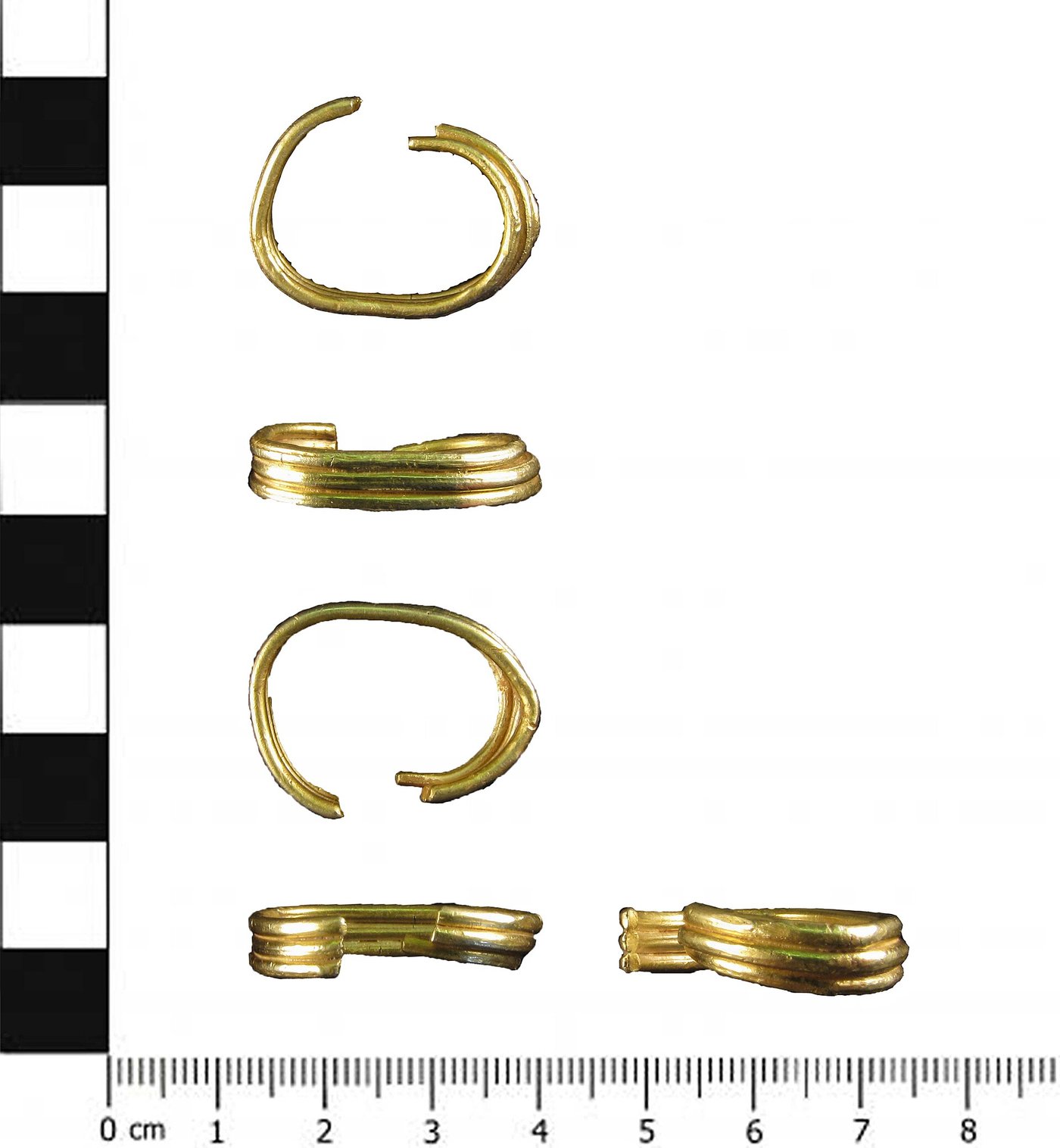
Other finds point the same way. Two small spiral rings pulled from the river proved, under analysis, to be made of tin: the oldest worked tin yet found in Germany, and the next comparable pieces come from six centuries later. There are hints of an early weight system, the kind used to measure metal for exchange. Persian Gulf pearls and Mediterranean glass beads of about the same date have turned up in the wider region. The Tollense was not a backwater. It sat on the routes along which metal, ornaments and people moved across a connected Bronze Age world.
Reading the arrowheads
In 2024 a fresh study went back to the humblest evidence of all: the arrowheads. Leif Inselmann and colleagues catalogued the shapes of the bronze arrowheads from the battlefield and set them against a reference collection of thousands of Bronze Age arrowheads from across central Europe, tracking which forms belonged to which region. Arrowheads are a good tell. They are made to be shot away and lost, so they end up scattered wherever the fighting happened, and their shapes follow local fashions.
The Tollense arrows came in a mix. Some are the types you would expect in the north, around the valley itself. But others match forms from southern central Europe, shapes that had no business being fired here unless the men shooting them had come from there. That is hard physical evidence for at least one side, or one contingent, arriving from far to the south. Combined with the foreign toolbox, it firms up a picture that once sounded fanciful: a clash on a northern river that drew fighters across a large slice of the continent, possibly including hired men from distant homelands.
How long did it last? Not one of the killing wounds shows any sign of healing: no scabbing of bone, no knitting, nothing. Injuries that a person survives even briefly start to change; these do not. That points to a single, short, catastrophic event, over in perhaps a day or two rather than a drawn-out campaign. What it was (a pitched battle between two armies, an ambush at a crossing, or the massacre of one force by another) is still argued. The evidence proves violence on a huge scale in a very tight window. It does not yet prove who won, or why they fought.
The bridge in the marsh
Why here? The valley itself may hold the answer. A survey of the ground in 2013 picked up a long structure running across the wet valley floor: a causeway or bridge more than 100 metres long, built of wooden posts and packed stone, a raised way that let people cross the marsh dry-shod. When the timbers were dated, most of them turned out to be far older than the battle, some by five centuries. Parts may have been repaired or rebuilt closer to 1250 BCE. Either way, this crossing had stood, and been kept up, for generations. It was a fixed point in the landscape, a place everyone knew, the spot where a route across the north German plain funnelled down to a single narrow line over the water.
Control a crossing like that and you control movement: of herds, of trade, of people. A crossing is exactly the sort of thing armies fight for and fight at. It is not hard to imagine a force pushing north or north-east along an old road, meeting resistance at the bottleneck of the bridge, and a battle boiling up around the one dry way over the marsh. The dead ended in the river because the river was right there, at the heart of the fight.
The quiet that never was
The deepest thing the Tollense overturned was not a date or a body count. It was a mood: a comfortable idea about what the deep past was like.
The myth: before cities, states and standing armies, northern Europe in the Bronze Age was a settled, largely peaceful world of farmers and traders. Real war (organised, large-scale, with thousands of men) belonged to later ages and to the literate south. Prehistory up here was quiet.
The reality: around 1250 BCE, on one small river, something between a couple of thousand and four thousand armed men fought hard enough to leave a carpet of the dead across hundreds of metres of valley. They came with bronze weapons and horses, some of them from far away, organised and supplied by someone with real power. The peace was always partly a trick of the evidence: wooden weapons rot, looted fields fall silent, and a battle by a river leaves almost nothing unless the water happens to keep it.
That last point matters. The Tollense survived by accident. The peat and the slow river sealed the bones from the air; the losers' bodies were dumped where the mud could hold them; a low-water summer put an arrowhead-pierced arm where a sharp-eyed walker would spot it. Change any one of those and the whole battle vanishes without trace, and we go on believing in the quiet. How many other Tollenses have simply dissolved, on rivers that did not keep their dead?
Still under the meadows
The men in the Tollense left no writing, no monument, not even a name we can read. Bronze Age northern Europe kept no records; there is no chronicle to tell us which chief called the muster, which side crossed the bridge, who walked away. Everything we know, we have prised out of the mud: a bone here, an arrowhead there, a rotted box of a stranger's tools. The people who won this fight expected to be remembered by their own, in songs that were never written down and are gone. Instead they are anonymous, and it is the losers, tipped into a river, who ended up telling the story.
Most of the battlefield is still down there. The digging goes on, slowly, a few square metres a season, with far more valley left than has ever been opened. Somewhere under those meadows are the men the current did not carry off, lying where they fell around a bridge that no longer stands, on a day that history forgot and a river refused to. We found them because one of them washed up with an arrow in his arm. We have barely begun to count the rest.
Read next: Uluburun: The Bronze Age Wreck Whose Cargo Came From Three Continents and Salme Ship Burials: The Raid That Came Before the Viking Age.
Sources & further reading
- Jantzen, D. et al. “A Bronze Age battlefield? Weapons and trauma in the Tollense Valley, north-eastern Germany.” Antiquity 85 (2011).
- Inselmann, L. et al. Study of the Tollense valley arrowheads and the interregional character of the conflict, Antiquity (2024).
- Andrew Curry, “Slaughter at the bridge: Uncovering a colossal Bronze Age battle,” Science (2016).
- University of Göttingen and Free University of Berlin, press releases on the Tollense arrowhead study (2024).
- Smithsonian Magazine and CNN, reporting on the 2024 arrowhead findings.
Image credits (via Wikimedia Commons): Tollense valley meadow — Erell (CC BY-SA 3.0); Tollense finds on display — Gary Todd (CC0); Bronze Age European swords and metalwork, Neues Museum, Berlin — Gary Todd (CC0); barbed-and-tanged flint arrowhead — S. Maslin (CC BY 2.0); Bronze Age gold penannular ring — West Yorkshire Archaeology Advisory Service / Amy Downes (CC BY 2.0).