On the morning of 4 July 2026, more than five hundred people picked their way across a damp Surrey water meadow to peer into a set of trenches beside the River Mole. Lead archaeologist Nowal Shaikhley had spent three weeks with a team of volunteers scraping back turf and silt near Fetcham Millpond, chasing foundations first glimpsed almost two decades earlier during routine work on the local water supply. By the time the queue had worked its way to the front of the site, she had an answer ready for them. "We can now say without doubt that we have a complete bath house," she told the crowd. "Not partial — we have each of the rooms." Under a grey English sky, in a field better known for dog walkers than dig days, a Roman spa that had lain forgotten for roughly sixteen centuries had just been confirmed room by room: cold room, warm room, hot room, furnace, plunge pool.
It would already be a good story if it stopped there. A complete, legible Roman bath house is a rare thing to find intact in Britain, let alone in a corner of the commuter belt eighteen miles from central London. But Fetcham Springs is not really a story about one building. It is a story about a single small field that people kept returning to, generation after generation, for reasons that had nothing to do with each other (hunting, toolmaking, farming, bathing, and, it now seems, burying their dead) across a span of time so long that the Roman bath house sitting at its centre is, if anything, one of the more recent chapters.
A spring, a mill, and a name that gives the game away
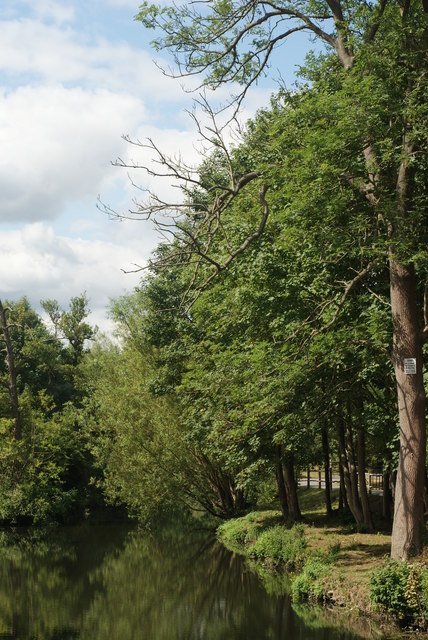
Fetcham sits just north of Leatherhead in Surrey, in the shallow valley the River Mole has carved on its way to join the Thames. The site under excavation lies in a field beside Fetcham Millpond, fed by natural springs that still rise from the chalk and greensand here. Hence the name Fetcham Springs, which was doing useful descriptive work centuries before anyone thought to dig. Fresh, reliable water was exactly what a Roman bath house needed, and exactly what had already drawn hunter-gatherers to this same stretch of valley thousands of years earlier. In archaeology, a good water source rarely gets used once and abandoned. It tends to accumulate people the way a good market town does, layer on layer, each generation only dimly aware of who came before.
The current excavation is part of a project called Communities at the River, a five-year programme backed by the National Lottery Heritage Fund and run through the Surrey County Archaeological Unit, with the landowner SES Water and the local Fetcham Residents Association as active partners. Its whole premise is that this should not be a dig done to a community, but one done with it: volunteers trowel alongside professional archaeologists, and the results are shared as they emerge rather than saved for an eventual academic paper. The open day on 4 July, which drew that crowd of over five hundred, was as much the point of the project as the archaeology itself.
The people who sat by the water 10,000 years ago
To understand why archaeologists were so excited to find a bath house here, it helps to know what they had already found in the same field. A first phase of excavation in 2009, prompted by planned water infrastructure works, cut down through the ground beside the millpond and hit something unexpected: a dense concentration of worked flint, more than five hundred pieces in total, clustered tightly enough that specialists could reconstruct the knapping process almost blow by blow. The pattern suggested two people had sat down side by side at the water's edge, roughly ten thousand years ago, and spent time together shaping blades from cores of raw flint. It is one of the most intimate archaeological pictures Surrey has ever produced of the hunter-gatherers who occupied Britain in the millennia after the last Ice Age.
That was not a one-off visit. Later flints from the Neolithic and Bronze Age show people kept coming back to the same spot for thousands of years afterwards, presumably for the same reason anyone returns to a reliable spring: because it is there, because it works, and because the last people who used it did not ruin it for the next.
The flintworking evidence at Fetcham dates to roughly 10,000 years ago, squarely within Britain's Mesolithic period, a good four thousand years before Stonehenge's earliest phase and around six thousand years before the Roman bath house was built on the very same ground. The bath house, in other words, is closer in time to us than it is to the flint-knappers who first used this spring.
Rome finds the spring
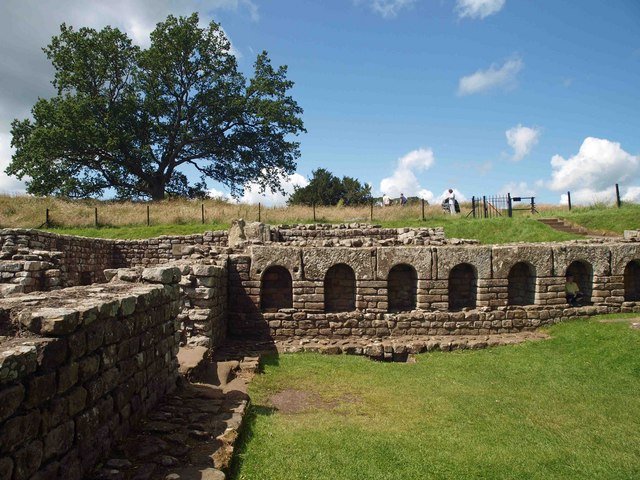
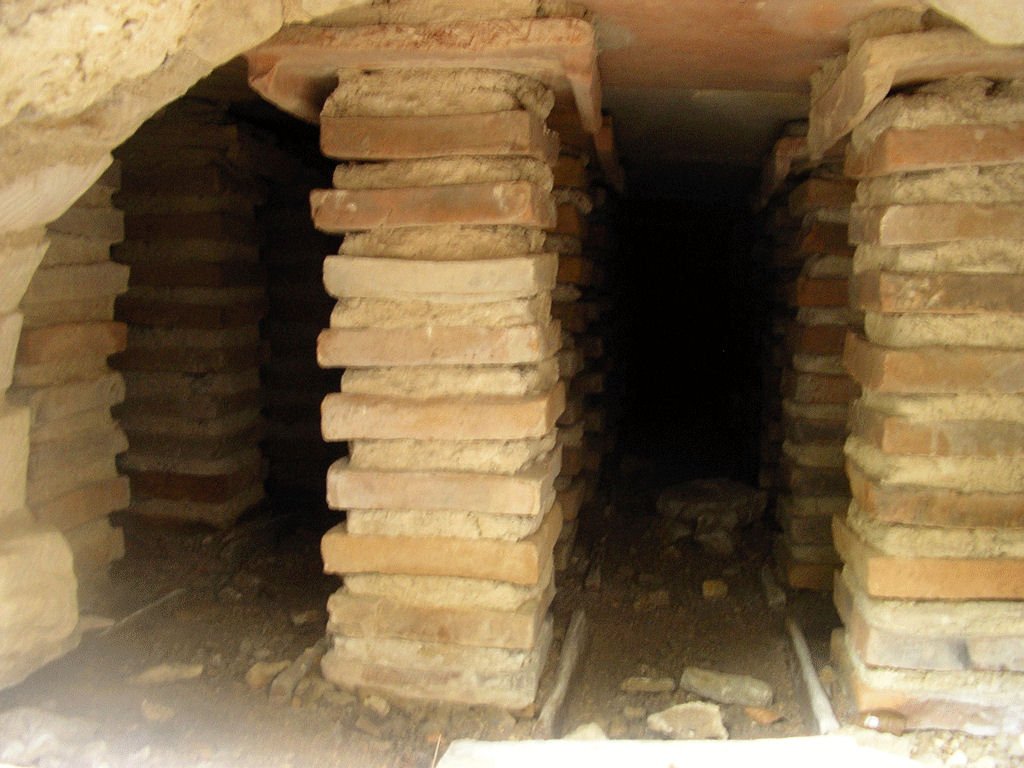
Sometime between the second and fourth centuries AD, someone with real resources decided this spring was worth building on properly. What went up was a bath house of the standard Roman type, but built to a complete plan: a cold room (frigidarium) for the plunge that opened and closed a bathing session, a warm room (tepidarium) to ease the body into and out of heat, a hot room (caldarium) kept close to sweating temperature, and a furnace (praefurnium) whose hot air was drawn beneath a raised floor and up through hollow box-flue tiles set into the walls. This was the underfloor central heating system the Romans called a hypocaust, one of the cleverest pieces of everyday Roman engineering, and it rarely gets the credit ordinary aqueducts and roads receive.
Bathing in Roman Britain was not a private, occasional indulgence the way a hot bath is today. It was a social institution, closer in spirit to a sauna combined with a gym and a gossip exchange: bathers moved through the sequence of rooms, worked up a sweat, scraped oil and dirt from their skin with a curved bronze tool called a strigil rather than soap, and lingered to talk business or catch up on news. Even a fairly modest rural bath house like this one represented a serious investment: someone had to quarry or fire the tile, keep a furnace fed with fuel for hours at a stretch, and maintain a water supply on demand. That kind of expenditure, in a valley setting rather than on the higher, drier ground where Surrey's known Roman villas typically sat, is precisely what has archaeologists intrigued rather than simply satisfied.
Three weeks, five artefacts, and a very definite answer
The 2009 trenches had already shown flint foundations, tantalising fragments of flue tile, and traces of what Surrey archaeologists suspected, but could not confirm, was a bath house. It took the 2026 season, and three weeks of careful, volunteer-assisted digging, to remove any doubt. Shaikhley's team exposed the full footprint: hot room to one side, furnace immediately behind it, warm and cold rooms completing the sequence, with evidence of at least two separate phases of building or repair visible in the walls. It was a structure that was maintained and altered over time rather than built once and abandoned.
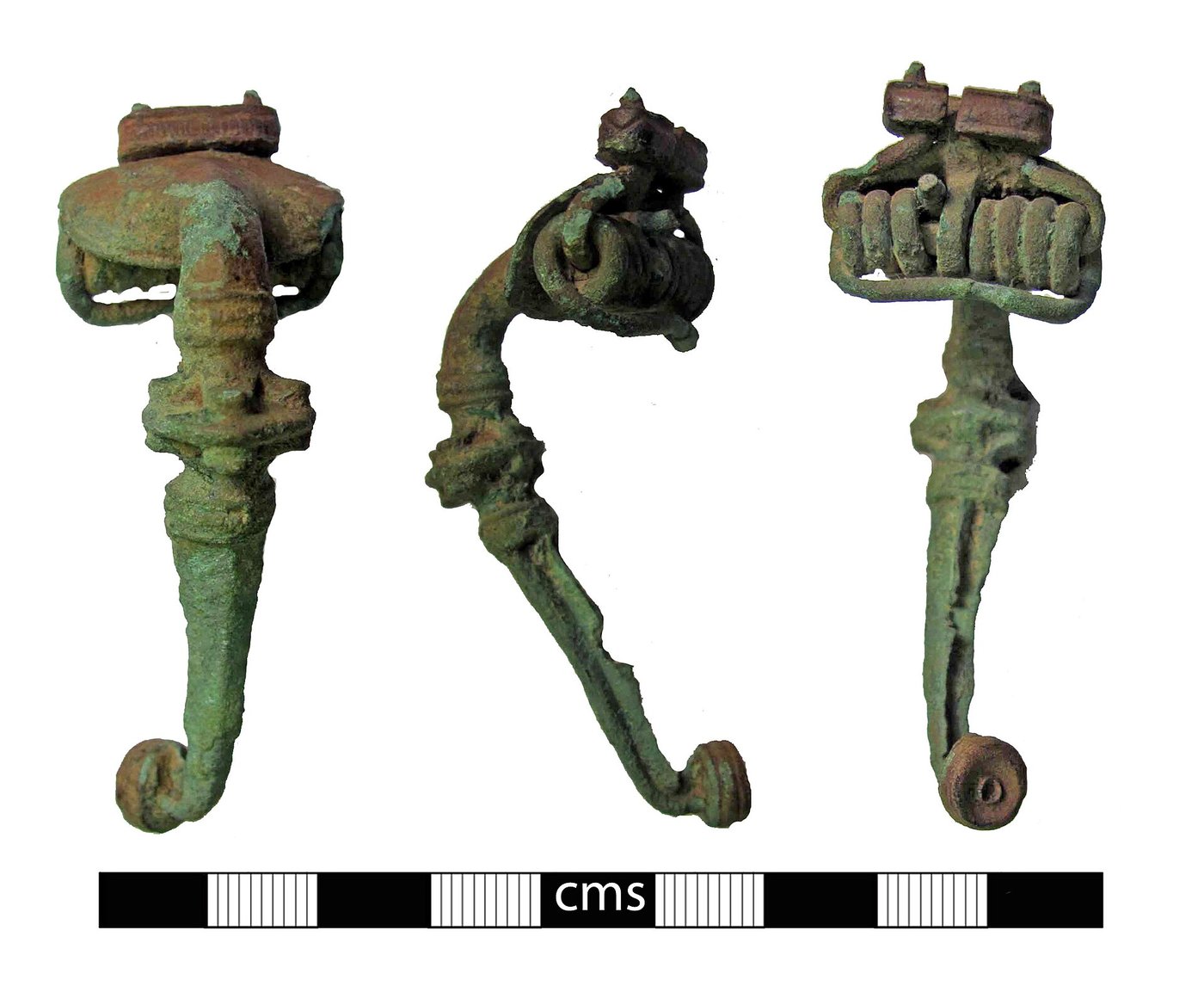
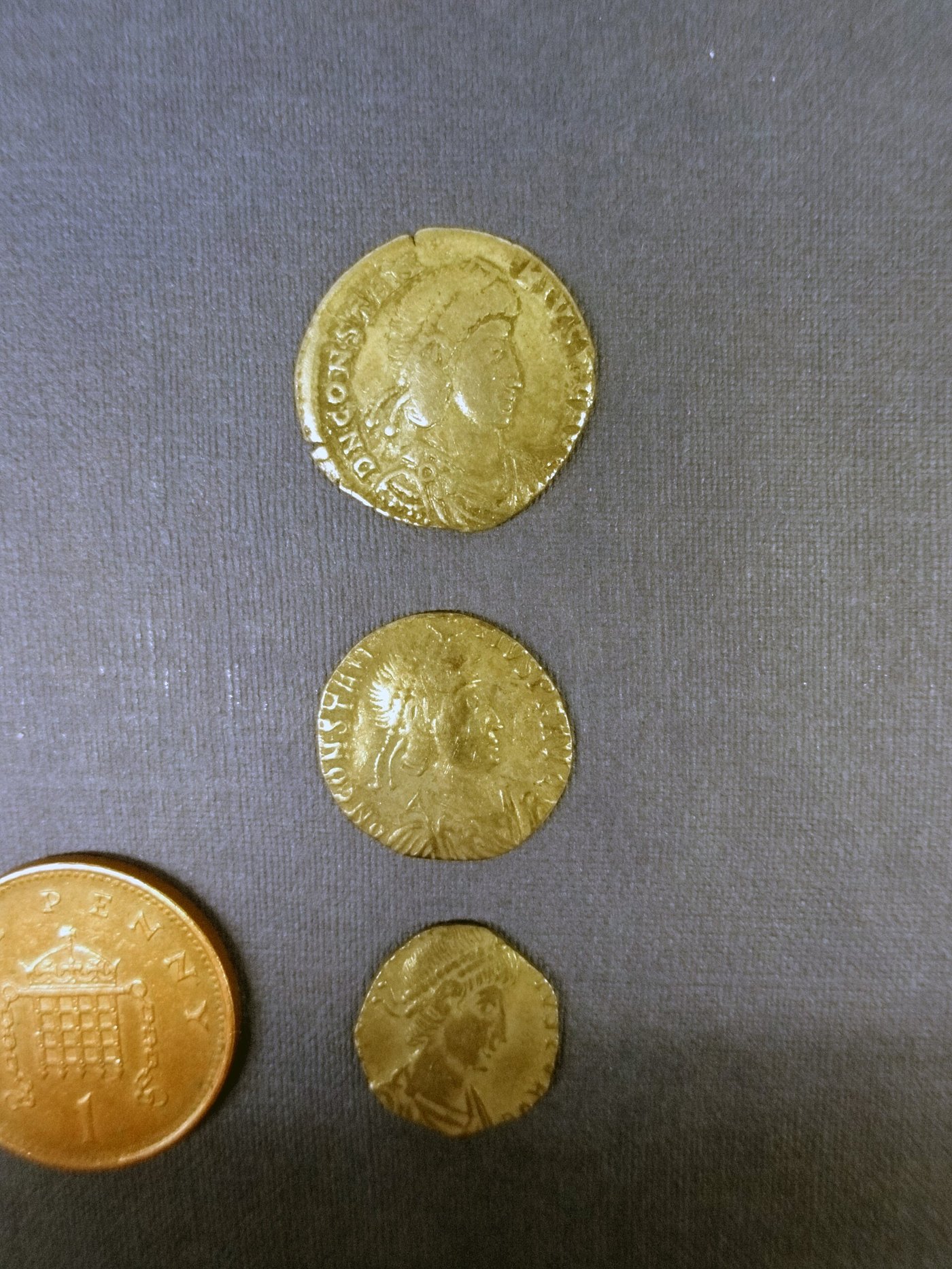
The finds that came out of the trenches alongside the walls were the kind that make a site feel inhabited rather than merely mapped: fragments of painted wall plaster, some still carrying traces of colour; a scatter of Roman coins; a bronze brooch, the everyday fastener that held a Roman British person's cloak or tunic in place; and a snaffle, the jointed bit fitted into a horse's mouth for riding or driving. None of it is treasure in the sense of gold or silver hoards. All of it is exactly the kind of ordinary loss (a coin dropped in the changing room, a brooch pin that slipped, a bit left behind by a groom) that tells archaeologists a place was lived in and used, not just built and admired.
"It's an amazing find. We can now say without doubt that we have a complete bath house. Not partial, we have each of the rooms."— Nowal Shaikhley, Surrey County Archaeological Unit, at the Fetcham Springs open day, 4 July 2026
The Saxons who did not leave
There is a comfortable, well-worn version of British history in which Roman rule ends in 410 AD, the legions and administrators pack up, and an entirely new Anglo-Saxon world begins on more or less empty ground. Fetcham Springs is one of a growing number of British sites making that version look too tidy. Beneath and around the Roman levels, the 2009 excavation turned up early Saxon pottery and a securely dated posthole: modest evidence, but evidence of people occupying the same ground in the early medieval period, a rarer find in Surrey than you might expect. Some archaeologists studying the area have gone further, tentatively linking the site to a seventh-century cemetery discovered at nearby Hawk's Hill, which would mean this small stretch of valley was doing double duty as both a living settlement and a burial ground within a few centuries of Rome's departure.
"When Roman Britain collapsed, Roman life stopped overnight — the villas and bath houses were abandoned, and the Anglo-Saxons who followed built their world from scratch on empty land."
The end of Roman administration in Britain was a slow unravelling, not a single event, and plenty of Romano-British sites saw continued or renewed use well into the early medieval period. The Saxon pottery and posthole at Fetcham suggest people kept returning to this particular spring for generations after the bath house's furnace had gone cold.
A bath house looking for its villa
The single biggest open question at Fetcham Springs is the one archaeologists are now actively chasing: where is the villa? Roman bath houses of this size and quality in rural Britain were very often attached to a villa estate (a country house with its own farmland, staff, and household), and Surrey's other known Roman villas tend to sit on higher, better-drained ground rather than tucked into a river valley next to a spring. That mismatch has left the Communities at the River team with two live possibilities, neither yet confirmed. One is that a villa does exist nearby and simply has not been located yet, hidden under later fields or the edges of the modern village; geophysical survey work aimed at finding it is planned for the coming seasons. The other is that this bath house was never attached to a private house at all, but functioned more like a wayside or spring-side amenity, perhaps connected to travel along the valley, or, given the site's very name, to some form of reverence for the spring itself, in the tradition that later made the thermal springs at Bath, sixty miles to the west, into the shrine and spa of Aquae Sulis.
No votive objects (the coins, pins, or carved stones Romano-British worshippers typically threw into sacred springs) have been reported from Fetcham so far, so the "spring shrine" idea remains speculation rather than an established reading of the site. Most archaeologists working on Fetcham currently treat the missing villa as the more likely explanation, simply not yet found. Both readings agree on one thing: a valley-bottom bath house without an obvious grand house attached to it does not fit the standard Romano-British pattern, and that is precisely why the site is considered important rather than routine.
Why a Surrey water meadow is worth the fuss
It is tempting to measure archaeological discoveries by scale: a lost city outranks a single building, a golden hoard outranks a scatter of coins. Fetcham Springs argues against that instinct. Nothing about this site is monumental. It is a modest bath house, in a modest valley, found by a project that leans on volunteers rather than a well-funded university expedition. What makes it worth the fuss is depth rather than size: in one unglamorous field beside a millpond, archaeologists have now traced human presence from Mesolithic flint-knappers, through Neolithic and Bronze Age visitors, to a working Roman spa, and on into an early Saxon community that did not simply vanish when Rome did. Twelve thousand years, give or take, compressed into a space you could walk across in a couple of minutes.
That is also what makes the project's community-archaeology model more than a nice gesture. The five hundred people who queued at the open day were not looking at a roped-off ruin behind glass; they were watching the ground beneath their own dog-walking routes turn out to hold a story stretching back to the end of the last Ice Age. Most of Britain's landscape has never been excavated at all, and a great deal of what does get investigated is driven by planning applications and building works rather than curiosity. Fetcham Springs is a reminder that the ordinary corners of a country (the water meadow behind the housing estate, the pond nobody thinks twice about) are still capable of holding a story that outlasts anyone who might tell it. The team's next task is to find the villa, if there is one; whatever they find, this small Surrey field has already outlived several versions of Britain, and shows every sign of having more to say.
Image credits (via Wikimedia Commons): Roman bath house at Chesters Roman Cavalry Fort — Steve F (CC BY-SA 2.0); hypocaust at Great Witcombe Roman villa — Justexp / Hogweard (CC BY 3.0); River Mole at Leatherhead, Surrey — Peter Trimming (CC BY-SA 2.0); Roman trumpet brooch, Portable Antiquities Scheme — Oxfordshire County Council, Anni Byard (CC BY-SA 2.0); Hoxne Hoard Roman coins — public domain.
Read next: Dilmun: The Land Sumer Called Deathless, and Its 11,774 Tombs and Karahan Tepe: The Watching Head Carved Into a Room Older Than Farming.
Sources & further reading
- Surrey County Council, "Communities at the River: Fetcham Springs Archaeology Project," Surrey History Centre marvels series.
- Fetcham Residents Association, "Roman Bath House Confirmed at Fetcham Springs," July 2026.
- Leatherhead Living / East Surrey News, "Roman Bath House confirmed at Fetcham Springs," 6 July 2026.
- Portable Antiquities Scheme (finds.org.uk), database records on Roman brooch typology and hypocaust flue tile finds in Britain.
- Guy de la Bédoyère, Roman Britain: A New History (Thames & Hudson) — background on Romano-British bathing culture and rural bath houses.