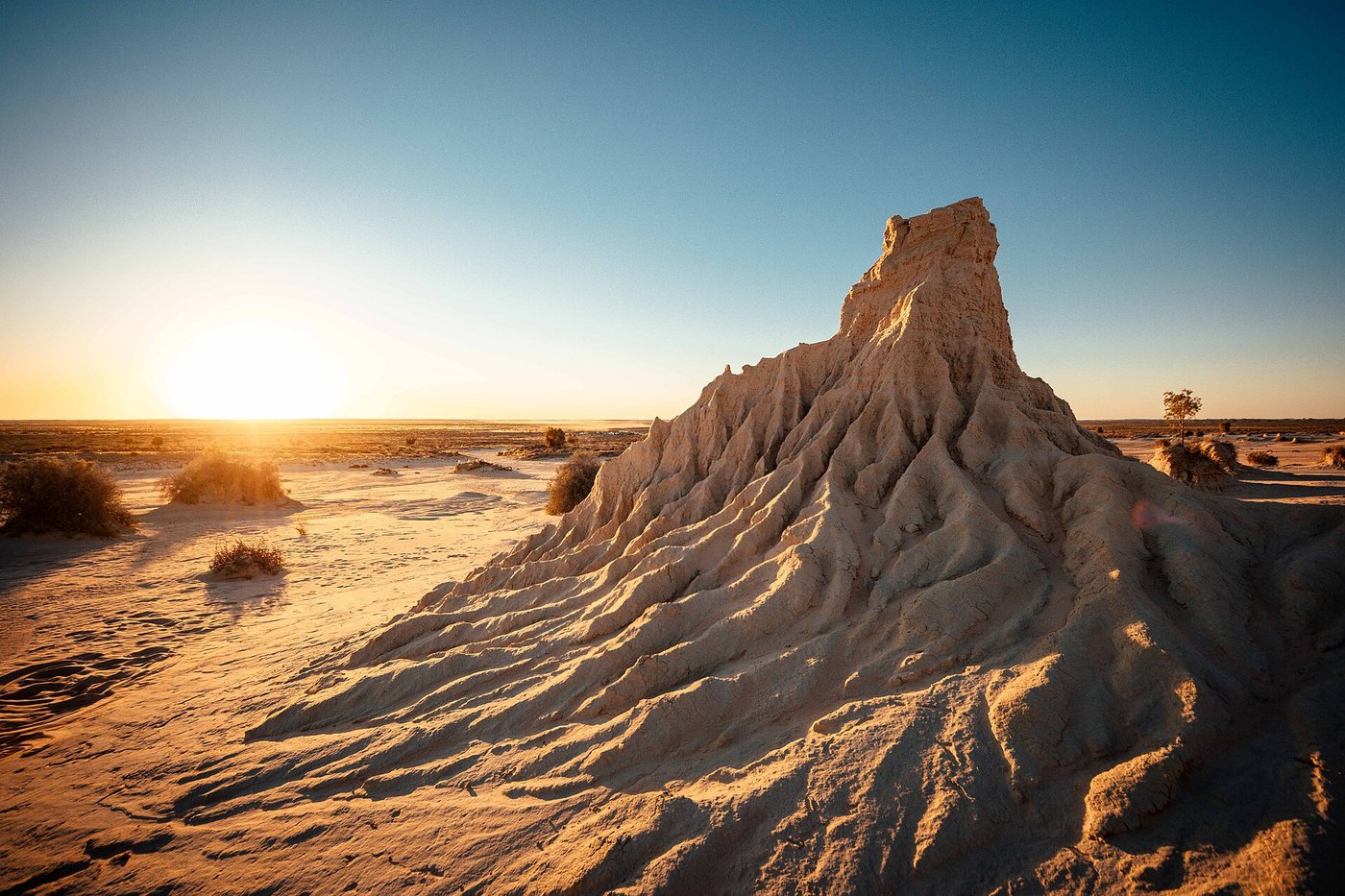
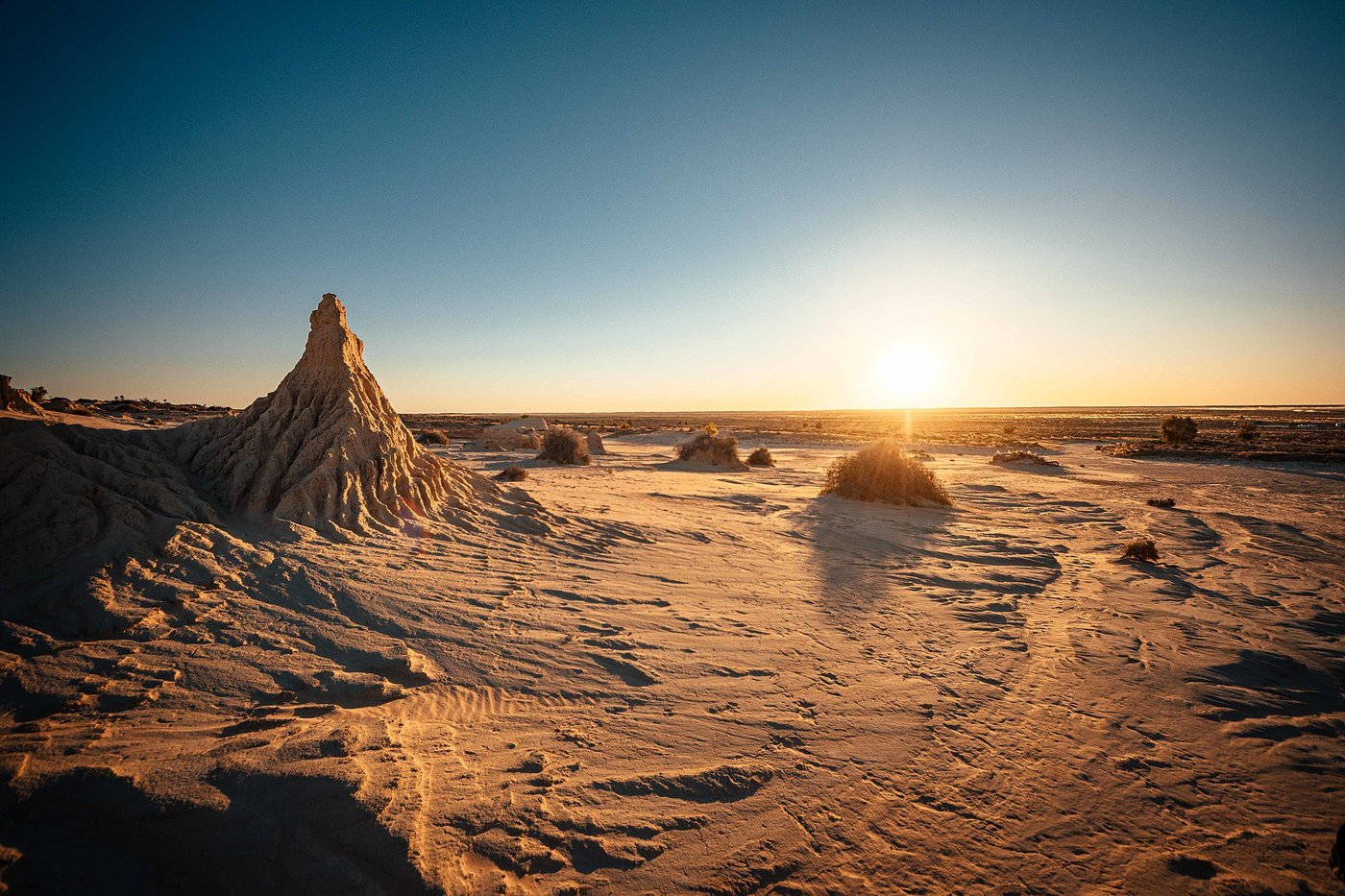
Jim Bowler was not looking for people. In the winter of 1968 he was a geologist chasing old shorelines, driving a battered vehicle across a dry lakebed in the far south-west of New South Wales, reading the land for signs of vanished water. The lakes here had been empty for thousands of years. What was left was a long, pale ridge of sand and clay on their eastern shores, sculpted by the wind into ramparts that early graziers had nicknamed the Walls of China. On 15 July, walking a blowout where the wind had stripped the dune back, Bowler saw something white catching the light. It was bone, and it had been burned. He had found the oldest cremation anyone has ever found, anywhere on Earth, though it would take years, and a second discovery, before anybody understood what that meant.
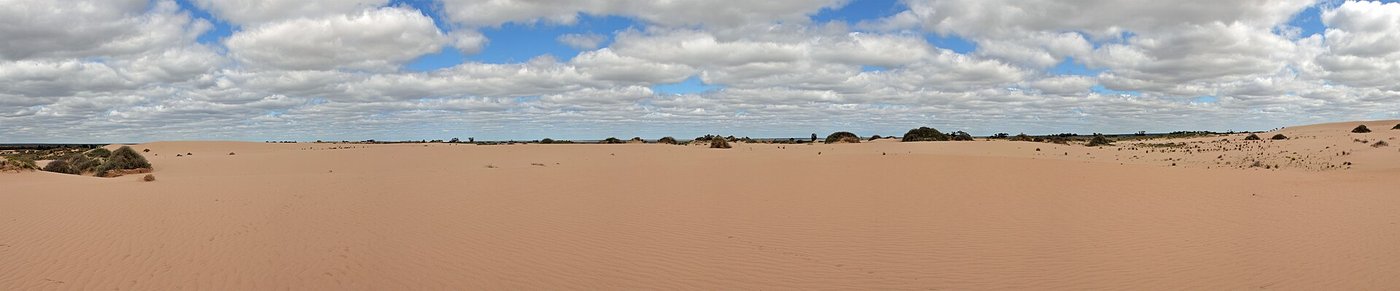
The place is called Lake Mungo. There is no lake. The water dried up around fifteen thousand years ago, and the name now belongs to a dusty basin in Mungo National Park, part of the Willandra Lakes, a chain of ancient lakebeds that once brimmed with fresh water and now hold only sand, saltbush and the wind. What makes this empty country matter is what the wind keeps uncovering. Two sets of human remains came out of that eroding dune, a woman and a man, and between them they pushed the known human story of Australia back tens of thousands of years and forced a hard argument about who is allowed to study the dead, and for how long.
A woman burned by a full lake
Start with her, because she came first. The remains Bowler found in 1968 belonged to a young woman, and the way she had been treated in death was startling. Her body had been burned. Then the burnt bones had been broken into small pieces. Then the pieces had been burned a second time and buried in a low mound near the shore. This was not a body left where it fell. It was a rite, carried out in stages, by people who had decided that fire and care were owed to their dead.
Archaeologists call her Mungo Lady. When she died, the lake in front of her was full. The Willandra basins were then a living system fed by an overflowing creek, ringed with reeds, loud with waterbirds. People camped along the shore and ate well: golden perch and Murray cod from the water, freshwater mussels by the thousand, emu eggs, yabbies, the small marsupials of the surrounding plains. The hearths and shell middens they left are still eroding out of the dune today, thin dark lines in the pale sand marking meals cooked forty thousand years ago. Mungo Lady was cremated on the edge of a landscape that was generous, not the desert it is now.
A single accidental fire cannot burn a body, break the bones, and burn them again. That sequence takes intent, and more than one person, and time. It is the earliest evidence anywhere of cremation as a deliberate practice: a society that had already worked out an elaborate way of handling death, complete with a second act performed after the first fire had cooled. Whatever these people believed about the dead, they held it strongly enough to do the work twice.
The man laid out in red
Six years later, in February 1974, Bowler was back on the lunette after heavy rain had scoured the dune again. A few hundred metres from where the woman had lain, a second skeleton was coming out of the sand. This one had not been burned. He had been buried whole, laid on his back with his knees slightly bent and his hands brought together at his groin, fingers interlaced. And he had been covered in red ochre, so much of it that the soil around his skull was stained pink.
The ochre is the detail that stays with you. Red ochre does not occur at Lake Mungo. The nearest good sources lie a long way off, and the powder that was scattered over this man had to be carried across country to reach his grave, perhaps as much as two hundred kilometres. Somebody thought it worth the journey. Mungo Man, as he became known, was an old man for his time, his teeth worn flat, his body marked by a lifetime of hard use. He was sent into the ground with pigment brought from the far edge of his people's world.
Put the two burials side by side and the picture sharpens. Within one community, on one shore, two people were given two entirely different and equally deliberate funerals: one by fire, one by earth and ochre. This was not a simple people improvising. It was a culture with more than one way to bury its dead, and reasons for choosing between them that we can no longer read.
Two dates that cannot both be right
How old were they? That question turned into one of the longest arguments in Australian science, and it mattered far beyond a single dune. The date at Mungo is not just the age of two graves. It is a floor under the whole question of how long people have lived on the continent.
Early estimates put the burials at around twenty-six to thirty thousand years, already remarkable. Then in 1999 a team led by Alan Thorne, using a combination of uranium-series, electron-spin-resonance and optical dating on the sediments, announced a far bigger number: Mungo Man was about sixty-two thousand years old. If that held, it would rewrite the timeline of humanity's spread out of Africa, because it would put fully modern people in the middle of Australia earlier than most models allowed them to have left the far side of the world.
The number did not hold. Bowler, who knew the dune better than anyone, thought the sampling had mixed sediments of different ages. In 2003 he led a fresh study built on optically stimulated luminescence (a method that measures when quartz grains last saw sunlight), taken carefully from the burial layers themselves. It produced a tighter, younger answer, backed by four independent dating methods reading the same story from the ground: both Mungo Lady and Mungo Man were laid to rest around forty to forty-two thousand years ago.
Sixty-two thousand versus forty-two thousand is not a quibble over decimals. The larger figure would have forced a rewrite of when our species left Africa; the smaller one fits the wider evidence for people reaching Australia by around fifty thousand years ago and living at Willandra soon after. The lesson of the fight was quieter than either number. A spectacular date from one method, pulled from sediment that may have shifted, is worth less than a modest date that several independent methods agree on. The dune had layered its own history unevenly, and reading it wrong in one place threw the whole clock out.
Forty-two thousand years is not a consolation prize. It still makes Mungo Lady the oldest cremation known anywhere on the planet, and it still places complex funeral rites in Australia at a time when much of Europe was shared between our species and the last of the Neanderthals. The people at Mungo were not late arrivals at the edge of the human story. They were near its beginning.
The DNA that promised too much
There was a second, stranger claim, and it is worth telling because it shows how badly a wish can bend a result. In 2001 a group reported that they had recovered mitochondrial DNA from Mungo Man, and that his genetic line looked deeply, impossibly divergent, unlike that of any living human. To some this seemed to support an old idea called multiregionalism: the notion that modern humans evolved partly in place, on several continents, rather than spreading from a single African origin.
It was too good to be true, and it was not true. Recovering authentic ancient DNA from a specimen that old, in a hot country, after decades of handling, is close to impossible; later workers concluded the sequence had almost certainly been contaminated with modern DNA, quite possibly European, from the many hands that had touched the bones. The extraordinary lineage was a laboratory ghost. Mungo Man's real genetic story is simply lost, cooked out of the bone by tens of thousands of years of Australian heat. The episode left a sober rule behind: when a result flatters the theory you already prefer, that is exactly the moment to distrust it.
The footprints of a wet morning
The dead are not the only people the dune has kept. In 2003 a young Mutthi Mutthi woman named Mary Pappin, walking the country with researchers, noticed marks pressed into a hard clay pan. They turned out to be human footprints: hundreds of them, the largest collection of Ice Age footprints anywhere in the world, made around twenty thousand years ago when the clay was soft mud after rain and then baked and buried before it could wash away.
You can read a morning in them. There are the long strides of tall men running, one of them moving fast enough that trackers estimate a sprint. There are the tracks of women and children walking. There is a single-legged set of prints where, some believe, a one-legged man moved on the mud with a hopping gait. For once the record is not bone or stone but the act of walking itself, frozen mid-step. The people who left the graves were not an abstraction. They ran and hunted and carried their children across this ground, and the ground remembered.
Whose ancestors, whose science
When Bowler lifted Mungo Lady's remains in 1968, he took them, as was normal then, back to a university in Canberra to be studied. Mungo Man went the same way in 1974. Nobody at the time asked the people whose country this was. The Paakantyi, the Ngiyampaa and the Mutthi Mutthi, the three groups who share the Willandra, watched their oldest ancestors carried off to a laboratory hundreds of kilometres away, to be measured and argued over by strangers.
That silence did not last. Aboriginal Australians pressed, for years, a plain point: these were not specimens, they were people, and they belonged at home. The science that had made Mungo famous had also treated the dead as property. Slowly the balance shifted. Mungo Lady was returned to the Willandra in 1992, kept in a locked safe at the park whose keys were held by Aboriginal elders: present in her own country, but not yet back in the ground.
Mungo Man's return became a journey in its own right. In 2015 the university formally handed his remains to Aboriginal elders, and in November 2017 he travelled back to Lake Mungo in a hearse, carried in a coffin made from an 8,000-year-old fossil red gum, greeted by communities at stops along the road. A man who had been laid out with imported ochre forty-two thousand years earlier was escorted home by his descendants, with ceremony, past the towns that had grown up on his country in the meantime.
Back into the ground
Having the ancestors home raised a harder question than bringing them back: what now? Leave them in a keeping place, available in principle for future study with better tools? Or return them to the earth for good, as many elders wanted, closing the door on the science? The two answers pulled against each other, and not every Aboriginal person agreed on which was right. Some feared that reburial without a permanent marker or protection could see the remains lost again, or eroded back out of the dune to be gawped at.
The decision, after long consultation and a legal challenge that reached the courts, was to rebury. On 24 May 2022, Mungo Man and Mungo Lady were returned to the earth of the Willandra, together with the remains of more than a hundred other ancient people recovered from the lakes over the years. They went back into the country that had held them for forty thousand years before a geologist's eye caught the light on burnt bone.
Australia was an empty, unchanging wilderness until Europeans arrived, a land whose first peoples lived lightly and simply, without deep history, without ceremony, without a past worth the name.
Mungo took that story apart. Here is a cremation forty-two thousand years old, a formal ochre burial beside it, hundreds of Ice Age footprints, and a food economy built on a lake that has since vanished, all of it the work of people whose direct descendants still speak for this country today. The continent was never empty and never static. It held one of the longest continuous human cultures on Earth, keeping its dead with fire and pigment while the rest of the world was still sharing itself with Neanderthals.
What the empty lake still holds
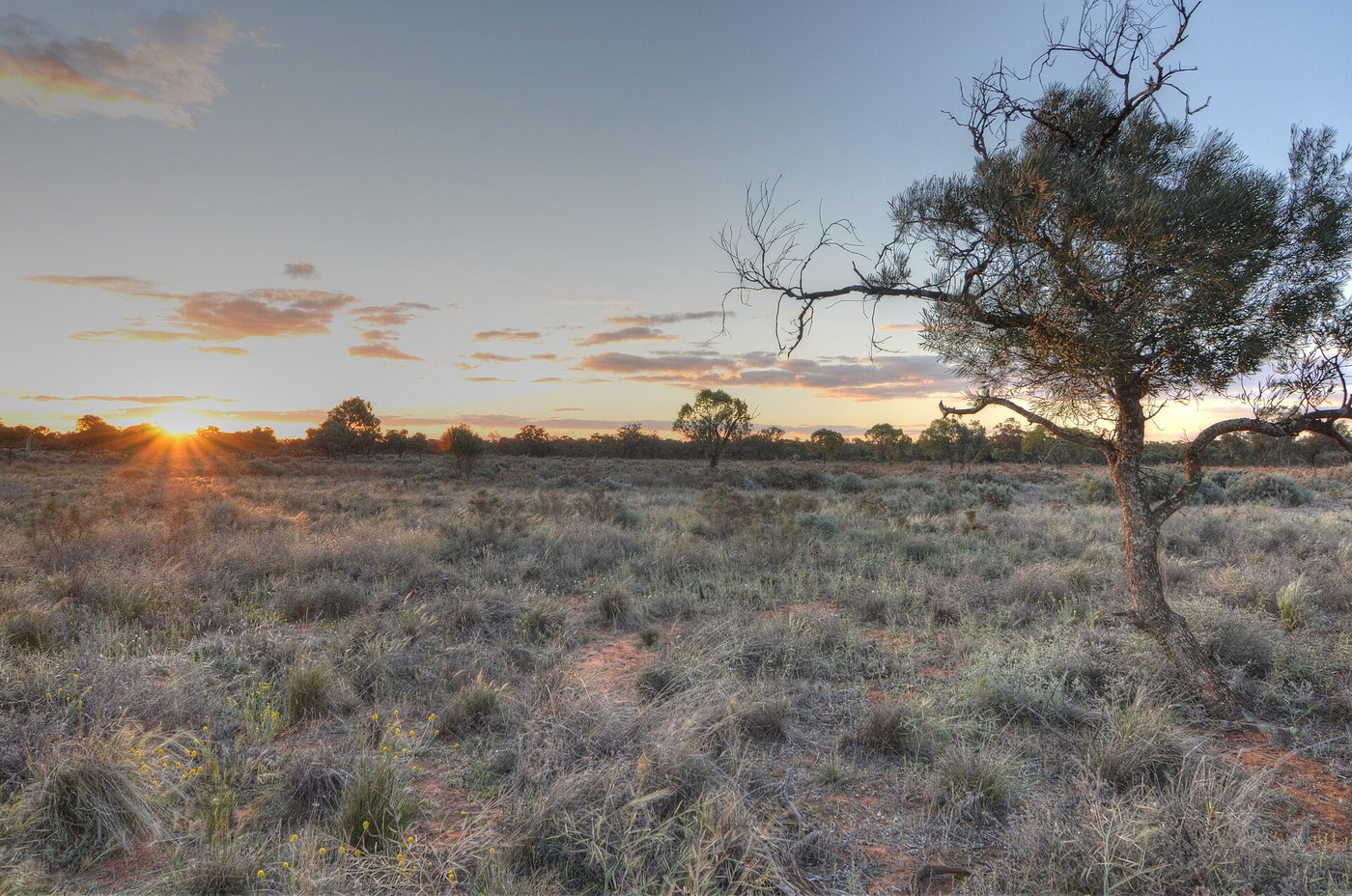
In February 2024, fifty years after he found Mungo Man, Jim Bowler went back to the Willandra one more time, well into his nineties. The dune he first walked in 1968 is still there, still eroding, still shedding hearths and shells and, now and then, bone. Nobody thinks Mungo Lady and Mungo Man were the only people buried on that shore. The wind that revealed them keeps working, and the country keeps its own counsel about what it will offer up next, and when.
The reburial closed one argument and left another open. We know, because of Mungo, that people were cremating and honouring their dead in Australia at the dawn of the modern human story. We will probably never know their names, their language, or the meaning of the choice between fire and ochre. That knowledge went back into the ground in 2022, by the wish of the people whose ancestors these are. Some questions, it turns out, are answered not by digging deeper but by deciding to stop.
Read next: Plain of Jars: The Stone Urn in Laos That Held 37 People and The Lost Civilisation Beneath the Sahara: When the Desert Was Green.
Sources & further reading
- J. M. Bowler et al., “New ages for human occupation and climatic change at Lake Mungo, Australia,” Nature (2003) — the study that settled the dating at around 40,000–42,000 years.
- A. Thorne et al., “Australia's oldest human remains: age of the Lake Mungo 3 skeleton,” Journal of Human Evolution (1999) — the disputed 62,000-year claim.
- G. J. Adcock et al., “Mitochondrial DNA sequences in ancient Australians,” PNAS (2001) — the multiregional DNA claim later attributed to contamination.
- Steve Webb, Willandra Lakes Hominids and later work on the fossil footprints — on the human remains and the Pleistocene trackways.
- National Museum of Australia, “Mungo Lady” and “Mungo Man” defining-moments records — discovery, repatriation and reburial.
- UNESCO World Heritage Centre, Willandra Lakes Region (inscribed 1981) — the site's landscape and cultural significance.
Image credits (via Wikimedia Commons): the Walls of China lunette — Kevinzoo45 (CC BY-SA 4.0); eroding lunette formations — Kevinzoo45 (CC BY-SA 4.0); dry-lake dunes panorama — Davidspicerj (CC BY-SA 4.0); sunset over Mungo — Davidspicerj (CC BY-SA 4.0).