In the autumn of 1972 a young man in eastern Bulgaria kept a shoebox under his bed, and inside it lay more gold than anyone alive had ever seen from the ancient world. Raycho Marinov was twenty-two, an excavator operator cutting a trench for electric cable on the flat ground behind the Black Sea port of Varna. His bucket kept turning up small bright objects caked in soil. He took them for brass, or scrap off some old machine, rinsed a handful, and carried them home in the box. They sat there for days while he got on with the job. When a friend finally looked at them properly and brought them to the town museum, the curators went quiet. The little brass trinkets were gold, they had been in the ground for six and a half thousand years, and they were about to change the story of when human beings first learned to hoard the stuff.
The place he had cut into is now called the Varna necropolis: a Copper Age cemetery on the western edge of the modern city, beside a lake that was once an open arm of the sea. Over the next twenty years archaeologists opened nearly three hundred graves there. About a third of the ground is still untouched. Out of the part they have dug came roughly three thousand gold objects weighing close to six kilograms, and, more important than the weight, the oldest worked gold anyone has ever found.
A lake that used to be the sea
Stand on the shore of Lake Varna today and you are looking at a long, calm stretch of water that runs inland from the coast. Six thousand years ago the geography was different. The lake was a lagoon, open to the Black Sea, and the low hills around it held small farming villages. The people who lived there grew grain, kept cattle and sheep, fished the shallows, and traded up and down the coast. They had no writing. They left no cities of the kind Mesopotamia would soon raise. What they had was metal, and an eye for it that nobody else in the world had yet developed.
This was the Chalcolithic, the Copper Age: the long stretch after the first farmers and before the first bronze, when people were learning that certain green and blue stones, heated hard enough, ran into a red metal you could hammer and cast. The communities around the lower Danube and the western Black Sea were among the earliest anywhere to work copper on a serious scale. They mined it, smelted it, and cast heavy axes and tools from it. Gold came out of the same workshops and the same instinct. It is softer, rarer and stranger, and it does one thing copper does not: it never tarnishes. A gold ornament made in 4500 BC still shines. That refusal to dull is probably half the reason it mattered so much.
Archaeologists gave the culture the name of the lake. The Varna people are known almost entirely from their dead, because the cemetery has told us far more than the flooded villages ever could. And the cemetery, once it was read carefully, turned out to hold a surprise much bigger than treasure.
Older than the pyramids by a long way
The first thing to settle is the date, because the date is the whole claim. Radiocarbon puts the graves at roughly 4600 to 4200 BC. That is not a little older than the famous ancient world. It is dramatically older. The first Egyptian pyramid, the stepped tomb of Djoser, would not be built for another sixteen centuries. The great cities of Sumer, the wheel, the earliest writing, all of it lay in the future when the Varna goldsmiths were at work. When people say Varna holds the oldest gold, they do not mean the oldest gold in Europe or the oldest gold with a nice story attached. They mean the oldest processed gold known anywhere on Earth.
The pieces Marinov first carried home came to a little over a kilogram of gold. That single accidental handful already held more gold than every other known site from the whole millennium of 5000 to 4000 BC put together, across the entire world. The full cemetery would multiply it many times over.
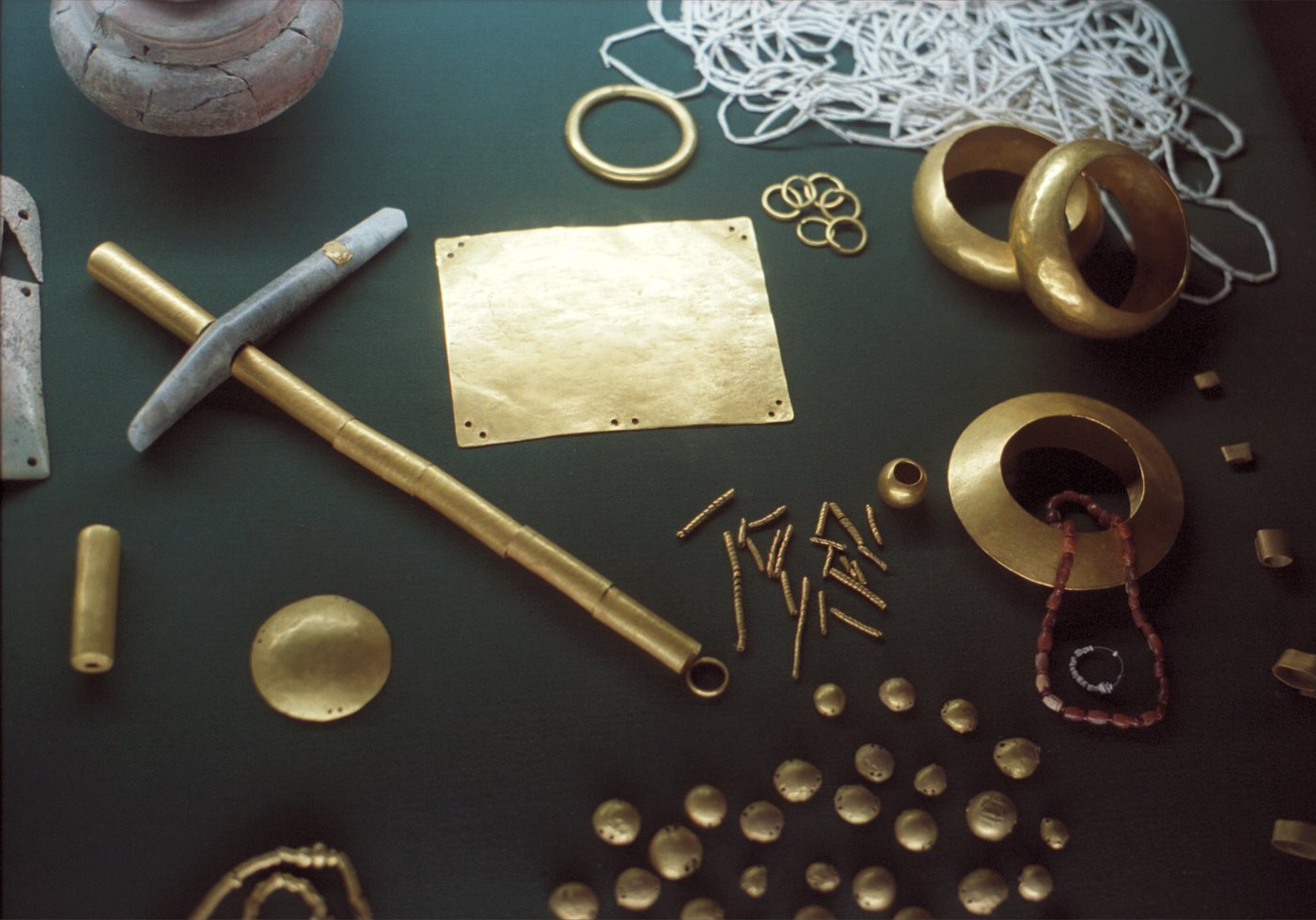
It is worth being clear about what “worked gold” means, because raw gold nuggets have been picked up and treasured since long before farming. What Varna shows is gold as craft: melted, drawn, hammered into sheet, cut into shapes, pierced and strung and stitched onto cloth and skin. Someone had to gather the metal, control a furnace hot enough to melt it, and know what to do next. Getting a single ounce of gold out of the ground can mean shifting tonnes of rock and gravel. This was not a chance find in a stream turned into a bead in an afternoon. It was an industry, with specialists, and a society willing to feed those specialists while they made objects nobody could eat.
The man in Grave 43
One grave stands above all the others, and it has a number rather than a name: Grave 43. In it lay a man, well built, somewhere in his forties, laid out on his back. Around and upon him the excavators counted more than a kilogram and a half of gold, more, on its own, than has been found in all the rest of the contemporary world combined. He had heavy bangles stacked on his arms, strings of beads, discs and plates that had been sewn to clothing long since rotted away, and a scatter of gold across the whole length of the body.
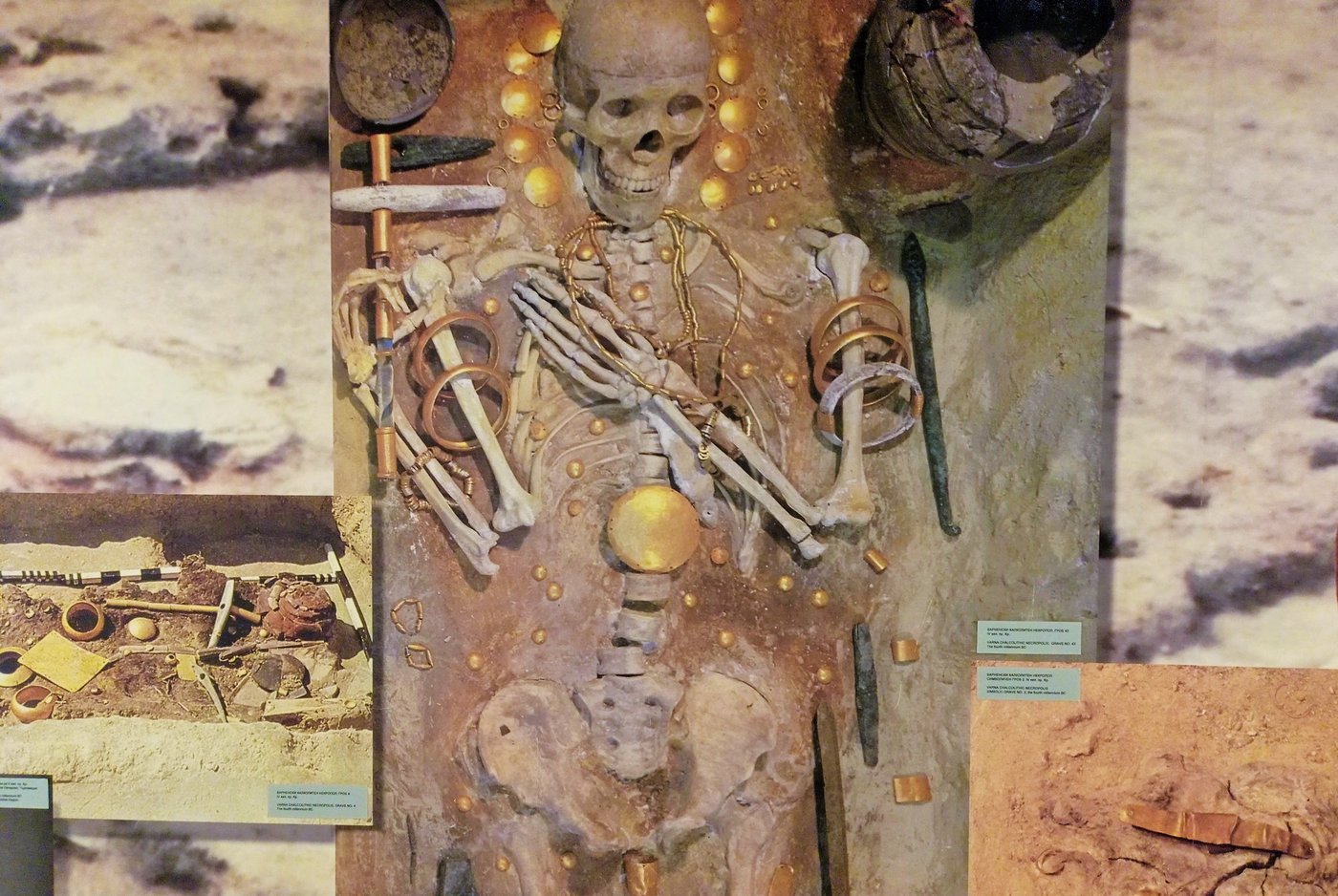
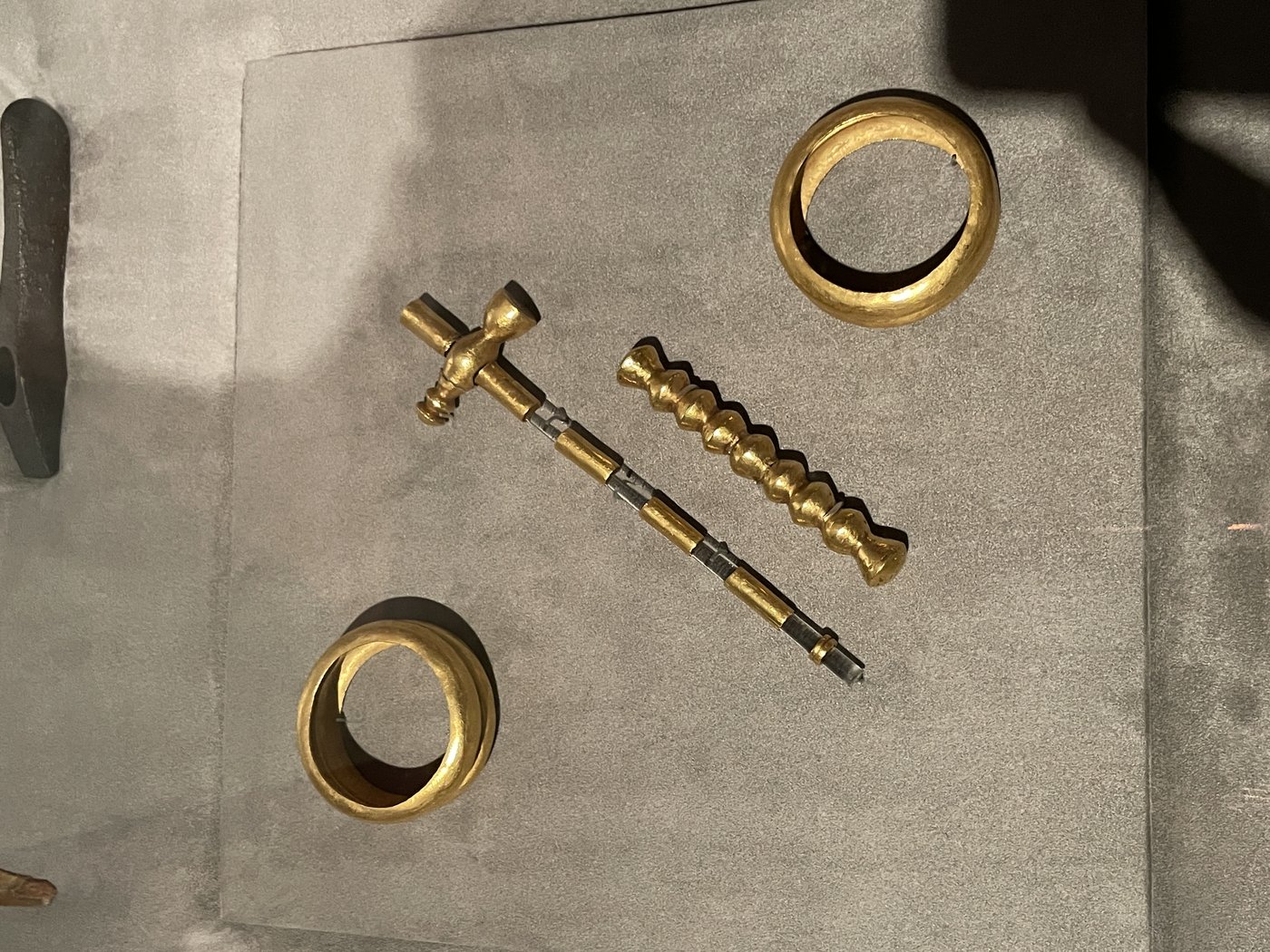
Two things about him have fixed the imagination of everyone who has studied the site. The first is a weapon: a polished stone axe or mace whose wooden handle had been sheathed in tube after tube of gold, so that the shaft itself gleamed. A working tool does not need a golden handle. This was a thing to be held up and seen, an object whose only job was to say who was holding it. Beside him lay a long blade of honey-coloured flint, longer than any practical knife, as much a symbol as an edge. The second thing is smaller and blunter in its message: a curved plate of gold that had covered the man’s genitals. Even that, on this body, was gold.
For decades Grave 43 has been called the burial of a chieftain, and sometimes, more boldly, the oldest known grave of a king. It is easy to see why. Here is a single person marked out from his community by a fortune in a metal that took enormous labour to produce, holding an object that can only be read as a sign of rank. Not everyone accepts the crown, though.
Was the man in Grave 43 a ruler, or something else? Some argue his wealth reflects command over people and land: the earliest chief we can point to. Others read the metalwork itself as the clue, and wonder whether his status came from controlling the smiths and the secret of the furnace, making him closer to a high priest of metal than a king in any later sense. The honest answer is that a cemetery cannot tell us how he gave orders, or whether he did. What it can prove is that his community agreed he was worth more gold than anyone else. That agreement is the discovery.
The graves with nobody in them
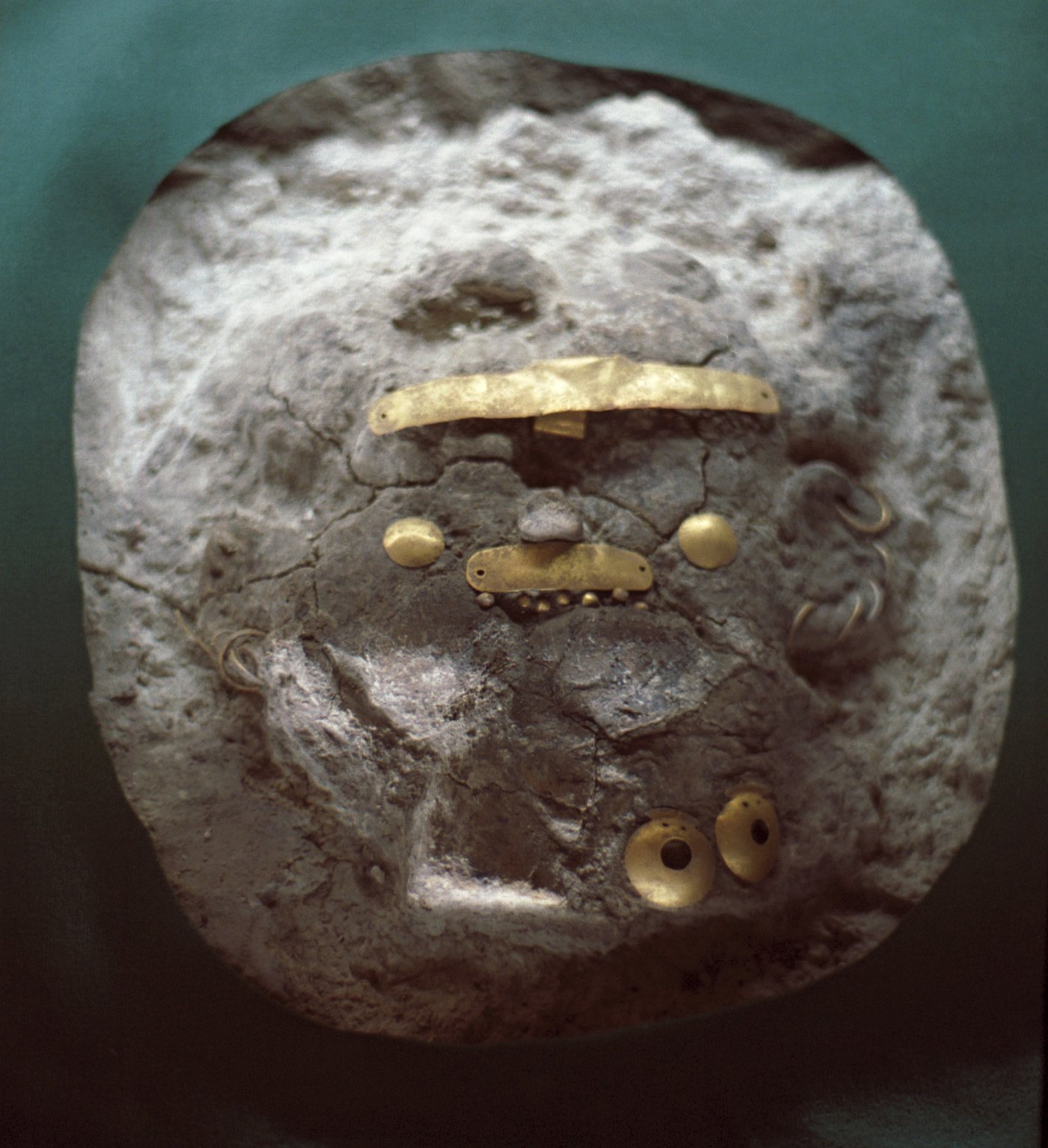
Not every rich grave at Varna held a body. Some of the most striking held none at all. Archaeologists call them cenotaphs: burials laid out with full ceremony and full treasure, but empty of a corpse. At Varna a few of these empty graves contained something found almost nowhere else: a face.
In place of a head, at the correct spot in the grave, the mourners had modelled a mask out of unbaked clay, life-sized, and fixed gold to it. Thin gold discs sat where the eyes should be. A small rectangular plate marked the mouth. Other plates and a diadem framed it. The clay has mostly crumbled, but the gold that dressed it survived, keeping the shape of a face that was never a face. Whoever these graves honoured could not be buried in person (lost at sea, perhaps, or dead too far away to bring home), so the community made them a body of earth and gold and gave them everything a living notable would take into the ground.
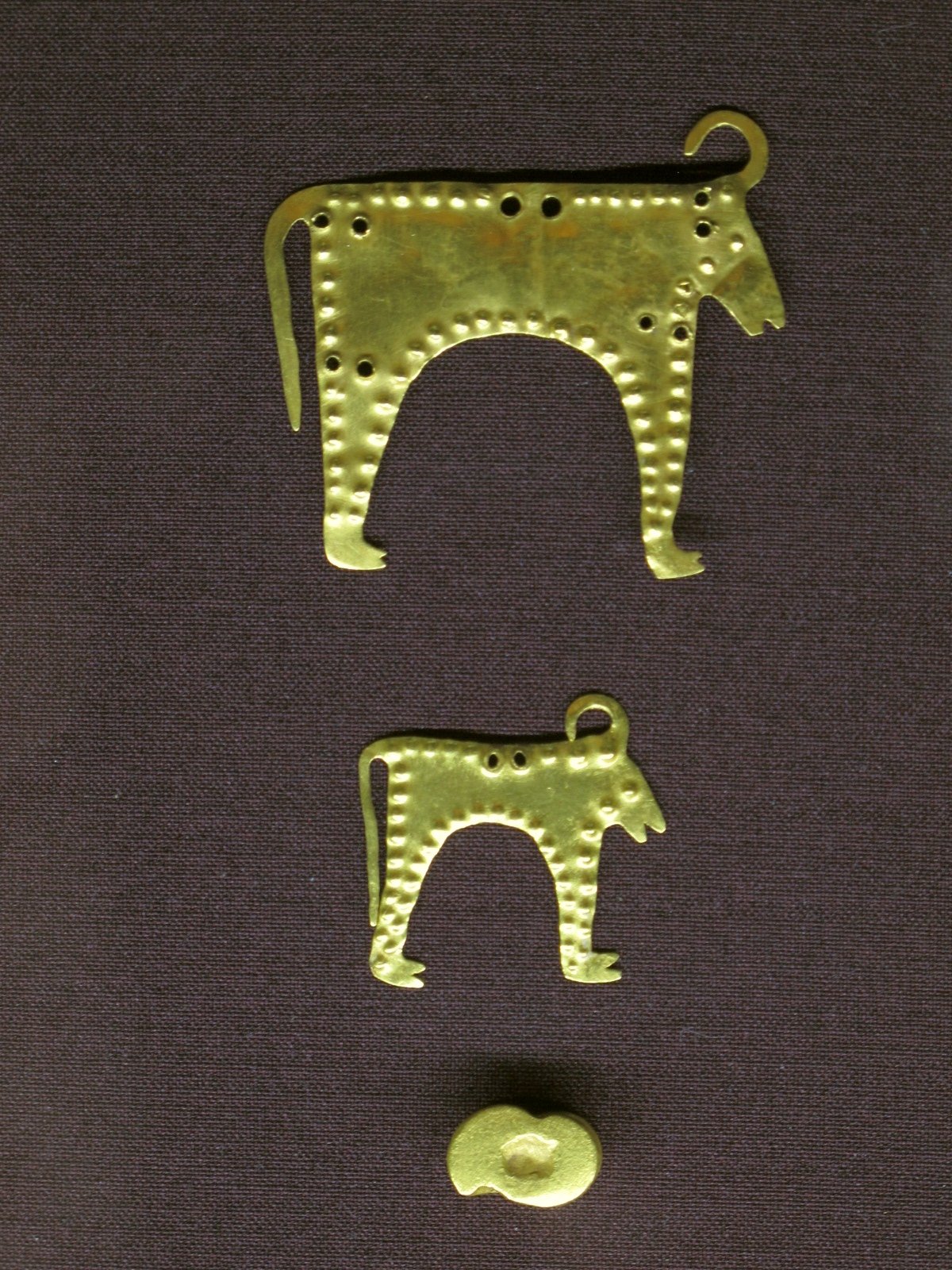
One of these empty graves, Grave 36, was among the richest of all. It held golden bull figurines, a small crown, a sceptre, hundreds of beads and rings and plates: a full outfit of power laid out for a person who was not there. The bulls matter: cattle were wealth in this world, walking capital, and a bull rendered in gold folds the two kinds of treasure into one. To be given such a grave without a body is its own statement of rank. Even in absence, this person was owed the whole show.
How to read a cemetery
Spread the whole necropolis out and a pattern jumps from it that has nothing to do with how pretty the objects are. Most of the graves are plain. Their occupants went into the ground with a pot or two, a flint blade, a few beads, the ordinary send-off of ordinary people. Roughly one grave in five held any gold at all, and in most of those it was a scrap. Then a tiny handful of graves (four of them) held around three-quarters of all the gold in the cemetery.
That is not how an equal society buries its dead. For a long time it was assumed that Copper Age farming villages were broadly level places, where a headman might be first among equals but no one owned a fortune. Varna broke the assumption. Here, six and a half thousand years ago, is hard evidence that some people were treated as worth vastly more than others, and that the difference could be measured, counted, and taken into the grave. Vladimir Slavchev, one of the curators who has spent his career with these objects, puts it plainly: the cemetery shows big differences between people, and in it we are looking at the first complex society. People then, he says, had the same ideas we do now.
The myth: sudden, spectacular gold like this must point to a lost advanced civilisation, or outside help, because “primitive” farmers could not have made it.
The reality: everything at Varna was made by local Copper Age communities using skills we can trace step by step in the region’s own workshops. What was advanced was not their machinery but their society: organised enough to free some people to spend their lives making things that only mattered because everyone agreed they mattered. The gold is not evidence of aliens or Atlantis. It is evidence of hierarchy, which is stranger.
The point that lingers is how modern it all feels. Gold cannot be eaten, worn for warmth, or planted. Its value is a story a group of people tell each other and agree to believe. At Varna that story is already fully formed. Value has been detached from use, concentrated in a few hands, and made to follow those hands out of life and into death. Nearly everything we find uncomfortable about wealth was already in place before the first city, the first king with a name, the first written word.
Where it came from, and how far it travelled
The Varna people did not live in isolation. Threaded through the graves, alongside the gold, are ornaments cut from Mediterranean sea shells (the bright, heavy Spondylus and the little tube-shaped Dentalium), carried a very long way from warm southern waters to this northern lagoon. Shell like this turns up right across Neolithic and Copper Age Europe, passed hand to hand along routes that moved goods and ideas centuries before roads. Some researchers think the shells worked almost as an early currency, a portable agreed-upon value. A people who prized shells brought from the far side of a sea were already thinking about wealth as something that moves.
The copper is easier to place: the Balkans held rich ore, and some of the oldest deep copper mines in the world sit not far away. The gold is harder. Its exact sources are still argued over, teased at with chemistry and isotopes, but the likeliest answer is that it came from the rivers and rocks of the surrounding region, gathered slowly and pooled into the hands of the few. However it was won, the effort was staggering. To produce the contents of Grave 43 alone, communities had to move earth and rock on a scale out of all proportion to a single funeral, and they did it, willingly, for the dead.
And then they were gone
Here the story turns sharp. Around 4200 to 4000 BC, the Varna culture and its neighbours all along the lower Danube stopped. Not slowly, but stopped. Villages that had stood for generations were abandoned. The great flowering of copper and gold ended. For something like a thousand years afterwards the region falls quiet in the archaeological record, a long gap with no obvious successor picking up where the goldsmiths left off. A world that had invented the concentration of wealth simply switched off.
Nobody is sure why, and the honest scholars say so. The old explanation was invasion: waves of horse-riding peoples from the eastern steppe rolling in and sweeping the farmers away. But the ground shows little sign of it: no burnt towns, no massacre layers, no clear mark of conquest at the moment things ended. That has pushed many researchers towards the climate. The centuries around the collapse saw the weather turn less reliable, with harsher swings in temperature and rain, and the Black Sea itself was rising. Fields near the water may have turned to marsh; harvests may have failed often enough, for long enough, to make the old way of life impossible. Perhaps, one archaeologist has suggested, their fields became swamps, and people simply had to become something else.
Vladimir Slavchev, weighing the collapse, has admitted the plainest version of the problem: there is still nothing to fill the gap, and, he adds, they have looked. A civilisation invented the hoarding of gold, buried a king in it, and then vanished so completely that six thousand years later its keenest students cannot say what became of it.
What the shoebox started
The gold from Varna now sits in cases in the city’s archaeology museum and in Sofia, laid out grave by grave so you can see the inequality for yourself: the plain burials, the modest ones, and then the blaze of Grave 43. Raycho Marinov’s accidental trench turned into one of the twentieth century’s great excavations, and it is not finished. Roughly a third of the cemetery is still in the ground, unopened, which means the richest grave found so far may not be the richest grave there is.
What Varna leaves behind is not really the gold, beautiful as it is. It is a mirror held up very early in the human story. Long before empires, before writing, before a single name we can pronounce, a community by a Bulgarian lake had already decided that some lives were worth more than others and could prove it in metal that would not tarnish. The man in Grave 43 has been silent for six and a half thousand years. His gold is still saying exactly what it was made to say.
Read next: Gundestrup Cauldron: Celtic Gods, Thracian Hands, Foreign Silver and Trypillia: The 6,000-Year-Old Cities That Burned Themselves Down.
Sources & further reading
- Slavchev, V., “The Varna Eneolithic Cemetery in the Context of the Late Copper Age in the East Balkans”, in The Lost World of Old Europe (Anthony & Chi, eds.), Princeton University Press.
- Higham, T. et al., “AMS dating of the Late Copper Age Varna cemetery, Bulgaria”, Radiocarbon / Antiquity.
- Renfrew, C., discussion of Varna and prehistoric rank in Before Civilization and later papers.
- Smithsonian Magazine, “The Mystery of the Varna Gold” (Smithsonian Journeys).
- Varna Regional Museum of History — the Chalcolithic gold collection and grave catalogue.
Image credits (via Wikimedia Commons): reconstructed Grave 43 — Ivano Giambattista (CC0); Varna gold treasure display — Zde (CC BY-SA 4.0); gold bracelets and sceptre — CryolophosaurusEllioti (CC BY 4.0); bull pendants from Grave 36 — Gabriele Burchielli (CC BY 2.0); face and funerary gold jewellery — Zde (CC BY-SA 4.0).