The jar was far too heavy to have been carried up the hill it sat on. It stood more than two metres across, a squat bowl of grey stone with walls as thick as a man's forearm, half-sunk into a slope about seventy kilometres north-east of the Laotian town of Phonsavan. People had peered into it before. What no one had done was empty it and count. When a small team cleared the packed soil out of the jar in the mid-2020s, the stone gave up the bones of at least thirty-seven people: skulls set in a ring around the inner wall, the long bones of arms and legs gathered together in the middle, laid in by hand across what may have been two and a half centuries.
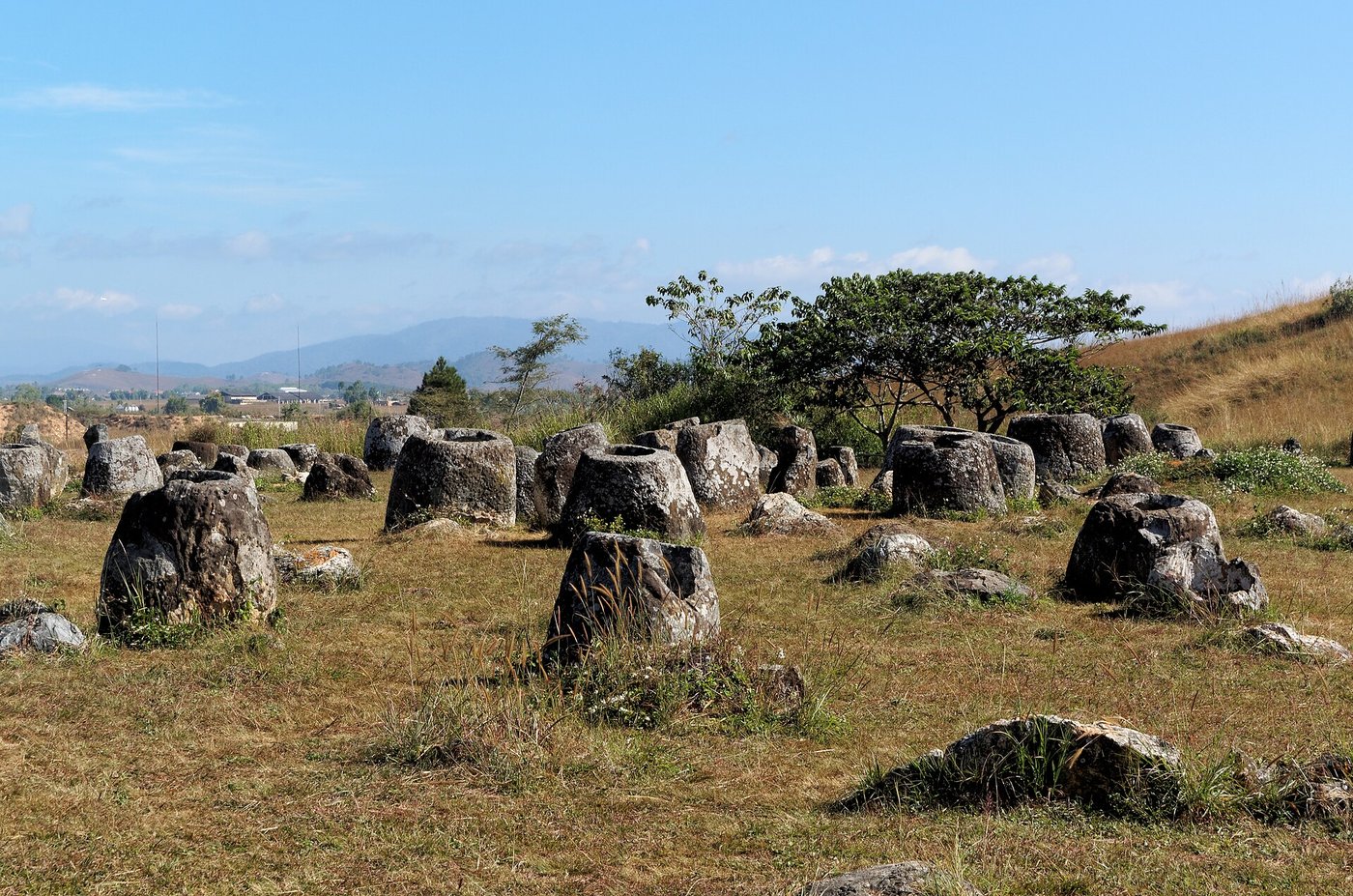
The jar belongs to one of the strangest ancient landscapes on earth. Across the uplands of Xieng Khouang province in northern Laos, more than two thousand carved stone vessels stand scattered over grassy hills and pine ridges, alone and in clusters, at over ninety recorded sites. Some are knee-high. Others rise past a grown adult and weigh several tonnes. They have no inscriptions, no carvings of gods or kings, nothing written on them at all. For most of a century the obvious question, what were they for, had only guesses for answers. The people who cut them left no name and no book. The stone had to speak for them, and it took a long time to work out what it was saying.
This is the story of that reading: of a French woman who crawled into a cave and came out with a theory, of a giant who was said to have drunk from the jars, and of the single vessel on a quiet hillside that finally showed what the plain had been doing with its dead.
Two thousand jars and nobody to ask
Fly low over the Xieng Khouang plateau and the jars look almost planted, like seed heads that turned to stone. They cluster on high ground with a clear view across the valleys, never down in the wet bottoms. The biggest groups hold hundreds of vessels; the smallest are a handful of jars sharing a ridge. Archaeologists number the sites rather than name them (Site 1, Site 21, Site 75) because there is no old name to use.
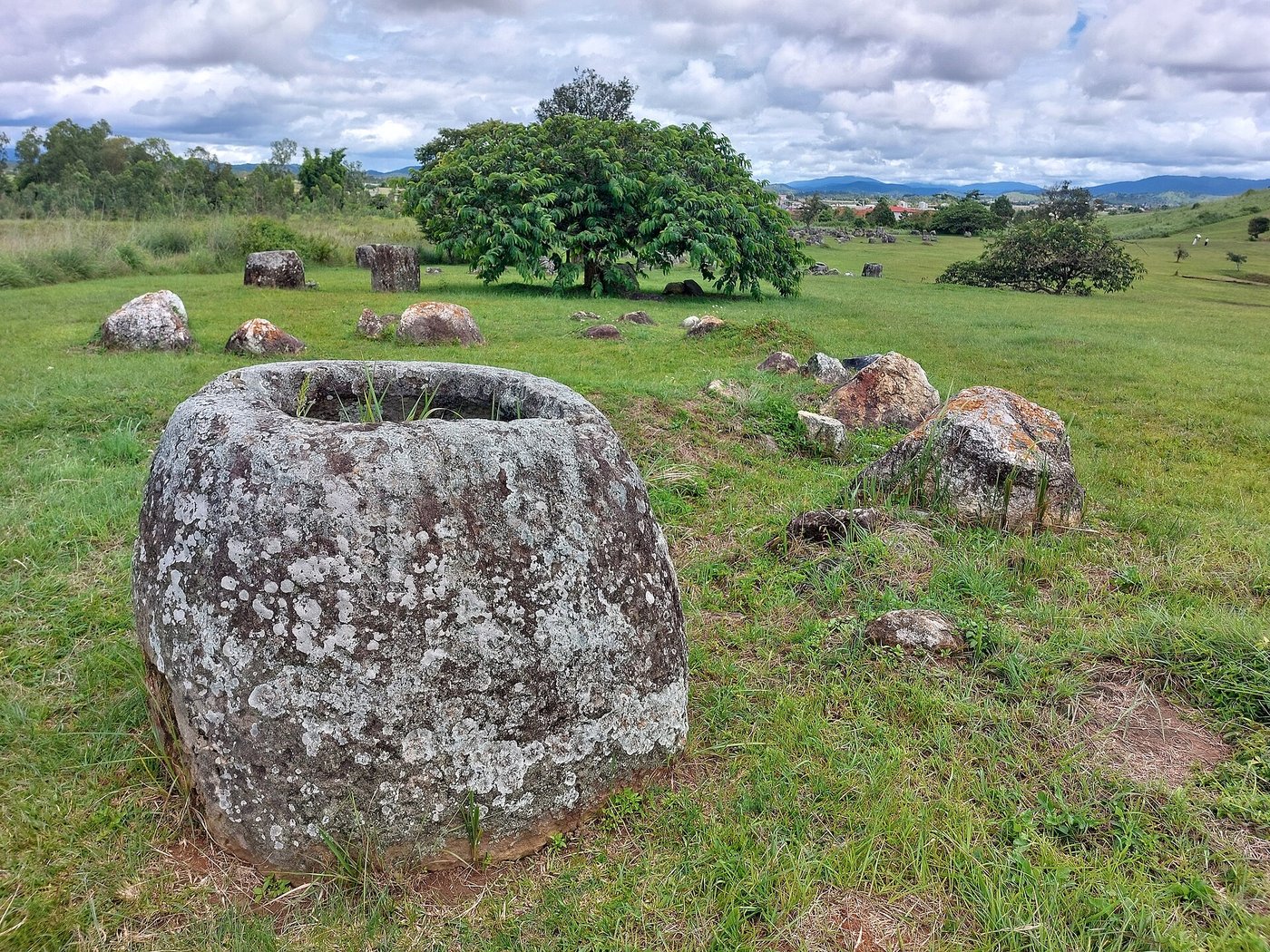
The jars were not thrown or moulded. They were cut: carved and hollowed out of solid blocks of sandstone, and in places of harder rock like granite and a stone called breccia. At Site 21 you can still find the quarry, with half-finished jars sitting where the carvers left them and the scars of the cutting on the rock face nearby. Once shaped, each vessel had to be dragged, sometimes for several kilometres, from the quarry to its final hill. Moving a three-tonne stone bowl across broken country, with no wheels and no draught animals to speak of, is not the kind of thing a community does on a whim. Somebody wanted these particular jars on these particular hills, and was willing to spend a great deal of effort to get them there.
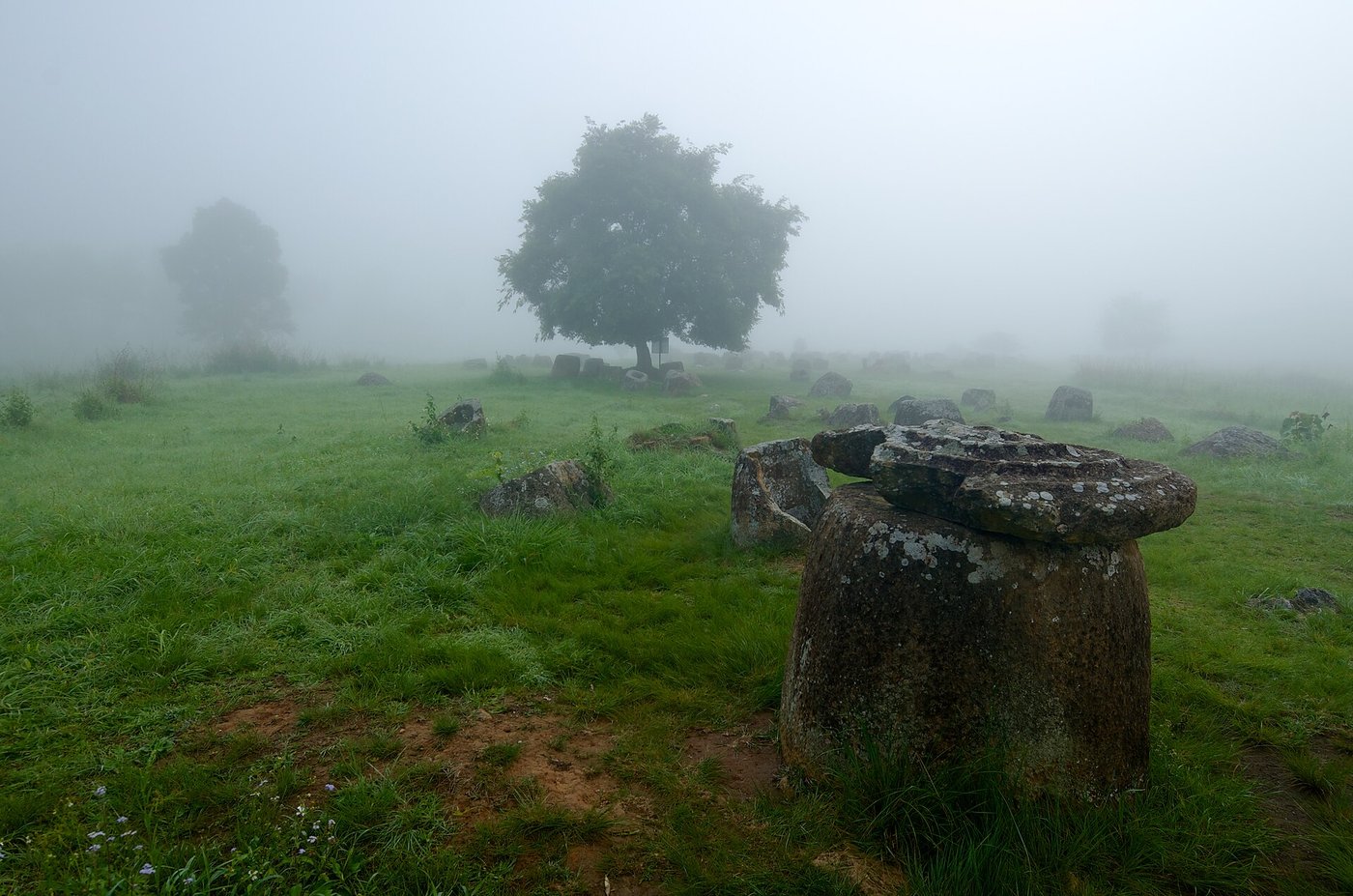
A few of the jars have thick stone discs lying near them, and these are usually read as lids, though most of the vessels were probably left open to the sky. Almost none carry decoration. One at Site 1 has a rough human figure carved on its side, arms raised, but it is the exception. The plain does not hand over its meaning easily. It offers only the jars, the discs, the quarries, and whatever the ground around them has kept.
The woman who climbed into the cave
The first person to study the plain properly was Madeleine Colani, a French botanist turned archaeologist who came to it in the early 1930s working for the École française d'Extrême-Orient. She was in her sixties, tough and exact, and she did something the casual visitors had not: she dug.
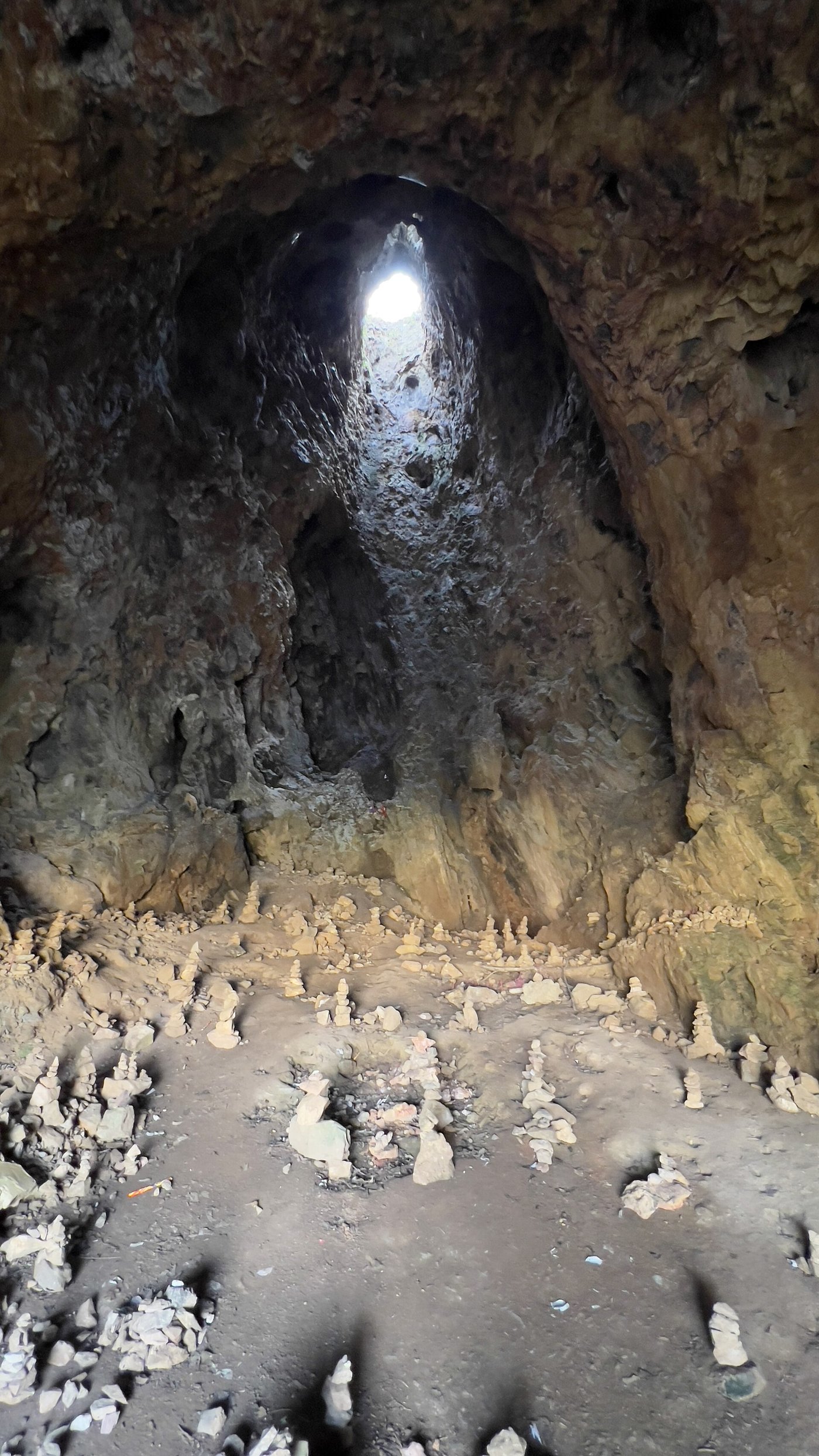
Near the largest cluster of jars stands a limestone cave with two natural holes in its roof. Colani went inside and found ash, charcoal, and scraps of burnt bone and teeth. To her the reading was plain: the holes were chimneys, the cave was a crematorium, and the jars around it were funerary vessels, containers where the burnt and cleaned bones of the dead were placed after the body itself had gone. Digging around the jars, she turned up beads, bronze, and human bone, which fit the idea. In 1935 she published her findings in two heavy volumes, and her conclusion set the frame for everything after: the Plain of Jars was a landscape of the dead, and the jars were graves.
Colani thought the jar builders belonged to the Iron Age, somewhere in the last few centuries before the common era. She could not have known how far off parts of that guess would turn out to be. But the heart of her idea, that the jars held human remains and that the dead were placed inside only after the flesh had gone, has survived nearly a century of later work, which is a rare thing for a theory built in the 1930s.
The giant and his cups of wine
Colani's crematorium was the outsiders' explanation. The people of Xieng Khouang had their own, and it was older and a good deal more fun. In the local telling, the jars were not graves at all. They were drinking cups.
The story goes that a race of giants once lived on the plateau, ruled by a king called Khun Cheung. After a great victory in war, the king ordered the jars cut so that his people could brew and store enormous quantities of lao lao, the strong rice wine of the region, and celebrate. The jars, in this version, are simply the mugs of the very large and the very thirsty. It is the kind of explanation that fits the objects perfectly (they do look like cups), and it kept the plain's meaning alive in memory for centuries when no archaeologist had ever heard of the place.
The jars were carved on the orders of the giant-king Khun Cheung to brew and store rice wine after a great victory. They are drinking vessels, scaled to the giants who used them, and nothing more solemn than that.
Wherever archaeologists have dug around and inside the jars, they have found the same thing: human remains (teeth, bone, sometimes whole secondary burials) along with the beads and bronze of grave goods. The jars are mortuary vessels, tied to the handling of the dead, not to any feast. The legend got the shape right and the purpose wrong.
There is a small truth folded inside the tall tale. Khun Cheung was a real name in the region's oral history, a legendary lord remembered in song across the Tai-speaking uplands. The plain gathered him up and made him its explanation, the way people everywhere reach for a familiar hero when a strange thing needs a story. The jars were already ancient and unexplained when his legend was still young.
Bones after the flesh was gone
To understand what the great jar on the hillside was doing, you need one idea: secondary burial. In many cultures the dead are not buried once but twice. First the body is left somewhere (in the open, in a temporary grave, in a tree) until the soft parts rot away and only clean bone is left. Then the bones are gathered, sometimes years later, and placed in their final home. The jars of Xieng Khouang were that final home. They were not coffins for fresh bodies. They were where the bones came to rest once time had done its work.
That is what the recent excavation at Site 75 laid bare. The jar there was one of the largest on the plain, roughly 1.3 metres tall and more than two metres wide, and it had been used not once but again and again. Radiocarbon dates taken from the teeth inside show the vessel was in use across the ninth to twelfth centuries of the common era, a stretch of perhaps two hundred and seventy years. Generation after generation, a family or a wider kin group seems to have brought its cleaned dead to the same stone and added them to those already there. The skulls were set around the edge, the limb bones drawn into the centre: not a jumble, but an order kept over centuries.
Mixed in with the bones were beads of glass. When chemists analysed them, the glass told a story the jars could not. It had not been made anywhere near the plateau.
The glass beads packed in among the bones at Site 75 were traced by their chemistry to two distant sources: workshops in southern India and in Mesopotamia. A hilltop in landlocked northern Laos, with no writing and no cities, was joined by trade to the Indian Ocean world and the Near East. The people who laid their dead in these jars were not cut off from the rest of Asia. Their grave goods had travelled thousands of kilometres to reach a bowl of stone on a Laotian hill.
The dig was led by Nicholas Skopal, of James Cook University in Australia, together with Souilya Bounxayhip of the Lao Department of Heritage, and published in 2026. Their reading is careful and plain: the jars were places of ancestral rite, tended by particular families over long spans of time, where the dead were brought to join the dead who had gone before.
“This was a collective mortuary space used repeatedly over generations,” Skopal said of the Site 75 jar, “potentially by extended family or community groups.” It is a quiet correction to a century of talk about a single lost people who built the jars and vanished. The jar was not a monument raised once and abandoned. It was a working grave that a community came back to, with its dead, for the better part of three hundred years.
A gap of two thousand years
Here the plain sets a trap for anyone who wants a tidy answer. If the bones in the great jar date to the ninth century and after, you might expect the jar itself to be roughly that old. It is not, or at least, it may not be.
In 2021 a separate team used a method called optically stimulated luminescence, which measures how long buried grains of sediment have been hidden from sunlight, to work out when some of the jars were first set in place. The answer reached back far further than the bones: as early as the late second millennium before the common era, somewhere between about 1240 and 660 BCE. That would make some jars close to three thousand years old, carved and dragged onto their hills more than a thousand years before the human remains now found inside them.
Both results can be trusted, and together they open a strange gap. It looks as though the jars were made by one distant era and then used, or reused, as graves by people living far, far later, perhaps continuously, perhaps after a long pause. The hands that cut the stone and the hands that laid the bones inside may have been separated by fifty generations. Whether the plain was in constant use across that whole span, or whether a much later people adopted the ancient jars of their land for their own dead, nobody can yet say.
The luminescence dates place the making of some jars in roughly 1240–660 BCE. The radiocarbon dates on the human remains inside the Site 75 jar fall in the ninth to twelfth centuries CE. That is a gap of up to two thousand years between the carving of a vessel and the burials found within it. Either the jars were in use across an extraordinarily long unbroken stretch, or a later society reused monuments it had inherited and did not build. The excavations so far cannot choose between the two, and only a handful of the ninety-odd sites have been dug at all.
The bombs that came after
There is a reason so little of the plain has been excavated, and it has nothing to do with the ancient past. Between 1964 and 1973, during the war in neighbouring Vietnam, the United States ran a secret bombing campaign over Laos aimed at communist forces moving through the country. Xieng Khouang, with its open plateau, sat in the middle of it. The plain was bombed for years.
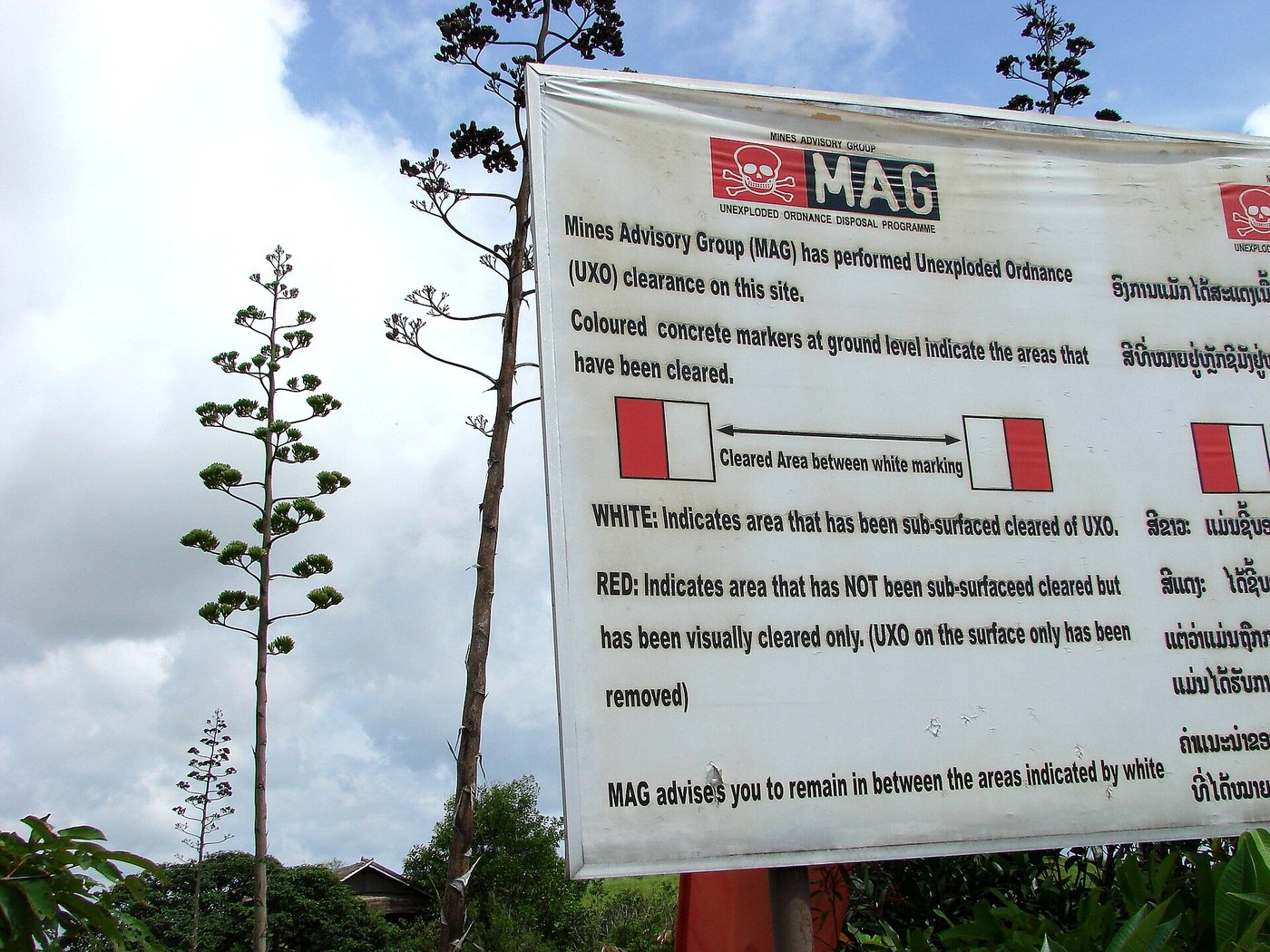
Laos became, by weight of bombs dropped per head, one of the most heavily bombed places in history. A large share of the ordnance never went off. Cluster munitions scattered small bomblets across the fields, and many of them are still there, buried and live, decades on. Unexploded ordnance still contaminates a wide stretch of Xieng Khouang, and it is a daily danger to farmers and children, not a historical footnote. Among the jars you can see craters, and the pocked stone of vessels caught in the blasts.
For years the danger kept nearly the whole plain shut. Only a few sites were cleared and safe enough to walk. Teams from clearance groups such as the Mines Advisory Group went over the ground metre by metre, marking the swept paths with painted stones: step on the white side, not the red. That slow work is why, when the Plain of Jars was finally added to the UNESCO World Heritage list in 2019, it came so late for a site of such importance. The bombs had to be dealt with before the jars could be.
What is left to dig
For all the recent progress, the plain keeps most of itself back. Ninety sites and more than two thousand jars, and only a small number have been properly excavated; the rest wait in ground that is often still dangerous to break. The single hillside jar with its thirty-seven dead is one careful answer, and it settles part of the old argument: these were graves, tended by families, joined to a wider world by a few beads of foreign glass. But it also sharpens the questions it does not answer. Who first cut the stone, three thousand years ago? Why hilltops, why these hills, why open to the sky? What happened in the long centuries between the carving and the bones?
The jars have kept their silence about the makers and given up only their use. They stand on the ridges of Xieng Khouang the way they have stood for millennia, weathered and patient, most of them still unopened, still full of whatever the plain decided to leave inside them. The counting is not finished. It has barely begun.
Read next: Areni-1: The Cave That Kept the World's Oldest Shoe and Chaco Canyon: The Desert City Built From 240,000 Trees Carried on Foot.
Sources & further reading
- N. Skopal, S. Bounxayhip et al., “Secondary burial and the use of megalithic jars at Site 75, Plain of Jars, Laos,” Antiquity (2026).
- L. Shewan, D. O'Reilly et al., “Dating the megalithic culture of Laos: radiocarbon, optically stimulated luminescence and U/Pb zircon results,” PLOS ONE (2021).
- M. Colani, Mégalithes du Haut-Laos (École française d'Extrême-Orient, 1935).
- UNESCO World Heritage Centre, “Megalithic Jar Sites in Xieng Khouang – Plain of Jars” (inscribed 2019).
- Mines Advisory Group (MAG), reports on unexploded ordnance clearance in Xieng Khouang province, Laos.
Image credits (via Wikimedia Commons): jars and tree at Site 1 — Dominic Nelson (CC BY-SA 4.0); the cave at Site 1 — Stefan Fussan (CC BY 4.0); jar with a stone disc — Emmanuel Campos (CC BY-SA 3.0); UXO warning sign at Site 1 — Adam Jones (CC BY-SA 3.0). Featured image: the Plain of Jars, Xieng Khouang — Jakub Hałun (CC BY-SA 4.0).