In the spring of 1972 a stocky, chain-smoking archaeologist walked across a low grey rise in the Karakum Desert of southern Turkmenistan, bent down, and started filling his pockets with broken pottery. The place had no name on any modern map worth the ink. It was sixty kilometres of sand north of the nearest town, in one of the emptiest quarters of Central Asia, a country of dunes and dry channels where a jeep could drive for a day and pass nothing but the odd camel. Victor Sarianidi turned the sherds over in his hands. They were old (Bronze Age old), and there were a great many of them. Local people called the mound Gonur Depe, which means, more or less, “the grey hill”. Sarianidi decided to come back and dig. He would keep coming back for the next forty years.
What he pulled out of the sand did not fit any list anyone had learnt at school. When we count the first civilisations, the places where cities and writing and kings appeared at the dawn of history, we name four, and we always name the same four. Egypt on the Nile. Sumer on the Tigris and Euphrates. The Harappans on the Indus. The Shang and their forerunners on the Yellow River. Four great river valleys, four cradles. Sarianidi thought he had found a fifth, hiding in a river delta nobody had thought to look at, and he spent the rest of his life arguing the case with anyone who would sit still long enough to hear it.
A civilisation that missed the roll-call
The river was the Murghab. It rises in the mountains of what is now Afghanistan, runs north into the Karakum, and then, instead of reaching a sea, spreads out and dies in the sand in a great fan of channels. That fan was the ancient land the Greeks later called Margiana and the Persians called Margush. Four thousand years ago it was green. The Murghab carried enough water to turn a stretch of desert into a patchwork of fields and reed beds, and on that patchwork, around 2400 BCE, people built towns of mud brick with walls, gates, and streets laid out on a plan.
Sarianidi gave the whole culture a clumsy but honest label: the Bactria–Margiana Archaeological Complex, BMAC for short, coined in 1976 to cover the related sites he was finding across two ancient regions. Others preferred a grander name, the Oxus Civilisation, after the old Greek name for the great river Amu Darya to the north. Whatever you call it, the thing it describes is real and was lost. No Greek historian wrote it up. No Bible mentioned it. It had risen, flourished for something like six or seven centuries, and fallen so completely that when Alexander the Great marched through the same ground more than a thousand years later, he passed over the buried ruins of its capital without a hint that it had ever existed.

The man who would not stop digging
To understand Gonur you have to understand the man who dug it, because for four decades the two were hard to tell apart. Victor Sarianidi was born in Tashkent in 1929 to a Greek family, trained in the Soviet system, and made his early name in Afghanistan, where in 1978 he unearthed the astonishing hoard of nomad gold known as the Bactrian treasure: more than twenty thousand pieces from six graves, later smuggled to safety through years of war. That alone would have made a career. But it was Margiana, on the Turkmen side of the border, that became his obsession.
He worked the way excavators did before the discipline turned cautious: on a huge scale, fast, exposing enormous areas of a site in a single season rather than picking at a trench for years. Critics grumbled that he dug quicker than he recorded, that the reports lagged behind the spade, that his conclusions ran ahead of his evidence. Some of that was fair. But nobody else had put in the decades on the ground, and nobody else had a feel for the place like his. He kept at it into his eighties, living in a spartan dig house through desert summers, until he died in 2013 with the trowel barely out of his hand. He is buried, by his own wish, out at the site: a small marked grave beside the far larger graves he had spent his life opening.
A city drawn with a ruler
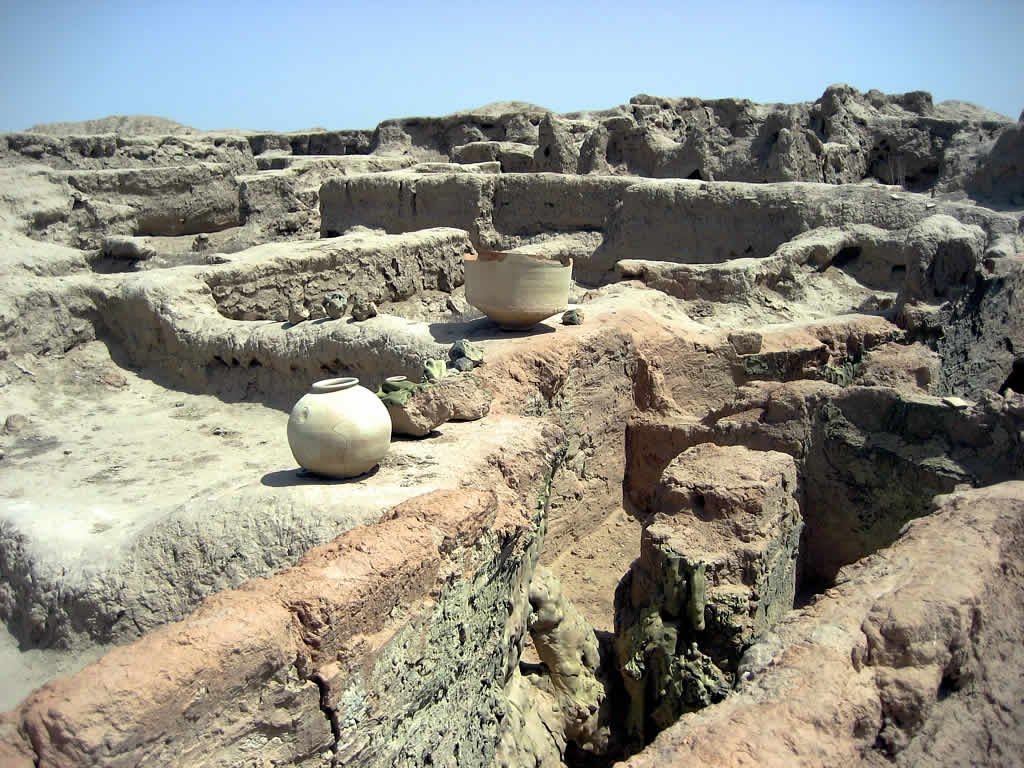
Stand on the edge of the main excavation and the first thing that hits you is order. Gonur was not a village that swelled outward by accident. It was designed. The northern mound, the older and grander of the two, covers a rectangle roughly three hundred and thirty metres by four hundred and sixty, and inside it everything answers to a plan. At the centre sits a monumental palace, a walled block about a hundred and fifty metres on a side, with a throne room, storerooms, and courtyards ringed by corridors. Around it stood temples. Around them ran walls with towers, and then another wall, and then another, so that the sacred core was wrapped in defence like the layers of an onion.
Water was everywhere in the plan. The builders cut channels to carry the Murghab's flow through the town, fed pools and basins, and laid what look like the ancestors of the covered water systems that later made Persian cities possible in the desert. For a place that now sits in blowing sand, Gonur was obsessed with water, and the obsession makes sense the moment you remember that the whole settlement was a wager against a river that could, and eventually did, walk away.
The palace complex at Gonur North measured about 150 by 140 metres and lay inside not one wall but a nest of them, with the temple precincts, the fire sanctuaries and the elite quarters folded in successive rings around a throne room. The whole northern settlement ran to roughly fifty-five hectares. To raise it, people quarried nothing and cut no stone: every wall, tower and vaulted drain was made of sun-dried mud brick, the cheapest building material on Earth and, handled at this scale, one of the most impressive.
Kings under the floor
The living city was remarkable. The dead one beside it was the reason the world finally took notice. West of the settlement lay a vast cemetery, the “large necropolis”, with more than three thousand graves cut into the ground over the life of the town. Most held ordinary people with ordinary things: a pot, a pin, a string of beads. But among them, and in a separate royal ground closer to the palace, Sarianidi found something else: tombs built like little houses, roofed and plastered, and stocked as if for a person who expected to go on ruling.
These royal burials held gold and silver vessels, ivory carved with animals and geometric bands, mosaic panels, weapons, and the bones of sacrificed animals. In one, a four-wheeled wooden wagon had been laid in the earth beside a draught animal, its wheels rimmed with bronze, dated to around 2250 BCE, among the earliest carts known anywhere. Camels were buried too, and dogs, and in one case a whole team of animals arranged as though ready to pull. Whoever lay in these graves had been sent off with the transport, the tableware and the livestock of a court.
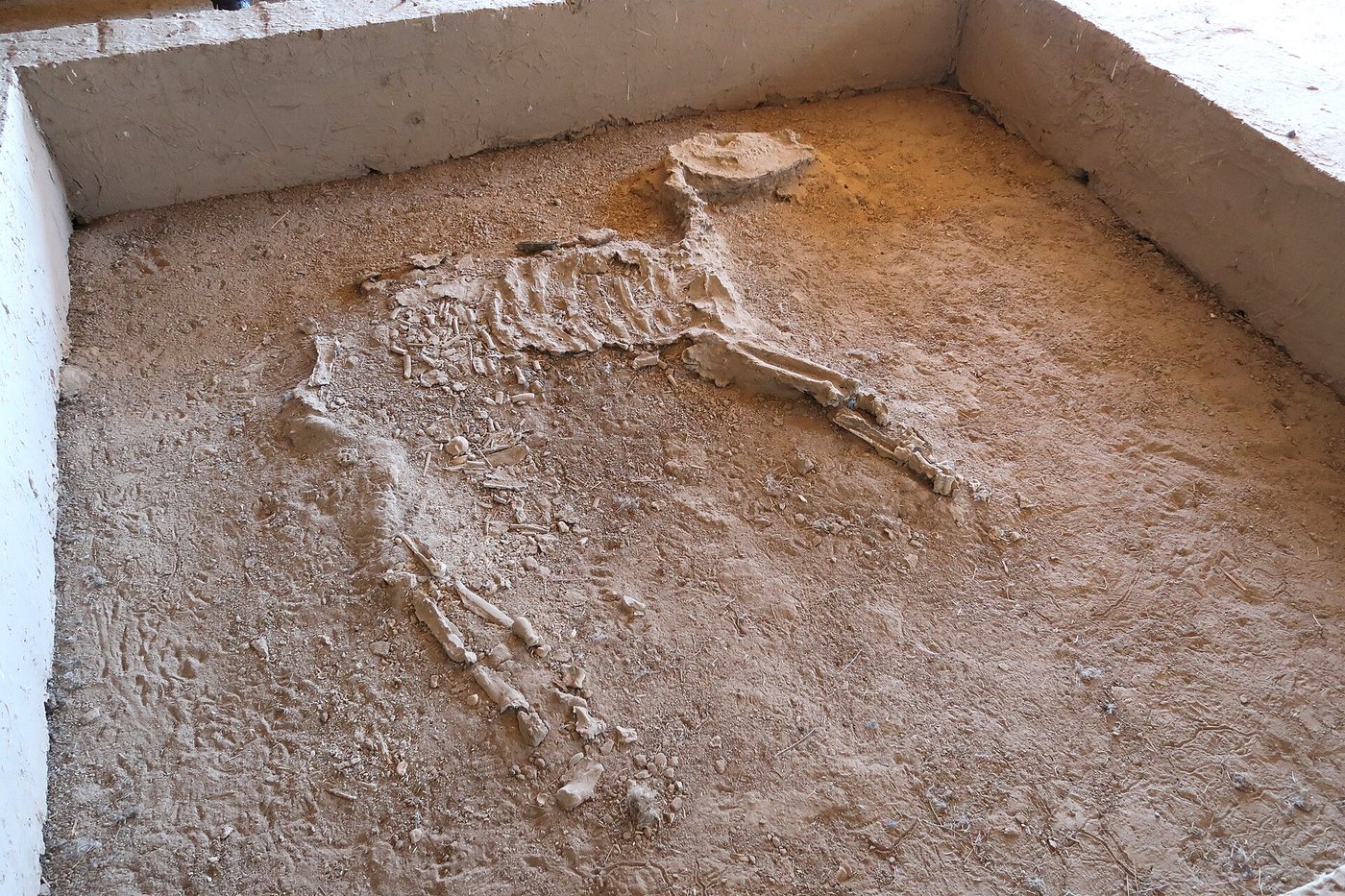
Nothing on this scale from the Central Asian Bronze Age had been seen before. The graves said, plainly, that this had been a stratified society with rulers rich enough to command metalworkers, ivory carvers and a supply of gold, and confident enough to bury a fortune in the ground rather than pass it on. A place that does that is not a frontier outpost. It is a capital.
Faces of grey stone
The Oxus people left almost no pictures of themselves in paint, but they left a signature in stone that is unmistakable once you have seen it. Across the whole region, in graves and, sadly, in the hands of looters, appear small seated female figures made in two materials at once: a body of dark green chlorite, carved as a wide flaring robe of fleece, and a separate head and hands of pale limestone, so that the woman seems to rise white-faced out of a mountain of wool. Collectors call them “Bactrian princesses”. Nobody knows who they were meant to be (a goddess, an ancestor, a guardian of the dead), but they are the face the civilisation turned to us across four thousand years, and it is a calm, closed, faintly forbidding face.
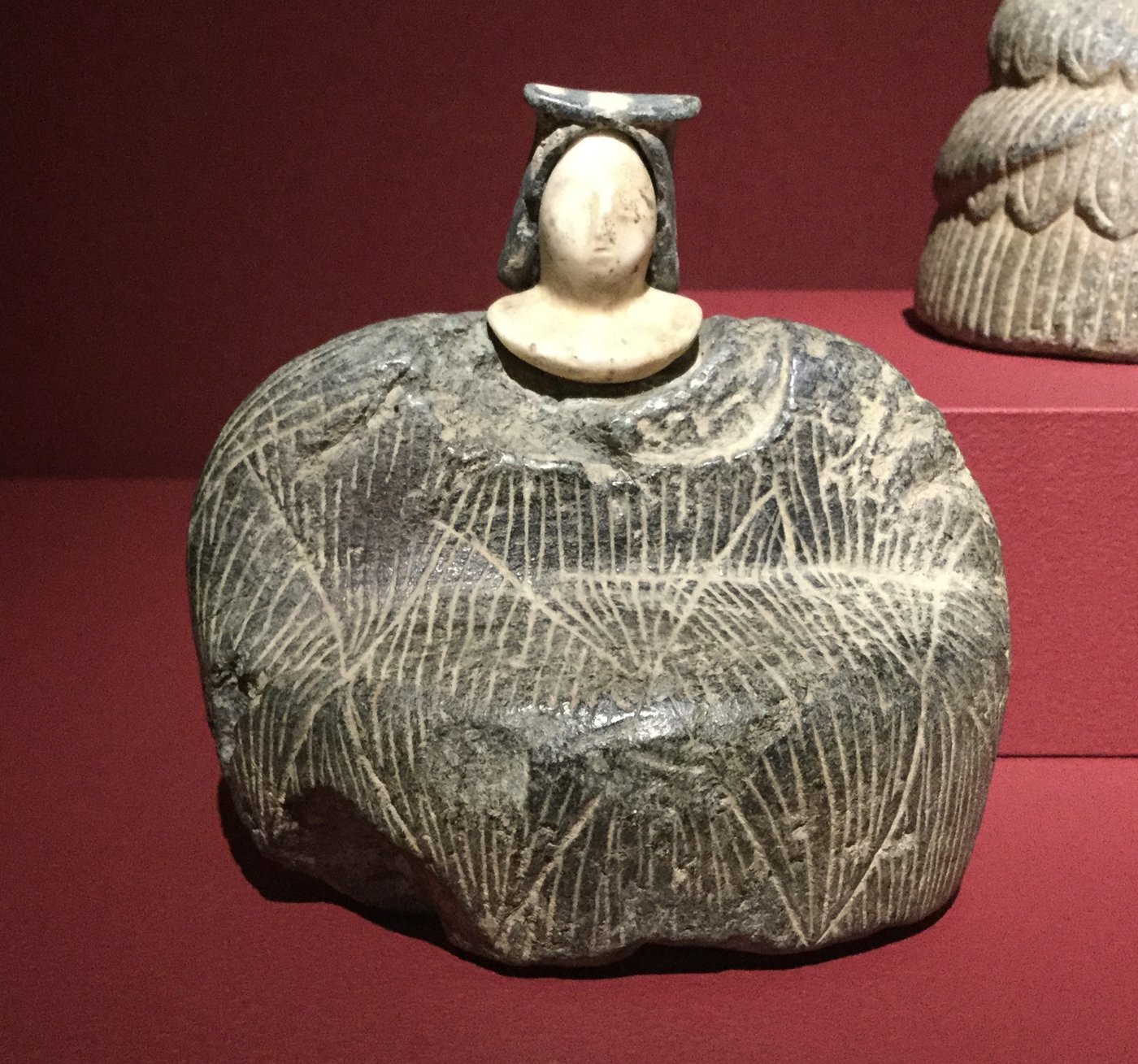
The problem with the princesses is the problem with a great deal of Oxus art: much of it reached museums through the antiquities trade, dug up by robbers and sold without a record of where it was found. That is why Gonur counted for so much. Here, at last, was material coming out of the ground under control, with its context intact, so that the loose finds scattered through the world's collections could finally be tied to a real place and a real date.
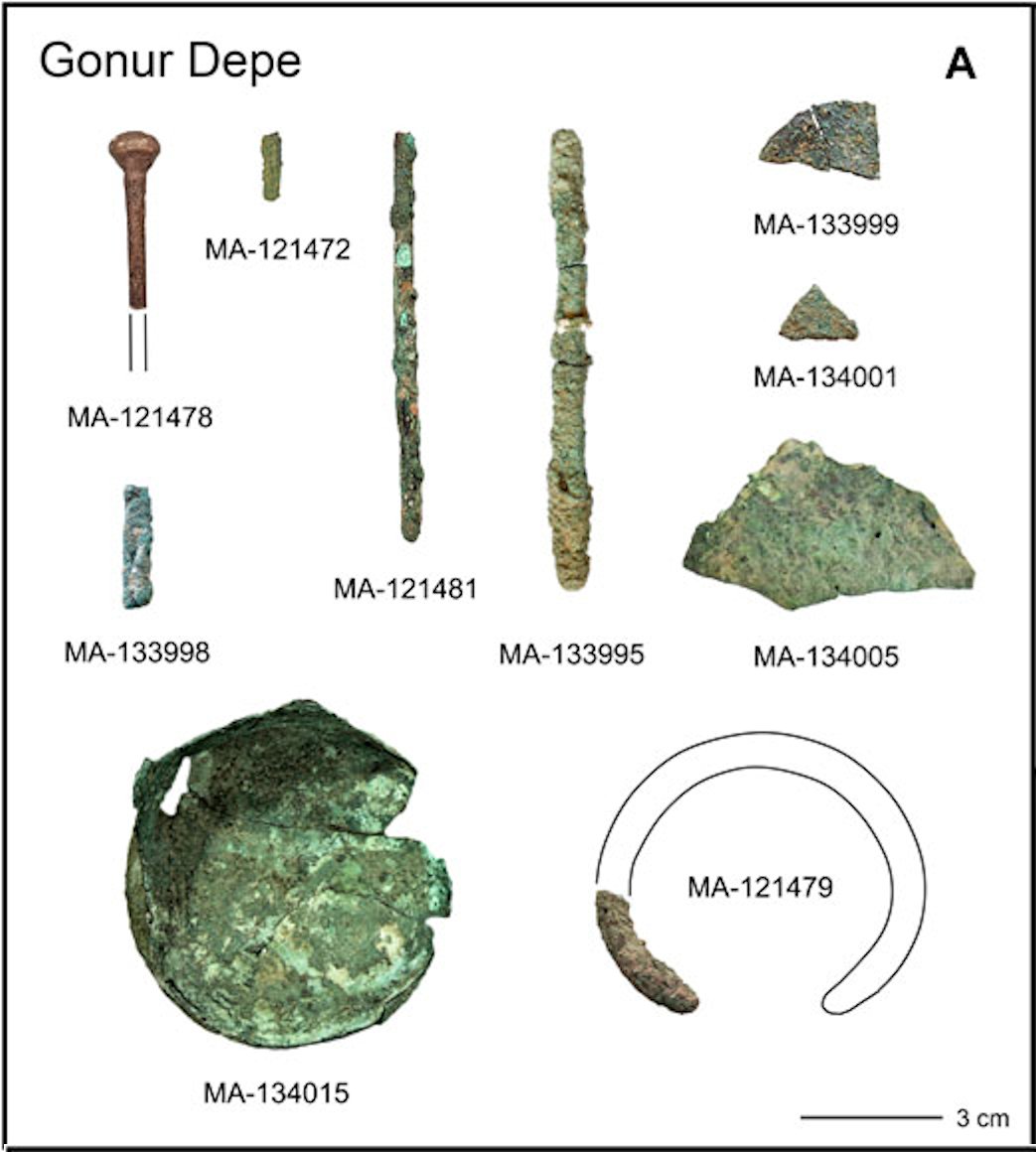
Bronze is copper mixed with tin, and tin is rare. The Oxus smiths had it, along with gold, silver, lead and lapis lazuli, because Margiana sat on the trade roads of its day. Lapis came down from the mines of Badakhshan in the mountains to the east. Tin and turquoise moved along the same routes. Carved ivory points to contact with the Indus world to the south. The metal in a Gonur grave is a map of half a continent's worth of exchange, running from Afghan valleys to Mesopotamian cities, all of it passing through this delta in the sand.
The drink of the gods
Now for the claim that made Sarianidi famous and got him into the most trouble. In the temple areas of Gonur he found rooms he read as fire sanctuaries: platforms and hearths where fire seemed to have been kept and tended, ringed by vessels. Inside some of those vessels, and in the ceramic strainers and bowls nearby, he reported traces of plants: ephedra, poppy, and cannabis. Put a fire cult together with the residue of stimulating and mind-altering plants, and Sarianidi reached for the oldest sacred drink he knew.
Two of the world's great religious traditions remember a holy intoxicant at their root. The Hindu Rigveda hymns the drink called soma, pressed from a plant, strained through wool, mixed and offered to the gods and drunk by priests to touch the divine. The Zoroastrian Avesta praises its twin, haoma. Scholars have argued for a century over what the original plant actually was. Sarianidi believed he had found the answer in the mud of Gonur: here, he said, was the very ritual (the fire, the pressing, the straining, the plants) that the hymns would later remember. Not a myth about a sacred drink, but the workshop where it was made, a thousand years before anyone wrote the hymns down.
Sarianidi announced that the Gonur temples held the physical remains of the soma-haoma cult (strainers, ritual vessels and residues of ephedra, poppy and hemp): the actual origin of the sacred drink of the Vedas and the Avesta, caught in the act of preparation in a Bronze Age fire temple.
When outside specialists re-examined the plant material, the case wobbled. A study led by the archaeobotanist Corrie Bakels found the samples contained ordinary broomcorn millet, not the reported drug plants, and could not confirm the ephedra, poppy or cannabis at all. Others pointed out that a fire sanctuary need not mean the specific rite of a scripture composed centuries later and hundreds of miles away. The honest position today is narrower and more interesting: Gonur clearly had fire ritual and elaborate drink-making gear, and it sat exactly where and when the ancestors of the Vedic and Avestan peoples were forming. Whether the cup held soma itself, or only its grandparent, is still open.
That caution matters, because the soma claim is the kind of headline that outruns its evidence and never quite gets caught. What is not in doubt is the setting. If you wanted to find the world in which the idea of a fire-and-drink sacrifice grew up, a world of temples with tended flames on the edge of the steppe, Gonur is a very good candidate for a photograph of it.
A city that could not write its own name
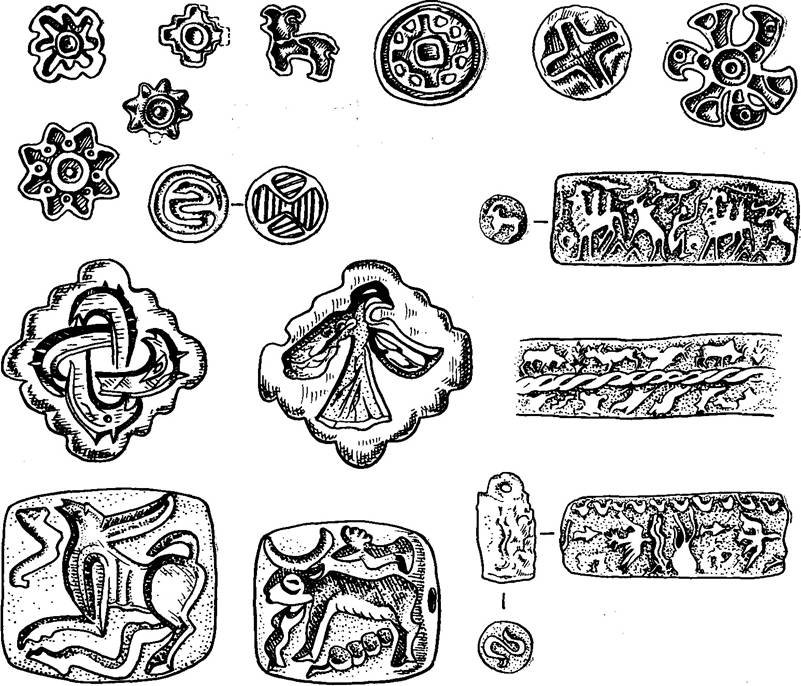
For all its wealth, the Oxus Civilisation is mute. It kept no library, cut no royal inscriptions, left no king-list. What it did leave is seals: hundreds of them, in metal and stone, stamped and cut with eagles, snakes, dragons, winged monsters and processions of animals. Seals mean administration: someone was marking property, sealing storerooms, signing for goods. And a handful carry marks that are not pictures but something more like signs in a row.
In 2000 Sarianidi found a small stone seal at the nearby site of Anau bearing five red marks that one scholar thought resembled early Chinese characters. It caused a brief stir and a long argument. Most specialists are not convinced it is writing at all, rather than decoration or a maker's mark. The likeliest truth is that the Oxus people, sitting between the literate Indus and the literate Mesopotamians and trading with both, used seals heavily but never crossed the line into a full script of their own. They are a civilisation we can see clearly and cannot read a word of.
The largest fight over Gonur is about ancestry. Because the site sits where and when Indo-Iranian languages (the family that leads to Sanskrit and Persian) are thought to have taken shape, some, Sarianidi among them, wanted the Oxus people to be the early Indo-Iranians. Ancient DNA has complicated that. The Gonur population turns out to descend mainly from Iranian farming stock, with little of the steppe ancestry that marks the Indo-Iranian speakers who arrived later from the north. The picture now favoured is a meeting rather than an identity: settled Oxus townsfolk and incoming steppe herders overlapping, trading and mixing, with the language of the newcomers eventually winning out. Gonur may be less the cradle of the Indo-Iranians than the doorway they came through.
When the river walked away
Nothing burned Gonur down. No army is recorded storming it, because no one recorded it at all. What ended it was quieter and, in that country, unanswerable. The Murghab is a shifting river. Its delta is a live thing that swings its channels east and west across the sand over centuries, and some time after about 1900 BCE the water that had made Gonur possible began to move away to the west. The walled towns shrank. People followed the river to new ground and built smaller places along its new course. The great palace emptied. The fires went out. The desert, which had been held back by a wet delta and a lot of human effort, came in and took the streets.
It was not a collapse so much as a slow relocation, spread over generations, with the culture thinning out and blending into the world of the steppe herders moving through. The Oxus style faded; new, plainer pottery and new burial customs took over; the memory of the palace-cities was gone within a few hundred years. By the time Persian kings ruled Margush as a province and listed it among their lands, the men who cut those inscriptions had no idea that the ground already held a capital far older than their own empire.
The grave beside the graves
Gonur today is a set of low mud walls on a flat pan of desert, fenced against the wind, reachable by a long drive from Mary. Tourists are few. The finds are in museums in Ashgabat and Mary, the gold behind glass, the grey princesses staring out with their limestone faces. And out among the excavated tombs is the small marked plot where Sarianidi lies, the one modern man in a field of Bronze Age dead, keeping company with the kings he pulled back into the light.
He overreached at times. The soma he was so sure of has slipped back into a question. The fifth-civilisation banner he liked to wave is argued over still. But strip the claims back to what the sand actually held, and it is enough. A planned city with a palace at its heart. Fire temples and water channels. Kings buried with wagons and gold. A signature carved in green stone. A web of trade running to the Indus and the Tigris. All of it raised on a dying river, forgotten so thoroughly that history left it off the list, until a man with full pockets and no intention of stopping put it back on.
Read next: Jiroft: The Civilisation Looters Reached Before the Archaeologists and Tillya Tepe: The Bactrian Gold Everyone Thought the Wars Had Melted.
Sources & further reading
- Victor Sarianidi, Gonur Depe: City of Kings and Gods (Ashgabat, 2005) — the excavator's own account of the site.
- Nadezhda Dubova and colleagues, papers of the Margiana Archaeological Expedition (Russian Academy of Sciences) — the continuing record of work at Gonur since Sarianidi's death.
- C. C. Bakels, “The contents of ceramic vessels in the Bactria-Margiana Archaeological Complex, Turkmenistan,” Electronic Journal of Vedic Studies (2003) — the reanalysis that challenged the soma-haoma claim.
- Vasant Shinde et al. and the wider literature on the Oxus Civilisation and its Indus contacts, including the trading post at Shortughai.
- Vagheesh Narasimhan et al., “The formation of human populations in South and Central Asia,” Science (2019) — the ancient-DNA study behind the current view of who the Gonur people were.
- Fredrik Hiebert, Origins of the Bronze Age Oasis Civilization in Central Asia (Harvard, 1994) — a foundational English-language survey of the BMAC.
Image credits (via Wikimedia Commons): Gonur ruins — David Stanley (CC BY 2.0); Margush panorama — Allan Mustard (CC BY-SA 4.0); horse and wagon burial at Gonur Depe — John Pavelka (CC BY 2.0); Bactrian composite female figure — Neoclassicism Enthusiast (CC BY-SA 4.0); BMAC bronze tools from Gonur Depe — Berger, Kaniuth, Boroffka et al. (CC BY-SA 4.0); seals of Margiana — unknown makers (public domain).